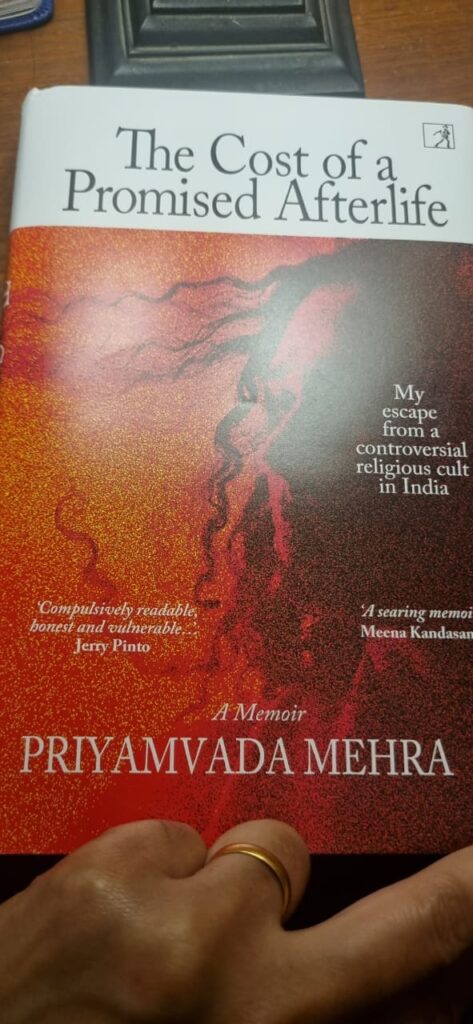
“The Cost of a Promised Afterlife: My Escape from a Controversial Religious Cult in India” by Priyamvada Mehra
For Moneycontrol, I interviewed Priyamvada Mehra on her recently published memoir The Cost of a Promised Afterlife: My Escape from a Controversial Religious Cult in India. It is published by Simon & Schuster India. I am ever so grateful that Priyamvada replied in the detail that she did as this is not an easy past to revisit. Later, she very kindly wrote, “Thank you for the gentleness and care you’ve put into this interview process, I really appreciate it.”
Here is the interview.
Priyamvada Mehra’s memoir, The Cost of a Promised Afterlife, has been published by Simon & Schuster India. At the age of nine, she was led into the fold of Rampal, a self-proclaimed godman who promised miracle cures and salvation in exchange for submission. What began as her parents’ desperate attempt to save her mother’s life from a brain tumour soon became something far more sinister—a world where faith became a cage, obedience a virtue and control, absolute. By thirteen, Priyamvada was a devoted follower. In 2006, she was inside his ashram, used as a human shield during a deadly clash between Rampal’s followers and a rival sect. Questioning was forbidden, loyalty was everything and defiance came at a cost. She endured heartbreaking losses and grew up with a twisted logic of miracles, bans on medical treatment, and violent sermons.
She witnessed her family fall to pieces under the weight of indoctrination and diseases. For two decades, she stumbled between two treacherous worlds, one ruled by cultic control, and both shaped by patriarchy, caste and class, and the systemic violence they breed.
In The Cost of a Promised Afterlife, Priyamvada Mehra finally tells her story. The memoir exposes how cults take root in a nation of 1.4 billion, and how godmen wield unchecked power. In India, godmen are everywhere. They exist. Their photos hang on walls, their voices fill television screens and their names are spoken in both prayers and scandals. But the word ‘cult’ is rarely used. It stays unspoken until another scandal breaks out, only to be buried under silence again. This silence allows blind faith to thrive and logic to crumble. Deeply intersectional in its lens, it lays bare the psychological and physical toll of being led into blind faith as a girl and the long journey of dissenting as a woman in a ‘man’s world’.
While reading it, I had to put it down many times and take a break. When an individual narrates a traumatic incident, a self-defence mechanism automatically kicks in, and the person recounts the incident(s) in the third person. It is delivered in a deadpan style. It is a self-preservation act to prevent themselves from any further harm while recollecting. This is evident in oral and written narratives. So, to read this memoir that is written in the first person but in a manner that it hammers the reader’s head with a nonstop single dull beat is quite unusual. Read the memoir for yourself and judge. In Sept 2025, Rampal was granted bail, but remains in Tihar Jail as he is considered a “risk to public order” by the Hissar district court.
This interview with Priyamvada Mehra was conducted via email. She now lives between India and Amsterdam, delicately exploring the idea of home and identity.
1. What was the genesis of this memoir? Why did you feel the need to document this story?
After moving to Europe in 2022, I found myself unable to adapt or function as what you’d call a “normal adult”. That failure pushed me to look inward, and that introspection led me straight back to my past, something I thought I had long left behind. To make sense of what I was feeling, I began reading everything I could: books, memoirs, research papers, anything that could bring me closer to understanding my own experiences and help me name them.
Somewhere in that process, I also began pouring my memories out onto paper. It felt like a flash flood. It was overwhelming, intense, and unstoppable. Before I knew it, I was staring at a few hundred pages of what I called “angry notes.” That’s when it struck me, maybe this was a story. So, the memoir wasn’t planned; it was born out of an excruciating process of introspection, a journey I was forced to take in order to move forward in my life.
2. What did it entail to write about your experiences? Did you require your family’s consent to include them in the story?
I tried finding people in India with similar experiences but couldn’t find much that resonated, or any literature on it, barring some investigative work. The only memoirs or academic writings on cults I came across were mostly by Westerners, especially Americans. The first book I read while coming to terms with my reality was Take Back Your Life: Recovering from Cults and Abusive Relationships by Janja Lalich and Madeleine Tobias. It gave me a language I didn’t have. It laid out the anatomy of a cult, the profile of a cult leader, and the long-term psychological damage caused by indoctrination and abusive relationships. It was a revelation. I hadn’t known I’d grown up in one. I hadn’t realised the relationships I was still chasing were rooted in abuse. That book cracked something open. No one had ever educated me about cults. No one used that word, even in a country like India, supposedly the world’s spiritual centre, where hundreds of thousands of self-proclaimed godmen and godwomen command the devotion of desperate millions. It forced me to see the desperation we lived with; how broken people cling to anything that promises certainty, even if that certainty comes from a ten-year-old boy in saffron robes calling himself a divine messenger when he should be in school, or from gurus protected by politicians, global celebrities, and power.
I returned to that book again and again. From there, I kept reading: memoirs, survivor accounts, research papers, anything that brought me closer to understanding my own experiences. I studied cults and their generational impact, the quiet struggles of those with disabilities and illnesses, and the heavy toll of caregiving. I uncovered the deep scars of caste and class, and traced the violence born of gender and patriarchy. Through that process, I finally found the vocabulary to articulate my own experience, and that’s how the writing began.
Unfortunately, consent wasn’t possible or practical, because my family remains deeply under the sway of the very cult I escaped from.
3. When and how did you find your voice to write this memoir/ your testimony? Recalling these facts could not have been easy.
The long process of introspection and reflection out of which my memoir was born took me through all five stages of grief, perhaps even more. First came the shock and disbelief that this was actually my life, that my entire family, our opportunities, our very existence, had been systematically eroded by a godman who, even while incarcerated, continues to exert control. The realisation that I was the only one who had made it to the other side of that religious dogma, the only one seeing things critically, was both liberating and devastating.
Then came another truth. The realisation that I had been at the receiving end of abuse and violence based on gender and caste. It sucked the soul out of my body. Abuse had been so thoroughly normalised for me for years that it took time to even recognise it for what it was. Then came anger. Each memory ignited such a seething fury within me that I wanted to claw my way back through time to throw the punches I never got to land. That’s when I began purging it all out on paper. All my traumas surfaced in ways I hadn’t expected.
I sought therapy for the first time in my life and was soon diagnosed with Complex-PTSD (please note: I was orally diagnosed and wasn’t prescribed any tests for diagnosis).
I continued to confuse scraps for love, to look for empathy in the wrong places, in the wrong people, hoping they would understand my pain, not realising they were, unfortunately, the source of it. It took immense emotional labour, therapy, and both physical and psychological safety before I could finally see clearly and muster the strength to break free from the chains of fear that had bound me for so long.
It’s hard to put into words how excruciating the entire process was. There were times I felt I was losing my mind. But I learned to take pauses when my mind and body signalled me to. I would return after a week, or a month, or more, whenever my gut told me I was ready again.
4. Writing is cathartic. Even for PTSD survivors. Did revisiting old traumas heal you?
If I had the choice, I would probably have preferred to just enjoy my new life in Europe, the travel, the nature, the quality of life. But I simply couldn’t. Even while exploring, even while trying to distract myself, I couldn’t shake off the emotional and psychological ache. My body kept giving me sensations that made me feel unsafe at all times. It was as if I were constantly confronted by a wild animal, even though, in reality, I was safe and loved.
I didn’t have the option but to try and figure out why I was feeling that way. My sole intention was to feel and act like a “normal,” functioning adult. I hadn’t thought of catharsis at that point because I didn’t even know what was wrong in the first place. When I eventually was able to put a name to my experiences, I still didn’t attach myself to the idea of catharsis or closure, because there was no guarantee it would give me that. So, I wrote, free from the expectation that it would heal me.
Writing or purging my past onto paper had always been my way of confronting difficult times when I had no one to talk to, no one to help me make sense of the dysfunction around me. This time too, I turned to writing without knowing how it would help. Only now, holding the book in my hands, do I feel proud of having stood up for my younger self. I feel deeply satisfied that I was able to find my voice, my identity. It has given me immense hope for the future, and a belief that I can slowly undo the harm.
Revisiting old traumas, again, wasn’t a choice I made. The traumas revealed themselves in their full force and I had no option but to confront them.
The process was painful, excruciating. It drained me, left me low and uncertain the whole time. But now that it’s out, now that it’s tangible, each cell in my body feels as though life has been injected back into it. Holding my book gives me a true sense of catharsis. It’s an acceptance of the reality of my loss: the loss of my family, my childhood, my time. And at the same time, I feel a deep, boundless hope, not just for myself, but for others who may find themselves in similar situations in their own lives.
5. In what manner did you learn to distance yourself from the cult’s teachings and by extension your family? You document some of the friction in the memoir, but please elaborate.
The process of distancing myself from the cult’s teachings was gradual and continuous. It began early in my life, around 2010, when my mother left home. But I couldn’t fully distance myself, because my family remained deeply consumed by the dogma, and I lived with them until 2020.
While reading Terror, Love and Brainwashing by Alexandra Stein, I underlined a line that has stayed with me: “Almost anyone, given the right set of circumstances, can be radically manipulated into otherwise incomprehensible and often dangerous acts.” It’s true. The timing was cruel. My parents found the cult when they were at their most vulnerable. Only then did I begin to fully understand how religious extremism had shaped my family and by extension, me.
It wasn’t just about belief. It was tied to my parents’ disabilities, their chronic illnesses, the weight of caste and class, the pressures of marriage, and the desperation of parenting in scarcity. None of these struggles existed in isolation; they fed into one another, creating the perfect storm. And in that storm, a godman found his grip.
Throughout my childhood and beyond, I inherited their fears, their traumas, and their hopes for salvation. They passed it on unknowingly. And I carried the cost. It’s only now that I truly realise the weight of that inheritance.
In writing this book, I made a sincere effort to portray my once beautiful, fun-loving family with both empathy and honesty, to acknowledge the complexity of human beings and their choices, while not softening the harsh realities of the abuse and oppression I endured. Even though they see themselves as “the chosen ones,” I see them as victims of larger manipulative systems.
If I could make one wish today, it would be to free my family from years of religious thought reform and place them back in time, when they accepted their reality, imperfect and flawed. When they didn’t chase idealised, problem-free lives, but embraced life with authenticity, navigating it as best they could. When they refused anyone selling them the illusion of certainty. When they were adults with autonomy, critical thinking, and the ability to question authority. That’s what the cult robbed them of.
6. How much of your objectivity on this past life of living in Rampal’s cult was honed by travelling/living abroad?
Objectivity was always there, that’s probably why I could start asking questions quite early on. But the way it sharpened after I moved to Europe was incomparable. Living abroad brought a massive shift in my perspective, about identity, self-worth, race, gender, caste, the politics of everything.
In India, I never really felt like I was having it the worst. Every day I saw poverty, homelessness, hunger, disease. I saw potholes, road rage, accidents, the daily evidence of systemic failure, and it all felt normal. That social failure had been accepted and normalised; chaos had become culture.
When I moved to Europe, I was suddenly surrounded by people from all over the world who were openly talking about racism, gender, colonial history, power. I saw Black people reclaiming their power, queer people living with pride, women walking safely on streets. These were things I had never experienced before. There was a sense of accountability, of questioning authority, especially in Amsterdam, and I felt that deeply.
In India, I had always been trying to fit into a narrative created by the upper caste, the rich and elite. I was ashamed, never fully confident, always evading questions about my caste, where my parents came from, all those markers of social hierarchy. But living abroad helped me shed that shame that society had forced upon me. I began to remove shame from my caste identity, from gender-based violence, from my experience in the cult, from everything that made me feel small or unsure of myself, all of which had never been my fault.
The more I looked around and heard people’s stories, the more I realised just how abnormal my own life had been. I don’t think I would have been able to write this memoir had I not gone through that cultural shock. In a way, it became a blessing in disguise.
7. Your mother left the family to live in the ashram. Apart from her being sicklier upon her return, were there any fundamental differences that you noted in her as being a woman who had lived in a community governed by a patriarchal authoritarian figure?
Her being sicklier upon her return wasn’t just physical, it was deeply mental. It was terrifying to have my mother back, not only with a broken body but also with a fractured mind. Alongside her treatment for Pott’s spine, she also had to undergo psychiatric care. Watching that was one of the most painful experiences of my life.
She had returned completely consumed by her devotion to Rampal. Her cognitive abilities had deteriorated, and her demeanour had become almost childlike, especially in the presence of visitors. She was the textbook example of someone whose identity and agency had been completely eroded by a religious cult. Post her return, she was delusional, disconnected from reality, and incapable of functioning as an autonomous adult.
Her transformation was the outcome of years of systematic thought reform, compounded by her ill health, an illness that the cult, I believe, deliberately sustained to keep her dependent and submissive. Emotionally and psychologically, she had become unrecognisable. The mother I once knew was gone. What remained was a helpless, fearful child in an adult’s body.
When we were instructed to bring her home from the ashram, she was paralysed neck down at that point, she reportedly didn’t even want to return. She still believed that Rampal was her only saviour, that he alone could deliver her from her suffering. That’s how deeply the indoctrination ran.
What’s even more heartbreaking is that no one in the family, neither my father nor my brother, questioned her condition, or how she had ended up that way. It was just accepted as divine will. We had been so thoroughly conditioned to never question the cult leader, to never question him.
The cult left her incapable of living in society as an independent person. It robbed her not just of her health, but of her sense of self.
On being a woman who had lived in a community governed by a patriarchal authoritarian figure, it wasn’t much different. Her life was still governed by patriarchy even before the cult. The place of the husband was taken by the guru.
8. Rampal had a rule that to criticize him was strictly forbidden/ (The 15th Rule out of 23 rules). He also said that “any alternative ideology or religious teaching was framed as corrupt, further isolating them from outside perspectives”. How is this any different from any other evangelical leader or a patriarch?
Perhaps it isn’t very different at all. Cults, after all, come in many forms and names — eastern or western, religious or political, family-based or corporate. What defines them is not their label, but the methods they use to control, manipulate, and isolate people. Rampal’s system, like many others, followed the classic anatomy of a cult.
Here are some defining characteristics of a religious cult that can help identify whether an individual, group, or organisation fits that description. These have been compiled based on well-established authoritative sources in cult psychology and sociology research.:
- Charismatic Leadership – The cult revolves around a self-proclaimed guru, baba, or spiritual figure who demands absolute loyalty and obedience.
- Blind Devotion and Control – Followers must surrender entirely to the leader’s authority, often cutting ties with family, education, or mainstream faith.
- Exclusive Teachings – The leader claims to possess a unique path to salvation or truth, unavailable anywhere else.
- Exploitation – Financial, emotional, and sometimes sexual exploitation is common. Followers may be forced to donate money, perform unpaid labour, or endure abuse disguised as devotion.
- Fear and Doomsday Narratives – Members are taught that leaving or questioning the leader will bring divine punishment or disaster.
- Isolation from Society – Followers are encouraged to live in communes or ashrams, severing connections with the outside world.
- Political or Criminal Ties – Many cults build protection networks through political or financial influence, sometimes operating like criminal enterprises.
Cults use classic psychological manipulation techniques to recruit and retain followers:
- Love bombing: overwhelming new recruits with affection and belonging.
- Fear and guilt: convincing them that leaving means ruin or death.
- Thought reform: constant repetition of teachings to erase critical thinking.
- Us vs. Them mentality: portraying outsiders as corrupt or impure.
- Gradual commitment: small acts of devotion that escalate into total control.
- Public confession and humiliation: used to enforce obedience and shame
So, to answer the question, there isn’t much difference between cult leaders like Rampal, or other leaders who weaponize faith for control, or patriarchs who demand submission. They all thrive on power, fear, and dependence. The only difference lies in the language and setting, the ideology changes, but the mechanics of control remain strikingly similar.
9. With hindsight, what did you lose, what did you gain (if at all!) by spending fourteen formative years in a religious cult from the age of nine? Years later, does the incarcerated Rampal and his cult teachings still have a hold on you?
It took me two decades to realise that I was a victim of a religious cult in India. I continue to lose my family to one, and nothing hurts more. It also took me years to understand that I was a victim of patriarchy, of casteism, and of the violence that these structures of oppression breed, all of it without any fault of my own. Unfortunately, that is what we call our “culture”. The time I lost isn’t coming back. The family I lost isn’t coming back. The long-term psychological and physiological harm cannot be undone. I’ve had to rebuild my life around that loss.
If I’m honest, I don’t think I gained anything, I only lost. The deepest wound has been losing my family to this cult and its relentless thought reform. I wouldn’t wish that on any child. I want parents, especially in India, to understand this, because our culture gives parents immense control over their children’s lives. There’s rarely any real separation, even after eighteen. Their lives are intertwined, but when parents, out of fear or misplaced faith, make decisions that deny their children autonomy, it becomes selfish and irresponsible. Their intentions may be good, but intention often translates into control and fear and that harms a child’s physical, psychological, and emotional wellbeing.
As for Rampal, I feel nothing for him now. But his teachings, the sermons, the rules, the consequences that were drilled into my young mind, have left their residue. They disrupted my relationship with the idea of spirituality itself. Years of indoctrination instilled an irrational fear that something bad would happen to me because I am a “traitor.” That fear is faint now, almost negligible, and it diminishes with each passing day.
Today, I have built a life that is beautiful, authentic, and free. A life that feels completely my own. And in that, I feel very far removed from the world I was once part of.
My story, I believe, can raise awareness about religious cults in India. It can help girls and women truly stand up for themselves and create the beautiful lives they have never stopped dreaming of. My story can help start a dialogue about the rot of caste and patriarchy, in our own minds, in our families, in our homes, and in our society. My memoir offers a deep look into the social issues we remain wilfully naive or ignorant about in India. It takes you through an excruciating journey of my escape from a religious cult, but it is equally a story of hope, possibility, freedom, power, and the beauty of a girl’s rebellion. I have written this book for my nine-year-old self, whose wings were clipped before they had a chance to form. I wrote it for my sixteen-year-old self, who had only known how to exist in crippling fear. I wrote it for my twenty-four-year-old self, who was doing her best just to survive. And then, I thought of the millions of girls who are nine, sixteen, and twenty-four today, in India and elsewhere, abused, helpless, subservient, scared, yet still dreaming. I decided to take them along with me on this journey. And so, I wrote it for them too. Readers will take away inspiration, to take a deep look within, and an even deeper look around. This book will open people’s eyes to their own truths and realities, and how they wish to navigate through them. What they choose to uphold, what they choose to change, and what they choose to let go.
Jaya Bhattacharji Rose