Jaya Posts

“India’s Forests: Revisiting Nature and History”, An interview with the editors, Arupjyoti Saikia and Mahesh Rangarajan

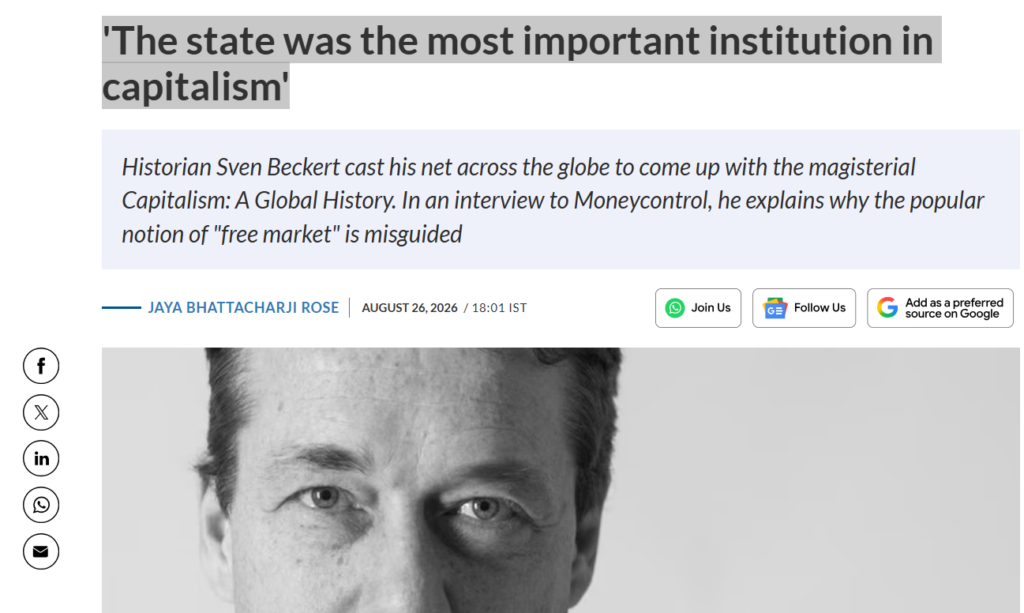
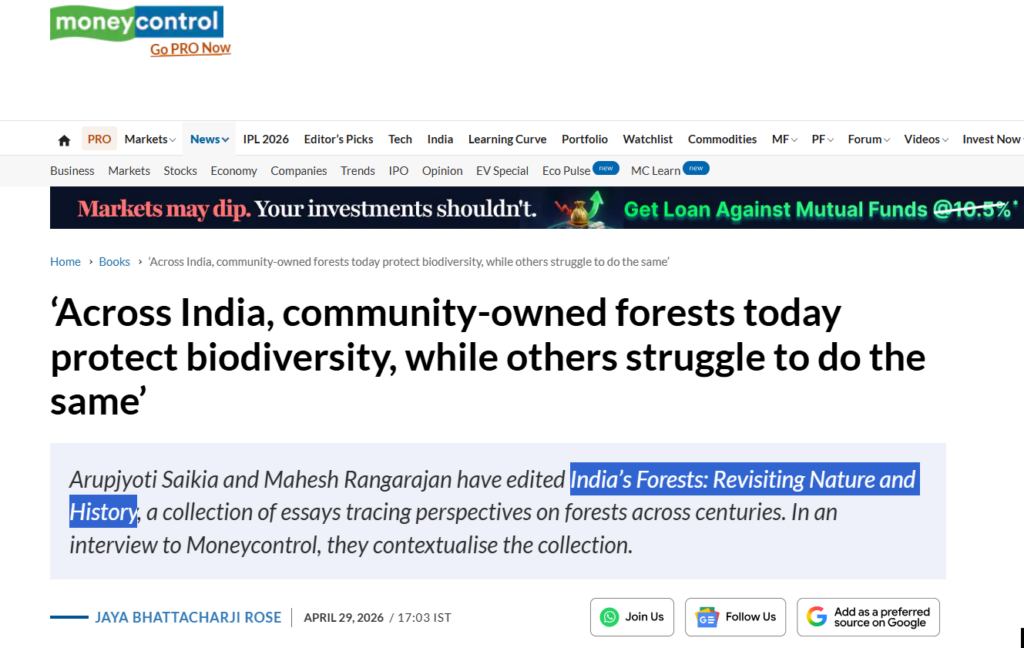
This interview with the editors was published on Moneycontrol on 29 April 2026. Here is the screenshot of the header. Given that many readers outside India are unable to access the interview easily, I am copy-pasting it here.

Arupjyoti Saikia & Mahesh Rangarajan (Eds.) India’s Forests: Revisiting Nature and History Vintage Books, an imprint of Penguin Random House India, 2026. Hb. Pp.360.
India’s Forests brings together essays by some of the country’s leading scholars with a fresh view of nature and history. These reappraisals of Indian forests and their many lives in past and present matter more than ever today. Born of years of sustained reflection, the essays here view forests not as passive unchanging backdrops to the past but as living, contested spaces.
Forests were shaped and in turn deeply influenced by power, culture and society. They could mean very different things to different people who often were in contest over meaning as much as control of the space or the resource. The volume spans from prehistory through ancient and early modern India into the present. It is also alive to the impact of the colonial era while tracing the changing fortunes of tribal and hill peoples. They are ecological lifelines and sites of legend, memory, and scientific knowledge. Material remains and life cycles of animals and plants matter, so too do social and literary imaginations.
Forests have been continually redefined through conflict, negotiation, and care. Attentive to the changing meanings across time and place, the book asks us fundamental and unsettling questions: what are forests for?

Contributors include: Shibani Bose “ ‘Digging’ Tales from Sylvan Trails: Perspectives from Archaeology”; Kumkum Roy, “People, Produce and the Political: Engaging with the Forest through the Arthashastra”; Aloka Parasher Sen “Multiple ‘Forests’ and Changing Borderlands: The Varied Indian Landscapes in Early India”; Meera Anna Oommen & Kathleen D. Morrison “Famines, Flagships and Floods: Historical and Contemporary Identities of Central Travancore’s Eastern Forest Frontier”; Mayank Kumar “Forest and Communities: Negotiations of Early Modern Monsoon Ecologies in India”; Divyabhanusinh “The Lion and the Unicorn: Fighting for Survival”; Sudha Vasan “Shifting Cultivator, Peasant, Forest-Dweller: Legacies and Landscapes of Improvement in the Baigachak”; Mukul Sharma “’God of the First Class’: Politics of Sacred Groves and Sarna in Jharkhand” and Vasudha Pande “Interrogating Ram Guha’s The Unquiet Woods: Thirty Years Later”.

Harini Nagendra, director, School of Climate Change and Sustainability, Azim Premji Universityendorses it saying “India’s Forests is a grand tour of the shifting forms, shapes and meanings taken by the country’s woods and jungles across the great arc of history. This integrative volume synthesizes information from a fascinating array of sources, from Mesolithic cave art and the Arthashastra to field trips and contemporary wildlife surveys; and captures a wide range of geographies from the Himalayas to the forests of Kerala. A must-read for anyone seeking a deeper understanding of the role forests play in our cultures, histories and imaginations.”

Arupjyoti Saikia is a professor of history at the Indian Institute of Technology Guwahati. He held the Agrarian Studies Programme Fellowship at Yale University, and visiting fellow positions a Cambridge University and the School of Oriental and African Studies (SOAS), University of London. His research spans across the economic, political and ecological histories of Assam. His published works include Forests and Ecological History of Assam, 1826 to 2000 AD (2011), The Unquiet River: A Biography of the Brahmaputra (2019) and The Quest for Modern Assam: A History, 1942–2000 (2023).

Mahesh Rangarajan is professor of history and environmental studies and chair of the HDFC Archives of Contemporary India at Ashoka University in Haryana. Previously, he has taught at Cornell University, University of Delhi, Krea University and the National Centre for Biological Sciences, Bengaluru. His notable works include Fencing the Forest (1996) and Nature and Nation (2015). He has edited the Oxford Anthology of Indian Wildlife (1999) and Environmental Issues in India (2007). His co-edited works include Shifting Ground (2014) and At Nature’s Edge (2018).

The following interview with the authors was conducted via email. It was lightly edited before publication.

  1. How do you define a forest? Has the definition changed over the years? Who defines it? What is it today as recognised by the government of India and international authorities? Also, what are the different technical definitions of a forest as determined by these bodies?

MR & AS: The book India’s Forests makes clear that ‘forest’ is, as one of our authors Kathleen Morrison puts it, a “vexed object, poorly defined yet meaningfully rich”. Forest is a space conceived differently across disciplines, eras, and political systems. For instance, in ancient India, forests had many roles. Each shaped by their use and location. The Arthashastra distinguished hasti vana, the area for elephants, from mriga vana, forests for enjoyment, organising woodlands by their strategic and economic value. If Sanskrit texts drew a clear line between grama, the organised village, and aranya, the wild forest, Tamil Sangam poetry described a continuous landscape where hills, bushes, and thick forests blended, reflecting human feelings and mixing wild and farmed land. More changes came in the later centuries.

The colonial period set legal limits on forests. The Indian Forest Act of 1878 turned forests into government-run lands, defined not by their trees but by who owned and controlled them. Forests became a political site instead of living nature. A major change came in more recent time. The Supreme Court of India expanded the definition of forests to include all wooded areas, regardless of ownership or classification in the Godavarman judgment of 1996. This important decision shifted the focus from official documents to the natural environment. This sparked strong debate about the future of communities living in forests without legal ownership. 

India’s Forests takes on the challenge of defining ‘forest’ clearly. Forests in this book cover a wide variety of landscapes, from rich rainforests to dry thorn forests and tall-grass savannahs, excluding only deserts and the tallest mountains. Forests are living nature made not just of trees but also herbs, fungi, orchids, and macro-fauna embedded in socio-cultural matrices. The book does not specify the exact technical definition used by the government though such reports are referred to as an important source of current government data. The idea of forests has made many journeys across time, space, ancient texts or modern legal lenses. This helps to secure the legal and proprietary lens of colonial rule, to the ecologically expansive definitions of recent times. Even now, the meaning of ‘forest’ is still considered by scientists, lawmakers, forest conservators, and activists-conservationists.

2. How did this book come about? How long was it in the making? What was the principle defining the commissioning of the articles? What are the key issues in this narrative that you wished to highlight? 

MR: We chose a range from prehistory to the current era and while all regions and ecotypes could not be covered, we have attempted to get a collection that is original, thoughtful, critical and stimulating. The occasion was the anniversary of the publication of a key work, The Unquiet Woods by Ramachandra Guha in 1989 a foundational work on environmental history, mainly a study of the Chipko movement. The essays engage with themes opened up by the book but in a critical if appreciative light. Much has happened in the study of forest histories in the last 35 years or so and we try in the introduction to look back and in the volume to point possible ways to go forward with fresh lines of enquiry.

AS: As Mahesh mentioned, Ramachandra Guha’s The Unquiet Woods opened up many layers of India’s pasts through the bright lenses of our nature, specially the woodlands. Since then, an enormous corpus of works have critically investigated India’s forested pasts. This trend continues to grow. These works’ geographical range and temporal scale is wide and deep! Equally historians have now explored newer archives and have engaged with newer methods inspired by other scholarly disciplines. All of these have helped us to get a nuanced understanding of India’s complex pasts and their evolving relations with the environment. We also wanted our readers to discover India’s forests as living landscapes shaped by agriculture and the ever-shifting worlds of trade across centuries and regions. We thought of bringing some of these newer works into one single frame which can help us to give a collective view of India’s forested pasts.

3. How will these academic essays on the history of India’s forests and Nature at various points of history help in future environmental action? How do you propose to bridge the communication gaps between this impressive evidence collated and action on the ground? 

MR: Such a work can inform debate, as it is not prescriptive or a call to action directly. But all authors are sensitive to these concerns and some have engaged with the issues for long, years even decades.  There is no short cut method to reaching out and we will try. Initial responses are very positive.

AS: Readers find here not prescriptions, but a firmer and a clearer picture of the variegated life of India’s forests. The essays in this book reveal that India’s forests have always been alive with activity and meaning. Far from being silent backdrops, these woodlands have witnessed centuries of struggle, bargaining, survival, and authority, stretching from the detailed forest classifications of the Arthashastra to the major changes brought by the Forest Rights Act of 2006. They go on to suggest that today’s decisions about conservation, community rights, and the restoration of ecosystems are quietly guided by echoes from centuries past. The creation of colonial forest reserves, the gradual loss of traditional rights, and the privileging of timber over biodiversity did not simply happen; they were crafted by history. The past of India’s forests may not hand us a roadmap, but it does reveal the pitfalls that once tripped up those who came before us.

4. What are the pros and cons of the colonial narrative for ecological histories that we inherited? How did it affect the development of a region, conservation methods, and impacted human behaviour. 

MR: There is no one unified colonial or imperial narrative.  Just as there is no one global or national one today. Certainly not on the forest. The colonial interlude in India was still critical in many ways.

There were indeed Abharanyas (forest reserves) in early India and in early modern India, there were hunting reserves, such as the well-known shikar gahs of the Mughals. Landed groups had pig sticking grounds. But the extent and scale and scope of state forestry was never of the level of imperial China. In this sense the kind of property rights with state forestry in the later years of the East India Company and then under Crown rule post 1858 was far more intrusive.

In order to secure the forest land and its wealth, there was a legal frame and an executive branch for taking land over. This was like enclosure (not literally with fences) but through punitive actions and penalties. There was a major attempt via silviculture to upgrade forest stock to yields more timber and other forests products. This meant many strictures on hunting, fishing, grazing collection and on opening up fresh land for cultivation. This enclosure of commons and open access lands had deep even wrenching effects that are felt to this day. A remarkable administrative accomplishment, the Imperial Forest Service secured the forest and protected it. But it was not conservation for its own sake but in service of empire.

AS: I agree with Mahesh that the colonial era left behind not only vast stretches of forest but also lasting scars on the people who had cared for these lands for generations. But that narrative cannot be so straightforward and each part of India will tell something different. There were undeniable gains: from the 1860s, new laws and policies curbed deforestation and established the framework of forest departments, protected zones, and wildlife safeguards that independent India would later expand. Without this groundwork, the dramatic and yet stable resurgence of the lion in Gir and the greater one-horned rhinoceros in Assam would have been unimaginable.

But these gains came at a steep price. Colonial forestry put profits above conservation [though this was not too simple] or timber above the rich diversity of life, replacing the trees that villages relied on with fast-growing, marketable trees which produced logs. Swidden cultivation simply was branded as a criminal act while pastoralists lost their age-old rights to graze in mountain meadows. Generations of customary rights vanished with a single law. Forests became sites for extraction, stripped of the intricate and emotive bonds that communities had woven over centuries. This imbalance still lingers in many ways but so is the challenging legacies of our environmental past.

5. India’s Forests focuses on the history of an age-old culture of peasant-pastoral wisdom that has been eroded by modernity, consumerism and a variety of vested interests.  Will the preservation and the commendable efforts of keeping this knowledge visible in academic discourses impact key stakeholders, policymakers, perhaps result in afforestation practices? 

MR: Kings, peasants, land owners, merchants and forest peoples looked at forests in different, often contrary ways. There were also times their interests or ideas coincided. It is true industry, commerce and so on have transformed not only forests but the earth system since the late 18th century, the time Britain embarked on the Industrial Revolution and eastern India came under the East India Company. The colonial era had far reached impact on animals, peoples and trees and plants and water as much as on land. What is notable, and this matters, is that the Western Ghats were a source of pepper and ivory makings it way to Rome 2000 years ago so the exchange economy is not new even if modern capitalism is. Oommen and Morrison show pepper collectors in the hills and ivory hunters and the ecosystems very much part of wider networks. In similar ways, the work of Dr Mayank Kumar on the early modern era shows how Rajasthan had records on conflict and control over animals and trees in rural areas by dominant groups and state authorities. There was still room to manoeuvre because peoples beyond or the edge of cultivated arable mattered to rulers. Their knowledge and wealth (animal or other produce) was taken and ties were not equal. But the kind of fixity of property, tenure and settling in the colonial and British imperial era had a ferocity all of its own. It is well illustrated in the novels of Bibhuti Bhushan Bandopadhyay on the clearance of the forest and the later continuities in the works of Mahasweta Devi.

This is of course a short response. For the richness of the stories the book has many voices, explores many forest paths and tracks.

On the last, time will tell. We are delighted at the early reception to the work and hopeful it will help inform if in small way the wider debate. This is not a book about what to set right and how. That calls for a different kind of book and work.

It is meant to be wake up call on ways of thinking most so about what forests mean and why issues of how to relate to nature are as much about the past as the future. How we got here matters no matter where we may want to go. The forests of today are as much as product of human history as of biological processes.

AS: The book does not paint a rosy picture of a missing rural landscape. Instead, India’s Forests reveals how peasant and forest communities were always entangled with power. That they bargained with kings, paid taxes, endured punishments, and constantly adapted. The essays in this book encourage readers to confront the many histories of India’s forests. As Mukul Sharma demonstrates in this volume, India’s sacred groves are also sites of contest, hierarchy, and ecological complexity, as well as a resounding tool for conservation templates. We cannot afford to overlook these tangled pasts, or risk falling into the old colonial trap of imposing one-size-fits-all solutions on richly varied lands and peoples.

As said earlier, one can think of the jhum farmers in the highlands of India’s North East. They observed the land’s slope, soil moisture, rainfall patterns, ecological pasts, and the many worlds of insects before deciding where to burn and where to grow. This complex ecological practice and wisdom had developed over many generations. Anthropological works of the 20th century provided a clearer, more detailed understanding of such ecological practices. The British imperial foresters called it wasteful and tried to stop it. What was challenged there was not just a farming method but a whole way of understanding how to live with forests. 

The essays in this book argue that such intimate encounters with nature were never unchanging or perfect. They changed, adapted, or regularly dealt with power at every step. Along with the measures adopted by the state, the rhinoceroses in Kaziranga also survived because the peasant communities knew about this flooded and forested habitat. For the peasant communities, the wet grasslands of the Brahmaputra floodplain are socio-ecological formations which they understood intimately. India’s Forests thus offers the readers a more critical view about human and nature relations.

6. Where and how did we lose our traditional knowledge bases, especially that exists within our culture? They have a deeper understanding than outsiders who impose their views. What proportion of these information repositories that exist in a micro-culture, stories, cultivation practices etc can we recover?

MR: This is best I defer to Prof Saikia.

AS: The loss happened in layers. Colonial legislation quickly criminalised community forest practices. Postcolonial development deepened the wound. We cannot recover everything. But the epistemological framework survives: the understanding that forests are social-ecological relationships, not timber warehouses.

7. Why are we moving or have we already developed an economy of exclusion and inequality at the cost of depriving traditional knowledge? What are the rights of local communities? Can these be exercised, enforced and implemented?  (As is being done in Brazil, if I am not mistaken.)

A lot of this can be traced to the legal frame, the practice and norms of imperial forestry instituted the 1860s and 1870s on wards. In the early years, while the most senior Inspector General was German for 35 years almost in many provinces, they got former military men to take charge. So, exclusion was built in very early. It was not and cannot be total as labour was required for a variety of reasons, such as cutting fire lines, making roads and felling trees. Until the Forest Rights Act of 2006, the rights of Scheduled Tribes and Other Forest Dwellers had no real legal space. Since then, it has been an uphill struggle between the official mind set and the securing of rights. It is important to acknowledge here that the Act had unanimous support not merely as critics feel to give away land or forest for votes but as a corrective. The land reform process of cultivable land of the 1950s had no counterpart for over 60 years with regard to forests.

Brazil has had a different history and the nature of indigeneity is different. It also has far fewer people in say the Amazon than India’s forests. Closer to home one can look at Nepal that has far more decentralised and participatory approaches via vis parks, forests and water than almost anywhere in India. But there are attempts at change in many cases at the state level so there are grounds for hope yet.

AS: I agree with Mahesh that India’s land reform programme including the abolition of zamindari in the 1950s which were largely done based on the political inspiration of India’s freedom movement had little parallel since then. Mahesh rightly highlighted that the exclusion was not accidental — it was architectured. Colonial forestry-built inequality into its legal foundations, erasing customary rights and replacing multi-layered community relationships with a single extractive logic serving the colonial state. Independent India largely inherited this framework with very limited transformation. The Forest Rights Act of 2006, we do need to note, was a historic corrective. It recognised for the first time both individual and community rights of forest dwellers — but implementation remains bitterly contested. There is little doubt that decentralised forest governance can deliver desirable results.

8. Forest cover has reduced to 21% in India. CSR efforts to plant trees in different parts of the country have been an ongoing practice for a while now. But do these initiatives in any way, take into account the symbiotic relationship between local communities and the forest that are outlined in the book? Will these planting drives help us recover our forests? 

MR: Having not directly worked on this, cannot say much. But replanting is not the same as regeneration. A mixed multi species formation is different from a plantation. A lot of work by ecologists in fact shows this and it might help value protection and prevention over plantation. The latter is needed but as a complement.

AS: The choice of species may of course not at all be in accord with livelihoods. The late Anil Agarwal illustrated how different regions have key trees for livelihood and ecology such as khejri in the Thar desert, banj and moru oak in the western Himalaya, Mahu and tendu in Central India and the peninsular highlands and one might add the Palmyra Palm on the Coromandel coast. These are not planted often but are grown or grow and if fostered with care yield multiple benefits and also play a role ecologically.

9. India’s Forests outlines the significance of forests to communities that has been mentioned in texts like the Arthashastra or preserving the practice of sacred groves in Jharkhand. People had a vested interest in preservation of Nature. We need forests to maintain our climate and weather patterns, most notably, our unique monsoon. This is imperative given the rapid climate change. Yet, large chunks of forests are being cleared for mining, growing cash crops, land banks, and urbanisation. How do we bring back this sense of belonging and enable a collective action to preserve rather than it becoming only the purview of environmental activists/academics? 

MR: Just to be clear, the Arthashastra is about extending and expanding the state role in and over the forest. The aranya or vana is not beyond the ambit of power but extending authority was a challenge. While enumerating multiple productive roles of the forest and kinds of forests, and kinds of peoples, there is a clear sense of power and hierarchy. This is especially clear with the Atavika Rajas or forest chiefs who are to be loyal and guard borders. Ashoka no less in an Edict warns that those who do not behave and obey will be punished.

The collective sense you refer to is strongest perhaps in hill, forest and Adivasi or Scheduled Tribe societies. One of the things we have to be careful about is not to romanticise or generalise. There are many who see this is as either/or choice national park or sacred grove or state versus community.

There is no doubt much to learn from local and communitarian ideas and practices, most so in keeping the systems productive and habitable over long periods. The actions you refer to such as mining and industry are often giving priority to short term extraction without much thought to the biota, top soil or water or to those they displace directly or indirectly. A different way of seeing is the starting point surely. Aside from specific cases or protests, a more holistic appreciation of ecologies and also of producer knowledge. The latter is helpful because if one thinks of mahua or tendu so important in central and main land India, you get a different view of the forest as entity than simply as land for mining.

Scholars and others are learning from real life situations and practices. Yes of course, there should be more informed discussion and the level of awareness all round of the linkages and connections needs to be part of larger discourse.

AS: Think of India’s many highland communities, who named their forest areas not by how much wood they could get but by the spirits living there, or the Van Gujjars of the Shivalik foothills, whose seasonal moves followed not government borders but the memory of grass and pastures. These were not just old traditions; they were exact, proven, living maps for survival. What replaced them when British imperial forestry began was a different kind of exactness the surveyor’s chain, the forest section number, the mining rights planned in colonial offices far from the sound of rain on sal leaves. The hills of Meghalaya lost not just trees and bushes but also a whole way of understanding nature when jhum cycles were restricted by official rules.

Despite those challenges across India, community-owned forests today protect biodiversity, while others struggle to do the same. For many, the Khasi clan’s ancestral forest remains a more effectively conserved landscape than many protected areas. 

The starting point is neither nostalgia nor laws alone; it is listening. When a floodplain dweller describes flood patterns along a river in eastern India, she is sharing climate information that no satellite has yet recorded. 

10. Forest / environment has a specific vocabulary. Why is it not more in vogue? Will it not help preserve and respect trees and forests if people recognise and understand their environment?

MR: In general, yes. But there are different terms in various regions, jangal in Hindustani is common parlance, Kadu in Tamil. Once you get to the local level, there are variety of terms for different kinds of uncultivated land scape: the rakhs for instance in central and western India is a grassland that may be dotted with trees. These were often cleared away and cultivated after independence though vital for diverse fauna and flora and for local livelihoods especially the rural poor. Similarly, despite the Kadu/Nadu dichotomy in Tamil, goat droppings (from their browse off grass, shrubs and herbs) was prized for the nutrient value for the cultivated land.

The problem is in a narrow view if you like a monochromatic view of a multifaceted entity. The forest can be habitat for bats and birds, mammals and insects, and diverse flora. It is not simply waste land to be carved up for cultivation or for industrial projects.

With all their faults, this was realised as early as the 1830s by some East India company surgeons as studied by the late great Dr Richard Grove. The early links of forests and climate were also first drawn in the Indian Ocean by such men and they were men. It is a different matter such ideas were not always acted on and when so only partially.

We still have an immense challenge when forests are viewed only in terms of timer i.e. Net Potential Value or NPV. Useful for forest products it hardly captures or does justice to multiple ecological and social functions or roles or relationships.

AS: Language moulds the way we see, and when words vanish, entire worlds slip away. The people of Arunachal Pradesh hold a treasury of names for forests along the mountain slopes, each term capturing the moisture, soil, seasons and how people relate these to them. Reduce all this to just ‘forest cover, and you erase a living map of relationships between humans and the natural world. When a place loses its name, it is already halfway to being lost.  Despite odds, these forest vocabularies survive in song or in rituals. Their return to the mainstream will be greatly helpful. This is what the earth desperately needs.

11. With the rapid technological growth, especially as the demand for AI grows exponentially, tech companies are being given permission to construct data centres in urban areas as well as agricultural and in some cases, forests. These centres are land, fresh water, and mineral guzzlers. Is there hope for the future of forests in this dismal context?   

MR: Modern industry and this certainly include AI very prominently so did not and does not budget for water. Not only is surface water scarce much of the year in most of India, ground water takes years to accumulate and has to be renewed as it is used. Meeting drinking eater view renewal is possible but more that calls for prudence.

On the other count, if you take a longer view, there has been woodland retreat and resurgence in the past. If we have more productive agriculture and more water prudent forms of use, both urban and rural, given there are less cattle now and pastoralism contrary to popular image can integrate with open land, scrub and open land ecosystems, there is lot of ground for hope.

It is important to note the success of grassroots regeneration of ecologies and also the positive government community partnerships. None are ideal and multiple challenges remain.

But you are correct the resource destructive path way is not prudent or just in such a land mostly of long dry and short wet seasons. Maybe we should look at this from the long-term perspective say a long-lived tree than a human life span. That will give sense of perspective a balance sheet cannot.

AS: I agree with Mahesh.

30 April 2026

“You Can’t Please All: Memoirs 1980-2024” Tariq Ali

Tariq Ali, You Can’t Please All: Memoirs 1980-2024, Seagull Books, 2026. Hb. Pp. 824

The revolutionary upsurge of 1968–1975 jump-hopped continents with ease but finally petered out. What happened after is the subject of You Can’t Please All. Tariq Ali recounts a life committed to writing and cultural interventions. An eyewitness in Moscow to the fall of the Soviet Union, he was caught up in the intellectual excitement that had gripped the country. In Porto Alegre, Hugo Chávez invited him to visit Caracas, and the two men developed a striking friendship.

Post-2001, as a founding member of the Stop the War Coalition, he became a fierce critic of the War on Terror, visiting many US cities with surprising regularity to engage in debate and discussion, inaugurating a new phase of political activism. Evident in his work is the integral part politics plays in his life. He is one of the most sought-after socialist and anti-imperialist public intellectuals on most continents.

Underlying the narrative is a chain of anecdotes, reflections, jottings and storytelling. The book explores his work for the theatre and film, as well as his fiction, including the acclaimed Islam Quintet. There are pen portraits of friends and comrades such as Edward Said, Derek Jarman, Richard Ingrams, Benazir Bhutto, Mary-Kay Wilmers, and the intellectuals who founded and relaunched New Left Review: E. P. Thompson, Perry Anderson and Robin Blackburn.

The book also contains a moving family portrait, describing how his parents met and lived during the early years of Pakistan.

Twenty-three years ago, Tariq Ali delivered the speech “In War There Is a Need for Translators” that has been published here. It was at the first W. G. Sebald lecture that is given annually on an aspect of literature in translation. It’s named after W.G. Sebald, who in 1989 set up the British Centre for Literary Translation (BCLT), University of East Anglia, Norwich, UK. Sebald, also known as “Max,” was a German writer who chose to reside in the UK and continued to write in German. His notable works include The Rings of Saturn, Austerlitz, and On the Natural History of Destruction, which cemented his position as a prominent 20th-century writer. Other writers who have delivered this lecture include Elif Shafak, Alberto Manguel, Lydia Davis, Jhumpa Lahiri, David Bellos, Arundhati Roy, Ali Smith, and Margaret Atwood.

The Seagull Books edition is for sale in the Indian subcontinent only.

Read an extract from the book on Moneycontrol

Tariq Ali is a writer, filmmaker, and longtime political activist and campaigner. He has written more than a dozen books on world history and politics, including The Clash of Fundamentalisms (2002), Bush in Babylon (2003), Rough Music (2005), and Pirates of the Caribbean: The Axis of Hope (2006), as well as scripts for both stage and screen. He is an editor of New Left Review and lives in London.

22 April 2026

Interview with Likla Lall

The following interview with Likla Lall was conducted for Moneycontrol (15 April 2026).

Likla Lall (Author) & Eva Sánchez Gómez (Illustrator) Ganesh Haloi: Colours of Home ART1ST, Pb. 2025

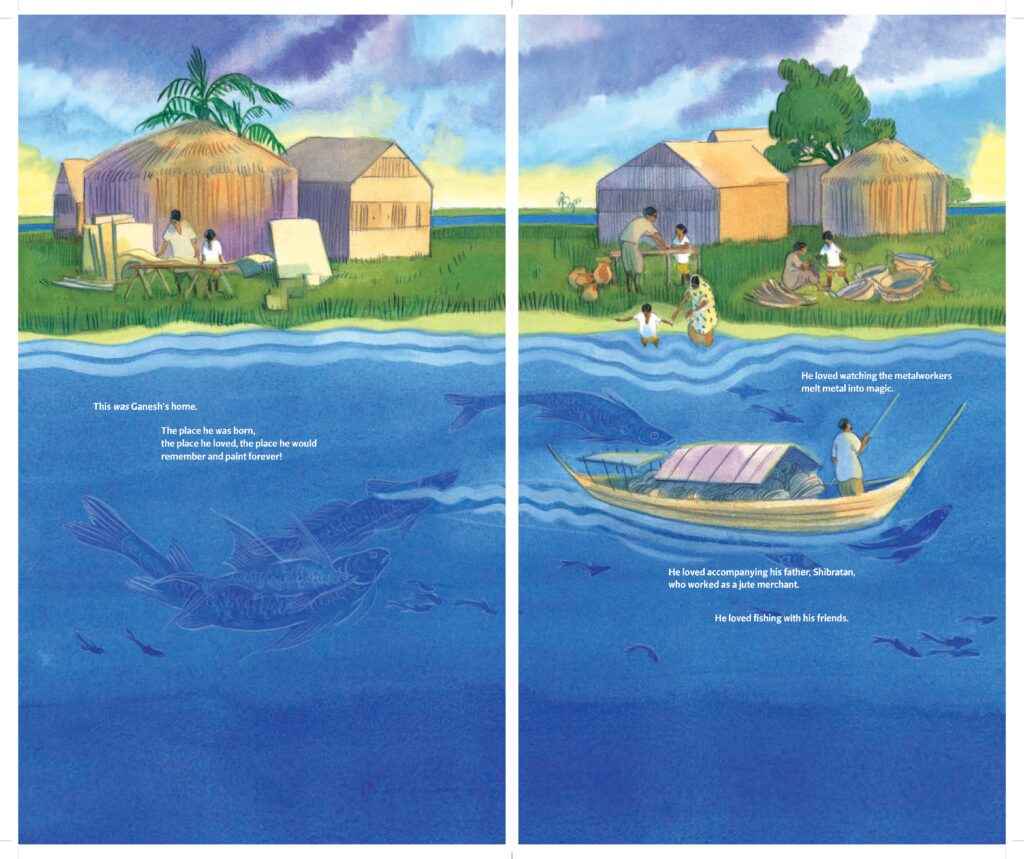
Ganesh Haloi: Colours of Home (2025), is a fascinating picture biography of the artist Ganesh Haloi. It narrates his life history simply and it is multi-layered that readers of all ages can appreciate it. The text is soaked in the art work in a manner that is readable, relevant, and resonates with the art on display. So, the connections offered are once again at multiple levels. Depending on which of the senses of the reader is tickled, it is an introduction to the heart and soul of what defines Ganesh Haloi’s work. Then from there, the reader may move on to different aspects of the story and the beauteous book production supports it impressively. The art work is inspired by Ganesh Haloi’s style including a wonderful three pages that briefly seem to emulate the tunnel books of the nineteenth century. In this book, they replicate the frescoes of the Ajanta Ellora caves that have deeply influenced Haloi. This is a book that weaves within it historical facts, such as that of the Partition of the Indian subcontinent; it is always anchored in time with dates in the artist’s life mentioned and innumerable concepts significantly that of the idea of home — the refugee camp called Cooper Camp, railway platform at Howrah station or Government College of Art and Craft, Calcutta or the caves of Ajanta and Ellora that ultimately shaped Haloi’s art. Ganesh Haloi contains a workbook section wherein the younger readers, can familiarise themselves with the various forms of art, taking inspiration from “ordinary” objects around them and learning to observe before reimagining it with their creative impulse. The end papers of the book provide a mini catalogue of the prominent paintings by Ganesh Haloi, providing thumbnail reproductions and the provenance; thereby gracefully educating readers on how to appreciate and recognise art. It is a legacy worth cherishing.

Published by Art1st and Kiran Nadar Museum of Art, supported by aKaR pRaKaR (Research Partner) and Institut Ramon Llull (with an illustration grant), written by Likla Lall, illustrated by Eva Sánchez Gómez and designed by Rohina Thapar. Art1st Books, reaches beyond art history to the cultural history of India, helping children in various cultural contexts make a personal connection to this heritage. The book is a part Art1sts’t Art Exploration Series. The series delves into the lives, particularly the childhood, of eminent artists. It explores the artists’ work and philosophy, approach and methodology, success and failure, in a story format, to engage and inspire children to in turn create their own art.

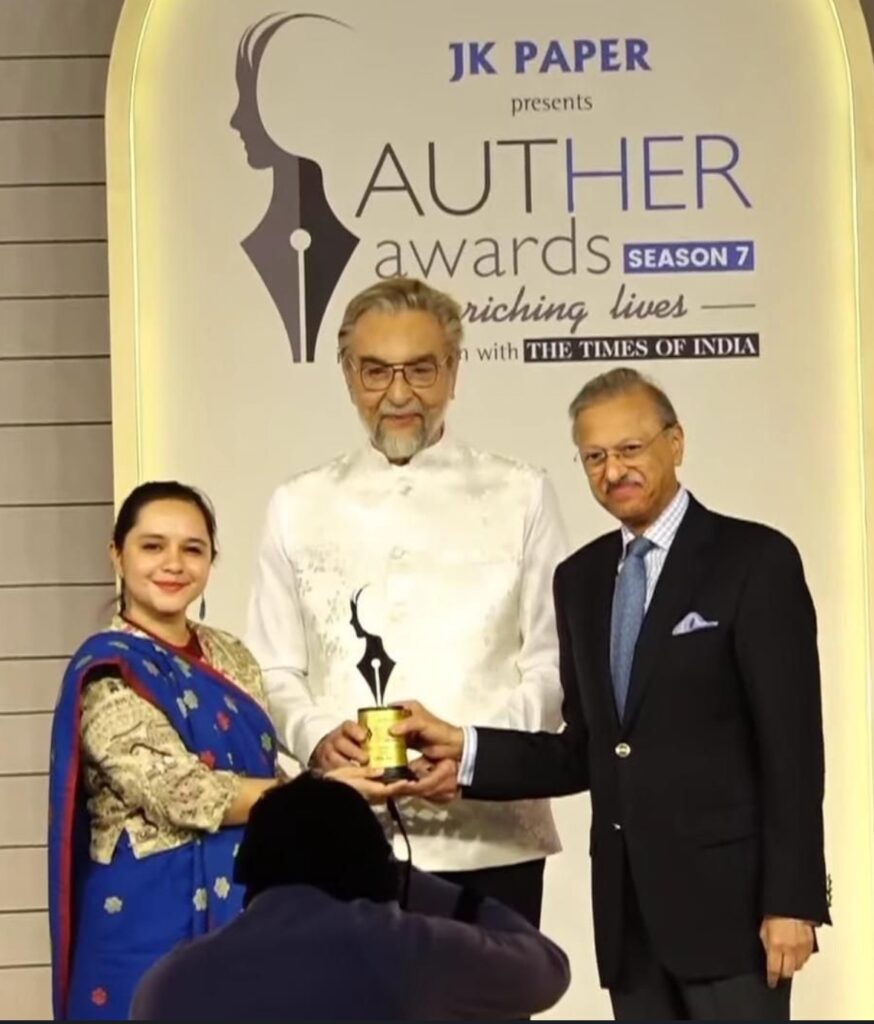
With Art1st, Likla Lall has been writing children’s books about art, including award-winning Art is a Verb and Somnath Hore: Wounds. She writes about the Self (with Little Light), on adventures (with PanicNot!) and comics on nature and mythology (with her sister and illustrator Keya Lall). She won the Best Children’s Literature AutHER Award 2026 for Ganesh Haloi. It was also selected for the BRAW Amazing Bookshelf – part of the Bologna Ragazzi Award 2026.

Eva Sánchez Gómez graduated with her Fine Arts degree from University of Barcelona. Now she lives and draws in La Garriga. She has illustrated more than thirty novels and picture books for publishers from different countries.

Rohina Thapar is a multi-disciplinary designer working at the intersection of communication, product, & brand. Rohina and Likla work together on Khel Theory, a collective that creates interactive educational material. 

The following interview with Likla Lall was conducted via email.

  1. How did this book come about?

Ganesh Haloi: Colours of Home is a part of Art1st’s Artist Exploration series that takes on the format of a picture book biography, along with an exploration of the artist’s work. The series aims to make artists approachable to young readers and inspire them to create their own art. The series began with Raza’s Bindu, but has since covered important Indian artists like Abanindranath Tagore, Somnath Hore, Ganesh Pyne, Jamini Roy, most recently Ganesh Haloi and many others. Our collaboration with the Kiran Nadar Museum Art and Akar Prakar has guided our choice of artists for this series. Reena and Abhijith Lath of Akar Prakar, especially, have a close and long relationship with Ganesh Haloi, and have been instrumental in guiding the research for this book. 

  • Whose story is this? If it is an amalgamation, then how much research did it involve? What were the primary sources used? Sometimes it almost feels as if you are referring to diaries/letters of the artist. Has Ganesh Haloi seen your book? What has he said about it?

The research for this book began with reading as much as possible about the Ganesh Haloi. We were grateful to access Naishabder Chitrakar, a biography of the artist, edited by Prakash Das. It includes essays on various aspects of his life, from his childhood to his entry into the world of art, his philosophy and pedagogy on art, and some of his poems, which gave me such clear insight into the way his mind works. I was also fortunate to meet and interview him several times, a delightful experience. He was in equal parts cheerful, poetic and kind as he led me through his home and his works. He patiently received various drafts of the story and was always encouraging.  The very last page of the story is a direct quote from him. One of the first few copies of the books was received by him and his family in Calcutta. In fact, I called him the day after winning at the AutHer Awards 2026 to share the news, and he was ever-joyful, inviting me once again to visit them in Kolkata. 

  • Brevity of text is the hallmark of this story. There is so much history to unpack in every sentence. How did you balance the words, facts, concept, and readability for all ages?

It is a task to condense an entire life story into a short story for children. For me, the next step is to arrive at a concept that brings it all together. As I read through the various and distinct parts of Ganesh Haloi’s journey, as well as immersed myself in his vibrant artwork, I began to imagine capturing this in a museum or gallery, much as his art is often displayed. What stuck were these four distinct places that defined him — four places with distinct memories, colours, ecologies and experiences. The illustrations invite the reader to dive into each place and see it through his eyes. The text pulls you through the narrative, guiding you through time and towards the next stop on the journey. And balancing in the space where word and picture meet are the emotions of this journey, of a child turning into a young man. And once you’ve read through the story, you’re invited to see the works for yourself and make your connections to it. These pages are crafted to include history, introspection, curiosity and expression. The instructions are easy to follow, but not dull, leaving room for artistic interpretation; after all, our readers are artists, no matter what age. 

  • It is more than complemented by the layers of artwork. Was this conceptualised digitally? Please share the ideation process and the various iterations. 

The Art1st process of book creation is extremely collaborative. The writer (Likla), illustrator (Eva) and designer (Rohina) have worked together previously on Abanindranath’s House of Stories, and have a beautiful working rhythm between them, executed across geographies. The research isn’t simply for the text and story, but to build visual references for this particular time period in Bengal. ‘What did people wear? Were there photographs and illustrations of Calcutta? Which fish call the Brahmaputra their home?’ Eva is a brilliant illustrator based in Spain, with a keen sense of visual narrative. Her wonderful imagination is perfectly paired with her skills with coloured pencils. She brought each of the four places in the book to life with her vibrant colours. She imagined the fabrication of the book: the many layers of the Ajanta Caves, or the never-ending spreads of the dismal Cooper’s Camp. We’re grateful for the support of Institut Ramon Llull in making this inter-national collaboration possible. 

  • Did the design evolve to fit the content? How do you ensure that your instructions are followed 100% while it is in production? The pages are shaped differently. There are cutouts arranged in the manner of tunnel books.  

The next part of the book-making is the design. Each of us brings a different perspective as we ‘read’ the works of Ganesh Haloi. Bangalore-based Rohina has designed several Art1st books, amongst other creative design projects. Her task was to integrate these various threads (the text, illustration, artworks and activities) and weave them into a coherent and self-encompassing world. She has a fine mastery over the shapes of paper as they fold, open, and even pop right out of the book. There is a long process of testing of pages, redesigning, colour correcting, and sample prints before the book is ready to go. Our print partners are Maharashtra-based Prudent Art & Fab. They painstakingly assemble each complex section of the book to create a piece of magic you can hold in your hands. 

  • Was the text tested thoroughly before being edited and then discussing design layouts? What did it involve? 

The text went through various iterations under the watchful eye of our editor, Ayushi Saxena. The biggest challenge was to wrangle and bring down the word count: there’s always so much more to say! As the illustration and design came together, we could see the shape we were making. It became easier to trust the collaboration of text and picture and kill some of our darlings. 

  • Art1st specialises in making biographies of prominent Indian artists in a pictorial format with worksheets provided to help learn the basic brushstrokes/ideology of the artist featured. It is the same for Ganesh Haloi too. What were the key details that you wished to incorporate and did and/or were challenged to do so?

This series follows an effective pedagogical design. The first part is the story, where one reads about the life of the artist. In the second part, one is presented with the artist’s works and provocations to look deeper. And finally, one is encouraged to create, through activities inspired by the artist’s process. Ganesh Haloi, as an artist, has a wonderful ability to capture the unseen. His works present abstract-looking landscapes that seem incredibly familiar in their essence. He has developed a language of his own that captures the rhythms of the unseen, the movement of the wind, the whispers of the rivers and the sensation of colour. These are some of the ideas that rest within the pages of this book, through questions and activities. 

  • Good children’s literature works at multiple levels and is timeless. It cuts across generations and ages. Thankfully, your text does not specify the age group it is meant for. Nevertheless, when working on the draft, how do you determine the target audience? What is it that you seek?

While the series is meant for children aged 8-12, our decade-long experience has repeatedly shown us that art really does transcend age. I have found adults absolutely enchanted by my first book Art is a Verb and its curious paper play. Similarly, adults are quick to admit in a safe space created for children that they haven’t heard of a particular artist or an art form, and the books playfully encourage them to read. Conversely, there is a notion that art belongs to adults, and yet, children of all ages are enchanted by art and quick to share their observations. There is a pedagogical base that guides the creation of the book (the structure, language, font size and so on), but it isn’t prescriptive, rather immersive. There is a freedom to allow the book to turn into the creature it is meant to be. 

  • How do you incorporate big ideas of free will, independent thinking, being a dreamer while focusing on turning thought into action, being imaginative, freedom of expression, idea of home, etc?

In retrospect, it is possible to decipher themes and learnings in the book, but to me, the process of creation was simpler. I was guided by the life story of an amazing artist. I tried to represent in the truest way possible way the circumstances of Haloi’s life: his birth in Jamalpur, the partition of the Indian subcontinent at the time of Independence in 1947 and the seeking of a new home in Calcutta (as it was known then), his life experience as a teacher and so on, knowing that it will resonate with the reader. Art-making, too, can be contemplated on and understood in so many ways. The absolute imagination of an artist brave enough to confront a blank canvas. The almost-alchemical understanding of materials as they turn pigments and paper into entirely new worlds. Their preoccupations as they consider the same subjects from different angles, repeating symbols, colours and ideas in an attempt to express the world. Once more, as a writer of art, I am guided by the art and by the artist, and I choose to follow and retrace their colourful paths. 

  1. How do you devise the worksheets? What is the intent? Can these be replicated in a classroom or are dependent on the individual text? What results have such experiments shown in the past?

Art1st has a pedagogical division that works with schools and educational organisations. It was from this work that Ritu Khoda (founder of Art1st) saw the gap in and need for books about Indian art for Indian children. We try to create the activity pages in a direct and DIY manner, well aware that not all readers have the same access to art environments or educators. For educators, we often offer a workshop or guide on how to use the books in their classrooms, if required. It is a practice for the book creators to conduct workshops at festivals, schools, libraries and foundations. A huge reason is the advocacy for art education, which is often treated as a secondary subject in STEM-first systems. I am often surprised by the responses. For example, our book Somnath Hore: Wounds came out as the COVID-19 lockdown was lifted. Our engagements around the idea of wounds, catharsis and healing created a safe space for people to share their own wounds and find connection. Colours of Home has been a lovely opportunity to step into ‘abstract’ art, often confusing them, but also giving them the freedom to explore beyond their assumed boundaries of art. 

22 April 2026

“A Man For All Seasons: The Life Of K.M. Panikkar” by Narayani Basu

K.M. Panikkar was a multifaceted man, one of India’s first public intellectuals as India won its independence. His imprint is all over India’s colonial and post-colonial history: from constitutional reform in the princely states, where he was a strong advocate for India’s current federal model to charting India’s maritime policy as a free country. He believed in an essential Hindu culture that held his land together, yet he was a committed secularist. He was Gandhi’s emissary and the founder of the Hindustan Times. He was independent India’s first and most controversial ambassador to both Nationalist China and the People’s Republic of China. He was Nehru’s man in Cairo and France and a member of the States Reorganisation Commission. He had enemies in the CIA as well as in India’s own Ministry of External Affairs. He frustrated his admirers as much as he provoked their reluctant respect. From the British Raj to the Constituent Assembly, across two world wars and an ensuing Cold War, K.M. Panikkar was India’s go-to man in all seasons.


Through it all, he never stopped writing—on Indian identity, nationalism, history and foreign policy—material that remains as relevant today as it was seven decades ago.


Yet, about the man himself, strangely little is known. In A Man for All Seasons, Narayani Basu bridges that gap. Drawing on Panikkar’s formidable body of work, as well as on archival material from India to England, from Paris to China, and from Israel to the United Nations, as well as on first-time interviews with Panikkar’s family, Basu presents a vivid, irresistibly engaging portrait of this most enigmatic of India’s founding fathers. Featuring a formidable cast of characters—from Jawaharlal Nehru, Mahatma Gandhi and Sardar Patel to Zhou Enlai, Chairman Mao and Gamal Abdel Nasser—A Man for All Seasons is as much a sweeping history of a young India finding its place in the world as it is the story of a man who was impossible to ignore then and remains so now.

Read an extract from the book on Moneycontrol. It has been published from the chapter “An Unlikely Diplomat”. The book is published by Westland Books.

Narayani Basu is the bestselling author of V.P. Menon: The Unsung Architect of Modern India (2020) and Allegiance: Azaadi & the End of Empire (2022). A historian and foreign policy analyst, her current area of interest focuses on the less known but key players in the story of Indian independence. A Man for All Seasons is her third book. She won the Best Nonfiction AutHer Award 2026 for it.

17 April 2026

“Gangs of Punjab: Guns, Greed, and Girlfriends” by Jupinderjit

Village boys with guns.Hits ordered from distant shores.
Flashy music videos. Social media hype.
Music stars in the crosshairs. Celebrity-like gangsters.
Drugs. Politics. Entertainment. Terror.


From the killing of Sidhu Moosewala to attacks linked to Gippy Grewal, and threats to Salman Khan, violence is no longer an act—it is a message. Punjab’s organized crime has mutated into cartel-style international syndicates, with wanton killings and an endless cycle of revenge.

Gangs of Punjab enters this ruthless underworld, tracing the rise of men who blur the line between outlaw and icon. Their rise comes at a deadly price, leaving behind a trail of bodies; but their fall is as dramatic and often fatal, sometimes at the hands of close confidantes. For those who survive betrayals, the relentless Punjab Police lie waiting.

In this cat-and-mouse game, nobody walks away clean.

The book uncovers how Punjab’s gangs evolved from local groups into international syndicates. The role of social media, music videos, and celebrity culture in enhancing criminal visibility. It describes links between organized crime, drugs, politics, and entertainment. It tries to explain why targeted killings have become instruments of signalling and revenge. It delves deep into the internal rivalries, betrayals, and violent downfalls within gang networks. Ultimately, how law enforcement responds to a constantly mutating criminal ecosystem.

Curiously the book tries to explain organized crime as a social and cultural phenomenon, not just focussed upon criminal activity. It documents a critical shift in how violence is performed and perceived within society. It attempts to connect regional crime to global networks and diasporic operations offering rare insight into policing, intelligence, and counter-gang strategies. Hopefully, it helps readers understand why crime in Punjab today is as much about image as power.

This book will appeal to all kinds of readers, including those who are avid readers of true crime and investigative journalism. It will most definitely appeal to those interested in contemporary Punjab and North Indian politics as gangs have been inextricably linked with politicians.

Read an extract from the book on Moneycontrol. The book is published by Rupa Publications India.

Jupinderjit Singh, is an award-winning investigative journalist celebrated for his crime reporting. He has so far published six books, many of which have been translated into multiple languages, but he is best known for Who Killed Moosewala? (2023), a bestseller that examines Punjab’s deep-rooted violence through the lens of the singer’s murder.

A recipient of the prestigious Prem Bhatia Young Journalist Award, he rediscovered Shaheed Bhagat Singh’s lost pistol and chronicled the find in a book. A creative spirit, Singh also writes short stories and poetry, and plays competitive chess.

17 April 2026

“Circle of Days” by Ken Follett

I had the honour of interviewing for TOI Bookmark, the legendary author Ken Follett on his latest novel Circle of Days. We did a video call. Here is the Spotify link. The YouTube link is also given below. The book is published by Hachette India.

‘Monumentally epic . . . a superb novel’ LEE CHILD

‘A tour de force’ PETER JAMES

From the master of epic fiction comes the deeply human story of one of the world’s greatest mysteries: the building of Stonehenge.


A FLINT MINER WITH A GIFT

Seft, a talented flint miner, walks the Great Plain in the high summer heat, to witness the rituals that signal the start of a new year. He is there to trade his stone at the Midsummer Rite, and to find Neen, the girl he loves. Her family lives in prosperity and offers Seft an escape from his brutish father and brothers, within their herder community.

A PRIESTESS WHO BELIEVES THE IMPOSSIBLE

Joia, Neen’s sister, is a priestess with a vision and an unmatched ability to lead. As a child, she watches the Midsummer ceremony, enthralled, and dreams of a miraculous new monument, raised from the biggest stones in the world. But trouble is brewing among the hills and woodlands of the Great Plain.

A MONUMENT THAT WILL DEFINE A CIVILISATION

Joia’s vision of a great stone circle, assembled by the divided tribes of the Plain, will inspire Seft and become their life’s work. But as drought ravages the earth, mistrust grows between the herders, farmers and woodlanders – and an act of savage violence leads to open warfare . . .

Truly ambitious in scope, Circle of Days invites you to join master storyteller Ken Follett in exploring one of the greatest mysteries of our age: Stonehenge.

Ken Follett is one of the world’s best-loved authors. More than 198 million copies of the thirty-eight books he has written have been sold in over eighty countries and in forty languages.

He started his career as a reporter, first with his hometown newspaper, the South Wales Echo, and then with the London Evening News.

Ken’s first major success came with the publication of Eye of the Needle in 1978, which earned him the 1979 Edgar Award for Best Novel from the Mystery Writers of America.

In 1989, The Pillars of the Earth, Ken’s epic novel about the building of a medieval cathedral, reached number one on bestseller lists everywhere. It was turned into a major television series produced by Ridley Scott, which aired in 2010.

Ken has been active in numerous literacy charities and was president of Dyslexia Action for ten years. He is also a past chair of the National Year of Reading, a joint initiative between government and business. He lives in Hertfordshire, England, with his wife Barbara. Between them they have five children, six grandchildren and two Labradors.

“There’s a Ghost in My Room: Living with the Supernatural” by Sanjoy Roy

The first spirit Sanjoy Roy encountered was one that haunted his ancestral house in Calcutta; he was five then. A few years later, the otherworldly made its presence felt again in his parents’ sprawling bungalow in Lutyens’ Delhi. Over the decades that followed, he and his family and friends have come across a variety of apparitions, spectres and phantoms in diverse locations both in India and abroad. Some of these beings are benign or at most mischievous, but others–lost, disturbed souls–are angrier and have to be placated.

For Sanjoy, his ability to sense and interact with the supernatural is not something remarkable, but part of his everyday reality. As he sees it, there is perhaps a dimension parallel to ours, one that is teeming with spirits and souls. There’s a Ghost in My Room is a fascinating travelogue through that mysterious world.

Rich in period detail, humour and adventure, this unusual memoir makes for a compelling read and is sure to enthrall both the haunted-world sceptic and those who believe.

I interviewed him for TOI Bookmark. Here is the Spotify link.

Sanjoy K. Roy is Managing Director of Teamwork Arts, which produces over thirty highly acclaimed performing arts, visual arts and literary festivals across forty cities including the world’s largest literary gathering: the annual Jaipur Literature Festival.

He lives in Gurgaon with his family.

TOI Bookmark with Nayanima Basu

Journalist Nayanima Basu had a ringside view of the total collapse of the republic of Afghanistan at the hands of the Taliban. From 8 to 17 August 2021, based in Kabul but travelling outside and talking to Afghans across the political spectrum, she sent despatches of the Taliban sweeping through the country, with provinces falling one after another. Covering a hostile war zone, a woman all alone, she saw the fall of Kabul in real time and managed to get out on the last flight by negotiating with Taliban bosses. Basu transports us to the heart of the action with her vivid narration and precise descriptions of what was happening in Afghanistan at large and Kabul in particular. Through her astonishing account of how she did her reporting – from asking gun-toting civilians for help to find her way back to her hotel and being chided by the hotel employees to stay safe in an iron room to being the only Indian journalist to ever interview the ‘Butcher of Kabul’ – Basu tells the story of not just the wreckage of the country’s present but also of the contentious past that lead to it.

Nayanima Basu has penned a truly gripping first person account of the dramatic fall of Afghanistan to the Taliban in August 2021. It reflects her indomitable courage in the face of acute and ever-present danger and her unfailing commitment to professionalism as a journalist. This is outstanding reporting but within a frame of deep political and historical familiarity with a truly complex country.- Shyam Saran, former Foreign Secretary of India

Nayanima Basu has given us a lively and informed account of her stay in Afghanistan at a pivotal moment, just as the Taliban took over the country in 2021. More than a diary of travel in a dangerous, exciting and exotic place, this book is an explanation of a phenomenon, the return of the Taliban, with which the world has yet to come to terms. Its consequences are still playing out, making this a valuable contribution to understanding the increasingly complex geopolitics of India’s periphery.- Shivshankar Menon, Former National Security Advisor and Foreign Secretary of India

An honest and poignant account of what unfolded in August 2021 in Afghanistan, which the world is still grappling with…What makes this book distinctive is the simple narration of an extremely difficult period that once again brought the Taliban back in power.- A.S. Dulat, former Head of Research and Analysis Wing and Special Director, Intelligence Bureau

Nayanima Basu is a New Delhi–based journalist covering foreign policy and strategic and security affairs with nearly two decades of experience. A major in history from the University of Delhi, Nayanima has been professionally associated with several media organisations such as the IANS, Business Standard, The Hindu Group, ThePrint and ABP Network. She has covered stories such as the assassination of former Pakistan prime minister Benazir Bhutto, India’s crucial years at the World Trade Organization (WTO), the global financial recession, India’s evolving ties with its difficult neighbours like Pakistan and China, and bilateral and multilateral summits. In the course of her reportage, she has also interviewed several key Indian and international political and military figures.

I wrote earlier about her book on my blog.

Then, I had the privilege of speaking with her on TOI Bookmark. Here is the Spotify link:

“Heartbeats: A Memoir” by ‎Björn Borg

No one had ever played tennis quite like Björn Borg. With his incredible athleticism, powerful shot-making and distinctive style, he became a sensation after he burst onto the scene aged just 15. As he ascended to the pinnacle of men’s tennis, Borg experienced unprecedented stardom and success that changed the game forever.
Hailed as one of the most talented players to ever step onto a tennis court, Borg collected the game’s highest honours, including eleven Grand Slam titles – with five consecutive Wimbledon titles — establishing himself as one of the greatest of all time. Then he stunned the sporting world by announcing his retirement at the age of 26 and disappeared from tennis.
After all these years of silence, Borg is ready to share everything. In this candid memoir, Borg takes us through all the major moments in his career, shares insights into his rivalry with John McEnroe — considered one of the best in the sport’s history — and their legendary 1980 Wimbledon final, and explains his shock retirement. Borg writes candidly about his personal life — for so long kept under wraps – including his childhood, his early stardom and his uncomfortable relationship with fame, alongside all the highs and lows of his unmatched career.
For the first time, readers will get Borg’s own account of his career, his choices, and the experiences that shaped him as a person, from his childhood right up to today. This look behind the curtain at an enigmatic player who has fascinated generations of tennis fans, is ultimately a fascinating look at the making of sporting legend and, for readers who know nothing about tennis, a rare glimpse into an extraordinary, compelling life.

Read an extract from the book on Moneycontrol.

Björn Borg is a Swedish former professional tennis player. He was ranked as the world No. 1 in men’s singles for 109 weeks. Borg won 66 singles titles during his career, including 11 majors (six at the French Open and five consecutively at Wimbledon). A teenage sensation at the start of his career, Borg experienced unprecedented stardom and consistent success that helped propel the rising popularity of tennis during the 1970s. His rivalries with Jimmy Connors and John McEnroe became cultural touchstones beyond the world of tennis, with the latter rivalry peaking at the 1980 Wimbledon final, considered one of the greatest matches ever played. This is his first memoir.

“Invisible Housemates: The Secret Lives of monkeys, geckos, pigeons and other creatures we live with..” by Deepa Padmanaban

No man is an island, but even if he were, there would be no escaping the many quieter beings that share space with him. From spiders weaving webs in the corners of our living rooms, to the gecko waiting for careless moths outside our windows, no person is ever alone, and this should be reason enough to uncover the secrets of the animals around us. To get to know our invisible housemates.

This book not only brings you folk stories, myths and details of local and cultural beliefs about these animals, but also information about the roles they play in shaping modern pop-culture and scientific inquiry – leading to breakthroughs that can save lives.

Read an extract from the book on Moneycontrol. The book has been published by HarperCollins India.

Deepa Padmanaban is a writer, journalist, and former scientist. She grew up in Mumbai, lived and worked in Germany and USA, and currently lives in Bengaluru.

Web Analytics Made Easy -
StatCounter