No man is an island, but even if he were, there would be no escaping the many quieter beings that share space with him. From spiders weaving webs in the corners of our living rooms, to the gecko waiting for careless moths outside our windows, no person is ever alone, and this should be reason enough to uncover the secrets of the animals around us. To get to know our invisible housemates.
This book not only brings you folk stories, myths and details of local and cultural beliefs about these animals, but also information about the roles they play in shaping modern pop-culture and scientific inquiry – leading to breakthroughs that can save lives.
Deepa Padmanaban is a writer, journalist, and former scientist. She grew up in Mumbai, lived and worked in Germany and USA, and currently lives in Bengaluru.
Pain is fundamental to our existence, signalling what requires our attention. But while pain is inevitable, suffering does not need to be. Palliative care aims to reduce both the pain and suffering associated with serious illnesses.
In this sensitively written book, award-winning writer, Jerry Pinto delves into the realm of palliative care through intimate stories of patients, families and devoted caregivers. Most likely having been a caregiver himself, he writes with a gentle kindness and a sympathy that only one who has been in that role, can see that which remains mostly invisible to most of our communities. With the portraits and the testimonies that he weaves into A Good Life, Pinto transforms the text into a moving exploration of hope and humanity, making it an essential read.
Jerry Pinto is the author of Em and the Big Hoom (winner of the Hindu Literary Prize and the Crossword Book Award for Fiction) and Helen: The Life and Times of an H-Bomb (winner of the National Award for the Best Book on Cinema).His other works include translations from Marathi of the autobiographies of Daya Pawar (Baluta), Malika Amar Shaikh (I Want to Destroy Myself) and Vandana Mishra (I, the Salt Doll), as well as Sachin Kundalkar’s novel (Cobalt Blue). He has also written two books of poetry. Jerry Pinto was awarded the prestigious Windham-Campbell Prize in 2016.
In this provocative book, The Sensual Self: Explorations of Love, Sex & Romance, bestselling author Shobhaa Dé asks you to ditch the rulebook and ‘abandon good sense’ when it comes to owning your sensuality. It doesn’t matter if you’re twenty or seventy, sensuality has no expiry date. Whether you’re nursing a heartbreak or rejection, dissatisfied with sex in marriage, or are anxious about your waning libido—Dé has got you covered. From thrilling first dates and the aesthetics of a perfect kiss, to the messy world of casual coupling, group sex, kinks, and sexual red flags, Dé strips away the taboos and lays it all bare with her trademark wit and candour. Whether it’s heartbreak, rejection, jealousy, or fidelity, she dives into the chaotic terrain of human desire and sexual complexities. She asks men to roll up their sleeves and put in more effort, be experimental and non-judgemental, and demands that women stop settling for boring dal-chawal sex when life can offer spicy, finger-licking chicken chilli fry. Part manifesto, part guide, The Sensual Self is a fearless exploration of sensuality, love, and desire across every age and stage of life. Bold and unfiltered, The Sensual Self shows how you can embrace your (im)perfect curves, take charge of your sensuality, reclaim your desires, and live, love, and lust, on your own terms.
Shobhaa Dé is a celebrated author, journalist, columnist, and social commentator. She has more than twenty bestselling books to her name. Her works have been extensively translated into a variety of languages, including French, German, Hungarian, Italian, Korean, Portuguese, Russian, Spanish, and Turkish.
I wrote a review article of Philippe Sands trilogy for Moneycontrol. It was published on 3 Dec 2025.
In 2010, barrister Philippe Sands was invited by the law faculty of a university in the city now known as Lviv, Ukraine, to deliver a public lecture on his work on crimes against humanity and genocide. Lemberg, Lviv, Lvov, and Lwów as it has been known through history are the same place. The name changed according to who commanded the city. It changed hands, no fewer than eight times in the years between 1914 and 1945. Sands had been asked to talk about the cases in which he had been involved, about his academic work on the Nuremberg trials, and about the trials consequences for the modern world. The Nuremberg trials which laid the groundwork for the human rights movement continues to fascinate Sands.
Philippe Sands KC is Professor of Law at University College London and Visiting Professor of Law at Harvard. He is a practising barrister at 11 Kings Bench Walk (KBW), appears as counsel before the International Court of Justice and other international courts and tribunals and sits as an international arbitrator. He has written multiple books but it is his bestselling oral histories that are considered exceptional. These are: East West Street, The Ratline, and 38, Londres Street. Some of these have won awards such as the Baillie Gifford Prize 2016 for East West Street, The Ratline was converted into a BBC podcast series, and now 38 Londres Street has been optioned for a film by Felipe Gálvez with Marvel actor Sebastian Stan in the lead. His books have been translated into more than 30 languages.
East West Street is a fascinating investigative narrative about two prominent jurists of the Nuremberg trials — Hersch Lauterpacht and Raphael Lemkin. These international criminal trials held by France, the Soviet Union, the United Kingdom, and the United States against leaders of the defeated Nazi Germany for plotting and carrying out invasions of several countries across Europe and committing atrocities against their citizens in the Second World War. Eighty years ago, on 20 November 1945 and 1 October 1946, the International Military Tribunal (IMT) tried 22 of the most important surviving leaders of Nazi Germany in the political, military, and economic spheres, as well as six German organizations. The purpose of the trials was not only to try the defendants but also to assemble irrefutable evidence of Nazi war crimes. Sands blends history with his memoir, his quest to discover the origins of his maternal family, particularly about his grandfather, Leon Buchholz, who never spoke about his past. This is a book about justice being delivered.
The Ratline is an investigation into unearthing the truth behind what happened to leading Nazi Baron Otto Gustav von Wächter who died in Rome in 1949. He was a high-ranking Nazi official, an SS officer who participated in the Final Solution extermination of Jews in Europe. During the occupation of Poland by the Germans, he was Governor of Krakow and responsible for the killing of Polish Jews. In The Ratline, Sands meets with Otto van Wächter’s son, Horst. The book is about them, Horst’s favourable stance of his antisemitic parents and engaging in many conversations with Sands over some years including giving him access to his mother, Charlotte Wächter’s papers. It is an extraordinary achievement given that Sands and Wächter did not shift from their stances but continued to maintain a dialogue. This is a book about trying to comprehend why a Nazi criminal escaped justice and why his son continues to be sympathetic for the evil his father unleashed.
38, Londres Street is the concluding part of the trilogy wherein Sands explores the question of another Nazi, Walther Rauff, and his close proximity to the Chilean dictator Augusto Pinochet. Rauff was the SS Commander who was responsible for the infamous Nazi mobile gas vans and later under the Pinochet regime, was associated with the equally dark “refrigerated trucks” that were linked to the disappearance of people who were vocal against the dictator. In this book, Sands in his trademark style, investigates, travels, and unearths evidence regarding this dark period of Chilean and Nazi Germany histories. But it is also Sands documentation of the impunity with which these criminals can get away with justice. Pinochet, for instance, who on medical grounds was granted pardon by the then British Home Secretary Jack Straw, returns to his homeland instead of being deported to Spain as had been requested and whose first act upon reaching the airport tarmac was to stand up from his wheelchair and walk!
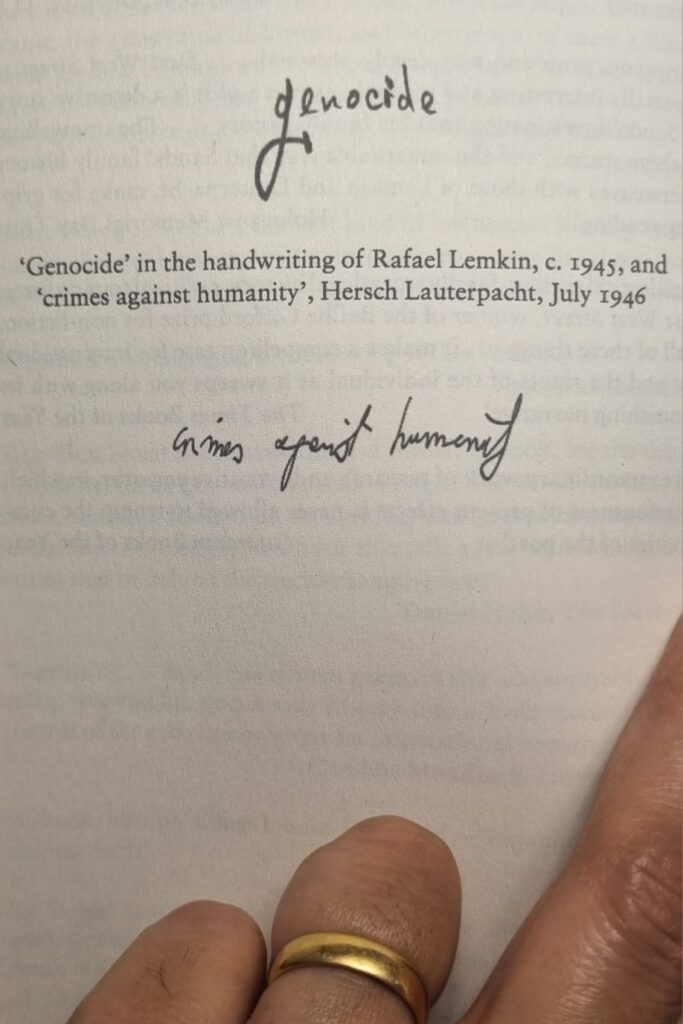
These books designed to be standalone narratives, have inadvertently come to be referred as a “trilogy”. Presumably because the narrative arc governing these three texts is Sands preoccupation with impact of the Nuremberg trials on international justice. More significantly, how did the two definitions coined at this time — “genocide” and “crimes against humanity” — impact contemporary global politics. These are ideas that continue to haunt international law in the twenty-first century. In each book, he explores, questions, and investigates key figures such as Lauterpacht and Lemkin in East West Street, Horst von Wächter in The Ratline and Walther Rauff and Augusto Pinochet in 38 Londres Street. In the texts, Sands uses his legal expertise to present evidence about criminals, jurists, ordinary citizens who are affected by these horrific acts and the idea of justice. The latter is a complicated space to inhabit as Sands narrative determines. For example, justice is meted out to a Nazi criminal like Hans Frank in the Nuremberg trials. Yet, there are those who with impunity escape justice as in the case of Augusto Pinochet and his aide Walther Rauff. Or there are those who inhabit the grey space of not seeing any wrong in acts of genocide particularly in those individuals who perpetrated this. All this despite there being plenty of hard evidence to suggest that these people not only participated but orchestrated the extermination of others. For example, like Otto von Wächter, whose son, Horst von Wächter (Financial Times profile, 2013) who firmly believes that ‘I must find the good in my father. My father was a good man, a liberal who did his best. Others would have been worse’. This is quite unlike Niklas Frank, who when he accompanied Sands to courtroom 600 in Nuremberg, spoke gently and firmly. “This is a happy room, for me, and for the world”. In principle Niklas was against the death penalty but not when it came to his father. And yet, Niklas Frank is the one who introduced Sands to Horst von Wächter. Later, Sands accompanied these two sons of the senior Nazi war criminals as they travelled through Europe to confront the past sins of their fathers. It has been documented in the film called What Our Fathers Did: A Nazi Legacy (2015).
In the summer of 1998, Sands had been peripherally involved in the negotiations that led to the creation of the International Criminal Court (ICC), at a meeting in Rome, and a few months later he worked on the Pinochet case in London. The former president of Chile had claimed immunity from the English courts for charges of genocide and crimes against humanity laid against him by a Spanish prosecutor, and he had lost. In the years that followed, other cases requiring the courts of international justice, like from the former Yugoslavia and Rwanda soon landed on his desk in London. Others followed, relating to allegations in the Congo, Libya, Afghanistan, Chechnya, Iran, Syria and Lebanon, Sierra Leone, Guantánamo, and Iraq. According to Sands, “The long and sad list reflected the failure of good intentions aired in Nuremberg’s courtroom 600.” He continues:
I became involved in several cases of mass killing. Some were argued as crimes against humanity, the killings of individuals on a large scale, and others gave rise to allegations of genocide, the destruction of groups. These two distinct crimes, with their different emphases on the individual and the group, grew side by side, yet over time genocide emerged in the eyes of many as the crime of crimes, a hierarchy that left a suggestion that the killing of large numbers of people as individuals was somehow less terrible. Occasionally, I would pick up hints about the origins and purposes of the two terms and the connection to arguments first made in courtroom 600. Yet I never inquired too deeply as to what had happened at Nuremberg. I knew how these new crimes had come into being, and how they subsequently developed, but little about the personal stories involved, or how they came to be argued in the case against Hans Frank. Nor did I know the personal circumstances in which Hersch Lauterpacht and Rafael Lemkin developed their distinct ideas.
On a map, Lviv is right in the centre of Europe. It stands at the midpoint of imaginary lines, connecting Riga to Athens, Prague to Kiev, Moscow to Venice. It is the epicentre of the fault lines that divided east from west, north from south. In those days, cities such as these, usually had two main streets, one that ran from north to south, the other from east to west. Lembergstrasse or East West Street in Lviv, is where Sands maternal grandfather Leon Buchholz and extended clan hailed from. Later, many of them, including Sands great-grandmother, lost their lives in the Nazi concentration camps. Leon, his wife, and their young daughter, fortunately managed to escape. Leon on a Polish passport and his wife on an Austrian passport.
East West Street: On the Origins of Genocide and the Crimes Against Humanity is an intricately told story. It is packed with information, as Sands digs deeper and deeper into official and personal archives. Surprisingly, he gets ready access and converses regularly even with the descendants of the Nazis. For example, Niklas Frank, whose father, Hans Frank (“The Butcher of Warsaw”) was one of those on trial at Nuremberg and ultimately sentenced to death. To Philippe Sands amazement as he delved deep into research, it became clear that the Nuremberg jurists, his legal hero Hersch Lauterpacht and Raphael Lemkin, whose work was foundational to the discipline of international criminal law, were from the same city as Leon Buchholz. The lawyers coined and defined “genocide” and “crimes against humanity”. This is a thrilling fact for a barrister to discover; to personally be at the intersection of his legal interests and his family history. It allowed Sands to write an incredible memoir. He masterfully interweaves the biographies of Lauterpacht and Lemkin’s with his Jewish lineage. The result is as spy thriller writer, John le Carré called it: “A monumental achievement: profoundly personal, told with love, anger and great precision.”
In fact, there is this brilliant section (Chapter 119) wherein Sands analyses “genocide” and “crimes against humanity” — the fundamental principles of human rights in international law.
Lauterpacht’s draft made no reference to genocide, or to the Nazis, or Germans as a group, or crimes against Jews or Poles, or indeed crimes against any other groups. Lauterpacht set his back against group identity in the law, whether as victim or perpetrator. Why this approach? He never fully explained it, but it struck me as being connected to what he experienced in Lemberg, on the barricades, observing for himself how one group turned against another. Later he saw firsthand how the law’s desire to protect some groups—as reflected in the Polish Minorities Treaty—could create a sharp backlash. Poorly crafted laws could have unintended consequences, provoking the very wrongs they sought to prevent. I was instinctively sympathetic to Lauterpacht’s view, which was motivated by a desire to reinforce the protection of each individual, irrespective of which group he or she happened to belong to, to limit the potent force of tribalism, not reinforce it. By focusing on the individual, not the group, Lauterpacht wanted to diminish the force of intergroup conflict. It was a rational, enlightened view, and also an idealistic one.
The counterargument was put most strongly by Lemkin. Not opposed to individual rights, he nevertheless believed that an excessive focus on individuals was naive, that it ignored the reality of conflict and violence: individuals were targeted because they were members of a particular group, not because of their individual qualities. For Lemkin, the law must reflect true motive and real intent, the forces that explained why certain individuals —from certain targeted groups—were killed. For Lemkin, the focus on groups was the practical approach.
Despite their common origins, and the shared desire for an effective approach, Lauterpacht and Lemkin were sharply divided as to the solutions they proposed to a big question: How could the law help to prevent mass killing? Protect the individual, says Lauterpacht. Protect the group, says Lemkin.
Unsurprisingly as happens in many family histories, there are many twists and turns. Horst von Wächter’s only child, Magdalena, brought up as a firm Catholic, for many years believed her father’s account of her grandfather and sympathised. But recently married, she was trying to understand the family’s past. Then she heard Philippe Sands podcast series The Ratline(BBC, 2018) and wrote to him saying that she concluded that her grandparents “were very aware of what they did and somehow never regretted it”. It is a burdensome family heritage that she was trying to recover from. She complimented Sands on his podcast series and believed that he had portrayed her father Horst “fairly”. Walter Rauff’s grandson had a similar reaction upon reading 38 Londres Street and wrote to Sands appreciating his profile of his grandfather. There seem to have been no familial repercussions there but a rift has been created between Magdalena and Horst. After coming to terms with her family’s Nazi past, she wrote on her social media page, “My grandfather was a mass murderer”. Her father ordered her to remove it but she refused.
The three books are very similar in structure that they posit two individuals in a setting with Sands being very much in the centre of the action. It is almost as if the lines are blurred between the authorial narrator and the litigator. In every text, Sands presents evidence to the reader as he would be expected to present it in the court before the judges and jurors. This could be in the form of texts, personal correspondence, photographs, archival material, documents, or oral testimonies of the survivors and their descendants. Astonishingly, even though he establishes fairly early on in the trilogy that silence is an act of self-preservation amongst the victims/relatives of genocide such as in the case of his own grandfather; even so, he manages to exhibit immense patience and maintain a dialogue with the individuals he interviews. His professionalism can be gauged in the manner in which he continues his conversations even if he does not agree with the interlocutor as becomes obvious in his discussions with Horst von Wächter. He presents his arguments in his narration but leaves it sufficiently open for the reader to come to their own conclusions. It is in all likelihood a challenging balancing act to perform with the written word, but Sands brings his decades of expertise as a barrister to the words on the page. He does tend to explore background details in excruciating minutiae and insists on placing them within the main narrative, but once the reader familiarises themselves with his writing style, it becomes easier and easier to read. It is almost like reading a thriller. It is impossible to put the books down despite the terrifying details that emerge. It is the truth.
The trilogy tackles subjects that are full of alarmingly violent details that were perpetrated by individuals who firmly believed in their acts. For instance, Rudolf Höss, the commandant of Auschwitz, privately told the US army psychologist Dr. Gilbert at the Nuremberg trials that the dominant attitude at Auschwitz was of total indifference. Any other sentiment “never even occurred to us”. This attitude is apparent in all the Nazis profiled in these books. It is immaterial that Sands is discussing facts from the past as disconcertingly these continue to have ramifications upon the present, in the twenty-first century. Most obviously being that of international law debating on “genocide” and “crimes against humanity”. So, despite 38 Londres Street concluding with an ambiguity that is frustrating, at least in the previous two books — East West Street and The Ratline — the younger generation, Niklas Frank and Magdalena provide hope by acknowledging and rejecting the criminal acts perpetrated by their forbears.
It is magnificent research and methodology that are on display. These compactly told narratives will appeal to younger generations of readers as they wish to know more about these despicable moments in history. More so, for the grey areas that exist in bringing the criminals to justice or for that matter how are these stories inherited, preserved — in memory, family histories, and archives.
Given the short lifespan of books, these bestselling oral histories by Philippe Sands will stand the test of time and sell. They are a must read.
From factories to farms, battlefields to boardrooms, clinics to classrooms―in the years since Independence, modern technology has swept through all corners of Indian life.
But back in 1947, this seemed impossible. Low literacy, poverty and lack of expertise meant that newly independent India was unable to afford the mighty technologies of World War II that were reshaping the globe. Yet, a determined team of far-sighted policymakers and scientists dared to make the impossible possible.
Today, India is home to leading software companies and a world-renowned space programme. For many Indians, modern technology has become part of daily life.
Uncoded: A Technological History of Independent India is a story of one of the greatest technological transformations in the modern world. Blending a unique narrative with illustrations, trivia, anecdotes and an informative timeline, it explores how a nation used science and technology to rebuild itself and reimagine its destiny against all odds.
Meghaa Gupta’s exploits in history are the outcome of an irrepressible urge to contextualize the challenges of the present with the past and make greater sense of the times we live in. She works in children’s publishing and firmly believes that all change begins with getting children to read books that demystify the world and its infinite possibilities. Meghaa has contributed to the history book On this Day (Dorling Kindersley, 2021) and is the author of the widely-acclaimed Unearthed: An Environmental History of Independent India (Puffin, 2020). She curates the children’s and youth section of the Green Lit Fest and the online magazine Sustainability Next.
At 8:15 a.m. on August 6th, 1945, the Japanese port city of Hiroshima was struck by the world’s first atomic bomb. Built in the US by the top-secret Manhattan Project and delivered by a B-29 Superfortress, a revolutionary long-range bomber, the weapon destroyed large swaths of the city, instantly killing tens of thousands. The world would never be the same again.
The Hiroshima Men’s unique narrative recounts the decade-long journey towards this first atomic attack. It charts the race for nuclear technology before, and during the Second World War, as the allies fought the axis powers in Europe, North Africa, China, and across the vastness of the Pacific, and is seen through the experiences of several key characters: General Leslie Groves, leader of the Manhattan Project alongside Robert Oppenheimer; pioneering Army Air Force bomber pilot Colonel Paul Tibbets II; the mayor of Hiroshima, Senkichi Awaya, who would die alongside over eighty-thousand of his fellow citizens; and Pulitzer Prize-winning novelist John Hersey, who travelled to post-war Japan to expose the devastation the bomb had inflicted upon the city, and in a historic New Yorker article, described in unflinching detail the dangers posed by its deadly after-effect, radiation poisoning.
This thrilling account takes the reader from the corridors of the White House to the laboratories and test sites of New Mexico; from the air war above Nazi Germany and the savage reconquest of the Pacific to the deadly firebombing air raids across the Japanese Home Islands. The Hiroshima Men also includes Japanese perspectives – a vital aspect often missing from Western narratives – to complete MacGregor’s nuanced, deeply human account of the bombing’s meaning and aftermath.
Fergal Keane, award-winning BBC foreign correspondent and author of Road of Bones: The Siege of Kohima 1944 writes, “I can think of no more important book for our time. Written with moral clarity, tremendous verve, and the ability of a truly great historian to render the immensity of a moment through the smaller voices as well as being faithful to the facts. I recommend this magisterial, haunting book to all generations.”
Giles Milton, author of The Stalin Affair adds further praise for the book saying, “The nuclear destruction of Hiroshima and Nagasaki was one of the most iconic moments of the twentieth century. Yet little has been written about the individuals whose actions led to Japan’s unconditional surrender. Iain MacGregor’s The Hiroshima Men is epic in scale yet intimate in detail, its pages filled with mavericks and geniuses who forever changed our world. A meticulously researched and compellingly written tour-de-force.”
Iain MacGregor has been an editor and publisher of nonfiction for thirty years working with esteemed historians such as Simon Schama, Michael Wood and James Barr. He is himself the author of the acclaimed oral history of Cold War Berlin: Checkpoint Charlie and his writing has appeared in the Guardian, the Express, as well as the Spectator and BBC History magazines. As a history student he has visited East Germany, the Baltic and the Soviet Union in the early 1980s and has been captivated by modern history ever since. He has published books on every aspect of the Second World War. Iain is a Fellow of the Royal Historical Society and lives with his wife and two children in London.
In this diagnosis of contemporary Indian society, with a tinge of dark humour, acclaimed writer Manu Joseph explores why the poor don’t rise in revolt against the rich despite living in one of the most unequal regions of the world.
The poor know how much we spend in a single day, on a single meal, the price of Atlantic salmon and avocados. ‘Why,’ he asks, ‘do they tolerate it? Why don’t they crawl out from their catastrophes and finish us off? Why don’t little men emerge from manholes and attack the cars? Why don’t the maids, who squat like frogs beside kitchen sinks, pull out the hair of their conscientious madams who never give them a day off? Why is there peace?’
Why the Poor Don’t Kill Us shows in pitiless detail just how hypocritical and exploitative people of privilege are, and it also shows how and why they get away with it. It’s a sharp, at times searingly witty, but a very perceptive critique of the many faults of the India we live in.
Why The Poor Don’t Kill Us has also evolved into a stand-up act by Manu Joseph. He prefers to call it ‘stand-up anthropology’.
Manu Joseph is the author of the novels Serious Men, The Illicit Happiness of Other People, and Miss Laila, Armed and Dangerous. He is the winner of the Hindu Literary Prize and the PEN Open Book Award, whose jury described him as ‘…that rare bird who can wildly entertain the reader as forcefully as he moves them’. He has been nominated for several other prizes. He is also the creator of the Netflix series, Decoupled.
He was the editor of Open Magazine and a columnist for the New York Times. This is his first work of non-fiction.
I interviewed Snigdha Poonam on her second book, Scamlands (published by Penguin Random House India), for Moneycontrol. It was published on 19 November 2025.
Snigdha Poonam is the author of Dreamers: How Young Indians Are Changing the World. It won 2018’s Crossword Award for nonfiction in India and was longlisted in 2019 for the PEN America Literary Awards. For fifteen years, her work has shown how major global phenomena shape human lives, often by focusing on a single person, group or event to reveal how transformative forces act on society.
Her work has been published in Granta, Financial Times Weekend, Guardian Longreads, New York Times Arts, The Economist’s 1843 magazine and Bloomberg’s Businessweek. In 2023, she received a MacDowell fellowship for creative nonfiction to finish Scamlands. She lives in Oxfordshire.
Her latest book is Scamlands: Inside the Asian empire of fraud that preys on the world. It is published by Penguin Random House India.
Snigdha Poonam’s Scamlands is a gripping account of scams from the rural heartland of Bihar, where she grew up and ending in a shining city by the South China Sea. Her reportage is fascinating as she follows the networks of deceit, creating a shadow economy, that thrives on inequality, technological change and the erosion of trust.
The following interview was conducted via email.
Why did you choose to write about scamsters? What triggered this intense interest that engaged you for more than five years in this project?
I actually began this journey with my previous book, Dreamers: How Young Indians Are Changing the World, so to be precise, I’ve spent closer to a decade immersed in the underworld of scams and fraud.
That earlier book, Dreamers, followed young men and women in small towns and villages in some parts of India. It traced their quest to become rich, famous, powerful, whatever it was they aspired to. It was meant to be a portrait of a generation that felt very different from mine, even though I was only a few years older. They were mostly in their twenties, but their worldview, their sense of possibility, seemed dramatically different.
As a journalist, I travelled constantly and met young people everywhere. I was curious about how they thought about their lives, their country, and their future. And again and again, our conversations returned to their dreams. Even in the poorest villages, young people from the most disadvantaged backgrounds would tell me they wanted to be the richest person in the world, or the local Member of Parliament, or a Bollywood star. I followed some of these journeys for years.
But over time, it became clear that despite their ambition and enterprise, the barriers they faced—barriers that had existed for generations—were not going to dissolve just because they wished them away. A few who already had some advantages (family connections, caste privilege, certain forms of cultural capital) managed to advance. But they were the exception. I began to see them drift, and in some cases, make moral compromises (as they entered politics, or other fields) because the straightforward route simply wasn’t taking them where they wanted to go.
By the end of that reporting, I noticed something more disturbing: those who were desperate to find a job were being pulled into scam centres that were springing up across the big cities. I saw an entire shadow infrastructure rising in places like Delhi, Gurgaon, parts of Mumbai and Bengaluru. Thousands of young people worked in scam call centres targeting victims mostly in the West.
Even after Dreamers was published, I couldn’t detach myself from this underworld I had stumbled into. Around the same time, India’s digital infrastructure was expanding rapidly — a massive push to digitise everything: bank accounts, payment systems, wallets. And with every new digital touchpoint came a new opportunity to scam someone.
The scam economy proliferated extraordinarily fast. And since I was already deeply inside it, it felt natural, almost necessary, to keep going, to explore how vast it was, how deep it ran, and how many people it was drawing in. That’s really where this project began.
What are the broad categories of scamming that exist? You mention many exploit the loneliness of the victim by offering love and partnership especially the Chinese scamsters netting gullible victims in the USA. Are there specific schemes to geographical territories?
Snigdha: Anything you need, anything you desire, or anything you fear can be turned into a weapon against you. Depending on the territory they are operating in, or the market they are targeting, they adjust their scams to match how desire or fear works in that particular society.
For example, love, sex, romance. These are universal desires, so those scams work everywhere. They work in India. They work in the United States, in China, in Poland.
In India, job scams are among the most common and people fall for them very easily. We have millions of people who would do anything to land a job. Many job scams begin with data leaks. Someone at an employment portal leaks the CVs, including contact details. Or, in a similar scenario, someone at a bank leaks data of people who might need a loan or have applied for one in the past. That information becomes the basis of loan scams.
Then there is greed. That is how the book begins, with lottery scams. A scammer called me and told me I had won a lottery of twenty-five lakh rupees. If someone calls and says you have been chosen to receive twenty-five lakh rupees under some invented scheme, many people want that money. And if they are told that they need to deposit twenty-five thousand rupees into a bank account to process paperwork or pay a supposed tax, many people pay it. The scammer can keep adding more fees and taxes. Sometimes they gain access to your bank account and take everything.
There is also fear. This is what we see with the digital arrests in India, which are now among the most prolific and frightening scams. They work on a simple idea. If an ordinary person in India gets a call from someone pretending to be the police, or the judiciary, or the government, they become very scared. This is especially true for people from minority communities. If they are told that their address or bank account or Aadhaar number is somehow linked to criminal activity, they can be overwhelmed by fear. If the scammer tells them they cannot call anyone because the government is watching, and that they must stay on the line and transfer all the money in their account to another account that is supposedly being held by the authorities during an investigation, many victims do exactly that.
Scamming is a large-scale industrial complex business. It cuts across international boundaries. The evidence points to horrific torture chambers of the individuals who are made to scam overseas victims. Many of these individuals are poor migrants from other countries, in search of better economic prospects. Your narrative seems to suggest that these are mostly to be found in China and Southeast Asia, but don’t we have these in India as well? How does this form of labour hiring and exploitation work?
Snigdha: That’s right. The Chinese-origin cyber-crime cartels have built a vast infrastructure across Southeast Asia, and they traffic young people from lower-income countries—often from English-speaking regions—with the goal of targeting victims anywhere in the wealthier parts of the world. That includes places like Singapore, which has a large population of affluent individuals, as well as the United States and other Western countries.
There are similarities in how job seekers end up in these scam operations, whether they’re domestic or transnational. At the core of the system is usually a simple hook: the promise of a job that doesn’t exist. It almost always begins with a fake job offer.
These offers can show up in multiple ways. A person might see an ad on a Facebook page, or be contacted directly on social media, or through a private channel like Telegram. Sometimes the approach comes through someone they know—a recruiter in their community, a friend of a friend, or a local middleman who appears trustworthy.
What makes the transnational side so much more frightening is how organized and anonymous the recruitment networks are. The system operates through multiple layers of human traffickers. At the top level are recruiters based inside the scam compounds in Southeast Asia, who almost never reveal their identities. They outreach to a second layer of traffickers—people who operate through WhatsApp, Telegram, or Facebook and who specialize in trapping jobseekers. That layer, in turn, connects with individuals on the ground in countries like India—people who might know the job seekers personally or who have access to local networks.
One victim of scam slavery told me that he had received a job offer from a recruiter in his village. Following that lead, he ended up moving through a long trafficking chain that eventually delivered him to Sihanoukville in Cambodia—where he was held hostage. Once he arrived, his passport was confiscated, and if he failed to carry out the scam work required of him, anything could happen: denial of food, solitary confinement, beatings, even death.
Scamlands shows that scamsters in India work mostly individually but at times the local community/neighbourhood is “civil” enough to not encroach upon each other’s territories. How is this enforced? Isn’t there a mastermind to these operations? Have I understood this correctly?
Snigdha: The hinterland scams often involve entire communities. What I found particularly striking in Barpeta in Assam was how many different people, within the same village, were connected to the scam economy in some way. There isn’t always a single mastermind, but everyone knows their role. They may not be full-time scammers, yet they still play a critical part in keeping the ecosystem running.
For example, there’s a doctor at the local Public Health Centre who has a legitimate job, but he also makes a side income by signing fake death certificates—fake in the sense that they show someone dying on a date, months or even a year after the person actually passed away. In that particular story, the entire scam economy revolved around fake deaths. The scam typically starts when someone dies. Then an insurance scammer steps in, impersonating a family member—or bribing the real family member—so that a life insurance policy can be taken out in the deceased person’s name. Months later, they present the fabricated death certificate to claim the payout.
They also need someone who can produce forged birth certificates for people who never existed. Just like in Jharkhand, the Panchayat system is often involved; the village chief is someone who signs off on official documents. They need the local customer-service centres, because that’s where the bank accounts are opened to receive the insurance payout. These individuals may not be full-time scamsters either—they also deal with legitimate customers, but their services are embedded in the scam economy.
Even e-commerce delivery workers end up playing a role. Once scammers gain access to a victim’s bank account (often through OTP fraud) they don’t want the stolen money going into their own accounts, which would leave a trail. So, they use the funds to buy expensive items online and have them shipped to fabricated addresses in their village. The house number doesn’t exist, but the delivery worker knows exactly where to bring the package, because he gets a cut. Again, it’s not his primary job, but he benefits from the system.
And you’re right: in areas where multiple scams run side by side—an e-commerce scam, a phone-wallet scam, a credit card scam—territory matters. One community might “own” a certain scam, and others don’t encroach on it. There is an internal logic and a kind of informal order that everyone understands.
Is there a code of honour amongst scamsters? What is their rule book?
Snigdha: There is no single rule book, but some patterns are common.
One is the importance of distance. Many scammers think about the distance between themselves and their victims. Someone in a rural area, for instance, often does not want to steal from another person in a nearby village. Even if they are calling numbers at random and do not know who will pick up, they hope to reach someone in a city. As I argue in the book, scamming is not only a way to earn easy money. The instinct can also be to take revenge on what feels like an unfair or uncaring world or system. So, a scammer in a village may feel less guilty if the victim is a prosperous individual in a big city. Similarly, a scammer sitting in a call centre in Delhi or Chandigarh feels less guilty if the target is in the United States or the United Kingdom. It is not only the physical distance. They are also aware of the huge inequality between their own lives and the lives of those they are scamming. That helps lighten some of the moral burden.
Another pattern is how the ability to scam someone can earn respect within a community. If a scammer manages to cheat someone who is not only wealthy but influential, they gain status. There are real cases where people have scammed the wife of a police commissioner, the brother of a former chief minister, even a former chief minister or a member of parliament. When that happens, the scammer becomes a sort of local hero within their network.
You document a class and caste shake up in the making, due to the new socio-economic mobility offered by mobile phone technology. Case in point being these scamsters, many of whom come from impoverished and/or disadvantaged backgrounds. Also, many of the stories are from the rural hinterlands of India. Do you think that the monies accrued in this manner will be sufficient for them to get rid of their caste discrimination, especially in the context of the Dalits whom you put in the spotlight? What did you glean?
Snigdha: The caste system intersects with these scams in some obvious ways and in some very surprising ones. But no, I don’t think the money earned through scams can be a sustainable way for communities to uplift themselves in any lasting sense.
For some individuals, or even for tightly knit networks, it can look possible for a while. Many of them do earn a lot of money in a short span of time. Some scams run for years, constantly evolving. With phone-based scams or text-based scams, the context keeps changing, so the scammers keep updating their skills, their knowledge, their scripts.
Some individuals did earn a great deal. But it never seemed like a way to end entrenched inequalities. At most, it can look like the playing field is being levelled for a brief moment. Very quickly, though, you see how class and caste tensions reassert themselves. Jealousies start to surface. Sometimes it is a neighbour. Sometimes it is someone from an upper caste community. Sometimes it is a collaborator who feels cheated. Many people are waiting for a chance to bring you down, especially those along the caste and class spectrum who cannot accept the idea of someone they once employed as a farm labourer now building a large house in the same village. These are the same people who might once have paid them not in cash but in leftover food or a bundle of straw for a leaking roof. And now they are reporting them to the police.
Even when scammers keep updating their methods, it gets harder over time. Some scams become so common that people begin to recognise the signs. There are YouTube videos demonstrating the scripts. Banks run awareness campaigns. People get arrested.
And whatever money they make, they also spend. They build large houses. They make luxurious purchases. The money does not usually last.
Of course, there are exceptions. I did come across villages where scam money funded a school or helped build a pond for fisheries. But these were occasional stories, not the norm. More often, you would walk into a village and see mud homes and dirt roads, and then suddenly five or six lavish houses with bright colours, tall gates, and huge balconies. And everyone knew exactly who lived in them. When police arrived for raids, they went straight to those houses. They would seize music systems, fixed deposits, even remote-controlled curtains.
So yes, there is upward mobility at the individual level. But I don’t think it is enough, or stable enough, to break the deeper structures of caste. Some scamsters invest in their children’s education, and perhaps that will create openings in the future. But for now, I think we have to wait and see.
Chasing the truth is a dangerous proposition. How do you verify the details mentioned to you? What was your methodology? While investigating these stories, did you own a different mobile phone to your personal device?
Snigdha: Parts of the book might make it seem as though I was chasing the truth, but in reality, I was simply following a story, and I went wherever it took me.
It was dangerous in parts, but I generally managed to stay out of harm’s way. Scamsters are criminals, of course, because what they do is criminal, but not all of them are frightening. Some were perfectly willing to sit down and talk to me, though not in public and not in their homes. One individual, for instance, would only meet me in my car at a distance from his village, where no one could see us, and I did not feel threatened by him at all.
I usually had someone from the area with me. That made a big difference. But yes, in other situations I did have to take many more precautions.
For instance, when I was reporting in Southeast Asia, I was faced with scam lords who acted like dangerous gangsters. Violence was routine. They shot at people. They threw the bodies out on the streets. People had been murdered for crossing them, exposing them, or trying to escape from the scam compounds. They had armed criminals working for them, and the threat was very real. In those situations, I took every precaution I could. I left my number and location with someone I trusted. I informed local activists about where I was going and followed their advice on how to stay out of their way.
And yes, I did use two phones. At first it was simply practical: one phone for speaking with scamsters, especially in situations where I was trying to understand their work by pretending to be a scammer. They would give me tasks to do on that phone. I never scammed anyone, of course, but they needed to believe I had a separate device that wasn’t my personal one.
Later, when reporting in Southeast Asia, having two phones became a safety measure. One activist insisted that if I were kidnapped, my main phone would be taken from me. So, I kept a second phone hidden in my clothes. That was the phone I would use to call for help to be rescued, or to reach the Indian embassy, or anyone else who could get me out.
What is the total estimated value of the money swindled by scamsters, across sectors? Is there any way of measuring it? What is the rate of growth of this shadow economy? In India, bank transactions are mostly done digitally. These scamster rely on this modus operandi too. So, what percentage, if any at all, of the recipient’s account can be traced by the authorities while tracking the stolen money? The impression that I got from your book was that many managed to get away scot-free with the money. Is there any government regulation in the offing for scamsters?
Snigdha: By definition, it is a shadow economy. Because of this, I don’t think there is any reliable way to measure the total value of the money swindled by scamsters, certainly not across all the scams in circulation at any given time. That was never my aim either. I entered the story as a writer trying to explore what happens to society when scamming becomes a way of life, when trust breaks down.
But while following the trail, I kept coming across official data about how much money people were losing. These estimates were based only on reported cases; people who actually go to the police. As you can imagine, that is a very small percentage. Many victims feel ashamed. Many do not want to get into the legal process or file an FIR. They simply stay quiet.
Even so, shocking numbers would surface. With digital scams, for example, the Home Ministry had a figure of around 2.7 billion dollars, or roughly 22,845 crore rupees, lost in the past year alone in India. They also reported a 400 to 500 percent jump from the previous year.
But I am still cautious about putting any definitive numbers on record, and that is because a major theme in the book is that these scams are no longer contained within the borders of any one country.
Some scams do operate within a specific region in India, and you can get a sense of the money involved there. But that does not apply to the full picture the book lays out. Technology, the internet, and a vast labour force willing to work for anyone anywhere mean that you cannot always know who the victims are, who the scammers are working for, or where the money is going.
In one of the book’s stories, the scammers are based in India but are working for entities they themselves cannot identify or locate. Those entities turn out to be in a completely different part of the world. The victims are in yet another region. As I went deeper into the story, I saw this more and more: the entire system becoming more global and more underground.
And this brings me to another part of your question. It is very hard to trace the stolen money. The ecosystem of digital transactions makes it extremely easy to move and hide funds once they have been taken. Cryptocurrency has become a common and convenient way to push money out of the reach of authorities.
Most countries do have regulations, but there are also enormous levels of political corruption. These scam networks are often closely connected to systems of political patronage or other forms of localised corruption. All of this makes it very difficult for the scams to be uprooted completely.
In the many years of investigation, did you ever figure out why would the scamsters put so much effort into these elaborate schemes despite living with fear on a daily basis?
Snigdha: I think I did, at least to the extent that I could through spending time in their world and talking to them. It is all there in the stories. And sometimes the scammers themselves articulate it much better than I ever could, but I can try to give you the gist.
In many of the scenarios I encountered, the starting point was that they had nothing to lose. They were starting from a place of having no opportunities at all. Someone pulls them into a network, gives them a small part in a scam, or they see someone else doing it and get the idea that they could try something similar.
At the beginning, it is mostly a means to earn money, to support their families, to meet basic needs. But very early in the process, it mutates into something else. They see how much money can be earned through these schemes if they become more ambitious or form a larger network. Unlike a traditional career path, where you wait years for a promotion, in this world two months can completely change your life. You go from having nothing to building an enviable bank balance. So even though fear becomes a daily companion, they continue. They know that if they can simply live with that fear, they can make a huge amount of money.
And it is not only about money. In rural settings, money is also power. It is influence. It changes your position in the marriage market. If you are an established scammer in a cluster of villages, people want to marry their daughters to you. Politicians come to you for funding before an election. The police will release you for a bribe even if you are arrested. Someone will put up bail. I saw cases where even the village head, the panchayat chief, would arrange bail because the scammer’s family would pay him lakhs of rupees to do it.
There is a whole system that makes it harder and harder to walk away from this way of life. And the hardest part is that none of the scammers I met ever lost awareness of what lay on the other side — if they stopped. Nothing waiting for them. The money comes and goes. A big house is built, but that is not the end of it. They have children in English-medium schools. Their wives start cooperatives in the village that need funding. They open small shops that also require support. They cannot simply step away. Walking away would mean falling back into that same emptiness.
So, despite the constant fear, they keep going. It becomes a vicious cycle.
Will the AI tools increase the scourge of scamsters and their elaborate schemes?
Snigdha: Artificial intelligence is already a force multiplier for a new wave of transnational fraud: It can generate scripts, fabricate composite identities across text, voice and video, and enable hyper-personalized manipulations that make scams more convincing and more profitable.
Economica: A global history of women, wealth and power by Dr. Victoria Bateman charts the course of women’s contribution to their national economy and acknowledges work done as being within and without the house too. Quite contrary to what Adam Smith believed that only paid work outside the home was construed as a contribution to the economy. Whereas Dr Bateman shows through empirical evidence marshalled from as far as the Stone Age to the present, the AI age, that women’s contribution, paid or unpaid was an essential part of the economy. Her book is packed with facts, anecdotes, histories, archaeological evidence, data sets etc. For instance, marriage contracts signed between the 11C and 15C included a clause wherein the woman could state she had the right to work after marriage. There are so many bits and pieces of information to share but the most enlightening was her use of the word “overlooked”. To use it constantly in the context of new evidence that confirmed the value of a woman’s work in the past is very empowering use of a simple word. It gives the reader the opportunity to reflect upon situations that they themselves may have been, where their evidence and work is overlooked whereas they are on the right path. It is new evidence so others cannot see it, recognise it, value it, or understand it. Developing faith in oneself and growing from there is what this book helps to achieve. It is not just a revisiting of inherited economic history narratives.
Humanity’s journey from poverty to prosperity is filled with men who have become household names. But how many female entrepreneurs, merchants and industrialists can you name?
Economica places women at the centre of the story of economic growth. Starting in the Stone Age and continuing to the present day, it takes the reader through the key economic milestones of the past twelve millennia — from the birth of farming to the advent of computing — all told through the experiences of women as well as men.
Historian Victoria Bateman weaves a thrilling, globe-spanning narrative that proves women weren’t ‘missing’ from economic life, they were merely hidden from view. We discover the female workers who helped to build the Great Pyramid of Giza, and to plumb the city of ancient Rome; the silk weavers who made a vital contribution to the development of the Silk Road and global trade; the women who dominated London’s brewing trade during medieval times; and the brave twentieth-century pioneers who fought to make our economies not just richer but fairer.
Dr Bateman is an economic historian, author and historical consultant. Her latest book, Economica: A Global History of Women, Wealth and Power, is the first major economic history of the world to be told from the perspective of female wealth creators.
Victoria has twenty years of experience teaching macroeconomics and economic history at the Universities of Oxford and Cambridge, including as Director of Studies in Economics at Gonville and Caius College. She is a Fellow of the Royal Historical Society and is currently a visiting academic at Gresham College, London. Victoria has spoken extensively on radio and television, providing historical context for current events, including as resident economic historian for BBC Radio 4’s “Understand: the economy”. In addition to her writing and speaking, Victoria also works as a historical consultant for period dramas on TV and screen. Victoria is passionate about communicating economic history and believes in using our knowledge of the past to inform the present and to build a better future.
Victoria has been profiled by The Times, has written for the Guardian, The Telegraph and Bloomberg, and has appeared on numerous occasions on the BBC and ITV. Her previous books include the acclaimed Naked Feminism: Breaking the Cult of Female Modesty (2023) and The Sex Factor: How Women Made the West Rich (2019). In her spare time, you can find Victoria enjoying tea and cake after a walk in the countryside.
A groundbreaking book about how to harness the power of collaboration and work most effectively in groups – coauthored by Getting Things Done‘s David Allen. It is published by Hachette India.
When Getting Things Done was published in 2001, it was a game-changer. By revealing the principles of healthy high performance at an individual level, it transformed the experience of work and leisure for millions. Twenty years later, it has become clear that the best way to build on that success is at the team level, and one of the most frequently asked questions by dedicated GTD users is how to get an entire team onboard.
By building on the effectiveness of what GTD does for individuals, Team will offer a better way of working in an organisation, while simultaneously nourishing a culture that allows individuals’ skills to flourish. Using case studies from some of the world’s most successful companies, Team shows how the principles of team productivity improve communication, enable effective execution and reduce stress on team members. These principles are increasingly important in the post-pandemic workplace, where the very nature of how people work together has changed so dramatically.
Team is the most significant addition to the GTD canon since the original, and in offering a roadmap for building a culture of sustainable high performance, will be welcomed by readers working in any sized group or organisation.
In Getting Things Done, David Allen revolutionised individual productivity – and now, he and Edward Lamont show us how to transform teams and organisations. This is a masterful guide for any team striving to navigate the complexities of collaboration in today’s fast-paced world — Dorie Clark, bestselling author of The Long Game and executive education faculty, Columbia Business School
Ed Lamont and David Allen have captured the best practices for working with people to produce the best possible results. Team is a no-nonsense manual for doing just that, no matter what your goal is or who you’re working with to achieve it. If you’re invested in making good things happen, and need others to assist, this is a must-read — Arianna Huffington, Founder & CEO, Thrive Global
The world needs this book . . .This is not a book to read once, and extract a few ideas. Team is a guidebook, outlining the step-by-step process to team effectiveness. My advice is that you keep this book on your desk. Use it and re-use it, until Team structures your day-to-day activity as a team . . .and get amazing things done, together — Tony Crabbe, business psychologist, author of Busy
If you regularly get things done with others, here’s your new productivity bible. In Team, David and Edward masterfully break down how the principles of GTD work for all team settings – whether you have a corporate, sports or family team. At its best, working in a team feels effortless. This book helps get you to this magical place, so you can accomplish more with others while actually enjoying the process — Chris Bailey, international bestselling author of Hyperfocus, The Productivity Project, and How to Calm Your Mind
David Allen is an international best-selling author who is widely recognized as the world’s leading expert on personal and organizational productivity. Time Magazine called his flagship book, Getting Things Done “the definitive business self-help book of the decade”.
Edward Lamont is co-founder and Senior Partner of Next Action Associates, the GTD partner for the UK and Ireland. He has over 25 years of experience in executive coaching, training and consulting in the areas of leadership, productivity, and motivation. Since 2009, he has founded and grown the most successful GTD franchises worldwide by using the principles in this book. Before moving into consulting, he worked covering commodities markets, and was a freelancer for the Financial Times.