Jaya Posts

TOI Bookmark podcast with Andaleeb Wajid

Andaleeb Wajid is a hybrid author, having published nearly 50 novels in the past 15 years. Andaleeb enjoys writing in a number of different genres such as young adult, romance, and horror. Andaleeb’s YA novel “Asmara’s Summer” was adapted for screen to become “Dil, Dosti, Dilemma” on Amazon Prime and other works are in the process of being optioned or adapted. Her YA novel, “The Henna Start-up” is the winner of the Neev Literature Festival Award 2024, Crossword Book Award 2024, and TOI Auther Award 2025, along with receiving honourable mention at the BK Awards, 2024.

She recently published her moving memoir “Learning to Make Tea for One: Reflections on Love, Loss and Healing”, published by Speaking Tiger Books.

I have known Andaleeb for years. It is absolutely marvellous to witness her growth as an author year on year. Hence, recording an episode of TOI Bookmark was extra special.

Here is a snippet from the conversation:

I really enjoy writing fiction. So, nonfiction as a rule I don’t like to approach. But this was different because I have also put so much of myself into the book. Which was why it was so difficult to write. When I write fiction I do tend to put parts of myself into the book but those are very miniscule parts. And this book took huge chunks of me. And I think it was supposed to be healing but at that time it did not feel that way. Now maybe in a couple of months I will be able to look at it.

TOI Bookmark is a weekly podcast on literature and publishing. TOI is an acronym for the Times of India (TOI) which is the world’s largest newspaper and India’s No. 1 digital news platform with over 3 billion page views per month. The TOI website is one of the most visited news sites in the world with 200 million unique monthly visitors and about 1.6 billion monthly page views. TOI is the world’s largest English newspaper with a daily circulation of more than 4 million copies, across many editions, and is read daily by approximately 13.5 million readers. The podcasts are promoted across all TOI platforms. I have recorded more than 138+ sessions with Jnanpith, Padma Bhushan, and Padma Shree awardees, International Booker Prize winners, Booker Prize winners, Women’s Prize for Fiction, Nobel Laureates, Pulitzer Prize, Stella Prize, AutHer Awards, Erasmus Prize, BAFTA etc. Sometimes the podcast interviews are carried across all editions of the print paper with a QR code embedded in it.

Some of the authors who have been interviewed are: Banu Mushtaq, Deepa Bhashti, Samantha Harvey, Jenny Erpenbeck, Michael Hoffman, Paul Murray, V. V. Ganeshananthan, Hisham Matar, Anita Desai, Amitava Kumar, Hari Kunzro, Venki Ramakishnan, Siddhartha Deb, Elaine Feeney, Manjula Padmanabhan, NYRB Classics editor and founder Edwin Frank, Jonathan Escoffery, Joya Chatterji, Arati Kumar-Rao, Paul Lynch, Dr Kathryn Mannix, Cat Bohannon, Sebastian Barry, Shabnam Minwalla, Paul Harding, Ayobami Adebayo, Pradeep Sebastian, G N Devy, Angela Saini, Manav Kaul, Amitav Ghosh, Damodar Mauzo, Boria Majumdar, Geetanjali Mishra, Viet Thanh Nguyen, William Dalrymple, Abdulrazak Gurnah, and Annie Ernaux.

2 July 2025

“Travellers in the Golden Realm: How Mughal India Connected England to the World” by Lubaba Al-Azami

‘A compelling, highly readable account of the earliest phase of English presence in India’ NANDINI DAS, author of Courting India

When the first English travellers in India encountered an unimaginable superpower, their meetings would change the world.

Before the East India Company and before the British Empire, England was a pariah state. Seeking better fortunes, 16th and 17th century merchants, pilgrims and outcasts ventured to the kingdom of the mighty Mughals, attempting to sell coarse woollen broadcloth along the silk roads; playing courtiers in the Mughal palaces in pursuit of love; or simply touring the sub-continent in search of an elephant to ride.

Into this golden realm went Father Thomas Stephens, a Catholic fleeing his home; the merchant Ralph Fitch looking for jewels in the markets of Delhi; and John Mildenhall, an adventurer revelling in the highwire politics of the Mughal elite. It was a land ruled from the palatial towers by women – the formidable Empress Nur Jahan Begim, the enterprising Queen Mother Maryam al-Zamani, and the intrepid Princess Jahanara Begim. Their collision of worlds helped connect East and West, launching a tempestuous period of globalisation spanning from the Chinese opium trade to the slave trade in the Americas.

Drawing on rich, original sources, Lubaaba Al-Azami traces the origins of a relationship between two nations – one outsider and one superpower – whose cultures remain inextricably linked to this day.

Read an extract from the book published on Moneycontrol. The book is published by Hachette India.

Dr Lubaaba Al-Azami is a cultural historian and Lecturer in Shakespeare and Early Modern Literature at the University of Manchester. Lubaaba is also Founding Editor of Medieval and Early Modern Orients (MEMOs, memorients.com), a transnational digital platform on premodern encounters between England and the Islamic Worlds.

2 July 2025

“Pious Labor: Islam, Artisanship, and Technology in Colonial India” by Amanda Lanzillo

In the late nineteenth and early twentieth centuries, working-class people across northern India found themselves negotiating rapid industrial change, emerging technologies, and class hierarchies. In response to these changes, Indian Muslim artisans began publicly asserting the deep relation between their religion and their labor, using the increasingly accessible popular press to redefine Islamic traditions “from below.” Centering the stories and experiences of metalsmiths, stonemasons, tailors, press workers, and carpenters, Pious Labor examines colonial-era social and technological changes through the perspectives of the workers themselves. As Amanda Lanzillo shows, the colonial marginalization of these artisans is intimately linked with the continued exclusion of laboring voices today. By drawing on previously unstudied Urdu-language technical manuals and community histories, Lanzillo highlights not only the materiality of artisanal production but also the cultural agency of artisanal producers, filling in a major gap in South Asian history.

Read an extract from the book published on Moneycontrol. It is taken from the chapter on “Lithographic Labor – Locating Muslim Artisans in the Print Economy”.

The book is published in India by Three Essays Collective.

Amanda Lanzillo is Lecturer in South Asian History at Brunel University London.

2 July 2025

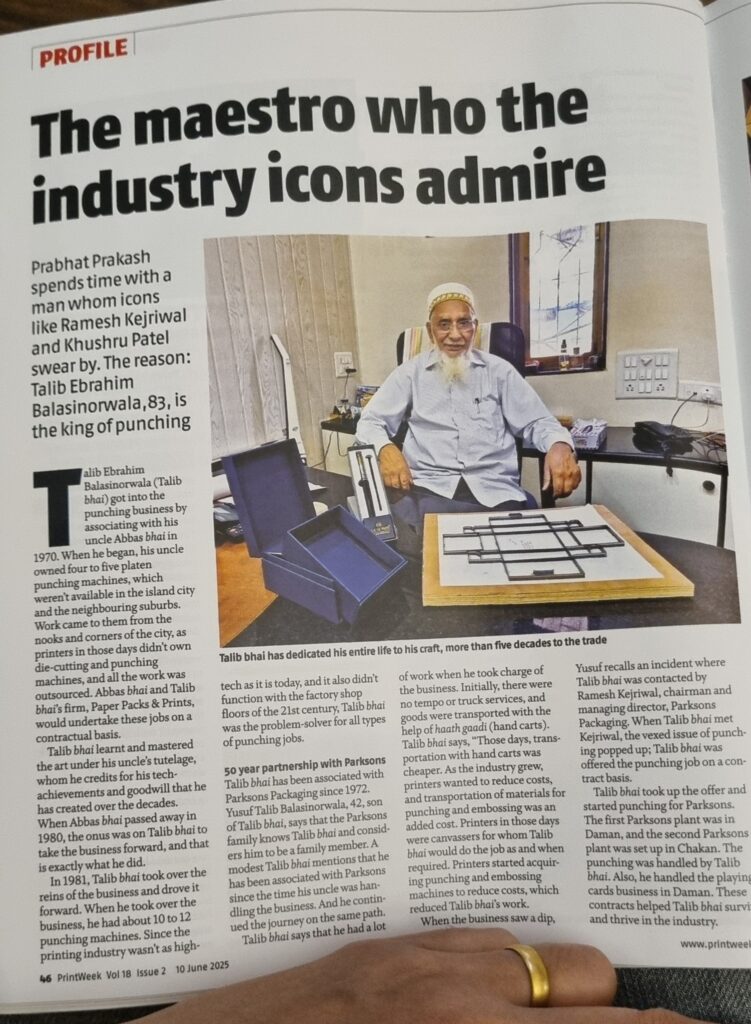
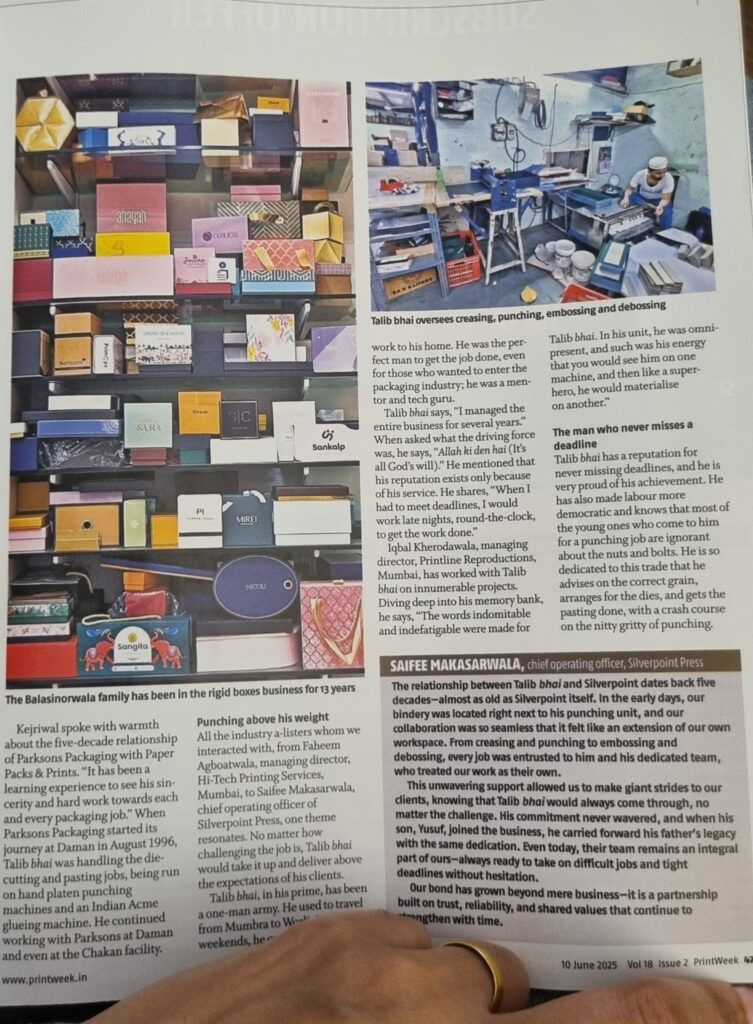
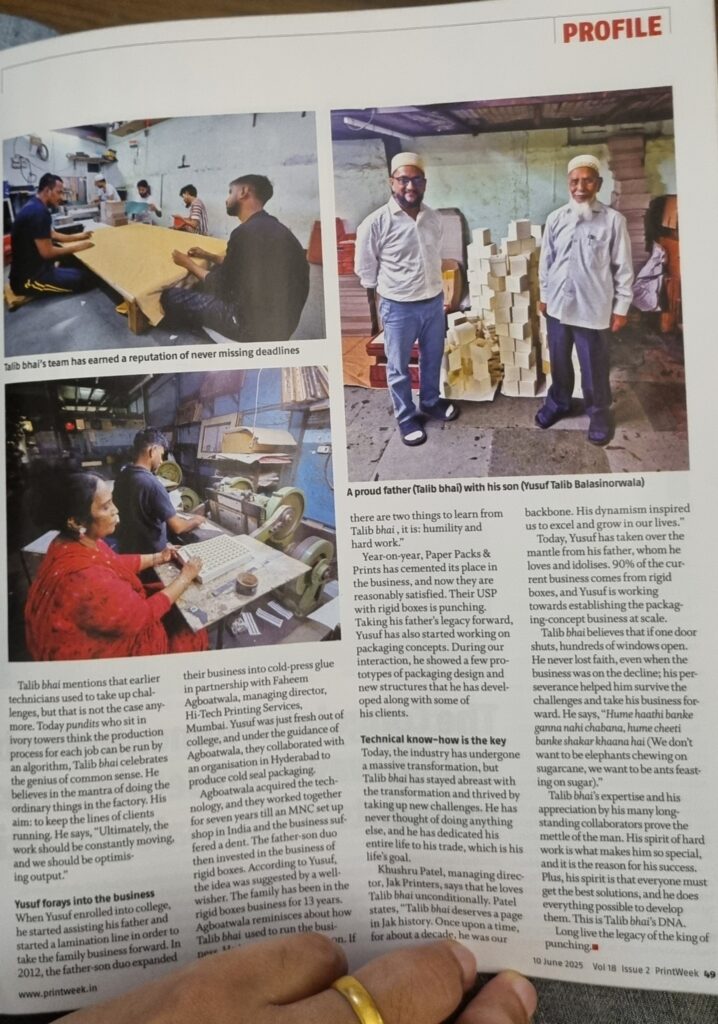
“The maestro who the industry icons admire”

Talib Ebrahim Balasinorwala, 83, is the king of punching.

Printweek India, 10 June 2025

21 June 2025

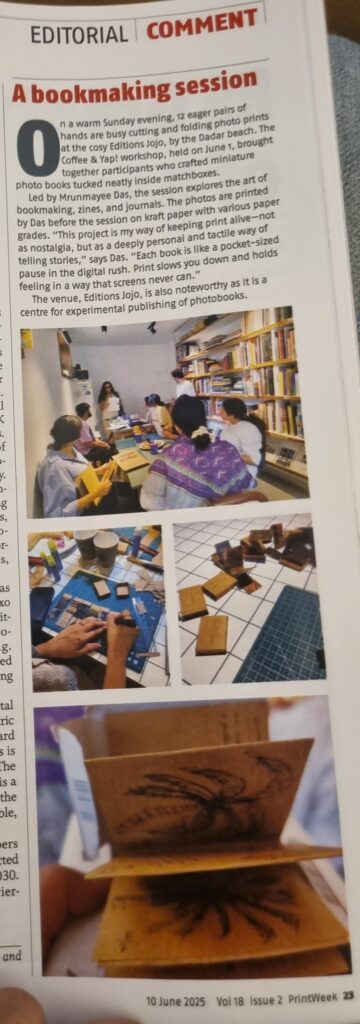
Bookmaking session, Mumbai

#photobook #Mumbai PrintWeek India magazine, 10 June 2025

21 June 2025

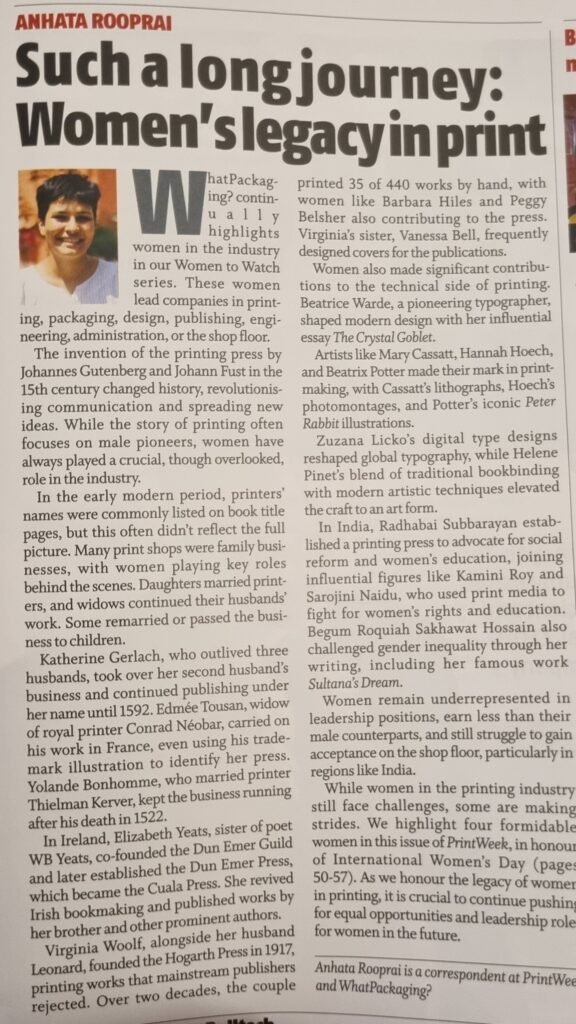
Women’s legacy in print

Fascinating historical account of women’s legacy in print published in Printweek India magazine, March 2025.

21 June 2025

“The Time Energy Toolkit: Design Your Life, One Day at a Time” by Apekshit Khare

Many of the self-help books that are available in the local book market are created overseas. The drops of wisdom that they are share are fine and commonsensical, but the case studies and scenarios most oft are not. They are mostly applicable for situations abroad. The Time Energy Toolkit: Design your life, one day at a time has much the same kind of wise words to share as it’s international counterparts, but it’s differentiating factor is the sharing of desi scenarios. This is critical. Understanding the local context, especially the work/corporate culture, then Apekshit Khare is able to guide the reader in fine tuning their behavioural practices to manage their time energy better.

There are plenty of tables and worksheets provided via a QR Code printed at the end of the book.

Ultimately, it is a very corporate/business handbook but it’s written in an accessible style.

Try using the book. See if it makes a difference to you.

It is published by Westland Books.

21 June 2025

“The Buddha’s Path to Awakening” Edited and translated from Pali to English by Sarah Shaw

The Buddha as man, animal, and god on the path to enlightenment.

According to ancient traditions, it takes countless lifetimes to become a Buddha. The Buddha’s own path to complete awakening was chronicled in five hundred and forty-seven stories known as the jātakas, which underwent numerous adaptations in the centuries after the Buddha’s lifetime. In the fifth or sixth century CE, in the region known as present-day Sri Lanka, an anonymous author wrote an introduction to these, recounting the history of a vow that prompted this great quest. This narrative, titled Jātakanidāna in Pali, preserves the oral traditions about the Bodhisatta, the one destined to become a Buddha in his final life. The text also functioned for centuries as a gateway to other early Buddhist teachings, offering valuable insights into the Buddha’s journey toward enlightenment.

The story begins when, in one of his lives as an ascetic named Sumedha, the Buddha vows to delay his own awakening until he can guide others toward their release from the cycle of rebirth. This vow sets him on a long series of lives—as man, animal, and god. At the culmination of his spiritual journey, he recalls his past lives, his teachings, and the establishment of the monastic community that would preserve and spread these teachings.

The Buddha’s Path to Awakening has become one of the most significant biographical works in the Buddhist tradition. This volume presents a new, authoritative translation, accompanied by the original Pali text.

It has been published by Murty Classical Library / Harper Collins India.

Sarah Shaw is a faculty member in the Department of Asian and Middle Eastern Studies at the University of Oxford.

21 June 2025

“The Questions of Milinda”, translated from Pali into English by Maria Heim

A Greek king and a Buddhist monk engage in a transformational philosophical dialogue.

The legendary conversation between the Greek King Milinda, traditionally identified as Menander, and the Buddhist monk Nagasena is believed to have taken place after Alexander’s campaign in India. The earliest versions of this dialogue originate from the northwestern region of the Indian subcontinent, known as Greater Gandhara, where Buddhism had taken root as early as the reign of Emperor Ashoka in the third century BCE. While the historical authenticity of this exchange remains uncertain, the dialogue―known in Pali as Milindapañha―has endured for over two millennia and is regarded as one of the most revered texts in Theravada Buddhism.

Throughout their conversation, Milinda and Nagasena explore fundamental questions about the nature of the world, kingship, and the sources of knowledge. Milinda’s probing inquiries drive the dialogue, while Nagasena offers insights grounded in Buddhist teachings, gradually transforming the Greek king from a curious skeptic into a committed Buddhist.

This edition, published by Murty Classical Library of India / Harper Collins India, features a modern English translation of one of the most renowned works of ancient Buddhist philosophy, alongside the original Pali text.

Maria Heim is George Lyman Crosby 1896 & Stanley Warfield Crosby Professor in Religion at Amherst College.

21 June 2025

“The Nehru-Era Economic History and Thought & Their Lasting Impact” by Arvind Panagariya

India’s economic model underwent transformational change following independence in 1947. The country’s first Prime Minister, Jawaharlal Nehru, embarked upon two foundational projects to build modern India: a political project aimed at establishing democracy with universal suffrage, and an economic one aimed at ending poverty. Three-quarters of a century later, his political project is a resounding success, but the opposite is true of the economic one as per the author.

The Nehru-Era Economic History and Thought & Their Lasting Impact examines the evolution of Nehru’s economic philosophy with socialism, self-sufficiency, and heavy-industry development at its core. Through extensive archival research, Arvind Panagariya reconstructs and reinterprets this history, paying particular attention to the administrative processes deployed to implement policies, contemporary economic thought, and important historical events not adequately covered in the existing literature. He assesses the evolution of Nehru’s own political beliefs and the construction of the Nehru development model, the resulting regime and exclusionary nature of economic growth, and the lasting intellectual legacy of the Nehru-era socialism on politicians, civil servants, policy analysts, and businesspeople in the six decades since Nehru’s death.

This book is the fascinating tale of a model with the near-unanimous approval of experts from all around the world at its inception and the impact of its failure.

Read an excerpt from the book on Moneycontrol.

The book has been published by Oxford University Press India.

Arvind Panagariya is a Professor of Economics in the School of International and Public Affairs at Columbia University. He was the first Vice Chairman of the NITI Aayog, Government of India, in the rank of a cabinet minister. He has authored more than 20 books, published professional articles in all the top Economics journals, and written for Foreign Affairs, Foreign Policy, and the WSJ. In 2012, the Government of India awarded him with Padma Bhushan, its third highest honor in any field.

21 June 2025

Web Analytics Made Easy -
StatCounter