India’s economic model underwent transformational change following independence in 1947. The country’s first Prime Minister, Jawaharlal Nehru, embarked upon two foundational projects to build modern India: a political project aimed at establishing democracy with universal suffrage, and an economic one aimed at ending poverty. Three-quarters of a century later, his political project is a resounding success, but the opposite is true of the economic one as per the author.
The Nehru-Era Economic History and Thought & Their Lasting Impact examines the evolution of Nehru’s economic philosophy with socialism, self-sufficiency, and heavy-industry development at its core. Through extensive archival research, Arvind Panagariya reconstructs and reinterprets this history, paying particular attention to the administrative processes deployed to implement policies, contemporary economic thought, and important historical events not adequately covered in the existing literature. He assesses the evolution of Nehru’s own political beliefs and the construction of the Nehru development model, the resulting regime and exclusionary nature of economic growth, and the lasting intellectual legacy of the Nehru-era socialism on politicians, civil servants, policy analysts, and businesspeople in the six decades since Nehru’s death.
This book is the fascinating tale of a model with the near-unanimous approval of experts from all around the world at its inception and the impact of its failure.
The book has been published by Oxford University Press India.
Arvind Panagariya is a Professor of Economics in the School of International and Public Affairs at Columbia University. He was the first Vice Chairman of the NITI Aayog, Government of India, in the rank of a cabinet minister. He has authored more than 20 books, published professional articles in all the top Economics journals, and written for Foreign Affairs, Foreign Policy, and the WSJ. In 2012, the Government of India awarded him with Padma Bhushan, its third highest honor in any field.
A history of modern South Asia told through five partitions that reshaped it.
As recently as 1928, a vast swathe of Asia–India, Pakistan, Bangladesh, Burma, Nepal, Bhutan, Yemen, Oman, the UAE, Qatar, Bahrain and Kuwait–were bound together under a single imperial banner, an entity known officially as the ‘Indian Empire’, or more simply as the Raj.
It was the British Empire’s crown jewel, a vast dominion stretching from the Red Sea to the jungles of Southeast Asia, home to a quarter of the world’s population and encompassing the largest Hindu, Muslim, Sikh and Zoroastrian communities on the planet. Its people used the Indian rupee, were issued passports stamped ‘Indian Empire’, and were guarded by armies garrisoned forts from the Bab el-Mandab to the Himalayas.
And then, in the space of just fifty years, the Indian Empire shattered. Five partitions tore it apart, carving out new nations, redrawing maps, and leaving behind a legacy of war, exile and division.
The book has been published by Harper Collins India.
Sam Dalrymple is a Delhi-raised Scottish historian, film-maker and multimedia producer. He graduated from Oxford University as a Persian and Sanskrit scholar. In 2018, he co-founded Project Dastaan, a peace-building initiative that reconnects refugees displaced by the 1947 Partition of India. His debut film, Child of Empire, premiered at the Sundance Film Festival in 2022 and his animated series, Lost Migrations, sold out at the British Film Institute the same year. His work has been published in the New York Times, Spectator and featured in TIME, The New Yorker and TheEconomist. He is a columnist for Architectural Digest and, in 2025, Travel & Leisure named him ‘Champion of the Travel Narrative’. Shattered Lands is his first book.
Award-winning writer and academic Viet Thanh Nguyen is a name that many in the literary world are familiar with. As a Vietnamese-American, he is acutely aware of his two identities and the histories he carries within himself. This is one of the recurring themes of his memoir, A Man of Two Faces. He has written plenty of books, most notably his Pulitzer Prize for Fiction 2016 The Sympathiser. It was recently turned into a TV series with Park Chan-wook and Robert Downey Jr. His books are published in India by Hachette India.
In 2023-24, Viet Thanh Nguyen delivered the prestigious Norton Lectures. In the lectures as well as in the discussions that follow, he addresses many of the aspects of being an immigrant in the USA that are at the heart of his moving memoir A Man of Two Faces.
We have recorded more than 134 episodes of TOI Bookmark. Each one is special and memorable. Every conversation is unique. It was an honour and a privilege to record this episode with Viet Thanh Nguyen. He is exceptionally busy with a demanding schedule. Yet, once we had figured out a mutually convenient time to record, across time zones, days and dates, he was immensely courteous and gave us his focussed attention. It did not seem as if he had been in back-to-back meetings/interviews during the day. It was Memorial Weekend in the USA, but he was working.
It was a fascinating conversation about reading and writing memoirs while discussing his book A Man of Two Faces. Also, how he had to think through himself, think through the history of his family that he was dealing with, and think through the language he was going to use.
Incidentally, 30 April 2025 marked fifty years since the conclusion of the Vietnam War.
Listen to the podcast on Spotify:
TOI Bookmark is a weekly podcast on literature and publishing. TOI is an acronym for the Times of India (TOI) which is the world’s largest newspaper and India’s No. 1 digital news platform with over 3 billion page views per month. The TOI website is one of the most visited news sites in the world with 200 million unique monthly visitors and about 1.6 billion monthly page views. TOI is the world’s largest English newspaper with a daily circulation of more than 4 million copies, across many editions, and is read daily by approximately 13.5 million readers. The podcasts are promoted across all TOI platforms. I have recorded more than 134+ sessions with Jnanpith, Padma Bhushan and Padma Shree awardees, International Booker Prize winners, Booker Prize winners, Women’s Prize for Fiction, Nobel Laureates, Pulitzer Prize, Stella Prize, AutHer Awards, Erasmus Prize, BAFTA, Walter Scott Prize for Historical Fiction etc. Sometimes the podcast interviews are carried across all editions of the print paper with a QR code embedded in it.
Some of the authors who have been interviewed are: Banu Mushtaq, Deepa Bhashti, Samantha Harvey, Jenny Erpenbeck, Michael Hoffman, Paul Murray, V. V. Ganeshananthan, Hisham Matar, Anita Desai, Amitava Kumar, Hari Kunzro, Venki Ramakishnan, Siddhartha Deb, Elaine Feeney, Manjula Padmanabhan, NYRB Classics editor and founder Edwin Frank, Jonathan Escoffery, Joya Chatterji, Arati Kumar-Rao, Paul Lynch, Dr Kathryn Mannix, Cat Bohannon, Sebastian Barry, Shabnam Minwalla, Paul Harding, Ayobami Adebayo, Pradeep Sebastian, G N Devy, Angela Saini, Manav Kaul, Amitav Ghosh, Damodar Mauzo, Boria Majumdar, Geetanjali Mishra, Viet Thanh Nguyen, William Dalrymple, Abdulrazak Gurnah, and Annie Ernaux.
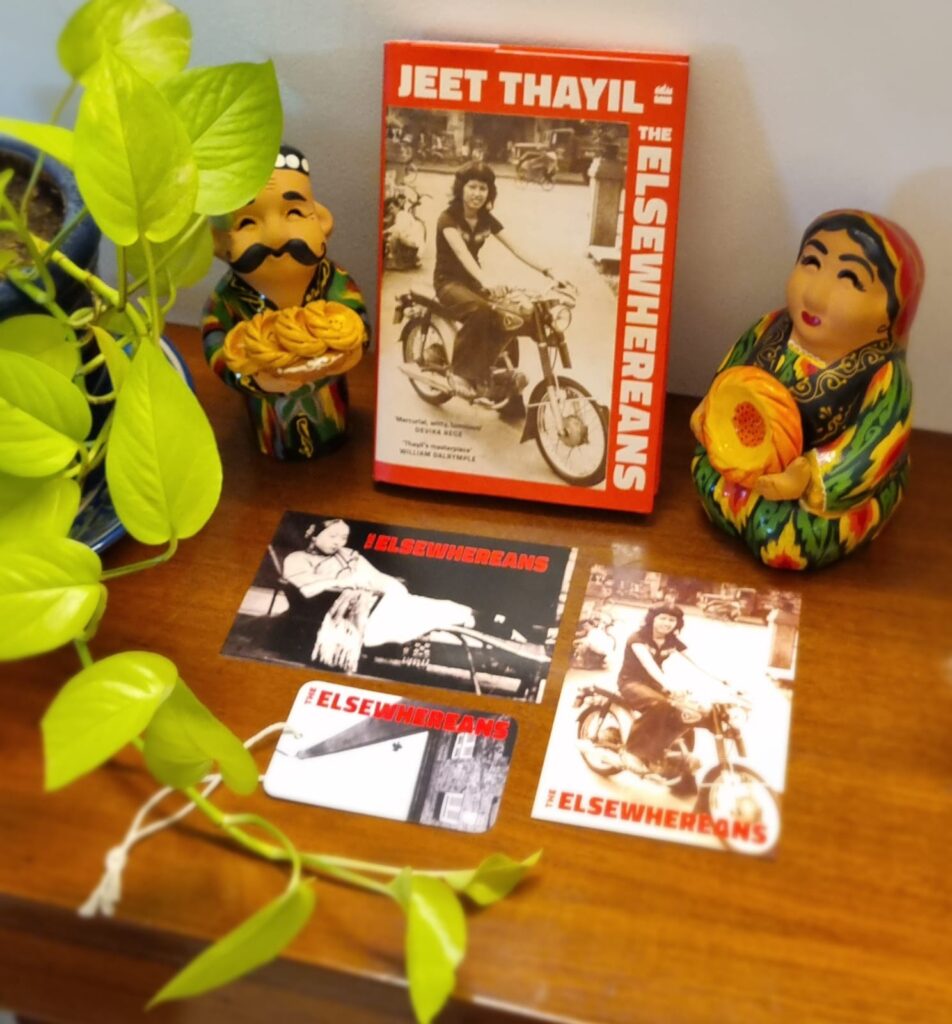
Jeet Thayil’s new novel The Elsewhereans: A Documentary Novel is being released by HarperCollins India on 23 June 2025. Jeet has been incredibly prolific in the past few months. He has published two volumes of poems including his stupendous collection I’ll have it Here. There are poems in this volume that bear witness to our new world. Jeet’s poetry is outstanding. The rhythm and performance element are pitch perfect with the words he finds to express his emotions. Hence, his novels are equally fascinating. Always expect the unexpected from Jeet where prose is concerned.
Here is the Spotify link to the TOI Bookmark podcast that I recorded with Jeet earlier this year.
I have just received an advance copy of his novel from the publishers and look forward to reading it asap.
‘Mercurial, witty, luminous’ – DEVIKA REGE
‘Thayil’s masterpiece’ – WILLIAM DALRYMPLE
Jeet Thayil’s The Elsewhereans is a genre-defying novel that melds fiction, travelogue, memoir, a ghost story, a family saga, photographs and much else into a tale that unfolds across continents and decades.
From the backwaters of Kerala to the streets of Bombay, Hong Kong, Paris and beyond, Thayil maps the restless lives of those shaped by separation – both the ones who leave and the ones left behind.
A hypnotic meditation on migration, loss, and the fragile threads of identity from one of the most brilliant voices in contemporary literature, The Elsewhereans is a novel of retrieval and reinvention – an elegy for vanished worlds, and a reckoning with the histories we inherit.
‘The Elsewhereans is a wonderfully rich evocation of the era of decolonization and non-alignment, and the peripatetic lives and multiple perspectives that it made possible. Reading it, I felt like I was meeting many ghosts from my own past.’ AMITAV GHOSH
‘Like the “river of three rivers” at its heart, The Elsewhereans surges forward in multiple narrative currents: autofiction, Kunstlerroman, mourning diary. Dispensing with conventional notions of plot, Thayil draws on real and imagined archives, testimonies and anecdotes to trace the wanderings of a family from Kerala to places as disparate as Bombay, Hanoi, Paris, Elmau and Algeciras. But it is above all his sentences – mercurial, witty, luminous – that pull us through each new and unexpected encounter. The result is a hauntingly lyrical meditation on migration, belonging and grief. The Elsewhereans is Thayil at his finest yet.’ DEVIKA REGE
‘How can a book so melancholy also be so exhilarating? The Elsewhereans blurs timezones and timelines as it traces the wanderings of a family across rivers and oceans, across silences and stories. It is equally attentive to the politics of nation-building and family caretaking. The centre of this dazzling spiral novel is deep love, examined with ruthless poetic precision, and found to be flawed but essential for survival.’ SHAHNAZ HABIB
‘Jeet Thayil just keeps getting better and better: this is writing of great skill and precision, charm and warmth, beauty and wit, taut as a coiled spring, laced with pin-sharp, pitch-perfect dialogue. The Elsewhereans could well be Thayil’s masterpiece.’ WILLIAM DALRYMPLE
Jeet Thayil is a poet, novelist, librettist and musician. He was born into a Syrian Christian family in Kerala. As a boy, he travelled through much of the Indian subcontinent and Southeast Asia with his father, T.J.S. George, a writer and editor. He worked as a journalist for twenty-one years in Bombay, Bangalore, Hong Kong and New York City. In 2005, he began to write fiction. The first instalment of his Bombay Trilogy, Narcopolis, was shortlisted for the Booker Prize, won the DSC Prize, and became a bestseller. His book of poems These Errors Are Correct won the Sahitya Akademi Award. His musical collaborations include the opera Babur in London. His essays, poetry and short fiction have appeared in The New York Review of Books, Granta, TLS, Esquire, The London Magazine, The Guardian and The Paris Review, among other venues. Jeet Thayil’s most recent book of poems is I’ll Have It Here.
Hachette India very kindly sent a copy of this book. I cannot wait to read this. It is just the kind of material that I enjoy reading. If only I could finish my other deadlines asap.
‘Thrilling, meticulous and wondrously original’ PHILIPPE SANDS
A jaw-dropping microhistory of the global economy over the last fifty years told through the many lives of a single ship.
At 94 meters long and 9,500 deadweight tonnes, once called the Bibby Resolution, is an unremarkable hulk, crossing the oceans unnoticed. And yet, the astonishing journey of this boat can tell us the story of the modern world.
First built as a Swedish offshore oil rig in the 1970s, it went on to become a barracks for British soldiers in the Falklands War in the 1980s, a jail off New York in the 1990s, a prison in Portland in the 2000s, and accommodation for Nigerian oil workers off the coast of Africa in the 2010s. It has been called Safe Esperia, HMP The Weare, even ‘The Love Boat’. In each of its lives this empty vessel has been commanded by economic forces much larger than itself: private investment, war, mass incarceration, imperial interests, national sovereignty, inflation, booms, busts and greed.
Through its encounters with a world of island tax havens, the English court system, exploited labour forces, free banking zones or immigration politics, the ordinary boat at the heart of this story reveals our complex modern economy to us, connecting the dots of a dramatically changing world in the making, and warning us of its dangerous consequences.
Capitalism. International law. Imperial decline. National sovereignty. Inflation. Sectoral stagnation. Gentrification. Mass incarceration. Booms. Busts. Racism. Greed. Empty Vessel is the story of globalism in one boat. First built as a Swedish offshore oil rig in the 1970s, it went on to house British soldiers in the Falklands War in the 1980s, prisoners from Riker’s Island in New York’s East River in the 1990s, Volkswagen factory employees in Germany in the 2000s, and Nigerian oil workers off the coast of Africa in the 2010s. In each of its lives it arrived as an empty vessel, filled at the behest of both public and private interests, for purposes of war, incarceration, and commerce – connecting people thousands of miles apart, all shaped by the same global economic transformations. So much of our global economy is composed of specific innovations, decisions, and human experiences as concrete as the barnacles scraped off a hull. Through this party boat, prison, oil rig and war vessel. Empty Vessel reveals this economy to us – and warns of its troubling consequences.
In the astonishing trajectory of a humble barge, Empty Vessel delivers an ambitious history of the global economy, linking everything from oil-drilling and offshore finance to military deployments and mass incarceration. I’ve rarely read a book that so deftly entwines a single, accessible story with the broad forces of globalization. A stunningly original history, as phenomenally well-researched as it is eloquently told
— Maya Jasanoff, author of THE DAWN WATCH
Kumekawa’s tale of the Barge . . . is an imaginative and beautifully written allegory of the decades of globalization and the fugitive wealth it supported. What an eye-opening read!
— Charles S. Maier, Leverett Saltonstall Professor of History, Emeritus, Harvard University
A captivating story-I read it like a detective novel-and at the same time a profound contribution to the history of economic, financial and material life in the contemporary globalized world — Emma Rothschild, Jeremy and Jane Knowles Professor of History, Harvard University
Kumekawa brilliantly traces the history of one vessel to make the historical forces of globalization concrete. A riveting and important read that shows the strange ties between tax havens and trade, prisons and ports. Offshore is more than a concept; it is a place. Kumekawa is the ideal guide to that place and its complicated inner workings
— Heidi Tworek, Professor of History and Public Policy and Canada Research Chair, University of British Columbia
When the world went on lockdown, Ian Kumekawa took a different tack, tracking a single barge through its journey across the planet. What he discovers is the hidden material life and labor that make the global economy possible. A brilliant, unforgettable tale of our modern times — Eric Klinenberg, author of 2020
An ingenious, marvelous book. Ian Kumekawa has captured the big economic stories of the past half-century in the perambulations of a single ship. His Vessel drifts across the globe from one major upheaval to the next, a floating, steel witness to extraction, mass production, deindustrialization, incarceration, and war. The result is a high seas picaresque through the systems that tie the modern world together — Henry Grabar, author of PAVED PARADISE
A gripping tale-of a floating prison, the worlds of global and offshore capital in which such ships are moored, and the maritime and legal infrastructures that keep such worlds afloat, even amidst the tidal waves of economic and ecological disaster
— Surabhi Ranganathan, Professor of International Law, University of Cambridge
Empty Vessel, both the book and the accommodation container ship whose checkered history it unfolds, brilliantly illuminates the workings of a global offshore economy that would prefer to remain in the shadows, lingering on the margins of the law, thriving on secrecy, sleight of hand and tax avoidance. By following in the vessels’ wake Kumekawa’s riveting story reveals not just its physical use and functions-as accommodation for British troops, New York prisoners, oil workers, asylum seekers-but explains how the Vessel became an exemplary object caught up in global skeins/schemes of capital and finance — John Brewer, Professor Emeritus, Caltech Division of Humanities and Social Sciences
A thrilling, meticulous and wondrously original journey, told with a flair and reverence for detail that captures all the joys, travails and horrors of life across time, place and water. A fabulous book — Philippe Sands, author of EAST WEST STREET
Kumekawa is an excellent guide to this half a century moment in the history of capitalism. By focusing on something small and very local he allows us to see something big and very global: the forgoing of new inequalities, the retooling of global economic hierarchies, the refashioning of trade and industry, the feverish burning of fossil fuels and the violence and coercions embedded into the neoliberal order supervised by a powerful but recast state. The many-headed hydra of neoliberalism has found its chronicler — Sven Beckert, author of EMPIRE OF COTTON
If you’ve ever struggled to understand what terms like “globalisation” or “financialistion” actually mean, Empty Vessel is the book for you. Kumekawa combines in depth research with powerful storytelling to show the reader, in concrete terms, how modern capitalism really works – and how it has changed over the last several decades — Grace Blakeley, author of VULTURE CAPITALISM
A compelling voyage in and of itself, taking the reader on a journey around the global economy that illuminates the systemic blind spots of the late twentieth century and early twenty-first century global economy. A trip on a barge that takes you further than you imagined — Kojo Koram, author of UNCOMMON WEALTH
15 June 2025 is Father’s Day. It has many histories but in the modern world, it seems to be celebrated on the second saturday of June. Hence, PanMacmillan India has sent their latest publication. It is a cuurious book to create with the focus on being some eminent men like Plato, Aristotle, Augustine of Hippo, Henry VIII, Thomas Jefferson, Emerson, Thoreau, Charles Darwin, Sigmund Freud and Bob Dylan. All men from the West. No other culture is represented. A limitation that some of the early reviewers of the book have also pointed out. But hey! all voices and perspectives are welcome.
A bold and original history of fatherhood, exploring its invention and transformation from the Bronze Age to the present through a collective portrait of emblematic fathers who have helped to define how the world should be ruled and what it means to be a man.
‘A richly absorbing piece of history embedded in a wealth of wonderful storytelling. A pleasure to read’ – Vivian Gornick, author of Fierce Attachments
‘An invigorating, impressively researched and honest read. Anyone doing the work of dismantling and reframing the heavy role of the father will find something here’ – Raymond Antrobus, author of Signs, Music ________
What is fatherhood, and where did it come from? How has the role of men in families and society changed across thousands of years? What does the history of fatherhood reveal about what it means to be a dad today?
From the anxious philosophers of ancient Athens and Henry VIII’s obsessive quest for an heir, to Charles Darwin’s theories of human origins, Bob Dylan’s take down of ‘The Man’, and beyond, Sedgewick shows how successive generations of men have shaped our understanding of what it means to be and have a father, and in turn our ideas of who we are, where we come from and what we are capable of.
Fatherhood is one of the most meaningful aspects of human culture, but we know little about when or where fatherhood first emerged, or even how or why. Despite its enigmatic beginnings, fatherhood has, for centuries, given shape to ideas about the world, defined human experiences, and provided the foundation of patriarchy. The history of fatherhood is not just the story of one of humanity’s great values: caring for those who cannot care for themselves. And it is not merely the story of patriarchy—“the power of fathers”—which is arguably the oldest and most widespread form of social hierarchy and political oppression. It is the story of how these twin strands of history became so entangled that they are often indistinguishable.
In Fatherhood, celebrated historian Augustine Sedgewick explains how this style of parenting emerged in the first place, why it has changed over time, and whether it will endure as we know it, despite its extraordinary costs. Told through the lives of emblematic fathers like Aristotle, Saint Augustine, Henry VIII, Thomas Jefferson, Charles Darwin, and Sigmund Freud, this is an ambitious yet intimate look at how masculinity has evolved and how men have come to hold disproportionate power by expanding and reinforcing the power of fathers in times of crisis.
Sedgewick, acclaimed for his “literary gifts and prodigious research” (The Atlantic), takes us from the Bronze Age to the present to revolutionize our understanding of fathers and challenge the fictions that have surrounded them for centuries. Fatherhood transforms our understanding of this fundamental idea, experience, and institution, allowing us to better know our past and re-envision our common future. _____
‘Absorbing, rigorous, and profoundly moving, Fatherhood is an exquisite narrative history that offers new ways of thinking about masculinity and the modern family’ Kate Bolick, author of Spinster
Augustine Sedgewick is the author of Coffeeland, winner of the 2022 Cherasco International Prize and a New York Times Editors’ Choice selection. He earned his doctorate at Harvard University, and his research on the global history of capitalism, work, food, and family has received fellowships from the American Council of Learned Societies, the American Antiquarian Society, and the Andrew W. Mellon Foundation, among others. Originally from Maine, Sedgewick lives in New York City with his son.
The Ghadar Movement was conceived in 1913 in the United States of America by Lala Har Dayal, Kartar Singh Sarabha, Sohan Singh Bhakna, Harnam Singh Tundilat and others, all of them Indian immigrants in the US. Inspired by Tilak, Savarkar, Madam Cama, Shyamaji Krishnavarma and others, the Ghadar plan was to smuggle arms to India and incite Indians in the British-Indian Army to mutiny. Many Ghadarites, most of them from Punjab, came back to India from the US in order to participate in the struggle. In India, revolutionaries like Rash Behari Bose and Vishnu Ganesh Pingle joined them.
Owing to lapses in planning and the presence of informers in their midst, the plan ultimately failed and the British came down very heavily on the conspirators.
Some like Kartar Singh Sarabha (who inspired a young Bhagat Singh) were sentenced to death for their part in the struggle. Many others suffered long and cruel jail sentences in the Andamans.
Rana Preet Gill is a Veterinary Officer with the Animal Husbandry Department of Punjab Government. She has authored four books―three novels―Those College Years, The Misadventures of a Vet, Maya and a collection of middles titled Finding Julia. Her articles and short stories have been published in The Tribune, Hindustan Times, The Hindu, The Statesman, The New Indian Express, Deccan Herald, The Hitavada, Daily Post, Women’s Era, Commonwealth Writers Journal, Himal and others.
It is the 1970s. Mumbai is in the underworld’s vice grip. Film stars, businessmen, traders and the common man-no one is safe from the mafia’s greed and wrath. But a determined, intelligent and no-nonsense policeman is about to bring them to justice … without ever firing a single bullet.
Assistant Commissioner of Police (Retd) Madhukar B. Zende is best-known for his sensational arrest of the serial murderer Charles Sobhraj, aka the Serpent. He is also lauded for successfully managing the violent riots in Mumbai that broke out in the aftermath of the demolition of the Babri Masjid in 1993, and ushering in an era of peace.
But Zende has many more stories of crime and justice under his belt, and in this book, he gives readers a glimpse into what it meant to be a cop in the seventies and eighties. From the puzzling case of the murder of Shanta Devi to the kidnapping of a famous movie mogul to the capture of dark luminaries like Arun Gawli, Karim Lala, Haji Mastan and Babu Reshim, Mumbai’s Most Wanted is a riveting account of a supercop who brought some of the city’s most dreaded villains to their knees.
The book extract is taken from Madhukar Zende’s account of capturing Charles Sobhraj for the second time in his career. It is published on Moneycontrol. It has been published by HarperCollins India.
Madhukar Bapurao Zende served in the Mumbai Police from 1959 to 1996. Over an illustrious career, he became the first officer to win a Police Medal for Meritorious Service and a President’s Medal for Distinguished Service in successive years. He now spends his time between the homes of his three children and in Pune. Hours of exercise, intensely tough sudokus, cooking, and meeting family and friends are his passions. This is his first book. He was assisted in its writing by his son, Jai Vijaya Madhukar Zende.
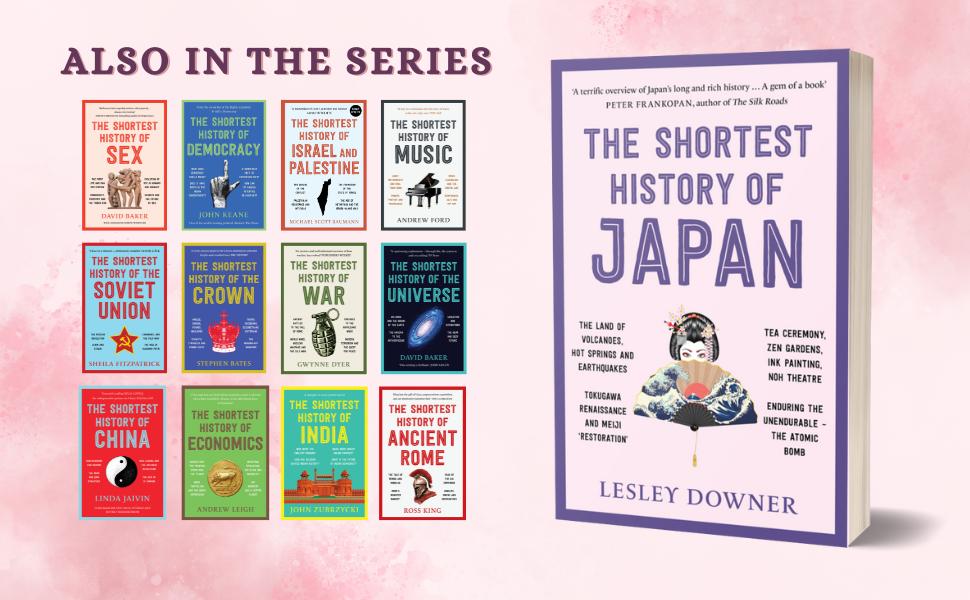
It is quite amazing that soon after it was announced that the Indian economy had surpassed the Japanese economy (a feat that has been unimaginable for decades!),Pan Macmillan India sent a copy of their latest title: The Shortest History of Japan by Lesley Downer. It is part of a magnificent series that is being published over a long stretch of time.
A riveting history of Japan – an island nation forged by isolation, shaped by influence and bound by tradition
Zen, haiku, martial arts, sushi, anime, manga, video games and the Ikigai philosophy – many aspects of Japanese society influenced cultures across the world. But where did it all begin? How did Japan’s unique traditions, philosophies, and aesthetics come to be?
This book takes us on a sweeping journey through the island nation’s rich and fascinating history – from its prehistoric roots in 14,500 BCE to the bustling, high-tech nation of today. It explores the myth of emperors descended from the Sun Goddess, the rise and fall of samurai warlords, the elegance of court ladies and geishas, the resilience of women warriors and rulers, and the pragmatism of its merchants and world-renowned businessmen who moulded modern Japan.
From the isolationist policies of the Tokugawa shoguns to the rapid Westernization of the Meiji era, Japan has skillfully balanced tradition and transformation. The island nation, shaped like a necklace along Asia’s coast, used the sea as a shield against invasion, helping protect its culture even as it was impacted by foreign influences.
Combining engaging storytelling and historical insight, Lesley Downer brings to life the people, power struggles, philosophies and art that forged one of the world’s most fascinating civilizations.
Lesley Downer is an author, journalist and historian. She has written four novels, The Shogun Quartet, set in the glittering world of nineteenth-century Japan. She has also written several works of non-fiction, including Geisha: The Remarkable Truth Behind the Fiction and The Brothers: The Hidden World of Japan’s Richest Family, which was chosen as a New York Times Book of the Year. She lives in London with her husband, the author Arthur I. Miller.
I have been waiting to read this book. I have been hearing all good things about it. Finally, Simon & Schuster India very kindly sent one of the copies that they had imported. Thank you!
The beautiful new novel that will make you laugh and cry, from the global bestselling author of Anxious People and A Man Called Ove. Fredrik Backman returns with an unforgettably funny, deeply moving tale of four teenagers whose friendship creates a bond so powerful that it changes a complete stranger’s life twenty-five years later…
* ONE OF GOODREADS READERS’ MOST ANTICIPATED BOOKS OF 2025 *
* A BARNES AND NOBLE NATIONAL BOOK CLUB PICK *
You have to take life for granted, the artist thinks, the whole thing: sunrises and slow Sunday mornings and water balloons and another person’s breath against your neck. That’s the only courageous thing a person can do.
In the corner of one of the most famous paintings in the world three tiny figures sit at the end of a pier. Most people don’t even notice them. Most people think it’s just a depiction of the sea. But Louisa, an aspiring artist herself, knows otherwise.
Twenty-five years earlier, in a distant seaside town, a group of teenagers seek refuge from their bruising home lives by spending long summer days together. They tell jokes, they share secrets, and they commit small acts of rebellion. These lost souls find in each other a reason to get up each morning, a reason to dream, a reason to love.
Out of that summer emerges a transcendent work of art, a painting that will unexpectedly be placed into 18-year-old Louisa’s care. Determined to learn how it came to be and to decide what to do with it, Louisa embarks on a cross-country journey. But the closer she gets to the painting’s birthplace, the more nervous she becomes.
In this stunning testament to the transformative, timeless power of friendship and art, Louisa is proof that happy endings don’t always take the form we expect.
Fredrik Backman is the #1 New York Times bestselling author of A Man Called Ove, My Grandmother Asked Me to Tell You She’s Sorry, Britt-Marie Was Here, Beartown, Us Against You, The Winners, Anxious People and two novellas, And Every Morning the Way Home Gets Longer and Longer and The Deal of a Lifetime, as well as one work of nonfiction, Things My Son Needs to Know About the World. His books are published in more than forty countries. His next novel, My Friends, will be published in May 2025. He lives in Stockholm, Sweden, with his wife and two children. Connect with him on Facebook and Twitter @BackmanLand or on Instagram @Backmansk.
While you are here, take a look at this lovely speech that Fredrik Backman gave on “Creative Anxiety and Procrastination”. At the Simon & Schuster centennial, 1 May 2024, author Fredrik Backman discusses the highs and lows of being an author, from attempting to get along with the voices in your brain, to the hidden joys of jet lag.