Jaya Posts

“We Will Not Be Saved: A memoir of hope and resistance in the Amazon rainforest” by Nemonte Nenquimo & Mitch Anderson

The first memoir by an indigenous tribal leader in the Amazon, who fought Big Oil to preserve her tribe’s territories, and thousands of acres of pristine rainforest.

”I’m here to tell you my story, which is also the story of my people and the story of this forest.”

Born into the Waorani tribe of Ecuador”s Amazon rainforest, Nemonte Nenquimo was taught about plant medicines, foraging, oral storytelling, and shamanism by her elders. Age 14, she left the forest for the first time to study with an evangelical missionary group in the city. Eventually, her ancestors began appearing in her dreams, pleading with her to return and embrace her own culture.

She listened.

Two decades later, Nemonte has emerged as one of the most forceful voices in climate-change activism. She has spearheaded the alliance of indigenous nations across the Upper Amazon and led her people to a landmark victory against Big Oil, protecting over a half million acres of primary rainforest. Her message is as sharp as the spears that her ancestors wielded – honed by her experiences battling loggers, miners, oil companies and missionaries.

In this astonishing memoir, she partners with her husband Mitch Anderson, founder of Amazon Frontlines, digging into generations of oral history, uprooting centuries of conquest, hacking away at racist notions of Indigenous peoples, and ultimately revealing a life story as rich, harsh and vital as the Amazon rainforest herself.

”An unforgettable memoir about fighting for your home and your heart.” – Reese Witherspoon (Reese”s Book Club November ”24 Pick)

If you want to understand the climate crisis and do something about it, read this book. Nemonte’s writing is as provocative as it is inspiring, a heroine speaking her truth which is exactly what we need to hear. Had we listened long ago to these voices we wouldn’t be in the eye of the storm now. – Emma Thompson, Actor and Writer

Read an extract from the book on Moneycontrol. It is published Headline Publishing Group/ Hachette India.

Nemonte Nenquimo, a Waorani leader, was born in Ecuador’s Amazon, one of the most bio-diverse and threatened rainforests on the planet. She is the co-founder of both the Indigenous-led non-profit Ceibo Alliance and its partner organization, Amazon Frontlines. Nemonte led her people in an historic legal victory against the oil industry, protecting half-a-million acres of rainforest and setting a precedent for Indigenous rights across the region. Her leadership has been widely recognized; in 2020, she won the Goldman Environmental Prize for Central and South America and was named to the BBC 100 Women and TIME 100 Most Influential People in the World.

Mitch Anderson is co-founder and Executive Director of Amazon Frontlines, a non-profit organization based in the Upper Amazon, which defends indigenous peoples’ rights to land, life, and cultural survival. In 2011, he moved to Ecuador’s northern Amazon to start a grassroots clean water project with Indigenous communities living downriver from contaminating oil operations. Through building more than 1,000 clean water systems in over 70 villages, Mitch supported the formation of the Ceibo Alliance, an Indigenous-led non-profit that won the prestigious UN Equator Prize and whose victories for the Amazon rainforest have inspired millions worldwide.

19 July 2025

“The Color of North : The Molecular Language of Proteins and the Future of Life” by Shahir S. Rizk and Maggie M. Fink

Each fall, a robin begins the long trek north from Gibraltar to her summer home in Central Europe. Nestled deep in her optic nerve, a tiny protein turns a lone electron into a compass, allowing her to see north in colors we can only dream of perceiving.

Taking us beyond the confines of our own experiences, The Color of North traverses the kingdom of life to uncover the myriad ways that proteins shape us and all organisms on the planet. Inside every cell, a tight-knit community of millions of proteins skilfully contorts into unique shapes to give fireflies their ghostly glow, enable the octopus to see predators with its skin, and make humans fall in love. Collectively, proteins orchestrate the intricate relationships within ecosystems and forge the trajectory of life. And yet, nature has exploited just a fraction of their immense potential. Shahir S. Rizk and Maggie M. Fink show how breathtaking advances in protein engineering are expanding on nature’s repertoire, introducing proteins that can detect environmental pollutants, capture carbon dioxide from the atmosphere, and treat diseases from cancer to COVID-19.

Weaving together themes of memory, migration, and family with cutting-edge research, The Color of North unveils a molecular world in which proteins are the pulsing heart of life. Ultimately, we gain a new appreciation for our intimate connections to the world around us and a deeper understanding of ourselves.

In the extract that has been published, Shahir S. Rizk recounts watching his grandmother work in the kitchen and his childhood memories of growing up in Egypt. Later, he manages to connect the dots between traditional knowledge, passed across generations to that of scientific discoveries which proved these communities already knew. This is a theme that is carried throughout the book as the authors share personal and professional experiences/case studies linking it to the information being gathered about proteins.

Maggie M. Fink puts it very well when she says:

Our bodies will stop functioning one way or another. We cannot cheat death. But as we learn more and more about the great symphony of proteins that make us who we are, we can better understand ourselves and the world around us. And with that knowledge comes the ability to create new notes – to design something that nature has never seen before. For the hope of gene editing doesn’t end with correcting mistakes, but rather with doing the miraculous: inventing entirely new proteins.

Biotechnology is a fascinating area of science. It has multiple applications. There are many experiments taking place – whether for medical advancement as The Color of North details and in other spheres, such as was recently showcased at a fashion show. Iris van Herpen’s recent Autumn/Winter 2025 couture collection, titled “Sympoiesis“, featured a dress made from man-made bio-based protein fibers, developed by the Japanese company Spiber. The dress is made from man-made protein fibers, the brainchild of Japanese firm Spiber, CEO Kazuhide Sekiyama. This innovative fabric is part of a growing trend of using sustainable, bio-based materials in high fashion, with the goal of reducing the fashion industry’s environmental impact. The collection also included a “living dress” made from bioluminescent algae, showcasing the potential of biotechnology in fashion.

Read an extract from the book on Moneycontrol. It has been published by Harvard University Press/ HarperCollins Publishers India.

Shahir S. Rizk is Associate Professor of Biochemistry at Indiana University South Bend and the Indiana University School of Medicine. The recipient of the Cottrell Scholar Award, he is an illustrator and poet whose work has appeared in Acorn, Modern Haiku, and Twyckenham Notes. He cohosts the podcast Rust Belt Science.

Maggie M. Fink is Adjunct Professor at Indiana University South Bend and a postdoctoral researcher at the University of Notre Dame, where she divides her time between science communication and studying bacterial genetics. She is an artist and poet whose work has appeared in Landlocked Lyres and been featured in exhibits at the University of Notre Dame. She cohosts the podcast Rust Belt Science.

18 July 2025

Sam Dalrymple’s “Shattered Lands : Five Partitions and the Making of Modern Asia”

A history of modern South Asia told through five partitions that reshaped it.

As recently as 1928, a vast swathe of Asia–India, Pakistan, Bangladesh, Burma, Nepal, Bhutan, Yemen, Oman, the UAE, Qatar, Bahrain and Kuwait–were bound together under a single imperial banner, an entity known officially as the ‘Indian Empire’, or more simply as the Raj.

It was the British Empire’s crown jewel, a vast dominion stretching from the Red Sea to the jungles of Southeast Asia, home to a quarter of the world’s population and encompassing the largest Hindu, Muslim, Sikh and Zoroastrian communities on the planet. Its people used the Indian rupee, were issued passports stamped ‘Indian Empire’, and were guarded by armies garrisoned forts from the Bab el-Mandab to the Himalayas.

And then, in the space of just fifty years, the Indian Empire shattered. Five partitions tore it apart, carving out new nations, redrawing maps, and leaving behind a legacy of war, exile and division.

Shattered Lands, for the first time, presents the whole story of how the Indian Empire was unmade. How a single, sprawling dominion became twelve modern nations. How maps were redrawn in boardrooms and on battlefields, by politicians in London and revolutionaries in Delhi, by kings in remote palaces and soldiers in trenches.

Its legacies include civil wars in Burma and Sri Lanka, ongoing insurgencies in Kashmir, Baluchistan, Northeast India, and the Rohingya genocide. It is a history of ambition and betrayal, of forgotten wars and unlikely alliances, of borders carved with ink and fire. And, above all, it is the story of how the map of modern Asia was made.

Sam Dalrymple’s book is based on research that includes previously untranslated private memoirs, and interviews in English, Hindi, Urdu, Bengali, Punjabi, Konyak, Arabic and Burmese. From portraits of the key political players to accounts of those swept up in these wars and mass migrations, including common people, Shattered Lands is an attempt to revisit a pivotal moment in the Indian subcontinent’s history. Ideally it should be remembered as a moment of independence from the British colonial power but increasingly, particularly, post-1984*, it is remembered as “Partition”. Whichever way it is seen, the fact remains that this is a time that has had a massive impact on the nations it spawned. If modern generations remembered it as a moment of independence, then the hope, joy and being self-reliant would be a legacy. Constantly remembering it as a moment of partition ( a truth understandably), continues to stoke the mills of hatred, othering, and communalism, across generations, instilling prejudices that are inherited but are now manifesting themselves in a monstrously virulent form. The judicious choice of words, particularly when put on paper, and how we choose to remember has a long term impact and should be selected with care. Nevertheless, Shattered Lands : Five Partitions and the Making of Modern Asia is a must read. It is published by HarperCollins India.

Read an extract from the book that was published on Moneycontrol.

I interviewed him for TOI Bookmark**. There is always so much to learn from these conversations that we record for TOI Bookmark. Sam Dalrymple is a new voice that has burst upon the scene with his debut non-fiction Shattered Lands: : Five Partitions and the Making of Modern Asia. It is published by HarperCollins India. In less than a month of its release on 19 June 2025, it has created a stir globally.

This was the first audio podcast that Sam Dalrymple recorded for his book. We had a freewheeling conversation about his book, his research methodology and the early reception to his book.

Here is a snippet from the conversation:

So, the story I wanted to tell is the story of how 100 years ago today India encompassed not just India and Pakistan as we know today but also encompassed twelve nation states. You have got Yemen, Oman, the UAE, Bahrain, Qatar, Kuwait, India, Pakistan, Bangladesh, Nepal, Bhutan, and Myanmar. And the idea that this was just the whole of India for British administered purposes. You have very real consequences of all these people being given Indian passports and invited into the Indian Army etc. Such that in the 1920s, you have many Burmese politicians are Indian nationalists, as are Yemeni politicians. You have Yemenis considering themselves as Indians which is a thing that we have completely forgotten.

Here is the episode of TOI Bookmark on Spotify:

Sam Dalrymple is a Delhi-raised Scottish historian, film-maker and multimedia producer. He graduated from Oxford University as a Persian and Sanskrit scholar. In 2018, he co-founded Project Dastaan, a peace-building initiative that reconnects refugees displaced by the 1947 Partition of India. His debut film, Child of Empire, premiered at the Sundance Film Festival in 2022 and his animated series, Lost Migrations, sold out at the British Film Institute the same year. His work has been published in the New York Times, Spectator and featured in TIME, The New Yorker and The Economist. He is a columnist for Architectural Digest and, in 2025, Travel & Leisure named him ‘Champion of the Travel Narrative’. Shattered Lands is his first book.

16 July 2025

*1984 is a significant year in modern Indian history as on 31 Oct 1984, the then prime minister, Indira Gandhi was shot dead by her security guards. It resulted in the worst communal riots that many parts of the country, especially the capital Delhi had witnessed. Many Sikhs were killed. The violence was unimaginable. The flag marches. The silence. The pieces of burnt paper fluttering down quietly on to roof tops and terraces while one could hear mobs on the rampage in the distance. Everywhere that one looked, there was only smoke spiralling upwards to be seen. It was a mere thirty-seven years after Indian independence achieved on 15 August 1947. So, there were still many living who remembered the events of 1947. Coincidentally, at this time, the state television, Doordarshan, broadcast the TV adapatation of Bhisham Sahni’s classic Tamas. The concatenation of events was ghastly. At the time, in the camps set up for the victims fleeing the mobs or whose homes and families had been destroyed in the violence, suddenly memories of the trauma of partition came out. These were recorded by many, many organisations and individuals. It was very new. It was being documented for the first time. It made sense to do so. Probably no one realised the long term consequences of entrapping history to a word and the way it should be viewed in one sense at the cost of another instead of as a balanced perspective. Now, 1947 is mostly remembered as “Partition” and not “Independence”. Sad, but true.

** TOI Bookmark is a weekly podcast on literature and publishing. TOI is an acronym for the Times of India (TOI) which is the world’s largest newspaper and India’s No. 1 digital news platform with over 3 billion page views per month. The TOI website is one of the most visited news sites in the world with 200 million unique monthly visitors and about 1.6 billion monthly page views. TOI is the world’s largest English newspaper with a daily circulation of more than 4 million copies, across many editions, and is read daily by approximately 13.5 million readers. The podcasts are promoted across all TOI platforms. Till date, I have recorded more than 138+ sessions with Jnanpith, Padma Bhushan, and Padma Shree awardees, International Booker Prize winners, Booker Prize winners, Women’s Prize for Fiction and Non-fiction, Nobel Laureates, Pulitzer Prize, Stella Prize, AutHer Awards, Erasmus Prize, BAFTA etc. Sometimes the podcast interviews are carried across all editions of the print paper with a QR code embedded in it.

Some of the authors who have been interviewed are: Banu Mushtaq, Deepa Bhashti, Samantha Harvey, Jenny Erpenbeck, Michael Hoffman, Paul Murray, V. V. Ganeshananthan, Hisham Matar, Anita Desai, Amitava Kumar, Hari Kunzro, Venki Ramakishnan, Siddhartha Deb, Elaine Feeney, Manjula Padmanabhan, NYRB Classics editor and founder Edwin Frank, Jonathan Escoffery, Joya Chatterji, Arati Kumar-Rao, Paul Lynch, Dr Kathryn Mannix, Cat Bohannon, Sebastian Barry, Shabnam Minwalla, Paul Harding, Ayobami Adebayo, Pradeep Sebastian, G N Devy, Angela Saini, Manav Kaul, Amitav Ghosh, Damodar Mauzo, Boria Majumdar, Geetanjali Mishra, Viet Thanh Nguyen, William Dalrymple, Abdulrazak Gurnah, and Annie Ernaux.

“The Chess Revolution: Understanding the Power of an Ancient Game in the Digital Age” by Peter Doggers

Despite being 1,500 years old, chess has never been more relevant than it is today. The Chess Revolution explores chess as a cultural phenomenon from its biggest stars and most dramatic moments to the impact of the internet and AI.

Chess, as it turns out, isn’t just one of the greatest games ever devised. It has inspired writers, painters and filmmakers, and was a secret mover behind technical revolutions like artificial intelligence that are transforming society. In The Chess Revolution the acclaimed Chess.com journalist Peter Doggers reveals how computers and the Internet have further strengthened the timeless magic of chess in the digital era, leading to a new peak in popularity and cultural relevance.

Chess is a staggering invention, if indeed it was invented. Maybe it just evolved. It is still evolving, now faster than ever, and Peter Doggers has traced and tracked its never-ending development with wit, vigour and insight. Nothing artificial about his intelligence — Sir Tim Rice

Peter Doggers has been covering the chess world as a journalist for almost 20 years, and no one knows more about its culture and controversies than him. Now he has undertaken a fascinating and synoptic survey that looks at the game’s glorious past and what he hopes could be an even more storied future. Thanks to the internet, more people are playing and following the game than ever before, Netflix’s The Queen’s Gambit has triggered a new wave of popular interest, and computers and AI – far from killing the game, as many anticipated – have helped to remake it. Doggers argues forcefully that chess, for so long in danger of being marginalised after the high point of the great Fischer-Spassky world championship match in 1972, is returning to the mainstream and can be a winner again — Stephen Moss, author of The Rookie: An Odyssey Through Chess (and Life)

The game of chess deserves this book — Tex de Wit, comedian, TV personality and chess player

Doggers is an excellent guide . . . The Chess Revolution provides an entertaining and instructive overview of a game in the throes of reinvention. A decade ago, it would have been quite possible to view chess as a fading sport, as its mysteries were solved by computers and its audiences tempted away by video games and other less taxing entertainments. Instead, by embracing a heady mix of technology and globalisation, it has been re-energised – providing a lesson for other human intellectual pursuits far beyond the sixty-four squares — James Crabtree, Financial Times

Read an extract from the book published on Moneycontrol. The book is published by Hachette India.

Peter Doggers is one of the most well-known and respected journalists in the chess world. An internationally ranked chess player, he is the Director of news and events at the market leader in online chess, Chess.com. Doggers has played chess for more than 35 years and has covered it for more than 18. He has interviewed dozens of grandmasters, played basketball with Magnus Carlsen, and interviewed Garry Kasparov at Bobby Fischer‘s grave. Doggers lives in Amsterdam, the Netherlands.

14 July 2025

“The Hindi Heartland: A Study” by Ghazala Wahab

The Hindi heartland, comprising Bihar, Chhattisgarh, Jharkhand, Madhya Pradesh, Rajasthan, Uttarakhand, and Uttar Pradesh, covers nearly 38 per cent of India’s total area and is home to over 40 per cent of India’s population. It provides the country with over 40 per cent of its parliamentarians and determines the contours of national politics (out of the fifteen prime ministers India has had since 1947, eight have been from the Hindi belt). Yet, despite its political significance, the Hindi belt is among the most impoverished regions in the country. It consumes the bulk of the country’s resources, but lags behind other states on various economic and welfare indices. It is plagued by violence, illiteracy, unemployment, corruption, poor life expectancy, and numerous other ills.

Centuries of war, conquests, invasions, political movements, and religious unrest have made the heartland a place of immense paradox. Despite its extraordinary and timeless religious heritage—some of the country’s most revered spiritual leaders were born here and it is home to innumerable shrines and places of pilgrimage—it has also witnessed some of the worst communal riots in the country and has been troubled by long-running, divisive sectarian politics. Many of India’s founders, who gave the country its secular identity, hailed from the heartland, but so too did those who have spread religious discord. And the land of Ganga–Jamuni tehzeeb routinely witnesses lynching and murder in the name of religion.

The book is divided into five sections. Section I explores the geography of the region, which stretches from Rajasthan in the west to Jharkhand in the east with Madhya Pradesh, Chhattisgarh, Bihar, Uttarakhand, and Uttar Pradesh in between. The author then looks at caste, religion, the rural–urban divide, and the tribes who belong to the region. In the chapter on the economy, she attempts to show how the economic backwardness of the Hindi belt has come about through faulty and myopic post- Independence policies conceived by various governments—these have come in the way of sustained and inclusive development. The chapter on language chronicles both the emergence of Hindi as the primary lingua franca of this region at the cost of other languages, as well as the politics that linked language with religion. The last chapter in this section explores the influence of the heartland on what is today popularly understood to be Indian culture.

Section II looks at the medieval and modern history of the region and covers the emergence of the Delhi Sultanate, the Mughals, the Marathas, and the East India Company.

Section III examines British colonialism through the lens of empire building, and shows how the imperialists distorted history to facilitate their divide and rule policy. It also dwells on the deliberate economic impoverishment of the Hindi belt and how this continues to impact the region even after Independence.

Section IV analyses the freedom struggle—and covers among other things the emergence of the idea of India and the increasing Hinduization of that idea. It establishes the Hindi belt’s criticality to Gandhi’s satyagraha, and the success of the British Indian government’s experiments with strategies that divided communities, which eventually led to the partition of the country.

Section V appraises developments in the region after Independence. It outlines the government’s struggle to rehabilitate refugees coming in from the west and the adoption of a liberal Constitution for the citizens of the newly independent nation. It examines the Hindi belt’s political peculiarity—the metamorphosis of the socialist movement into a movement that ended up furthering caste and religious divisions in the region; the book analyses the rise of temple politics (incidentally, all three temples that are mired in disputes and controversy are located in the Hindi belt) that threaten the very idea of a multi-religious, multi-ethnic, multi-cultural, and multi-lingual India that has held sway for almost a century.

Given its disproportionate influence on the nation’s politics, culture, and identity, it is surprising that there has never been an authoritative history and account of the region until now. Based on meticulous research and interviews with key stakeholders, award-winning journalist and writer Ghazala Wahab, a native of the region, gives us a magisterial account of the Hindi heartland. “

The book excerpt that has been published in Moneycontrol is taken from the opening pages of the chapter on economy. The Hindi Heartland: A Study is published by Aleph Book Company.

Ghazala Wahab is the author of Born a Muslim: Some Truths About Islam in India which won the Tata Literature Live! Book of the Year (Non-fiction, 2021) and the Atta Galatta Bangalore Literature Festival Book of the Year (Non-fiction, 2021), and Dragon on Our Doorstep: Managing China through Military Power (with Pravin Sawhney). She is the editor of FORCE, a magazine on national security and defence. She has edited The Peacemakers, a collection of essays profiling individuals who ensured peace and stability in their communities during times of severe communal tension and violence.

14 July 2025

TOI Bookmark: Murzban Shroff

Murzban Shroff is a Mumbai-based writer. He has published his fiction with over 75 literary journals in the U.S. and UK. His stories have appeared in innumerable literary journals such as The Gettysburg ReviewThe Minnesota ReviewThe Saturday Evening PostChicago TribuneLitMagManoa, and World Literature Today. He is the recipient of the John Gilgun Fiction Award and the Bacopa Review Fiction Award. He holds seven Pushcart Prize nominations, among the most honoured short story prizes in the U.S.

His story collection, Breathless in Bombay, was shortlisted for the Commonwealth Writers’ Prize in the best debut category from Europe and South Asia, and rated by the Guardian as among the ten best Mumbai books. His novel, Waiting for Jonathan Koshy, was a finalist for the Horatio Nelson Fiction Prize and has been published in India, China, and the U.S. His India collection, Third Eye Rising, featured on the Esquire list of Best Books of 2021.

Shroff’s latest book, Muses Over Mumbai, a collection of 17 full-length stories, has received glowing endorsements from male writers such as Salman Rushdie, Jonathan Franzen, Robert Olen Butler, Ben Fountain, Amit Chaudhuri, and Jeet Thayil. It is published by Bloomsbury India.

I interviewed him on TOI Bookmark. Here is a snippet from the conversation:

I reserve the short story form for my issue-based fiction because I feel that when I am covering a territory like Mumbai, it is very difficult to have an overarching theme and weave it into a single piece of work. I feel Mumbai works best as a polyphony of class and cultures. There are multiple issues working at multiple levels; how do you best represent the diversity. Let me expand a bit on that, Jaya. If you look at Muses of Mumbai it has seventeen stories, out of which two are almost novellas, which means that they are about 15-17,000 words. Now each story is completely different from the other, not only in terms of subject matter and characters but also socio-economics and in terms of writing styles. Some I have used elements like memoir writing, used elements like essay, like whimsy. So the styles themselves represent the diversity and that is why I think the short story form works marvellously because short story is a marvellously promiscuous form of writing.

Listen to it on Spotify:

TOI Bookmark is a weekly podcast on literature and publishing. TOI is an acronym for the Times of India (TOI) which is the world’s largest newspaper and India’s No. 1 digital news platform with over 3 billion page views per month. The TOI website is one of the most visited news sites in the world with 200 million unique monthly visitors and about 1.6 billion monthly page views. TOI is the world’s largest English newspaper with a daily circulation of more than 4 million copies, across many editions, and is read daily by approximately 13.5 million readers. The podcasts are promoted across all TOI platforms. Till date, I have recorded more than 138+ sessions with Jnanpith, Padma Bhushan, and Padma Shree awardees, International Booker Prize winners, Booker Prize winners, Women’s Prize for Fiction and Non-fiction, Nobel Laureates, Pulitzer Prize, Stella Prize, AutHer Awards, Erasmus Prize, BAFTA etc. Sometimes the podcast interviews are carried across all editions of the print paper with a QR code embedded in it.

Some of the authors who have been interviewed are: Banu Mushtaq, Deepa Bhashti, Samantha Harvey, Jenny Erpenbeck, Michael Hoffman, Paul Murray, V. V. Ganeshananthan, Hisham Matar, Anita Desai, Amitava Kumar, Hari Kunzro, Venki Ramakishnan, Siddhartha Deb, Elaine Feeney, Manjula Padmanabhan, NYRB Classics editor and founder Edwin Frank, Jonathan Escoffery, Joya Chatterji, Arati Kumar-Rao, Paul Lynch, Dr Kathryn Mannix, Cat Bohannon, Sebastian Barry, Shabnam Minwalla, Paul Harding, Ayobami Adebayo, Pradeep Sebastian, G N Devy, Angela Saini, Manav Kaul, Amitav Ghosh, Damodar Mauzo, Boria Majumdar, Geetanjali Mishra, Viet Thanh Nguyen, William Dalrymple, Abdulrazak Gurnah, and Annie Ernaux.

7 July 2025

TOI Bookmark: Profs. Anjali Nerlekar and Ulka Anjaria

Anjali Nerlekar is Associate Professor at Rutgers University, and coeditor of Modernism/ Modernity. Most recently, she co-edited the Oxford Handbook of Modern Indian Literatures in 2024. She is the author of Bombay Modern: Arun Kolatkar and Bilingual Literary Culture (NUP, 2016; Speaking Tiger, 2017), and has also coedited a special double issue of Journal of Postcolonial Writing on “The Worlds of Bombay Poetry” and a special issue of South Asia: A Journal of South Asian Studies on “Postcolonial Archives.” She also continues the work of building “The Bombay Poets’ Archive” at the Rare Manuscripts Collection at Cornell University. Her research interests include Her research interests include multilingual Indian modernisms; modern Marathi literature; Indian English literature; Indo-Caribbean literature; translation studies; Caribbean and postcolonial studies; and Indian print culture.

Ulka Anjaria is Professor of English and Barbara Mandel Professor of Humanities at Brandeis University. She is also Director of the Mandel Center for the Humanities at Brandeis. Her research interests include South Asian literature and film, realism, and the global novel. She is the author of Realism in the Twentieth-Century Indian Novel: Colonial Difference and Literary Form (2012), Reading India Now: Contemporary Formations in Literature and Popular Culture (2019), and Understanding Bollywood: The Grammar of Hindi Cinema (2021), along with essays and chapters in several journals and volumes. She is the editor of A History of the Indian Novel in English (2015) and co-editor (with Anjali Nerlekar) of The Oxford Handbook of Modern Indian Literatures (2024). She is currently working on a monograph tentatively titled Bad Mothers, on gender, caste, and modernism in 20th-century Indian literature.

Recently, they co-edited The Oxford Handbook of Modern Indian Literatures (Oxford Handbooks), published in India by Oxford University Press.

The Oxford Handbook of Modern Indian Literatures refutes the Anglocentrism of much literary criticism of the global South by examining “Indian Literature” as a multilingual, dialogic, and plural space constituted by both continuities and divergences. In forty-three chapters and with a team of scholars who exemplify the method of historically situated and theoretically rigorous literary criticism, this volume shows how the idea of Indian literature is a relational and comparative concept. Through readings of a vast diversity of multilingual literature in a range of genres, the chapters highlight contact zones and interchanges across seemingly sedimented boundaries. The Handbook provides an overview of the current state of modern Indian writing and features a range of texts and approaches from across India’s many languages and literary traditions, examining and amplifying recent critical attention to the multilingualism that is at the base of any curation of what could be termed, with qualification, “Indian Literatures.” The book ranges from the 19th century to the 21st, with especial focus on the centrality of gender and caste to Indian modernism and new generic formations such as graphic novels, autofiction, and videogames.

It was a pleasure speaking with the two professors on TOI Bookmark. Here is a snippet from the conversation:

One of the conversations we had when we went to India and talked to students about this book in September [2024], one of the questions students had was how can you subsume, and this was an example, how can you subsume Tamil Modernism under India? So we tried to explain as if we already know the term what India is? But in the actual chapters and in the actual work follows, its gets queried, dismantled, reformulated. For example, Tamil Modernism or the question of Tamil is featured here but then we also talk about Tamil in Sri Lanka and Tamil in Singapore. A chapter goes across India and Singapore. The border, contact zones of the borders is another concept that we always kept in mind. This idea of relationality and contact zones from which we started looking at the idea of what it is that is Indian or what that it is modern for example?

Listen to it on Spotify:

TOI Bookmark is a weekly podcast on literature and publishing. TOI is an acronym for the Times of India (TOI) which is the world’s largest newspaper and India’s No. 1 digital news platform with over 3 billion page views per month. The TOI website is one of the most visited news sites in the world with 200 million unique monthly visitors and about 1.6 billion monthly page views. TOI is the world’s largest English newspaper with a daily circulation of more than 4 million copies, across many editions, and is read daily by approximately 13.5 million readers. The podcasts are promoted across all TOI platforms. I have recorded more than 138+ sessions with Jnanpith, Padma Bhushan, and Padma Shree awardees, International Booker Prize winners, Booker Prize winners, Women’s Prize for Fiction, Nobel Laureates, Pulitzer Prize, Stella Prize, AutHer Awards, Erasmus Prize, BAFTA etc. Sometimes the podcast interviews are carried across all editions of the print paper with a QR code embedded in it.

Some of the authors who have been interviewed are: Banu Mushtaq, Deepa Bhashti, Samantha Harvey, Jenny Erpenbeck, Michael Hoffman, Paul Murray, V. V. Ganeshananthan, Hisham Matar, Anita Desai, Amitava Kumar, Hari Kunzro, Venki Ramakishnan, Siddhartha Deb, Elaine Feeney, Manjula Padmanabhan, NYRB Classics editor and founder Edwin Frank, Jonathan Escoffery, Joya Chatterji, Arati Kumar-Rao, Paul Lynch, Dr Kathryn Mannix, Cat Bohannon, Sebastian Barry, Shabnam Minwalla, Paul Harding, Ayobami Adebayo, Pradeep Sebastian, G N Devy, Angela Saini, Manav Kaul, Amitav Ghosh, Damodar Mauzo, Boria Majumdar, Geetanjali Mishra, Viet Thanh Nguyen, William Dalrymple, Abdulrazak Gurnah, and Annie Ernaux.

7 July 2025

A tale of “TOI Bookmark” and “Bookmarks”

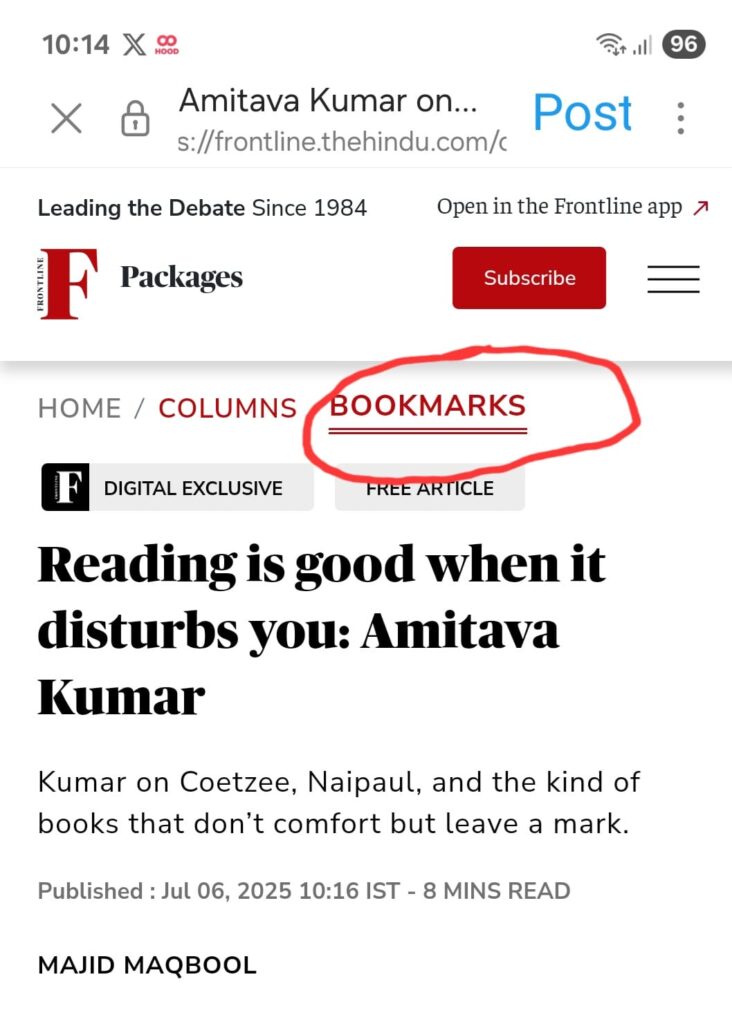
On Sunday, 6 July 2025, I spotted a new column being announced by The Hindu called “Bookmarks”. It’s aim is to feature prominent writers, public intellectuals, scholars, activists, etc – talking about books that have shaped their lives and worldview. This is good news. The more spaces that open up in mainstream media for writers/books, the better it is for the publishing ecosystem.

Here is the image from The Frontline website:

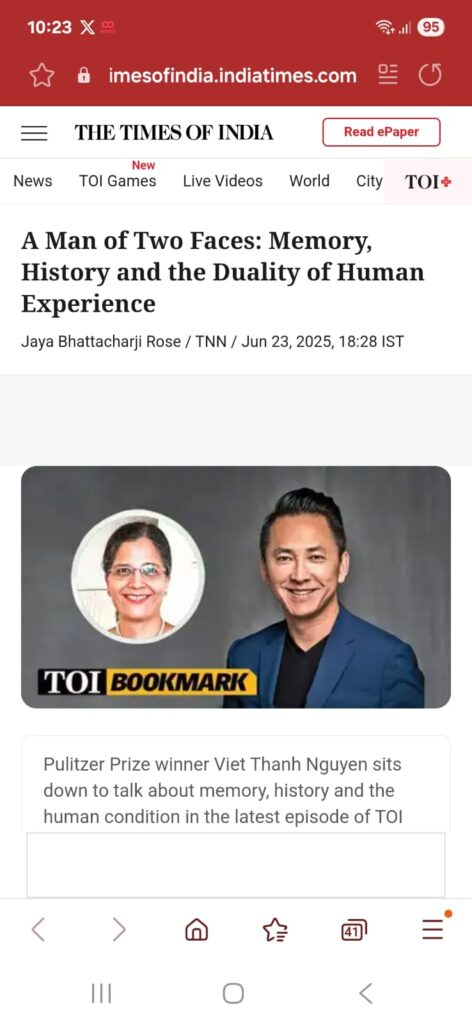
A couple of years ago, I began a podcast series with the Times of India called “TOI Bookmark”. TOI Bookmark is a weekly podcast on literature and publishing. TOI is an acronym for the Times of India (TOI) which is the world’s largest newspaper and India’s No. 1 digital news platform with over 3 billion page views per month. The TOI website is one of the most visited news sites in the world with 200 million unique monthly visitors and about 1.6 billion monthly page views. TOI is the world’s largest English newspaper with a daily circulation of more than 4 million copies, across many editions, and is read daily by approximately 13.5 million readers. The podcasts are promoted across all TOI platforms. Till date, I have recorded more than 138+ sessions with Jnanpith, Padma Bhushan, and Padma Shree awardees, International Booker Prize winners, Booker Prize winners, Women’s Prize for Fiction and Non-fiction, Nobel Laureates, Pulitzer Prize, Stella Prize, AutHer Awards, Erasmus Prize, BAFTA etc. Sometimes the podcast interviews are carried across all editions of the print paper with a QR code embedded in it.

Some of the authors who have been interviewed are: Banu Mushtaq, Deepa Bhashti, Samantha Harvey, Jenny Erpenbeck, Michael Hoffman, Paul Murray, V. V. Ganeshananthan, Hisham Matar, Anita Desai, Amitava Kumar, Hari Kunzro, Venki Ramakishnan, Siddhartha Deb, Elaine Feeney, Manjula Padmanabhan, NYRB Classics editor and founder Edwin Frank, Jonathan Escoffery, Joya Chatterji, Arati Kumar-Rao, Paul Lynch, Dr Kathryn Mannix, Cat Bohannon, Sebastian Barry, Shabnam Minwalla, Paul Harding, Ayobami Adebayo, Pradeep Sebastian, G N Devy, Angela Saini, Manav Kaul, Amitav Ghosh, Damodar Mauzo, Boria Majumdar, Geetanjali Mishra, Viet Thanh Nguyen, Rachel Clark, William Dalrymple, Abdulrazak Gurnah, and Annie Ernaux.  

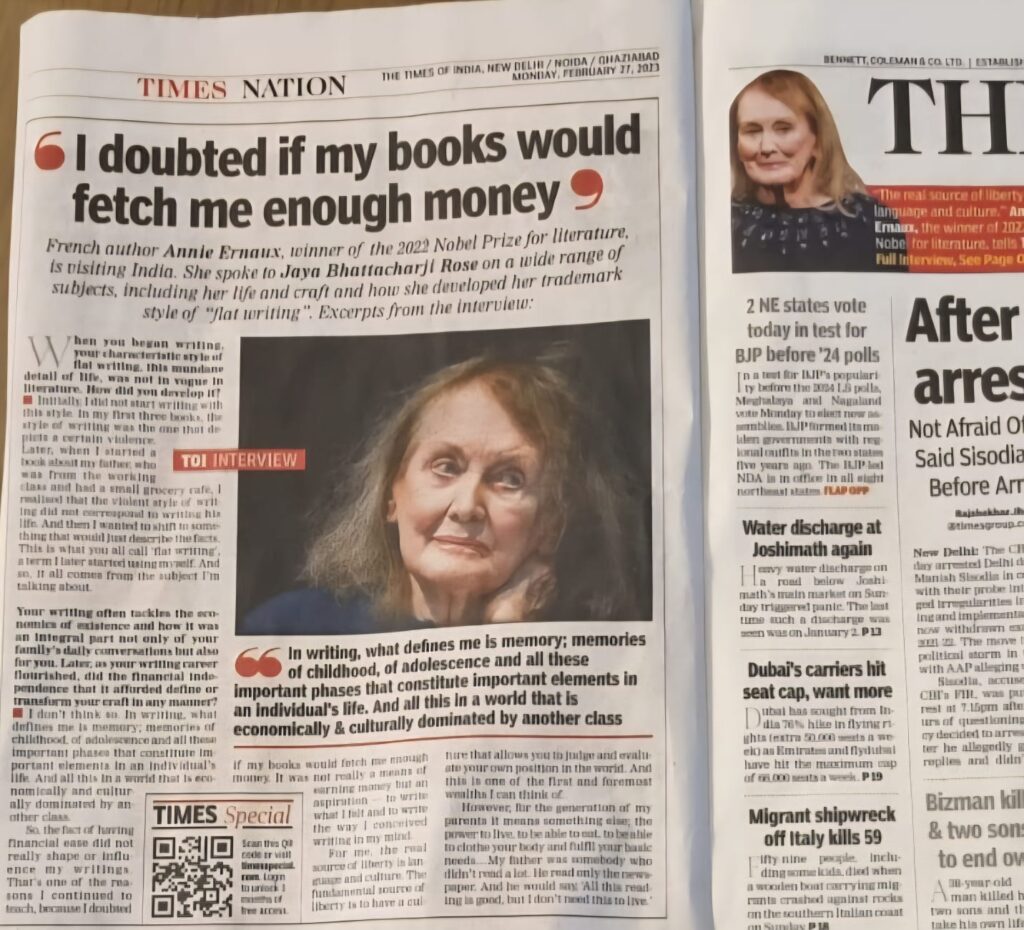
TOI Bookmark is available on the Times of India website and on Spotify too. Sometimes, links to it are published in the print media. For example, my conversation with Nobel laureate, Annie Ernaux.

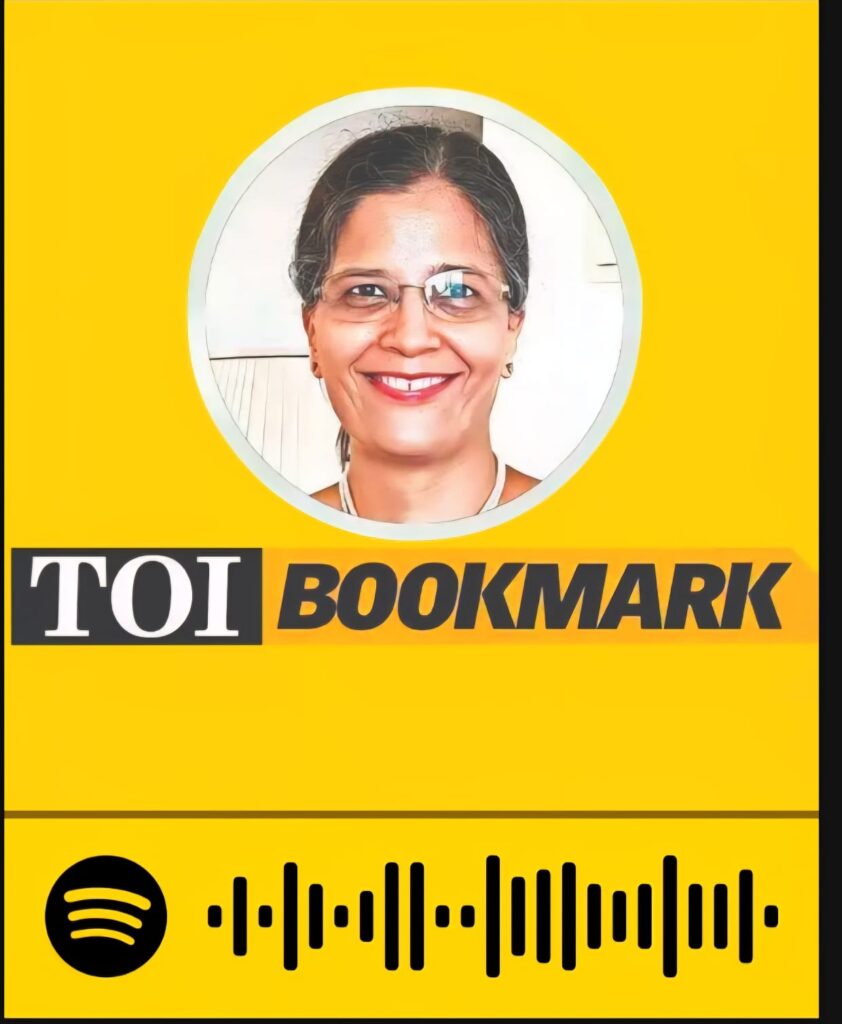
Here is the logo from the Spotify channel:

Here is an example of how the interviews are carried in print. This is an interview with Annie Ernaux from 2023.

Imitation is the best form of flattery. So of all the words in the English language that The Hindu could use to describe their new column of author conversation, to pick “Bookmark(s)” is rather amusing. I look forward to reading the Frontline interviews.

7 July 2025

“Between Two Rivers” by Moudhy Al-Rashid

I read this book in one sitting. At times, it does get a little challenging to remember the names that are from the past, but after a while, even that is no longer an impediment to reading this marvellous book. Moudhy Al-Rashid falls in love with cuneiform by sheer accident. She is on her way to becoming a lawyer but one fine day, whiling away her time in London, she enrolls in an intensive course called “The Book in the Ancient World”. It changed her life. The British Museum tutor, Irving Finkel, showed his students artefacts from Mesopotamia and talked about their historical significance. To an untrained eye, like Moudhy Al-Rashid’s at the time, these artefacts looked like lumps of clay but as Finkel spoke, it became clear that clay tablets contained neat cuneiform writing from a different millennia. They had been dug up by Hormuzd Rassam, the Mosul-born archaeologist in 1881.

In Between Two Rivers, historian Moudhy Al-Rashid analyses prominent artefacts with cuneiform found in Mesopotamia. It is a fascinating set of essays. The last one is on the women mentioned especially Enheduanna.

In 2022, the BBC had published an article on Enheduanna as well. “Enheduanna: The world’s first named author“, 26 Oct 2022.

Here is the book blurb for Between Two Rivers. It is published by Hodder and Stoughton/ Hachette India:

Thousands of years ago, in a part of the world we now call ancient Mesopotamia, people began writing things down for the very first time.

What they left behind, in a vast region between the Tigris and Euphrates rivers, preserves leaps in human ingenuity, like the earliest depiction of a wheel and the first approximation of pi. But they also capture breathtakingly intimate, raw and relatable moments, like a dog’s paw prints as it accidentally stepped into fresh clay, or the imprint of a child’s teeth.

In Between Two Rivers, historian Dr Moudhy Al-Rashid reveals what these ancient people chose to record about their lives, allowing us to brush hands with them millennia later. We find a lullaby to soothe a baby, instructions for exorcising a ghost, countless receipts for beer, and the adorable, messy writing of preschoolers. We meet an enslaved person negotiating their freedom, an astronomer tracing the movement of the planets, a princess who may have created the world’s first museum, and a working mother struggling with ‘the juggle’ in 1900 BCE.

Together, these fragments illuminate not just the history of Mesopotamia, but the story of how history was made.

I have never read a book on Mesopotamia that so beautifully brings to life the people themselves. There are beautiful descriptions of what it is to be pregnant, to give birth, to have small children, to love a dog. I love the way in which she’s not just writing about priests or kings, but is giving us a clay tablet on which a little child has bitten, so you have the imprint of his teeth. It melts away the sense of time. A wonderful read. — TOM HOLLAND

An ode to the power of history. It builds a persuasive case for history writing as a particularly human impulse, and for how lives of people living thousands of years ago can reflect and shape our modern lives in unexpected ways … Al-Rashid punctuates her prose with personal recollections and humour, as well as touching reflections on her experience of motherhood. She is our companion, tour guide and teacher … a plethora of fun historical facts … To write a book like this one, the author needs to have both mastery over the subject material and an engaging style of communication. Al-Rashid excels in both areas. For general audiences, Between Two Rivers is a fascinating, balanced introduction to this complex – and at times elusive – ancient world. ― The Conversation

This book is an extraordinary invitation to the magical land of Mesopotamia, written like your best friend is sitting with you next to a cozy fire with a warm drink, spinning mesmerizing tales of the fascinating land which birthed our modern world. It is a stunning debut effort, written by both a wonderful scholar and talented social media communicator. — PROFESSOR SARAH PARCAK

Fascinating and magnificent, beautifully written and explained: this book is a masterpiece. — GEORGE MONBIOT, author of Feral and The Invisible Doctrine

A marvellous book, which not only brims with humanity but offers fascinating and often funny insights into everyday life in this crucial era of world history. Fart jokes to exam stress, motherhood and tax evasion: you’ll find something here that reminds you that this ancient history is not as remote as you might think. Al Rashid describes her job of reading ancient Mesopotamian texts as like shaking hands with strangers. — JAMES BARR, author of A Line in the Sand

Her infectious enthusiasm imbues Between Two Rivers, a lively and beguiling history of ancient Mesopotamia … I found myself completely enthralled by an ancient period and civilisation I previously knew very little about. — CAROLINE SANDERSON ― What to Read Now

A lively portrait of this ancient civilisation … Al-Rashid is an engaging and knowledgeable guide … Many of her characters – bored schoolboys, tired parents and squabbling siblings – are extremely relatable … Between Two Rivers provides remarkable insights into ancient lives … even at a distance of nearly four millennia, it is impossible not be moved ― Sunday Times

A highly readable introduction to an era of history that deserves to be better known. — Starred Review ― Kirkus

Wonderfully vivid. ― Literary Review

tender, moving and vivid history of ancient Mesopotamia and how it still speaks to us. — ROBERT MACFARLANE

Absorbing, learned and wittyBetween Two Rivers is far more than an account of ancient Mesopotamia. Al-Rashid offers an ingenious, passionate ‘history of histories’, spinning outwards from relics collected by a royal priestess more than 2,500 years ago. In discovering familiar human joys and sorrows – surviving in times of peace and war, dealing with royal and divine demands, the desperate love for our children – we vividly witness how lives across the millennia are revealed and connected by archaeology and cuneiform. — REBECCA WRAGG SYKES author of Kindred

Ancient Mesopotamia comes alive in Moudhy Al-Rashid’s must-read, millennia-spanning history, cleverly wrought from tablets written in the world’s oldest script … spellbinding … a fresh and very human portrait of the region… Through her clever sifting of the texts, we see how cuneiform … helped to bind these civilisations together across millennia… We also discover, in Al-Rashid’s vivid rendering of the texts, very moving details from the lives of real people in Mesopotamia over the ages … Al-Rashid’s academic background gives her a wonderful confidence as she roves around the literary and archaeological evidence. She is also a gifted storyteller, able to spin a yarn of gold from the very fragmentary sources … This is a delightful book, and a must-read for anyone interested in these civilisations. I hope it serves to shine a larger spotlight on this extraordinary period in humanity’s past. — Emily Wilson ― New Scientist

Dr Moudhy Al-Rashid is a Junior Research Fellow at the University of Oxford’s Wolfson College, where she specialises in the languages and history of ancient Mesopotamia. She completed her B.A. from Columbia University in Philosophy, and after a single day of learning about cuneiform texts at a summer school, decided to pursue the subject with a Master’s degree and eventually a Doctoral degree at the University of Oxford.

She has written for academic and popular journals, including History Today, on topics as diverse as mental illness in ancient Mesopotamia to Late Assyrian scholarly networks. In addition to her writing, she has also appeared on several podcasts, including the BBC Podcasts Making History and You’re Dead to Me. Through her Twitter account, which has over 27,000 followers, she hopes to give ancient Mesopotamia as wide an audience as possible and to humanise its long history. Originally from Saudi Arabia where she grew up, she now lives near Oxford with her family and their four dogs.

2 July 2025

PENGUIN LAUNCHES ‘PENGUIN EIGHT’—A NEW IMPRINT DEDICATED TO THE STORIES OF NORTHEAST INDIA

July 1, 2025

Penguin Random House India is proud to announce the launch of Penguin Eight, a new publishing imprint dedicated to books that explore the cultural and literary richness of Northeast India. The imprint is a significant step in Penguin’s continued mission to publish diverse, representative, and meaningful stories from across the country.

With a sharp editorial focus, Penguin Eight will publish works by both emerging and established writers—regardless of where they are from—whose narratives reflect the complexities, histories, and voices of the Northeast. The goal is to create a lasting platform for high-quality writing that engages deeply with the region’s unique realities and lived experiences. The name Penguin Eight draws inspiration from the eight states that comprise Northeast India. The imprint will release close to half a dozen titles annually to begin with, spanning fiction, non-fiction, memoir, poetry, history, politics, folklore, and more.

As part of the launch, Penguin Random House India also unveiled the new logo for Penguin Eight, designed in-house by Aakriti Khurana. Inspired by the natural landscape of the Northeast, the logo features two stylised fiddlehead fern fronds—an organic and locally resonant motif found in the region. The design symbolizes growth, rootedness, and new beginnings—perfectly echoing the imprint’s ambition to amplify voices from a culturally vibrant and deeply storied part of the country.

Deepthi Talwar, Executive Editor, Penguin Random House India, says, ‘With Penguin Eight, we’re taking a deliberate step toward editorial inclusivity—ensuring that literature about the Northeast has a visible, committed platform within mainstream publishing. As programming director of Penguin Presents The White Owl Literary Festival in Dimapur, I’ve had the opportunity to listen to readers, authors, and thinkers from the region. This imprint is an outcome of those conversations, and of our belief that thoughtful commissioning and long-term engagement can play a transformational role in publishing. Our submissions are open, and we’re looking to build a list that is both accessible and enduring.’

Milee Ashwarya, Publisher & SVP – Adult Publishing Division, Penguin Random House India, says, ‘Penguin Eight is an important milestone in Indian publishing—it is the first imprint by a major publishing house solely dedicated to the literature of a specific region. At Penguin, we are deeply committed to inclusive and representative publishing, and this imprint reflects that ethos in action. Over the years, we’ve steadily built a relationship with readers and writers from the Northeast—starting with key titles, then launching a dedicated literature festival, and now creating a lasting publishing home. Penguin Eight is a long-term investment in regional storytelling, one that will make these narratives more visible, celebrated, and accessible to readers across India and the world.’

About Penguin Random House India

Penguin Random House India is the country’s leading trade publisher, publishing over 450 new titles every year and managing a diverse backlist of more than 3,500 books. Our publishing spans literary and commercial fiction, non-fiction, and children’s books — from politics, history, memoir, and business to health, self-help, cookery, and culture.

We are home to some of India’s and the world’s most celebrated voices — including winners of the Nobel Prize, Booker Prize, Jnanpith Award, and Sahitya Akademi Award. Several of our authors have also been honoured with the Bharat Ratna and Padma Vibhushan, reflecting the influence of their work in literature and public life.

Penguin Random House India also serves as the exclusive distribution partner for several major international and local publishers, bringing books to readers across India and the subcontinent.

2 July 2025

Web Analytics Made Easy -
StatCounter