Who would have guessed that it is possible for an Indian woman to defy all odds to become India’s first master of wine. One in a Billion is an account of how Sonal C. Holland did just that. It is a smoothly written memoir, straddling the space of motivational and narrative non fiction books. There are interesting nuggets of information shared, such as:
p. 173 It’s no secret that Indians love to drink! India is the third largest alcobev market by volume in the world, next only to the United States and China. Every year, Indians guzzle six billion litres of alcohol, over half the world’s whisky ( a staggering 1.5 billion litres) and double the amount of beer. We imported 219 million bottles of whisky in 2023, which was up by 60 per cent from 2011.
A double-digit growth consistently over the past decade makes wine the fastest-growing beverage in the country. Indians are becoming exposed to the wine lifestyle on account of their social networks, international travel, rising disposable incomes and aspirational living. As the demand for luxury products and more spending drives premiumisation across sectors, wine and other alcoholic beverages are the direct beneficiaries of this upward moving trend. Premium vodka, rum, gin and sake, alongside high-quality wines and craft beers, have grown popular too.
Consumers perceive wine to be healthy, see it as a symbol of success and sophistication, and it is socially the most acceptable drink. No other alcoholic beverage enjoys this trilogy of appeal, and it has worked in the favour of wine remarkably.
….
Women represent an important demographic for wine consumption in India as they are choosing wine for being a softer, healthier option as well as for its aura of elegance. Research shows that women, in general, feel less inhibited and face less criticism when drinking wine in front of their family members. In a soceity that has traditionally lived in joint families and encouraged only male drinking, women drinking wine at restaurants, bars and at home is a huge opportunity and a real game changer for the industry. In a way, wine has democraticised drinking for women in India, allowing them to join their male counterparts in enjoying a drink. This movement is now reaching smaller cities; with the exposure to urban culture and the arrival of luxury dining options, women finally have the liberty to experience wine regularly.
A book that is far too smoothly written, almost as if ghost written, and not a firsthand lived experience. There is something very sanitised, without granularity in the prose. Definitely has interesting nuggets of information about Sonal Holland’s life and the wine sector in India, but it is almost as if this book is fulfilling the desire to be a calling card of the subject. After all, Indians (possibly globally too), once you have a book to your name, your respectability rises manifold.
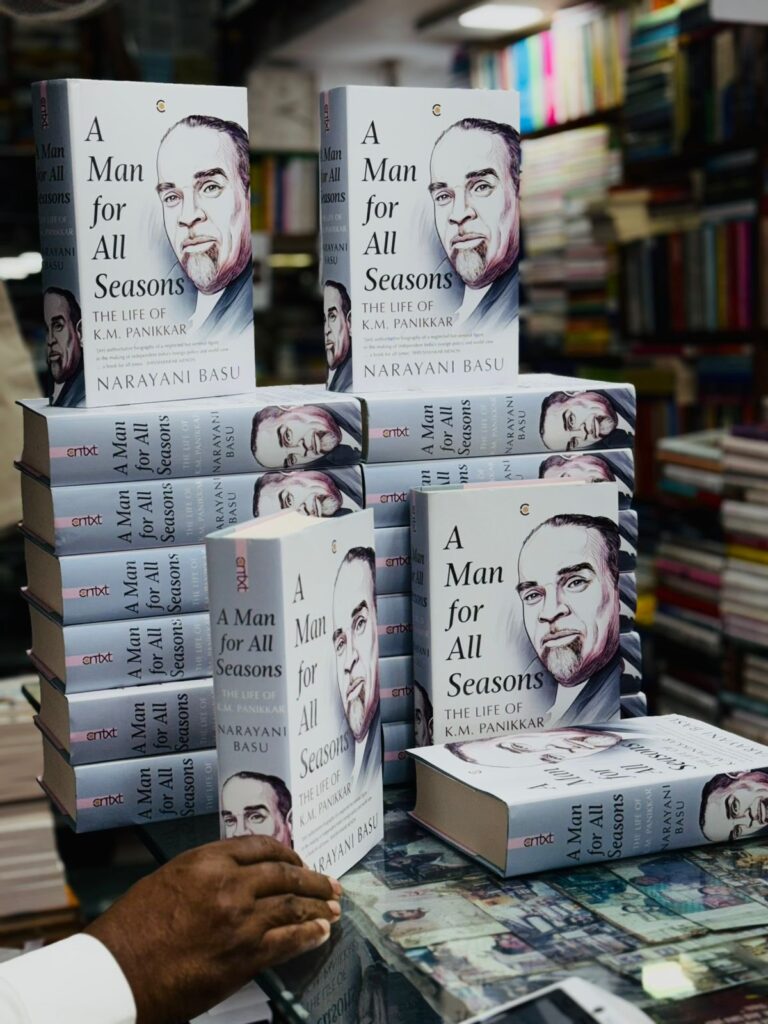
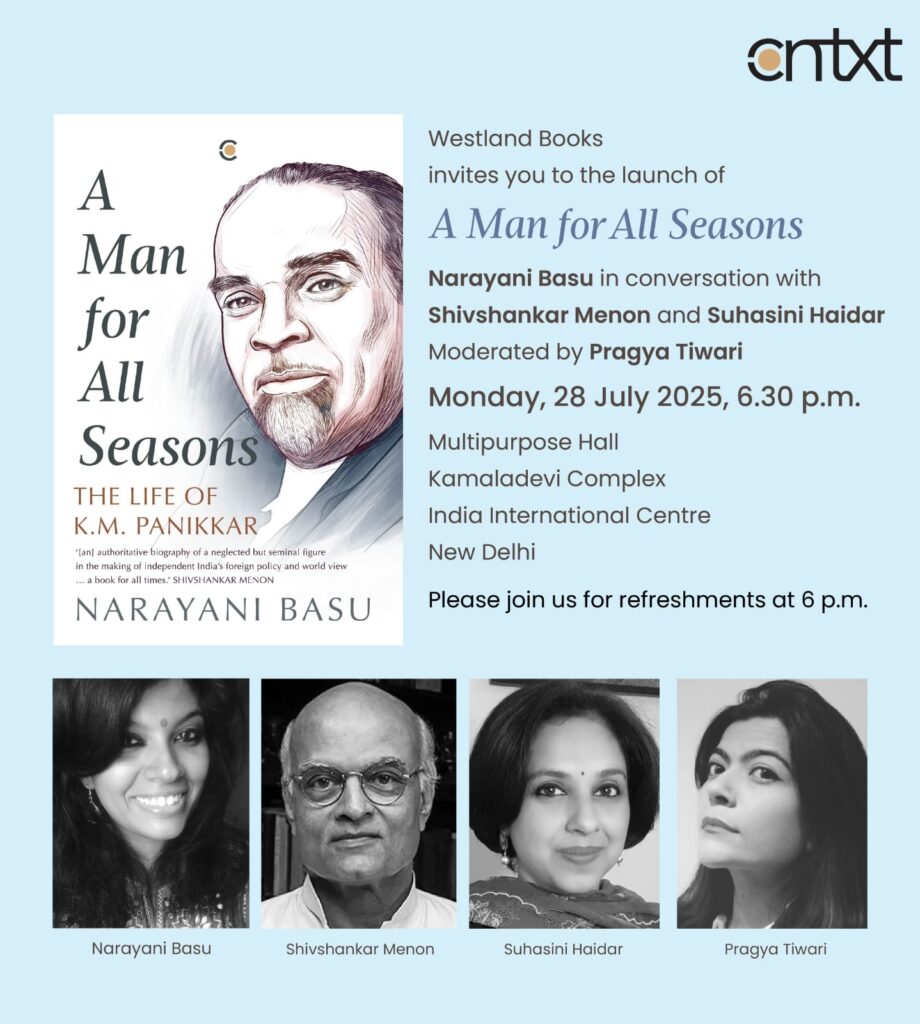
A Man for All Seasons (published by Westland Books) has been a few years in the making. Biographies are not easy to write, especially if you want to stay clear of writing a hagiography. Also, not too dry, by focussing only on facts and step by step details. It could not have been easy to write but it is always interesting to read what a biographer thinks is important vis-a-vis historical details. How do they go back in the past to recreate a life? Is it focussing on the life that the person led in their time or is it to be written from the perspective of present day India with a view on the modern reader’s appetite? Which is it to be? Tough act. Nevertheless, Narayani Basu manages to find the right balance.
From Twitter
Book blurb
AN UNFLINCHING LOOK AT ONE OF INDIA’S MOST FASCINATING FIGURES—THE PUBLIC INTELLECTUAL AND DIPLOMAT WHO HELPED SHAPE A POST-COLONIAL INDIA. K.M. Panikkar was a multifaceted man, one of India’s first public intellectuals as India won its independence. His imprint is all over India’s colonial and post-colonial history: from constitutional reform in the princely states, where he was a strong advocate for India’s current federal model to charting India’s maritime policy as a free country. He believed in an essential Hindu culture that held his land together, yet he was a committed secularist. He was Gandhi’s emissary and the founder of the Hindustan Times. He was independent India’s first and most controversial ambassador to both Nationalist China and the People’s Republic of China. He was Nehru’s man in Cairo and France and a member of the States Reorganisation Commission. He had enemies in the CIA as well as in India’s own Ministry of External Affairs. He frustrated his admirers as much as he provoked their reluctant respect.
From the British Raj to the Constituent Assembly, across two world wars and an ensuing Cold War, K.M. Panikkar was India’s go-to man in all seasons.
Through it all, he never stopped writing—on Indian identity, nationalism, history and foreign policy—material that remains as relevant today as it was seven decades ago.
Yet, about the man himself, strangely little is known. In A Man for All Seasons, Narayani Basu bridges that gap. Drawing on Panikkar’s formidable body of work, as well as on archival material from India to England, from Paris to China, and from Israel to the United Nations, as well as on first-time interviews with Panikkar’s family, Basu presents a vivid, irresistibly engaging portrait of this most enigmatic of India’s founding fathers. Featuring a formidable cast of characters—from Jawaharlal Nehru, Mahatma Gandhi and Sardar Patel to Zhou Enlai, Chairman Mao and Gamal Abdel Nasser—A Man for All Seasons is as much a sweeping history of a young India finding its place in the world as it is the story of a man who was impossible to ignore then and remains so now.
Narayani Basu is the bestselling author of V.P. Menon: The Unsung Architect of Modern India (2020) and Allegiance: Azaadi & the End of Empire (2022). A historian and foreign policy analyst, her current area of interest focuses on the less known but key players in the story of Indian independence. She lives in New Delhi. This is her third book.
Inner Sense: How the New Science of Interoception Can Transform Your Health (published by Profile Books/Hachette India) looks at the intersection of many sciences to understand how humans can improve their health. It does not necessarily focus on those identified as clinically sick for whatever reason. Even able bodied individuals have their moments of anxiety, self-doubt, and possible physical manifestations thereof. It is about knowing oneself better without advocating positive toxicity. Caroline Williams attempts to understand scientifically the underlying reasons for a diverse group of individuals feeling the way they do. Her sample cases are fairly varied. She also advocates trusting one’s gut, following one’s instincts and trusting one’s heart.
On p.78 she makes a valid observation:
The brain’s predictions and interpretations of what’s happening in the body can carry a lot of weight in the equation that adds up to how we feel. So it stands to reason that if we could somehow change what the brain thinks is happening in the body, it mught help to change how energised we feel.
An important aside: I’m not suggesting that anyone with chronic fatigue is able to think themselves better. Research suggests that this condition is usually the result of a physical glitch in the system, not an imagined one, and the same is true of many instances of everyday fatigue.
Later she discusses at length about the importance of gut health and recognising the signals.
p.101ff …gut feelings are so important. If hunger didn’t make us feel bad and eating didn’t feel good, our prehistoric ancestors might have wasted away in a cave rather than risk going out hunting and gathering. If being sick didn’t feel so miserable, we might not learn to avoid bad food, and the next rotten piece of meat could kill us. And if we didn’t know to stop eating when we felt full, we might keep seeking out food at the expense of other important things, such as staying safe and warm and fostering life-enriching relationships.
These relationships are as important for our survival as finding enough calories. Humans are relatively puny compared to our natural predators, and we have long childhoods, during which we are dependent on others for food. It makes sense that at some point in our evolution, the basic motivational feelings for finding food were recycled as motivators that prompted us to seek out social institutions. As a result, we get hungry for food but also for human connection and comfort. We feel sick not just when we’ve eaten something rancid but also when a creepy stranger stands too close to us. And we feel warm and fuzzy inside when eating our favourite meal and when we’re with someone we love. For most of our evolutionary history this system has guided us well. But in a world where comfort food is easier to come by than meaningful human connection and where much of what we eat is tastier than it is filling, it can be a struggle to know what our bodies — and minds — are asking for.
To make things even more complicated, food and comfort aren’t the only things our guts communicate with the brain about. The gut is hardwired into the fight-of-light system, meaning that it also sends out signals that are a side effect of a body-wide call to action. We all know what it feels like when our stomach flips when we are nervous; when we are faced with a life-or-death situation (or a more trivial social encounter that feels like one), digesting our last meal can wait. The blood that would usually be required for digestion is diverted to the muscles and brain, so its share of glucose and oxygen can be used to deal with the emergency. The sensation of a knot deep in your stomach, the fluttering of butterflies or a cold wave as the blood drains from your belly is a direct result of digestion grinding to a halt while the blood is sent elsewhere.
This system also works well — at least, when we need a burst of energy to deal with a cahllenge — but it can easily get out of whack in the stressful modern world. The link between emotional issues and digestive problems that has long proven difficult to explain is becoming increasingly clear — and even harder to treat in a medical system that thinks of conditions as being either physical or ‘all in the mind’.
All things considered, the overlap between our gut feelings and emotional state means taht trusting your gut is not always as straightforward as it might be.
p.111ff It is often said that the gut has a ‘second brain’ that operates semi-independently from the brain in our heads. The enteric nervous system is embedded in the gut walls along most of the gut, and contains more neurons than the spinal cord. It’s reputation as a second brain comes from the fact that it can manage the complex process of digestion without any input from the actual brain, regulating the contractions that push food through the gut and the hormones involved in the digestion.
While the enteric nervous sytem can do a lot without the say-so of the brain, they are not totally disconnected. Over the past decade, it has become clear that the insides of the gut not only talk among themselves via the enteric nervous system, but are also in constant contact with the brain, via the vagus and spinal sensory nerves. These lightning-fast connections mean that the brain hears what’s happening in the gut in miliseconds. It also means that whatever is happening in the brain affects the gut just as quickly. This is the much-talked-about gut-brain acix, which is proving to be a new frontier in understanding what makes us tick — and what makes us sick.
This is a fascinating book. It goes into a fair amount of biochemical details about how these systems are interconnected inside us. Also, sharing new scientific discoveries or rather finding scientific evidence for statements (as mentioned above) that people have made for a long time and discovering the truth.
Perhaps this book is for you, if you are an eclectic reader, perhaps it is for you, if you are a specialist interested, but it is definitely for you if you are charmed by Ozempic and Wegovy.
Believer’s Dilemma concludes Abhishek Choudhary’s landmark two-part study of Atal Behari Vajpayee (1924–2018), the RSS propagandist who established himself as an imaginative moderate, drawing the Hindu Right from the fringes to displace Congress as the natural party of power.
This magisterial second volume combines new archival documents with revealing interviews to present an unsentimental history of India’s ongoing political moment, beginning with the short-lived Janata coalition and the Vajpayee–Morarji Desai tussle to steer foreign policy; Mrs Gandhi’s ad-hocism in Assam, Punjab and Kashmir; Rajiv’s cynical turn toward the Hindu vote; Vajpayee’s failure to secularize the newborn BJP; the Sangh Parivar’s meticulous plan to raze the Babri, and much more. Choudhary traces these machinations of the previous half-century to cast fresh light on major events from Vajpayee’s term in office (1998–2004), including his desperation to conduct nuclear tests; his cold pragmatism and heartbreak in negotiating with Pakistan and China; his wide range of emotional strengths, which allowed him to manage an unwieldy thirteen-party coalition and turn India into a multi-party democracy; his role in propping India up as a potential superpower and embedding capitalist aspiration into its socio-political imagination.
According to historian, Ramachandra Guha, this is “the finest biography of an Indian prime minister that I have read”.
Mapping the evolution of the Sangh Parivar, this book reveals a deeper pattern in Vajpayee’s character: his reflexive loyalty to his ideological family in moments of crisis – be it the 1983 Assam riots, the 1992 Babri aftermath, the 2002 Gujarat riots, or his tragic last public appearance in 2008, when the stroke-battered patriarch voted against the Indo-US nuclear deal he had earlier helped seed.
A decade in the making, Believer’s Dilemma is an original and psychologically insightful take on the Hindu Right and its first prime minister.
Today, in the evening, this extract was embedded in Nalin Mehta’s The Editor’s Pick newsletter that is circulated to nearly one million subscribers.
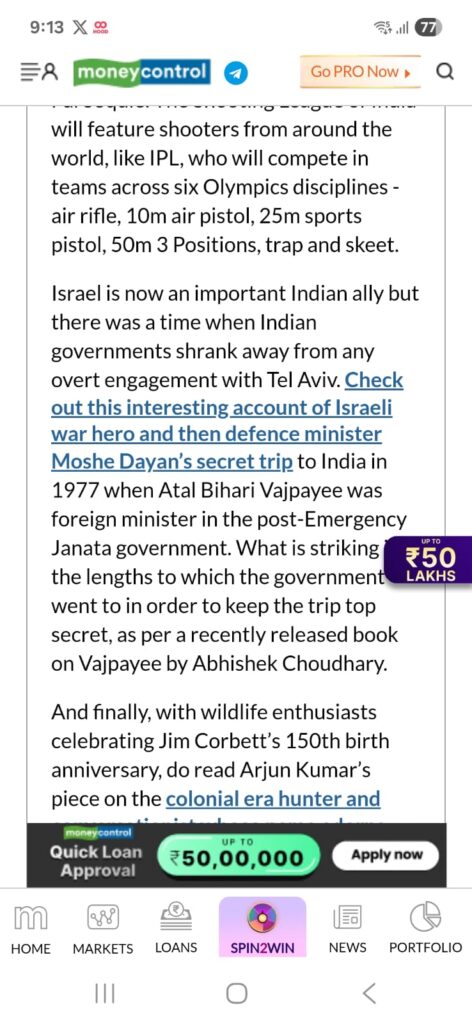
Israel is now an important Indian ally but there was a time when Indian governments shrank away from any overt engagement with Tel Aviv. Check out this interesting account of Israeli war hero and then defence minister Moshe Dayan’s secret trip to India in 1977 when Atal Bihari Vajpayee was foreign minister in the post-Emergency Janata government. What is striking is the lengths to which the government went to in order to keep the trip top secret, as per a recently released book on Vajpayee by Abhishek Choudhary.
Abhishek Choudhary studied economics in Delhi and Chennai, followed by brief stints in nonprofits and journalism. He was awarded the NIF Fellowship in 2017 to research former prime minister Vajpayee’s life. During the winter of 2021–22, he was a scholar-in-residence at the International Centre Goa. He lives in Delhi.
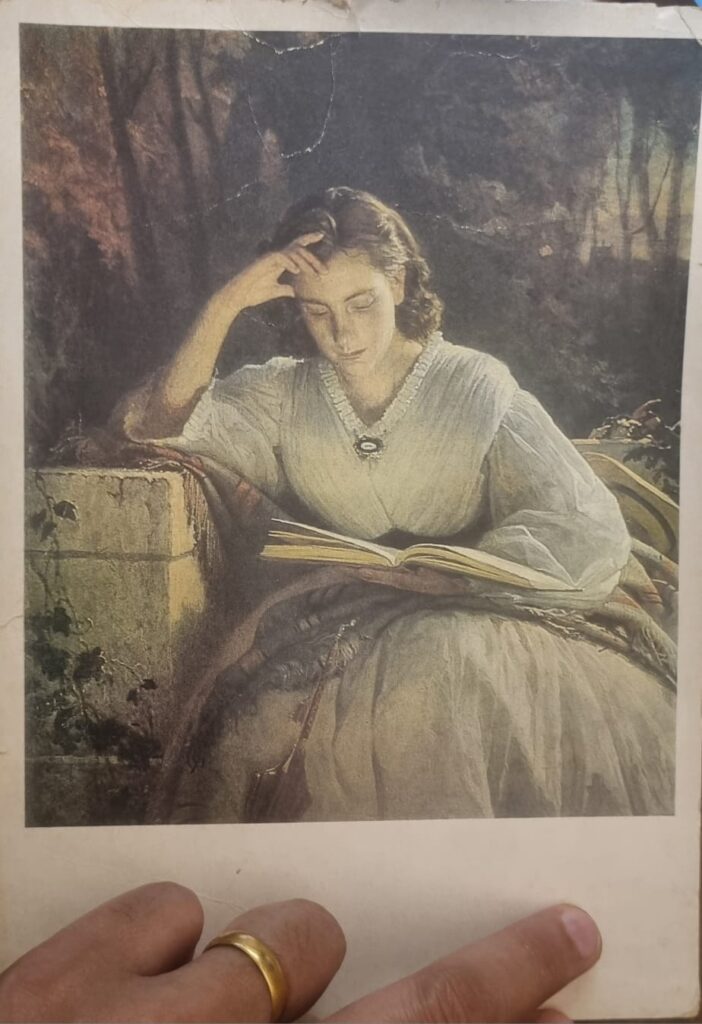
Painting by Ivan Kramskoi (1837 – 1887) Reading a Book. Portrait of Sophia Kramskya, the Artist’s Wife. 1860s. Oil on canvas. 64.5 x 56 cms. The Tretyakov Gallery, Moscow.*
Individuals or institutions — globally — interested in exploring publishing consultancy services and/or paid promotions pertaining to literature/books/publishing on this blog may email for more details.:
jayabhattacharjirose1 at gmail dot com
*This image is from a postcard printed in the USSR. I bought it in the 1980s when we had the Soviet festival in India. One of the highlights was a magnificent exhibition of paintings and artefacts on loan from the Hermitage Museum. They had also set up a counter to sell mementos. A beautiful set of postcards featuring painting by various artists was also available.
PanMacmillan India has launched a new imprint called Macmillan Business. As the name suggests, its focus will be books tackling business, wealth, money management etc. There is already a vast number of such books in the market but when a publishing company that has been around since 1843 makes this announcement, it is worth noticing. They quite literally mean business. This is a company that has published notable authors such as Lewis Carroll, Alfred Lord Tennyson, Charles Kingsley, T.H. Huxley, Tom Hughes, and Christina Rossetti. Sure, these are not business writers but the long tail of their books that spans centuries makes for excellent business. It is in the DNA of the company to commission/publish books with a long shelf life. Presumably, this is the context for the inaugural title being Mango Millionaire: Smart Money Management for a Sweeter Life. It has been co-authored by Radhika Gupta, Managing Director & CEO of Edelweiss Mutual Fund and Niranjan Avasthi, who is known for his deep insights on mutual funds, investor behaviour and market trends.
The current practice amongst business management books across the spectrum are to analyse and dissect one, maximum two principles. These inevitably also contribute to the title of the book, and slowly, if word-of-mouth popularity confirms the value of the book, in the wisdom it imparts, then the title/phrase synonymous with the book enters modern language. Providing examples will merely narrow it down to a few but think of some books in this genre and you will know what I mean. Perhaps “mango millionaire” will also follow suit? Who knows.
For now, the details provided in the book pertaining to personal finance are interesting to read. They range from your relationship with money, debt, saving versus investing, taxes, real estate, gold, fixed income, equities, mutual funds, money hygiene, portfolio building, money and the family etc. Very basic headers but those that will appeal to the middle class. These are thoughts that are constantly plaguing the common wo/man on how to secure their future. Given the hype in the media regarding markets, mutual funds, bank interests and the general shrill noise that exists in this ecosystem, it is hard to discern the difference between a valuable personal finance product vs a dud sold by an overenthusiastic sales person eager to meet their KRAs.
Mango Millionaire offers advice interpsersed with anecdotes/case studies of people whom the authors have encountered in their work. It sort of straddles the space between offering a broad picture of the personal finance sector and that of a handy manual. Given the low price point of Rs 399, it will appeal to the mass market and may even find its way into being adopted by specialist courses. It could become a prescribed textbook too. This will definitely ensure that the ROI on the book will prove to be lucrative. Only time will tell!
The book blurb reads:
An easy and straightforward guide to mastering your money – from two trusted experts
How much should you spend and how much should you save? Should you rent or buy? How much debt is too much? Which insurance policy is right for you? How do you choose the best investment product?
If you’ve ever found yourself grappling with these questions, you’re not alone. As India’s financial landscape has evolved, the sheer number of choices have grown, but so have the myths and misinformation. Managing money isn’t just for the privileged few; it’s for everyone – especially the aam janta, or the mango people.
Radhika Gupta and Niranjan Avasthi draw from their extensive experience at Edelweiss Mutual Fund – one of India’s leading and fastest-growing asset management companies – to bring you Mango Millionaire – a crisp, reliable and no-nonsense guide to smart financial planning.
From budgeting and saving to investing, debt management, risk and taxes, it lays down practical advice in bite-sized, easy-to-read chapters. Packed with insightful stories from real investors and easy-to-follow steps, Mango Millionaire slices through the jargon and serves up practical answers to empower you to take control of your financial future.
Meanwhile, there is one detail that I am unable to wrap my head around. If both the authors are veterans in the field and can dispense with sound advice regarding money, then why is it that Radhika Gupta’s name is in a larger and bolder font than that of Niranjan Avasthi. Is it an ego clash? It begins with the design of the book cover. Then it spills into the text itself. Truth be told, the introduction is pleasant enough with Radhika Gupta acknowledging the efforts of her co-author but largely talking about her own encounters. These may be random strangers at the airport who recognise her or even an uncle at a wedding, who will tap her on the shoulder for advice. Nevertheless, the ellision between objectivity and the use of the first person is slippery. It carries on through the text. For many readers it may not matter but to me it does. It bothers me that people who are meant to be dispensing advice about finance, a very personal and sensitive matter, are not sufficiently objective. Thus, making for an unstable and a volatile mix. The trust factor is built knowing that the personal finance advice being dispensed is provided objectively and with the best interests of the consumer/client at hand. For now there is a gap. While it is understandable that a business/personal finance/self help book can only speak in general terms, and perhaps that is why the reliance on the first person, to establish credentials via firsthand experience. Nevertheless, it does come across a little rough around the edges.
Business books published overseas use the first person as well. But the structure of the book is clearly spelt out. There is a range of ways in which this can be tackled but most often than not, the case studies are distinctively highlighted and the author(s) do not shy away from using the first person. But when they do, they do it with conviction. Even books that have more than one author make it a point to duly acknowledge each other throughout the book, making it clear to the reader, which topic is an author’s strength.
Despite my reservations about the book, I have been recommending it to various folks. It offers sound advice. Use it as a guide, not necessarily as the gospel truth.
The launch of Macmillan Business is a good effort and it should be lauded. Let’s see what the future holds. If the firm’s DNA exists in this imprint, then it will be a success. Time will tell.
India in Triangles is a truly fascinating account about the Great Trigonometrical Survey of India in the nineteenth century. It was a mission to map India by the British using triangulation. A method that helped them measure every inch with accuracy. Along the way, they calculated the height of the world’s tallest mountain and revealed the true shape of the earth.
Shruthi Rao and Meera Iyer tell a riveting tale of how India was mapped. It is an extraordinary story that incorporates mini biographies of the key people like William Lambton, George Everest, and Radhanath Sikdar, to name some. The authors have used scientific data, mathematical descriptions and historical details that could have fallen into the dangerous trap of being a complicated account; instead it is lucidy, swiftly moving, and despite being packed with information, it is immensely readable. They have also managed to create a text that does not dumb down its tone as if that is the only way for speaking to children. This book will work in the cross over market.
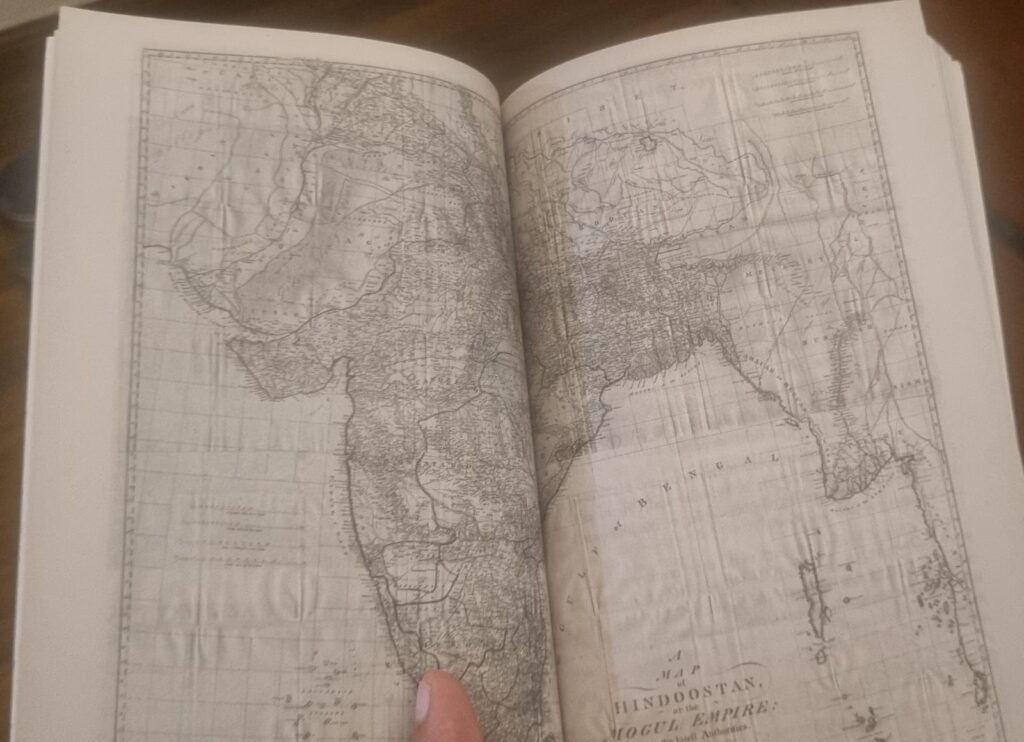
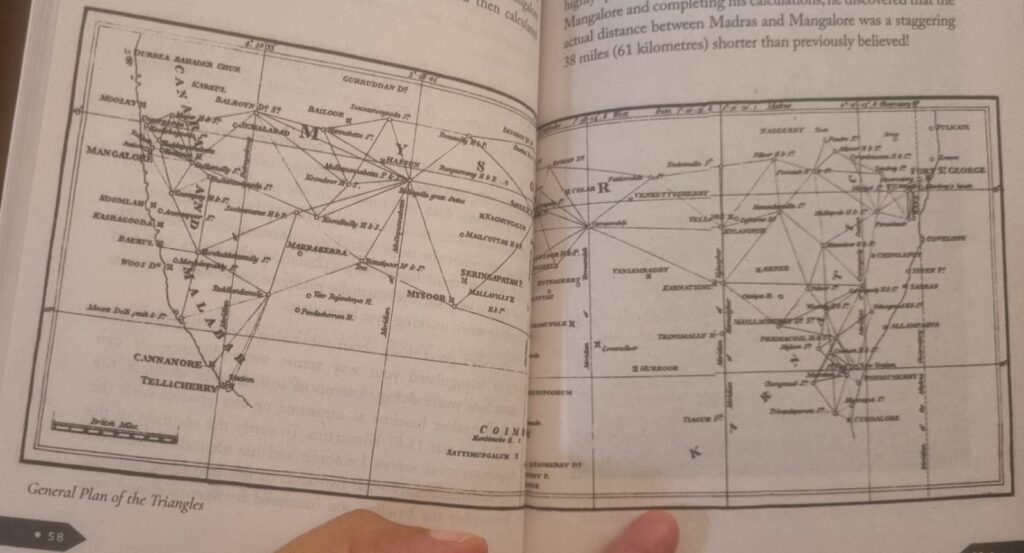
There are illustrations of the instruments used and even of the maps created. Unfortunately, some of the maps are quite unreadable and like black blotches of newsprint.
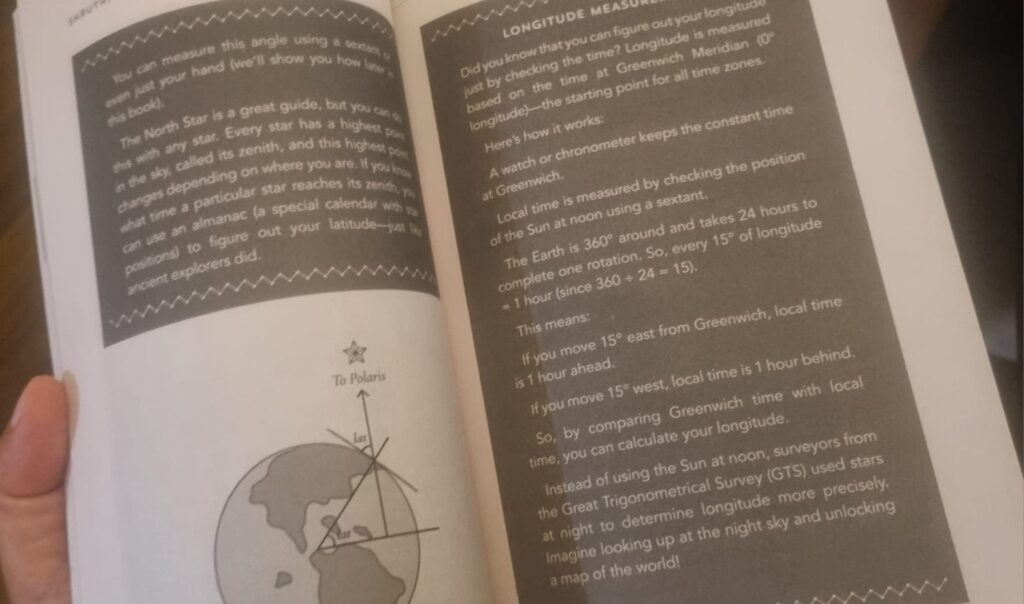
While I get the importance of watching costs in producing a book, surely, exceptions to the rule could have been in the case of India in Triangles. Firstly, when reproducing maps in a book, avoid doing a double page spread where the map falls into the gutter. Consider, printing the map in a folded paper. Make the experience immersive, tactile, and legible. Let the target audience know what it means to open a folded map and pore over it. Secondly, avoid using blurry, black and white print. Try and spend time with the design, even if the original reproduction of the map is of poor quality, and attempt to sharpen the image. It will take many hours to fix but ultimately, it will be worth it. When a book is a pleasure to read, the word spreads very quickly. Finally, even if this title is meant as children’s literature, surely there could have been an attempt to make the information in the boxes easier to read (or just do away with them!). To put faint white print on a dark background is uninteresting, dull and makes the text very difficult to read. Why is the joy taken out of reading because of the constant emphasis on cost? Surely, a decent balance can be struck between the two factors.
Sadly, this delightful book, has been printed on poor quality paper, that is rough to touch and is reminiscent of school textbooks. So, even if the layout, dimensions, and content of the book is not the same as the textbook, the memories that it throws up while holding such a book can mar the reading pleasure.
Reading a book is not just about reading the words on the page. Avoid making it into a workmanlike experience that is inevitably equated with reading school curricula. Reading should not be a chore. It should be a memorable pleasure and most certainly, when it is a book on the mapping of the Indian subcontinent. Tweaking a few design elements, looking at options in the market within the budget, to produce a low cost publishing may take a while to cobble but it will be worth it. It just requires a wee bit of imagination and a confident boldness, matching the astonishing clarity and perfect tenor with which the authors write. Their storytelling is filled with immense joy bordering on almost childish glee at stringing together the stories that make up this sparkling narrative.
This book is going to sell well. It will have a long tail.
All said and done, read it. It is published by Puffin Books, Penguin Random House India.
Naaga arrived today, courtesy the publisher, Harper Collins India. It is being released on 25 July 2025.
Book blurb:
Who are the naagas and sarpas, the divine serpents of Indian mythology?
What secrets lie within their mythical realm, Naagaloka?
What is the nagamani, and what myths surround its legendary power?
K. Hari Kumar combines meticulous research with vivid storytelling to uncover the cultural, spiritual, and historical significance of serpent worship in India.
Drawing connections with belief systems across the subcontinent, Naaga offers a fascinating exploration of shared truths, striking contrasts, and the enduring reverence for these animals.
Embark on a journey into a world where serpents are protectors, adversaries and symbols of divine power-deities that continue to inspire awe and devotion in India’s spiritual consciousness.
K. Hari Kumar is a bestselling Indian author, screenwriter and filmmaker. With an impressive track record of being one of India’s top genre writers, his stories rooted in Indian folklore and mythology have captivated readers across the subcontinent.
K Hari Kumar’s collection of horror short stories, India’s Most Haunted – Tales of Terrifying Places, published by HarperCollins India is one of the highest selling horror story books in India. The Times Of India deemed it as a must-read horror book, and it was also listed in HarperCollins India’s hundred best books written by Indian authors. The Malayalam translation of India’s Most Haunted was published as Indiayile Prethalayangal by Mathrubhumi Books in March 2022. The book will be soon translated into Hindi as well. He wrote the honourary foreword for FlameTree Publishing’s anthology titled Asian Ghost Stories (UK, Simon & Schuster).
In addition to his accomplishments in literature, K. Hari Kumar has made notable contributions to the world of cinema as a screenwriter and creative consultant. His novel The Other Side of Her received critical acclaim when adapted into the web series Bhram, featuring the talented Kalki Koechlin. As a filmmaker, he has directed two short films, a documentary, a music video and the cinematic trailer of his books. K. Hari is also an international award nominated photographer. His photographs have featured on covers of his books.
Educated in Gurugram, K. Hari Kumar holds a B.Tech in Information Technology and a B.A in English Literature, highlighting his diverse academic background. He currently resides in Pune with spouse, where he continues to fuel his creative pursuits. Hari is currently working on a series of books on folk mythology that will be published by HarperCollins.
Andrew Miller’s first novel, Ingenious Pain, was published by Sceptre in 1997. It won the James Tait Black Memorial Prize, the International IMPAC Dublin Literary Award and the Grinzane Cavour Prize for the best foreign novel published in Italy. It has been followed by Casanova, Oxygen, which was shortlisted for the Booker Prize and the Whitbread Novel of the Year Award in 2001, The Optimists, One Morning Like a Bird, Pure, which won the Costa Book of the Year Award in 2011, The Crossing, Now We Shall Be Entirely Free, The Slowworm’s Song and The Land in Winter, which won the Winston Graham Historical Prize and the Walter Scott Prize for Historical Fiction in 2025. Andrew Miller’s novels have been published in translation in twenty countries. Born in Bristol in 1960, he currently lives in Somerset.
The Land in Winter is a fabulous historical novel set in the extraordinary winter of 1962. The snowfall/blizzard began on Boxing Day 1962 and continued till March 1963. It was an unusual time where people were caught unawares, trapped indoors, with few rations. After a few days, even if the snow ploughs had helped clear roads, people were unsure if the grocery stores would be stocked. Supplies were erratic.
This novel centres around two young couples — Dr Eric and Irene Parry and Bill and Reeta Simmons. They are neighbours and outsiders to the village. Dr Parry is a GP and Bill Simmons is trying his hand at farming. Both the young wives are pregnant. The Land in Winter is about the lives of these four individuals, their intersections as well as their relationship with the other villagers in the local community.
There is a slow and deliberate build up to the story. But once the snow fall begins, the chapters are shorter, with the people trapped indoors and learning to live with each other. Given that the opening pages highlight some of the differences that were creeping into their marital relationships, the blizzard had proven to be (initially) a good thing. Over time, there are revelations that put their plans for a stable and content future as a young family asunder.
Andrew Miller specialises in historical fiction. Always has written in this genre. Ever since he chose writing as his profession at the age of eighteen. He has been fortunate to have won innumerable prestigious prizes. His research and eye for historical details to make the novel sound authentic in terms of the period it is set in, is meticulous. It is rewarding for the reader as it makes for a rich narrative. He makes multiple drafts and rewrites his texts, or portions thereof, as many times as is required. As a result, the sentences that he writes are exquisite. At times, even if the reworking has not improved the text, he discards it. Tough but essential. It is illuminating, liberating and rewarding because the text becomes clearer. It is a hard task to undertake and never gets any easier with every book that he writes but it helps get closer and closer to the truth he seeks in every story. There is immense variety in the kind of historical fiction that he writes.
Frankly, the two literary prizes that this book has collected so far in 2025 are well worth it!
Read The Land in Winter by Andrew Miller. It is published by Sceptre/ Hachette India.
A human story of war as experienced by a doctor who was the only surgeon at the Kargil field hospital
Arup Ratan Basu’s first posting as a young surgeon in the Indian Army Medical Corps was at a field hospital in the Kashmir valley. He was frustrated at being sent to a place that was not even equipped with a functional operation theatre while his classmates were taking up postings at established hospitals in major cities.
Little does the rookie surgeon know that he will soon be deputed to a small town that was turning into a dangerous theatre of war. Between 19 May 1999 and 24 July 1999, as the sole army surgeon at the field hospital in Kargil, he ended up performing two hundred and fifty surgeries, including on an enemy soldier.
Curious and sympathetic, the young surgeon engaged with his patients and colleagues and recorded his impressions in a notebook purchased at the town bazaar. He does not venture into the technical, logistic and strategic aspects of war; instead he remains resolutely focused on the people and the extraordinary price they pay. The result is a one-of-a-kind testimony, invaluable and enthralling.
As the first military surgeon on call at Kargil in the summer of 1999-when Pakistani troops, disguised as goatherds, crossed over the Line of Control and besieged critical Indian peaks-Lt. Col. (Dr.) Arup Ratan Basu toiled to rescue nearly 350 of our valiant soldiers from the jaws of death. One can only imagine how helpless he, trained to be a lifesaver, must have felt seeing a steadfast stream of young men marching to their deaths at those inhospitable heights-that too in a war not of their nation’s making.
In Basu’s view, it’s not so much about the futility of war as its untold human cost, which gets muffled beneath the nationalist pomp and clamour of any war effort-even one like Kargil, undertaken in self-defence. Yet for the parents who lose their sons, wives their husbands, and children their fathers, this is the only real consequence of war. And perhaps on no one’s conscience do these deaths weigh more heavily than on a doctor’s-who, for no fault of his own, could not prevent them.
A military doctor with a poet’s sensitivity and talent for lyrical expression, Arup Ratan Basu has composed a haunting elegy to the lives lost and blood spilt at Kargil. And as a powerful, poignant, and heart-wrenching indictment of the debilitating cost of war, The Kargil War Surgeon’s Testimony ought to be read-and remembered.
Interestingly, this endorsement was received the Monday of the week when Operation Sindoor happened. Later, when Shashi Tharoor spoke and was sent on the foreign mission to garner support via diplomatic channels, he echoed these very same words. It was prescient of him to have sent it when he did. Also, a curious way to connect these two incidents at the Indo-Pak border, more than twenty-five years apart.
Arup Ratan Basu received an MBBS degree from the Armed Forces Medical College, Pune. He joined the Army Medical Corps in 1989 and completed a master’s in surgery and post-doctoral fellowship in gastro-intestinal surgery. During the Kargil conflict of 1999, he was deputed as a general surgeon to the field hospital in Kargil, and he received the Yuddh Seva Medal for his services there. In 2001 he was deputed to Kabul, Afghanistan, immediately after the collapse of the first Taliban regime. He served there for ten months and was awarded a certificate of appreciation by the government of Afghanistan. Later, he served in various command hospitals of the Army Medical Corps and settled down in his hometown, Jamshedpur, in 2013.
Basu has written three books in Bengali. This is his first book in English.