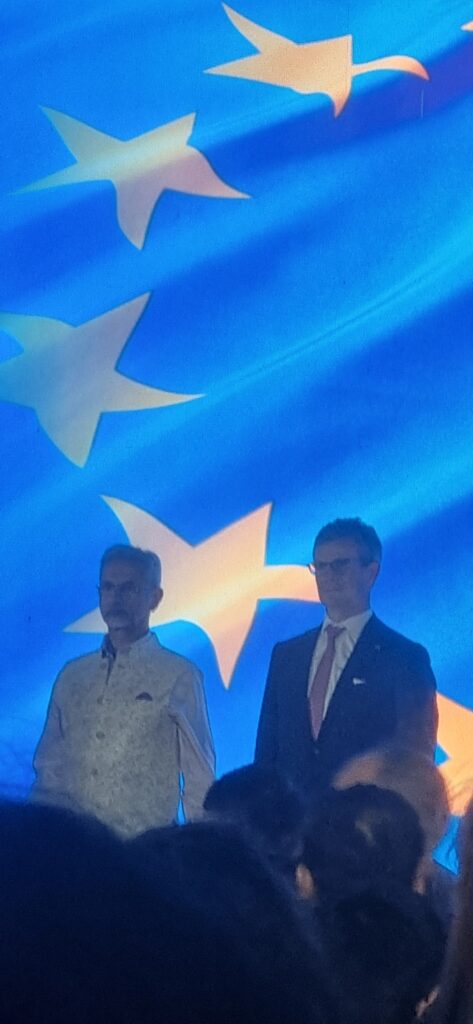
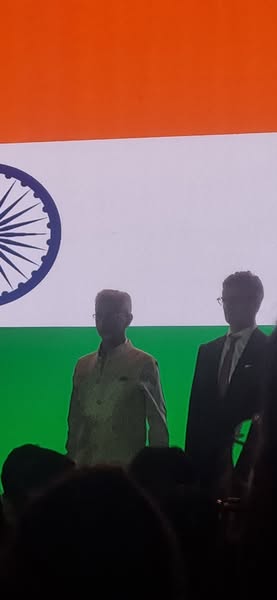
I attended the EU Day celebrations in India. They were held at the Taj Palace Hotel. The EU Ambassador to India, Hervé Delphin, and the Chief Guest, the Indian Foreign Minister, Mr. S. Jaishankar, spoke.
EU Day celebrations in India. Muted affair but held in New Delhi. EU Ambassador to India, Hervé Delphin, extends support to India in combating acts of terrorism. A moment of silence was observed for the innocent lives that fell in recent acts.
India’s longstanding relationship with European nations is posted to develop further. Our cooperation is acquiring many dimensions, in complex trade negotiations tbat we are confident will be done soon. Space, trade, investment, energy, technology, or defence. AI, etc. It is clearly a multipolar world. Both of us have an interest in exoanding and developing our convergences. At the end of the day we are democratic polities,we are pluralistic societies and we are market economies.
I thank all those who have supported us and resolute in doing so.
This year, the EU celebrates the 75th anniversary of the Schuman Declaration and the 25th anniversary of the EU’s motto: United in Diversity.
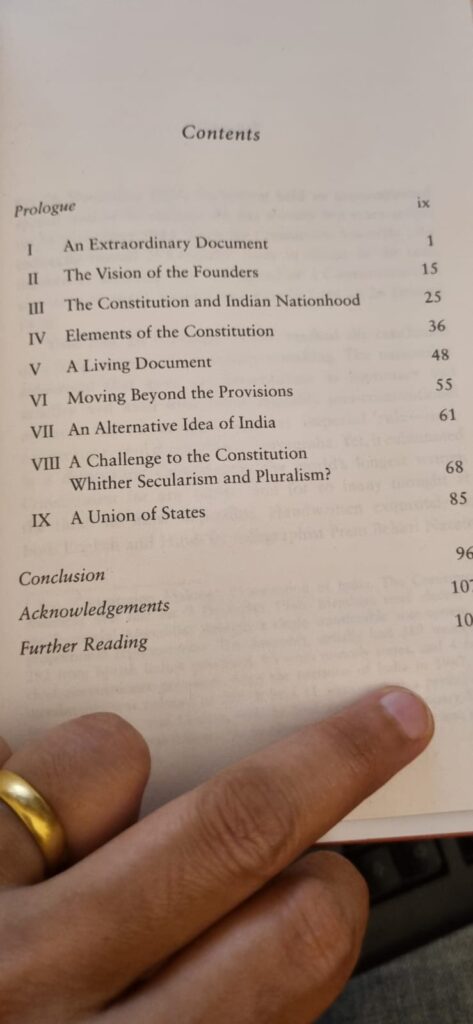
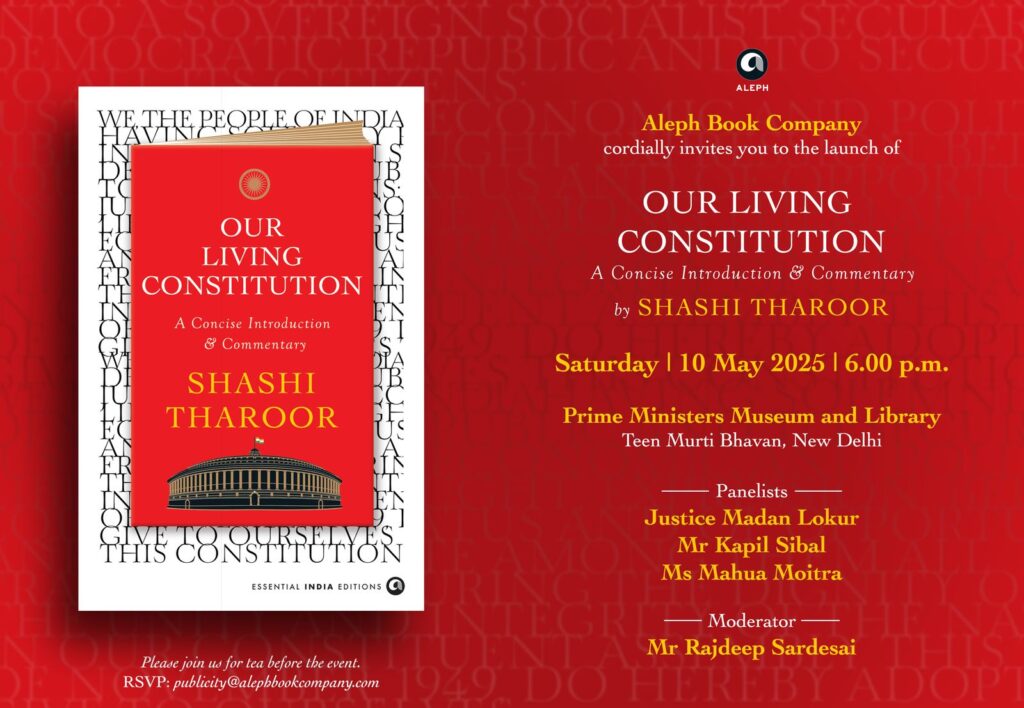
Our Living Constitution: A Concise Introduction & Commentary by Dr. Shashi Tharoor is a slim hardback, an essential commentary on the workings of the longest written constitution in the world. It is published by Aleph Book Company. Our constitution is truly a visionary document. A fact that Dr. Tharoor chooses to spell out in the nine chapters.
The opening passages of the prologue encapsulate the arguments laid out in this slim treatise.
On 26 November 2024, Parliament held an unprecedented special session to celebrate the day seventy-five years earlier, on 26 November 1949, when the Constitutent Assembly, the indirectly-elected 299-member body in charge of the task, finished its daunting task and agreed on a Constitution that was to be formally adopted two months later, on 26 January 1950.
That day, 26 November 1949, marked the conclusion of a long process of Constitution-making. The nationalist movement that gave our Constitution its legitimacy and sanctity had itself used many arguably non-constitutional methods in its struggle against imperial rule — non-cooperation, civil disobedience, satyagraha. Yet, it culminated in a democratic Constitution, the world’s longest written Constitution for any nation and (or so many thought at the time) its most imperilled. Handwritten exquisitely in both English and Hindi by calligraphist Prem Behari Narain Raizada, each page adorned with intricate artwork inspired by Indian culture and heritage and designed by famous artists led by Nandlal Bose, the Constitution was not merely a legeal document: it was a work of art. In its pages, to borrow Jawaharlal Nehru’s famous metaphor, the soul of a nation, long suppressed, had found utterance.
On that occasion, Dr B. R. Ambedkar, chairman of the Drafting COmmittee of the Constituent Assembly, rose in what is now the Central Hall of the Samvidhan Sadan (the old Parliament House) to address his colleagues, his fellow Founding Fathers, with a prescient warning to the nation, ‘Howveer good a Constitution may be,’ he said, ‘it is sure to turn out bad because those who are called to work it, happen to be a bad lot. However bad a Constitution may be, it may turn out to be a good lot. The working of a Constitution does not depend wholly upon the nature of the Constitution.”
It was a sobering reminder that the Constitution we celebrated then, as we celebrate it today, can be distorted and misused by ‘wrong-minded’ people in power.
As a staunch defender of democracy in both principle and practice, Dr Ambedkar anxiously wondered whether Indians would place ‘the country above their creed’. He recalledd the history of the Buddhist Bhikshu sanghas, which were known to have observed rules of modern-day parliamentary procedure, and added: ‘The democractic system India lost. Will she lose it a second time? I do not know. But it is quite possible, in a country like India . . . there is danger of democracy giving place to dictatorship. Iti s quite possible for this newborn democracy to retain its form but give place to dictatorship in fact. If there is a landslide [victory], the danger of the second possibility becoming actuality is much greater.’
p. ix – xi.
Later, in the chapter “The Vision of the Founders” the context behind the Constitution’s adoption is detailed. Read an extract published on Moneycontrol ( Friday, 16 May 2025). It is a sobering reminder of the incredibly diverse history of this sub-continent. This diversity was represented in the constitutent assembly and is apparent even today, in modern India. It is at the very heart of this nation that we call India.
The book is being launched on 10 May 2025 in New Delhi.
The Edible Series is a fascinating collection of books that PanMacmillan India is making available locally. Although these originated in the UK with the incredible Reaktion Books making it a sturdy and regular offering in their frontlists. But it seems that this series has proven to be a steady bestseller, so the back and front lists exist side by side. The template it fairly simple with a detailed and concise history of the food. These are heavily illustrated with four-colour images that complement the written text beautifully. There are images from historical sources, contemporary sources, photographs, illustrations etc. At the end of every book there is a collection of recipes — a combination of the familiar and unfamiliar as the authors prefer to give a balanced representation to the geographies where the food under discussion is to be found/cooked/consumed. It is truly remarkable that in the internet age when recipes are to be easily found on the internet as well as histories, a print book series on food history has found its niche and continues to sell.
On Moneycontrol, I curate the book’s section, and carried an extract from Tea. Read here.
AutHer Awards is the joint initiative of JK Paper Limited and The Times of India. It is my honour and privilege to be the Literary Director of the prestigious AutHer Awards, the only award for women writers in India. Our country is full of literary awards and festivals, of course, but women writing has historically been underrepresented. Even globally, for women writers there are only a handful of awards. For example, in the UK, there are two awards — the Women’s Prize for Fiction and Non-Fiction and the Warwick Prize for Women in Translation; in Australia it is the Stella Prize; in the USA it is the Carol Shields Prize; in the Hispanic world there is the Sor Juana Inés de la Cruz Literary Prize for women writers at the Guadalajara Book Fair. And in India, we have the AutHer Awards.
The writers represent not just the traditional literary styles of fiction and non-fiction, but also cutting-edge, modern forms. In fact, some of the most powerful literature on display in these awards allows writers the space to explore the “what if” scenarios far more freely than any other structured form of writing would enable. The books shortlisted at the AutHer 2025 give reading pleasure and are thought-provoking. At the same time, they, hopefully, provoke readers to think differently and for themselves. The wonderful authors who have written them range from teenagers to those on the higher side of fifty. They have written across a breathtaking array of diverse genres — from picture books, to nonfiction, young adult novels, stories across faiths, folktales, climate fiction, literary fiction, historical fiction, memoirs, biographies, histories, war reporting, short stories, multi-generational sagas and mythologies.
According to 2024 publishing data from India, it is clear that trade literature is growing across categories – fiction, nonfiction, and children’s literature. It is safe to say that there is an increasing contribution from women writers to the publishing ecosystem. We also live at a time of great churn in the world of books with AI disrupting how we consume knowledge and the written word. Despite these tectonic technological changes, the book publishing market is expected to surpass — USD 224.14 Billion by 2034. The rising usage of digital devices like smartphones and tablets is driving the market growth for book publishing. Consequently, e-books, audiobooks, and other digital forms are becoming more popular. Women writers have a critical role to play in this evolution. In fact, the first author to be successful using newly developed digital options in 2011 was E. L. James. Her self-published Fifty Shades of Grey went viral as an e-book. At that time, the emergence of Kindles and iPads ensured that people could read erotic literature written by a woman without being judged by others, particularly when reading in public. It was such a roaring success that when Random House bought it (2012) their employees were given a Christmas bonus of $5000 each[1] from sales to editorial to distribution. Till date, she has sold more than 165 million copies of her books.
In 1992, Prof. G N Devy made the observation that print technology had diminished the existing oral traditions. Folk singers, actors and authors such as the legendary singer Ila Arun are pivotal in bridging oral traditions and the performing arts with the print form. This human connect between various contact zones is significant in cultural mixing and in the evolution of a society. Now we have AI. It is here to stay. But writers write. They ideate. They comment. They capture the zeitgeist.
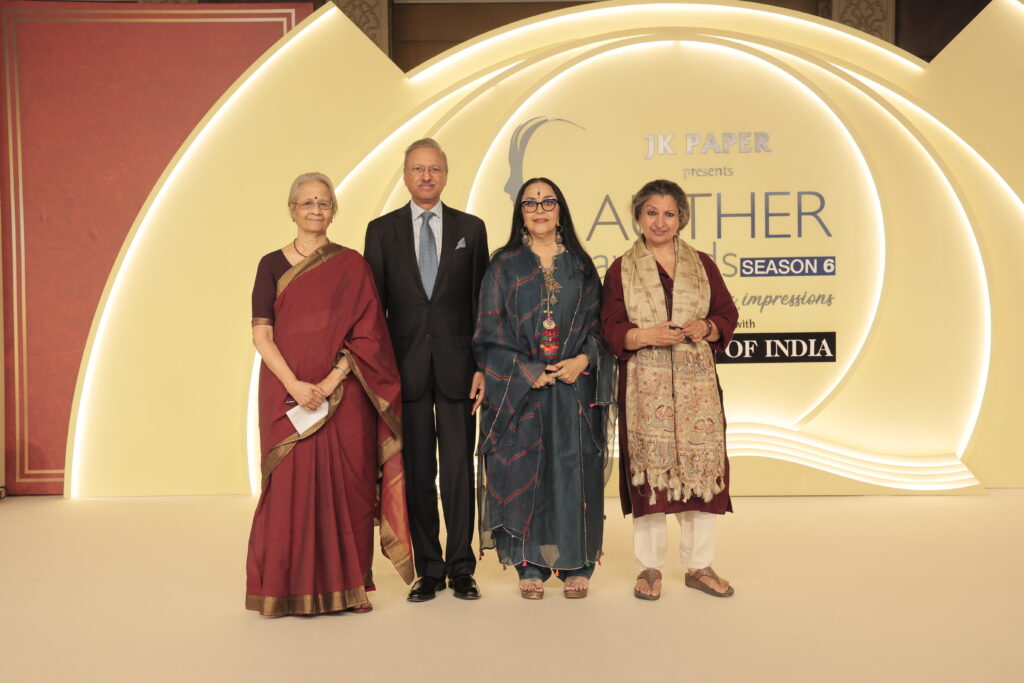
This year the Chief Guest for the AutHer Awards gala event was the 2022 International Booker Prize Winner and wonderful bilingual writer —Hindi and English —Geetanjali Shree. Addressing the audience, she said, “I think it’s wonderful what AutHer Awards is doing— rewarding and recognising women and their work. It is not about segregating women and separating them from men but setting right a balance, which has been going wrong for a long time. It is about shifting the margins and periphery and bringing women to the centre and the mainstream community.” Reiterating her belief, she said, “No award goes to any single person; an award actually lights up a whole world around that person and shows what we are all capable of.”
The Guest of Honour was noted folk-pop singer, actress, playwright, and author Ila Arun. She said it beautifully that kavita (poetry), kahani (story), lekhni (pen), and siyahi (ink), belong to the female gender. So, when a woman chooses to express herself via her words, she cannot stop herself at all. She continued, “Ink, pen, and paper are extremely important to me. Even though we exist in a technology-driven world, my room is still filled with papers, because that is only how I can express myself. I have tried to give voice to women in my own way. I have been engaged with theatre for the past 42 years.” She added, “I am more connected to paper than I am to music; my connection to singing is purely incidental.” As the Literary Director, I echo Ms. Arun’s sentiment. I am a techno-optimist but I too am a firm believer in writing, using pen and paper, so that the neural synapses are rewired. However much, neural technologies may try and ape the human brain, they simply cannot. Books will endure because creativity powers machine, and not the other way round.
The AutHer Awards platform was created with the specific intent to celebrate the women storytellers. It is a vibrant literary space that within a few years of its establishment has made a mark for itself. Past winners have included Sonora Jha, Sudha Bhardwaj, Chitra Bannerjee Divakaruni, Farah Bashir, Preeti Shenoy et al. The Lifetime Achievement Award has been given to literary giants like Prof. Romila Thapar, Anita Desai, Shashi Deshpande, Nayantara Sahgal, and Mridula Garg.
The literary prize categories are: Best Fiction, Best Non-Fiction, Best Debut Author, and Best Children’s Author (8+ and above). The Best Manuscript category encourages girls (14-18 years) to submit their unpublished manuscripts for consideration. The winner is awarded a publishing contract. The books submitted for the awards are recommended by publishers, authors, and readers. It allows for a rich mix of writing, beyond those that generated a buzz. This is an open call to assess literary merit. The submissions are audited to ensure that they meet the eligibility requirements including that the book has been published in the specific time period, confirming the existence of a print edition (not digital print/POD), and the author’s Indian nationality must be Indian, irrespective of their domicile.
AutHer Awards would not be possible without our eminent jurors, renowned for their intellectual heft and the depth of their work in the industry. This year, Season 6, we had for Fiction: Sahitya Akademi winner Esther David, Betty Trask winner Siddharth Dhanvant Shanghvi, and popular writer and documentary filmmaker Trisha Das, Non-Fiction: eminent linguist who has led the People’s Linguistic Survey of India and Padma Shree Prof. G. N. Devy, Sahitya Akademi Yuva Puraskar winner and historian Manu Pillai, and award winning writer and World Bank economist Shrayana Bhattacharya, Debut: Sahitya Akademi award-winning writer Anita Nair, chef Suvir Saran, and writer/translator Sutapa Basu and Children’s Literature: former two-time parliamentarian and a Trustee Chairperson of the Nargis Dutt Foundation Priya Dutt, award-winning writer and filmmaker Devashish Makhija, and Anasuya Vaidya, Director, Akshara Theatre. The Popular Award is determined by the number of votes garnered online.
We had an incredible shortlist and it was challenging for the jurors to pick winners. In fact, at times, two winners were selected for a single category, as it was considered a fair representation of the variety of creativity in the particular genre.
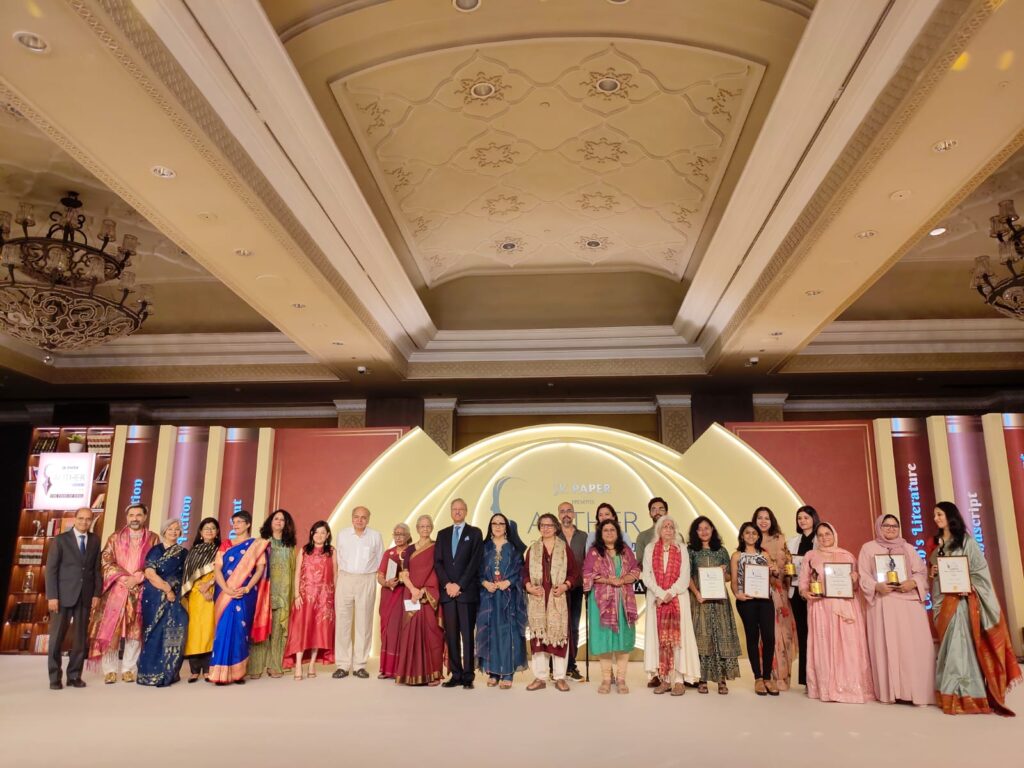
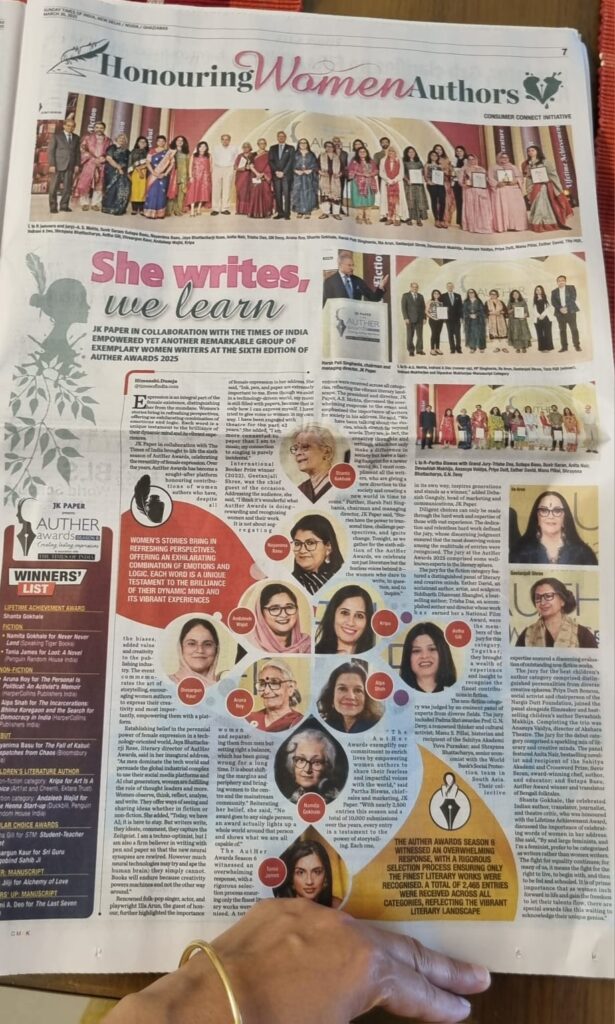
The 2025 winners were: Fiction: Namita Gokhale (Never, Never Land, Speaking Tiger Books) and Tania James (Loot, Penguin Random House India). Non-Fiction: Aruna Roy (The Personal is Political: An Activist’s Memoir, HarperCollins Publishers India) and Alpa Shah (The Incarcerations: Bhima Koregaon and the Search for Democracy in India, HarperCollins Publishers India). Debut: Nayanima Basu (The Fall of Kabul: Despatches from Chaos, Bloomsbury India). Children’s Literature: Andaleeb Wajid (The Henna Start-up, Duckbill, Penguin Random House India) and Kripa (Art is a Love). Popular Choice: The votes were tied for Astha Gill’s STM: Student-Teacher Meet and Divsargun Kaur’s Sri Guru Hargobind Sahib Ji. Tista Hijli’s manuscript won for Alchemy of Love and Indrani A. Deo’s was the runner’s up with for The Last Seven Hours.
The AutHer Awards Season 6 witnessed an overwhelming response, with a rigorous selection process ensuring only the finest literary works were recognised. A total of 2465 entries were received across all categories, reflecting the vibrant literary landscape. Harsh Pati Singhania, chairman and managing director, JK Paper said, “Stories have the power to transcend time, challenge perspectives, and ignite change. Tonight, as we gather for the sixth edition of the AutHer Awards, we celebrate not just literature but the fearless voices behind it— the women who dare to write, to question, and to inspire.” The president and director, JK Paper, A.S. Mehta, discussed the overwhelming response to the event and emphasised the importance of writers for society in his address. He said, “We have been talking about the stories, which stretch far beyond words. They are, in fact, the creative thoughts and writings, which not only make a difference in society but leave a lasting footprint for a newer world. So, I must compliment all the writers, who are giving a new direction to the society and creating a new world in time to come.”
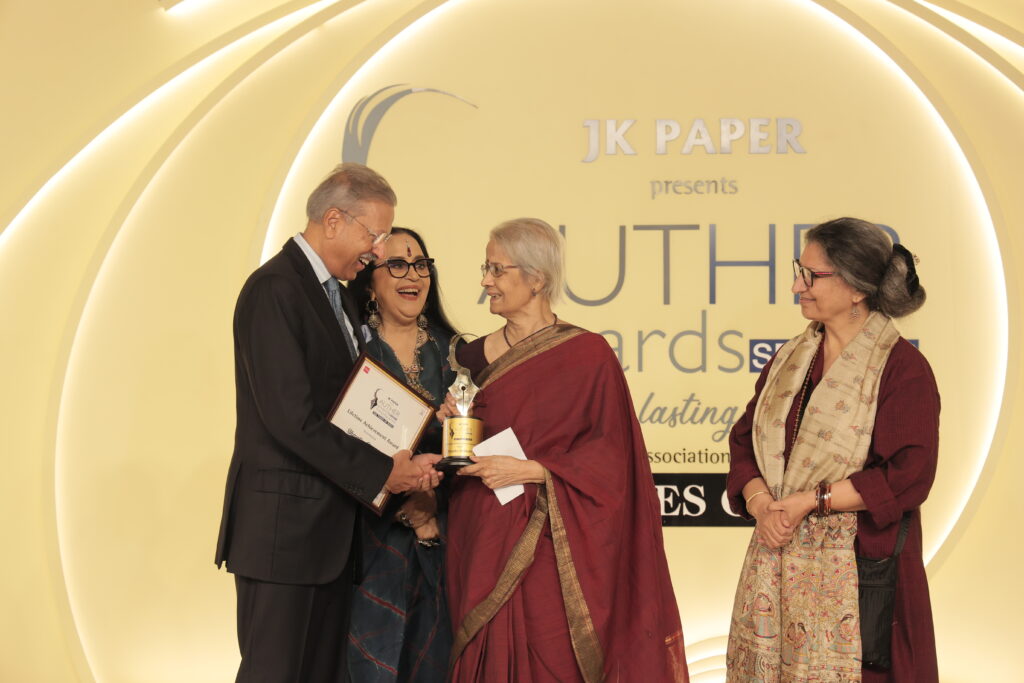
Shanta Gokhale, the celebrated Indian author, translator, journalist, and theatre critic, who was honoured with the Lifetime Achievement Award, discussed the importance of celebrating words of women in her address. She said, “By and large feminists, and I’m a feminist, prefer to be categorised as writers rather than women writers. The fight for equality continues; for many of us, it means the fight for the right to live, to begin with, and then to be fed and schooled. It is of prime importance that as women inch forward in life and gain the freedom to let their talents flow, there are special awards like this waiting to acknowledge their unique genius.”
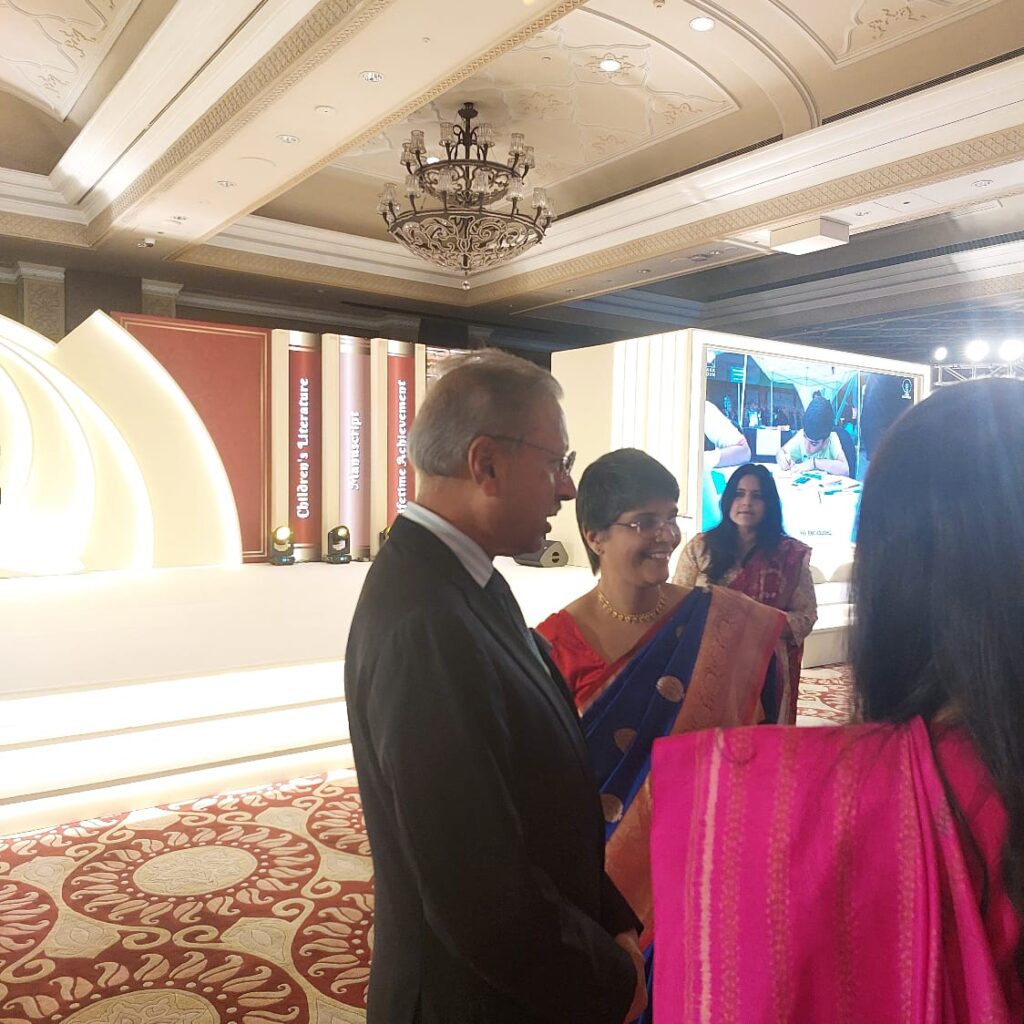
AutHer Awards 2025, Season 6, was an evening to remember with a packed hall with people standing at the back. It was a phenomenal experience! I hope you enjoy reading and discovering the AutHer awards literature as much as we have.
Jaya Bhattacharji Rose
Literary Director, AutHer Awards
Jaya Bhattacharji Rose has been working in the publishing industry since the early 1990s. She has worked with literary magazines, independent presses, women’s presses, multinational firms, and academic journals. She is the co-founder of Ace Literary Consulting, a literary agency that only looks at the best of the best literature across genres. As an international publishing consultant focused primarily on the business of publishing, she works with publishing firms on their business strategies and strategic partnerships, conceptualises programmes, and writes commissioned reports. She is also the Literary Director, AutHer Awards, established by the Times of India and JK Paper Mills. She is the host of the popular weekly Times of India podcast on literature and publishing called TOI Bookmark. The guests featured have been national and international authors including Jnanpith, Padma Bhushan, & Padma Shri awardees, Nobel Laureates, Booker Prize winners, Pulitzer Prize winners, BAFTA awardees, diplomats, bestselling authors, debut writers, and legendary writers, across genres and languages. The podcast is distributed on Spotify too. She is also the curator, books section, Moneycontrol.com, India’s foremost fintech and news platform. During the pandemic, in June 2021, she conceptualised the Scholastic Writers Academy, wherein students are mentored in online creative writing workshops. Till date, more than 100 workshops have been conducted, with over 3000+ students and some adults have been mentored, their short stories published in print anthologies and made available through online retailers. Participants have registered from across India but also abroad — the USA, the UK, the Middle East, Nepal, Singapore, Malaysia, and New Zealand. She is a blogger on the business of publishing and books. Her blog has received more than 7.8+ m visitors.
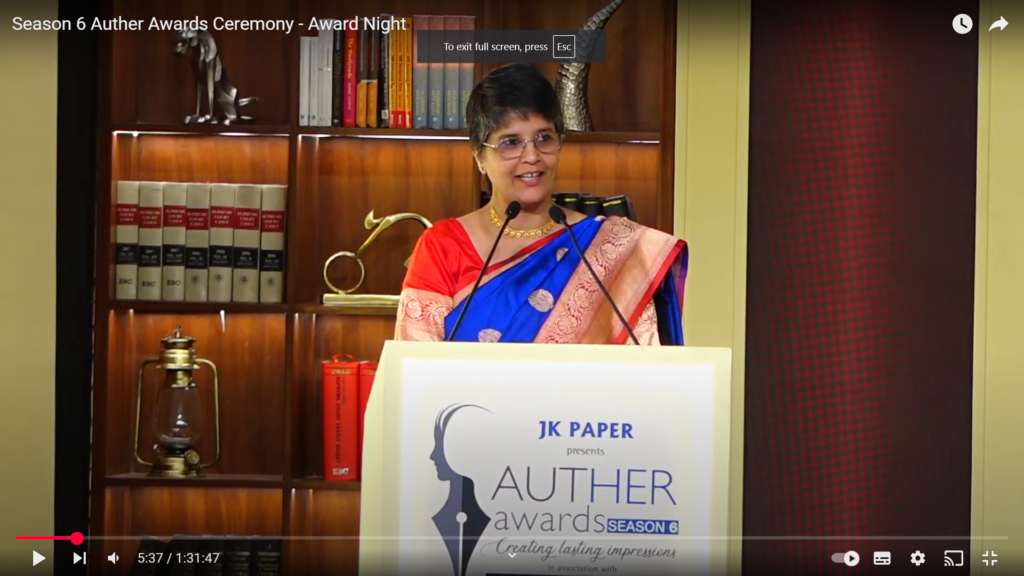
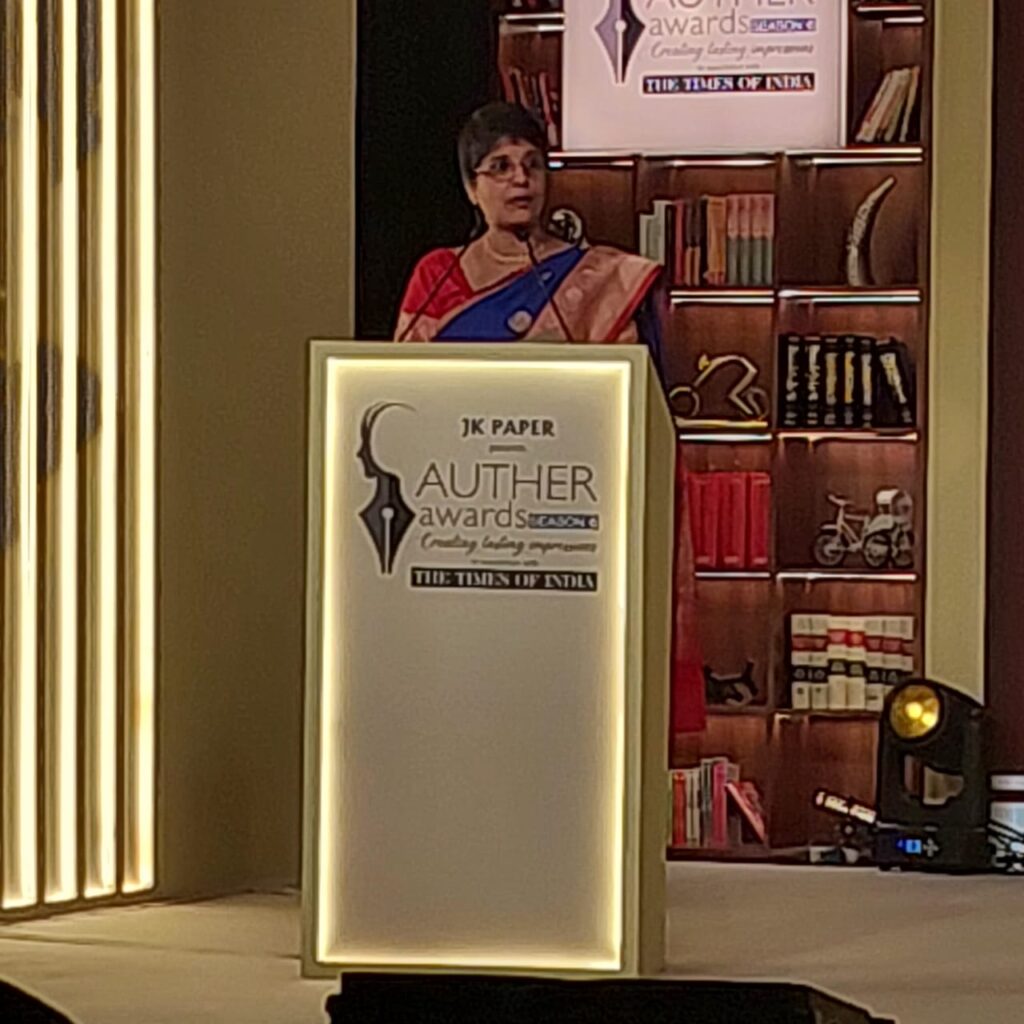
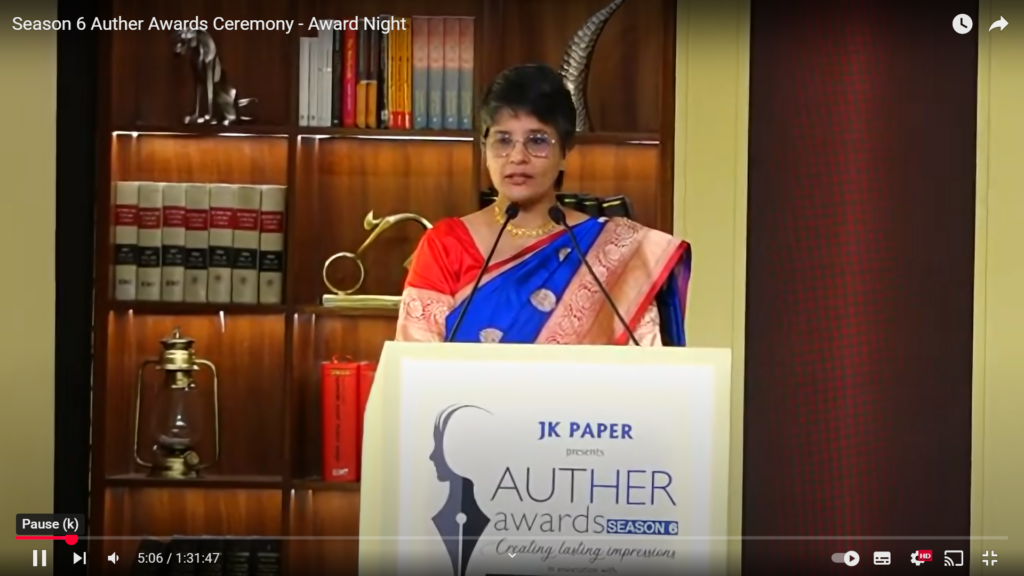
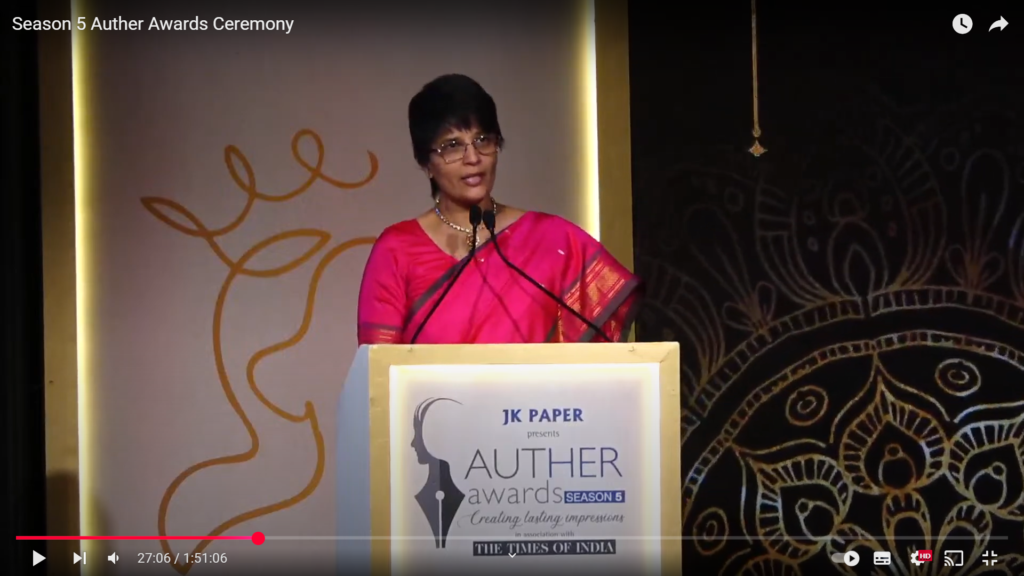
AutHer Awards, Season 6, was held on Friday, 21 March 2025, Taj Palace Hotel, New Delhi. I am reproducing my speech of the evening. It opened the proceedings.
Good evening!
As the Literary Director, AutHer Awards, I am delighted to welcome you all to the sixth season of the Times of India AutHer awards.
We live at a time of great churn in the world of books with AI disrupting how we consume knowledge and the written word. Despite these tectonic tech changes, the book publishing market is expected to surpass- USD 224.14 Billion by 2034. The rising usage of digital devices like smartphones and tablets is driving the market growth for book publishing. Consequently, e-books, audiobooks, and other digital forms are becoming more popular.
Women writers have a critical role to play in this evolution. In fact, the first author to be successful using newly developed digital options in 2011 was E. L. James. Her self-published Fifty Shades of Grey went viral as an ebook. At that time, the emergence of Kindles and iPads ensured that people could read erotic literature written by a woman without being judged by others, particularly when reading in public. It was such a roaring success that when Random House bought it (2012) their employees were given a Christmas bonus of $5000 each from sales to editorial to distribution. So yeah, women writers are fantabulous!
During the first industrial revolution in the nineteenth century, women left their homes to enter the workforce for the first time. In the twenty-first century, during the second industrial revolution, as men dominate the tech world and persuade the global industrial complex to use their social media platforms and AI chat generators, women are fulfilling the role of the thought leaders and more. Women observe, think, reflect, analyse, and write. They offer different and nuanced ways of seeing. Share ideas whether in fiction or non-fiction.
In 1992, Prof. G N Devy — who sits on this year’s AutHer awards jury — made the observation that print technology had diminished the existing oral traditions. Folk singers, actors and authors such as the legendary singer Ila Arun – our guest of honour today – are pivotal in bridging oral traditions and the performing arts with the print form. This human connect between various contact zones is significant in cultural mixing and in the evolution of a society. Now we have AI. It is here to stay. But writers write. They ideate. They comment. They capture the zeitgeist.
I am a techno-optimist but I am also a firm believer in writing, using pen and paper, so that the neural synapses are rewired. However much neural technologies may try and ape the human brain, they simply cannot. Books will endure because creativity powers machine, and not the other way round.
The books shortlisted at the AutHer awards tonight give reading pleasure and are thought-provoking. At the same time, they, hopefully, provoke readers to think differently and for themselves. The wonderful authors who have written them range from teenagers to those on the higher side of fifty. They have written across a breathtaking array of diverse genres — from picture books, to nonfiction, YA novels, stories across faiths, folktales, climate fiction, literary fiction, historical fiction, memoirs, biographies, histories, short stories, multi-generational sagas and mythologies.
The AutHer Awards would not be possible without our eminent jury — all distinguished writers who understand the power of storytelling; whether in the book form, theatre or even in cinema. So, a special thank you to our jurors: for their time and for their appreciation of the nuances of writing.
Ladies and gentlemen, we are really proud that the AutHer awards is the first and biggest award for women writers in India. and I hope you enjoy reading and discovering the AutHer awards literature as much as we have.
Thank you.
It was carried as a full page spread in the Times of India, across all editions in the country.
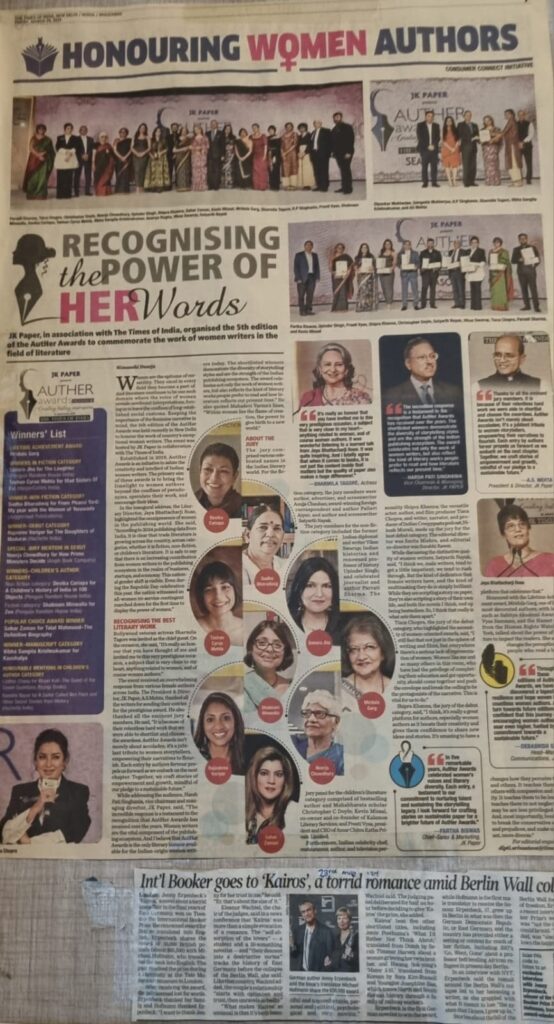
In 2024, I was appointed Literary Director, AutHer Awards. It was my first season but the fifth for the prestigious literary prize for women writers in India or of Indian origin. AutHer Awards is the joint initiative of JK Paper Limited and The Times of India.I am copy-pasting the speech that I delivered on the occasion.
Good evening!
I am delighted to welcome you all to AutHer Awards 2024. This is now our fifth edition — and I am very proud to say that the Auther Awards remain the only award for women writers in India. India is full of literary awards and festivals, of course, but women writing has historically been under represented. Even globally, for women writers there are only a handful of awards. For example, in the UK, there are two awards — the Women’s Prize for Fiction and Non-Fiction and the Warwick Prize for Women in Translation; in Australia it is the Stella Prize; in the USA it is the Carol Shields Prize; in the Hispanic world there is the Sor Juana Inés de la Cruz Literary Prize for women writers at the Guadalajara Book Fair. And in India, we have the AutHer Awards.
According to 2024 publishing data from India, it is clear that trade literature is growing across categories – fiction, nonfiction, and children’s literature. It is safe to say that there is an increasing contribution from women writers to the publishing ecosystem. This is unsurprising given the national gender shift. In the realm of business, startups, the economy— we are seeing huge increase in participation by the women. You only have to look at this year’s Republic Day parade to see what women power means- from the Rafaele pilots to the all-women military contingents.
The Auther Awards would not be possible without our eminent jury — all well-known and acclaimed writers themselves — who understand the literary landscape well. The rigorous process of selecting long lists and short lists is a lot of work — and believe me … also a lot of vigorous debate 🙂
So, a special thank you to our jurors: for their time, for their appreciation of the nuances of writing and for their thoughtful eye for writers and their craft.
There is a wide spectrum of writing on display today. It represents not just the traditional literary styles of fiction and non-fiction, but also — in the age of AI — cutting-edge, modern forms. In fact, some of the most powerful literature on display in these awards allows writers the space to explore the “what if” scenarios far more freely than any other structured form of writing would enable.
I have been fortunate to come from a lineage of educated and strong women — going back to the late 19th century. Women, who built eminent careers but who also successfully juggled parenting and housework… India has long had a vibrant tradition of feminism — women’s writings have been an inseparable part of it and our growth as a nation. They are also critical to our future — as I realise when I look at my 14-year-old daughter — who is here today — and the readings she encounters.
These literary awards are our effort to honour the best of India’s women writers who are doing sterling work in making the invisible visible and articulating the silences. AutHer Awards is a beacon of this shift in Indian literature. We have an incredible variety of books featured by women tonight. Each distinctive. Each worthy of being heard, seen and read.
I hope you enjoy reading and discovering the AutHer awards literature as much as we have.
Thank you!
Later, the Times of India published a full page spread in print. It was made available across the country.
The text given below is from the publisher’s website for Forest of Noise. It was published on 30 November 2024. On 6 May 2025, it was announced that Mosad Abu Toha won the Pulitzer Prize for Commentary — a series of articles that he wrote for The New Yorker. When I first read this collection of poems, I found it very moving. Months later, they continue to be sharp and searing. There are many poems worth sharing but it would be a violation of his copyright, if I reproduced any here. Just get the book and read it.
***
Barely 30 years old, Mosab Abu Toha was already a well-known poet when the current assault on Gaza began. After the Israeli army bombed his house, pulverising a library he had painstakingly built for community use, he and his family fled for their safety. Not for the first time in their lives.
Somehow, amid the chaos, Abu Toha kept writing poems. These are those poems. Uncannily clear, direct and beautifully tuned, they form one of the most astonishing works of art wrested from wartime. Here are directives for what to do in an air raid and lyrics about the poet’s wife, singing to his children to distract them. Huddled in the dark, Abu Toha remembers his grandfather’s oranges and his daughter’s joy in eating them. Here are poems to introduce readers to his extended family, some of them no longer with us.
Moving between glimpses of life in relative peacetime and absurdist poems about surviving in a barely liveable occupation, Forest of Noise invites a wide audience into an experience that defies the imagination ― even as it is watched live. This is an extraordinary and arrestingly whimsical book, that brings us indelible art in a time of terrible suffering.
Mosab Abu Toha, Things You May Find Hidden in My Ear: Poems from Gaza, winner of the Palestine Book Award 2022 and the American Book Award 2023
TOI Bookmark is a weekly podcast on literature and publishing. TOI is an acronym for the Times of India (TOI) which is the world’s largest newspaper and India’s No. 1 digital news platform with over 3 billion page views per month. The TOI website is one of the most visited news sites in the world with 200 million unique monthly visitors and about 1.6 billion monthly page views. TOI is the world’s largest English newspaper with a daily circulation of more than 4 million copies, across many editions, and is read daily by approximately 13.5 million readers. The podcasts are promoted across all TOI platforms. I have recorded more than 128+ sessions with Jnanpith, Padma Bhushan, and Padma Shree awardees, International Booker Prize winners, Booker Prize winners, Women’s Prize for Fiction, Nobel Laureates, Pulitzer Prize, Stella Prize, AutHer Awards, Erasmus Prize, BAFTA etc. Sometimes the podcast interviews are carried across all editions of the print paper with a QR code embedded in it.
Some of the authors who have been interviewed are: Samantha Harvey, Jenny Erpenbeck, Michael Hoffman, Paul Murray, V. V. Ganeshananthan, Hisham Matar, Anita Desai, Amitava Kumar, Hari Kunzro, Venki Ramakishnan, Siddhartha Deb, Elaine Feeney, Manjula Padmanabhan, NYRB Classics editor and founder Edwin Frank, Jonathan Escoffery, Joya Chatterji, Arati Kumar-Rao, Paul Lynch, Dr Kathryn Mannix, Cat Bohannon, Sebastian Barry, Shabnam Minwalla, Paul Harding, Ayobami Adebayo, Pradeep Sebastian, G N Devy, Angela Saini, Manav Kaul, Amitav Ghosh, Damodar Mauzo, Boria Majumdar, Geetanjali Mishra, William Dalrymple, and Annie Ernaux.
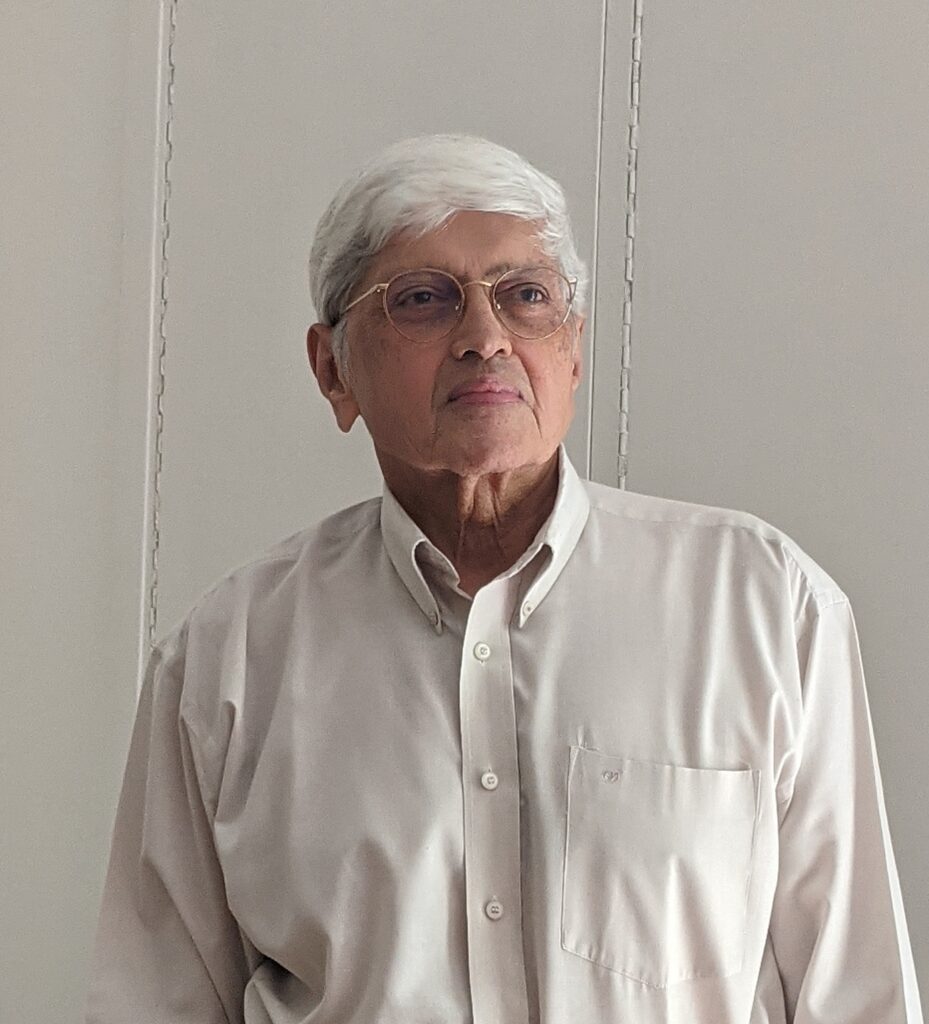
We have recorded umpteen episodes but recording a conversation with Gopalkrishna Gandhi is very precious. He is a highly admired and well reputed bureaucrat, diplomat, and former governor. He is also a writer. But it his lineage that is often brought to the fore. His grandfathers were Mahatma Gandhi (paternal) and the first and only Indian governor general of India, C. Rajagopalachari (maternal).
Mr Gandhi has written innumerable books but his recent publication The Undying Light is his memoir. It is published by Aleph Book Company. Given that he was born nearly three years before India gained independence from the British, he is able to provide a sweeping and fascinating account of modern Indian history. This is truly a life well spent. An aspect that really stood out for me in the memoir was the subtext of the interpretation of the Constitution of India. It is the longest written constitution in the world, but it is a living and breathing document. For a gentleman like Mr Gandhi, who has been able to engage with various aspects of it as an Indian Administrative Services officer, a diplomat when he was appointed as High Commissioner to South Africa, and later as Governor of West Bengal, The Undying Light is a valuable insight into how Indian citizens and its administrators rely upon this visionary document for our democratic rights.
Here is a snippet from the conversation:
I am glad you are emphasising the importance of the constitution and the place of the constitution in this book. I can’t but say here that the Preamble, a lyrical document, has been translated with rest of the Constitution into all the languages of India. But the Sanskrit translation of the Constitution starts with “We the People of India” as “Vayam Bharatasya Jahana” and the Urdu translation starts with “Hum Hind ki Awam”. There is an extraordinary lyrical voltage to “Vayam Bharatasya Jahana” and “Hum Hind ki Awam” which takes it even beyond the English, “We the People of India”. This book is about the people of India. Both as a collectivity and as so many individuals.
Listen to the conversation on Spotify:
Buy it from Amazon India or wherever books are sold:
TOI Bookmark is a weekly podcast on literature and publishing. TOI is an acronym for the Times of India (TOI) which is the world’s largest newspaper and India’s No. 1 digital news platform with over 3 billion page views per month. The TOI website is one of the most visited news sites in the world with 200 million unique monthly visitors and about 1.6 billion monthly page views. TOI is the world’s largest English newspaper with a daily circulation of more than 4 million copies, across many editions, and is read daily by approximately 13.5 million readers. The podcasts are promoted across all TOI platforms. I have recorded more than 128+ sessions with Jnanpith, Padma Bhushan, and Padma Shree awardees, International Booker Prize winners, Booker Prize winners, Women’s Prize for Fiction, Nobel Laureates, Pulitzer Prize, Stella Prize, AutHer Awards, Erasmus Prize, BAFTA etc. Sometimes the podcast interviews are carried across all editions of the print paper with a QR code embedded in it.
Some of the authors who have been interviewed are: Samantha Harvey, Jenny Erpenbeck, Michael Hoffman, Paul Murray, V. V. Ganeshananthan, Hisham Matar, Anita Desai, Amitava Kumar, Hari Kunzro, Venki Ramakishnan, Siddhartha Deb, Elaine Feeney, Manjula Padmanabhan, NYRB Classics editor and founder Edwin Frank, Jonathan Escoffery, Joya Chatterji, Arati Kumar-Rao, Paul Lynch, Dr Kathryn Mannix, Cat Bohannon, Sebastian Barry, Shabnam Minwalla, Paul Harding, Ayobami Adebayo, Pradeep Sebastian, G N Devy, Angela Saini, Manav Kaul, Amitav Ghosh, Damodar Mauzo, Boria Majumdar, Geetanjali Mishra, William Dalrymple, and Annie Ernaux.
It is always such a pleasure speaking with Ranjit Lal, award-winning writer who has an abiding interest in natural history, birds, animals and insects. Recording this fantabulous episode of #TOIBookmark is one such example.
Here is a snippet from our conversation:
“… you need a little patience. That is all. I have always considered that you do not have to go to Nature, Nature will come to you. Sit quietly in a place for half hour and things will start happening. You do not have to do anything. Just keep your eyes and ears open. “
This interview is facilitated by EUPL and funded by the European Union.
Please explain what the European and International Booksellers Federation is about? Also, please explain the “and beyond” that is in the introduction on the EIBF website.
EIBF represents national booksellers’ associations in the European Union and at an international level. Through its member associations, EIBF speaks on behalf of more than 25.000 individual booksellers of all kinds, including independent bookshops, chains, family businesses. EIBF membership covers a wide geographic area from the Faroe Island to Latvia, and from Germany to New Zealand. Our members are the national booksellers trade associations mentioned in the sentence above. Examples of members include: The Booksellers Association of the UK and Ireland, Börsenverein in Germany, Swedish Booksellers Association,
Ceylon Importers and Exporters Booksellers Association – Full list: https://europeanbooksellers.eu/booksellers-associations
What are the services that EIBF offers?
We represent our members and their interests on a global platform, before the European institutions and other international organisations. Our mission is to further the interests of the bookselling industry, by ensuring that the voices of booksellers are heard in every relevant debate.
We do this by meeting with decision makers from European and international institutions, explaining the specificities of the bookselling industry at different stages.
Additionally, we strengthen the link between booksellers’ associations worldwide, to enable knowledge exchange, innovation and growth, especially through our RISE Bookselling programme. The links are strengthened by initiatives such as organising a conference for members in Frankfurt (https://europeanbooksellers.eu/press/eibf-75th-frankfurt-book-fair), 4 international calls/year where members can informally exchange about the situation in their respective countries (https://europeanbooksellers.eu/press/eibf-international-call-highlights-challenges-and-initiatives-global-bookselling), etc.
Does it explore strategic partnerships with countries outside the EU?
Yes. EIBF is a membership-based organisation, open to booksellers’ associations and independent booksellers from all over the world. Our non-EU members include: Norway, German-speaking Switzerland, the UK, Canada, USA, Australia, New Zealand and more recently Sri Lanka. We also have booksellers from the Faroe Island, Guatemala and Kyrgyzstan who are members of our association on an individual basis. Part of our team also visited the Guadalajara International Book Fair for the first time in order to develop further our relationships with Latin American Booksellers.
4. What are the major trends in European bookselling? Are these different from the rest of the world?
Fascinatingly, during the covid pandemic, there was a massive boost to book sales. Post-pandemic, what is your view on the co-existence of strategies for retail stores in the physical and digital world? What should be the focus? Can they be separated or must they align or be in a symbiotic relationship with each other? What is your opinion?
Today’s bookselling business can no longer be summed up as a solely off-line activity. The COVID-19 pandemic heralded an immense interest in shopping online with local businesses, including independent bookshops. To stay up to date and cater for their customers’ constantly changing needs, modern bookselling has had to become a hybrid profession: booksellers now need to have one eye on the physical, brick-and-mortar shop, and the other on the digital shop window.
This new aspect of the trade inevitably brings new challenges – e.g., the need for technical skills and legal expertise on how to conduct e-commerce – which are not always solved intuitively. Lots of small independent bookshops needed help to take the plunge into the online – help which was in many cases provided by their trade association or other bookseller collectives in the shape of a common e-commerce platform. The creation of these platforms has shown that what may seem impossible when on one’s own, is perfectly feasible together.
There is a continued interest in shopping online with independent bookshops, even after the end of the COVID-19 pandemic. This shows that e-commerce is not only for those large market players and big tech companies anymore: there is a specific place and role to play for independent, local bookshops
Do the existing fixed book rates in some European countries such as France and Germany result in interesting bookselling scenarios for EIBF?
I don’t understand the question. EIBF is a trade organisation that represents the interests of all its members. Some of our members operate in a fixed book price market and some don’t. Our work is to help and support them, as well as provide them with advice when necessary. Fix/free book price are a national policy matter.
How did you get into bookselling?
I hold a degree in European journalism and a master in media and business. My first internship after graduating was with the Federation of European Publishers (FEP), the other organisations implementing the European Union Prize for Literature. After 5 months with them, I started a second internship with the European and International Booksellers Federation (EIBF), and then was hired there as a full-time employee to oversee the European Affairs and Communications. I took over as Director in April 2019, when the former Director left the organisation. Both times – when I was first hired as a full-time employee and when I took over as a Director – the EIBF board required that I spent some time working in a bookshop, in order to have first-hand experience on the ground. I fully agreed with their request. As I represent the interests of booksellers on a daily basis, it was important to me to fully comprehend what booksellers’ reality is like. So, all in all, things just naturally came one after the other and, since I’ve always been an avid reader and a bookshop lover, I never cease to be amazed by booksellers’ resilience and creativity, which are what make my daily work so enjoyable.
8. Does an author see a boost in their sales in Europe after winning the EUPL prize?
Answering that question would require to look at sales data for the specific book of a specific author in a given country, which we don’t have and is not the objective of our Prize. The aim of the Prize is to promote the circulation of literature within Europe and encourage greater interest in non-national literary works through translation. Does an author see a boost in their book translation after winning the EUPL Prize? Yes, definitely! You just need to take a look at the different authors’ profiles on the EUPL website where we list their respective translation deals.
9. Has the EUPL Consortium been able to analyse the direct and indirect impacts of winning the EUPL Prize?
Please note that EUPL is organised by a Consortium that comprises two different organisations: the Federation of European Publishers (FEP) and the European and International Booksellers Federation (EIBF). We are therefore not the only ones in charge of doing the analysis/assessment work.
All in all, direct and indirect impacts are difficult to quantify, since we cover 41 countries, over a cycle of three years, since 2009. That represents more than 150 authors and a huge amount of information to keep track of. However, there are some qualitative trends that we have been able to identify over the years. As mentioned in my answer to the previous question, a direct impact of winning the EUPL is the increased number of translations for a given book. One of our authors with the highest record is North Macedonian author Goce Smilevski whose book Sigmund Freud’s Sister was translated into more than 25 different languages.
It has also become clear over time that smaller countries and/or countries that do not have a plethora of literary Prizes do see a great added-value in the EUPL, especially in its potential to convey national literature across borders. EUPL 2023 special mention for Estonia, Tõnis Tootsen, was featured quite prominently on the Estonian stand at this year’s Frankfurt Book Fair for instance (see below).
Among the indirect impacts we’ve noticed and that authors themselves have mentioned, are the opportunities to expand one’s own network; be it by connecting with other authors or other professionals from the book sector. Through EUPL, winners and nominated authors get the chance to take part in book fairs, festivals and other type of events. Those events are the opportunity for them to meet with fellow EUPL authors from the same or previous editions, as well as to exchange with publishers or translators.
10. What are the promotional strategies (offline and online) that the EUPL Consortium employs for the EUPL Prize winners?
Please note that EUPL is organised by a Consortium that comprises two different organisations: the Federation of European Publishers (FEP) and the European and International Booksellers Federation (EIBF). We are therefore not the only ones in charge of the promotional strategy.
Offline (in person events): Each author nominated for a given EUPL edition, benefits in that same year of a bookshop event, organised in their home country by the EUPL consortium. The idea being to spotlight their book, their Prize nomination and give them the opportunity to exchange with their readers at home. We also have long-lasting partnerships with the main book fairs in Europe, including the Frankfurt Book Fair, where we organise events to promote EUPL authors.
Offline/Online (the anthology): Every year, we produce an anthology that compiles 5-page excerpts of all the nominated books of that year. Each excerpt is available is original language and in English translation. All anthologies can be found here. They are downloadable in E-Pub format and accessible E-pub format since the 2018 anthology. Paper copies of the anthology are distributed at the bookshop events and at most major book fairs, especially at the right agents’ centre, in order to spark interest for translation.
Online (EUPL social media channels, website and newsletter): EUPL is present on Facebook, Twitter and Instagram. These channels are dedicated to sharing news about the Prize itself, but also the latest news of our authors past and present, including new books, new translations, other Prizes they won, etc. The aim is to keep promoting them, even years after they were nominated for the Prize and to give them more visibility through our channels. The same goes for our newsletter that features information about the current edition, as well as news about authors who were nominated in previous years. As for our website, it spotlights the latest news about the Prize, including the events we organise and where EUPL authors are present. Additionally, each EUPL author benefits from a profile page on our website that introduces their winning book, translation deals for that book, and a short biography.
Online (partnership): In the same way that we are answering this interview, we also work in partnership with different journalists, bloggers, reviewers, etc. to promote the Prize at local, national, European and international level. For three years now we’ve had a partnership with Trafika Europe Radio, an online radio that puts the spotlight on European authors and recorded podcasts with our authors. We’ve also been working for the same amount of time with French blogger and literary reviewed Tara Lennart from Bookalicious who’s showcasing the Prize and our authors towards a French-speaking audience.
Disclaimer: This paper was written under the European Union Policy & Outreach Partnerships Initiative with the view to promote European Union Prize for Literature awardees. The publication was funded by the European Union. Its contents are the sole responsibility of the authors and do not necessarily reflect the views of the European Union.