This is interesting. A non-fiction book, published in English by self-publishers Notion Press in 2017 has been released by HarperCollins India in 2025. “The Toilet Seat” by Latha more than proved its worth in the market. Even so, the author in her acknowledgements cannot get over her joy at receiving a phone call from an established brand name regarding the publication of her book. It is a bestseller in Tamil.
Mary-Frances O’Connor’s The Grieving Body: How the stress of loss can be an opportunity for healing is an interesting book. It is complicated. While she offers helpful and practical advice to those grieving, it is intertwined with her own experience and living with MS and the anxiety it brings. She talks frankly about deep sadness and despair that can engulf a person when mourning the loss of a loved one whereas in her case it is also intermingled with bouts of depression. Challenging but she offers ways of tackling it and use this terrible sense of loss as a way of healing oneself and pushing ahead. Death anxiety is a state of being that exists for many of us. It is our fear of separation from loved ones. It is at the basic neuro-biological level. She is clearly that bereavement can affect the immune system. Also, the concept of dying of a broken heart is a very real thing. It is not imaginary. Bereavement is a period of increased risk for illness and death, and recognising this should lead to better medical care. Bereavement is a monumental stress event and it should be treated in such a manner. Grief is not a disease, but it has physiological effects, just as pregnancy is not a disease, but it increases the risk of hypertension and gestational diabetes.
In this book, the doctor, first analyses the physiological effects of grief on our bodies and then offers practical advice on how to heal ourselves.
Much to think about except those who have been recently impacted by a death in their family, may find it hard to read. Nevertheless, persist. Who knows, it may help in adjusting to a new life without our loved ones.
I truly enjoyed reading this story about a young man who had a promising career as an athlete but it was cut short by injuries to his back and knees. So, he did the next best thing. Took the college scholarship for physical education that was being offered to him based on his past potential. There, a coach recognising Sonny’s talent for engaging with people hired him to be a recruiter for college teams. It involved identifying talent at a very young age, travelling extensively, and then persuading the families to send the child to college, to further their career as a sportsperson. There are many, many fascinating anecdotes but the truly astonishing one is about Sonny Vaccaro’s relationship with Michael Jordan and of course the creation of the Air Jordan line at Nike. When negotiating, Jordan’s lawyer miscalculated. He figured he would ask for a larger base guarantee upfront of $300,000 and reduce the royalty from twenty cents to ten cents a pair. It is a decision that has cost Michael Jordan millions of dollars as in the first year alone, Nike sold $125 million worth of shoes.
Matt Damon portrays Sonny Vaccaro in the film, Air.
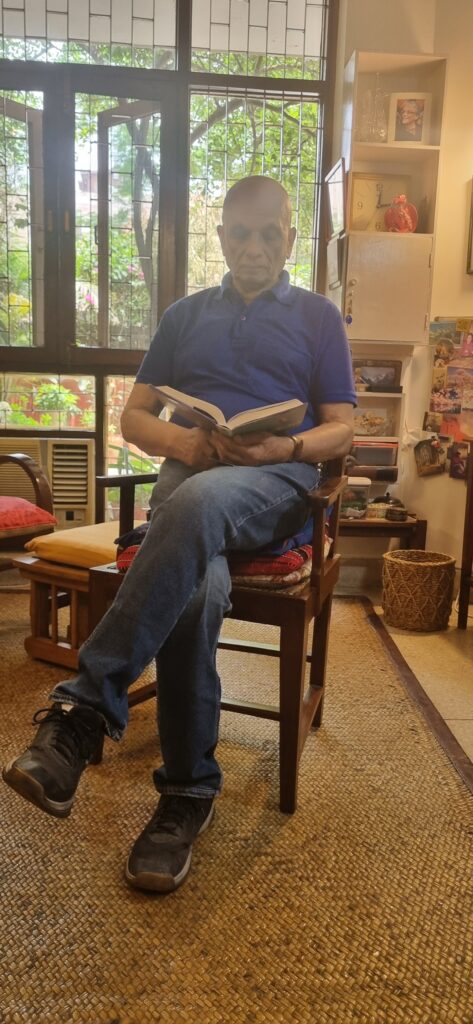
. This is so perfect. Romesh Bhattacharji , former Narcotics Commissioner of India, reading #KaranMadhok‘s book, “Ananda: An Exploration of Cannabis in India”.
Upon spotting this picture on Facebook, Karan Madhok shared it on his wall saying, “This is a wonderful full circle moment: I quoted India’s former Narcotics commissioner Romesh Bhattacharji in my book – glad to see he’s got his hands on a copy.”
Cannabis, or ganja, is practically as old as recorded Indian civilization, with references to the plant being found in some of India’s earliest written texts and myths. Native strains of the plant are as common as rice or millet in many Indian states, and can often be found growing wild in the countryside. In scriptures and in the opinion of enthusiasts, ganja is said to provide ananda (bliss) or vijaya (victory) over the cares and ills of the world. Cannabis is best known as a recreational drug but it has a myriad other uses as well.
In this lively, well-researched, humorous, and occasionally trippy account of ganja, Karan Madhok looks at every aspect of the cannabis plant: botanical, spiritual, medical, and recreational. Madhok hits the road in search of cannabis strains around the country, including a visit to the Himalayan hamlet that is home to the world-renowned Malana Cream (which has inspired various counterculture movements); looks for the mythical Idukki Gold in Kerala; seeks the Sheelavathi variety in the Andhra/ Orissa region; portrays the travails of addicts, and details the shadowy world of gangsters and suppliers; hangs out with devotees who openly consume bhang and other derivatives of ganja; and visits hospitals and clinics which use the drug for a wide range of therapeutics.
Besides the factual and eye-opening research into every aspect of the narcotic, the author contemplates the concepts of freedom, creativity, spirituality, and paranoia associated with the drug, and examines the upside and problems of decriminalizing ganja in India. Ananda, the first major study of cannabis in India, is entertaining, and enlightening—it is the perfect introduction to an integral aspect of the country that has often got a bad rap and is imperfectly understood.
Karan Madhok’s debut novel, A Beautiful Decay, was published in 2022. His creative work and journalism have appeared in Epiphany, Sycamore Review, Bombay Review, SLAM Magazine, Fifty Two, The Caravan, Scroll, among others.
Karan is the editor and co-founder of the Indian arts and culture website The Chakkar. He is a graduate of the MFA programme from the American University in Washington D.C.
My father, Romesh Bhattacharji, has been visiting Kashmir for many decades, from the 1960s. He is a photographer, a high altitude trekker and extremely passionate about the mountains. He knows the Himalayas very well, whether charted treks or not. He has travelled extensively in the state. In the last few years of government service as bureaucrat, his “beat” included Jammu & Kashmir. With him, I too, had to the good fortune of travelling in the state, in all four seasons. We drove everywhere, for hours and hours. Length and breadth of the state. We saw it in summer, winter, and changing of seasons. We witnessed the first snowfall of the season in Gulmarg. We saw plenty of saffron fields. We saw the chinar leaves turn red gold and create the most magnificent carpet on the forest floor. We drove to the upper reaches and with every twist of the road, the stunning beauty of the state would hit one. It is truly astonishing. We experienced the silence of the snow and the drummers waking everyone for sehri during ramzan in the quiet of the early morning snowfall. All said and done, my father knows the main routes and the lesser known routes of Kashmir and it is these routes that he wrote about last year in his book. So, after the events of 22 April 2025, it has been absolutely heartbreaking to see what is happening there. It is unbelievable that this paradise on earth is being assaulted in the most dastardly fashion. The tranquility and the beauty that the cover photo of dad’s book on Kashmir (HarperCollins India, 2024) is at complete variance with what is happening today. While staring at this cover photograph, I can only pray and hope that peace will return soon.
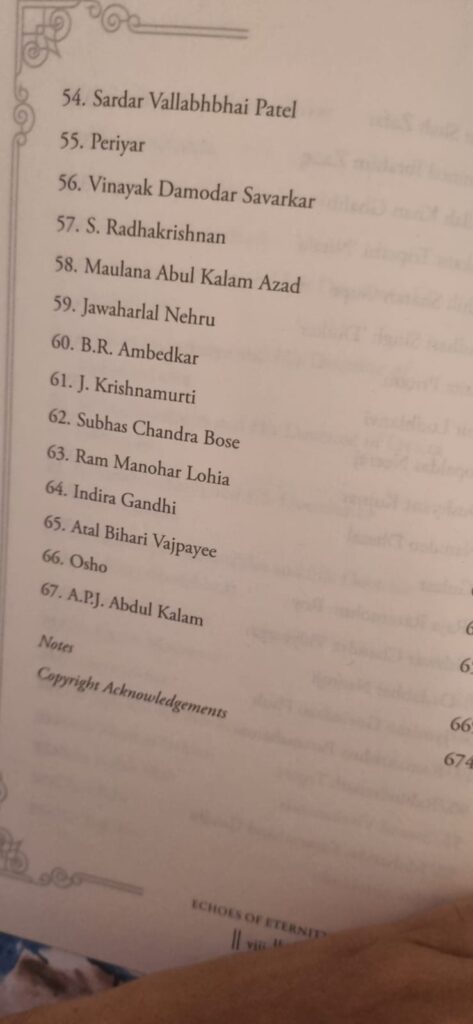
In his fine introduction to the book, Echoes of Eternity, former diplomat, Pavan K. Varma, explains very clearly his methodology for selecting the texts included in this anthology. Also, the reason for putting together this essential book. Here is an excerpt from the opening pages:
India is a civilisation of moulik such — the power of original thought. This faculty has been the bedrock on which the Indian people have survived and flourished since the dawn of time. Other ancient civilisations, such as the Greek, Roman, Persian, Assyrian and even classical Chinese, have long ceased to exist. What makes our civilisation different is a certain ability for cerebral interrogation, discovery and renewal that has bestowed the great stream of Indian ideas with antiquity, continuity, diversity, assimilation and peaks of refinement.
This compendium, or anthology, seeks to capture some of the magnitude of this vast ideational canvas. Its breadth covers a period of 7,000 years at the very least, from the Rigveda, dated circa 3500 to 3000 BCE, to the philosopher Osho, closer to the present. The subjects its includes range from philosophy, metaphysics, religion, values, politics, economics, arts, literature, poetry and aesthetics to social change and renewal. The geographical sweep is as wide, covering the whole of Bharatvarsha, from the Himalays to Kanyakumari, and Dwaraka to Puri and the Northeast. This selection would have been even richer in contenthad the script of the great Indus Valley Civilisation been deciphered, and one can only hope that scholars will succeed one day.
As can be imagined, the greatest challenge in such a task was what to select and what to leave out. Our corpus of thought is so copious that some degree of judicious selectivity had to be exercised. It also required going through tons of literary material in order to decide what the final selection would be. Certainly, there was an element of subjectivity involved in the process and the final decision was mine. I am fully conscious that there will be some who feel that the contents are incomplete, or that certain texts have been excluded which, according to their thinking, need to be there, or that the material is disproportionately focused on some texts, or even on some historical periods, to the neglect of others. I plead guilty to these accusations, since I have already made the disclaimer that a process of selectivity was involved, and that is bound to lead to some exclusions. My only defence is that I was influenced by no extraneous or ulterior agenda, that my intent was entirely benevolent, and it was my genuine attempt to provide a fair sampling of the infinite sparkle of ideas that have gone into the making of our civilisational heritage.
To my mind, even this is a good beginning to introduce readers to our remarkable legacy of thought. Many educated Indians are woefully unaware of its contents, depth and range. They are aware of some important names, and may have read a few texts, but on the whole, there is a regrettable ignorance with regard to the endless river of thought of which there are legatees. For such people, this book, I hope, will serve as an essential primer to undersand the brilliance and continuity of our cerebral evolution, and inform them that the concept of nationhood is underpinned, since time immemorial, not only by a shared geography, but also the generous benediction of application of mind that, like some exquisite weave, binds us all together.
This infusion of knowledge is particularly important for us at this juncture, when we are poised to take our legitimate place at the high table of the world.
p. ix – xi
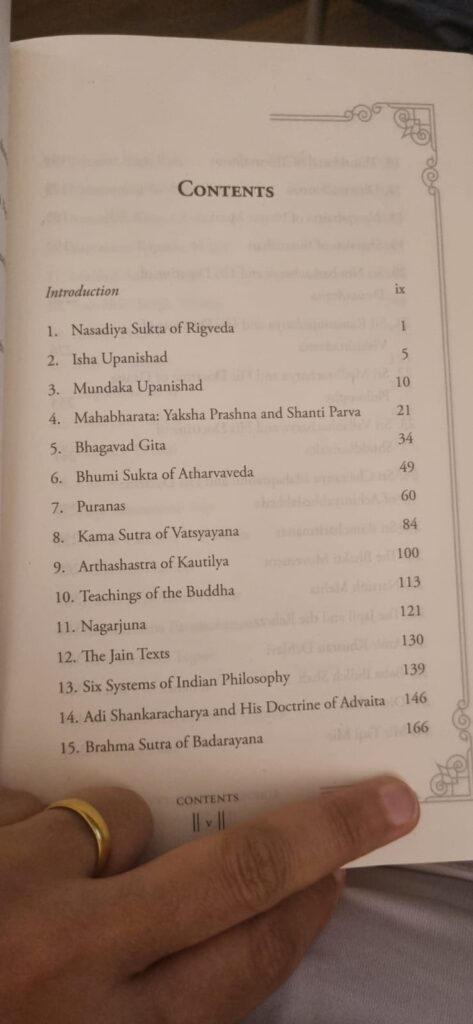
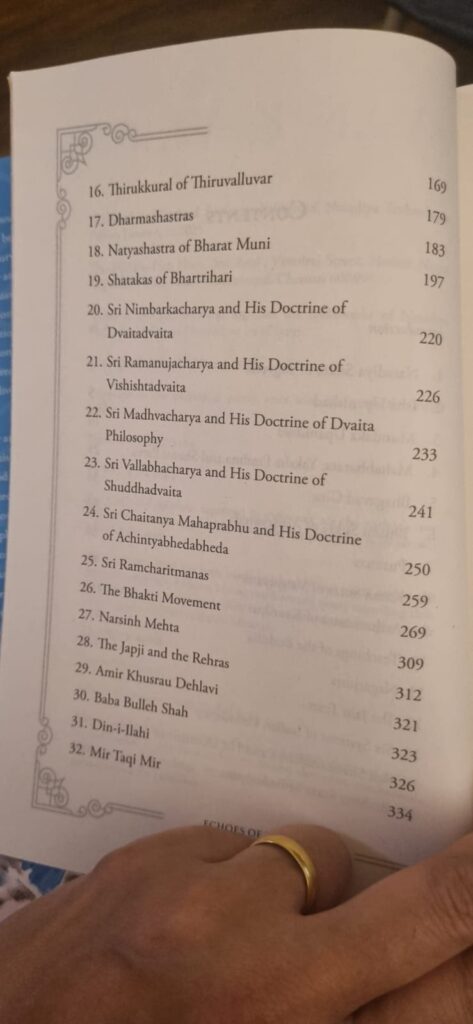
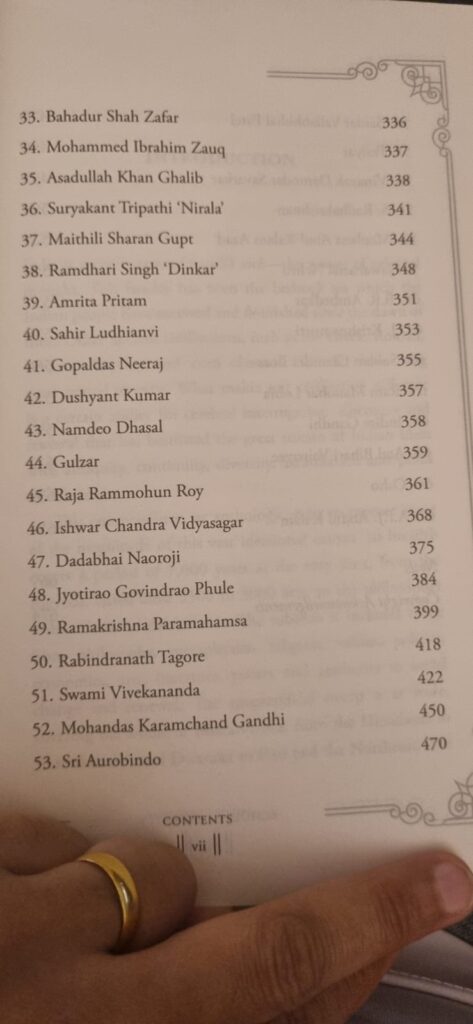
Here are images of the list of contents that are spread across four pages. It will give a sense of the breadth of literary selections included in the volume.
From the ancient Nasadiya Sukta to twentieth-century discussions about caste and nation, this is an anthology of Indian philosophical and political thought that deserves a place on every bookshelf. Wise and diverse, reflective and provocative, each of the pieces in this collection, be it Sanskrit verse, Urdu poetry or a speech in Parliament, belongs to the canon of intellectual thought that defines Indianness.
Echoes of Eternity has its limitations as the author has recognised but it is certainly a good introduction to our rich literary inheritance. It is worth remembering.
The Urdu newspaper Pratap – and its Hindi counterpart Vir Pratap – had a long and eventful history. Launched by Mahashay Krishan on 30 March 1919 and ably carried on by his son Virendra and later his grandson Chander, it was a torchbearer against the British Raj that covered all the major events during India’s struggle for independence and after, until it wound up in 2017.
This book, published by HarperCollins India, chronicles the exciting lives of the newspapers, their founder and editors, as well as landmark events of Indian history, from Independence to the Emergency and Operation Blue Star. Pratap was known for its bold stance, which lead to it being shut down for a year by the British administration within twelve days of its launch, the arrest of its founder and editors-in-chief multiple times, and even a parcel bomb being delivered to its office in 1983. An icon of Indian journalism, Pratap is a reminder of the importance of speaking truth to power. Its story deserves to be read by all.
A veteran journalist and columnist, Chander Mohan was the distinguished editor of the Hindi daily Vir Pratap for forty years. Born in Lahore in pre-partition Punjab, he has been a leading voice in Hindi journalism in North India, writing searing and uncompromising editorials. From travelling in Rajiv Gandhi’s press entourage to Lahore with Prime Minister Atal Bihari Vajpayee, he is privileged to have witnessed several eras of politics and media. Semi-retired, he pens ‘Maryadain’, a weekly column for a national newspaper while managing several educational institutions in his hometown, Jalandhar. Journalism and education are his two passions, and he finds a way for both to complement each other.
As a journalist with nearly three decades of experience across TV, print and digital media, Jyotsna Mohan has always sought to hold up a mirror to society. Her journey led her to pen her debut book Stoned, Shamed, Depressed, an Amazon bestseller that dives deep into the secret lives of India’s teens and reveals challenges that resonate with young people globally. A columnist for publications in India and abroad, her writings reflect societal issues and challenge the status quo, which she says is her family legacy! She brings this outlook to her online talk show Table Talk with Jo. Born in Jalandhar, Jyotsna now lives with her husband and two children in Abu Dhabi.
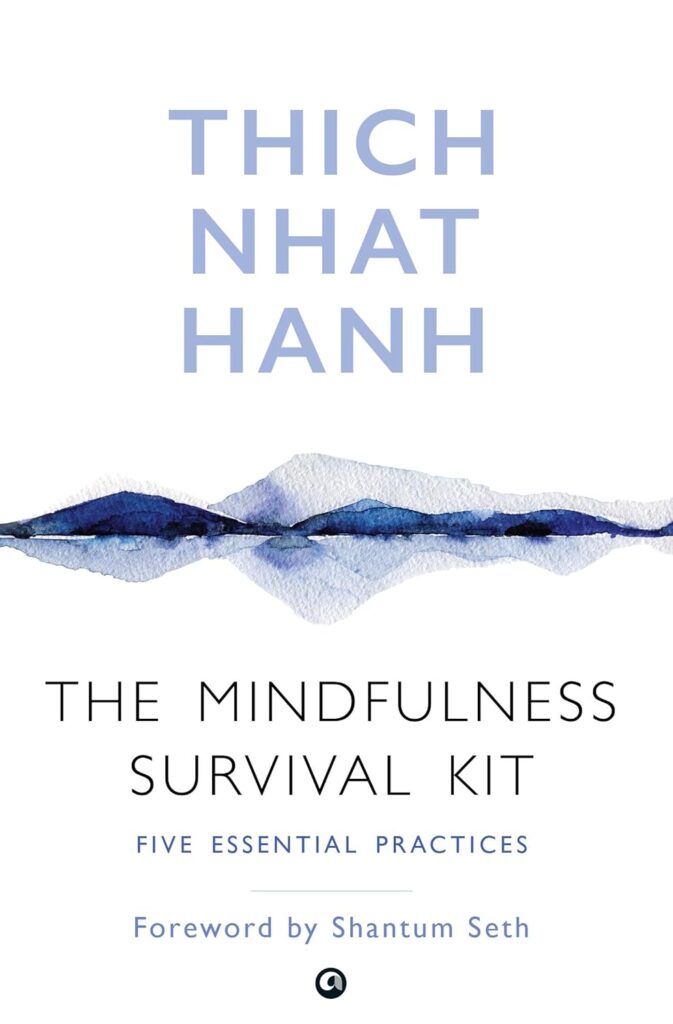
The Five Mindfulness Trainings, also known as ‘Precepts’, form the foundation of ethics and morality in Buddhism: not to kill, steal, commit adultery, lie, or consume intoxicants. In The Mindfulness Survival Kit, revered Zen Master and peace activist Thich Nhat Hanh discusses the deep relevance of these simple yet profound principles in both our personal lives and in the world around us.
Describing the precepts as a ‘diet for a mindful society’, he shares insights into their value and meaning and teaches how embracing each mindfulness training can nurture a society grounded in care, harmony, and mutual respect. In his poetic and lucid style, Hanh presents a practical and secular vision for building and sustaining a way of life that is healthy, compassionate, and doesn’t harm or disrupt peace. Thich Nhat Hanh was one of the best-known Zen Buddhist teachers in the world. He was the author of numerous bestselling books. He lived in Plum Village, in southwest France, where he taught the art of mindful living. He passed away in Hue, Vietnam, in January 2022.
“At 15,700 feet, I was clinging for dear life. Like a lizard’s belly I had pressed my body tight into a cliff of the Kargil War. There was no safety rope around my waist to secure my passage along the cliff wall, which was near-perpendicular in stretches. My hands and feet had the barest of holds and pressing against the cliff wall was the only safeguard against the forces of gravity that would send me plummeting thousands of feet below into the Gragario nallah.”
Posted with The Indian Express in Kashmir and later, during the Kargil War, Vikram Jit Singh is that rare breed of war correspondents who took grave risks to their lives in the line of duty. Embedded with Army’s seek-and-destroy columns, he climbed Safapora mountains at night to hunt down killers of 23 Wandhama Pandits.
Incorporating unpublished photographs of Point 5353 in Drass taken by Pakistani intrusive patrols in Oct 1998 during the Kargil build-up, Flowers on a Kargil Cliff establishes how 5353 and Bajrang Post were captured. Photos reveal Gen P. Musharraf and his entourage of generals across LoC in March ’99.
Vikram Jit Singh is a correspondent of the proverbial trenches. And, a diehard romantic who sent alpine flowers from Kashmir & Kargil battlefields in letters to his anxious fiancée.
Singh was embedded with the Indian Army’s riflemen and sepoys in the innermost cordons of Kashmir counter-terrorist operations. He was then stationed at Srinagar for The Indian Express since October 1997. When the Kargil War broke out, his experiences of facing bullets with ground soldiers during day-and-night Kashmir operations stood him in good stead. He was the only media person permitted twice to climb to the enemy bunkers at the Kargil high-altitudes with the assault troops, while navigating treacherous cliff faces, ducking Pakistani air-burst shelling and staying the night under small arms and artillery fire at 15,700 feet. As a combat journalist, Singh filed first-hand battle accounts with unique datelines: ‘Safapora Heights’ and ‘Point 4812’. It led the Siachen legend, Lt. Gen. Sanjay Kulkarni (retd.), to inscribe on the book: “Vikram has been baptised under fire as a war correspondent, and has operated less as a correspondent and more as a soldier in Kashmir…Truthful reporting is his forte…An inspirational journalist.”
Singh was invited to write an eyewitness account of shelling duels from his vantage points in the towering heights for the book, With Honour and Glory — Five Great Artillery Battles, published in 2021 by the United Service Institution of India under the aegis of the Directorate of Artillery, Army HQs, New Delhi.
A journalist of 33 years standing, Singh reported for India TV while stationed at Srinagar in 2004, the second of his two stints in the troubled vale. He has been an investigative journalist for Tehelka and The Indian Express, and his stories include the expose of the judges in the 2002 Punjab Public Service Commission ‘Ravi Sidhu’ scam, the $1 billion International Financial Consortium fraud, the petrol pumps allotment scam and the serial poaching escapades of Rajiv Gandhi Khel Ratna awardee & international trap shooter, Manavjit Singh Sandhu.
Singh has featured in several podcasts and national / regional TV interviews relating to wildlife conservation, defence, security, regional geopolitics, Kashmir and the Kargil War. He is also a naturalist who was groomed in his formative years by the birdman, Dr. Salim Ali. He writes columns on wildlife / environment for The Times of India and Hindustan Times newspapers in Chandigarh and his articles on wildlife conservation have been published in Sanctuary Asia magazine. He was nominated as a Member (Expert) to the Chandigarh State Wildlife Advisory Board and has been a consultant to the Governments of Punjab and Chandigarh UT on conservation issues.
Vikram Jit Singh’s writing style is very precise, clear, and calm despite all that he documents in Flowers on a Kargil Cliff. His accounts are clearcut and as descriptive as his writing hero Hemingway whom he invokes in the quote to the extract given below. Singh’s articles about the conflict in Kargil and subsequent pieces on the military are worth reading.
Read an excerpt from his book that was published on Moneycontrol.
Nearly 90 million people around the world identify as Tamil, a proud and ancient community with a unique language, history, and culture. The Tamil people have given India and the world some of its most iconic revolutionaries and political leaders, industrialists, philosophers, sportspeople, scientists, and mathematicians (including winners of the Nobel Prize), and celebrated writers, poets, dancers, musicians, and actors. The influence of the community on science, culture, religion, philosophy, art, architecture, literature, film, and politics has endured across millennia. While the majority of Tamils live in South India, the diaspora is to be found in countries around the world—especially in Sri Lanka, Malaysia, Singapore, Canada, the UK, and USA, where Tamil traditions thrive and assume new and interesting forms. A people of immense resilience, intellect, and creativity, the Tamils continue to leave an indelible mark on the world.
But who are the Tamils, really? How have they preserved a distinct cultural heritage while evolving across time and geographies? And what is the Tamil ‘gunam’ or identity? How has Tamil culture endured even as it has evolved and mutated over centuries?
In The Tamils, author Nirmala Lakshman draws from a wealth of historical information, original research, and her own keen observations of the community that she is part of to craft a rich and expansive exploration of Tamil history, society, and culture. The book has been published by Aleph Book Company.
Today’s Tamil Nadu largely corresponds to ancient Tamilakam and is bound by the mountain ranges of the Western Ghats and the Bay of Bengal, with tracts of dry red earth, green paddy fields, and pebbled riverbeds in between. This book traces the remarkable journey of the people of this land, starting from the Stone Age (1.7 million years ago) all the way up to the epic Sangam era (300 BCE to 300 CE), whose literature highlights the influential role of dynasties like the Pallavas, Pandyas, Cholas, and Cheras, and the thriving Jain community of that time; it then examines the evolution and spread of Tamil culture through the Bhakti movement, and the arrival of Christianity and Islam. In parallel to the cultural, philosophical, and religious influences that shaped Tamil society, the book examines the medieval and modern political history of the region, and describes the setting up of the sultanates of the south, the rule of the Nayaks, the Vijayanagar dynasty, the Marathas, and the coming of the British. Thereafter, it goes deep into the freedom struggle, and the Non-Brahmin movement before describing the distinctive attributes of the Tamils in the modern era, especially the changes that are taking place in the twenty-first century.
Through incontestable scholarship and lucid analysis, the book delves into the complex intersections of politics, religion, caste, economics, and gender in Tamil society, while also capturing the spirit of Tamil creativity in art, architecture, handicrafts, dance, music, sports, mathematics, IT, and more. It studies the opposites that mark the community—the refinement and heights of Tamil culture, but also the violence stemming from centuries of prejudice. It explores the ways in which Tamil culture continues to evolve—through migration, debate, acculturation, and social upheavals. Accessible and comprehensive, The Tamils is a compelling portrait of one of the world’s oldest continuous cultures—in an ever-globalizing world, it reflects on what it means to be Tamil today.
Nirmala Lakshman has been steeped in Tamil culture by virtue of being Tamil and observing Tamil society through her years in journalism. She is currently Publisher and Chairperson of The Hindu Group of Publications and was earlier Joint Editor of the paper. She founded and edited The Hindu Literary Review, conceptualized and created Young World, India’s only children’s newspaper supplement, and developed several other feature sections of The Hindu. She launched The Hindu’s annual literature festival and continues to curate it. Nirmala has a PhD in postmodern fiction, and has written a book on Chennai, Degree Coffee by the Yard, and edited an anthology of contemporary Indian journalism, Writing a Nation.
Read an extract from the book published on Moneycontrol.