Hindi Posts

Jaya’s newsletter 8 ( 14 Feb 2017)

It has been a hectic few weeks as January is peak season for book-related activities such as the immensely successful world book fair held in New Delhi, literary festivals and book launches. The National Book Trust launched what promises to be a great platform — Brahmaputra Literary Festival, Guwahati. An important announcements was by Jacks Thomas, Director, London Book Fair wherein she announced a spotlight on India at the fair, March 2017.  In fact, the Bookaroo Trust – Festival of Children’s Literature (India) has been nominated in the category of The Literary Festival Award of International Excellence Awards 2017. (It is an incredible list with fantabulous publishing professionals such as Marcia Lynx Qualey for her blog, Arablit; Anna Soler-Pontas for her literary agency and many, many more!) Meanwhile in publishing news from India, Durga Raghunath, co-founder and CEO, Juggernaut Books has quit within months of the launch of the phone book app.

In other exciting news new Dead Sea Scrolls caves have been discovered; in an antiquarian heist books worth more than £2 m have been stolen; incredible foresight State Library of Western Australia has acquired the complete set of research documents preliminary sketches and 17 original artworks from Frane Lessac’s Simpson and his Donkey, Uruena, a small town in Spain that has a bookstore for every 16 people  and community libraries are thriving in India!

Some of the notable literary prize announcements made were the longlist for the 2017 International Dylan Thomas Prize, the longlist for the richest short story prize by The Sunday Times EFG Short Story Award and the highest Moroccan cultural award has been given to Chinese novelist, Liu Zhenyun.

Since it has been a few weeks since the last newsletter the links have piled up. Here goes:

  1. 2017 Reading Order, Asian Age
  2. There’s a pair of bills that aim to create a copyright small claims court in the U.S. Here’s a breakdown of one
  3. Lord Jeffery Archer on his Clifton Chronicles
  4. An interview with award-winning Indonesian writer Eka Kurniawan
  5. Pakistani Author Bilal Tanweer on his recent translation of the classic Love in Chakiwara
  6. Book review of Kohinoor by William Dalrymple and Anita Anand
  7. An article on the award-winning book Eye Spy: On Indian Modern Art
  8. Michael Bhaskar, co-founder, Canelo, on the power of Curation
  9. Faber CEO speaks out after winning indie trade publisher of the year
  10. Scott Esposito’s tribute to John Berger in LitHub
  11. An interview with Charlie Redmayne, Harper Collins CEO
  12. Obituary by Rakhshanda Jalil for Salma Siddiqui, the Last of the Bombay Progressive Writers.
  13. Wonderful article by Mary Beard on “The public voice of women
  14. Enter the madcap fictional world of Lithuanian illustrator Egle Zvirblyte
  15. Salil Tripathi on “Illuminating evening with Prabodh Parikh at Farbas Gujarati Sabha
  16. The World Is Never Just Politics: A Conversation with Javier Marías
  17. George Szirtes on “Translation – and migration – is the lifeblood of culture
  18. Syrian writer Nadine Kaadan on welcoming refugees and diverse books
  19. Zhou Youguang, Who Made Writing Chinese as Simple as ABC, Dies at 111
  20. Legendary manga creator Jiro Taniguchi dies
  21. Pakistani fire fighter Mohammed Ayub has been quietly working in his spare time to give children from Islamabad’s slums an education and a better chance at life.
  22. #booktofilm
    1. Lion the memoir written by Saroo Brierley has been nominated for six Oscars. I met Saroo Brierley at the Australian High Commission on 3 February 2017. 
    2. Rachel Weisz to play real-life gender-fluid Victorian doctor based on Rachel Holmes book
    3. Robert Redford and Jane Fonda to star in Netflix’s adaptation of Kent Haruf’s incredibly magnificent book Our Souls at Night
    4. Saikat Majumdar says “Exciting news for 2017! #TheFirebird, due out in paperback this February, will be made into a film by #BedabrataPain, the National Award winning director of Chittagong, starring #ManojBajpayee and #NawazuddinSiddiqi. As the writing of the screenplay gets underway, we debate the ideal language for the film. Hindi, Bengali, English? A mix? Dubbed? Voice over?
    5. 7-hour audio book that feels like a movie: Julianne Moore, Ben Stiller and 166 Other People Will Narrate George Saunders’ New Book – Lincoln in the Bardo.
    6. Doctor Strange director Scott Derrickson on creating those jaw-dropping visual effects

New Arrivals ( Personal and review copies acquired)

  • Jerry Pinto Murder in Mahim 
  • Guru T. Ladakhi Monk on a Hill 
  • Bhaswati Bhattacharya Much Ado over Coffee: Indian Coffee House Then and Now 
  • George Saunders Lincoln in the Bardo 
  • Katie Hickman The House at Bishopsgate 
  • Joanna Cannon The Trouble with Goats and Sheep 
  • Herman Koch Dear Mr M 
  • Sudha Menon She, Diva or She-Devil: The Smart Career Woman’s Survival Guide 
  • Zuni Chopra The House that Spoke 
  • Neelima Dalmia Adhar The Secret Diary of Kasturba 
  • Haroon Khalid Walking with Nanak 
  • Manobi Bandhopadhyay A Gift of Goddess Lakshmi: A Candid Biography of India’s First Transgender Principal 
  • Ira Mukhopadhyay Heroines: Powerful Indian Women of Myth & History 
  • Sumana Roy How I Became A Tree 
  • Invisible Libraries 

14 February 2017 

An Interview with Daisy Rockwell, Author, Artist and a Hindi-Urdu Translator

This interview was first published on Bookwitty.com on 20 December 2016 ) 

Daisy Rockwell is an artist, writer and Hindi-Urdu translator living in the United States. Rockwell grew up in a family of artists in western Massachusetts. From 1992-2006, she made a detour into academia, from which she emerged with a PhD in South Asian literature, a book on the Hindi author Upendranath Ashk and a mild case of depression. Upendranath Ashk was a Hindi writer, based in Allahabad, who began publishing in pre-Independent India but soon, due to his irascible temperament chose to self-publish much of his later work. Daisy Rockwell met the Hindi writer on a few occasions in the 1990s and began translating his fiction with his permission. Unfortunately Ashk never saw Daisy Rockwell’s publications. Daisy Rockwell’s diligent dedication to the task shines through the quality of the English translations that were ultimately published. The translated literature is a pure delight to read; smooth and evocative of the early and mid-twentieth India they are set in.

Rockwell has written The Little Book of Terror, a volume of paintings and essays on the global war on terror (Foxhead Books, 2012), and her novel Taste was published by Foxhead Books in April 2014. Her translation of Ashk’s well-known novel about the evolution of a writer Girti Divarein was published by Penguin India as Falling Walls (2015), her collection of translations of selected stories by Ashk, Hats and Doctors ( 2013); and her new translation of Bhisham Sahni’s legendary novel about the partition of India, Tamas ( 2016).

An Interview with Daisy Rockwell, Author, Artist and a Hindi-Urdu Translator - Image 1
An Interview with Daisy Rockwell, Author, Artist and a Hindi-Urdu Translator - Image 2

How did you choose Hindi to be the language to master and translate from?

I wandered into Hindi in college and never really wandered out again. I loved learning languages and had studied French, Latin, ancient Greek, and German. I wanted something less familiar and happened to take a social sciences course with Susanne Hoeber Rudolph, who spoke of her life doing research in India, so I decided to sign up for Hindi. Translation was something one had to do anyway in graduate school, but I was fortunate to take a translation seminar with AK Ramanujan shortly before his death, and that illuminating experience has stayed with me always.

How do you select a text to translate?

It’s hard to say. Often a text chooses you, rather than vice versa. I wrote my doctoral dissertation about Upendranath Ashk, and always wanted to translate his work, though that project fell by the wayside. Eventually I took it up again because it wouldn’t let me go.

Do you have any basic guidelines that you follow while translating? For instance is it crucial to convey the authentic form of Hindi used in the language of origin or is it important to stress readability in the destination language?

What’s important to me is that the translation reads as well as the original, and that the reader in English can get the same feeling from it that the Hindi reader might (despite the vastly different reading contexts).

If the text you decide to work upon has been translated before into English, do you ever read it or do you like to approach your project with a fresh perspective?

I would never retranslate something that was already done well. I first check the existing translation against the Hindi in the opening chapter. If I decide to retranslate it, I keep the other translations at hand and consult with them, as though I were sitting among friends. Even if I think the previous translator did poorly, I recognize that he or she may see things in ways that would escape me, or know things I don’t know. Translation is a lonely business, and the other translators keep me company. I argue with them, listen to them, curse at them, and lean on them. Much of Hindi literature has not been translated, however, so retranslation is actually a rare luxury.

What has been the most exciting challenge you have encountered while translating Hindi?

Translation is almost always challenging, but rarely exciting.

What form of Hindi are you most comfortable with? Does it belong to a particular period of Hindi literature?

Because of Ashk and Bhisham Sahni, I have become really strong in 1930’s-40’s Punjabi-centric Hindi. I know all kinds of architectural details and articles of clothing and turns of phrase. Oddly, contemporary writing can be much more difficult for me.

Does translating Hindi while based in USA create any cultural challenges or is the immersion in your text so complete that your geographical location is immaterial?

It’s terribly challenging, but Twitter and social media have changed things dramatically. Much of the translating I’ve done would be difficult in India or Pakistan as well, without the reach of social media. There is much in novels of the earlier part of the 20th century that cannot be found in dictionaries nor in contemporary discourse. It’s not stuff most people know. I have to hunt high and low for definitions of some terms, and I depend greatly on my twitter friends for help in this regard.

Do you think it is “easier” to publish translations of Hindi literature as compared to when you first started in the 1990s? If yes, what are the possible reasons for this growing interest?

It is easier to publish them in India. In the US, I have yet to find a publisher for any of my translations. In India there is definitely a growing interest in translations and a growing respect for non-English language literatures. I am not sure how this happened, but I am thankful for it, and all signs point to continued growth in publication and interest.

How do you define “original text” as opposed to the “transcreations” authors such as Bhisham Sahni and Upendranath Ashk undertook with their own works when translating into English — a style not uncommon among many bilingual writers? Won’t the “revisions” to the text done later by the authors themselves be considered as “original” text? Which version do you opt to use in your translation?

I think bilingual authors should avoid translating their own work as much as possible. It seems most writers cannot withstand the temptation to alter the original while translating. They are the author, after all, so they have the right–but in doing so they deprive the English readers of the original text. At times, they alter the original beyond recognition, as in the sad case of Qurratulain Hyder’s translations River of Fire and Fireflies in the Mist. It is also often the case that bilingual people are rarely the same writer in two languages. Sahni translated Tamas himself, for example, but his English writing style was brittle and high-brow; though he knew English extremely well, he didn’t know the kind of English that Tamas would have been written in. The Hindi of Tamas is strikingly clear, succinct, and unadorned. His translation was unable to capture that. Hyder’s English was also perfect, but she clearly believed that the material must be presented differently to English readers and changed her works in sometimes very peculiar ways. And despite the fact that her English was perfect, I don’t believe that she wrote as well in English as she did in Urdu. It wasn’t a matter of being correct or not, but a matter of flow and style. In the case of the Sahni family, there was recognition that their father’s translation did not quite capture the spirit and they generously gave permission to retranslate. Sadly, Hyder’s heirs, following her wishes, refuse to grant permission to anyone to retranslate the books, so they remain off-limits to English readers, except for in their transcreated versions.

Your two creative pursuits — painting and translations can be exacting and very fulfilling. Do they in any way influence each other? For instance if you are tussling with a particularly challenging piece of translation does it get reflected in your painting and vice versa?

I’d like to think they’re connected, but if they are, the connection is not clear to me. I’ve occasionally illustrated translations or discussions of translation, but most of the time they are quite separate in my mind.

Is your preference only for literary fiction or would you try pulp fiction or even poetry in the future?

I’ve always been a high literature kind of gal. I never read pulp fiction (except for Blaft’s Tamil Pulp Fiction!) at all. There are plenty of translators who could do that, at any rate, but classics, in particular, require a great deal of reflection and research, and that’s where my niche lies. I have been translating some poetry lately though, such as Shubham Shree’s Poetry Management, and Avinash Mishra’s untranslatable poems on Hindi orthography . I’ve also been translating some poetry by Mangalesh Dabral, which has not yet been published.

An Interview with Daisy Rockwell, Author, Artist and a Hindi-Urdu Translator - Image 3


Kindle books in Indian languages could be a game changer: What Amazon’s new initiative will mean for publishing in Indian languages

My article on Kindle books being introduced in Indian languages was published in The Mint on 21 Dec 2016. )

Photo: iStock

Photo: iStock

Amazon India has announced that Kindle will launch digital books in five Indian languages—Hindi, Tamil, Marathi, Gujarati and Malayalam. The titles include Ishq Mein Shahar Hona by Ravish Kumar (Hindi), Rajaraja Chozhan by Sa. Na. Kannan (Tamil), Mrutyunjay by Shivaji Sawant (Marathi), Ek Bija Ne Gamta Rahiye by Kaajal Oza Vaidya (Gujarati), Aarachar by K.R. Meera (Malayalam) and Mayapuri by Shivani (Hindi). Kindle devices seventh generation and above will support Indic scripts, enabling readers to access such books.

This is a move that could be a game changer in India. Amazon India has moved methodically to embed itself in Indian publishing. First, it launched Kindle with free lifetime digital access provided by BSNL, but only for English e-books. In November, the acquisition of local publishing firm Westland—known for its commercial fiction best-sellers and translation programme—was completed at reportedly $6.5 million (around Rs44 crore), a small portion of the $5 billion allocated by Jeff Bezos as investment in India. In fact, Seattle-based Amazon Publishing’s translation imprint, AmazonCrossing, has surpassed all other publishers in the amount of world literature it makes available in the US. This was first highlighted in December 2015 by Chad Post, publisher, Open Letter Books, on his influential website, Three Percent. In October 2015 AmazonCrossing announced it had a $10 million budget to invest in translations worldwide. It is probably no coincidence that Amazon India vice- president and country manager Amit Agarwal has been inducted into the Bezos core team, which is responsible for its global strategy.

In an email, Post responded to the news, saying: “This seems like a great thing for Indian readers and anyone interested in Indian literature. Amazon’s stated goal is to make as many books available in as many formats to as many people as possible, and this program is a strong move in that direction. Increasing digital access to these books will be huge—it greatly expands the potential audience, and could help AmazonCrossing expand into publishing Indian writers in translation. AmazonCrossing published 60 works translated into English in 2016, which is far more than any other publisher. The majority of these titles are translated from German, French and Spanish, but AmazonCrossing has expanded into doing works from Iceland, Turkish, Chinese and Indonesian, so it makes sense that they would be interested in finding books from these five Indian languages.”

In India, this announcement could not have come at a more opportune moment. With demonetization, Indians who prefer dealing in cash are perforce moving to digital payments. Also, by July 2017, it will be mandatory for all handsets manufactured, stored, sold and distributed in India to support the inputting of text in English, Hindi and at least one more official Indian language, and support reading of text in all these languages, thus making it feasible to read books other than English on the Kindle app too.

Kannan Sundaram, publisher, Kalachuvadu, welcomed the decision: “We hope it will increase our revenue from e-books which is pretty low now. Tamilians are spread all over the world. It is near impossible to reach hard copies to them. So this will boost the chances for them to read Tamil books of their choice.” Best-selling author Ashwin Sanghi called it an “outstanding initiative by Amazon India. It’s about time that vernacular writing moved out from the confines of paperback. It will also enable out-of-print books to be made available now.” Another best-selling author, Amish Tripathi, said this will address the inadequate distribution and marketing of Indian language books, for the much larger market is the one in Indian languages. “I am personally committed to this and am very happy that of the 3.5 million copies that have been sold of my books, a good 500,000 of them are in Indian languages.” Others remarked upon the best global practices it would bring to local publishing.

Well-known Hindi lexicographer Arvind Kumar says it will influence reading patterns by encouraging cross-pollination of literature across cultures by “opening new avenues for translation of two-way Hindi to English and other Indian languages which are being introduced on Kindle, and from many non-English languages like French and German or, say, Latin American into Hindi”. Mini Krishnan, OUP, too endorsed it, saying readership in the Indian languages is healthy, so “a highly portable personal library will surely do well”.

21 December 2016 

Worldreader in India


WR logoWorldreader is actively seeking strategic partnerships with publishers and authors in India. Today it is being accessed by over 6 million readers in 69 countries, providing them with book titles in more than 43 languages. Worldreader would like to discuss a non-exclusive contract for publishing licenses for good, addictive and evergreen content for children, young adults and adults/women especially in Hindi and English. Given that the Worldreader platform supports multi-lingual formats the content could be across other Indian regional languages too. These texts could be across genres and reading segments– picture books, chapter books, bilingual books for children, stories, anthologies, fiction, translations, non-fiction, spiritual, health, cooking, memoirs, biographies, etc. Please email: jayabhattacharjirose1 at gmail dot com . For more information on Worldreader, please see the note below. 

Worldreader ( www.worldreader.org ) is a non-profit organization with the mission of ‘providing digital books to children and families in the developing world. It was established in 2010 by Colin McElwee and David Risher. Worldreader is on a mission to bring digital books to every child and her family, so that they can improve their lives.It focuses on enabling digital reading especially using the mobile platform. The mantra is “Books for All”. Today it is being accessed by over 6 million readers in 69 countries, providing them with book titles in more than 43 languages. Another plus point in Worldreader’s favour is that it supports multi-lingual formats. It firmly believes that “Literacy is transformative”.

In fact Worldreader is one of Fast Company’s most innovative nonprofits of 2016 and won the GLOMO Award 2016 for the best mobile innovation for education. Even the UNESCO report on “Reading in the Mobile Era” highlights Worldreader’s programme. ( http://unesdoc.unesco.org/images/0022/002274/227436e.pdf )

Worldreader is now in India. It has been launched in India with its mobile reading to children programme or mR2C.

mR2C in Delhi, pix credit, David Risher, Feb 2016

mR2C in Delhi, pix credit, David Risher, Feb 2016

It is a two-year pilot in Delhi NCR. In collaboration with select NGOs as implementing partners mR2C seeks to promote pre-literacy skills by encouraging parents to read to and with their young children (age 0-6) and by empowering them to do so by giving them access to a free digital library of high quality, locally relevant books and educational materials via their mobile phones. But Worldreader is focussing on all reading segments and age groups: from toddlers – children – young adult — adult literature. Given how many people, especially women, own a mobile and are willing to charge it first, despite not having ready access to water or electricity makes the idea of delivering books via mobiles an attractive proposition.

mR2C in Delhi, pix credit, David Risher, Feb 2016

mR2C in Delhi, pix credit, David Risher, Feb 2016

The organization uses e-readers, mobile phones and other digital technology to reach readers in more than 69 countries, providing them with over 28,500 book titles in 43 languages ranging from Afrikaans to Hindi. The e-book titles cover a spectrum of reading materials, ranging from beginner readers learning to read, to students and teachers accessing educational materials, to those reading for pleasure. So far it has reached more than 245 schools and libraries; 1,110,196 people reading every month; 5,653,216 people reached since 2010 and since its programme was launched in India, it has 92,698 active readers online ( Dec 2015). It works with 180 publishers to acquire and digitize compelling and relevant content for readers. The non-profit also works with donors, organizations, communities and governments to develop and digitize local and international books, as well as manage logistics and support. It has digitized more than 5,000 titles from African and Indian publishers. They are headquartered in San Francisco, California and have offices in Europe and Africa.

Through an internet-connected mobile device (feature and smartphones), children and families can read e-books with the organization’s reading application, called Worldreader Mobile. 250 million children of primary school age cannot read and write. 774 million people around the world are illiterate. 171 million people could be lifted out of poverty if all students in low‐income countries left school with basic reading skills – that is equivalent to a 12% drop in the number of people living on less than $1.25 a day. Geographically ¾ of illiterate adults worldwide are in sub-Saharan Africa and Southwest Asia. 2 out 3 illiterate people are women. It is known that readers in developing countries are primarily male but by removing cultural barriers that prohibit or discourage women from owning mobile technology and training women (as well as men) how to use basic mobile phones to access books and stories increases the possibility of women and girls reading more.  This mobile reading in turn positively impacts children since it appeals to (and can benefit) neo-literate and semi-literate adults and adolescents.

Worldreader Mobile is a reading application that provides access to books, educational resources and health information to people with mobile phones. The non-profit launched Worldreader Mobile in April 2012.  The app is also available on Opera Software, Microsoft Windows phones, and in Mozilla’s Firefox Marketplace. In partnership with Opera Software, Worldreader launched a Web-browser app, promoted on the Opera Mini platform. Reading on Worldreader Mobile is particularly popular with women, who spend on average 207 minutes reading per month, compared to 32 minutes for men. Research from a 2013 Report by UNESCO, Reading in the Mobile Era, found that reading on a mobile phone increased reading time across all media. There were also clear benefits for children that were not of reading age as one-third of mobile readers in the developing world use their phones to read stories to children.

Ian Denison at CEOSpeak, Jan 2016

Ian Denison at CEO Speak, Jan 2016. Organised jointly by NBT & FICCI.

Worldreader contends that their mission is two-fold: increasing access to books while springboarding local publishers and authors into an international market. It makes content available in English and an array of local languages such as Hindi and Marathi and this is possible without the high costs and other limitations with print. Worldreader defrays digital start-up costs for local publishers, giving readers better access to relevant content, while simultaneously introducing publishers to new markets. Thereby, strengthening your brand, spreading the word about your publishing house and lists and most importantly, allow your books to be accessed by the diaspora too.

At the recently held CEOSpeak organised jointly by NBT and FICCI on 10 January 2016, Ian Denison, Chief Publishing and Branding, UNESCO said “Problem is not enough content is available when content is primary to get reading takeoff actively on digital devices.” He illustrated this in his presentation by showing the Worldreader icon appealing for more good quality content to be available on the platform. In India Worldreader is actively seeking good content / publishing licenses in English and other local languages especially for children ( 0-12 years) and literature for adults.

13 March 2016

Penguin Random House signs a co-publishing deal with Manjul Publishing House

PRH

Penguin Random House reinforces commitment to India’s regional languages
New co-publishing deal with Manjul Publishing
Vaishali Mathur appointed to
Head of Language Publishing and Rights

Penguin Random House in India today strengthened its commitment to ensuring its authors’ works reach the widest possible readership by announcing a new co-publishing partnership for local language translation with Manjul Publishing House and the appointment of Vaishali Mathur to Head of Language Publishing and Rights.

Under the partnership with Manjul Publishing, Penguin Random House titles will be made available in Hindi, Gujarati, Tamil, Telugu and Marathi in the first roll out phase. An initial list of about 50 titles will be released over the course of 2016, growing to a wider range in the coming years.  This list will encompass both adult and children’s titles across fiction and non-fiction, and consist of both newly released titles and some of Penguin Random House’s most popular perennial bestsellers. To drive this initiative, Vaishali Mathur will take on the newly created role of Head of Language Publishing and Rights.  Alongside her current role as Executive Editor for commercial publishing, Vaishali will take on a wider responsibility for further language sales as well as rights deals to language publishers in India and worldwide.

CEO Gaurav Shrinagesh comments:

“It has long been Penguin Random House’s aim to provide books and content for a large range of readers, not only throughout India but also across the globe.  Through this new strategic partnership with Manjul Publishing and the appointment of Vaishali to oversee our translation and rights sales, I am delighted that we will now be able to expand the reach of our authors’ works across languages and territories.”

Vaishali Mathur, Executive Editor and Head of Language Publishing and Rights adds:

I am extremely enthused with this opportunity to bring Penguin Random House’s extensive catalogue of Indian and International books to the readers of local languages across the country. With this program we will be able to reach out to a larger readership and provide our authors with a wider canvas.”

Vikas Rakheja, Managing Director, Manjul Publishing House says:

“We at Manjul Publishing House are thrilled to be associating with Penguin Random House in India to co-publish their select titles in Hindi and other Indian language translations. At Manjul we hold the unique distinction of single-handedly creating the niche segment of Indian language translations in the Indian publishing industry and are pleased that we will now be able to apply this expertise to popular Penguin Random House titles. We are certain that this co-publishing venture will successfully take mainstream titles from the Penguin Random House stable to the vernacular reader in India, thereby expanding their reach considerably.”

In addition to focusing on translations to local languages, Penguin Random House in India has long been the leading publisher for translation of works into English.  Through its acclaimed Penguin Classics list as well as individual translations, its authors have been lauded with awards including those of the Sahitya Akademi, the Crossword Book Award and for the past three years its translated fiction has appeared on the shortlist for the prestigious DSC Prize for South Asian Literature.

Caroline Newbury

VP Marketing and Corporate Communications

Random House India

Penguin Random House

 cnewbury@penguinrandomhouse.in

20 Feb 2016

Book launch: Mrinal Pande’s “Dhvaniyon ke aalok mein stree” ( 4 January 2016, IHC)

On Monday, 4 January 2016, I attended Hindi publisher Rajkamal Prakashan’s book launch  for noted journalist and writer, Mrinal Pande’s Dhvaniyon ke aalok mein stree . Mrinal Pande has written a nonfiction book about the vast contribution of professional women musicians (largely tawaifs or courtesans till the mid 20thC) to Hindustani classical and semi-classical music in post-1857 India. Most of whom went unmentioned even by famous musicians and Ustads, whom they had lovingly and selflessly tutored and mentored through their early days of penury. The panel includes  journalist Yatendra Mishra, singer Shubha 20160104_190652Mudgal, poet Ashok Vajpeyi, Mrinal Pande and publisher Ashok Maheshwari. The event was introduced by editor Satyanand Nirupam.

I enjoyed the event immensely. Two hours went by so swiftly. I could have heard the conversations some more.

I liked the narrative which emerged from the evening’s chat. Women musicians were a phenomenal influence and in many cases taught men who were to later earn quite a name for themselves. But the focus was not necessarily on the women musicians who have been profiled in the book but many like Shubha Mudgal’s Nani ( maternal grandmother) who yearned to learn music but was not allowed by her father. Instead he insisted she learn the piano. To fulfil her desire of learning Hindustani music Nani had herself photographed holding various Indian musical instruments in the garden. (I am curious though how did the Nani get access to those musical instruments with which she was photographed in the garden?) Or the many rich wives of Bombay boxwallahs or the corporates who were taught music to while their time. It served another purpose too – the male musicians social ambitions of being seeing in the right circles. But the true preservers, inheritors and practitioners of music, were the Hindu and Muslim tawaifs, who kept Hindustani musical traditions alive by performing every night gave music a lease of life. Equally significantly they kept local languages and dialects or “bolis” alive in the Hindi that was commonly known and spoken. They were not averse to borrowing, blending, improvising and creating fresh interpretations as long as music was heard. This for Mrinal Pande is a crucial aspect of the womens musicians contribution to language and musical traditions. Her analysis of Hindi being kept alive since it had not as yet been politicised and hijacked depriving it of its backbone, ie the various bolis some of which were integral to the gharanas. So these remained in the social consciousness. I found this gem fascinating.

Another one was that of women singers graduating from anonymity to establishing their name to a recording. The idea that after the 3.5 minutes of 78 rpm had been cut by the German engineers the women to ensure the correct singer was given due credit said her name at the tail end of the song. It is incredible what technology and different kinds of publishing can do for the identity and self-worth of an individual.

The Union Home Ministry note issued in 1946 when Govind Vallabh Pant who was a minister in the provisional government debarring women singers who had a pesha or were tawaifs from singing. Later Mr Keskar, Minister for Information and Broadcasting, post independence, nullified the government note banning,”women whose personal lives are a public scandal”, in 1952. Suddenly it all made sense to my mind…once again the notion of identity of the women along with the patriarchal tyranny which was implicit in the 1946 order. But when Mr Keskar overturned the order he insisted the religion of singer be evident. All muslim singers were to add the prefix “Begum” and hindu singers had to add the suffix, “Devi”. Now that too is a curious move…identification along religious lines. Not unheard of. It could be considered at par with the star all Jews had to stitch on their coats in Nazi Germany.

I liked the story about Mrinal Pande’s mother, the popular Hindi novelist, “Shivani”, taking her husband’s permission to write and then adopting a pen name. Ironically it is Shivani who now remains alive in people’s minds. I enjoyed Shubha Mudgal’s response about her son being cared for by the extended clan while she was on tour and the astonishment expressed by the Indian diaspora who could not fathom how this was possible — “Had she taken permission from her husband to do so?” Having said that I know these women continue to be rare examples and not necessarily the norm.

Even Yatindra Mishra’s tale about his Dadi (paternal grandmother) not being permitted to sing since it would be frowned upon by society especially now that the family had lost their princely status. Given the context that women musicians were mostly tawaifs this would have really complicated matters for the family. So her father did not allow her to sing saying, “What will people say? They will think we have fallen on such hard times that now the daughter of the house is singing to earn!” Funny how far Indian society has now come with children being encouraged to sing and perform publicly in the hope they can become professional singers, preferably in Bollywood.

I liked how gracefully and tactfully Shubha Mudgal and Mrinal Pande dealt with the comment about “deterioration” of Indian classical musicians performing mobile ring tones and snatches of popular Hollywood musicals. It was fascinating to observe the arguments playing out between the purists and those who were arguing for the evolution of musical traditions such as the examples noted by Ashok Vajpayee. He said sometimes he can identify bits of Gwalior or Bhopal gharanas in modern renditions. Interesting.

Dhvaniyon ke aalok mein stree has been published by Rajkamal Prakashan. It is available in hardback and paperback.

6 January 2016


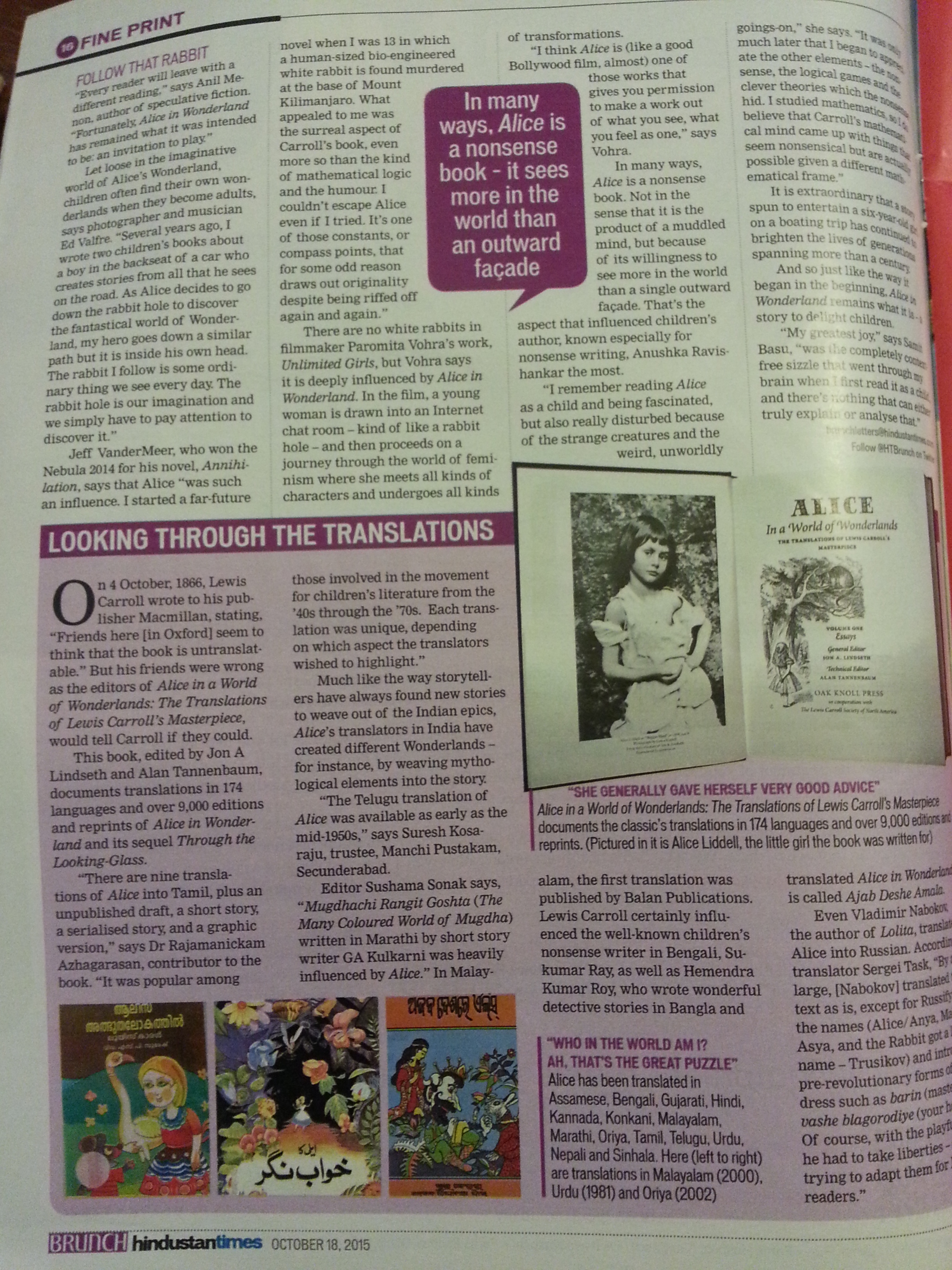
“Alice in Wonderland” continues to inspire readers across the world

( My article on Alice in Wonderland has been published in Hindustan Times popular and widely circulated Sunday 20151018_065049supplement Brunch on 18 October 2015. It is a generous two-page spread in print20151018_065100 with the title “Curiouser And Curiouser”. I am c&p the text from the digital version here. The original url can be viewed at: http://www.hindustantimes.com/brunch/alice-in-wonderland-continues-to-inspire-readers-across-the-world/story-NKnM2TiOACiTMXQXtUI51M.html )

Scottish writer George MacDonald persuaded Carroll to self-publish Alice. It had been tested out on the MacDonald children by their mother – and the family loved it. (Above, Carroll with Mrs MacDonald and her children.) (Getty Images/Science Source)

Who’d have thought a self-published story written for the daughters of a friend would become a world classic, eagerly bought, borrowed and downloaded even now, 150 years later?

 Alice in Wonderland was written in 1865 by Charles Lutwidge Dodgson, a mathematics professor at Oxford, better known by his pen name, Lewis Carroll. He wrote it for Lorina, Alice and Edith, the three daughters of his friend, Reverend Henry Liddell.

Start of many things

Alice in Wonderland is about a girl named Alice who falls down a rabbit hole in pursuit of the White Rabbit and discovers a nonsensically delightful world with colourful characters like the Red Queen, the Mad Hatter, the Cheshire Cat and the March Hare. More writers, artists and creators all over the world have credited Alice as an inspiration than any other book, thanks to its imaginative world filled with fantastic linguistic acrobatics in rhyme and prose.

That the book should have emerged in the staid Victorian era of verbose and righteous prose says much for the power of creativity. Carroll was persuaded to publish Alice with his own illustrations, by Scottish author and poet, George MacDonald.

The story had been tested out on the MacDonald children by their mother. The family thoroughly enjoyed the tale, and Carroll self-published it. Then, it was edited and published by Alexander Macmillan.

Alice, coverLewis Carroll requested the well-known artist of Punch, Sir John Tenniel to create the illustrations, many of which were ultimately based on the original drawings made by the author. To commemorate the 150th year of its publication, Macmillan, the original publisher, has produced a scrumptious edition of The Complete Alice, with the original Tenniel illustrations in full colour. It is unusual for a publisher to be celebrating 150 years of a text, but Alice in Wonderland is perceived to be “a world text”.

Alice in Wonderland is about a girl named Alice who falls down a rabbit hole in pursuit of the White Rabbit. On the left is an illustration of the character by Carroll himself, and next to it (right) by Tenniel. (Photos: Stapleton Collection/Corbis, The Print Collector/Corbis)

“It’s one of those texts that IS, like Shakespeare,” says graphic novelist Samit Basu. “Its constant reinterpretations in everything, from zombie comics to action-fantasy novels, have kept the original text alive, and that’s the greatest thing that can happen to any book.”

This is evident by the text’s vast influence across creative platforms and genres – storytelling, play on words, visual arts, filmmakers, still photography and translations.

According to filmmaker and author Devashish Makhija, a lot of motifs from Alice have been uncannily replicated across the world. “Tweedledum and Tweedledee seem to have inspired Herge’s Thompson and Thomson in Tintin,” he says. “Batman’s Joker seems to have shades of the Mad Hatter, at least in his inexplicable (but profound) reliance on creating some sort of chaos in anything he communicates.”

And there’s more. When Alice fell down a rabbit hole to discover a topsy-turvy world, Makhija argues, she opened a clear story-telling device for creators of the future. “The ‘hole’ – although in existence before this book – was used pointedly for the first time as a portal connecting two dimensions through which a character ‘travels’.

It has since been used in versions in almost ALL of fantasy writing: the wardrobe in CS Lewis’s Narnia series, the square drawn with chalk in Pan’s Labyrinth, platform 93/4 inHarry Potter, the bridge of Terabithia, HG Wells’s time machine and even the bathtub in Anurag Kashyap’s No Smoking.”

Follow that rabbit

“Every reader will leave with a different reading,” says Anil Menon, author of speculative fiction. “Fortunately, Alice in Wonderland has remained what it was intended to be: an invitation to play.”

Let loose in the imaginative world of Alice’s Wonderland, children often find their own wonderlands when they become adults, says photographer and musician Ed Valfre. “Several years ago, I wrote two children’s books about a boy in the backseat of a car who creates stories from all that he sees on the road. As Alice decides to go down the rabbit hole to discover the fantastical world of Wonderland, my hero goes down a similar path but it is inside his own head. The rabbit I follow is some ordinary thing we see every day. The rabbit hole is our imagination and we simply have to pay attention to discover it.”

Jeff VanderMeer, who won the Nebula 2014 for his novel, Annihilation, says that Alice “was such an influence. I Jeff Vandermeer, Southern Reach Trilogy, Rabbit Totem, illustrated by Jeremy Zerfossstarted a far-future novel when I was 13 in which a human-sized bio-engineered white rabbit is found murdered at the base of Mount Kilimanjaro. What appealed to me was the surreal aspect of Carroll’s book, even more so than the kind of mathematical logic and the humour. I couldn’t escape Alice even if I tried. It’s one of those constants, or compass points, that for some odd reason draws out originality despite being riffed off again and again.”

There are no white rabbits in filmmaker Paromita Vohra’s work, Unlimited Girls, but Vohra says it is deeply influenced by Alice in Wonderland. In the film, a young woman is drawn into an Internet chat room – kind of like a rabbit hole – and then proceeds on a journey through the world of feminism where she meets all kinds of characters and undergoes all kinds of transformations.

“I think Alice is (like a good Bollywood film, almost) one of those works that gives you permission to make a work out of what you see, what you feel as one,” says Vohra.

In many ways, Alice is a nonsense book. Not in the sense that it is the product of a muddled mind, but because of its willingness to see more in the world than a single outward façade. That’s the aspect that influenced children’s author, known especially for nonsense writing, Anushka Ravishankar the most.

“I remember reading Alice as a child and being fascinated, but also really disturbed because of the strange creatures and the weird, unworldly goings-on,” she says. “It was only much later that I began to appreciate the other elements – the nonsense, the logical games and the clever theories which the nonsense hid. I studied mathematics, so I do believe that Carroll’s mathematical mind came up with things that seem nonsensical but are actually possible given a different mathematical frame.”

It is extraordinary that a story spun to entertain a six-year-old girl on a boating trip has continued to brighten the lives of generations spanning more than a century.

And so just like the way it began in the beginning, Alice in Wonderland remains what it is – a story to delight children.

“My greatest joy,” says Samit Basu, “was the completely context-free sizzle that went through my brain when I first read it as a child, and there’s nothing that can either truly explain or analyse that.”

**

Looking back through translations

On 4 October, 1866, Lewis Carroll wrote to his publisher Macmillan, stating, “Friends here [in Oxford] seem to think that the book is untranslatable.” But his friends were wrong as the editors of Alice in a World of Wonderlands: The Translations of Lewis Carroll’s Masterpiece, would tell Carroll if they could.

Alice in a World of Wonderlands: The Translations of Lewis Carroll’s Masterpiece documents the classic’s translations in 174 languages and over 9,000 editions and reprints. (Pictured in it is Alice Liddell, the little girl the book was written for)

This book, edited by Jon A Lindseth and Alan Tannenbaum, documents translations in 174 languages and over 9,000 editions and reprints of Alice in Wonderland and its sequel Through the Looking-Glass.

“There are nine translations of Alice into Tamil, plus an unpublished draft, a short story, a serialised story, and a graphic version,” says Dr Rajamanickam Azhagarasan, contributor to the book. “It was popular among those involved in the movement for children’s literature from the ’40s through the ’70s. Each translation was unique, depending on which aspect the translators wished to highlight.”

Alice has been translated in Assamese, Bengali, Gujarati, Hindi, Kannada, Konkani, Malayalam, Marathi, Oriya, Tamil, Telugu, Urdu, Nepali and Sinhala. Here (left to right) are translations in Malayalam (2000), Urdu (1981) and Oriya (2002).

Much like the way storytellers have always found new stories to weave out of the Indian epics, Alice’s translators in India have created different Wonderlands – for instance, by weaving mythological elements into the story.

“The Telugu translation of Alice was available as early as the mid-1950s,” says Suresh Kosaraju, trustee, Manchi Pustakam, Secunderabad.

Editor Sushama Sonak says, “Mugdhachi Rangit Goshta (The Many Coloured World of Mugdha) written in Marathi by short story writer GA Kulkarni was heavily influenced by Alice.”

In Malayalam, the first translation was published by Balan Publications. Lewis Carroll certainly influenced the well-known children’s nonsense writer in Bengali, Sukumar Ray, as well as Hemendra Kumar Roy, who wrote wonderful detective stories in Bangla and translated Alice in Wonderland: it is called Ajab Deshe Amala.

Even Vladimir Nabokov, the author of Lolita, translated Alice into Russian. According to translator Sergei Task, “By and large, [Nabokov] translated the text as is, except for Russifying the names (Alice/Anya, Mabel/Asya, and the Rabbit got a last name – Trusikov) and introducing pre-revolutionary forms of address such as barin (master) and vashe blagorodiye (your honour). Of course, with the playful verses, he had to take liberties – again, trying to adapt them for Russian readers.”

18 October 2015 

Literati: “For the price of a book…” ( 13 September 2015)


jaya_bhattacharji-300x300My monthly column, Literati, in the Hindu Literary Review was published online ( 12 September 2015) and will be in print ( 13 September 2015). Here is the http://www.thehindu.com/books/literary-review/jaya-bhattacharji-rose-on-the-hunger-for-books-in-india/article7641333.ece. I am also c&p the text below. 

How can you argue with the low prices, especially in a nation where such a hunger for books exists?

This year the Delhi Book Fair held at Pragati Maidan was held on a much smaller scale than previous years. It was dominated by stalls put up by publishers of school textbooks. Government institutions were represented by the National Book Trust, Sahitya Akademi and Indira Gandhi National Centre for the Arts with their reasonably priced publications in many Indian languages and dialects. Religious organisations too displayed their publications, some of which were being distributed free. Most of the larger publishing houses were conspicuous by their absence (preparing for the next edition of the World Book Fair 2016).

But it was the smaller stalls of remaindered books that were fascinating. These are books that are scheduled for

Visitors having a close look at the books available at the 21st Delhi Book Fair at Pragati Maidan, in New Delhi in August, 2015. Photo: Sushil Kumar Verma ( The Hindu)

Visitors having a close look at the books available at the 21st Delhi Book Fair at Pragati Maidan, in New Delhi in August, 2015. Photo: Sushil Kumar Verma ( The Hindu)

pulping in other book markets and are also disposed off by weight. These titles are brought into local markets, usually priced very low. Three books for Rs.100 or for Rs. 500, depending upon their condition and interest in the book or author. It is not unusual to find books with labels from overseas school libraries and institutions, personal inscriptions or treasures like the one Jairaj Singh, a journalist, found at the Delhi Book Fair — an autographed first edition of Kingsley Amis’ Memoirs for Rs. 50 only.

People noodle through these stalls, trailing bags on wheels. Within a limited budget it is possible to acquire a pile of books till the next book fair comes around. It is to these remaindered stalls that the maximum number of buyers— teachers, parents, school children, students, librarians — go. In fact, the presence of these stalls, piled high with books, thrown in an untidy heap, was frowned upon by established publishers at the World Book Fair, February 2015. But how can you argue with the low prices, especially in a nation where such a hunger for books exists? This is borne out by the Amazon India spokesperson who says, “the number of books sold per day has grown by 1400 per cent over the past two years. Over 2500 sellers today offer lakhs of books to their customers across India on amazon.in. The portal has the largest online selection of books in India across languages, including three major regional languages — Hindi, Tamil and Kannada — which have found a huge audience, especially in non-metro cities where regional language books have featured in the top 10 bestsellers list. Over 50 per cent of the orders are coming from outside of the top eight cities.” According to informed sources, online book portals in India are growing at the rate of 12 to 15 per cent per annum.

In August 2015, the longlist for the Man Booker Prize for Fiction was revealed. It is a fabulously diverse list, exciting for the range of debut and experienced writers, geographical regions, varied writing styles and publishers it showcases. A handful, such as Anuradha Roy’s Sleeping on Jupiter, Sunjeev Sahota’s The Year of the Runaways, Bill Clegg’s Did You Ever Have a Family, Hanya Yanagihara’s A Little Life, Anne Tyler’s A Spool of Blue Thread, Marilynne Robinson’s Lila and Anne Enright’s The Green Road are readily available. But try getting hold of Leila Lalami’s The Moor’s Sigh, Chigozi Obioma’s The Fishermen or Anna Smaill’s The Chimes — you either have to pay for  it online (there seems to be no fixed price for the edition even on the same portal, so a comparison of prices is advisable) or bide your time till  it is available at a brick-and-mortar bookshop. Recently, there have been discussions on ebook sales plateauing, primarily because of price fluctuation and smartphones replacing ereaders. (“The plot may be unravelling for e-books” Aimee Picchi, CBS News, 4 September 2015, http://cbsn.ws/1XJDgCf )

final-logo-pratham-booksThis is a trend apparent in India too, as is evident with the launch of the non-profit trust Pratham Books’ open source digital platform, Storyweaver (https://storyweaver.org.in/ ). It features 800 stories in 26 languages (14 Indian and 12 international languages), with an image repository of over 2,000 images. It can be viewed on desktop computers, laptops, tablets or mobile phones. Users will be able to read, download, translate, create, print and publish new stories through the platform using the Creative Commons licensed content on the site. Similarly, Daily Hunt (http://dailyhunt.in/ ) offers news, free and some nominally priced books, in 12 languages and has had 2.3 billion views a month.

Freshly published print books continue to be unaffordable for many readers in India, as is evident from the rush to Amartya Senbuy cheaply priced, sometimes weathered, remaindered books. Yet, it is significant to note that most Indians, despite being economically challenged, possess a handheld device. Hence, innovative ways of bringing together literature and technology to whet a ferocious book appetite at affordable prices have to be explored. It is also a tremendous way of giving neo-literates a chance to practice their literacy too, instead of it stagnating. As Amartya Sen says in his introduction to The Country of First Boys “…having an educated …population can be a major contributor to enhancing steady and sustainable economic growth.”

12 September 2015 

Storyweaver, Pratham Books

final-logo-pratham-booksWelcome to StoryWeaver from Pratham Books : http://www.storyweaver.org.inbanner-2-fc6332eba5193186348e9c5190fee65b

A whole new world of children’s stories. It is a platform that hosts stories in languages across India and beyond. So that every child can have an endless stream of stories in her mother tongue to read and enjoy. StoryWeaver is an open platform designed to be innovative and interactive. It invites both, the weaver of stories and the reader to connect and share the fascinating world of words and illustrations. This then, marks a new chapter in children’s literature and publishing. Come discover the magic of stories and the joy of reading – a cornucopia that will delight endlessly.

Medianama has a wonderful article on Pratham Books and Storyweaver. It is available at: http://www.medianama.com/2015/09/223-pratham-books-open-source/ But I am also copy-pasting the text in case it is not easily available sometimes.

Non profit trust Pratham Books has launched StoryWeaver, an open source digital platform, which features 800 stories in 24 languages (14 Indian and 12 international languages), with an image repository of over 2,000 images. These will be openly licensed and free of cost; content creators and other users will be able to read, download, translate, version-ise and print through the platform. Users will also be able to create and publish new stories, using the Creative Commons licensed content on the site.

The stories are available in Assamese, Bengali, Gujarati, Hindi, Kannada, Konkani, Malayalam, Marathi and Odiya, along with English translations to all these languages (and Tamil and Telugu, excepting Assamese and Malayalam). It lists publishers like itself, African StoryBook Initiative and World Konkani Centre. The stories can be filtered by reading levels as well. The platform provides DIY videos for creating and translating stories. ( https://storyweaver.org.in/tutorials )

Anyone can translate stories by clicking on the ‘translate’ option under the selected story, which redirects you to login via Pratham Books, Facebook or Google+ and provides a host of Indian and African languages, along with French, German and Spanish to translate to. It displays the original text for reference and once done translating it lets users put in a new title, creator details and publish. Pratham Books says that it has generated more work opportunities for illustrators through their CC work. It also states that its primary users are teachers, librarians, writers and parents.

The trust hopes that this move will not only encourage more content creation but also address the scarcity of multilingual story resources in India and multiply it. With the launch of the platform, the trust has also created a “Weave a story” campaign where it has roped in children’s books writers Anushka Ravishankar, Soumya Rajendran, Rohini Nilekani and Rukmini Banerjee to write a special story for children. StoryWeaver will invite users to translate these stories and the trust expects that 100 new versions will spawn out of the 3 original stories. The first story to be launched on the platform is Ravishankar’s “Its All the Cat’s Fault”, which is expected to get 5 derivative versions today.

Google Impact Challenge shortlist
In August 2013, Google had shortlisted 10 non-profit organisations in India as finalists for its Google Impact Challenge intended to support a technology based social project with an award of Rs 3 crores. Among these was Pratham Books which intended to develop an open source platform to create and translate 20,000 e-books in minimum 25 languages to enable 20 million book reads by 2015.

Launch of books crowdsourcing platform
In June, Pratham Books launched a crowdsourcing platform called DonateABook which let nonprofits and schools raise funding for books in order to provide them to Indian children. It connected book seekers with people who wanted to give books away. Then, there were 30 campaigns on the website, looking to raise between Rs 3,500- Rs 110,000 for multiple cities and towns in India.

The projects have been assigned for underprivileged kids, kids from government schools in villages, immigrant construction workers’ children and more, and sought books across Indian and English languages. Individuals as well as organisations who wanted to get books for the children they work with could also start campaigns on the platform. The platform sought to get 50,000 books for children by this Children’s Day, which falls on 14 November every year.

The Bangalore-based trust publishes cost effective books across Indian languages. It publishes books across genres like fiction, science, history, maths and nature among others. It claims to have published over 300 original titles in 18 languages, totalling up to 2,000 books across genres of fiction, nonfiction, and story books on science, history, mathematics and nature


8 Sept 2015

Literati – “The library as social experience” ( 16 August 2015)

jaya_bhattacharji-300x300My monthly column, Literati, in the Hindu Literary Review was published online ( 15 August 2015) and will be in print ( 16 August 2015). Here is the url http://www.thehindu.com/books/literary-review/jaya-bhattacharji-rose-on-the-relevance-of-libraries-today/article7539673.ece#. I am also c&p the text below. 

Buying books the traditional way is a cherished subjective experience, heavily dependent on the curating abilities of the book buyer.

My five-year-old daughter asked me, “Why can’t libraries be like bookshops? If we like a book, why must we return it to the library? Why can we not buy and keep it?” I was stumped. It was a perceptive observation.

***

“You either see it or you don’t” was an eccentric American Dennis Severs’ mantra,who converted his Georgian home in London into a time capsule with pieces collected from the 17th century till Edwardian times. Brian Selznick’s absolutely ‘scrumdiddlyumptious’ forthcoming book, The Marvels, is heavily inspired by Dennis Severs’ imaginative lifestyle. To my mind, this mantra aptly marks the rapid disappearance of brick-and-mortar bookstores and at the same time provides a possible solution for their survival.

In Delhi, two iconic bookshops — Fact & Fiction and Galgotia — are closing. There are many factors responsible globally for closure of bookstores, such as rising rents, fewer customers and an increasing use of e-readers like Kindle, iPads and smartphones. Buying books the traditional way is a cherished subjective experience, heavily dependent on the curating abilities of the book buyer. Obviously, a regular customer is wistful at the announcement of their favourite bookstore closing. On the other hand, online retailers have to innovate, evolve and work constantly at providing customer satisfaction without ever knowing who is buying from their portal.

For most readers, it is like being in a dream spell. Having read about a book, many readers want instant gratification and engage in impulsive buying, usually possible only with online retail. It is a human behaviour that has evolved with access to the Internet 24×7 for more than a generation.

Recently, I read a bunch of absolutely delightful titles from the TED Books that take off from where TED talks leave off, such as Pico Iyer’s The Art of Stillness, Chip Kidd’s Judge This and Chimamanda Ngozi Adichie’s We Should all be Feminists. I also read a devastatingly moving novel, The Blue between Sky and Water, by Palestinian writer Susan Abulhawa; a delightful anthology, The Pleasure of Reading,edited by Antonia Fraser; and an excellent collection of commentaries, Nehru’s India, edited by Nayantara Sahgal. War novel Escape from Baghdad! by Bangladeshi Saad Hossain and The Word at War made it to the list. When I discuss these books animatedly with friends, many automatically order these online. This change in human behaviour has affected the lifeline of bookstores.

In a possible model for a bookstore of the future, non-profit Pioneer Works in Red Hook, U.S., opened a ‘remarkably small’ bookstore. It stocks new and used books, local zines, lit mags, children’s books conveniently located at their height and a modest wall spotlighting a rotating small press. Also, the shop clerk assures customers that if they do not find the book title they are looking for, he will order it for them.

Then there is Trilogy in Mumbai, founded by Meethil Momaya and Ahalya Naidu in December 2014. It houses a library and a bookstore; though they are under the same roof they do not share shelf space. Titles are available in Hindi, English and Marathi. The library functions like any old-school library and the bookstore works like (almost) any other bookstore in the world. The very idea of having a bookstore and a library together in the same place without a wall dividing the two was to allow members the freedom to read books without owning them (library) and when they love a book they would like to own, they always have the option of buying it (bookstore). There is a symbiotic relationship between the two spaces. Borrowers very often want to buy the book they have either issued or find in the library. If it is available in the bookstore they can buy it immediately.

There is also the model that legislator Dr. T.M. Thomas Isaac has suggested in Kerala wherein libraries turn into centres for students to gather and study together in the evenings.

These examples illustrate a recommendation made at the Indian Public Libraries Conference 2015 held on March 17-19, 2015 in New Delhi. Recommendation on refurbishment of public libraries, point 8f, states, “Facilities in public libraries should include, ‘multi-purpose social space’ for use by the community extending services beyond the provision of reading facilities.”

Paul X. McCarthy, in Online Gravity: The Unseen Force Driving the Way You Live, Earn, and Learn, illustrates how a new set of economic rules, very different from those in the physical world, are governing businesses. According to him, one of the fundamental consequences of gravity-giant formation is the way in which it is influencing the shape of products, companies and ultimately the whole economy online. But I wonder if the cross-filtering and influencing of experiences across mediums has not already begun? What is the future of libraries and bookstores if they don’t evolve by catering to community demands and expectations? Libraries and bookstores die because they fail to fulfil this. Reading may be a personal experience, but libraries and bookstores are social experiences. Somewhere the customised experiences of individuals increasingly created by blending digital and real services have begun to spill over into the physical world.

15 August 2015

Web Analytics Made Easy -
StatCounter