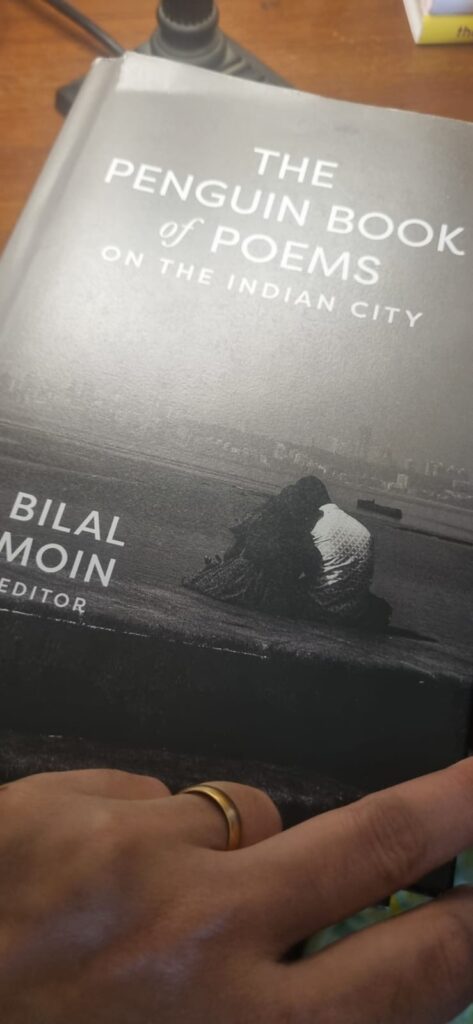
Economist Bilal Moin’s ambitious project of creating The Penguin Book of Poems on the Indian City: A Poetic Journey Through 37 Indian Cities, Exploring Their Stories, Struggles, and Spirit is commendable. It consists of 375 poems, translated from nearly 20 languages and takes readers across 40 cities. If it were not of a doorstopper size, it would be a comforting book to carry and dip into. Ideally, Bible paper should have been used and not bulk paper as has been. It is formidable to pick this volume up and read. Nevertheless, it does have some fine poetry and unexpected voices. From the expected, canonised poets, to new and emerging voices.
I found this referenced on the social media. It is one of my favourite books. I cannot find CD2 narrated online. If anyone finds the link, please send it to me.
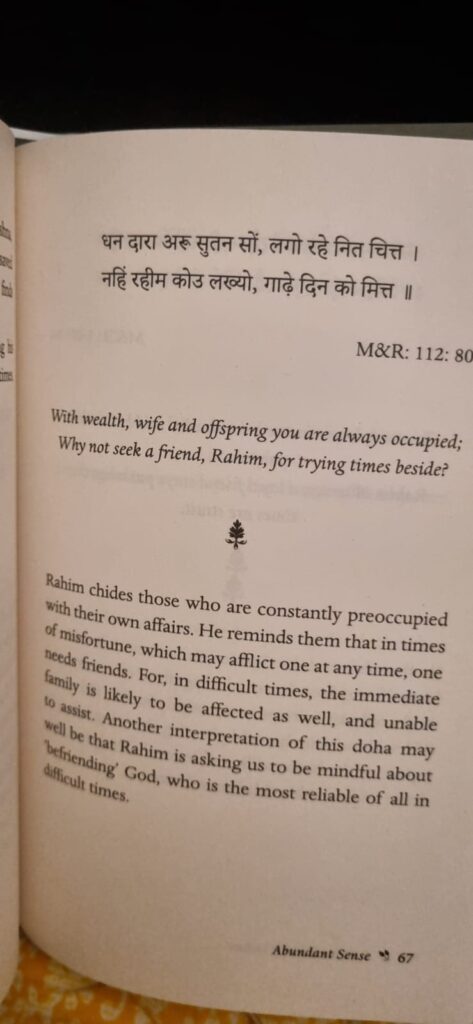
While reading Abundant Sense, I realised how many of Rahim’s doha’s were familiar. These were part of our Hindi curriculum in middle school. We had supplementary books that consisted of prose and poetry. If memory serves me correctly, we had one volume of poetry devoted to Hindi poets like Mahadevi Varma, Dinkar, Suryakant Tripathi (Nirala), Harivansh Rai Bachchan et al. Another volume of poetry consisted of poets like Kabir and Rahim. For prose, we had a fine collection of Premchand’s stories written in the Devnagari script. These were slim texts published by the National Council of Educational Research and Training (NCERT). So, reading Rahim’s doha’s in Abundant Sense brought back memories.
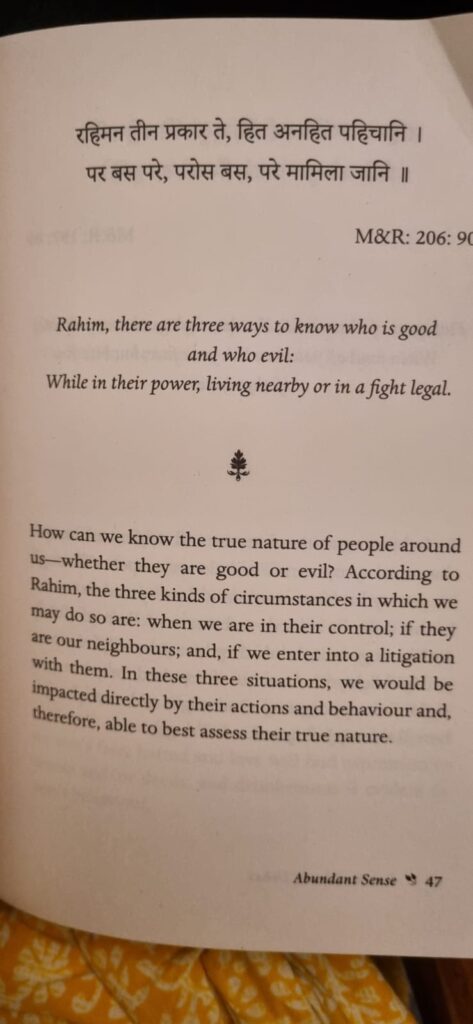
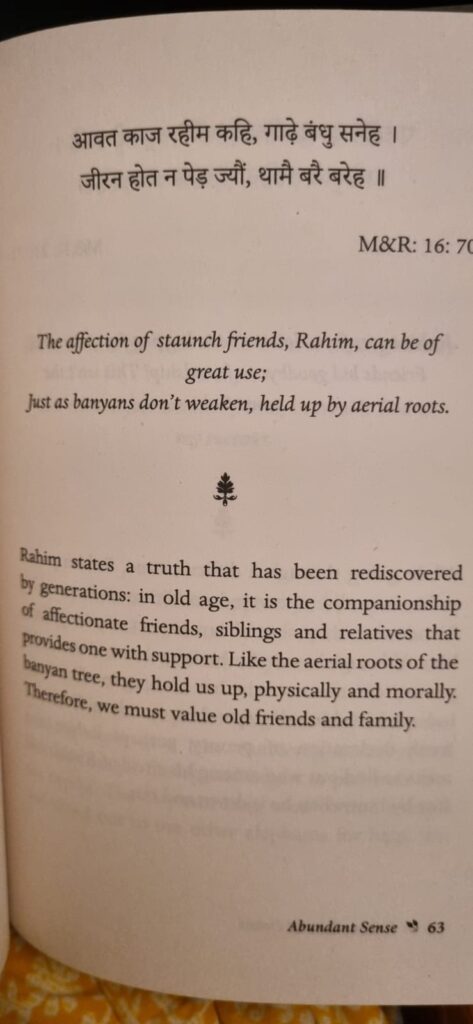
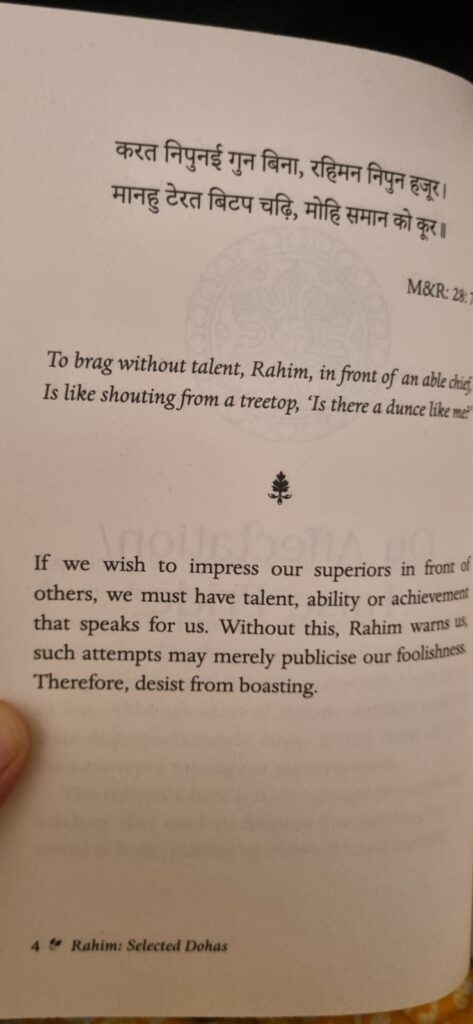
Every page has a doha. The original in Hindi, followed by a literal translation of the couplet and the explanation in English. Here are four examples of these competent translations:
Abundant Sense ( published by Westland Books) is an exquisitely produced book, beginning from the elegant dust jacket to the design layout of every single page. It is generous and a pleasure to read. This is a book that is a keeper but has probably been designed keeping the “gift market” in mind as well. For instance, it would make for an excellent contribution to the Diwali hampers that are circulated.
Book blurb
Abdur Rahim Khan-i-Khanan was a remarkable man, a navaratna in Akbar’s court—warrior, general, administrator, minister, scholar, polyglot, translator and poet. But, today, he is remembered primarily as a poet, a fact evident in his mausoleum in Delhi, now partially restored, which introduces him thus: ‘Rahim was famous for his dohas and Persian translation of the Ramayana.’
Rahim’s life saw wild swings of fate; he knew glory and ignominy, power and insignificance, and above all, loss. Born into wealth and nobility, he was yet finely attuned to the lives and needs of the common man. And four centuries later, his dohas, or couplets, are still invoked, still on the tongue of ordinary folk.
This thoughtfully compiled volume is the first substantial body of translations of Rahim’s dohas, comprising more than half of the 290 dohas he has written. Chandan Sinha’s translation breaks with the modern tendency to use free verse, working instead with meter and rhyme to strongly evoke the original, especially its memorability. Accompanied by brief explanations of each verse as well as the original in Devanagari, Abundant Sense is a tribute to one of the greats of Indian history and literature.
A writer, translator and former civil servant, Chandan Sinha read English Literature at St. Stephen’s College, Delhi, and Public Administration at the Universities of South Carolina and Syracuse in the USA. In 2023 he superannuated from the Indian Administrative Service as Director General of the National Archives of India.
Sinha writes in both English and Hindi. He has published articles in various journals and is the author of three books: Public Sector Reforms in India: New Role of the District Officer (Sage, 2007); Kindling of an Insurrection: Notes from Junglemahals (Routledge, 2013) and The Vision of Wisdom, Kabir: Selected Sakhis (Rupa, 2020).
The present work is the second in a series of translations of Hindi poetry from the early modern period in India.
The text given below is from the publisher’s website for Forest of Noise. It was published on 30 November 2024. On 6 May 2025, it was announced that Mosad Abu Toha won the Pulitzer Prize for Commentary — a series of articles that he wrote for The New Yorker. When I first read this collection of poems, I found it very moving. Months later, they continue to be sharp and searing. There are many poems worth sharing but it would be a violation of his copyright, if I reproduced any here. Just get the book and read it.
***
Barely 30 years old, Mosab Abu Toha was already a well-known poet when the current assault on Gaza began. After the Israeli army bombed his house, pulverising a library he had painstakingly built for community use, he and his family fled for their safety. Not for the first time in their lives.
Somehow, amid the chaos, Abu Toha kept writing poems. These are those poems. Uncannily clear, direct and beautifully tuned, they form one of the most astonishing works of art wrested from wartime. Here are directives for what to do in an air raid and lyrics about the poet’s wife, singing to his children to distract them. Huddled in the dark, Abu Toha remembers his grandfather’s oranges and his daughter’s joy in eating them. Here are poems to introduce readers to his extended family, some of them no longer with us.
Moving between glimpses of life in relative peacetime and absurdist poems about surviving in a barely liveable occupation, Forest of Noise invites a wide audience into an experience that defies the imagination ― even as it is watched live. This is an extraordinary and arrestingly whimsical book, that brings us indelible art in a time of terrible suffering.
Mosab Abu Toha, Things You May Find Hidden in My Ear: Poems from Gaza, winner of the Palestine Book Award 2022 and the American Book Award 2023
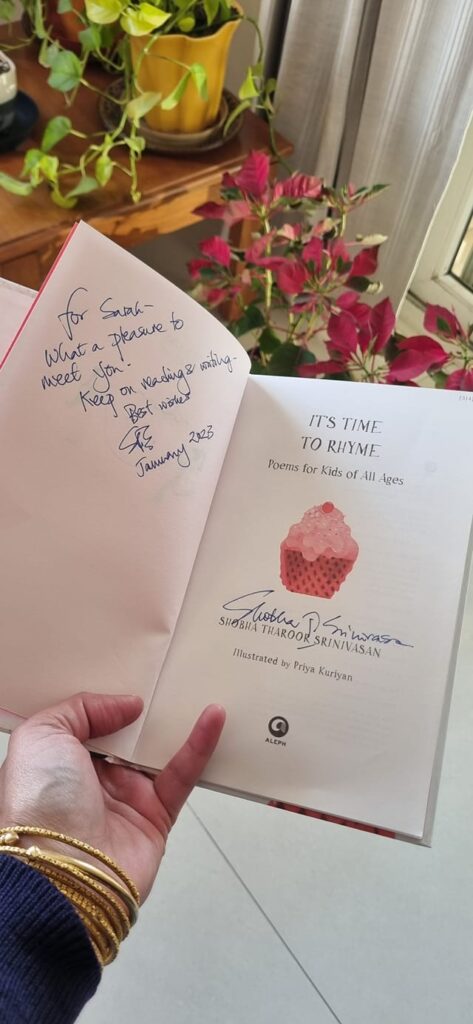
On 27 Jan 2023, Shobha Tharoor Srinivasan visited my daughter’s school. It was an author interaction organised for eighth graders. Apparently, the conversation revolved around poetry and writing. I am not surprised since Shobha’s debut book — It’s Time To Rhyme ( Aleph Book Company) — is a delicious collection of poems. My daughter too loves poetry and is musically inclined. For instance, when is in a foul mood or when she was an infant throwing a tantrum, the only way to get across to her was by playing music or speak to her in a sing song manner. So, the kid was thrilled to meet Shobha and talk poetry. And then the author very sweetly inscribed the book for Sarah.
What is not to like in this book! It is utterly brilliant. Stupendous!
With offerings from sonnets in iambic pentameter, to limericks, acrostics, and villanelles, It’s Time to Rhymeis the perfect introduction to the joys of poetry for readers of all ages. Shobha Tharoor Srinivasan should consider writing a long poem for children. A story well told is heard far and wide. Format does not matter. The few poems collected in this slim volume are a guarded taster of what she is capable of! It is high time publishers broke shackles of the staid expectations of educators and parents and brought the fun back in storytelling. Let it be wild. Let it be nonsensical. Let it be joyous!
unannounced visitor I dropped by into my dream careful not to awaken the buried whispers I lit a candle by their grave startling the slumbering shadows into a frenzy of activity bats taking wing flying blindly into one another this in turn caused the whispers to awaken look me in the eye and begin to do what they did best
bear witness
Legendary publisher Naveen Kishore, founder, Seagull Books, has published his debut collection of poetry called Knotted Grief. It has been published by Speaking Tiger Books. He is the recipient of the Goethe Medal, a Chevalier de l’Ordre des Arts et des Lettres and was awarded the 2021 Ottaway Award for the Promotion of International Literature. Those who are fortunate to communicate with him directly and regularly, have been aware of his talents as a poet for a very long time. His emails are interspered with poetry or at times are only written in verse. The manner in which he responds to situations, events, moments, emotions are well described in his poems but also the way in which he arranges the words on the page. The visual element is as important as the content, ideas and emotions. For years, I have asked Naveen Kishore to get his poems published. I have always found the poems fantastic. It is a gift to be able to compose poems easily focussing upon the reader, so it always seem as if the poems are special. So I was delighted when the publication of Knotted Grief was announced by Speaking Tiger Books.
In Knotted Grief, the collection of poems are categorised according to “Coda”, “Kashmiriyat”, “Street Full of Widows”, “Selected Griefs”, “Tilted Sky”, “Under the Skin” and “Birdcall”. The poems are of varying lengths, from a cluster of words to verses scattered on the page. The sparse arrangement on the page ensures that the reader is absorbed by the few words on the page.
Upon reading the volume, I posed a few questions to Naveen Kishore. Here is the slightly edited version of the Q&A.
How did this collection happen? The collection happened by accident when my publisher friend Xavier Hennekinne of Gazebo ‘discovered’ that I write poetry by finding some of my poems in online poetry journals. he asked my if I had a book and I said no I have many folders with poems I have been writing for the last ten years! The reason fr not having a manuscript was simple enough. I was so busy writing I couldn’t stop, take stock, and put one together. This was solved by my friend and translator Tess Lewis who offered to select a first draft so that publishers could read it like a book! I went on to share this with Xavier at Gazebo and he in turn shared it with his poetry editor Phil Day, who is himself a poet and a painter. Phil then requested I send hi the four hundred odd poems I had set aside while selecting this collection and immersed himself in these for a few months and came up with Knotted Grief as you read it now!! Gazebo will publish on April 1st. The Speaking Tiger edition happened when I shared the Australian page set version except that Ravi selected more poems because he wanted an additional thirty pages. There is no collaboration between Seagull and Speaking Tiger! I offered my manuscript as any first time author to a publisher I admire. Seagull has nothing to do with it except do what we always do spread the word for friends in publishing!
Did you compose poetry specifically for this volume or did you select from previous compositions? No. I have been writing on the human condition for many years. Kashmir is one theme but it could easily be Palestine. There is no recent or previous. You write every day. Like music. It is all a continuous riyaz.
Why did you focus upon grief? Is it one of the offshoots of the pandemic? I didnt. Choose grief. It is usually the other way round. Grief does the choosing, if I may put it like that. You are visited upon by loss of friends close ones in an ever widening or lessening circle of affection. People close to you die. Go away. So you embrace their memory. Similarly at a political, national versus personal level their is grief that springs from what we as people do to each other. Again the ‘human condition’, ‘Kashmir’ ,’Palestine’ Interchangeable grieving. The poems and yes grieving is never without hope.
You have always written fabulous poetry. Why did you choose to publish your poetry now and not earlier? I cannot as a publisher publish my own books! So one waited for someone to ‘discover’ my poems. Takes time! Besides to me the act of writing is more vital.
How many translations is this poetry being published in? Who are the publishers? Are you supervising the translations or are you letting the poems speak for themselves? So far Rajkamal Prakashan Samuh very generously offered to do the Hindi; Ravi Dee Cee of DC books is doing the Malayalam; Papyrus is doing the Marathi; Unistar in the Punjabi; Chintan in Bengali; I am reaching out in Tamil, Kannada and Assamese too. Let see. Not really supervising but making myself available for translators should they wish to talk about things. Complete freedom to take liberties as long as the essence of the ‘target’ language is hospitable to what I may be attempting in English. So yes the poems have to touch the translators.
As far as I know, the arrangement of the words on the page are as critically important as the poem itself. How will you manage this quality control in the translated texts especially if you are unfamiliar with the destination language? I am flexible. It will boil down to the combination of the translator and editor in the language edition to do the best they feel they can to convey render share the original thought in their own languages. This means they have the freedom to lay out the poems the way they wish.
You are a publisher known for publishing extensive translations. Are there any guidelines/sensibilities that you have honed as a publisher over the years that you would ensure are followed in translating your poetry as well? None. I leave it to the publisher, editor, and translators who become the first sensitive readers in that language. Having said that I may be able to help fine hone the languages I know, Punjabi, Hindi, Bengali.
Would you change the collections ever so slightly in every language or will the same edition be made available in all editions? I think mostly the Indian edition is being followed. I would more or less treat that as the one I would want translated. But open to the variant should it happen organically or for reasons that are yet to come up.
I truly liked Knotted Grief. Perhaps you will too. Buy it. Read it.
Shikhandin never ceases to amaze me. She writes. That’s it. She is unafraid of experimenting with forms that are most suitable to her expression. She is impossible to slot as a writer belonging to a specific category. Her creativity gushes forth. She commands the reader to engage. Her observation is acute. Her commentary perceptive. She is unique. Using the feminine pronoun is probably a disservice to her since she consciously chose the nom de plume to mask any gendered reading of her works. Nevertheless, I can only urge you to read her works. Her short stories, novels, and now her poetry in this exquisite volume published by Dibyajyoti Sarma, RedRiver. Sarma’s sensitivity towards Shikhandin’s poems is evident in the care with which he has laid out her poems on the page. There is something magical about the reading experience of “AfterGrief”, poetry about mourning but the period in which she revised the poems, the pandemic, the poems took on a different hue. Instead of dissecting her poems, here are a few samples:
Death is the violence of silence tearing up your day with an unscrambled scream “Death”
There is a man standing on the shore, looking past the waves, frisky, frothy and white. He is looking towards the brightening horizon. He is weeping. He is weeping silently with an oddly self-conscious sort of abandon. He is holding on to a plastic bag crammed with indecipherable things and a motor cycle helmet. His sandals feet are digging, making washable prints on the wet sand. He is pretending to flick off the grit from his cheeks. “Man on the Shore”
After death’s ceremony there is numbness After funeral’s festivity there is stillness Afterwards, when the house has emptied, they arrive A Long and loyal line of days, to follow you around Twilight days to softly follow you around, mother Sentries of quietude — a river of boundless, soundless solitude. … Tell me, how much of grief can a human heart Store beneath the liquid of a tranquil face? “After the passing of father”
In the aftermath, when fire’s rage has cooled to skin-scorching Ash, the wood ones of dawn will break your heart with their absences. No deluge can dampen the spirits of free creatures, but fires are fierce opponents of joy . . . . … She was a woman who had loved the natural world. Speaking in hushed tones of the miracle of snakes birthing in a grove. After the garden was gone, she took to growing cacti and succulents. A dark green one with cylindrical shoots still remains. Growing from one pot into another, passing from house to house, but never yours, until now. “Woodnotes”
But it is the penultimate poem in this collection, “Crossing”, that is worth reading, sharing and discussing. (Photographed below.) I truly hope that one day, one day, Tishani Doshi and Shikhandin will be in conversation with each other about the crying need to be poets especially in these times. Perhaps, Ranjit Hoskote can be asked to be in conversation too. All three poets have published collections of poems in 2021 that will stand out for years to come; it is not just a witnessing, it is as if they are fulfilling their roles of poets as has been inherited from Classical times — their poems are recording history, telling stories and bordering almost on a prayer, urging people to remember their rich past and live in hope for the future, but not be passive agents in the present.
Today, my eleven-year-old daughter woke up much earlier than her usual time. She had had a nightmare. She dreamt that she was in 1939 Nazi Germany. She was in a classroom and then opened a door to go elsewhere. Then, to her horror, she was packing her precious belongings and needed to run. She did not know where she was running but she was and she was terrified. While narrating the incident, she looked alarmed and began wringing her hands in nervous fear. She kept using the collective pronoun “we”, but when asked over and over again, who else was with you, she finally admitted to the singular “I”.
The trigger for this dream in all likelihood have been the books and documentaries about World War Two that she has immersed herself in. She recently read a YA novel, based on a true story, of a Catholic girl who saved a family of thirteen Polish Jews. And much else. Much of it is driven by interest and partially by her school curriculum.
The point of this anecdote is that Art is powerful. It serves multiple purposes. If employed correctly, it operates more than Art for Art’s Sake. Most importantly, it allows the artist to use their creative sensibilities to observe, record, comment and preserve events in collective memory, lest we as a race forget the horrors that have been perpetrated.
Poet Tishani Doshi’s latest collection A God at the Door ( HarperCollins India) serves this purpose admirably. The seething rage and at times, a sense of helplessness, that she feels as an individual witnessing the systematic violence, communalism and the boxing in of women into their homes, are noted in her poems. “The Stormtroopers of My Country” that is an ode to the decimation of a beautiful country is extremely powerful. It is a country that will vanish rapidly if we allow it to happen. The poem ends with a firm belief in our abilities to survive the most violent of assaults.
with the pogrom atrocity death march love march no such thing as a clean termite to burn is to purify oh our culture so ancient so good we’re in the thick of the swastika now no brow beating will divide us together we must stick
The importance of the artists and writers in turbulent times can never be under estimated. They have the immense ability to imprint searing words upon the reader’s mind that are hard to shirk. Such as:
History too has a hard time remembering the black waters they crossed, … …History tries not to be sentimental, although letters give things away. ( “Many Good and Wonderful Things”)
Or
There comes a point in the battle when the last international watchdog is forced to leave the country. Reader, I know you’re prone to anxiety. This is when it happens. The lagoon, the ambush, Bullets raining down in a no-fire zone. Quick, into my echo chamber. ( “Instructions on Surviving a Genocide”)
Or
… I found a village, a republic, the size of a small island country with a history
of autogenic massacre. In it were all our missing women. They’d been sending proof of their existence —
copies of birth and not-quite-dead certificates to offices of the registrar.
What they received in response was a rake and a cobweb in a box. (“I Found a Village and In It Were All Our Missing Women”)
Or
Forget where you came from, forget history. It never happened, okay? We need soldiers on the front line. Of course we can coexist. We say potato, they say potato. We give them their own ghetto. (“Nation’)
Or
Say the words ‘Bay of Bengal’ and ‘Buchenwald’ one after the other, and they sound beautiful, just as ‘landfills does. And then imagine it: (“Do Not Go Out in the Storm”)
The poems in this collection are crying to be performed by multitudes of people. There is no other way to describe this but there seems to be a strong force at the core of these poems that is urging the reader to read these out aloud and share them with more and more people. It is as if when read out aloud, the truth these words enshrine will hit home hard and perhaps embolden us to push back. It is an incredible experience to read poetry that much of the time is a wail of pain and anger intermingled and yet gets transferred seamlessly to the reader and co-opt them into this collective grief. The desire to act can only happen if the personal will is strong enough to turn it into a political act. Perhaps by immemorialising contemporary events, the poet urges a mass awakening to fight against the ills.
My head hurts. And yet I find myself going over and over and over these poems. Soon, my daughter will be able to read and understand these poems. I hope she does. I hope she will convey them to her peers and in time, future generations. These poems/stories/ moments-in-history should not be forgotten.
Collegiality and Other Ballads: Feminist Poems by Male and Non-Binary Alliesis a unique experiment. Inviting people who do not identify themselves as of the woman gender but feel strongly on women-related issues offers a searing perspective on how feminism/women’s movements have impacted civil society. There is a collective anger evident in many of the poems at many of the injustices women face regularly. It probably stems from the sensitive understanding, empathy and the recognition on the part of the poets, many of whom belong to marginalised communities of society. Majoritarian discourses are blind or completely oblivious to the daily struggles of these individuals who are mostly left to battle an unequal social system. By bringing together these diverse genders, many of whom still inhabit a niche space in society or focussed LGBTQA+ imprints in mainstream publishing, Shamayita Sen ( editor) and Hawakal publishers have in Collegiality created a well-defined platform that may lend itself to more literary explorations in future.