I have received an advance copy of this book. It is published by HarperCollins India. It is embargoed till 19 June 2025. So, I cannot post an image of the book that I got nor write about it or quote from it. So, here is the Kindle/Amazon link from where you may purchase it. Meanwhile, here is the book blurb. More on this much anticipated book later. And yes, for those who may be curious, Sam is William Dalrymple’s son.
A history of modern South Asia told through five partitions that reshaped it.
As recently as 1928, a vast swathe of Asia–India, Pakistan, Bangladesh, Burma, Nepal, Bhutan, Yemen, Oman, the UAE, Qatar, Bahrain and Kuwait–were bound together under a single imperial banner, an entity known officially as the ‘Indian Empire’, or more simply as the Raj.
It was the British Empire’s crown jewel, a vast dominion stretching from the Red Sea to the jungles of Southeast Asia, home to a quarter of the world’s population and encompassing the largest Hindu, Muslim, Sikh and Zoroastrian communities on the planet. Its people used the Indian rupee, were issued passports stamped ‘Indian Empire’, and were guarded by armies garrisoned forts from the Bab el-Mandab to the Himalayas.
And then, in the space of just fifty years, the Indian Empire shattered. Five partitions tore it apart, carving out new nations, redrawing maps, and leaving behind a legacy of war, exile and division.
Shattered Lands, for the first time, presents the whole story of how the Indian Empire was unmade. How a single, sprawling dominion became twelve modern nations. How maps were redrawn in boardrooms and on battlefields, by politicians in London and revolutionaries in Delhi, by kings in remote palaces and soldiers in trenches.
Its legacies include civil wars in Burma and Sri Lanka, ongoing insurgencies in Kashmir, Baluchistan, Northeast India, and the Rohingya genocide. It is a history of ambition and betrayal, of forgotten wars and unlikely alliances, of borders carved with ink and fire. And, above all, it is the story of how the map of modern Asia was made.
Sam Dalrymple’s stunning narrative is based on deep archival research, previously untranslated private memoirs, and interviews in English, Hindi, Urdu, Bengali, Punjabi, Konyak, Arabic and Burmese. From portraits of the key political players to accounts of those swept up in these wars and mass migrations, Shattered Lands is vivid, compelling, thought-provoking history at its best.
Sam Dalrymple is a Delhi-raised Scottish historian, film-maker and multimedia producer. He graduated from Oxford University as a Persian and Sanskrit scholar. In 2018, he co-founded Project Dastaan, a peace-building initiative that reconnects refugees displaced by the 1947 Partition of India. His debut film, Child of Empire, premiered at the Sundance Film Festival in 2022 and his animated series, Lost Migrations, sold out at the British Film Institute the same year. His work has been published in the New York Times, Spectator and featured in TIME, The New Yorker and TheEconomist. He is a columnist for Architectural Digest and, in 2025, Travel & Leisure named him ‘Champion of the Travel Narrative’. Shattered Lands is his first book.
I received a copy of Raj Khosla: The Authorized Biography, published by Hachette India. It is the definitive biography. I am looking forward to reading it. Meanwhile, here is the book blurb.
The 1940s witnessed the scripting of an origin story that would go down in the books. A young man was signed on by Guru Dutt as assistant director after eager assurances of his competency in Hindi, a white lie that was soon unmasked.
This was Raj Khosla, an aspiring playback singer, eager to get a foot in the door any which way. In a plot twist he would have approved of, he became instead a filmmaker who made a habit of hits, routinely setting the box office on fire.
He made taut thrillers (C.I.D.) , family dramas (Do Raaste) , timeless romances (Do Badan) and action spectacles (Dostana) . Few filmmakers have demonstrated such versatility and command over their craft. He was behind some of Hindi cinema’s most enduring soundtracks, from ‘Lag ja gale’ to ‘Jhumka gira re’ to ‘Jaane kya baat hai’. Yet, Raj’s legacy remains confined to the odd footnote. Through interviews with family, friends and coworkers – including Asha Bhosle, Waheeda Rehman, Mumtaz, Asha Parekh, Sharmila Tagore, Dharmendra, Manoj Kumar, Prem Chopra, Bindu, Mahesh Bhatt and Aamir Khan – this biography addresses this glaring gap in the history of Bollywood. Examining Raj Khosla’s work, it reveals a director and a man who was as talented and sensitive as he was flawed. The result is a tender treatment that lays bare a caring employer,a
Napoleon fanboy, a maudlin soul who wore his heart on his sleeve, a passionate lover of music, and a man who transformed Hindi cinema.
Amborish Roychoudhury is the author of In a Cult of Their Own: Bollywood Beyond Box Office and Sridevi: The South Years. His work has appeared in Hindustan Times, Firstpost and Outlook India, among others. His first book won him a special mention at the 66th National Film Awards. He has served on film festival juries and explores India’s cinematic legacy through his work.
Anita Khosla did her postgraduation in mass media from Sophia College, Mumbai, and went on to pursue a career in journalism, writing for Screen, Filmfare and Eve’s Weekly back in the 1980s. Today, she serves as the proprietor of Raj Khosla Films, is a proud mother and grandmother, and lives in Gurugram.
Uma Khosla Kapur, an alumnus of St. Bede’s College, Simla, is a homemaker, wife and mother, in addition to being a director at Raj Khosla Films. She has inherited her father’s great passion for music, and lives with her husband G.M. Kapur in Kolkata.
‘Absolutely riveting’ Peter Frankopan, author of The Silk Roads ‘Disturbing and enlightening’ Chris Miller, author of Chip War ‘Hugely important’ Rana Foroohar, author of Makers and Takers ‘A once-in-a-generation read’ Robert D. Kaplan, author of Waste Land
As Trump wages a tariff war with China, seeking to boost domestic electronics manufacturing, this book offers an unparalleled insight into why his strategy is embarrassingly naïve.
Apple isn’t just a brand; it’s the world’s most valuable company and creator of the 21st century’s defining product. The iPhone has revolutionized the way we live, work and connect. But Apple is now a victim of its own success, caught in the middle of a new Cold War between two superpowers.
On the brink of bankruptcy in 1996, Apple adopted an outsourcing strategy. By 2003 it was lured to China by the promise of affordable, ubiquitous labour. As the iPod and iPhone transformed Apple’s fortunes, their sophisticated production played a seminal role in financing, training, supervising and supplying Chinese manufacturers – skills Beijing is now weaponizing against the West.
Investigative journalist Patrick McGee draws on 200 interviews with former Apple executives and engineers to reveal how Cupertino’s choice to anchor its supply chain in China has increasingly made it vulnerable to the regime’s whims. Both an insider’s historical account and a cautionary tale, Apple in China is the first history of Apple to go beyond the biographies of its top executives and set the iPhone’s global domination within an increasingly fraught geopolitical context.
Read an extract from the book on Moneycontrol. The book has been published by Simon & Schuster India.
Listen to our conversation on TOI Bookmark* podcast.
Review
‘Apple is more than the world’s greatest company. It is integral to the whole culture of globalisation. Patrick McGee not only narrates the epic history of Apple, but explains how, in effect, it got taken over by China, the world’s greatest illiberal power. To call this book a page-turner is almost to diminish its importance. It is a once-in-a-generation read‘ — Robert D. Kaplan, author of the New York Times bestseller The Revenge of Geography and the forthcoming Waste Land: A World in Permanent Crisis, and Robert Strausz-Hupé Chair in Geopolitics at the Foreign Policy Research Institute
‘Absolutely riveting. An extraordinary story, expertly told – and one that has important implications for Apple, for tech and for global geoeconomics.’ — Peter Frankopan, Professor of Global History at Oxford and author of the bestselling The Silk Roads
‘Deeply researched, disturbing and enlightening, Apple in China reveals how Apple enabled China’s rise, seemingly at the cost of its own future. In these pages we watch as the world’s most profitable company gets outmaneuvered by the world’s most powerful dictator. Using an impressively broad palette, McGee paints a picture of Apple CEO Tim Cook resolutely trying to save costs by placing nearly all of the company’s advanced manufacturing base in Beijing’s grip, only to find it impossible to wriggle free’ — Chris Miller, New York Times bestselling author of Chip War
‘A masterpiece of investigative journalism, replete with revelations. Every iPhone owner will want to read this book, but no Apple employee will risk being seen with it. McGee shows how China played the long game, convincing Apple to invest on an unprecedented scale and, inadvertently, help build its grand authoritarian project. This book is a warning for anyone eager to do business in hostile countries.’ — Geoffrey Cain, author of Samsung Rising and The Perfect Police State, and a former sanctions investigator for the US Congress
‘There is little doubt that Big Tech companies – like the world’s richest and most influential one, Apple – wield as much power as many nation states. But what’s less well known is how these companies are themselves manipulated by the Chinese state for its own economic and political ends. In this hugely important new book, Patrick McGee shows us how Apple’s quest for wealth and power in China may in the end be the undoing both of the company and of America’s quest for technology supremacy’ — Rana Foroohar, Financial Times Global Business Columnist, CNN Global Economic Analyst, and author of Makers and Takers: The Rise of Finance and the Fall of American Business
‘A tour-de-force account of how the world’s most influential company empowered the inexorable rise of the regime that now shapes its – and our – future. Paced like a thriller and spanning the years from before Steve Jobs’s fateful decision to outsource production to more recent times which shine a fresh spotlight on Tim Cook’s careful wooing of Donald Trump, Apple in Chinacaptures every twist and turn of the tech giant’s off-kilter and decidedly off-script relationship with the authoritarian state. What will surprise many is how China ensnared a corporate titan by matching and then surpassing its knack for ruthless efficiency and global dominance’ — Megan Murphy, former Editor in Chief of Bloomberg BusinessWeek
‘A masterful and deeply reported portrayal of how Apple gained China and lost its soul’ — Isaac Stone Fish, author of America Second and CEO of Strategy Risks
Patrick McGee has been a journalist with the Financial Times since 2013, reporting from Hong Kong, Germany, and California. He led the FT’s Apple coverage from 2019 to 2023 and won a San Francisco Press Club Award for his deep dive into Apple’s HR problems. Previously, he was a bond reporter at The Wall Street Journal in New York. He has a Master’s in Global Diplomacy from SOAS, University of London, and a degree in Religious Studies from the University of Toronto. He resides in the Bay Area with his wife and two daughters.
6 June 2025
*TOI Bookmark is a weekly podcast on literature and publishing. TOI is an acronym for the Times of India (TOI) which is the world’s largest newspaper and India’s No. 1 digital news platform with over 3 billion page views per month. The TOI website is one of the most visited news sites in the world with 200 million unique monthly visitors and about 1.6 billion monthly page views. TOI is the world’s largest English newspaper with a daily circulation of more than 4 million copies, across many editions, and is read daily by approximately 13.5 million readers. The podcasts are promoted across all TOI platforms. I have recorded more than 142+ sessions with Jnanpith, Padma Bhushan, and Padma Shree awardees, International Booker Prize winners, Booker Prize winners, Women’s Prize for Fiction, Nobel Laureates, Pulitzer Prize, Stella Prize, AutHer Awards, Erasmus Prize, BAFTA etc. Sometimes the podcast interviews are carried across all editions of the print paper with a QR code embedded in it.
Some of the authors who have been interviewed are: Banu Mushtaq, Deepa Bhashti, Samantha Harvey, Jenny Erpenbeck, Michael Hoffman, Paul Murray, V. V. Ganeshananthan, Hisham Matar, Anita Desai, Amitava Kumar, Hari Kunzro, Venki Ramakishnan, Siddhartha Deb, Elaine Feeney, Manjula Padmanabhan, NYRB Classics editor and founder Edwin Frank, Jonathan Escoffery, Joya Chatterji, Arati Kumar-Rao, Paul Lynch, Dr Kathryn Mannix, Cat Bohannon, Sebastian Barry, Shabnam Minwalla, Paul Harding, Ayobami Adebayo, Pradeep Sebastian, G N Devy, Angela Saini, Manav Kaul, Amitav Ghosh, Damodar Mauzo, Boria Majumdar, Geetanjali Mishra, William Dalrymple, Abdulrazak Gurnah, Dr Rachel Clark, Charlotte Wood, Catherine Chidgey, Andrew Miller, Sam Dalrymple, and Annie Ernaux.
This book was sent by PanMacmillan India in time for World Environment Day. I look forward to reading it soon.
The amazing true story of the man behind modern weather prediction
Consider a world without weather prediction. How would we know when to evacuate communities ahead of fires or floods, or figure out what to wear tomorrow? Until 40 years ago, we couldn’t forecast weather conditions beyond ten days. Renowned climate scientist Dr. Jagadish Shukla is largely to thank for modern weather forecasting. Born in rural India with no electricity, plumbing, or formal schools, he attended classes that were held in a cow shed. Shukla grew up amid turmoil: overwhelming monsoons, devastating droughts, and unpredictable crop yields. His drive brought him to the Indian Institute of Tropical Meteorology, despite little experience. He then followed an unlikely path to MIT and Princeton, and the highest echelons of climate science. His work, which has enabled us to predict weather farther into the future than previously thought possible, allows us to feed more people, save lives, and hold on to hope in a warming world.
Paired with his philanthropic endeavors and extreme dedication to the field, Dr. Shukla has been lauded internationally for his achievements, including a shared Nobel Peace Prize with Al Gore for his governmental research on climate change. A Billion Butterflies is a wondrous insider’s account of climate science and an unbelievable memoir of his life. Understanding dynamical seasonal prediction will change the way you experience a thunderstorm or interpret a forecast; understanding its origins and the remarkable story of the man who discovered it will change the way you see our world.
“Jagadish Shukla’s A Billion Butterflies is engaging and illuminating—part fascinating memoir, part critical history of modern climate science, and part manifesto. It is the almost magical story of a barefoot boy who rises from a tiny Indian village and discovers how to predict the previously unpredictable monsoon rains—upon which the fragile supply of food for his village and thousands like it depend. Along the way he has to overcome the contrary scientific thinking of some of meteorology’s greatest minds. Ultimately, he, himself, becomes a world leader and defender of climate science. It is a rich tale written in layman’s terms and deserves the attention of anyone wanting to discover the story—and people—behind the latest climate science.” —Rob Wesson, geophysicist and author, Darwin’s First Theory
“A Billion Butterflies is the wonderful story of Jagadish Shukla’s pathfinding contributions for extending the range of forecasting weather and climate variations. He is one of the towering figures in the science of weather and climate and his book should be read far and wide.” — Syukuro Manabe, Nobel Laureate (2021)
“In A Billion Butterflies: A Life in Climate and Chaos Theory, Dr. Jagadish Shukla weaves a rich tapestry of his journey from a small village in India to the forefront of climate science. His profound insights into the delicate balance of our planet’s climate systems are not just a testament to his scientific rigor but also a call to action. This book is a compelling narrative that marries the personal with the planetary, urging us to heed the lessons of the past and act decisively for a sustainable future. It’s a must-read for anyone who cares about the legacy we leave for the generations to come.” — Dante S. Lauretta, Regents Professor at the University of Arizona Lunar and Planetary Laboratory and Author of The Asteroid Hunter: A Scientist’s Journey to the Dawn of our Solar System
“A Billion Butterflies is a multi-dimensional tale which beautifully weaves together global cultures, personal ambition and cutting-edge science. The book is a masterpiece!” – Dr. Bob Bishop, President & Founder, International Centre for Earth Simulation (ICES)
“The memoir of a scientist who rose from poverty in India to triumph in his specialty. … An admirable and inspiring account from a pioneering figure in climate research.” – Kirkus Reviews
“A scintillating look at the rewards and pitfalls of dedicating one’s life to science.” – Publishers Weekly
“Shukla is a captivating storyteller, modest, funny, and warm. Readers will be thrilled to discover a new hero, a globally impactful scientist, educator, and humanitarian.” – Booklist (starred)
DR. JAGADISH SHUKLA is a Professor of Climate Dynamics at George Mason University. Internationally recognized for his role in the development of weather and climate science, he has received the International Meteorological Prize by the UN and the Exceptional Scientific Achievement Medal of NASA, the highest honor given to a civilian by NASA. For his work as a lead author for the Intergovernmental Panel on Climate Change’s 4th assessment, his team was awarded the Nobel Peace Prize.
I received a copy of this book courtesy HarperCollins India. It arrived in time for World Environment Day.
‘This book will change the way you see the world and could change the world itself’ CHRIS VAN TULLEKEN, BESTSELLING AUTHOR OF ULTRA- PROCESSED PEOPLE
‘A must read for anyone who buys anything plastic’ MICHAEL MOSS, PULITZER PRIZE-WINNING AUTHOR OF SALT, SUGAR, FAT
‘Eye-popping, engaging and rigorous’ MIKE BERNERS-LEE, AUTHOR OF A CLIMATE OF TRUTH
‘As alarming as it is entertaining … brilliant’ HUGH FEARNLEY -WHITTINGSTALL, HOST OF WAR ON PLASTIC WITH ANITA AND HUGH
Over the past seventy years, McDonald’s, Coca-Cola, Procter & Gamble, Unilever and other consumer goods makers have harnessed single-use plastics to turbocharge their profits. They’ve poured billions of dollars into convincing us we need disposable diapers, cups, bags, bottles, shampoo in sachets and plastic packaged ultra-processed foods.
We were never clamouring for any of these items, but this shift towards disposability has fundamentally transformed our daily habits. Think of toddlers kept in disposable diapers for far longer than their parents w ore cloth, our obsession with bottled water and our insatiable appetite for convenient snacks and coffee.While at first we shaped plastics, somewhere along the way, plastics took over and began shaping us.
Like any addiction, our plastic habit has consequences. It is damaging our climate and biodiversity and we are only just starting to understand its effect on our own health.
How did plastic take over our lives? And why have we been unable to rein it in? In investigating how we got here, Consumed arms us to make better decisions about where we go next. It is only by understanding this history that we will stop accepting the same failed solutions and demand better from the brands that got us hooked on plastic in the first place.
Saabira Chaudhuri has covered consumer goods companies for the Wall Street Journal for the past decade, reporting on plastics, waste and sustainability, among other topics, from the US, India, UK and elsewhere in Europe. She has an MA in business and economic reporting from New York University and a BA in sociology from Mount Holyoke College. Saabira lives in London with her husband, two children and dog. She grew up in Bangalore, India, where she first developed her fascination with what we throw away.
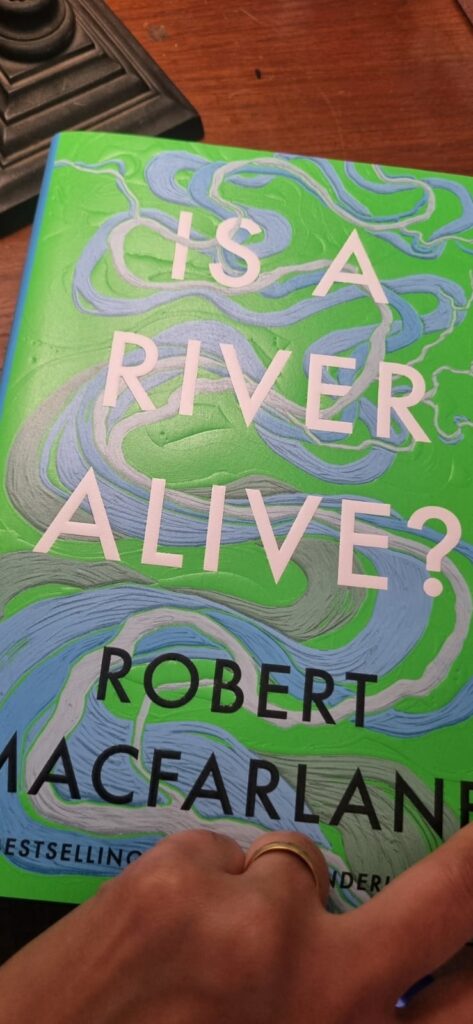
This magnificent book arrived in the post today. I am going to read it asap. Meanwhile, I figured I should post the book blurb. It is published by Penguin Random House India.
From celebrated writer Robert Macfarlane comes this brilliant, perspective-shifting new book – which answers a resounding yes to the question of its title.
At its heart is a single, transformative idea: that rivers are not mere matter for human use, but living beings – who should be recognized as such in both imagination and law. Is a River Alive? takes the reader on an exhilarating exploration of the past, present and futures of this ancient, urgent concept.
The book flows first to northern Ecuador, where a miraculous cloud-forest and its rivers are threatened by goldmining.
Then, to the wounded rivers, creeks and lagoons of southern India, where a desperate battle to save the lives of these waterbodies is under way.
And finally, to north-eastern Quebec, where a spectacular wild river – the Mutehekau or Magpie – is being defended from death by damming in a river-rights campaign.
At once Macfarlane’s most personal and most political book to date, Is a River Alive? will open hearts, spark debates and lead us to the revelation that our fate flows with that of rivers – and always has.
ROBERT MACFARLANE is internationally renowned for his writing on nature, people and place. His bestselling books include Underland, Landmarks, The Old Ways, The Wild Places and Mountains of the Mind, as well as the book-length prose-poem, Ness. His work has been translated into more than thirty languages, won many prizes around the world and been widely adapted for film, music, theatre, radio and dance. He has also written operas, plays, and films including River and Mountain, both narrated by Willem Dafoe. He has collaborated closely with artists including Olafur Eliasson and Stanley Donwood, and with the artist Jackie Morris he co-created the internationally bestselling books of nature-poetry and art, The Lost Words and The Lost Spells. As a lyricist and performer, he has written albums and songs with musicians including Cosmo Sheldrake, Julie Fowlis and Johnny Flynn, with whom he has released two albums, Lost In The Cedar Wood and The Moon Also Rises. In 2017, the American Academy of Arts and Letters awarded him the E.M. Forster Prize for Literature, and in 2023 in Toronto he was the inaugural winner of the Weston International Award for a body of work in the field of nonfiction. He is a Fellow of Emmanuel College, Cambridge.
“Robert Macfarlane is a once-in-a-generation virtuoso, and I don’t know when his kaleidoscopic language and world-expanding scholarship have been used to more potent effect than in this impassioned, resounding affirmative to the title’s urgent question.” —JOHN VAILLANT, author of Fire Weather
“Is a River Alive? is itself a river of poetic prose, an invitation to get onboard and float through the rapids of encounters with places and people, the eddies of ideas, to navigate the resurgence of indigenous worldviews through three extraordinary journeys recounted with a vividness that lifts readers out of themselves and into these waterscapes. Read it for pleasure, read it for illumination, read it for confirmation that our world is changing in wonderful as well as terrible ways.” —REBECCA SOLNIT, author of Orwell’s Roses
“This book is a beautiful, wild exploration of an ancient idea: that rivers are living participants in a living world. Robert Macfarlane’s astonishing telling of the lives of three rivers reveals how these vital flow forms have the power not only to shape and reshape the planet, but also our thoughts, feelings, and worldviews. Is a River Alive? is a breathtaking work that speaks powerfully to this moment of crisis and transformation.” —MERLIN SHELDRAKE, author of Entangled Life
“Is a River Alive? is one of the best books I’ve read in a very long time—exciting, brilliantly comprehensive, mind-altering. In one of its many stunning moments, Macfarlane describes the myriad rivers trapped and buried under the concrete of our cities. ‘Daylighting’ occurs on those rare occasions when these ghost-rivers are dug out & released to the surface to feel the sun, to expand—majestic creatures—and spread life once again. To read this book is to feel your ghosted soul undergo such ‘daylighting’—metaphysical, political, emotional, linguistic. Any soul going dormant, any citizen going numb, will be revivified and propelled back to their essential core, where rage, wonder, and imagination intertwine, and a powerful hope for the earth arises. A spellbinding, life-changing work.” —JORIE GRAHAM, Pulitzer Prize-winning poet
“Is a River Alive? is a beautifully written, poetic testament to the vitality of the Earth and the forms of politics that can be based upon that premise.” —AMITAV GHOSH, author of Sea of Poppies
“Like its subject, Is a River Alive? is a work of flow and counter-flow. It is lyrical, evocative, closely observed and deeply moving. Robert Macfarlane offers new ways to think and, just as importantly, feel about the majestic and mysterious non-human world.” —ELIZABETH KOLBERT, author of The Sixth Extinction
In the last century, technology has transformed the human experience across the world. This has been super-charged by the arrival of the internet, smart phones, AI and machine learning, and created trillion-plus dollar companies and household names like Apple, Amazon, Google and Microsoft.
Our Future is Biotech explains why biotech is next: because our biggest remaining challenges as a species concern biological systems.
Biotech companies will solve our most intractable problems, from cancer, dementia, obesity and diabetes to elderly care, mental health conditions, and even clean power generation, agricultural production and environmental degradation.
Biotech means that we can all live better, safer, healthier, wealthier, happier, and longer lives. The industry has already delivered “miracle cures” for several diseases, and there is more to come. But despite this, few people are aware of the phenomenal progress being made. Our Future is Biotech addresses this, explaining what biotech is, what is coming next, and how you might profit from it too.
Tech has been the most important theme for human progress for the last century. Biotech is next.
Andrew Craig is a best-selling author, entrepreneur, and founder of personal finance business Plain English Finance. His stated mission with the company is “to improve the financial affairs of as many people as possible”.
Andrew’s first book, How to Own the World, has been one of the top-selling personal finance books in the UK for several years, and currently enjoys thousands of reviews across Amazon, Audible and Goodreads. It has also been published in China, India and Vietnam.
Since founding Plain English Finance, Andrew has appeared in numerous national and specialist financial publications including: The Telegraph, The Mail on Sunday, The Financial Times, The Mirror, City A.M., The Spectator, Shares and MoneyWeek magazines, YourMoney, This is Money and Money Observer. He has been interviewed on Sky Television, Bloomberg and Shares Radio, and was featured in Michael Winterbottom’s 2015 documentary-comedy The Emperor’s New Clothes.
Andrew began his finance career at SBC Warburg in the late 1990s. Since then, he has held various senior equity roles at leading investment banks, both in London and New York. In that time, Andrew has met with the senior management teams of well over one thousand companies and with hundreds of professional investors, and has regularly been involved in high-profile stock market transactions. These have included the Kingdom of Sweden’s sale of Nordea Bank AB in 2013 (totalling 7.6 billion dollars) and the stock market flotation of several dozen companies including the likes of easyJet, Burberry, Campari, Carluccio’s, the Carbon Trust and lastminute.
From January 2015 to June 2021, Andrew was a partner at an investment bank specializing in biotechnology and life sciences, WG Partners LLP.
Andrew lives in Hampshire, England, with his wife, Rachel, and their two small children, Ella and Oscar.
Dumps and landfills around the world are overflowing. The millions of tonnes of garbage generated every day have given rise to waste wars, cons and cover ups across thousands of miles and multiple oceans. And few people have any idea they’re happening.
Roaming across five continents, Alexander Clapp delves deep inside the world of Javanese recycling gangsters, cruise ship dismantlers in the Aegean, Tanzanian plastic pickers, whistle-blowing environmentalists in the jungles of Guatemala, and a community of Ghanaian boys who burn Western cellphones and televisions for cents an hour. He reveals how most of our trash actually lives a secret second life, getting shipped, smuggled or dumped from one country onto another, with devastating consequences for the poorest nations of the world.
Waste Wars is a jaw-dropping exposé of how and why, for the last forty years, our garbage has spawned a massive global black market, one that offloads our consumption footprints onto distant continents, pristine landscapes, and unsuspecting populations. The book is published by Hachette India.
Alexander Clapp is a journalist and writer based in Greece. His reporting has appeared in publications including Guardian Long Read, The New Republic, the New York Times, New Left Review, The Economist and The Baffler. Clapp is the recipient of numerous journalism awards. In 2017 he was named a Balkan Fellow for Journalist Excellence and won a European Union Migration Media Award. In 2018 he won a Matthew Power Literary Reporting Prize. In 2019 he won a Robert B. Silvers Reporting Grant. In 2021 he won a Pulitzer Center Breakthrough Journalism Award. His award-winning piece, “The Vampire Ship,” published in the September 2020 issue of The New Republic, has been optioned for a forthcoming documentary series.
No parent should ever have to outlive their children. Unfortunately, Yiyun Li and her husband, lost both their sons. Vincent in 2017, at sixteen, and James in 2024, at nineteen. Both chose suicide.
In Things in Nature Merely Grow (published by HarperCollins India), Yiyun Li makes the case for “radical acceptance”. Reality which can be conveyed in many ways, is better spoken in the most straightforward language. Over and over again, she refers to the facts that one gathers. It is a fact. The emotional quotient is not necessarily addressed or considered sufficiently signifcant to be mentioned in the book. In fact, she says, while addressing the reader very early on in the book, if you think suicide is too depressing a subject; if the fact that all things insoluble in life remain insoluble is too bleak for you; and if you prefer that radical acceptance remain a foreign concept to you, this is a good time to stop reading. (p.25). To live after these events in her life, almost as she recognises worthy of a Greek tragedy, requires the radical acceptance that she suggests. It is the only way to live each day. She relies upon the garden metaphor. In fact, she was encouraged to take up garderning by William Trevor.
I’ve come to understand Trevor’s point: gardening is good training for a novelist. One learns to be patient, one learns to make concessions, one learns to redefine one’s visions and ambitions, and one learns to stop being a perfectionist. A garden is good training for life, too. Would it have changed Vincent a little, had he had the opportunity to work on the garden with me for a season, several seasons? Better stop asking these questions that tread in the realm of alternatives — whatever the answer is doesn’t make a difference in this life.
And one must garden as realistically as one lives after the deaths of one’s children. One must, especially, refrain from giving the flowers and plants metaphorical or symbolic meaning beyond nature’s mere way of being.
(p.79-80)
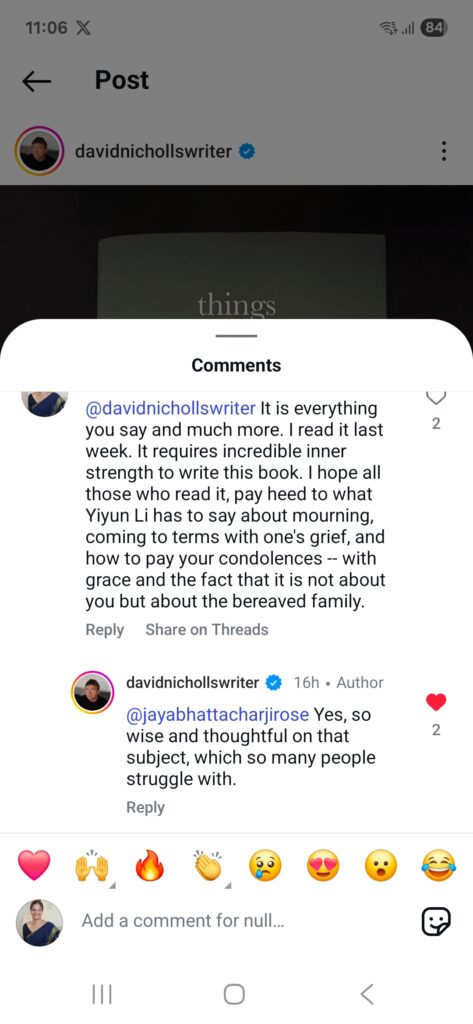
Things in Nature Merely Grow is a moving tribute by Yiyun Li to her second son, James. It is also a meditation on grief by a parent who is hurting and oddly enough a manual for mourners, on how to offer their condolences to the bereaved family.
Interestingly enough, David Nicholls wrote about it on his Instagram account too. I replied to him. Not only he, but Helen Fielding too ( author of Bridget Jones Diary) liked my response.
Read it.
Yiyun Li is the author of ten books, including The Book of Goose, which received the PEN/Faulkner Award; Where Reasons End, which received the PEN/Jean Stein Book Award; the essay collection Dear Friend, from My Life I Write to You in Your Life; and the novels The Vagrants and Must I Go. She is the recipient of a MacArthur Fellowship, Guggenheim Fellowship, and Windham-Campbell Prize, PEN/Malamud Award, PEN/Hemingway Award, among other honours. A contributing editor to A Public Space, she teaches at Princeton University.
This is a small book about big disruptions. Over two decades, and across two different political regimes, the world’s largest democracy combined the rise of cheap mobile phones, cheap data and a unique digital ID system to create an unprecedented revolution in digital public goods. This included the rise of path-breaking fintech systems like Unified Payments Interface (UPI), the creation of a new kind of welfare state based on digital direct benefit transfers and interlinked e-governance systems that brought almost half a billion people who never had bank accounts into the financial system. India’s Techade pieces together the story of how this digital revolution came to be. It is a crisp, yet comprehensive account of the systems, the innovators, the processes and the political will that drove the digital enterprise across India. A must-read for anyone who wishes to understand the transformative nature of technology and its deep impact on Indian society, politics and culture.
Nalin Mehta is Managing Editor, Moneycontrol. Earlier he was Dean, School of Modern Media, UPES; President, EDGE Metaversity and Non-Resident Senior Fellow, Institute of South Asian Studies, National University of Singapore. He has taught and held research positions at universities and institutions in Australia (ANU, La Trobe University), Singapore (NUS), Switzerland (International Olympic Museum) and India (IIM Bangalore, Shiv Nadar University). He was previously Executive Editor, The Times of India-Online, where he led a number of AI-led tech innovations to redefine digital media. He has also served as Managing Editor, India Today (English TV channel) and Consulting Editor, The Times of India. He is the author of five bestselling and critically acclaimed books, including India on Television (winner of the Asian Publishing Award for Best Book on Asian Media, 2009), Behind a Billion Screens (longlisted as Business Book of the Year, Tata Literature Live, 2015), Dreams of a Billion (winner of the Ekamra Sports Book of the Year, 2021, co-authored) and, most recently, The New BJP: Modi and the Remaking of the World’s Largest Political Party.
We recorded a fabulous episode of TOI Bookmark in 2023. It was uploaded in two parts. Here they are: