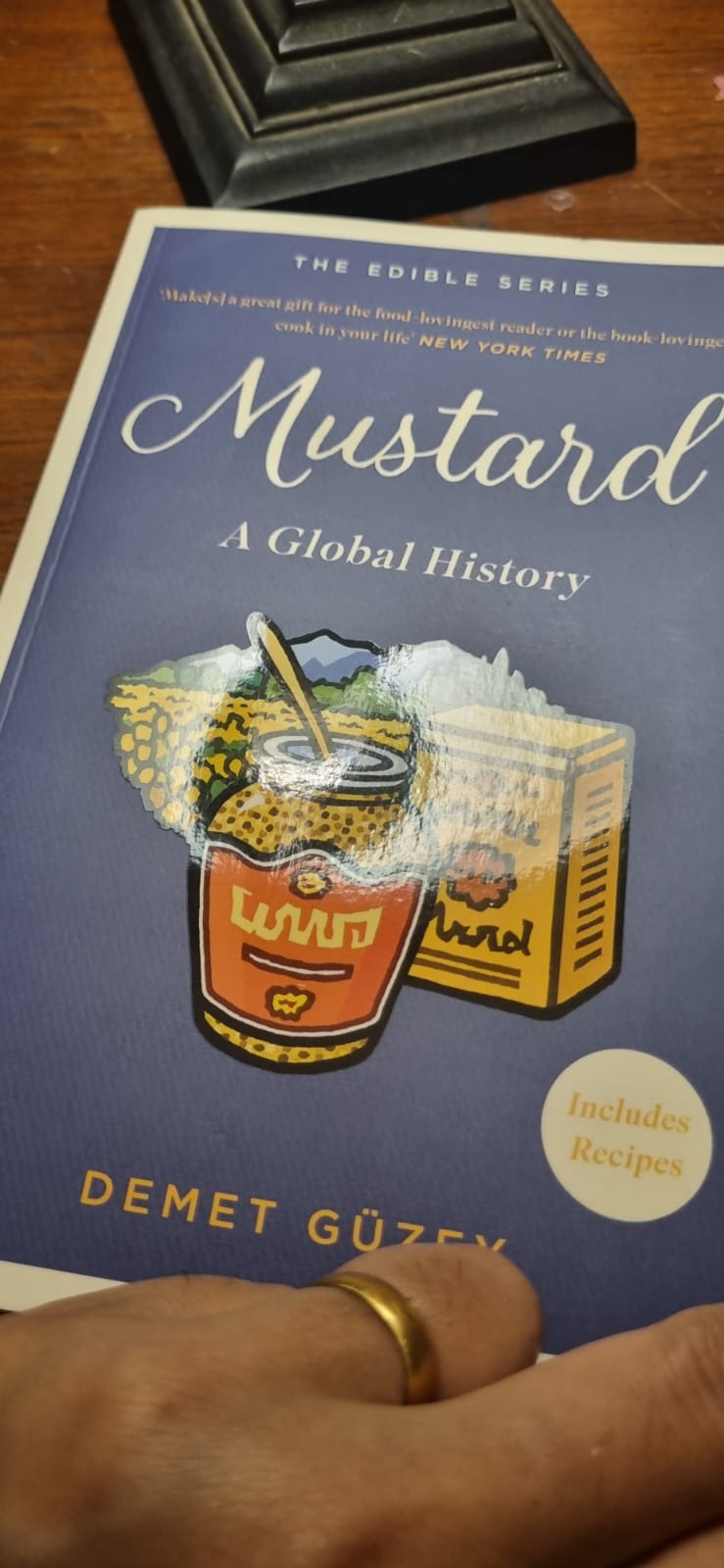
The Edible Series launched by Reaktion Books in the UK and licensed by Pan Macmillan India is a brilliant set of books on food. At a time when there is excessive information available on the internet about food and a zillion cooking programmes, with many people advising on different kinds of cuisines, this series does a remarkable job of offering in a nutshell, a global history of the specific food item. Also included in every book are a bunch of recipes. Whether you agree with them or not is immaterial; the fact that they exist and allow the reader to explore some styles of cooking is a start. In fact, this series reminds me of The Modern Library Food series (Series Editor, Ruth Reichl). Those books were mostly a mix of travelogue, memoir and recipes, and were far more subjective than The Edible Series. The latter is objective, with well-researched images illustrating the text (a possible genuflection to the information age of “picturising” every text) and plenty of history. The space reserved for the recipes are at the end, a few pages. I find them a curious selection in every text — but then I read cookbooks to unwind, I collect recipe books and recipes and cook regularly in the old fashioned way.
Mustard: A Global History is fascinating in its own way but what I cannot comprehend is that if editors lay stress on appropriate images to illustrate the text, then why not connect the dots with regard to the food mentioned. For example, on the opening page of the book, the first dish mentioned using mustard is mayonnaise. Throughout the book, there are a few more scattered references. Understandably so, since mustard is a key ingredient to the condiment. Yet, there isn’t a single recipe for it in the book. Why? Is it because it is considered to be an extremely difficult emulsion to prepare at home? In fact, the hallmark of a good cook is if they can create a perfect mayonnaise dressing. It is not easy! Trust me. I make it regularly. Everything has to be just right but once you master it, it is very quick and easy to make.
In fact, to correct the aberration in the book, here is my recipe for mayonnaise. It was given by a grand aunt. I find it very easy to make a large jar of it. It refrigerates well too. It is convenient to have it handy, as a sandwich spread or the base of other dressings, especially for a prawn cocktail.
Mayonnaise recipe
4 tablespoons vinegar 3 – 4 large eggs 4 teaspoons sugar 1 heaped teaspoon mustard Salt and pepper to taste 1 large bottle salad oil Mix all ingredients except salad oil at speed 3 for half a minute. Gradually add oil running the mixie motor on speed 1, turning it off every few seconds, till all the oil has been mixed. Frankly, you can add the salt, pepper, mustard, and sugar as per your taste. Mix at a high speed for more than half a minute, if need be, to ensure that all the ingredients mix well. Then dribble the oil in slowly. I never switch off the mixie. It gets done. Pour into bottles and refrigerate. There are no shortcuts to making this recipe. Also be warned there will be many disasters along the way, but once past the learning curve, this is a brilliant recipe to keep handy.
Here is an image of the latest batch that I made. It is devoured by everyone in the family. So, I have to ensure that there is always a fresh stock readily available.
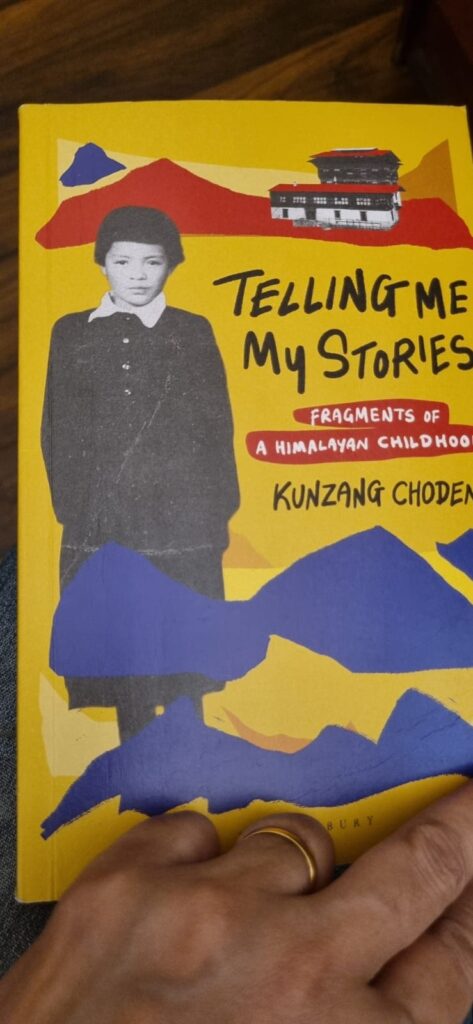
My first introduction to Kunzang Choden was when her manuscript The Circle of Karma was placed on my desk. It was one of the first novels that I edited and thoroughly enjoyed doing so as well. It was also the first book that was placed on the Penguin/Zubaan joint imprint. It was a project that we poured our heart and soul into. We even created a micro-author website for Kunzang to promote her and the book. It was delightful. It was experimental and unheard of. This was in 2004 or so, when the internet was still in its nascent stages and we were using dialup modems to connect to the world wide web. Later, when I organised the book launch at the British Council, New Delhi, it was an incredible experience. The auditorium was packed. Some of us were left standing outside in the foyer. It is then that I noticed a quiet young man standing near the front door, flanked by a bunch of smartly dressed men. It was the then prince and now King of Bhutan, Jigme Khesar Namgyel Wangchuck. He had just finished or was about to finish studying at the University of Oxford. It was extraordinary to see him at the event. But if you read Kunzang’s latest book, Telling Me My Stories ( published by Bloomsbury India), her association with the royal family is explained. Kunzang’s mother was related to the royal family.
I interviewed Kunzang Choden for TOI Bookmark. Here is the Spotify link:
Telling Me My Stories is a stunning memoir that truly exemplifies the title of the book. It is almost as if Kunzang has taken these fragments of stories that she heard, or were passed down generation to generation, and has tried to create a coherent narrative about her family. She was orphaned at a very young age — her father passed away when she was 9 and her mother a couple of years later. Over the years, Kunzang heard stories about them, or was handed pieces of their belongings by various relatives that made her want to patch together their stories. She has done a fine job in this book.
Her skill as a storyteller and as a collector of forgotten Bhutanese folktales and retelling them has become an important art form. Probably in many ways it enabled and empowered her to share the history of her family in the way she has done so. She focussed on herself and her ancestors, shared their stories pleasantly, gleaning facts from bits and pieces of oral testimonies and memories shared by those who knew her family in the past. The conversion of oral tales into the written word, providing a coherent narrative to the story is not as easy as it looks when read. It requires patience, persistence, and plenty of research to connect the dots and produce a chronological narrative. This is what Kunzang has achieved in Telling Me My Stories.
While weaving together her ancestral history particularly that of her parents, she also achieves a remarkable feat of documenting the change in Bhutan: from a closed nation, relying on a barter economy to becoming the modern country it is today. She refers to the various social reforms that the government instituted, including sponsoring Bhutanese children to be educated in India. Kunzang was one of those who benefitted from this scheme even though it entailed a 15-day trek from Bhumthang to Kalimpong. Quite an introduction to a new life when you are merely a nine-year-old girl, leaving home for the first time.
I truly enjoyed reading Telling Me My Stories.
Listen to our conversation on TOI Bookmark. It is available on Spotify. Here is a snippet:
I mention somewhere that the death of our parents came to us in such a blasé way and we never really had the time and the opportunity to absorb it, to mourn it, to understand it, and it stayed with me. You are right, it is kind of like a healing process for me to write about it, talking to myself about it, and going through the whole process. The time we learned about the deaths and how we had nobody to really help us or guide us. Even to help us to mourn, to cry, to hold us or explain things to us. We sort of just developed, my brothers and I, developed our own coping strategies and that sort of stays embedded in my psyche.
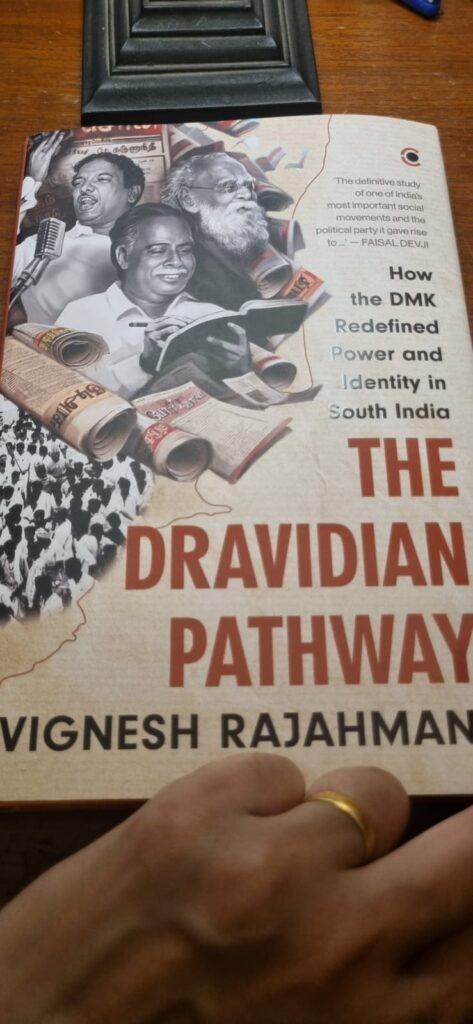
Politics at the best of times can be bewildering. So, when a book like The Dravidian Pathway comes along, one can only hope it provides a useful explanation on how and why the Dravida Munnetra Kazhagam (DMK) movement became as big as it did and is a political entity to contend with in Tamil Nadu. The DMK is a political party that cannot be ignored and is able to hold its own. It is particularly fascinating when observing contemporary politics and the inroads that the North Indian parties like the BJP are trying to make in South India. These days, there are videos circulating on social media of various DMK party members or individuals linked to DMK politicians, refusing to acknowledge BJP politicians ( here and here). The why and the wherefores about the DMK are documented and analysed by Vignesh Rajahmani, He has put together a lot of information and data to provide a sense of history and chronology about the DMK. It is a book that will be useful to political scientists, perhaps even politicians, researchers, and journalists. It has been published by Westland Books.
Book blurb
The transformation of the Dravidian socio-cultural movement into an electorally viable political party-the Dravida Munnetra Kazhagam, or DMK-is one of the most fascinating stories in modern India. It is also one that is critical to an understanding of South Indian politics as a whole.
Although the movement and the party have both been widely studied, the interplay between the two has been largely neglected, with scholars tending to focus on outcomes. Vignesh Rajahmani’s innovative, detailed study of the Dravidian Movement explores the strategic leadership of DMK and non-DMK figures like Periyar E.V. Ramasamy, C.N. Annadurai, M. Karunanidhi and K. Kamaraj. It illustrates their synthesis of anti-caste ideology, socio-economic and educational mobility, and inclusive Dravidian-Tamil identity, and considers why that vision resonated with marginalised communities.
Tracing the early DMK years, from the party’s social justice campaigns to its landmark electoral victory in 1967, Rajahmani highlights the challenges of navigating ideological commitments within the constraints of political pragmatism, while also making politics accessible to the common person. He explains how iterations on the initial ideology and political offering can reinvigorate such movements, keeping their politics agile, and importantly, incentivising inclusive policymaking. An investigation into how the DMK shaped Tamil Nadu’s counter-hegemonic political identity, which has proven electorally resilient in spite of majoritarian onslaughts, The Dravidian Pathway is a timely contribution to the public and scholarly understanding of Tamil Nadu’s politics.
‘The definitive study of one of India’s most important social movements and the political party it gave rise to’ — Faisal Devji, Beit Professor of Global and Imperial History, University of Oxford
‘[C]asts casts new light on the deepening of democratic politics in the early decades of the Indian republic.’ — Srinath Raghavan, author of Indira Gandhi and the Years That Transformed India
‘Ideas and interests, coalitions and contests, personality and populism are measured in Rajahmani’s stimulating book.’ — Shruti Kapila, author of Violent Fraternity: Indian Political Thought in the Global Age
‘[S]hows us that majoritarianism is not the only pathway to power—social reform is not just a viable political strategy, it is rich with democratic possibilities too’. — Siddharth Varadarajan, founding editor of The Wire
Vignesh Rajahmani is a postdoctoral research fellow in Indian and Indonesian politics at the Royal Netherlands Institute of Southeast Asian and Caribbean Studies, with a PhD in Political Science and Public Policy from King’s College London. He is also a postdoctoral affiliate at the Center for Information, Technology, and Public Life at the University of North Carolina at Chapel Hill, and a research affiliate at the King’s India Institute, King’s College London. Rajahmani has over five years of professional experience in public policy, legislative research and political consulting, including his advisory work on a range of Indian parties’ electoral strategies and manifestos, at regional and national levels. His research interests include public policy, the politics of mobilisation, democratic development, the interplay between domestic politics and foreign policy, and political communication in the age of social media.
The transition from childhood to adulthood is a natural, evolution-honed cycle that now faces radical change and challenge. The adolescent brain, sculpted for this transition over eons of evolution, confronts a modern world that creates so much social pressure as to regularly exceed the capacities of the evolving mind. The problem comes as a bombardment of screen-based information pelts the brain just as adolescence is undergoing a second key change: puberty is hitting earlier. The result is a neurological mismatch between an ultra-potent environment and a still-maturing brain that can lead to anxiety, depression, and other mental health challenges. It is a crisis that is part of modern life but can only be truly grasped through a broad, grounded lens of the biology of adolescence itself. Through this lens, Richtel shows us how adolescents can understand themselves, and parents and educators can better help.
For decades, this transition to adulthood has been defined by hormonal shifts that trigger the onset of puberty. But Richtel takes us where science now understands so much of the action is: the brain. A growing body of research that looks for the first time into budding adult neurobiology explains with untold clarity the emergence of the “social brain,” a craving for peer connection, and how the behaviors that follow pave the way for economic and social survival. This period necessarily involves testing—as the adolescent brain is programmed from birth to take risks and explore themselves and their environment—so that they may be able to thrive as they leave the insulated care of childhood.
Richtel, diving deeply into new research and gripping personal stories, offers accessible, scientifically grounded answers to the most pressing questions about generational change. What explains adolescent behaviors, risk-taking, reward-seeking, and the ongoing mental health crisis? How does adolescence shape the future of the species? What is the nature of adolescence itself?
Matt Richtel is a health and science reporter at the New York Times. He spent nearly two years reporting on the teenage mental-health crisis for the paper’s acclaimed multipart series Inner Pandemic, which won first place in public-health reporting from the Awards for Excellence in Health Care Journalism and inspired his book How We Grow Up: Understanding Adolescence. He received the Pulitzer Prize for national reporting for a series of articles about distracted driving, which he expanded into his first nonfiction book, A Deadly Wandering, a New York Times bestseller. His second non-fiction book, An Elegant Defense, on the human immune system, was a national bestseller and chosen by Bill Gates for his annual Summer Reading List.
Former CNN/CNN International Anchor and Business Correspondent Alison Kosik —recognised around the globe as the face of Wall Street for the network — found herself trapped in a failing marriage. The savvy mother of two, was terrified to leave her husband. Why? She didn’t have the confidence to take on big financial decisions on her own. Despite spending her working hours explaining financial and business concepts, she had allowed her husband to take charge of all their big money decisions — from buying a house and how to finance it to their investments and retirement savings — and had no clue how to do any of it on her own. It sounds crazy, doesn’t it? But Alison is far from atypical. It turns out plenty of educated and high-achieving women — married or single — avoid getting involved with managing their financial lives. In What’s Up With Women and Money? Alison gives a step-by-step action plan on a variety of money topics. Alison also interviews dozens of women who share their cautionary tales of why avoiding money decisions can lead to bad outcomes. Alison also talks one on one with inspirational women like Sheryl Sandberg, Rebecca Minkoff, Jessica Alba, Barbara Corcoran, and Deepica Mutyala — women who inspire other women and help them gain confidence — to take control of their financial lives. Alison simplifies complicated financial topics of investing, car buying and paying down debt, breaking them down into easy-to-follow steps, with practical tidbits that make each page accessible, digestible and fun. By the end of What’s Up With Women and Money?, women will not only feel empowered and confident about their finances, but they will also feel ready to take action after being motivated without judgment.
Alison Kosik is a Journalist and Freelance Correspondent and Anchor at ABC News. Prior to joining ABC, Kosik was a Business Correspondent and Anchor at CNN and CNN International. Alison has interviewed leading CEOs, investors, executives, international dignitaries, musicians, and sports figures. She has interviewed some of the biggest names in business, politics and technology, from Warren Buffett to Hillary Clinton to Mark Cuban and Michael Saylor.
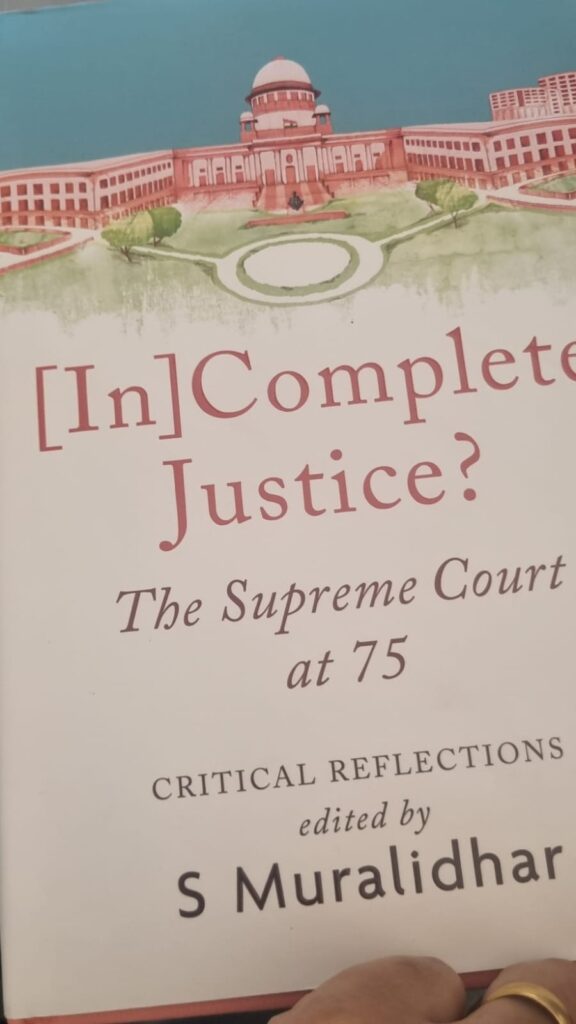
Look what arrived today. Definitely a must read. The introduction is fascinating. Now to read the rest.
Book blurb:
In its seventy-fifth year, how should one view the Supreme Court of India – an institution that has not only transformed in its composition and functioning but has also been a catalyst for change in other branches of the State? How has it fared in terms of accountability, transparency and its responsibility to both the law and the people? Has it consistently managed to strike the delicate balance between judicial activism and the imperative of accountability in the exercise of judicial power?
To what extent has the Court fulfilled its role as a countermajoritarian body capable of checking majoritarian impulses and the excesses of State power? Has it remained true to its constitutional mandate, interpreting the Constitution in the spirit of its foundational values – liberty, equality, fraternity and dignity? And how consistent has its jurisprudence been in defending these ideals?
This book brings together a range of voices – former judges, practicing lawyers, legal scholars, researchers and a journalist – to engage with these questions through a series of essays and interviews. Their reflections offer a critical exploration of the Supreme Court’s evolving role and functioning. This volume aims to foster meaningful dialogue and deepen public understanding of the Court’s challenges in retaining its legitimacy while striving to fulfill the constitutional promise of equal and fair justice.
S. Muralidhar is a Senior Advocate at the Supreme Court.He has previously served as the Chief Justice of the Odisha High Court and as the Chief Justice of the Punjab and Haryana High Court and he has also served as a Justice of the Delhi High Court.
[In]Complete Justice? The Supreme Court at 75: Critical Reflections is published by Juggernaut Books.
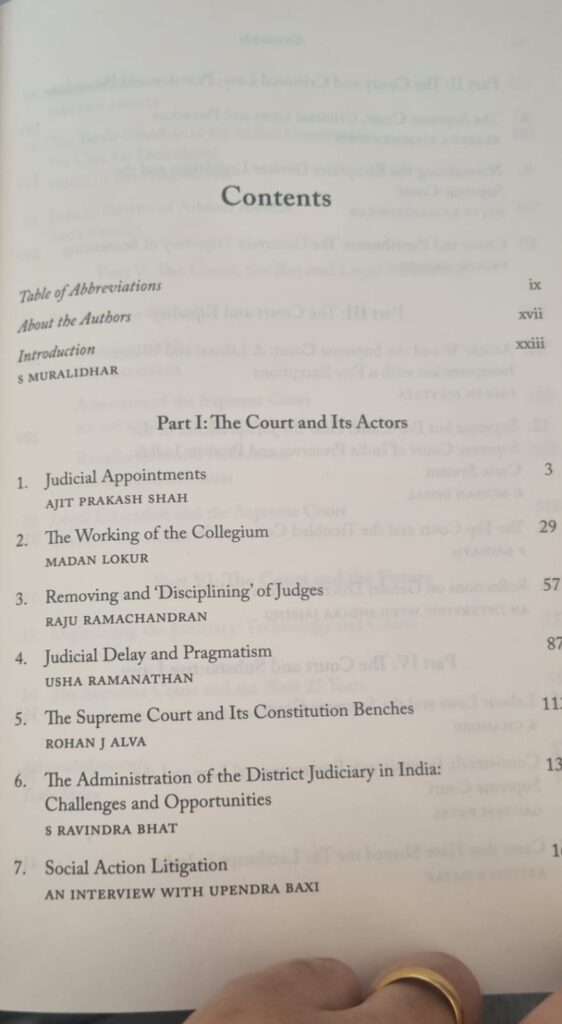
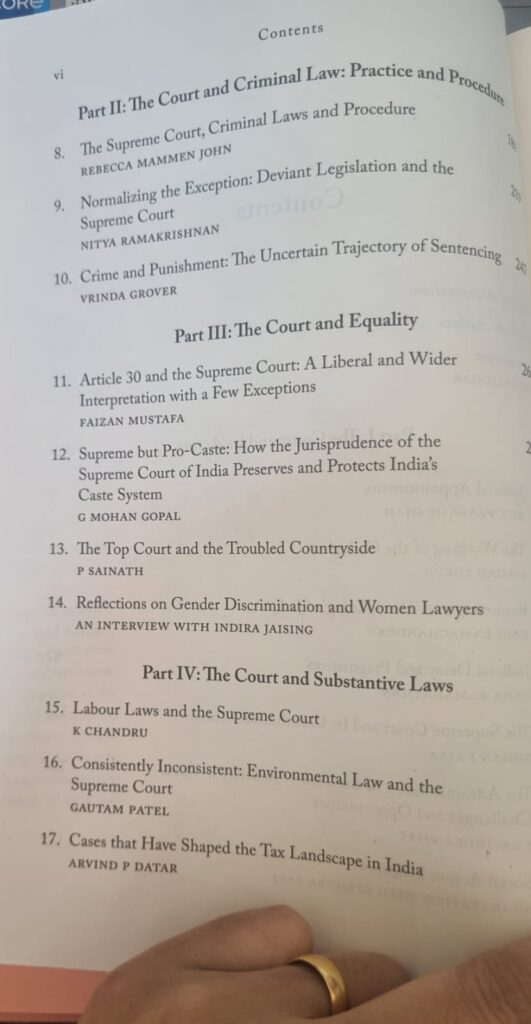
Meanwhile, here is the list of contents.
Interestingly, the editor has pledged the royalties to be received from this book to Vanavil Trust.
The Great Trigonometrical Survey (GTS), an ambitious mission in the nineteenth century to map India using triangulation―a brilliant method that helped them measure every inch with accuracy. Along the way, they calculated the height of the world’s tallest mountain and revealed the true shape of the earth. The survey lasted nearly a hundred years and was led by several men, including William Lambton, George Everest and Andrew Waugh. But it wasn’t just them—thousands of people worked on this massive project.
India in Triangles is a fascinating account of the survey in India. The authors are able to share an important piece of history without dumbing down any information, even though the intended target audience is for young adults. This is the kind of book that will work supremely well in the crossover market for its readability, accessibility to information, listing and acquisition of the heavy equipment used in the mapping and of course, the stories involving the key people. It is a slim volume that is easily read like a thrilling adventure story. The fascination with which these pioneers chose to map the subcontinent does not dim with time.
Shruthi Rao has a master’s degree in energy engineering, and worked in the IT industry before she started writing. She is the author of multiple books such as 10 Indian Women Who Were the First to Do What They Did ,20 Indians Who Changed the World, Manya Learns to Roar, among others. She lives in the San Francisco Bay Area, and loves books, desserts, trees, benches, science and long walks.
Meera Iyer loves listening to, researching and writing about stories of people and places, buildings and streets. She volunteers with the Indian National Trust for Art and Cultural Heritage (INTACH) to help protect and celebrate Bengaluru’s history and heritage. She loves coffee, dark chocolate and potsherds.
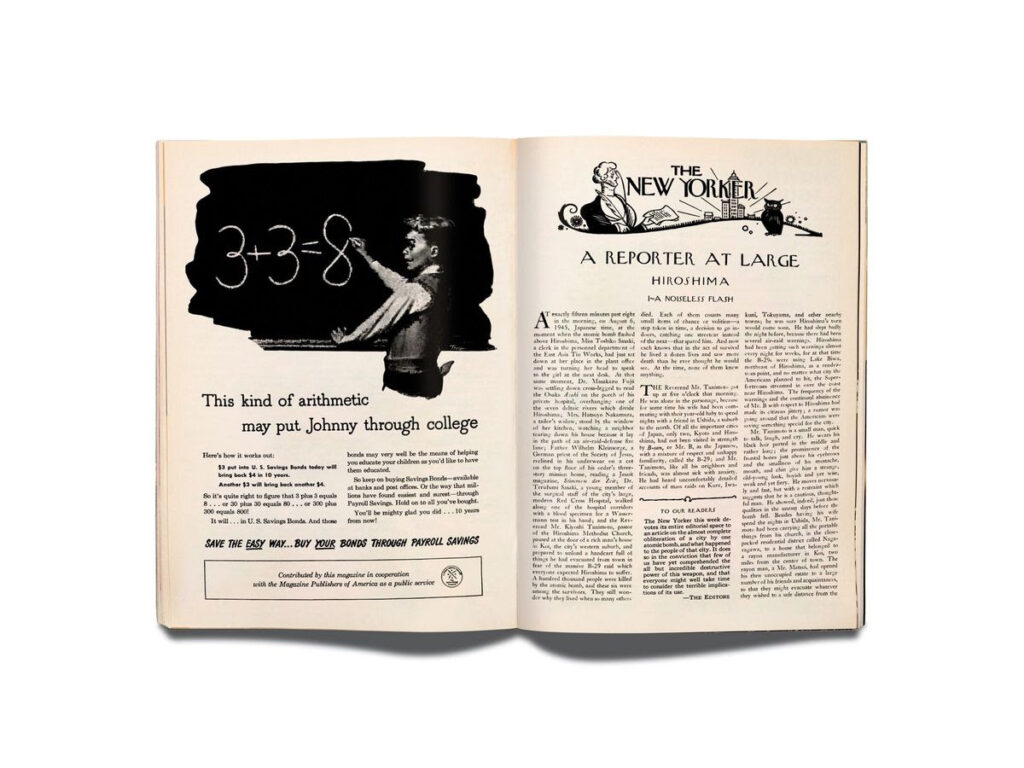
Today is the eightieth anniversary of the atomic bombing of Hiroshima. Every time I have to teach the undergraduates, I give them John Hersey’s essay, “Hiroshima” (The New Yorker, 23 August 1946) to read and analyse. Many give up, but those who persevere, are stunned by it. For many of these students, reading English at the best of times is a bit of a struggle and most certainly a long essay that made up the entire special issue of The New Yorker.
In the newsletter circulated by the magazine on 3 Aug 2025, their staff reporter, Jane Mayer writes:
Thirty years after this magazine published John Hersey’s “Hiroshima,” I sat in his classroom at Yale, hoping to learn how to write with even a fraction of his power. When “Hiroshima” appeared, in the August 31, 1946, issue, it was the scoop of the century—the first unvarnished account by an American reporter of the nuclear blast that obliterated the city. Hersey’s prose was spare, allowing the horror to emerge word by word. A man tried to lift a woman out of a sandpit, “but her skin slipped off in huge, glove-like pieces.” The detonation buried a woman and her infant alive: “When she had dug herself free, she had discovered that the baby was choking, its mouth full of dirt. With her little finger, she had carefully cleaned out the infant’s mouth, and for a time the child had breathed normally and seemed all right; then suddenly it had died.”
Hersey’s candor had a seismic impact: the magazine sold out, and a book version of the article sold millions of copies. Stephanie Hinnershitz, a military historian, told me that Hersey’s reporting “didn’t just change the public debate about nuclear weapons—it created the debate.” Until then, she explained, President Harry Truman had celebrated the attack as a strategic masterstroke, “without addressing the human cost.” Officials shamelessly downplayed the effects of radiation; one called it a “very pleasant way to die.” Hinnershitz said, “Hersey broke that censorship.” He alerted the world to what the U.S. government had hidden.
Soon after “Hiroshima” was published, the influential Saturday Review ran an editorial condemning “the crime of Hiroshima and Nagasaki.” America’s military establishment tried to quell the outrage with a piece in Harper’s by Henry Stimson, a retired Secretary of War. The article—ghostwritten by McGeorge Bundy, a future national-security adviser—claimed that dropping nuclear bombs on Japan had averted further war, saving more than a million American lives. Kai Bird, a co-author of “American Prometheus,” the definitive biography of J. Robert Oppenheimer, told me that this pushback was specious: “Bundy later admitted to me that there was no documentary evidence for this ‘million’ casualty figure. He just pulled it out of thin air.”
Hersey’s report helped transform The New Yorker. Although the magazine had published dispatches from brilliant war correspondents, including Janet Flanner, it was still widely considered a weightless amusement. “Hiroshima” marked a new, more serious era. It also changed journalism. For many reporters of my generation, “Hiroshima” was a model of what might be called the ethical exposé. It was built on rigorous reporting and meticulously observed details, and, through its quiet, almost affectless voice, the reader became another eyewitness. Hersey’s narrative approach was deceptively simple. Threading together the stories of six survivors, he described the destruction from their perspective, which implicitly made the point that nuclear warfare posed an unconscionable threat to humanity. People usually think of investigative reporting as relying on obscure documents and dry financial data. But Hersey, whose 1944 novel, “A Bell for Adano,” won a Pulitzer, showed that to truly affect readers such reporting must be paired with literary craft and be propelled by a sense of urgency.
Hersey, the secular son of high-Wasp missionaries to China, transferred an almost stern sense of morality to his work. As a professor, he was priestly, soft-spoken, and intimidating. His reverence for journalism as a sacred duty could be self-righteous, but it set a standard for conscientiousness that I still try to meet. His seminar Form and Style in Non-Fiction Writing required students to analyze and emulate the techniques of great writers from Homer to Thornton Wilder. In fact, “The Bridge of San Luis Rey,” Wilder’s 1927 novel, which unfurls the personal stories of characters who die at the bridge, had inspired the form of “Hiroshima,” and Hersey hoped to teach us through such examples. Private tutorials were equally inspiring and mortifying. Some of my Yale classmates still burn with embarrassment when recalling them. One remembers Hersey pulling out a copy of Fowler’s “Dictionary of Modern English Usage” and asking, “Are you familiar with this?” Another will never forget Hersey, who marked comments in pencil, noting that she’d misspelled “masturbation.” A third says that Hersey, a stickler for accuracy, criticized a description of fingernails “bitten to half the normal length” as hyperbolic. After making each point, Hersey erased his notes. The message was clear: now we were on our own.
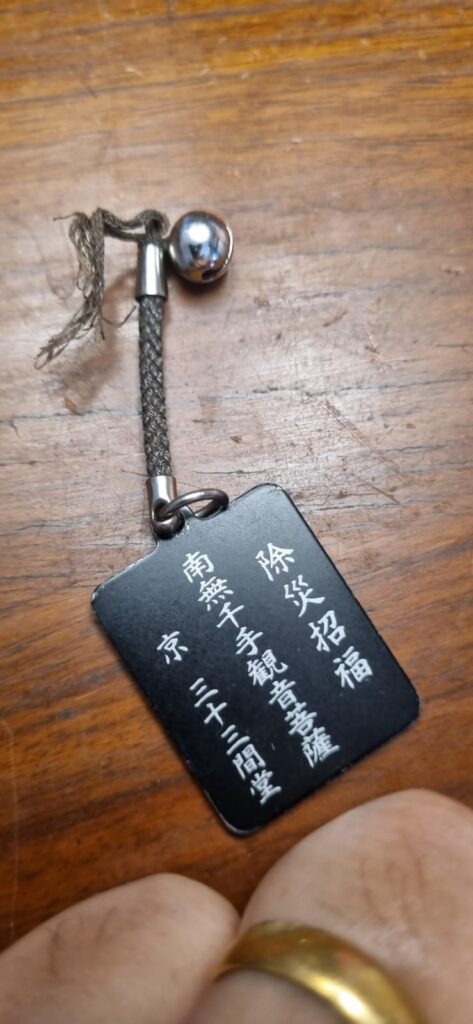
Years ago, my mother had visited Hiroshima. She was very moved by the experience. She bought a memento for me. First I tied it to whichever handbag I carried. Once the threads weakened and fell apart, I put it into a pocket of my handbag and carry it still. I do not know what the letters in Japanese spell out but the changing colours of the design in different lights is extraordinary.
In this image, it looks green, but I have seen it a vibrant blue, a dull gold-brown and even turn to black. I have no idea why or how it does this, but it does.
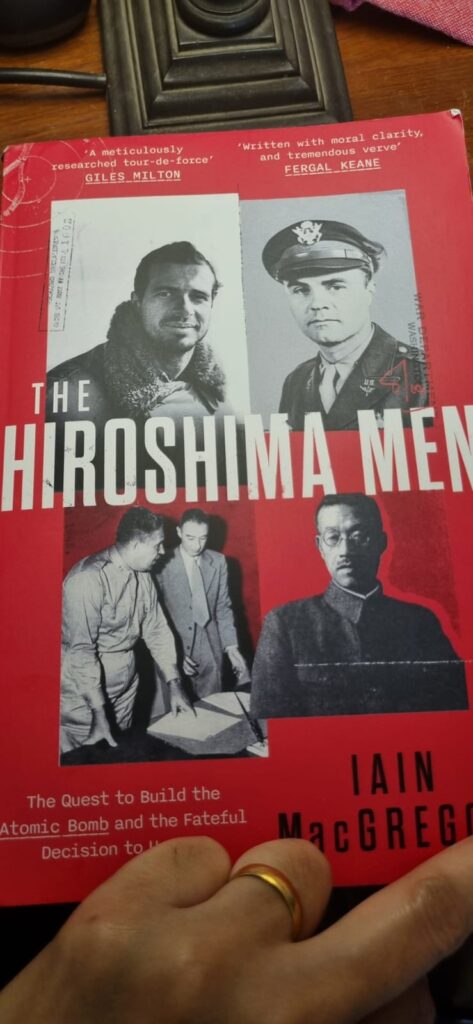
Yesterday, Hachette India sent The Hiroshima Men. I have as yet to read it but it is a timely publication.
Here is the book blurb:
At 8:15 a.m. on August 6th, 1945, the Japanese port city of Hiroshima was struck by the world’s first atomic bomb. Built in the US by the top-secret Manhattan Project and delivered by a B-29 Superfortress, a revolutionary long-range bomber, the weapon destroyed large swaths of the city, instantly killing tens of thousands. The world would never be the same again.
The Hiroshima Men’s unique narrative recounts the decade-long journey towards this first atomic attack. It charts the race for nuclear technology before, and during the Second World War, as the allies fought the axis powers in Europe, North Africa, China, and across the vastness of the Pacific, and is seen through the experiences of several key characters: General Leslie Groves, leader of the Manhattan Project alongside Robert Oppenheimer; pioneering Army Air Force bomber pilot Colonel Paul Tibbets II; the mayor of Hiroshima, Senkichi Awaya, who would die alongside over eighty-thousand of his fellow citizens; and Pulitzer Prize-winning novelist John Hersey, who travelled to post-war Japan to expose the devastation the bomb had inflicted upon the city, and in a historic New Yorker article, described in unflinching detail the dangers posed by its deadly after-effect, radiation poisoning.
This thrilling account takes the reader from the corridors of the White House to the laboratories and test sites of New Mexico; from the air war above Nazi Germany and the savage reconquest of the Pacific to the deadly firebombing air raids across the Japanese Home Islands. The Hiroshima Men also includes Japanese perspectives – a vital aspect often missing from Western narratives – to complete MacGregor’s nuanced, deeply human account of the bombing’s meaning and aftermath.
Reviews published on Amazon India
I can think of no more important book for our time. Written with moral clarity, tremendous verve, and the ability of a truly great historian to render the immensity of a moment through the smaller voices as well as being faithful to the facts. I recommend this magisterial, haunting book to all generations — Fergal Keane, award-winning BBC foreign correspondent and author of Road of Bones: The Siege of Kohima 1944
Iain Macgregor’s compelling account impresses in many ways. Unheralded individuals take centre stage. Vividly drawn characters spring to life. But it is his expertly managed juxtaposition of science, strategy and visceral horror that stands out — Joshua Levine, New York Times bestselling author of Dunkirk
The nuclear destruction of Hiroshima and Nagasaki was one of the most iconic moments of the twentieth century. Yet little has been written about the individuals whose actions led to Japan’s unconditional surrender. Iain MacGregor’s The Hiroshima Men is epic in scale yet intimate in detail, its pages filled with mavericks and geniuses who forever changed our world. A meticulously researched and compellingly written tour-de-force — Giles Milton, author of The Stalin Affair
The Hiroshima Men is a brilliant, superbly researched story of genius and terrifying destruction — Alex Kershaw, New York Times bestselling author of Against All Odds: a True Story of Ultimate Courage and Survival In World War II
The atomic bombing that obliterated Hiroshima has not lacked for attention from historians and other writers. But Iain MaGregor’s gripping book vastly expands the cast of characters: politicians and scientists in Japan and the United States; military men on both sides, from generals to pilots and air crews; victims on the ground both dead and alive; writers and journalists covering the story – all portrayed vividly as the story dramatically unfolds — William Taubman
Once again, MacGregor weaves together a wide range of sources to create a gripping, moving and frequently surprising narrative, this time of how World War II ended in human-created apocalypse, and a new era began with a mix of hope and horror that still characterizes our lives eight decades later — Frederick Taylor, author of Dresden: Tuesday 13 February, 1945
A meticulously researched and profoundly thought-provoking account of one of history’s most consequential events . . . More than just a work of history, this is also a sobering meditation on war, science and morality. Superb — James Holland
The Hiroshima Men is a searing and humane reckoning with the human cost of atomic warfare, blending meticulous history with unflinching moral clarity — Philip W Blood, author of War Comes to Aachen: The Nazis, Churchill and the ‘Stalingrad of the West’
Iain MacGregor has been an editor and publisher of nonfiction for thirty years working with esteemed historians such as Simon Schama, Michael Wood and James Barr. He is himself the author of the acclaimed oral history of Cold War Berlin: Checkpoint Charlie and his writing has appeared in the Guardian, the Express, as well as the Spectator and BBC History magazines. As a history student he has visited East Germany, the Baltic and the Soviet Union in the early 1980s and has been captivated by modern history ever since. He has published books on every aspect of the Second World War. Iain is a Fellow of the Royal Historical Society and lives with his wife and two children in London.
How have the character and technology of war changed in recent times? Why does battlefield victory often fail to result in a sustainable peace? What is the best way to prevent, fight and resolve future conflict?
The world is becoming a more dangerous place. Since the fall of Kabul and Russia’s invasion of Ukraine, the US-led liberal international order is giving way to a more chaotic and contested world system. Western credibility and deterrence are diminishing in the face of wars in Europe and the Middle East, tensions across the Taiwan Strait, and rising populism and terrorism around the world. Can peace, mutual respect and democracy survive, or are we destined to a permanent chaos in which authoritarians and populists thrive?
Using decades of experience as policy advisors in conflicts in Iraq and across Africa, and on recent fieldwork in Israel and Taiwan, the authors analyse the nature of modern war, considering state-on-state and intra-state conflicts. They investigate how technology can be a leveller for small powers against larger aggressors and the role of leadership, diplomacy and economic assistance.
Weighing up past lessons, present observations and predictions about the future, The Art of War and Peace explores how wars can be won on the battlefield and how that success can be translated into a stable and enduring peace.
Sir Nick Carter, former UK Chief of Defence Staff says in his foreword:
“The strategic content is increasingly complex, dynamic and competitive. The free world, and the multilateral system that has assured our security and stability for several generations, are facing ever increasing and -proliferating threats from resurgent authoritarian powers, hostile alliances and non-state actors.
These threats blend old elements — competition for resources, territory and political power — with new approaches. Our rivals engage in a continuous struggle involving all the instruments of statecraft, ranging from what we call peace to the threat of nuclear war. Their strategy of ‘political warfare’ is designed to undermine cohesion to erode economic, political and social resilience, and to challenge our strategic position in key regions of the world.
…
The pervasiveness of information and the pace of technological change are transforming the character of warfare. Old distinctions between ‘peace’ and ‘war’, between ‘public’ and ‘private’, between ‘foreign’ and ‘domestic’, and between ‘state’ and ‘non-state’ are increasingly out of date. The triumph of the narrative increasingly determines defeat or victory.
….
[The authors comprise of] an American-Australian and a South African…a metaphor for the international cooperation necessary by which the efforts of good people can success over evil. …I had the privilege of working with both of them in Afghanistan, two men who care deeply about ending conflict, both brave to a fault.
This is a book about strategy, about how to plan, prevent and fight modern wars and, once the fighting has stopped, how to win the peace. It is a book about how to re-establish deterrence, a product of assiduous planning, painstaking training, selfless sacrifice and enlightened allies.
For there are no instant wins in standing up to authoritarianism.
Martin Niemoller, the German theologian and pastor, is best known for his opposition to the Nazi regime and his 1946 poem on the dangers of inaction in the face of terror: “First they came for the socialists, and I did not speak out — because I was not a socialist. Then they came for the trade unionists, and I did not speak out – because I was not a trade unionist. Then they came for the Jews, and I did not speak out – because I was not a Jew. Then they came for me — and then there was no one left to speak for me.”
Dr. David Kilcullen is Professor of International and Political Studies at the University of New South Wales, Canberra, Professor of Practice at Arizona State University, and CEO of the geopolitical risk analysis firm Cordillera Applications Group. He is a leading theorist and practitioner of guerrilla and unconventional warfare, counterinsurgency and counterterrorism and the author of five prize-winning books. He was awarded the 2015 Walkley Award (Australia’s equivalent of the Pulitzer Prize) for longform journalism for his war reporting on the rise of the Islamic State in Iraq and Syria.
Dr Greg Mills heads the Johannesburg-based Brenthurst Foundation, established in 2005 by the Oppenheimer family to strengthen African economic performance. He holds degrees from the Universities of Cape Town (BA Hons) and Lancaster (MA cum laude, and PhD), and was, first, the Director of Studies and then the National Director of the SA Institute of International Affairs from 1994-2005. He is the author of the best-selling books Why Africa Is Poor and Africa’s Third Liberation. His writings won him the Recht Malan Prize for Non-Fiction Work in South Africa.
From the icy oceans of our poles to remote coral islands, Sir David Attenborough has filmed in every ocean habitat on planet earth. In fact, he is known to be (probably one of the rare few) who has been engaged with all kinds of audio-visual technology, across formats, from the time television was launched till date (2025). In his centenary year, with long-term collaborator Colin Butfield, he shares the story of our last great, critical wilderness, and the one which shapes the land we live on, regulates our climate and creates the air we breathe.
Through one hundred years, eight unique ocean habitats, countless intriguing species – and through personal stories, history and cutting-edge science — Ocean uncovers the mystery, the wonder and the frailty of the most unexplored habitat on our planet. And it shows its remarkable resilience: it is the part of our world that can, and in some cases has, recovered the fastest, and in our lifetimes we could see a fully restored marine world, even richer and more spectacular than we could possibly hope, if we act now.
Ocean: Earth’s Last Wilderness (published by Hachette India) is the book accompanying the last film that Sir Attenborough will ever make. In India it was released on 8 May 2025 by Jio Hotstar. We are honoured that Sir Attenborough gave us permission to publish this book extract on Moneycontrol. It is from the opening chapter wherein he ruminates about the discoveries in the oceans that have been noticed and documented by humans. The vast advancements in technology have helped tremendously. Whether it is the ability to scan the depths of the ocean and map the ocean bed to relying upon satellite imagery to spot sea mounts.
In this chapter, Sir Attenborough uses the lifetime of a blue whale – some ninety years — as a handy benchmark to mark the timeline of modern ocean discovery. Apparently, blue whales have been recorded in all the ocean basins; only the frozen parts of the Arctic and Southern Ocean were out of their reach, something that he is convinced will surely change over the coming years as whale numbers recover and the sea ice retreats. Ocean is a fascinating film and an equally fascinating book. For once, the print product accompanying a film is perfect.
It is a book almost a century in the making, but one that has never been more urgently needed.
Sir David Attenborough is a broadcaster and naturalist whose television career is now in its seventh decade. After studying Natural Sciences at Cambridge and a brief stint in publishing, he joined the BBC in 1952 and spent ten years making documentary programmes of all kinds, including the Zoo Quest series. In 1965, he was appointed Controller of a new network, BBC2, and then, after four years became editorially responsible for both BBC1 and BBC2.
After eight years of administration, he returned to programme-making to write and present a thirteen-part series, Life on Earth, which surveyed the evolutionary history of animals and plants. This was followed by many other series which, between them, surveyed almost every aspect of life on earth.
Colin Butfield is co-founder of Studio Silverback, Executive Producer of the WWF’s Our Planet project and an advisor for the Earthshot Prize.