Non-fiction Posts

“The Chess Revolution: Understanding the Power of an Ancient Game in the Digital Age” by Peter Doggers

Despite being 1,500 years old, chess has never been more relevant than it is today. The Chess Revolution explores chess as a cultural phenomenon from its biggest stars and most dramatic moments to the impact of the internet and AI.

Chess, as it turns out, isn’t just one of the greatest games ever devised. It has inspired writers, painters and filmmakers, and was a secret mover behind technical revolutions like artificial intelligence that are transforming society. In The Chess Revolution the acclaimed Chess.com journalist Peter Doggers reveals how computers and the Internet have further strengthened the timeless magic of chess in the digital era, leading to a new peak in popularity and cultural relevance.

Chess is a staggering invention, if indeed it was invented. Maybe it just evolved. It is still evolving, now faster than ever, and Peter Doggers has traced and tracked its never-ending development with wit, vigour and insight. Nothing artificial about his intelligence — Sir Tim Rice

Peter Doggers has been covering the chess world as a journalist for almost 20 years, and no one knows more about its culture and controversies than him. Now he has undertaken a fascinating and synoptic survey that looks at the game’s glorious past and what he hopes could be an even more storied future. Thanks to the internet, more people are playing and following the game than ever before, Netflix’s The Queen’s Gambit has triggered a new wave of popular interest, and computers and AI – far from killing the game, as many anticipated – have helped to remake it. Doggers argues forcefully that chess, for so long in danger of being marginalised after the high point of the great Fischer-Spassky world championship match in 1972, is returning to the mainstream and can be a winner again — Stephen Moss, author of The Rookie: An Odyssey Through Chess (and Life)

The game of chess deserves this book — Tex de Wit, comedian, TV personality and chess player

Doggers is an excellent guide . . . The Chess Revolution provides an entertaining and instructive overview of a game in the throes of reinvention. A decade ago, it would have been quite possible to view chess as a fading sport, as its mysteries were solved by computers and its audiences tempted away by video games and other less taxing entertainments. Instead, by embracing a heady mix of technology and globalisation, it has been re-energised – providing a lesson for other human intellectual pursuits far beyond the sixty-four squares — James Crabtree, Financial Times

Read an extract from the book published on Moneycontrol. The book is published by Hachette India.

Peter Doggers is one of the most well-known and respected journalists in the chess world. An internationally ranked chess player, he is the Director of news and events at the market leader in online chess, Chess.com. Doggers has played chess for more than 35 years and has covered it for more than 18. He has interviewed dozens of grandmasters, played basketball with Magnus Carlsen, and interviewed Garry Kasparov at Bobby Fischer‘s grave. Doggers lives in Amsterdam, the Netherlands.

14 July 2025
“The Hindi Heartland: A Study” by Ghazala Wahab

The Hindi heartland, comprising Bihar, Chhattisgarh, Jharkhand, Madhya Pradesh, Rajasthan, Uttarakhand, and Uttar Pradesh, covers nearly 38 per cent of India’s total area and is home to over 40 per cent of India’s population. It provides the country with over 40 per cent of its parliamentarians and determines the contours of national politics (out of the fifteen prime ministers India has had since 1947, eight have been from the Hindi belt). Yet, despite its political significance, the Hindi belt is among the most impoverished regions in the country. It consumes the bulk of the country’s resources, but lags behind other states on various economic and welfare indices. It is plagued by violence, illiteracy, unemployment, corruption, poor life expectancy, and numerous other ills.

Centuries of war, conquests, invasions, political movements, and religious unrest have made the heartland a place of immense paradox. Despite its extraordinary and timeless religious heritage—some of the country’s most revered spiritual leaders were born here and it is home to innumerable shrines and places of pilgrimage—it has also witnessed some of the worst communal riots in the country and has been troubled by long-running, divisive sectarian politics. Many of India’s founders, who gave the country its secular identity, hailed from the heartland, but so too did those who have spread religious discord. And the land of Ganga–Jamuni tehzeeb routinely witnesses lynching and murder in the name of religion.

The book is divided into five sections. Section I explores the geography of the region, which stretches from Rajasthan in the west to Jharkhand in the east with Madhya Pradesh, Chhattisgarh, Bihar, Uttarakhand, and Uttar Pradesh in between. The author then looks at caste, religion, the rural–urban divide, and the tribes who belong to the region. In the chapter on the economy, she attempts to show how the economic backwardness of the Hindi belt has come about through faulty and myopic post- Independence policies conceived by various governments—these have come in the way of sustained and inclusive development. The chapter on language chronicles both the emergence of Hindi as the primary lingua franca of this region at the cost of other languages, as well as the politics that linked language with religion. The last chapter in this section explores the influence of the heartland on what is today popularly understood to be Indian culture.

Section II looks at the medieval and modern history of the region and covers the emergence of the Delhi Sultanate, the Mughals, the Marathas, and the East India Company.

Section III examines British colonialism through the lens of empire building, and shows how the imperialists distorted history to facilitate their divide and rule policy. It also dwells on the deliberate economic impoverishment of the Hindi belt and how this continues to impact the region even after Independence.

Section IV analyses the freedom struggle—and covers among other things the emergence of the idea of India and the increasing Hinduization of that idea. It establishes the Hindi belt’s criticality to Gandhi’s satyagraha, and the success of the British Indian government’s experiments with strategies that divided communities, which eventually led to the partition of the country.

Section V appraises developments in the region after Independence. It outlines the government’s struggle to rehabilitate refugees coming in from the west and the adoption of a liberal Constitution for the citizens of the newly independent nation. It examines the Hindi belt’s political peculiarity—the metamorphosis of the socialist movement into a movement that ended up furthering caste and religious divisions in the region; the book analyses the rise of temple politics (incidentally, all three temples that are mired in disputes and controversy are located in the Hindi belt) that threaten the very idea of a multi-religious, multi-ethnic, multi-cultural, and multi-lingual India that has held sway for almost a century.

Given its disproportionate influence on the nation’s politics, culture, and identity, it is surprising that there has never been an authoritative history and account of the region until now. Based on meticulous research and interviews with key stakeholders, award-winning journalist and writer Ghazala Wahab, a native of the region, gives us a magisterial account of the Hindi heartland. “

The book excerpt that has been published in Moneycontrol is taken from the opening pages of the chapter on economy. The Hindi Heartland: A Study is published by Aleph Book Company.

Ghazala Wahab is the author of Born a Muslim: Some Truths About Islam in India which won the Tata Literature Live! Book of the Year (Non-fiction, 2021) and the Atta Galatta Bangalore Literature Festival Book of the Year (Non-fiction, 2021), and Dragon on Our Doorstep: Managing China through Military Power (with Pravin Sawhney). She is the editor of FORCE, a magazine on national security and defence. She has edited The Peacemakers, a collection of essays profiling individuals who ensured peace and stability in their communities during times of severe communal tension and violence.

14 July 2025

TOI Bookmark: Profs. Anjali Nerlekar and Ulka Anjaria

Anjali Nerlekar is Associate Professor at Rutgers University, and coeditor of Modernism/ Modernity. Most recently, she co-edited the Oxford Handbook of Modern Indian Literatures in 2024. She is the author of Bombay Modern: Arun Kolatkar and Bilingual Literary Culture (NUP, 2016; Speaking Tiger, 2017), and has also coedited a special double issue of Journal of Postcolonial Writing on “The Worlds of Bombay Poetry” and a special issue of South Asia: A Journal of South Asian Studies on “Postcolonial Archives.” She also continues the work of building “The Bombay Poets’ Archive” at the Rare Manuscripts Collection at Cornell University. Her research interests include Her research interests include multilingual Indian modernisms; modern Marathi literature; Indian English literature; Indo-Caribbean literature; translation studies; Caribbean and postcolonial studies; and Indian print culture.

Ulka Anjaria is Professor of English and Barbara Mandel Professor of Humanities at Brandeis University. She is also Director of the Mandel Center for the Humanities at Brandeis. Her research interests include South Asian literature and film, realism, and the global novel. She is the author of Realism in the Twentieth-Century Indian Novel: Colonial Difference and Literary Form (2012), Reading India Now: Contemporary Formations in Literature and Popular Culture (2019), and Understanding Bollywood: The Grammar of Hindi Cinema (2021), along with essays and chapters in several journals and volumes. She is the editor of A History of the Indian Novel in English (2015) and co-editor (with Anjali Nerlekar) of The Oxford Handbook of Modern Indian Literatures (2024). She is currently working on a monograph tentatively titled Bad Mothers, on gender, caste, and modernism in 20th-century Indian literature.

Recently, they co-edited The Oxford Handbook of Modern Indian Literatures (Oxford Handbooks), published in India by Oxford University Press.

The Oxford Handbook of Modern Indian Literatures refutes the Anglocentrism of much literary criticism of the global South by examining “Indian Literature” as a multilingual, dialogic, and plural space constituted by both continuities and divergences. In forty-three chapters and with a team of scholars who exemplify the method of historically situated and theoretically rigorous literary criticism, this volume shows how the idea of Indian literature is a relational and comparative concept. Through readings of a vast diversity of multilingual literature in a range of genres, the chapters highlight contact zones and interchanges across seemingly sedimented boundaries. The Handbook provides an overview of the current state of modern Indian writing and features a range of texts and approaches from across India’s many languages and literary traditions, examining and amplifying recent critical attention to the multilingualism that is at the base of any curation of what could be termed, with qualification, “Indian Literatures.” The book ranges from the 19th century to the 21st, with especial focus on the centrality of gender and caste to Indian modernism and new generic formations such as graphic novels, autofiction, and videogames.

It was a pleasure speaking with the two professors on TOI Bookmark. Here is a snippet from the conversation:

One of the conversations we had when we went to India and talked to students about this book in September [2024], one of the questions students had was how can you subsume, and this was an example, how can you subsume Tamil Modernism under India? So we tried to explain as if we already know the term what India is? But in the actual chapters and in the actual work follows, its gets queried, dismantled, reformulated. For example, Tamil Modernism or the question of Tamil is featured here but then we also talk about Tamil in Sri Lanka and Tamil in Singapore. A chapter goes across India and Singapore. The border, contact zones of the borders is another concept that we always kept in mind. This idea of relationality and contact zones from which we started looking at the idea of what it is that is Indian or what that it is modern for example?

Listen to it on Spotify:

TOI Bookmark is a weekly podcast on literature and publishing. TOI is an acronym for the Times of India (TOI) which is the world’s largest newspaper and India’s No. 1 digital news platform with over 3 billion page views per month. The TOI website is one of the most visited news sites in the world with 200 million unique monthly visitors and about 1.6 billion monthly page views. TOI is the world’s largest English newspaper with a daily circulation of more than 4 million copies, across many editions, and is read daily by approximately 13.5 million readers. The podcasts are promoted across all TOI platforms. I have recorded more than 138+ sessions with Jnanpith, Padma Bhushan, and Padma Shree awardees, International Booker Prize winners, Booker Prize winners, Women’s Prize for Fiction, Nobel Laureates, Pulitzer Prize, Stella Prize, AutHer Awards, Erasmus Prize, BAFTA etc. Sometimes the podcast interviews are carried across all editions of the print paper with a QR code embedded in it.

Some of the authors who have been interviewed are: Banu Mushtaq, Deepa Bhashti, Samantha Harvey, Jenny Erpenbeck, Michael Hoffman, Paul Murray, V. V. Ganeshananthan, Hisham Matar, Anita Desai, Amitava Kumar, Hari Kunzro, Venki Ramakishnan, Siddhartha Deb, Elaine Feeney, Manjula Padmanabhan, NYRB Classics editor and founder Edwin Frank, Jonathan Escoffery, Joya Chatterji, Arati Kumar-Rao, Paul Lynch, Dr Kathryn Mannix, Cat Bohannon, Sebastian Barry, Shabnam Minwalla, Paul Harding, Ayobami Adebayo, Pradeep Sebastian, G N Devy, Angela Saini, Manav Kaul, Amitav Ghosh, Damodar Mauzo, Boria Majumdar, Geetanjali Mishra, Viet Thanh Nguyen, William Dalrymple, Abdulrazak Gurnah, and Annie Ernaux.

7 July 2025

“Between Two Rivers” by Moudhy Al-Rashid

I read this book in one sitting. At times, it does get a little challenging to remember the names that are from the past, but after a while, even that is no longer an impediment to reading this marvellous book. Moudhy Al-Rashid falls in love with cuneiform by sheer accident. She is on her way to becoming a lawyer but one fine day, whiling away her time in London, she enrolls in an intensive course called “The Book in the Ancient World”. It changed her life. The British Museum tutor, Irving Finkel, showed his students artefacts from Mesopotamia and talked about their historical significance. To an untrained eye, like Moudhy Al-Rashid’s at the time, these artefacts looked like lumps of clay but as Finkel spoke, it became clear that clay tablets contained neat cuneiform writing from a different millennia. They had been dug up by Hormuzd Rassam, the Mosul-born archaeologist in 1881.

In Between Two Rivers, historian Moudhy Al-Rashid analyses prominent artefacts with cuneiform found in Mesopotamia. It is a fascinating set of essays. The last one is on the women mentioned especially Enheduanna.

In 2022, the BBC had published an article on Enheduanna as well. “Enheduanna: The world’s first named author“, 26 Oct 2022.

Here is the book blurb for Between Two Rivers. It is published by Hodder and Stoughton/ Hachette India:

Thousands of years ago, in a part of the world we now call ancient Mesopotamia, people began writing things down for the very first time.

What they left behind, in a vast region between the Tigris and Euphrates rivers, preserves leaps in human ingenuity, like the earliest depiction of a wheel and the first approximation of pi. But they also capture breathtakingly intimate, raw and relatable moments, like a dog’s paw prints as it accidentally stepped into fresh clay, or the imprint of a child’s teeth.

In Between Two Rivers, historian Dr Moudhy Al-Rashid reveals what these ancient people chose to record about their lives, allowing us to brush hands with them millennia later. We find a lullaby to soothe a baby, instructions for exorcising a ghost, countless receipts for beer, and the adorable, messy writing of preschoolers. We meet an enslaved person negotiating their freedom, an astronomer tracing the movement of the planets, a princess who may have created the world’s first museum, and a working mother struggling with ‘the juggle’ in 1900 BCE.

Together, these fragments illuminate not just the history of Mesopotamia, but the story of how history was made.

I have never read a book on Mesopotamia that so beautifully brings to life the people themselves. There are beautiful descriptions of what it is to be pregnant, to give birth, to have small children, to love a dog. I love the way in which she’s not just writing about priests or kings, but is giving us a clay tablet on which a little child has bitten, so you have the imprint of his teeth. It melts away the sense of time. A wonderful read. — TOM HOLLAND

An ode to the power of history. It builds a persuasive case for history writing as a particularly human impulse, and for how lives of people living thousands of years ago can reflect and shape our modern lives in unexpected ways … Al-Rashid punctuates her prose with personal recollections and humour, as well as touching reflections on her experience of motherhood. She is our companion, tour guide and teacher … a plethora of fun historical facts … To write a book like this one, the author needs to have both mastery over the subject material and an engaging style of communication. Al-Rashid excels in both areas. For general audiences, Between Two Rivers is a fascinating, balanced introduction to this complex – and at times elusive – ancient world. ― The Conversation

This book is an extraordinary invitation to the magical land of Mesopotamia, written like your best friend is sitting with you next to a cozy fire with a warm drink, spinning mesmerizing tales of the fascinating land which birthed our modern world. It is a stunning debut effort, written by both a wonderful scholar and talented social media communicator. — PROFESSOR SARAH PARCAK

Fascinating and magnificent, beautifully written and explained: this book is a masterpiece. — GEORGE MONBIOT, author of Feral and The Invisible Doctrine

A marvellous book, which not only brims with humanity but offers fascinating and often funny insights into everyday life in this crucial era of world history. Fart jokes to exam stress, motherhood and tax evasion: you’ll find something here that reminds you that this ancient history is not as remote as you might think. Al Rashid describes her job of reading ancient Mesopotamian texts as like shaking hands with strangers. — JAMES BARR, author of A Line in the Sand

Her infectious enthusiasm imbues Between Two Rivers, a lively and beguiling history of ancient Mesopotamia … I found myself completely enthralled by an ancient period and civilisation I previously knew very little about. — CAROLINE SANDERSON ― What to Read Now

A lively portrait of this ancient civilisation … Al-Rashid is an engaging and knowledgeable guide … Many of her characters – bored schoolboys, tired parents and squabbling siblings – are extremely relatable … Between Two Rivers provides remarkable insights into ancient lives … even at a distance of nearly four millennia, it is impossible not be moved ― Sunday Times

A highly readable introduction to an era of history that deserves to be better known. — Starred Review ― Kirkus

Wonderfully vivid. ― Literary Review

tender, moving and vivid history of ancient Mesopotamia and how it still speaks to us. — ROBERT MACFARLANE

Absorbing, learned and wittyBetween Two Rivers is far more than an account of ancient Mesopotamia. Al-Rashid offers an ingenious, passionate ‘history of histories’, spinning outwards from relics collected by a royal priestess more than 2,500 years ago. In discovering familiar human joys and sorrows – surviving in times of peace and war, dealing with royal and divine demands, the desperate love for our children – we vividly witness how lives across the millennia are revealed and connected by archaeology and cuneiform. — REBECCA WRAGG SYKES author of Kindred

Ancient Mesopotamia comes alive in Moudhy Al-Rashid’s must-read, millennia-spanning history, cleverly wrought from tablets written in the world’s oldest script … spellbinding … a fresh and very human portrait of the region… Through her clever sifting of the texts, we see how cuneiform … helped to bind these civilisations together across millennia… We also discover, in Al-Rashid’s vivid rendering of the texts, very moving details from the lives of real people in Mesopotamia over the ages … Al-Rashid’s academic background gives her a wonderful confidence as she roves around the literary and archaeological evidence. She is also a gifted storyteller, able to spin a yarn of gold from the very fragmentary sources … This is a delightful book, and a must-read for anyone interested in these civilisations. I hope it serves to shine a larger spotlight on this extraordinary period in humanity’s past. — Emily Wilson ― New Scientist

Dr Moudhy Al-Rashid is a Junior Research Fellow at the University of Oxford’s Wolfson College, where she specialises in the languages and history of ancient Mesopotamia. She completed her B.A. from Columbia University in Philosophy, and after a single day of learning about cuneiform texts at a summer school, decided to pursue the subject with a Master’s degree and eventually a Doctoral degree at the University of Oxford.

She has written for academic and popular journals, including History Today, on topics as diverse as mental illness in ancient Mesopotamia to Late Assyrian scholarly networks. In addition to her writing, she has also appeared on several podcasts, including the BBC Podcasts Making History and You’re Dead to Me. Through her Twitter account, which has over 27,000 followers, she hopes to give ancient Mesopotamia as wide an audience as possible and to humanise its long history. Originally from Saudi Arabia where she grew up, she now lives near Oxford with her family and their four dogs.

2 July 2025

TOI Bookmark podcast with Andaleeb Wajid

Andaleeb Wajid is a hybrid author, having published nearly 50 novels in the past 15 years. Andaleeb enjoys writing in a number of different genres such as young adult, romance, and horror. Andaleeb’s YA novel “Asmara’s Summer” was adapted for screen to become “Dil, Dosti, Dilemma” on Amazon Prime and other works are in the process of being optioned or adapted. Her YA novel, “The Henna Start-up” is the winner of the Neev Literature Festival Award 2024, Crossword Book Award 2024, and TOI Auther Award 2025, along with receiving honourable mention at the BK Awards, 2024.

She recently published her moving memoir “Learning to Make Tea for One: Reflections on Love, Loss and Healing”, published by Speaking Tiger Books.

I have known Andaleeb for years. It is absolutely marvellous to witness her growth as an author year on year. Hence, recording an episode of TOI Bookmark was extra special.

Here is a snippet from the conversation:

I really enjoy writing fiction. So, nonfiction as a rule I don’t like to approach. But this was different because I have also put so much of myself into the book. Which was why it was so difficult to write. When I write fiction I do tend to put parts of myself into the book but those are very miniscule parts. And this book took huge chunks of me. And I think it was supposed to be healing but at that time it did not feel that way. Now maybe in a couple of months I will be able to look at it.

TOI Bookmark is a weekly podcast on literature and publishing. TOI is an acronym for the Times of India (TOI) which is the world’s largest newspaper and India’s No. 1 digital news platform with over 3 billion page views per month. The TOI website is one of the most visited news sites in the world with 200 million unique monthly visitors and about 1.6 billion monthly page views. TOI is the world’s largest English newspaper with a daily circulation of more than 4 million copies, across many editions, and is read daily by approximately 13.5 million readers. The podcasts are promoted across all TOI platforms. I have recorded more than 138+ sessions with Jnanpith, Padma Bhushan, and Padma Shree awardees, International Booker Prize winners, Booker Prize winners, Women’s Prize for Fiction, Nobel Laureates, Pulitzer Prize, Stella Prize, AutHer Awards, Erasmus Prize, BAFTA etc. Sometimes the podcast interviews are carried across all editions of the print paper with a QR code embedded in it.

Some of the authors who have been interviewed are: Banu Mushtaq, Deepa Bhashti, Samantha Harvey, Jenny Erpenbeck, Michael Hoffman, Paul Murray, V. V. Ganeshananthan, Hisham Matar, Anita Desai, Amitava Kumar, Hari Kunzro, Venki Ramakishnan, Siddhartha Deb, Elaine Feeney, Manjula Padmanabhan, NYRB Classics editor and founder Edwin Frank, Jonathan Escoffery, Joya Chatterji, Arati Kumar-Rao, Paul Lynch, Dr Kathryn Mannix, Cat Bohannon, Sebastian Barry, Shabnam Minwalla, Paul Harding, Ayobami Adebayo, Pradeep Sebastian, G N Devy, Angela Saini, Manav Kaul, Amitav Ghosh, Damodar Mauzo, Boria Majumdar, Geetanjali Mishra, Viet Thanh Nguyen, William Dalrymple, Abdulrazak Gurnah, and Annie Ernaux.

2 July 2025

“Travellers in the Golden Realm: How Mughal India Connected England to the World” by Lubaba Al-Azami

‘A compelling, highly readable account of the earliest phase of English presence in India’ NANDINI DAS, author of Courting India

When the first English travellers in India encountered an unimaginable superpower, their meetings would change the world.

Before the East India Company and before the British Empire, England was a pariah state. Seeking better fortunes, 16th and 17th century merchants, pilgrims and outcasts ventured to the kingdom of the mighty Mughals, attempting to sell coarse woollen broadcloth along the silk roads; playing courtiers in the Mughal palaces in pursuit of love; or simply touring the sub-continent in search of an elephant to ride.

Into this golden realm went Father Thomas Stephens, a Catholic fleeing his home; the merchant Ralph Fitch looking for jewels in the markets of Delhi; and John Mildenhall, an adventurer revelling in the highwire politics of the Mughal elite. It was a land ruled from the palatial towers by women – the formidable Empress Nur Jahan Begim, the enterprising Queen Mother Maryam al-Zamani, and the intrepid Princess Jahanara Begim. Their collision of worlds helped connect East and West, launching a tempestuous period of globalisation spanning from the Chinese opium trade to the slave trade in the Americas.

Drawing on rich, original sources, Lubaaba Al-Azami traces the origins of a relationship between two nations – one outsider and one superpower – whose cultures remain inextricably linked to this day.

Read an extract from the book published on Moneycontrol. The book is published by Hachette India.

Dr Lubaaba Al-Azami is a cultural historian and Lecturer in Shakespeare and Early Modern Literature at the University of Manchester. Lubaaba is also Founding Editor of Medieval and Early Modern Orients (MEMOs, memorients.com), a transnational digital platform on premodern encounters between England and the Islamic Worlds.

2 July 2025

“Pious Labor: Islam, Artisanship, and Technology in Colonial India” by Amanda Lanzillo

In the late nineteenth and early twentieth centuries, working-class people across northern India found themselves negotiating rapid industrial change, emerging technologies, and class hierarchies. In response to these changes, Indian Muslim artisans began publicly asserting the deep relation between their religion and their labor, using the increasingly accessible popular press to redefine Islamic traditions “from below.” Centering the stories and experiences of metalsmiths, stonemasons, tailors, press workers, and carpenters, Pious Labor examines colonial-era social and technological changes through the perspectives of the workers themselves. As Amanda Lanzillo shows, the colonial marginalization of these artisans is intimately linked with the continued exclusion of laboring voices today. By drawing on previously unstudied Urdu-language technical manuals and community histories, Lanzillo highlights not only the materiality of artisanal production but also the cultural agency of artisanal producers, filling in a major gap in South Asian history.

Read an extract from the book published on Moneycontrol. It is taken from the chapter on “Lithographic Labor – Locating Muslim Artisans in the Print Economy”.

The book is published in India by Three Essays Collective.

Amanda Lanzillo is Lecturer in South Asian History at Brunel University London.

2 July 2025

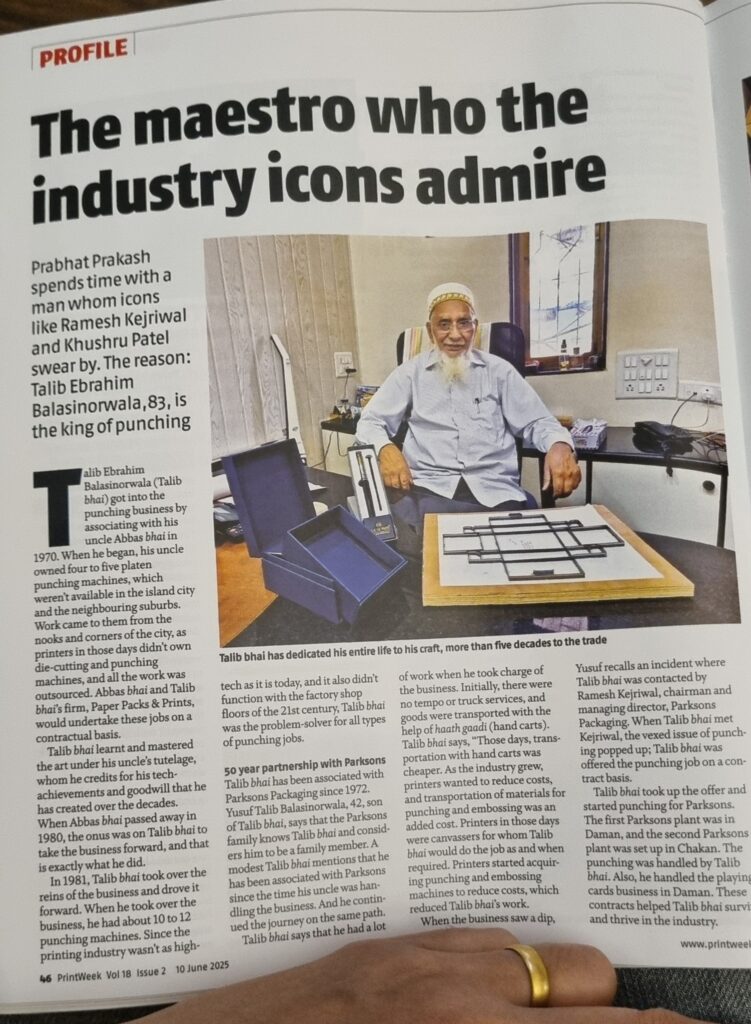
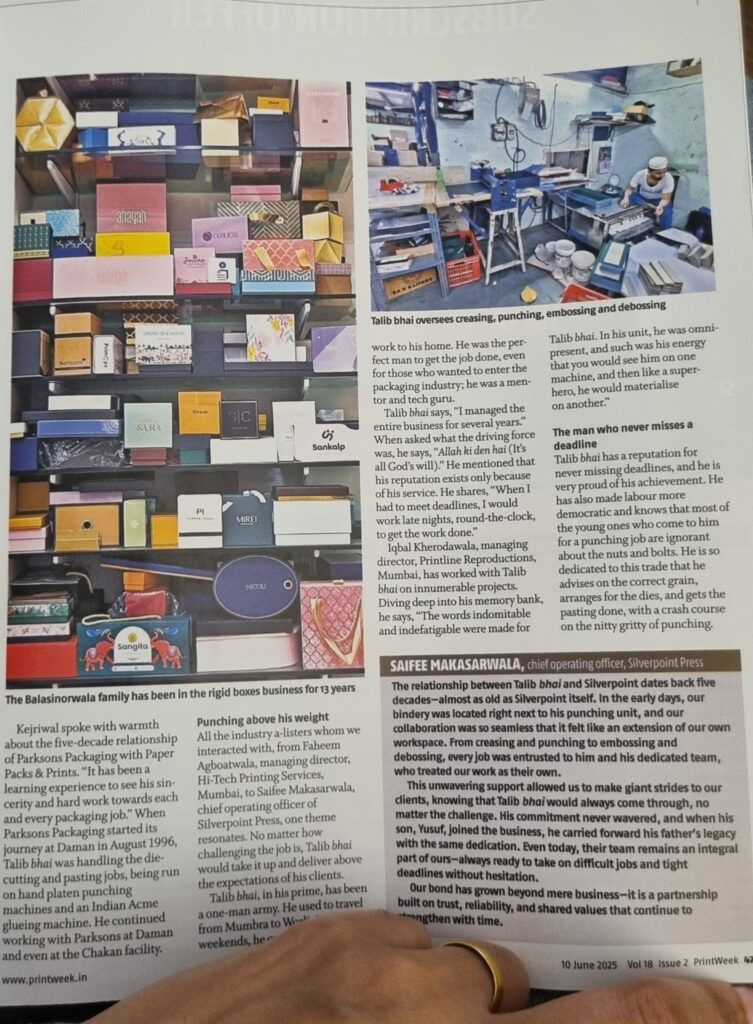
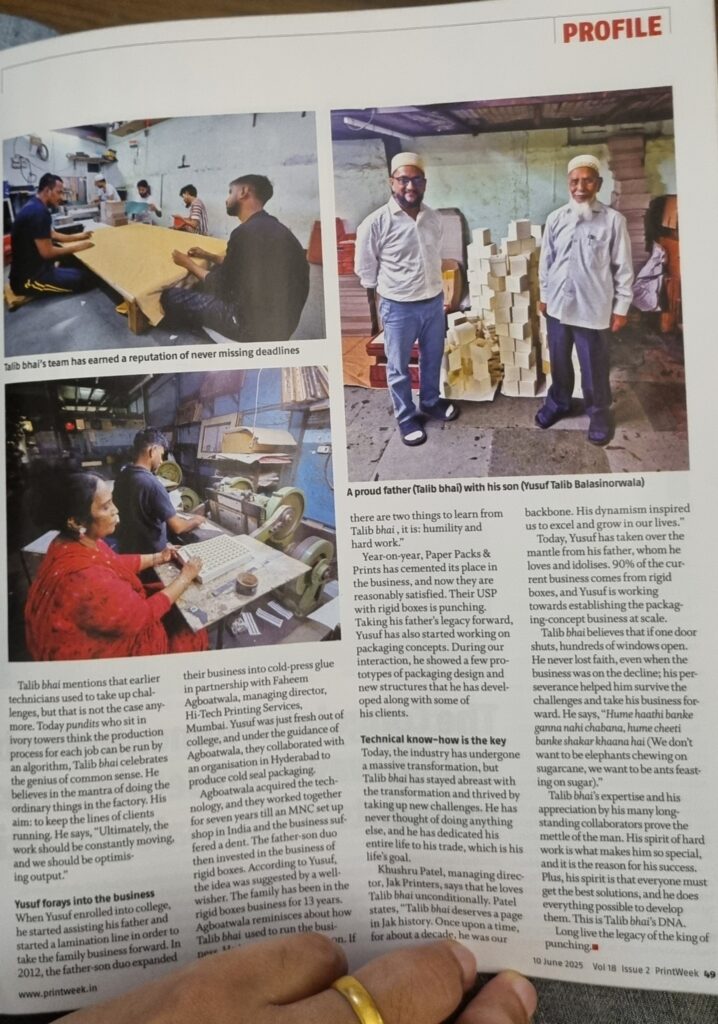
“The maestro who the industry icons admire”

Talib Ebrahim Balasinorwala, 83, is the king of punching.

Printweek India, 10 June 2025

21 June 2025

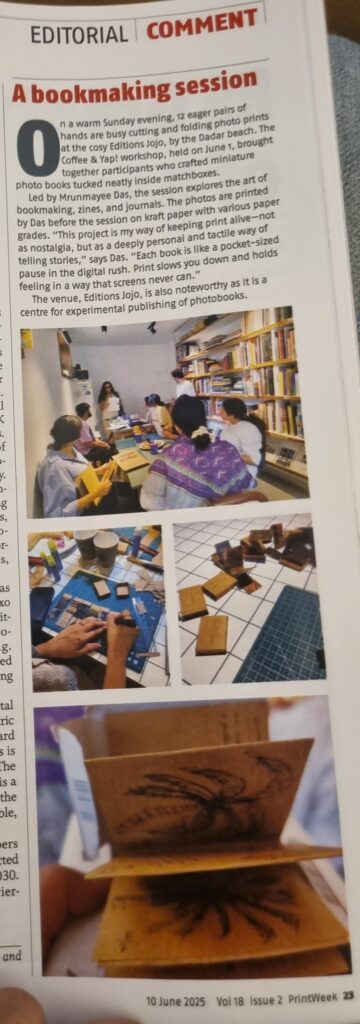
Bookmaking session, Mumbai

#photobook #Mumbai PrintWeek India magazine, 10 June 2025

21 June 2025

“The Nehru-Era Economic History and Thought & Their Lasting Impact” by Arvind Panagariya

India’s economic model underwent transformational change following independence in 1947. The country’s first Prime Minister, Jawaharlal Nehru, embarked upon two foundational projects to build modern India: a political project aimed at establishing democracy with universal suffrage, and an economic one aimed at ending poverty. Three-quarters of a century later, his political project is a resounding success, but the opposite is true of the economic one as per the author.

The Nehru-Era Economic History and Thought & Their Lasting Impact examines the evolution of Nehru’s economic philosophy with socialism, self-sufficiency, and heavy-industry development at its core. Through extensive archival research, Arvind Panagariya reconstructs and reinterprets this history, paying particular attention to the administrative processes deployed to implement policies, contemporary economic thought, and important historical events not adequately covered in the existing literature. He assesses the evolution of Nehru’s own political beliefs and the construction of the Nehru development model, the resulting regime and exclusionary nature of economic growth, and the lasting intellectual legacy of the Nehru-era socialism on politicians, civil servants, policy analysts, and businesspeople in the six decades since Nehru’s death.

This book is the fascinating tale of a model with the near-unanimous approval of experts from all around the world at its inception and the impact of its failure.

Read an excerpt from the book on Moneycontrol.

The book has been published by Oxford University Press India.

Arvind Panagariya is a Professor of Economics in the School of International and Public Affairs at Columbia University. He was the first Vice Chairman of the NITI Aayog, Government of India, in the rank of a cabinet minister. He has authored more than 20 books, published professional articles in all the top Economics journals, and written for Foreign Affairs, Foreign Policy, and the WSJ. In 2012, the Government of India awarded him with Padma Bhushan, its third highest honor in any field.

21 June 2025

Web Analytics Made Easy -
StatCounter