debut Posts

Jaya’s newsletter 8 ( 14 Feb 2017)

It has been a hectic few weeks as January is peak season for book-related activities such as the immensely successful world book fair held in New Delhi, literary festivals and book launches. The National Book Trust launched what promises to be a great platform — Brahmaputra Literary Festival, Guwahati. An important announcements was by Jacks Thomas, Director, London Book Fair wherein she announced a spotlight on India at the fair, March 2017.  In fact, the Bookaroo Trust – Festival of Children’s Literature (India) has been nominated in the category of The Literary Festival Award of International Excellence Awards 2017. (It is an incredible list with fantabulous publishing professionals such as Marcia Lynx Qualey for her blog, Arablit; Anna Soler-Pontas for her literary agency and many, many more!) Meanwhile in publishing news from India, Durga Raghunath, co-founder and CEO, Juggernaut Books has quit within months of the launch of the phone book app.

In other exciting news new Dead Sea Scrolls caves have been discovered; in an antiquarian heist books worth more than £2 m have been stolen; incredible foresight State Library of Western Australia has acquired the complete set of research documents preliminary sketches and 17 original artworks from Frane Lessac’s Simpson and his Donkey, Uruena, a small town in Spain that has a bookstore for every 16 people  and community libraries are thriving in India!

Some of the notable literary prize announcements made were the longlist for the 2017 International Dylan Thomas Prize, the longlist for the richest short story prize by The Sunday Times EFG Short Story Award and the highest Moroccan cultural award has been given to Chinese novelist, Liu Zhenyun.

Since it has been a few weeks since the last newsletter the links have piled up. Here goes:

  1. 2017 Reading Order, Asian Age
  2. There’s a pair of bills that aim to create a copyright small claims court in the U.S. Here’s a breakdown of one
  3. Lord Jeffery Archer on his Clifton Chronicles
  4. An interview with award-winning Indonesian writer Eka Kurniawan
  5. Pakistani Author Bilal Tanweer on his recent translation of the classic Love in Chakiwara
  6. Book review of Kohinoor by William Dalrymple and Anita Anand
  7. An article on the award-winning book Eye Spy: On Indian Modern Art
  8. Michael Bhaskar, co-founder, Canelo, on the power of Curation
  9. Faber CEO speaks out after winning indie trade publisher of the year
  10. Scott Esposito’s tribute to John Berger in LitHub
  11. An interview with Charlie Redmayne, Harper Collins CEO
  12. Obituary by Rakhshanda Jalil for Salma Siddiqui, the Last of the Bombay Progressive Writers.
  13. Wonderful article by Mary Beard on “The public voice of women
  14. Enter the madcap fictional world of Lithuanian illustrator Egle Zvirblyte
  15. Salil Tripathi on “Illuminating evening with Prabodh Parikh at Farbas Gujarati Sabha
  16. The World Is Never Just Politics: A Conversation with Javier Marías
  17. George Szirtes on “Translation – and migration – is the lifeblood of culture
  18. Syrian writer Nadine Kaadan on welcoming refugees and diverse books
  19. Zhou Youguang, Who Made Writing Chinese as Simple as ABC, Dies at 111
  20. Legendary manga creator Jiro Taniguchi dies
  21. Pakistani fire fighter Mohammed Ayub has been quietly working in his spare time to give children from Islamabad’s slums an education and a better chance at life.
  22. #booktofilm
    1. Lion the memoir written by Saroo Brierley has been nominated for six Oscars. I met Saroo Brierley at the Australian High Commission on 3 February 2017. 
    2. Rachel Weisz to play real-life gender-fluid Victorian doctor based on Rachel Holmes book
    3. Robert Redford and Jane Fonda to star in Netflix’s adaptation of Kent Haruf’s incredibly magnificent book Our Souls at Night
    4. Saikat Majumdar says “Exciting news for 2017! #TheFirebird, due out in paperback this February, will be made into a film by #BedabrataPain, the National Award winning director of Chittagong, starring #ManojBajpayee and #NawazuddinSiddiqi. As the writing of the screenplay gets underway, we debate the ideal language for the film. Hindi, Bengali, English? A mix? Dubbed? Voice over?
    5. 7-hour audio book that feels like a movie: Julianne Moore, Ben Stiller and 166 Other People Will Narrate George Saunders’ New Book – Lincoln in the Bardo.
    6. Doctor Strange director Scott Derrickson on creating those jaw-dropping visual effects

New Arrivals ( Personal and review copies acquired)

  • Jerry Pinto Murder in Mahim 
  • Guru T. Ladakhi Monk on a Hill 
  • Bhaswati Bhattacharya Much Ado over Coffee: Indian Coffee House Then and Now 
  • George Saunders Lincoln in the Bardo 
  • Katie Hickman The House at Bishopsgate 
  • Joanna Cannon The Trouble with Goats and Sheep 
  • Herman Koch Dear Mr M 
  • Sudha Menon She, Diva or She-Devil: The Smart Career Woman’s Survival Guide 
  • Zuni Chopra The House that Spoke 
  • Neelima Dalmia Adhar The Secret Diary of Kasturba 
  • Haroon Khalid Walking with Nanak 
  • Manobi Bandhopadhyay A Gift of Goddess Lakshmi: A Candid Biography of India’s First Transgender Principal 
  • Ira Mukhopadhyay Heroines: Powerful Indian Women of Myth & History 
  • Sumana Roy How I Became A Tree 
  • Invisible Libraries 

14 February 2017 
Wyl Menmuir, “The Many”

Timothy has come to resurrect Perran. He has come to destroy Perran’s house, to erase his memory. He’s come because that’s what upcountry folk do, to replace the drudgery of the city with that of the coast. He has come to
save them from themselves, or to hold up a mirror to them and they will see themselves reflected back in all their faults and backwardness. He has come to change them, to impose himself on them, to lead them or to fade into their shadows.

The Many is Wyl Menmuir’s debut novel which has been longlisted for the ManBooker Prize 2016. It is a slim novel based in a fishing village in north Cornwall. It revolves around two men — Ethan and Timothy. Ethan is a local and Timothy Buchannan is from the city. They form an unlikely pair and yet seem to spend a lot of their time together — idling, talking and fishing. They are seemingly bound by the fisherman Perran who had disappeared mysteriously some years earlier — Timothy questioning Perran’s disappearance and Ethan reticent about sharing any information about a man he was close to. In fact it is Perran’s abandoned cottage and its spoilt contents which is bought by Timothy when he visits the village much to the local villagers surprise, distaste and discomfort. There is a sense of despair hovering in the air, with the stench of death literally personified by the wasted fish caught in the polluted waters. There is desperation amongst the villagers in trying to eke out an existence by farming the sea for fresh produce which is rarely forthcoming. Whatever little money is to be made is dependant very heavily on the price set by Clem on behalf of the fishermen. The catch is inevitably sold to a mysterious group of people who stand a little away from the beach fixing a price with Clem. It is never very clear what they intend on doing with the poor catch, probably recycle it for the pharmaceutical industry but it is a paltry income welcomed by the locals since that is all they have access to.ev_wyl_menmuir

While reading The Many there are many thoughts unleashed particularly about the slowly decaying lifestyle of a fishing village, the increasing dominance of city ways and yet the inexplicable power ( and cruelty) of Nature and its complicated relationship with Man. It manifests itself in this novel in many ways particularly in the mysterious fevers that plague Timothy and his hallucinations blurring the line between reality and fiction. Yet when reading the novel it all seems so plausible that it is impossible to query it.

This is a novel that has to be read at one go but one of those rare stories that once you have reached the end you start reading it all over again. There are moments one has to pause and wonder if it is reminiscent of similar writing in the past and then realise it would be unfair to compare The Many to any other writing. Wyl Menmuir’s style is wholly original, it grips one with its exquisitely chiselled style to create a stunningly beautiful and memorable novel much like the Cornish coast is. As with most longlists that put the spotlight on new voices and new styles of writing, the Man Booker judges have been correct in highlighting the debut novel of Wyl Menmuir. Whether he makes it to the shortlist or not is immaterial for now. This is a writer worth looking out for in the future. He is a confident storyteller who is aware of what it takes to be a master craftsman.

The Many is a debut novel with an earthiness to it and yet something so slippery and mysterious, with an almost magical quality to it.

Read it.

Wyl Menmuir The Many Salt Publishing, Norfolk, 2016. Pb. pp. 148 

9 August 2016 

*Book sent by the publisher, Chris Hamilton- Emery

* Images off the Internet

Max Porter “Grief is the thing with Feathers”

‘If your wife is a ghost, then she is not wailing in the cupboards and corners of this house, she is not mooching about bemoaning the loss of her motherhood or the bitter pain of watching you boys live without her.’

‘No?’

‘No. Trust me, I know a bit about ghosts.’

‘Go on.’

‘She’ll be way back, before you. She’ll be in the golden days of her childhood. Ghosts do not haunt, they regress. Just as when you need to go to sleep you think of trees or lawns, you are taking instant symbolic refuge in a ready-made iconography of early safety and satisfaction. That exact place is where ghosts go.’

I look at Crow. Tonight he is Polyphemus and has only one eye, a polished patent eight-ball.

‘Go on then. Tell me.’

We sit in silence and I realise I am grinning. 

I recognise some of it. I believe him. I absolutely blissfully believe him and it feels very familiar. 

‘Thank you Crow.’

  ‘All part of the service.’

  ‘Really. Thank you, Crow.’

  ‘You’re welcome. But please remember I am your Ted’s song-legend, Crow of the death-chill, plase. The God-eating, trash-licking, word-murdering, carcass-desecrating math-bomb motherfucker, and all that.’

  ‘He never called you a motherfucker.’

  ‘Lucky me.’

( p.68-70)

In 2015 a buzz began about a promising debut by Max Porter. He is an editor at Granta Books and was due to publish Grief is the Thing with Feathers a novel about an English widower and his two sons. It is a brilliant meditation on grief, loneliness,  death and Ted Hughes. It is a novel that is written from three perspectives — the dad, the sons and the crow. The latter is a psychic manifestation of the dad who also happens to be writing a book on the poet Ted Hughes called Ted Hughes’ Crow on the Couch: A Wild Analysis but the symbolism of the bird works at multiple levels too. For instance the crow is associated with grief, intelligence, personal transformation, believed to be a spirit animal, a creature presumed to have mystical and magical powers, is a steady presence in folklore, mythology and to have personal insight. The Crow in Grief is the Thing with Feathers is no less. Surprisingly in this magical fable Max Porter with gentleness and supreme craftsmanship is able to weave in the mystical and modern with a personal tribute to a literary giant, Ted Hughes. It works splendidly not just in words but with a keen eye on the layout of text designed on each page seemingly in-step with the sentiment expressed. It won the International Dylan Thomas Prize 2016 where the judges commended it for its “imaginative prose”. The prize is for the best work of English-language literary fiction – poetry, drama or prose – by a writer of 39 or under, marking Thomas’s own death shortly after his 39th birthday.

According to the Bookseller, Granta where Max Porter works promoted him to editorial director of Granta and Portobello Books. Porter, who has published authors including Man Booker Prize-winning Eleanor Catton along with Han Kang, Tom Bullough, Caroline Lucas and Sarah Moss, will continue to acquire fiction and non-fiction for both lists. Sigrid Rausing, publisher of Granta, said: “I’m thrilled to announce Max Porter’s promotion. Max is a valued member of Granta’s editorial team – there is no part of publishing that he doesn’t do extremely well, and being a writer himself he understands the writing process from all angles.” Porter added: “I am delighted to be taking on this new role at Granta and Portobello. This is a remarkable team of people, dedicated to publishing outstanding books. It is a pleasure and a privilege to be here.” ( 31 May 2016 http://bit.ly/1su3hdE )

Grief is the Thing with Feathers is an exquisitely complex novel that is a must have.

Max Porter Grief is the Thing with Feathers Faber & Faber , London, 2015. Hb. pp. 115 Rs 799

6 June 2016

Shobha Rao ” An Unrestored Woman”

Shobha Rao’s Unrestored Woman is a collection of short loosely interlinked stories first published by Virago Press and released in the Indian subcontinent by Hachette. The stories are classic in structure but the plot and treatment fairly unconventional. There are a range of stories inevitably dealing with Indian subcontinent during British Raj or at the time of Partition. With a South Asian name one approaches the collection assuming it would be of a particular style only to discover the writing is very modernist — bold, sharp, exploratory. It is no wonder then that T. C. Boyle included “Kavitha and Mustafa” in his anthology of Best of Ameican Fiction 2015. Although Shobha Rao is a writer of promise Unrestored Woman will forever remain her unfinished canvas in her yet-to-come oeuvre. Her justifiable admiration for Ritu Menon and Kamla Bhasin’s seminal work on Partition Borders and Boundaries: Women in India’s Partition is very evident but it is preventing Shobha Rao from making her stories her own.  Instead what comes through is the strong desire to assert her South Asian roots, her sensitivity to the issues and her attempt to engage with them but alas is unable to convey it with a passion. Aamer Hussein in his review of the book in The Independent is correct in saying that Shobha Rao is on “a firmer ground as a realist”. ( 6 March 2016 http://ind.pn/1sSJaWq )

Maybe the author is working on a full-length manuscript like a novel or historical fiction on women and Independence/ Partition of the subcontinent that will have more depth than the few sketches presented here.  Having said that Shobha Rao is a writer to keep on one’s literary radar.

Shobha Rao An Unrestored Woman and other stories Virago Press, an imprint of Little, Brown Book Group, Hachette India, 2016. Pb. pp. 244. Rs. 399 

3 June 2016 

Noelle Stevenson, “Nimona”

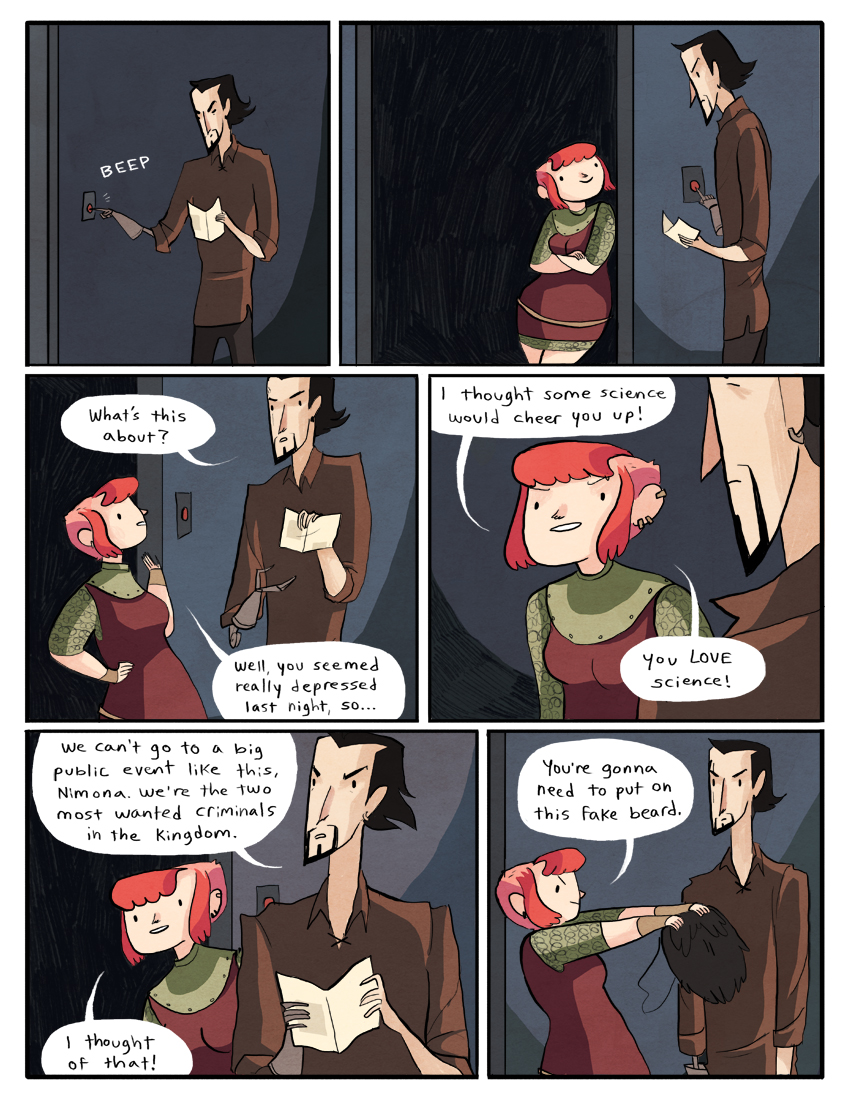
nimoina-coverNoelle Stevenson’s debut graphic novel Nimona is about a young shape shifter who is a badass sidekick to super villain, Lord Blackheart. It is utterly delightful for its romp through the world of evil. Nimona for all her evilness comes across as a super-confident young girl who is not deterred by any challenge. Sometimes even Lord nimona2Blackheart is taken aback by her boldness.

According to Wikipedia, Nimona is a fantasy comic by the American comics writer and artist Noelle Stevenson. Stevenson started Nimona as a webcomic while a student at Maryland Institute College of Art. The comic was first published in June 2012 and doubled as Stevenson’s senior thesis. HarperCollins published the webcomic as a young adult graphic novel Noelle Stevenson in May 2015.  In June 2015, 20th Century Fox Animation acquired the rights for an animated feature film adaptation. It has won a few awards and was shortlisted for the National Book Award 2015. ypl_nba2015pg

It is a book about a mighty girl. Meant to be owned. Savoured. Read over and over again.

Noelle Stevenson Nimona HarperTeen, an imprint of HarperCollinsPublishers, New York, 2015. Pb. pp. 270 $12.99

18 April 2016 

Meg Rosoff, “Jonathan Unleashed”

Award-winning young adult writer Meg Rosoff is a brilliant writer. No wonder she has been awarded the Astrid Lindgren Memorial Award ( ALMA) this year or what is fondly referred to as the Nobel Prize for Children’s Literature, given its whoppingly delicious prize money of £430,000. It is given to an author for their body of work. ( http://www.theguardian.com/books/2016/apr/05/meg-rosoff-wins-astrid-lindgren-memorial-award-how-i-live-now ) What is particularly satisfying is that such a passionately ferocious storyteller is conferred the award for her work in young adult literature within weeks of the publication of her first adult trade novel, Jonathan Unleashed.

Jonathan Unleashed is about Jonathan Trefoil, in his twenties, living in New York, working in an advertising firm that he does not particularly relish but the saving grace in his life are the two dogs he is babysitting. Dante and Sissy belong to Jonathan’s brother who has had to relocate to Dubai for a job. Thrown into this mix are his girlfriend who does not particularly care for the menagerie, a vet and old school friend/colleague. His girlfriend persuades him to get married online since her magazine will sponsor it. He has a breakdown with the pressures of work and a love-life that is nerve-wracking — Jonathan has a better sleep at night cuddled up in bed with Sissy, the cocker spaniel, than his girlfriend! It is a Meg Rosoffromance novel with the rawness and honesty of young adult writing and at a quick pace that is never dull to read. Meg Rosoff gets the various emotions of dogs ever so well. Not surprising given her love for the four-legged beasts. The relationship between humans and dogs is superbly executed and can only be written by one who has lived and observed dogs closely. Jonathan Unleashed is hilarious and impossible to put down.

Read it.

Meg Rosoff Jonathan Unleashed Bloomsbury, London, 2016. Pb. pp.280 Rs 499 

18 April 2016 


Zainab Sulaiman, “Simply Nanju”

Simply NanjuZainab Sulaiman’s book Simply Nanju is about a young differently-abled boy and his classmates. All of them have a bunch of challenges but have caring teachers and didis who tend to the children during school hours. This is a story with good diversity in the representation of communities albeit restricted to a narrow socio-economic class. Every single character’s story has been sensitively created by the author. A story about differently-abled children is an excellent idea given the paucity of literature in this area.

It is also timely given the debates about the ‘Accessible India Campaign’ and the Central government having released the ‘Inclusiveness and Accessibility Index’ that measures the actions and attitudes of different organisations towards people with disabilities.  ( HT Editorial, 6 April 2016, http://www.hindustantimes.com/editorials/government-must-remove-the-barriers-and-fast-track-the-disability-bill/story-0r7PDbg8ghLa54JlSEkykO.html )

The editorial continues to say:

The United Nations pegs the disabled in India at 15% of the population but the census of India fixes it at just 2.2%. This means there are many who do not get access to the State benefits that are due to them. One of the main reasons why the numbers are low is that the enumerators often don’t ask the right questions; families tend to hide those who suffer from mental illness; and sometimes they are unaware of challenges like autism. To redress this situation, the government needs to pump in more money on public awareness programmes and train enumerators better.

Last, but not the least, political parties must stop dillydallying on the passage of the Rights of Persons with Disabilities Bill, 2014, which is pending in Parliament. The Bill replaces the Persons with Disabilities (Equal Opportunities, Protection of Rights and Full Participation) Act, 1995. Instead of seven disabilities specified in the Act, the Bill covers 19 conditions. The Bill is being brought in to fulfil obligations under an international treaty. Many have criticised the Bill, saying that it’s not perfect — but then no Bill is. At least this has expanded the number of disabilities and that is a step forward and will give many more disabled people access to opportunities and funds that are earmarked for them.

There are sweet touches of incorporating lingo spouted by the kids such as “Shutyamouth!” and “Tensioning”. Children tend to experiment wildly and it is not easy to transfer it on to texts but Zainab Sulaiman has. As she tells Archit Taneja in a fabulous blog post on the Duckbill website “I did get some of the lingo from the kids I worked with at a school. It’s an interesting jumble of their mother tongue and what they learned at school. As teachers, we would try really hard to change this and make them speak “proper English”. However, I’ll admit that I cracked up every time they used them. I secretly wanted them to talk more like that! ” ( https://theduckbillblog.wordpress.com/2016/04/04/zainab-sulaiman-interviewed-by-archit-taneja/ )

The story is a gentle whodunnit story of trying to discover who is the culprit responsible for stealing notebooks in class. Unfortunately this story is a flat and standard narrative of children’s literature, not very nuanced and far too noisy relying on many conversations to propel the plot forward. Also the premise of the book relying only on children of financially challenged backgrounds with stereotypical characteristics of domestic violence, child abuse, alcoholics etc is a little difficult to digest. It would have been preferable if the book focused on differently-abled children and brought out the challenges by creating a landscape that would resonate with readers of all age-groups and social standing. Despite every good intention and experience of the author working as a special educator this book will only further alienate such children. Young middle class readers ( who are presumably the prime target group) will read it as pure fiction and move on little realising that such individuals exist around them too. If the purpose of literature is to help sensitise grave issues such as disabled children Simply Nanju is a book that falls far short of expectations. Yet sell it will. Probably even get adopted as supplementary texts in schools since there is little or no literature on the subject. It will make an excellent conversation starter encouraging debates in schools.

All said and done it is a book that must be read.

Zainab Sulaiman Simply Nanju Duckbill Books, Chennai, 2016. Pb. pp. 122. Rs. 199

Of two women short story writers — Diane Cook and Arlene Heyman

Over the past few days I have read two debut short story collections — Diane Cook’s powerfully imaginative and equally disconcerting Man vs Nature and Arlene Heyman’s incisive and humorous  Scary Old Sex.

Man vs NatureDiane Cook’s ( http://dianemariecook.com/ ) short stories have been published in online literary magazines. For once the book blurb has to be taken for what it is—this is an astonishingly bold collection of stories. It is easily classified as speculative fiction, nudging the logical boundaries of imagination sufficiently to create a world which is not necessarily dystopic but disconcerting nevertheless especially in the new rules governing human social behaviour. There is a cold-hearted undercurrent to the stories that is chilling bringing home the point very strongly — irrespective of the situation, it is always survival of the fittest. What is frightening is that the scenarios these stories delineate are all in the realm of possibility. An unpleasant thought! It is very difficult to get rid from the mind’s eye of the landscape these stories create. Hence it is not surprising that this has been a Finalist for The Believer Book Award and the LA Times Book Prizes, Honorable Mention from the Pen/Hemingway Award, Longlisted for the Guardian First Book Award and A Boston Globe, iBooks, and San Francisco Chronicle Best book of 2014.

Arlene Heyman’s debut Scary Old Sex is of a different ilk altogether. The short stories Scary Old Sexare descriptive and yet so detached, almost as if there is a clinical precision in the manner the mind operates.  It is about sex but unlike most stories that focus on the act here the focus on how the mind operates is spellbindingly written. Being a practising psychiatrist is a definite advantage for Arlene Heyman. It maybe unfair to yoke the two distinct aspects of the author yet it is impossible not to see the influence her profession has on her storytelling. She is able to distinguish between the physical and mental wants of the individual. But equally stupendous is the fine detail with which she describes not only the real world but the spectrum of emotions her characters experience — a rare quality not often seen in short story writing. One of the most interesting stories is “In Love with Murray”, probably an autobiographical story based on Arlene Heyman’s affair with Bernard Malamud — it is dedicated to him. Read Elaine Showalter’s delightful review-article in the Guardian about the literary muse, Arelene Heyman, and unearthing the literary history + mystery that this collection encases. ( Scary Old Sex by Arlene Heyman review – lusty, tough and life-affirming , 25 Feb 2016 http://www.theguardian.com/books/2016/feb/25/scary-old-sex-by-arlene-heyman-review )

Both collections are highly recommended.

Diane Cook Man Vs Nature Oneworld Publications, London, 2015. Pb. pp. 258 

Arelene Heyman Scary Old Sex Bloomsbury, London, 2015. Pb. pp. 230 Rs 499


Alex Gino, “George”


George“Are you nervous about the audition? Kelly asked. “Don’t be. My dad says that men performing in non-traditional gender roles is good for feminism. He says it’s important, as an artist, to be in touch with his feminine side.”

Scott snuck glances her way too, but where Mom’s eyes were filled with concern and confusion, Scott looked at George as if his sibling made sense to him for the first time. George had never been gladder to have an older brother.

 George heard her name coming from kids talking to their parents, as well as the word boy. Adults’s heads turned her way. Most looked at her with open faces of surprise. A few smiled and waved. Others crinkled their faces in disgust. George stepped offstage and out of view of staring eyes. 

“Well, you can’t control who your children are, but you can certainly support them, am I right?” Principal Maldonado’s earrings sparkled in the auditorium light. 

Alex Gino’s debut novel George was twelve years in the making and it has already won an award — the 2016 Mike Morgan and Larry Roman’s Stonewall Book Award for Children. (http://www.alexgino.com/ )  George  is about a ten-year-old boy who believes s/he is a girl. She takes her best friend, Kelly, into confidence and it takes Kelly a while to come to terms with the revelation. Later Kelly proves to be George’s best ally when she quietly gives up the lead role of Charlotte the spider in the class play of Charlotte’s Web without the permission of their teachers. George proves to be an incredible actor. The audience claps approvingly many of whom do not even realise that George is a boy!

George is fantastic! So sensitively done. The ending is a bit too convenient and sugary, but satisfying. To put in the tough conversations about being a transgender, hormonal therapy and the possibility of surgery as an adult could not have been easy. The reactions of adults and children ( including the bullying incidents) to George are beautifully done. The range of emotions George faces from pure disgust to his kind to the kind-heartedness of the school principal to quiet acceptance by the elder brother, Scott, to coming-to-terms but ultimately joy by Kelly. Using theatre as a literary technique to help George in coming out is cliched but works very well. Even setting the stage with the tiny Shakespearean drama background in the early pages is neatly done.

It took a while for me to understand the author’s name, Alex Gino, as an acknowledgement of her being a transgender and referring to herself in the plural on the book jacket. It is not common. The idea of using literature as  a way of opening conversation about sexuality with children is good.

These conversations about transgender rights have been gaining momentum for some time. But last year with the news of Olympic decathlete champion Caitlyn Marie Jenner, formerly known as Bruce Jenner, announcing her transformation as a transgender caught the world by storm. It opened up debates about diversity and LGBTQ rights. When the announcement broke there were some fabulous opinion articles published, including one in the Guardian by a transgender activist. ( Alas, I am unable to locate the link for now.) But there are a few more essays that are worth reading such as Urvashi Butalia on transgender or hijra, Mona Ahmed in Granta, ( http://granta.com/monas-story/), photographer Dayanita Singh’s book on Mona called Myself Mona Ahmed http://www.dayanitasingh.com/myself-mona-ahmed),  Scott Esposito’s essay, “The Last Redoubt”, published in the White Review ( November 2014, http://www.thewhitereview.org/features/the-last-redoubt/ ) and Scott Esposito on Juliet Jacques’s “Beyond the Trans-Memoir” in the Literary Hub ( September 2015, http://lithub.com/beyond-the-trans-memoir/). In India, the Supreme Court ruled in 2014, that transgenders will be introduced as a “third gender category”.  Also how can one forget Welsh author Jan Morris’s memoir, Conundrum, published in 1974 and advertised as a personal memoir of transsexualism.

Challenge will lie in having this book discovered by the target audience. Even if you have liberal minded librarians and educationists willing to keep the book, parents will be up in arms. Gatekeepers come in all hues. Also a big question will be if knowing one’s sexual orientation is possible as a ten-year-old — it is debatable. Is it really possible that George can be so confident and sure about herself and spew so much information about being a transgender? The confident voice is that of a transgender adult. Also youngsters like to experiment. It’s a given. Absolutely nothing wrong with it. So a question that begs to be asked: do such books address diversity in literature and add to social debates or do they given young readers the license to explore sexuality and provide them with information? And George does discuss and analyse a lot of ways about becoming a transgender person.  All said and done, George, is a significantly magnificent contribution to young adult literature and must be read.

Alex Gino, George, Scholastic Press, New York, 2015. Hb. pp.200. 

16 Feb 2016


‘A sponge of history’ An interview with Kanishk Tharoor

Swimmer among the stars

(I interviewed Kanishk Tharoor on his collection of short stories — Swimmer Among the Stars, published by Aleph. The interview was published online on 30 January 2016 and will be in print on 31 January 2016. Here is the original url: http://www.thehindu.com/books/literary-review/kanishktharoor-talks-to-jaya-bhattacharji-rose-about-his-book-swimmer-among-the-stars-stories/article8171724.ece )

Kanishk Tharoor about writing in his pyjamas in the company of many cups of tea.

Kanishk Tharoor’s debut book Swimmer among the Stars: Stories is a magnificent collection of short fiction. It transports one into a different world, especially with its minute details, achieving the near-impossible with words. Tharoor’s short fiction was nominated for a National Magazine Award in the U.S. He writes the ‘Cosmopolis’ column for The Hindu Business Line’s BLink. He is currently at work on a radio series to be aired on BBC Radio in the spring of 2016, and on a novel. He lives in New York City.

Excerpts:

How did these stories grow? Out of a line, character or a memory?

The stories have quite separate points of origin. Some — like ‘Elephant at Sea’ — sprang from a real life story told to me when I was younger. Others were sparked by observations, an experience, sometimes just a line or an image. The work of the story would become justifying that line or image.

How many years were they in the making were these stories? Kanishk Tharoor

About a decade. The oldest story in the collection, ‘The Loss of Muzafar’, was written when I was 19. Most of the stories in the collection were written in the last five years.

How do you start a story? Do you plan in detail?

I begin with an image or idea or adventurous premise. I rarely plan — you can get away with that in short stories more easily than you can in a novel. I find that I do my best thinking as I write, so the story takes shape in the midst of its writing.

These stories are not historical fiction yet have a strong whiff of history in them. How much research does each story require?

‘Research’ makes it sound like a kind of deliberate project. The truth is I’m a helpless sponge of all sorts of historical material, particularly of rather obscure or little-known moments in history. The only research I really did was for the last story in the collection, ‘The Mirrors of Iskandar’, which retells episodes from legends about Alexander the Great that were known in the medieval world from Scotland to the Straits of Malacca.

I get the impression upon reading Your stories seem that it is like a fine blend of political news reporting and fiction, as in ‘The Fall of an Eyelash’ about refugees or the conversations in ‘A United Nations in Space’ revolving around international diplomacy. Is this intentional?

I don’t know if I’d call it a blend of political reporting and fiction… this is all very much fiction! But I am interested in political and social issues, and that interest filters into my fiction.

What is your writing routine?

I don’t really have a routine, as I inconsistently have time to devote to my fiction. When I write, it’s often in my pyjamas and in the company of many cups of tea.

In this collection you have very distinct voices and stories revolving around languages including the title story. This fascination with linguistic abilities that you capture so well in the diction makes me wonder if at times you write in public spaces too to capture the variety of languages? Was NYC with it being a repository of many languages an inspiration?

I actually do almost all my writing at home. But yes NYC was a source of inspiration for the story even though it wasn’t set there. NYC is actually a repository of dying languages that have survived in diaspora even as they have disappeared in their countries of origin. I think, more generally, there is a lot of NYC in the spirit of the collection, a city that in many ways has as its jurisdiction the world.

What writer do you admire the most and what would you like to ask them? 

I’ll say the Portuguese novelist Jose Saramago. I’d ask him about where in Lisbon his ghost likes to wander.

How do you read? In print or digitally or both? Are you an eclectic reader? 

I read literature almost solely in print. I do not own an e-reader.

I read news mostly online, though I have subscriptions to a few journals. In terms of books, I read mostly fiction but I also consume  history, politics, and other non-fiction subjects.

Who are the authors you admire and who have influenced you? 

Too many to list. Perhaps predictably, the likes of Toni Morrison, Saramago, Italo Calvino, Borges, Amitav Ghosh and so on. But also the 19th century collectors of folklore, medieval Persian poets, and ancient tellers of epic around the world.

30 January 2016

Web Analytics Made Easy -
StatCounter