The first spirit Sanjoy Roy encountered was one that haunted his ancestral house in Calcutta; he was five then. A few years later, the otherworldly made its presence felt again in his parents’ sprawling bungalow in Lutyens’ Delhi. Over the decades that followed, he and his family and friends have come across a variety of apparitions, spectres and phantoms in diverse locations both in India and abroad. Some of these beings are benign or at most mischievous, but others–lost, disturbed souls–are angrier and have to be placated.
For Sanjoy, his ability to sense and interact with the supernatural is not something remarkable, but part of his everyday reality. As he sees it, there is perhaps a dimension parallel to ours, one that is teeming with spirits and souls. There’s a Ghost in My Room is a fascinating travelogue through that mysterious world.
Rich in period detail, humour and adventure, this unusual memoir makes for a compelling read and is sure to enthrall both the haunted-world sceptic and those who believe.
I interviewed him for TOI Bookmark. Here is the Spotify link.
Sanjoy K. Roy is Managing Director of Teamwork Arts, which produces over thirty highly acclaimed performing arts, visual arts and literary festivals across forty cities including the world’s largest literary gathering: the annual Jaipur Literature Festival.
Journalist Nayanima Basu had a ringside view of the total collapse of the republic of Afghanistan at the hands of the Taliban. From 8 to 17 August 2021, based in Kabul but travelling outside and talking to Afghans across the political spectrum, she sent despatches of the Taliban sweeping through the country, with provinces falling one after another. Covering a hostile war zone, a woman all alone, she saw the fall of Kabul in real time and managed to get out on the last flight by negotiating with Taliban bosses. Basu transports us to the heart of the action with her vivid narration and precise descriptions of what was happening in Afghanistan at large and Kabul in particular. Through her astonishing account of how she did her reporting – from asking gun-toting civilians for help to find her way back to her hotel and being chided by the hotel employees to stay safe in an iron room to being the only Indian journalist to ever interview the ‘Butcher of Kabul’ – Basu tells the story of not just the wreckage of the country’s present but also of the contentious past that lead to it.
Nayanima Basu has penned a truly gripping first person account of the dramatic fall of Afghanistan to the Taliban in August 2021. It reflects her indomitable courage in the face of acute and ever-present danger and her unfailing commitment to professionalism as a journalist. This is outstanding reporting but within a frame of deep political and historical familiarity with a truly complex country.- Shyam Saran, former Foreign Secretary of India
Nayanima Basu has given us a lively and informed account of her stay in Afghanistan at a pivotal moment, just as the Taliban took over the country in 2021. More than a diary of travel in a dangerous, exciting and exotic place, this book is an explanation of a phenomenon, the return of the Taliban, with which the world has yet to come to terms. Its consequences are still playing out, making this a valuable contribution to understanding the increasingly complex geopolitics of India’s periphery.- Shivshankar Menon, Former National Security Advisor and Foreign Secretary of India
An honest and poignant account of what unfolded in August 2021 in Afghanistan, which the world is still grappling with…What makes this book distinctive is the simple narration of an extremely difficult period that once again brought the Taliban back in power.- A.S. Dulat, former Head of Research and Analysis Wing and Special Director, Intelligence Bureau
Nayanima Basu is a New Delhi–based journalist covering foreign policy and strategic and security affairs with nearly two decades of experience. A major in history from the University of Delhi, Nayanima has been professionally associated with several media organisations such as the IANS, Business Standard, The Hindu Group, ThePrint and ABP Network. She has covered stories such as the assassination of former Pakistan prime minister Benazir Bhutto, India’s crucial years at the World Trade Organization (WTO), the global financial recession, India’s evolving ties with its difficult neighbours like Pakistan and China, and bilateral and multilateral summits. In the course of her reportage, she has also interviewed several key Indian and international political and military figures.
I interviewed Rahul Pandita on his debut novel, Our Friends in Good Houses (HarperCollins India), for Moneycontrol. It was published on 12 Nov 2025.
Rahul Pandita is a journalist who is known for his reporting from war-torn areas. He is the author of Hello, Bastar: The untold story of India’s Maoist Movement; Our Moon has Blood Clots: A memoir of a lost home in Kashmir; The Lover Boy of Bahawalpur; and the co-author of The Absent State. He was awarded the International Red Cross Award for conflict reporting in 2010. His debut novel, Our Friends in Good Houses, has just been published by HarperCollins India.
Our Friends in Good Houses is about Neel, a journalist drawn to war zones. It’s in these spaces riven by conflict that his sense of dislocation, of not belonging anywhere, drops off him. At all other times, he’s in quest, seeking solid ground: a home. It is a pursuit that takes him halfway across the world to America and back to the urban dystopia of Delhi, headlong into fleeting relationships that glimmer with the promise of shelter.
He is a Yale World Fellow and also the recipient of the New India Foundation Fellowship. He lives in Delhi.
The following interview was conducted via email.
How and why did Our Friends in Good Houses come about? Would you like to elaborate on the title too?
RP: A major part of my journalistic career has been spent at the cusp of journalism and writing, what David Foster Wallace would term as being a “non-journalist journalist.” It means that I wrote in a certain way, to build the narration of a story in a particular way. The idea always was to offer a Denkbild or thought-image to my experiences. But even as I was doing it, I felt an inadequacy in my dispatches, namely that it did not have that additional layer of meaning that, in my view, made it complete. Through Our Friends in Good Houses I think my attempt was to put that additional layer. But it was also an attempt to make sense to myself of so many things I had experienced out there.
The title came to me very organically. Its meanings changed for me at different stages of writing. I’d like the readers to have the chance to derive their own meanings from it.
For most of your professional life, you established your credentials as a memoirist and a narrative nonfiction writer. So, why did you choose to write fiction? How many years did it take to write this novel?
RP: Fiction simply for reasons mentioned earlier. But also, because I felt that there are some truths you come closer to in fiction than in non-fiction. I was telling my editor Dharini Bhaskar the other day that I have no belief in psychoanalysis. But in many ways, this novel is me lying down on a couch, smoking a cigarette, while a psychoanalyst in tweed jacket with leather elbow patches, who, lo and behold, is also me, hears me out. It is like what the Buddhists say: Thought is the thinker.
The first passages of the novel were written in the US in the year 2015. But a majority of it was written between 2022-23.
In a recent panel discussion in Rome, Juan Gabriel Vásquez said that “There is a sense in which we have as novelists that we can say anything, we can discuss anything because the way stories go, seems to make them, seems to enjoy a certain kind of impunity.” Thoughts?
RP: I think what Vásquez calls “impunity” is really the moral latitude of fiction; it is the permission to wander into difficult or uncomfortable territories without the burden of having to declare a position. A novel can explore what is unspeakable in ordinary language because it doesn’t argue; it listens, it witnesses, it imagines. Storytelling allows for that simply because it creates a space where contradictions can coexist without needing to be resolved.
In Our Friends in Good Houses, I found myself drawn to lives caught between belonging and estrangement, love and loss. These are not easy moral terrains, and yet fiction allows you to walk through them without fear of judgment — to feel your way, rather than reason your way, toward understanding. That’s the novelist’s real privilege, perhaps: not impunity in the sense of freedom from consequence, but the deeper freedom to look closely, to stay with the discomfort, and to find in it some trace of truth.
What are the freedoms that fiction enables and empowers a writer with that non-fiction does not?
Fiction gives you the freedom of uncertainty, the freedom to not know and to write anyway. In non-fiction, there is an implicit contract with fact, a responsibility to the verifiable. But fiction allows you to approach truth obliquely, through emotion, through intuition, through invention. You can tell a lie that reveals something profoundly true.
When I’m writing fiction, I’m not accountable to chronology or evidence; I’m accountable to the inner weather of a character, to rhythm, to silence, to the unsaid. Fiction lets you stretch time, blur voices, or inhabit contradictions that reality might resist. It allows for moral complexity without the need for moral clarity.
What is the difference between reportage and fiction? What are the different demands that these writing styles make upon the author?
RP: Reportage and fiction share a common impulse: understanding human experience; but they travel toward it through very different routes. Reportage demands fidelity to the visible world; fiction demands fidelity to the inner one. In reportage, the writer is a witness. The reporter’s task is to see clearly, to document with precision, to stay alert to what is real and verifiable. The discipline is outward: you listen, you observe, you report. Fiction, on the other hand, asks you to surrender certainty.
In this age of migrations and conflicts, the idea of home is very fluid. What is your definition of home?
RP: I wish I could articulate that. But I can tell you this much: it is a sacred space, a hermitage. And it is something that is inseparable from love.
Conflict writing is your forte. Whether as a survivor or as a writer. But this novel describes multiple levels of conflict, even those that exist in domestic spaces. What are the emotional see-saws that you registered while writing?
RP: I’ve spent much of my writing life inside the vocabulary of external conflict. But while writing Our Friends in Good Houses, I had to meditate upon how those same fractures replicate themselves in smaller, quieter rooms. The domestic space can be just as volatile; love can wound as sharply as any shrapnel.
Is it fair to ask an author about the similarities between their life and the fiction that they create?
RP: The writer always draws something from his life or from those around it. Fiction is never hallucination unless one is describing hallucination experienced by a character. Invariably, that experience will also turn out to be that of the writer. Beckett had a heart murmur, so had Murphy. But having said that, a lot of it also bears no similarity. With the first novel, though, the similarities can be much more. As my friend Manu Joseph told me the other day: the real challenge is the second novel. Ha ha ha.
How much war and other types of literature did you read to write Our Friends in Good Houses or was that unnecessary?
RP: I had no need; I have been to enough wars myself.
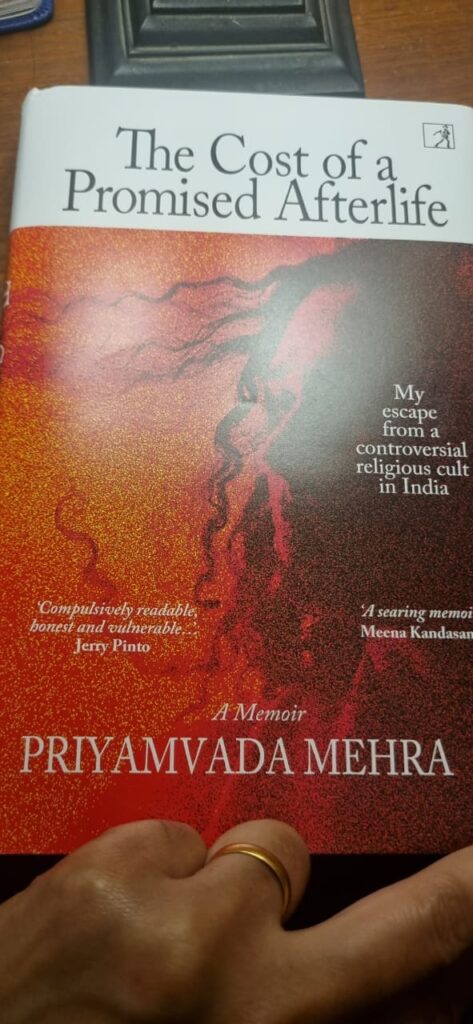
For Moneycontrol, I interviewed Priyamvada Mehra on her recently published memoir The Cost of a Promised Afterlife: My Escape from a Controversial Religious Cult in India. It is published by Simon & Schuster India. I am ever so grateful that Priyamvada replied in the detail that she did as this is not an easy past to revisit. Later, she very kindly wrote, “Thank you for the gentleness and care you’ve put into this interview process, I really appreciate it.”
Here is the interview.
Priyamvada Mehra’s memoir, The Cost of a Promised Afterlife, has been published by Simon & Schuster India. At the age of nine, she was led into the fold of Rampal, a self-proclaimed godman who promised miracle cures and salvation in exchange for submission. What began as her parents’ desperate attempt to save her mother’s life from a brain tumour soon became something far more sinister—a world where faith became a cage, obedience a virtue and control, absolute. By thirteen, Priyamvada was a devoted follower. In 2006, she was inside his ashram, used as a human shield during a deadly clash between Rampal’s followers and a rival sect. Questioning was forbidden, loyalty was everything and defiance came at a cost. She endured heartbreaking losses and grew up with a twisted logic of miracles, bans on medical treatment, and violent sermons.
She witnessed her family fall to pieces under the weight of indoctrination and diseases. For two decades, she stumbled between two treacherous worlds, one ruled by cultic control, and both shaped by patriarchy, caste and class, and the systemic violence they breed.
In The Cost of a Promised Afterlife, Priyamvada Mehra finally tells her story. The memoir exposes how cults take root in a nation of 1.4 billion, and how godmen wield unchecked power. In India, godmen are everywhere. They exist. Their photos hang on walls, their voices fill television screens and their names are spoken in both prayers and scandals. But the word ‘cult’ is rarely used. It stays unspoken until another scandal breaks out, only to be buried under silence again. This silence allows blind faith to thrive and logic to crumble. Deeply intersectional in its lens, it lays bare the psychological and physical toll of being led into blind faith as a girl and the long journey of dissenting as a woman in a ‘man’s world’.
While reading it, I had to put it down many times and take a break. When an individual narrates a traumatic incident, a self-defence mechanism automatically kicks in, and the person recounts the incident(s) in the third person. It is delivered in a deadpan style. It is a self-preservation act to prevent themselves from any further harm while recollecting. This is evident in oral and written narratives. So, to read this memoir that is written in the first person but in a manner that it hammers the reader’s head with a nonstop single dull beat is quite unusual. Read the memoir for yourself and judge. In Sept 2025, Rampal was granted bail, but remains in Tihar Jail as he is considered a “risk to public order” by the Hissar district court.
This interview with Priyamvada Mehra was conducted via email. She now lives between India and Amsterdam, delicately exploring the idea of home and identity.
1. What was the genesis of this memoir? Why did you feel the need to document this story?
After moving to Europe in 2022, I found myself unable to adapt or function as what you’d call a “normal adult”. That failure pushed me to look inward, and that introspection led me straight back to my past, something I thought I had long left behind. To make sense of what I was feeling, I began reading everything I could: books, memoirs, research papers, anything that could bring me closer to understanding my own experiences and help me name them.
Somewhere in that process, I also began pouring my memories out onto paper. It felt like a flash flood. It was overwhelming, intense, and unstoppable. Before I knew it, I was staring at a few hundred pages of what I called “angry notes.” That’s when it struck me, maybe this was a story. So, the memoir wasn’t planned; it was born out of an excruciating process of introspection, a journey I was forced to take in order to move forward in my life.
2. What did it entail to write about your experiences? Did you require your family’s consent to include them in the story?
I tried finding people in India with similar experiences but couldn’t find much that resonated, or any literature on it, barring some investigative work. The only memoirs or academic writings on cults I came across were mostly by Westerners, especially Americans. The first book I read while coming to terms with my reality was Take Back Your Life: Recovering from Cults and Abusive Relationships by Janja Lalich and Madeleine Tobias. It gave me a language I didn’t have. It laid out the anatomy of a cult, the profile of a cult leader, and the long-term psychological damage caused by indoctrination and abusive relationships. It was a revelation. I hadn’t known I’d grown up in one. I hadn’t realised the relationships I was still chasing were rooted in abuse. That book cracked something open. No one had ever educated me about cults. No one used that word, even in a country like India, supposedly the world’s spiritual centre, where hundreds of thousands of self-proclaimed godmen and godwomen command the devotion of desperate millions. It forced me to see the desperation we lived with; how broken people cling to anything that promises certainty, even if that certainty comes from a ten-year-old boy in saffron robes calling himself a divine messenger when he should be in school, or from gurus protected by politicians, global celebrities, and power.
I returned to that book again and again. From there, I kept reading: memoirs, survivor accounts, research papers, anything that brought me closer to understanding my own experiences. I studied cults and their generational impact, the quiet struggles of those with disabilities and illnesses, and the heavy toll of caregiving. I uncovered the deep scars of caste and class, and traced the violence born of gender and patriarchy. Through that process, I finally found the vocabulary to articulate my own experience, and that’s how the writing began.
Unfortunately, consent wasn’t possible or practical, because my family remains deeply under the sway of the very cult I escaped from.
3. When and how did you find your voice to write this memoir/ your testimony? Recalling these facts could not have been easy.
The long process of introspection and reflection out of which my memoir was born took me through all five stages of grief, perhaps even more. First came the shock and disbelief that this was actually my life, that my entire family, our opportunities, our very existence, had been systematically eroded by a godman who, even while incarcerated, continues to exert control. The realisation that I was the only one who had made it to the other side of that religious dogma, the only one seeing things critically, was both liberating and devastating.
Then came another truth. The realisation that I had been at the receiving end of abuse and violence based on gender and caste. It sucked the soul out of my body. Abuse had been so thoroughly normalised for me for years that it took time to even recognise it for what it was. Then came anger. Each memory ignited such a seething fury within me that I wanted to claw my way back through time to throw the punches I never got to land. That’s when I began purging it all out on paper. All my traumas surfaced in ways I hadn’t expected.
I sought therapy for the first time in my life and was soon diagnosed with Complex-PTSD (please note: I was orally diagnosed and wasn’t prescribed any tests for diagnosis).
I continued to confuse scraps for love, to look for empathy in the wrong places, in the wrong people, hoping they would understand my pain, not realising they were, unfortunately, the source of it. It took immense emotional labour, therapy, and both physical and psychological safety before I could finally see clearly and muster the strength to break free from the chains of fear that had bound me for so long.
It’s hard to put into words how excruciating the entire process was. There were times I felt I was losing my mind. But I learned to take pauses when my mind and body signalled me to. I would return after a week, or a month, or more, whenever my gut told me I was ready again.
4. Writing is cathartic. Even for PTSD survivors. Did revisiting old traumas heal you?
If I had the choice, I would probably have preferred to just enjoy my new life in Europe, the travel, the nature, the quality of life. But I simply couldn’t. Even while exploring, even while trying to distract myself, I couldn’t shake off the emotional and psychological ache. My body kept giving me sensations that made me feel unsafe at all times. It was as if I were constantly confronted by a wild animal, even though, in reality, I was safe and loved.
I didn’t have the option but to try and figure out why I was feeling that way. My sole intention was to feel and act like a “normal,” functioning adult. I hadn’t thought of catharsis at that point because I didn’t even know what was wrong in the first place. When I eventually was able to put a name to my experiences, I still didn’t attach myself to the idea of catharsis or closure, because there was no guarantee it would give me that. So, I wrote, free from the expectation that it would heal me.
Writing or purging my past onto paper had always been my way of confronting difficult times when I had no one to talk to, no one to help me make sense of the dysfunction around me. This time too, I turned to writing without knowing how it would help. Only now, holding the book in my hands, do I feel proud of having stood up for my younger self. I feel deeply satisfied that I was able to find my voice, my identity. It has given me immense hope for the future, and a belief that I can slowly undo the harm.
Revisiting old traumas, again, wasn’t a choice I made. The traumas revealed themselves in their full force and I had no option but to confront them.
The process was painful, excruciating. It drained me, left me low and uncertain the whole time. But now that it’s out, now that it’s tangible, each cell in my body feels as though life has been injected back into it. Holding my book gives me a true sense of catharsis. It’s an acceptance of the reality of my loss: the loss of my family, my childhood, my time. And at the same time, I feel a deep, boundless hope, not just for myself, but for others who may find themselves in similar situations in their own lives.
5. In what manner did you learn to distance yourself from the cult’s teachings and by extension your family? You document some of the friction in the memoir, but please elaborate.
The process of distancing myself from the cult’s teachings was gradual and continuous. It began early in my life, around 2010, when my mother left home. But I couldn’t fully distance myself, because my family remained deeply consumed by the dogma, and I lived with them until 2020.
While reading Terror, Love and Brainwashing by Alexandra Stein, I underlined a line that has stayed with me: “Almost anyone, given the right set of circumstances, can be radically manipulated into otherwise incomprehensible and often dangerous acts.” It’s true. The timing was cruel. My parents found the cult when they were at their most vulnerable. Only then did I begin to fully understand how religious extremism had shaped my family and by extension, me.
It wasn’t just about belief. It was tied to my parents’ disabilities, their chronic illnesses, the weight of caste and class, the pressures of marriage, and the desperation of parenting in scarcity. None of these struggles existed in isolation; they fed into one another, creating the perfect storm. And in that storm, a godman found his grip.
Throughout my childhood and beyond, I inherited their fears, their traumas, and their hopes for salvation. They passed it on unknowingly. And I carried the cost. It’s only now that I truly realise the weight of that inheritance.
In writing this book, I made a sincere effort to portray my once beautiful, fun-loving family with both empathy and honesty, to acknowledge the complexity of human beings and their choices, while not softening the harsh realities of the abuse and oppression I endured. Even though they see themselves as “the chosen ones,” I see them as victims of larger manipulative systems.
If I could make one wish today, it would be to free my family from years of religious thought reform and place them back in time, when they accepted their reality, imperfect and flawed. When they didn’t chase idealised, problem-free lives, but embraced life with authenticity, navigating it as best they could. When they refused anyone selling them the illusion of certainty. When they were adults with autonomy, critical thinking, and the ability to question authority. That’s what the cult robbed them of.
6. How much of your objectivity on this past life of living in Rampal’s cult was honed by travelling/living abroad?
Objectivity was always there, that’s probably why I could start asking questions quite early on. But the way it sharpened after I moved to Europe was incomparable. Living abroad brought a massive shift in my perspective, about identity, self-worth, race, gender, caste, the politics of everything.
In India, I never really felt like I was having it the worst. Every day I saw poverty, homelessness, hunger, disease. I saw potholes, road rage, accidents, the daily evidence of systemic failure, and it all felt normal. That social failure had been accepted and normalised; chaos had become culture.
When I moved to Europe, I was suddenly surrounded by people from all over the world who were openly talking about racism, gender, colonial history, power. I saw Black people reclaiming their power, queer people living with pride, women walking safely on streets. These were things I had never experienced before. There was a sense of accountability, of questioning authority, especially in Amsterdam, and I felt that deeply.
In India, I had always been trying to fit into a narrative created by the upper caste, the rich and elite. I was ashamed, never fully confident, always evading questions about my caste, where my parents came from, all those markers of social hierarchy. But living abroad helped me shed that shame that society had forced upon me. I began to remove shame from my caste identity, from gender-based violence, from my experience in the cult, from everything that made me feel small or unsure of myself, all of which had never been my fault.
The more I looked around and heard people’s stories, the more I realised just how abnormal my own life had been. I don’t think I would have been able to write this memoir had I not gone through that cultural shock. In a way, it became a blessing in disguise.
7. Your mother left the family to live in the ashram. Apart from her being sicklier upon her return, were there any fundamental differences that you noted in her as being a woman who had lived in a community governed by a patriarchal authoritarian figure?
Her being sicklier upon her return wasn’t just physical, it was deeply mental. It was terrifying to have my mother back, not only with a broken body but also with a fractured mind. Alongside her treatment for Pott’s spine, she also had to undergo psychiatric care. Watching that was one of the most painful experiences of my life.
She had returned completely consumed by her devotion to Rampal. Her cognitive abilities had deteriorated, and her demeanour had become almost childlike, especially in the presence of visitors. She was the textbook example of someone whose identity and agency had been completely eroded by a religious cult. Post her return, she was delusional, disconnected from reality, and incapable of functioning as an autonomous adult.
Her transformation was the outcome of years of systematic thought reform, compounded by her ill health, an illness that the cult, I believe, deliberately sustained to keep her dependent and submissive. Emotionally and psychologically, she had become unrecognisable. The mother I once knew was gone. What remained was a helpless, fearful child in an adult’s body.
When we were instructed to bring her home from the ashram, she was paralysed neck down at that point, she reportedly didn’t even want to return. She still believed that Rampal was her only saviour, that he alone could deliver her from her suffering. That’s how deeply the indoctrination ran.
What’s even more heartbreaking is that no one in the family, neither my father nor my brother, questioned her condition, or how she had ended up that way. It was just accepted as divine will. We had been so thoroughly conditioned to never question the cult leader, to never question him.
The cult left her incapable of living in society as an independent person. It robbed her not just of her health, but of her sense of self.
On being a woman who had lived in a community governed by a patriarchal authoritarian figure, it wasn’t much different. Her life was still governed by patriarchy even before the cult. The place of the husband was taken by the guru.
8. Rampal had a rule that to criticize him was strictly forbidden/ (The 15th Rule out of 23 rules). He also said that “any alternative ideology or religious teaching was framed as corrupt, further isolating them from outside perspectives”. How is this any different from any other evangelical leader or a patriarch?
Perhaps it isn’t very different at all. Cults, after all, come in many forms and names — eastern or western, religious or political, family-based or corporate. What defines them is not their label, but the methods they use to control, manipulate, and isolate people. Rampal’s system, like many others, followed the classic anatomy of a cult.
Here are some defining characteristics of a religious cult that can help identify whether an individual, group, or organisation fits that description. These have been compiled based on well-established authoritative sources in cult psychology and sociology research.:
Charismatic Leadership – The cult revolves around a self-proclaimed guru, baba, or spiritual figure who demands absolute loyalty and obedience.
Blind Devotion and Control – Followers must surrender entirely to the leader’s authority, often cutting ties with family, education, or mainstream faith.
Exclusive Teachings – The leader claims to possess a unique path to salvation or truth, unavailable anywhere else.
Exploitation – Financial, emotional, and sometimes sexual exploitation is common. Followers may be forced to donate money, perform unpaid labour, or endure abuse disguised as devotion.
Fear and Doomsday Narratives – Members are taught that leaving or questioning the leader will bring divine punishment or disaster.
Isolation from Society – Followers are encouraged to live in communes or ashrams, severing connections with the outside world.
Political or Criminal Ties – Many cults build protection networks through political or financial influence, sometimes operating like criminal enterprises.
Cults use classic psychological manipulation techniques to recruit and retain followers:
Love bombing: overwhelming new recruits with affection and belonging.
Fear and guilt: convincing them that leaving means ruin or death.
Thought reform: constant repetition of teachings to erase critical thinking.
Us vs. Them mentality: portraying outsiders as corrupt or impure.
Gradual commitment: small acts of devotion that escalate into total control.
Public confession and humiliation: used to enforce obedience and shame
So, to answer the question, there isn’t much difference between cult leaders like Rampal, or other leaders who weaponize faith for control, or patriarchs who demand submission. They all thrive on power, fear, and dependence. The only difference lies in the language and setting, the ideology changes, but the mechanics of control remain strikingly similar.
9. With hindsight, what did you lose, what did you gain (if at all!) by spending fourteen formative years in a religious cult from the age of nine? Years later, does the incarcerated Rampal and his cult teachings still have a hold on you?
It took me two decades to realise that I was a victim of a religious cult in India. I continue to lose my family to one, and nothing hurts more. It also took me years to understand that I was a victim of patriarchy, of casteism, and of the violence that these structures of oppression breed, all of it without any fault of my own. Unfortunately, that is what we call our “culture”. The time I lost isn’t coming back. The family I lost isn’t coming back. The long-term psychological and physiological harm cannot be undone. I’ve had to rebuild my life around that loss.
If I’m honest, I don’t think I gained anything, I only lost. The deepest wound has been losing my family to this cult and its relentless thought reform. I wouldn’t wish that on any child. I want parents, especially in India, to understand this, because our culture gives parents immense control over their children’s lives. There’s rarely any real separation, even after eighteen. Their lives are intertwined, but when parents, out of fear or misplaced faith, make decisions that deny their children autonomy, it becomes selfish and irresponsible. Their intentions may be good, but intention often translates into control and fear and that harms a child’s physical, psychological, and emotional wellbeing.
As for Rampal, I feel nothing for him now. But his teachings, the sermons, the rules, the consequences that were drilled into my young mind, have left their residue. They disrupted my relationship with the idea of spirituality itself. Years of indoctrination instilled an irrational fear that something bad would happen to me because I am a “traitor.” That fear is faint now, almost negligible, and it diminishes with each passing day.
Today, I have built a life that is beautiful, authentic, and free. A life that feels completely my own. And in that, I feel very far removed from the world I was once part of.
My story, I believe, can raise awareness about religious cults in India. It can help girls and women truly stand up for themselves and create the beautiful lives they have never stopped dreaming of. My story can help start a dialogue about the rot of caste and patriarchy, in our own minds, in our families, in our homes, and in our society. My memoir offers a deep look into the social issues we remain wilfully naive or ignorant about in India. It takes you through an excruciating journey of my escape from a religious cult, but it is equally a story of hope, possibility, freedom, power, and the beauty of a girl’s rebellion. I have written this book for my nine-year-old self, whose wings were clipped before they had a chance to form. I wrote it for my sixteen-year-old self, who had only known how to exist in crippling fear. I wrote it for my twenty-four-year-old self, who was doing her best just to survive. And then, I thought of the millions of girls who are nine, sixteen, and twenty-four today, in India and elsewhere, abused, helpless, subservient, scared, yet still dreaming. I decided to take them along with me on this journey. And so, I wrote it for them too. Readers will take away inspiration, to take a deep look within, and an even deeper look around. This book will open people’s eyes to their own truths and realities, and how they wish to navigate through them. What they choose to uphold, what they choose to change, and what they choose to let go.
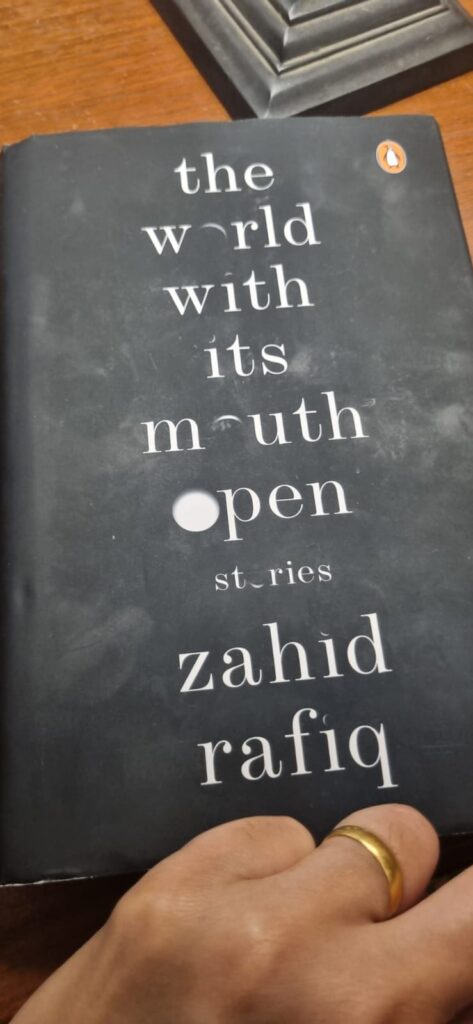
I had been hearing all good things about The World With Its Mouth Open for a while now. It lives up to its expectations. It is never an easy task, especially for a debut writer, to produce eleven short stories and every single one of them unusual in its tone, literary style, and subject matter. I cannot help but wonder if Zahid Rafiq shifts effortlessly in his thinking and writing between two languages — English and Kashmiri. Reading the stories in English, the structured sentences, turn of phrases, use of literary techniques, experimentation with the form, and the ability to play with voices is of a confident writer and speaker of the language. Yet, when it comes to dialogue and some observations of the local terrain, particularly in the change of rhythm in the words, or even the repetition, I felt as if the author was relying considerably on Kashmiri for expression and structure of conveying emotion and feeling. There were times when it almost felt as if there were elements used from fairy tales and fables, to some degree even oral narratives. I can only attribute it to being evident when there was a slight shift in the rhythm and unexpectedness of what came in the text, with echoes of what I recalled from reading such fairy tales or being told stories by elders. When I posed this to Zahid, he said that he was unable to articulate now, long after the book has been published as to what exactly he was doing because he was so immersed in the storytelling that he did what he felt best. Nor can he understand where the variation in style came. It just did. We recorded a freewheeling conversation for an episode of TOI Bookmark. Unfortunately, it was on a day when Zahid was battling a viral fever and was under the weather.
I spoke to Zahid for TOI Bookmark. Here is the Spotify link:
Book blurb
In eleven stories, The World With Its Mouth Open maps the inner lives of the people of Kashmir as they walk the uncertain terrain of their days, fractured from years of war. From a shopkeeper’s encounter with a mannequin, to an expectant mother walking on a precarious road, to a young boy wavering between dreams and reality, to two dogs wandering the city, these stories weave in larger, devastating themes of loss, grief, violence, longing, and injustice with the threads of smaller, everyday realities that confront the characters’ lives in profound ways. Although the stories circle the darker aspects of life, they are―at the same time―an attempt to run into life, into humor, into beauty, into another person who can offer refuge, if momentarily.
Zahid Rafiq’s The World With Its Mouth Open is a powerful collection announcing the arrival of a new voice that bears witness to the human condition with nuance, heart, humor, and incredible insight.
Zahid is a writer living in Srinagar, Kashmir. He did his BA at Kashmir University, studied journalism as a Fulbright scholar at the University of California, Berkeley. As a journalist, he wrote for Indian and international publications including The New York Times, Christian Science Monitor, the BBC, Vice, Al Jazeera, Foreign Policy, and others. Rafiq completed his MFA in fiction at Cornell University and has been a teaching fellow in the Humanities at Bard College.
The World with Its Mouth Open (published by Penguin India) is his first book.
Nepali writer Weena Pun’s writings have appeared in Himal Southasian, the Kathmandu Post, The Record, “House of Snow: An Anthology of the Greatest Writing About Nepal”, and elsewhere. She is a graduate of Stanford University and the MFA Program in Creative Writing at Cornell University. Her debut novel “Kanchhi” is published by Hachette India.
It was a pleasure speaking with Weena Pun on TOI Bookmark.
Here is a snippet of our conversation:
“…it was not easy. It took me a lot of drafts to make it seem like the scenes wrote themselves. Language was a problem. If I had to write a dialect, I would write it in Nepali first in longhand, then I would later translate it and then go back and edit it to ensure that they flowed well. “
Spotify link is given below.
Book blurb
In the misty foothills of Torikhola, Kanchhi, the only child of her mother, Maiju, refuses to play by the stifling rules of her hamlet. She befriends boys, writes letters to them, and opposes the shame imposed on her swelling ambitions and curiosity. There is a life beyond the forlorn valleys and gorges, and Kanchhi is intrigued by the possibilities. One cold November morning she leaves home – with two bags and some millet bread Maiju prepares for her. That, however, is the last anybody sees of her.
Now, a decade after Kanchhi’s puzzling disappearance, echoes of her defiance grow thin. Life has moved on. For one, the civil war has arrived at the hamlet’s doorstep. And yet, much has remained still. Maiju lights a lamp in front of the gods and feverishly prays for her daughter’s return. And the villagers, uncertain of what befell Kanchhi, continue to debate. Did she run off, chasing the highs and lights of the big city? Or did the cruelties of the ongoing civil war engulf her whole?
In this impressively sure-footed debut, Weena Pun brings to life the political and social tremors stirring the valleys of Nepal at the turn of the millennium, as well as the tenacious, tragedy-riven women of the time. A delicate and finely wrought saga, Kanchhi is an intimate exploration of vulnerable girlhood in turbulent territories.
***
TOI Bookmark is a weekly podcast on literature and publishing. TOI is an acronym for the Times of India (TOI) which is the world’s largest newspaper and India’s No. 1 digital news platform with over 3 billion page views per month. The TOI website is one of the most visited news sites in the world with 200 million unique monthly visitors and about 1.6 billion monthly page views. TOI is the world’s largest English newspaper with a daily circulation of more than 4 million copies, across many editions, and is read daily by approximately 13.5 million readers. The podcasts are promoted across all TOI platforms. I have recorded more than 145+ sessions with Jnanpith, Padma Bhushan, and Padma Shree awardees, International Booker Prize winners, Booker Prize winners, Women’s Prize for Fiction, Nobel Laureates, Pulitzer Prize, Stella Prize, AutHer Awards, Erasmus Prize, BAFTA etc.
Some of the authors who have been interviewed are: Banu Mushtaq, Deepa Bhashti, Samantha Harvey, Jenny Erpenbeck, Michael Hoffman, Paul Murray, V. V. Ganeshananthan, Hisham Matar, Anita Desai, Amitava Kumar, Hari Kunzro, Venki Ramakishnan, Siddhartha Deb, Elaine Feeney, Manjula Padmanabhan, Edwin Frank, Jonathan Escoffery, Joya Chatterji, Arati Kumar-Rao, Paul Lynch, Dr Kathryn Mannix, Cat Bohannon, Sebastian Barry, Shabnam Minwalla, Paul Harding, Ayobami Adebayo, Pradeep Sebastian, G N Devy, Angela Saini, Manav Kaul, Amitav Ghosh, Damodar Mauzo, Boria Majumdar, Geetanjali Mishra, William Dalrymple, Abdulrazak Gurnah, Andrew Miller, Dr Rachel Clarke, and Annie Ernaux.
Cora is used to sudden explosions that come at a light being left on, or realising too late she’s been overly friendly in the way she’s spoken to a tradesman. She lives trying not to set a match to Gordon’s anger, but sill she spills petrol about her, dripping it over shoes she has forgotten to polish, sloshing it across a particular shirt not washed in time. She races from thing to thing, tending to whatever might spark, but it’s always something behind her, just out of sight that she hadn’t thought of. But today is different. She gets to choose how it’s presented. And she feels fearless. Yes, he might — will — be furious, but the consequences won’t be pointless this time. She will have got what she wants: for her son to grow up with his own name.
….
You reminded me how important it is for everyone to have their own name, but it was completely my decision to call him something different.
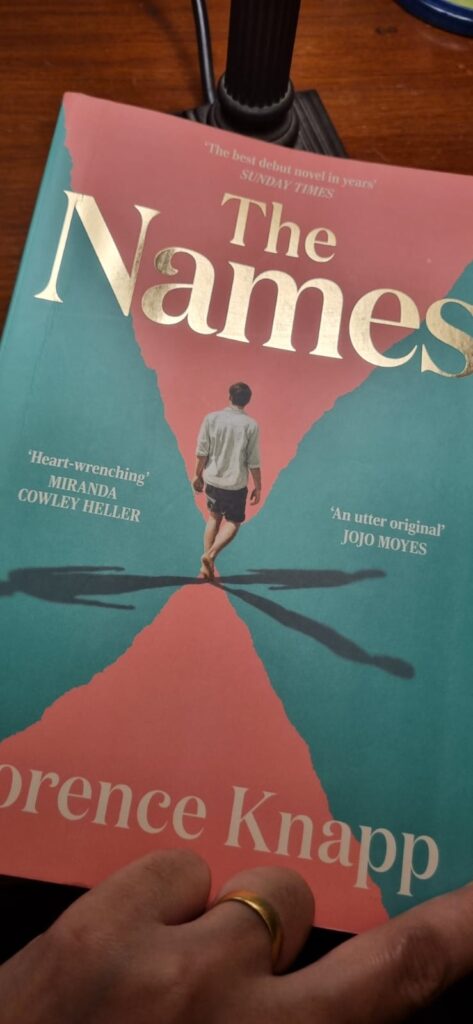
Debut novelist Florence Knapp’s The Names is about Cora and her family, her children Maia and Bear/Julian/Gordon — depending on which strand of the story you wish to dwell upon. Cora’s husband is a successful doctor, who is well liked in the community he serves, but his darker side of being a patriarch, who believes in the traditional gendered roles of a woman and man and is passionate about tradition — are facts that no one outside the family seems to be aware of. It is this intersection of the private and public, the relationship between the husband and wife, father and daughter, father and son that is explored by the author. The Names is spread over thirty five years, beginning with the birth and registeration of the son’s name. The story is narrated with gaps of seven years, with the story revolving around either Bear or Julian or Gordon. This is dependant on whether Cora registered her son’s name as “Bear”, as suggested by Maia or “Julian”, as preferred by Cora, or “Gordon”, as ordered by Gordon the father, to carry on the patriarchal tradition of naming the first son as his father and grandfather before him. Florence Knapp in her storytelling explores the what-if scenarios of naming Cora’s son one of the three names suggested for him. She believes that it is the smallest of actions that brings about the change in the future. The Names illustrates that belief through the three different stories. But it is the relentless and sharply observed scenarios of domestic violence, in even the “meaningless” actions of a woman/wife/mother, that makes the reader’s heart race. It is alarming.
Florence Knapp is a seamstress who wrote this novel fairly quickly but then put it into a drawer. After a few months, she read it once more and decided to have it published. In her interviews promoting the book, she often mentions that in one of her circle’s, the women were introduced to a domestic violence activist. This person spoke at length about the violence perpetrated upon women. It made Florence Knapp think about it a lot. The end result is this book.
While I understand the precision of this writing is as precise as that probably required in creating a garment or embroidering when working with a thread and a needle, it is the horror of the violence on the page that is deeply disturbing. Not that it is unheard of or is unusual but for us, living in India, in a hyper-masculine society, where patriarchal norms have returned with such a fury, this book is hard to read. Daily news consists of women being burnt to death for dowry, young girls being raped and murdered, sexual harrasment and eve teasing are rampant. Earlier we read about these violent acts of violence but today with smartphones available in everyone’s hands, there are reels easily available on social media platforms. It is ghastly. And these are only a few of the stories that make their way into the main media. There are countless such stories that play out, day and night, across socio-economic classes. So, while I can understand the rave reviews it is receiving in the Anglo-American book market, the 13-publisher auction and (so far) sale into twenty languages for translation, it is a story that will require nerves of steel to be read.
While the characters in the book, the major and the minor, are well etched, it is Gordon (the father) who comes across as a flat character. It is almost as if the entire energy of the author was spent in making the invisible in a homemaker’s life visible. A sterling effort but then the perpetrator of the gendered violence should have been a little more rounded.
Nevertheless, The Names reputation as a book that must be read in 2025 stands true. Sometimes stories like this need to be told, so that victims while reading the novel, can recognise situations for themselves, and perhaps, figure out a way forward. Many a time and oft, victims and their children/younger wards are trapped and lose their sense of reality. The simplest act, such as calling out for help, is the hardest task.
Read The Names. It is published by Hachette India.
On Thursday, 15 May 2025, the Indian Foreign Minister, Mr. S. Jaishankar tweeted that he had spoken to the Acting Afghan Foreign Minister Mawlawi Amir Khan Muttaqi. As NDTV reported, by speaking with the Taliban foreign minister, Jaishankar had scripted history.
Good conversation with Acting Afghan Foreign Minister Mawlawi Amir Khan Muttaqi this evening.
Deeply appreciate his condemnation of the Pahalgam terrorist attack.
Welcomed his firm rejection of recent attempts to create distrust between India and Afghanistan through false and…
One of the responses to this conversation that stood out was that of journalist and author Nayanima Basu. She posted a long post on Facebook on Friday, 16 May 2025. I am reproducing the text here:
Four years can significantly affect public memory. When the Taliban returned to power in Kabul on 15 August 2021, global reactions were largely negative, including from India, which promptly shut down its embassy in Kabul and revoked valid visas for Afghans, including those traveling to India for higher studies under ICCR scholarships and medical treatment.
The Indian government, despite multiple requests from former Afghan diplomats and ministers, did not provide temporary refuge to these individuals. Consequently, Afghan students and patients were left in a difficult situation as India prioritized security and viewed the Taliban as an adversary.
I was in Kabul and also in other key cities of Afghanistan in August 2021. Reporting from ground zero I witnessed first-hand how the situation was rapidly evolving as the U.S. withdrawal concluded in the most chaotic manner, marking the end of their longest war. I reported that many Afghans, excluding the elite in Kabul, were preparing to adjust to the Taliban’s return. But they knew India will remain their steadfast friend, no matter what.
Subsequently, I wrote several analyses discussing and advocating the importance of India reassessing its stance towards the Taliban, highlighting that significant global changes have occurred since the Taliban’s previous rule in the 1990s. I also wrote in my book (The Fall Of Kabul : Despatches From Chaos) why India needs to engage with the Taliban, including addressing issues such as women’s education and the implications of regional dynamics, particularly regarding Pakistan.
Read one of my pieces from August 2023 that explores the potential benefits of re-establishing people-to-people ties with Afghanistan in light of these challenges. For further insight, read my book (Available both online and in bookstores globally).
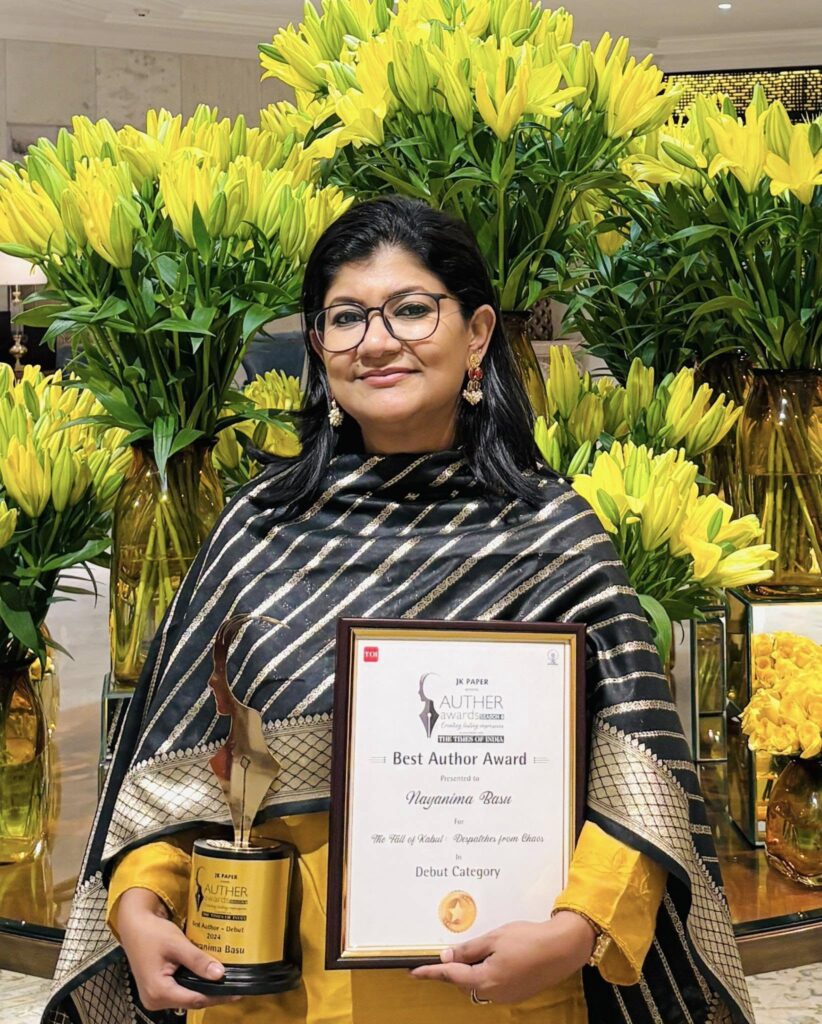
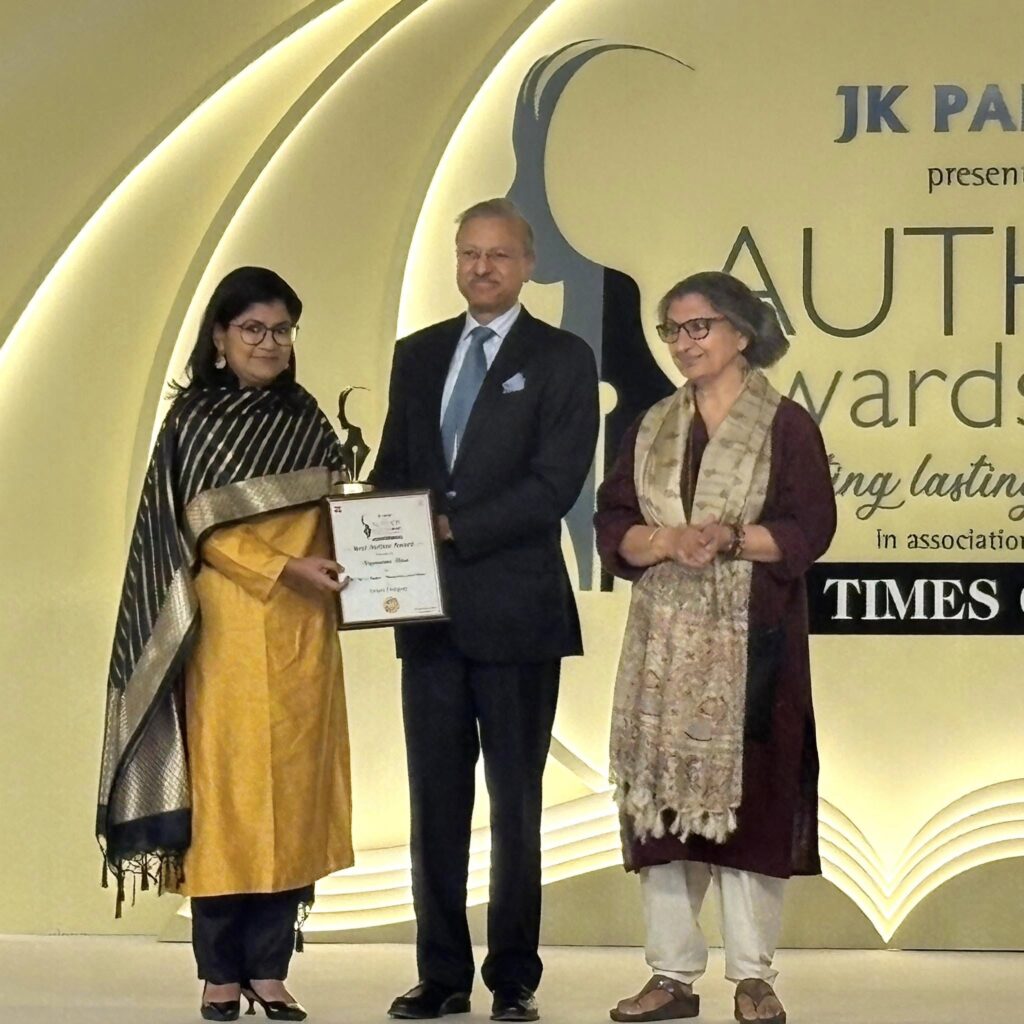
As the Literary Director, AutHer Awards, I was pleased that a new voice had been discovered and recognised. I hope Nayanima Basu will write more reportage and publish books regularly. We need balanced and nuanced voices to write about moments in history as we live through them. It is easy to be swayed by popular sentiment, but Nayanima Basu’s commentaries are worth reading in real time. They have gravitas.
Good luck to Nayanima!
Dreams do come true ♥️
It was a privilege to receive this honour from the very best Geetanjali Shree & industry stalwart Harsh Pati Singhania 🙏
Buku Sarkar‘s Not Quite a Disaster After All ( HarperCollins India) is a collection of six interlinked stories or six vignettes, if you will. The stories revolve around two women — Anjali and Anita. Anjali is the daughter of a very wealthy family from Calcutta. Anything that she asks for or desires is easily fulfilled; an option that she does not necessarily exercise when testing her wings in New York as a student. She is ultimately successful in her career as a designer and also becomes an author. Her fastidiousness for detail in everything that she does permeates through every story in the collection. Surprisingly, she is far more generous and forgiving of her friend Anita who lives in Ohio and is a mother trying to juggle a career too. In some senses, the friends work like counterpoints to each other in the story, almost as if the distance between them due to their difference lifestyles and behaviour creates an amplitude that indicates what women are capable of. They represent the extreme points of women in society. These two are the central women, but there are other women characters like Anjali’s mother, a devoted wife, Anjali’s editor and the young book publicist. They can be considered as stereotypical examples of women homemakers, wives and publishing professionals or they can be seen as alternative role models to the lives that Anjali and Anita have chosen.
The stories are seemingly arranged chronolgically to depict the life of Anjali from childhood to a successful designer based in the UK and who has a book launch in New York. She is living the middle class dream. But as the stories show, there is a dissatisfaction and a simmering discontent. It is a feeling that begins in childhood when even Anjali has not a clue what it implies. It is in the title story that Anjali seems to be at peace and when that occurs, the reader heaves a sigh of relief.
Buku Sarkar is a much published writer in many magazine publications but this is her first book. It is remarkably composed and poised writing. At first, it does not feel as if there is anything complicated in the writing style. Simple. She evokes childhood memories. She writes about the past in India and the USA. It is done almost in a bored, languid, matter-of-fact style. Yet, by the time the book concludes, the characters have neatly nestled inside one and are part of one’s life. The title “Not Quite a Disaster After All” grows on one from being at first a seemingly wishy-washy title to a strong, assertive remark. You can almost hear the women chant it to themselves to reaffirm their existence and purpose. It is very well done.
Accessing micro-histories via fiction is probably “easy” for the reader but challenging for the writer to produce. Inserting characters and creating bridges between fact and fiction requires a focussed determination to share an account. Beasts Of A Little Land is a historical fiction debut by Korean-American writer Juhea Kim. The author was born in Cheon, Korea, and moved to Portland when she was nine. She is a Princeton University graduate and her writing has been oubkished in numerous literary magazines.
The novel spans the historical period of 1917 – 1965. It is a turbulent time for Korea. There is sufficient historical evidence and witness accounts that document the changes. But to do such a broad sweep of the country/ies is a Herculean task. It requires minute attention to detail. Perhaps it is possible because of the perspective Juhea Kim has by living in the USA. This is a book that takes a while to read. It is not a “quickie”, but like the other wonderful books on the Oneworld imprint, this too is stupendous.
Now to await Juhea Kim’s second novel. What will it be on?
Beasts of a Little Land is being distributed in India by HarperCollins India.