Jaya Posts

“Create, Copyright and Disrupt”

23 April is celebrated as World Book and Copyright Day. According to UNESCO  “23 April is a symbolic date for world literature. It is on this date in 1616 that Cervantes, Shakespeare and Inca Garcilaso de la Vega all died. It is also the date of birth or death of other prominent authors, such as Maurice Druon, Haldor K.Laxness, Vladimir Nabokov, Josep Pla and Manuel Mejía Vallejo. It was a natural choice for UNESCO’s General Conference, held in Paris in 1995, to pay a world-wide tribute to books and authors on this date, encouraging everyone, and in particular young people, to discover the pleasure of reading and gain a renewed respect for the irreplaceable contributions of those, who have furthered the social and cultural progress of humanity.”

It is befitting to mention Create, Copyright and Disrupt: India’s Intellectual Property Dilemmas by Prashant Reddy T. and Sumathi Chandrashekharan. The title itself a play on the slogan “Create, Protect, Innovate” that has been adopted by IP agencies and IP conferences worldwide. It gives a good overview on the patent history in India particularly for the pharmaceutical industry, the impact of the Berne Convention the publishing industry in India to the recent amendment to the Copyright Act ( 2012) brought about at the insistence of ex-Parliamentarian and prominent lyricist Javed Akhtar and finally the Geographical Indications of Goods Act [Registeration and Protection] Act, 1999 illustrated with the famous Neem and Basmati rice  cases.  The essays are written lucidly with a view to being accessed by the lay person and not necessarily mired in legal speak.

This is a good manual to have handy to understand how IPR works particularly since it revolves around the discussion and recognition of copyright as being a right to reproduce the work, communicate the work to the public or to the right to incorporate the work in another format such as a sound recording. This is dependant on recognising the author’s intellectual capital and compensating them adequately for it through licensing fees, time period of which varies from nation to nation. There are variations to this in the issue of first ownership of the copyrights particularly in the case of music and lyrics where the creator has been in the employment of the firm and been compensated for the work done. IPR conversations are critical since they link the creativity of a human mind to that of a right, the protection of whose onus falls upon the State, thereby ensuring the author/creator can earn some money of it. And it gains more significance when so much information is available digitally and where content is viewed as the oil of twenty-first century!

Prashant Reddy T. and Sumathi Chandrashekharan Create, Copyright and Disrupt: India’s Intellectual Property Dilemmas ( Foreword by Shamnad Basheer) Oxford University Press, New Delhi, 2017. Hb. pp. 372 Rs. 850 

23 April 2017 

“The Accusation” by Bandi


These stories of fiction written by a North Korean writer and published under a pseudonym were smuggled out of the country in 2013. (Some reports say 2013 others 2014) “Bandi” which means “firefly” was born in 1950 and continues to be based in the country and is an official writer for the government. Written in meticulous longhand on the coarse brown manuscript paper used in North Korea, the book — a collection of seven short stories — is a fierce indictment of life in the totalitarian North. The stories closely follow the “seed theory,” a guideline of all North Korean writers, which requires them to structure their writing tightly around a core ideology — though Bandi uses the same device to attack the party line. For instance the stories will portray the indoctrination of the people and yet how forced it is but the people are unable to express themselves (“Pandemonium”), the desperate measures a son takes to meet his dying mother in the village except is condemned to forced labour for not having the required travel permit (“So Near, Yet So Far”), the mother who tries to pacify her easily frightened simpleminded infant but lives in mortal fear of Comrade Secretary discovering that it is the larger-than-life size portraits of Marx and Kim Il-sung that are the triggers (“City of Specters”) and innumerable instances of how food is rationed.  In “Record of a Defection” the narrator’s family is reduced to the wavering class “because my father was a murderer—albeit only an accidental one, and one whose sole victim was a crate of rice seedlings.” The author’s identity is deliberately concealed even in the note from Do Hee-yun included in the book.  Do Hee-yun is a representative of the Citizens’ Coalition for Human Rights of Abductees and North Korean Refugees.

According to the New York Times, “In 2013, the manuscript was smuggled out, hidden among works of propaganda glorifying Kim Il-sung, the country’s founding president and grandfather of the current leader, Kim Jong-un. . . . The Accusation was published in South Korea in 2014 by Chogabje.com, a conservative news website and publisher, but failed to gain much attention. Mr. Do persisted, pitching the manuscript to publishers abroad. ” Initially the reception to the stories was lukewarm until the French translation became a sleeper hit. Since then the stories have been translated into 18 languages and published in 20 countries and list is growing steadily. Here is a CNN report of the book reading organised at the border of South Korea and North Korea.

The book has been translated magnificently by award-winning translator Deborah Smith since despite the tough subject the stories read smoothly. On the surface the stories may seem to be acceptable propoganda literature and in no danger of being censored. Yet the off-the-cuff remarks of “starving slaves”, “grain riots”, “ration coupons” or the anger against medals which are given to those who “dedicate themselves solely to the establishment and preservation of socialism” since these useless chunks of iron would not fill stomachs manages to capture the simmering rage of Bandi at the totalitarian regime of North Korea. Every single story ends on a note where the protagonist bitterly realises that there is no escape from the pincer-like grip of the state authorities. Such as in the conclusion of “Record of a Defection”:

There is, of course, great peril in this. We might easily be shot by the coast giard or patrol boat, to be swallowed up like leaves in the wind and waves. And still, knowing this, we choose to bet our lives on this chance. Because we feel that to slide into oblivion would genuinely be better than continuing to live as we have been, persecuted and tormented. If fate intervenes, perhaps the hand of a rescuer might draw us to some new shore. Otherwise, we can only hope that our canoe on the vast blue will mark this land as a barren desert, a place where life withers and dies! 

But the anecdote which sums up the suffocating living conditions of the citizens is in this story shared by the grandmother, Mrs Oh, in “Pandemonium”:

“Once upon a time there was a garden, surrounded on all sides by a great, high fence. In that garden, an old demon ruled by a great, high fence. In that garden, an old demon ruled over thousands upon thousands of slaves. But the surprising thing was that the only sound ever to be heard within those high walls was the sound of merry laughter. Hahaha and hohoho, all year round — becuase of the laughing magic which the old demon used on his slaves. 

“Why did he use such magic on them? To conceal his evil misreatment of them, of course, and also to create a deception, saying, ‘This is how happy the people in our garden are.’ And that’s also why he put the fences up, so that the people in other gardens couldn’t see over or come in. So, well, think about it. Where in the world might you find such a garden, such a den of evil magic, where cries of pain and sadness were wrenched from the mouths of its people and distorted into laughter?” 

Read The Accusation. It is a terrifyingly seminal publication of 2017 particularly at a moment in history when political winds of Right-wing are blowing globally. Many of the horrors described in these seven stories are only a short step away from what exists in other forward-looking nations, albeit different ideologies.

Bandi The Accusation: Forbidden Stories From Inside North Korea  Serpents Tail, London, 2017. Pb. pp. 250. Rs 599 ( Distributed in India, Bangladesh, Bhutan, Nepal, Pakistan and Sri Lanka by Hachette India.)

18 April 2017 

” Translating the ‘Panchatantra’ ” by Rohini Chowdhury

( Puffin India has recently released a new translation of Panchatantra translated from Sanskrity by well-known writer Rohini Chowdhury. Reproduced below with the author’s permission is her essay included in the book on why she translated these beloved tales. Here is a lovely trailer for the book released by the publishers, Penguin Random House India. They have also illustrated some of the stories as cartoon strips.)   

Those who pay no heed to good counsel are destroyed halfway to their goal.

The fables of the Panchatantra have always been a part of the landscape of my life, and so, when my daughters were born and grew old enough to listen to bedtime tales and ask for them, these were amongst the first stories I told them. It was in searching for more Panchatantra tales for my daughters that I realised the absence of a complete translation for children, and one that maintained the structural integrity of the original work.  Now, one of the most interesting features of the Panchatantra is its story-within-a-story structure – stories contain stories, which contain more

One who anticipates disaster and plans ahead, survives and lives a long happy life

stories, somewhat like a Russian matryoshka doll that contains doll within doll within doll. In every translation and retelling that I could find, though the stories had been charmingly retold and often beautifully illustrated, they had been presented as stand-alone tales without the context or frame-story within which they occur in the Panchatantra. This, I felt, took away from the tales substantially. I therefore decided to translate the complete Panchatantra myself, keeping intact its original form and structure.

The translation went much slower than I had expected; the children

The one who gives a stranger all his friendship while forsaking his own kind, meets an unhappy end.

grew much faster and had soon outgrown these tales. So, for many years, I put this translation aside and became busy writing and translating other books – till a conversation with Puffin India in July 2015 brought me back to it.  I looked at the Panchatantra again, with different eyes, and realised its true significance: not only was it a masterly treatise on politics and government and a manual for conducting our daily lives with wisdom and common sense, but devised to educate the three foolish sons of a king in the ways of the world, it was also a revolutionary, and successful, experiment in teaching young people. Where traditional methods had failed with the princes, the fables of the Panchatantra succeeded – by teaching them practical wisdom, and by awakening in them a curiosity about the world. Within six months, the blockhead princes had become wise and knowledgeable young men. Since then, says the Panchatantra, its stories have been used to educate young people everywhere, a claim that is borne out by the many translations and retellings of this work that are found all over the world, even today.

We know very little about the author of the Panchatantra, except what the introduction to the work itself tells us – that his name was Vishnusharma, that he was a Brahman, exceptionally learned, a renowned teacher, and eighty years of age at the time he composed this work.  Since we have no other evidence regarding Vishnusharma, it is difficult to say whether he really was the author of the Panchatantra or himself a fictional character, invented as a literary device for the purpose of narrating the stories. Some versions of the Panchatantra – from southern India and South-east Asia – give the author’s name as Vasubhaga. Again, there is not enough evidence to confirm his identity or his existence.

The original Panchatantra is in Sanskrit, and has been written in a mixture of prose and verse, in a style that is simple and direct. The work is divided into five parts (hence the name: pancha: five and tantram: parts), each part dealing with a particular aspect of kingship, government, life and living. The stories are narrated mainly in prose, but the lessons derived from the tales are usually given in verse form.  The Panchatantra’s ‘story within a story’ structure—individual stories are placed within other stories, and each individual part or tantra replicates the structure of the work as a whole—serves to keep its audience engrossed as it takes them into a series of stories, deeper and deeper, from one level to the next.

Most of the characters of the Panchatantra are animals that behave, think and speak like humans. In every culture across the world, people have given human characteristics to animals. But the qualities that people see in particular animals vary across cultures. Thus, an owl is considered wise in England, but evil and unlucky in India. The animals of the Panchatantra conform to the ideas held about them in Indian culture. So, a heron is regarded as deceitful and cruel, for he stands still for hours on one leg pretending to be an ascetic doing penance when we all know that he is actually waiting to grab the next unwary fish that swims too close. Similarly, an elephant is noble and proud, a jackal is greedy and cunning, and a lion, though the king of the animals, is arrogant and often easily fooled by a weaker, more intelligent animal. An ox is loyal, a dog is unclean and greedy, and a cobra dangerous and untrustworthy. The audience for which the stories of the Panchatantra were meant would have known these qualities of particular animals, and so would have known instantly what to expect of them in the stories.

The author of the Panchatantra has used one more device to make it easy for his audience to understand the nature of his characters, and that is their names.  He has given his characters, whether human or animal, names that highlight certain aspects of their appearance or behaviour, or give insights into their nature. Thus we have Pingalaka the lion, whose name means ‘one who is red-gold’, named for his fiery coat, Dantila the jeweller whose name means ‘one who has big and projecting teeth’ and immediately gives us a vivid image of the man, Chaturaka the wily jackal whose name means ‘one who is sly and cunning’, and Agnimukha the bedbug, whose name means ‘fire-mouth’ and almost makes us go ‘ouch’ as we imagine his bite!

The appeal of the Panchatantra is not limited only to the young.  Apart from its wonderful stories and ageless wisdom, it is a work that looks at life head-on.  Rather than seeking to present linear solutions where good wins over evil, moral behaviour wins over the immoral or even amoral, it acknowledges that life, love and friendship can be complex, that politics, government, human interactions are not always straightforward, and even right and wrong, truth and falsehood can often be a matter of circumstance, expediency, or what is practical.

As a result, the stories of the Panchatantra became immensely popular, and travelled across the world – in translations, or carried by scholars, merchants, and travellers. Even today, the tales resonate with people of all ages, at different levels, in different ways, everywhere. In its Arabic translation, the Panchatantra became famous as Kalila wa Dimna (after the names of two of the principal characters, the jackals Karataka and Damanaka); in Europe it became known as the Fables of Bidpai. Many of the stories of the Panchatantra can be found in the fables of La Fontaine in the 17th century, and their influence can be seen in the stories of the Arabian Nights, as well as in the fairy tales of the Brothers Grimm. The stories also travelled to Indonesia in both oral and written forms.  Today there may be found more than two hundred versions of the Panchatantra across the world, in more than fifty languages. The oldest recension is probably the Sanskrit Tantrakhyayika from Kashmir; this predates the Panchatantra version available to us today. The most famous retelling of the original work is the 13th century version by Narayana, known as the Hitopdesa.

My translation, a labour of love for my daughters, is my attempt to make this great work available to the young people of today.

Rohini Chowdhury is an established children’s writer and literary translator. Her books can be bought on Amazon.

Copyright © Rohini Chowdhury, 2017.

Chimamanda Ngozi Adichie “Dear Ijeawele”

Dear Ijeawele, or a Feminist Manifesto in Fifteen Suggestions by Chimamanda Ngozi Adichie is a slim little book which developed out of a letter she wrote to her friend. It contains advice to Ijeawele on how to raise her daughter as a feminist. There are some fine pearls of wisdom such as “Teach Chizalum to read.” Or ” Teach her that the idea of ‘gender roles’ is absolute nonsense”. Chimamanda Adichie selects fifteen of the classic arguments associated with feminism that are bandied about which are primarily internalising patriarchal arguments. For instance, mixing up feminism and femininity, choice of dress being confused with morality,  perceiving marriage as an achievement and using the language of ‘allowing’ which encapsulates the power equations, learning about gender-neutral roles instead of capitulating to definitions that are primarily patriarchal constructs, rejecting the idea of gender roles, appreciating to identify yourself as an individual who is composed of many parts to make the whole — motherhood is not the sole definition of a woman’s identity, talking about female sexuality and celebrating it rather than being ashamed of it, and finally not to be caught in biological arguments that ultimately constrict a woman’s movement and ambitions.

But, but, but…Dear Ijeawele  reads too much like a primer for feminism. Agreed it is a good starting point for those who want to understand what feminism is about, the exercising of choice and all genders being equal. Adichie does warn against generalisations from one’s personal experience and does try and encompass various aspects of the feminist spectrum. Yet it is too simple and reductive. For instance it is all very well to stress on the independence of a woman and how to negotiate for her spaces in the world but how can she do it if she does not have financial independence? Adichie touches upon it but specifically within the context of Igbo culture being materialistic so “while money is important — because money means self-reliance — you must not value people based on who has money and who does not”. Whereas this is the crux of feminism and a woman’s identity for economics is the basis of any relationship. Most cultures around the world are deeply embedded in patriarchal structures that essentially clip a woman’s financial means by domesticating her and reminding her of her primary responsibilities being towards the family and children. But if women are taught to be financially sound to earn their independence it will be the first step in “correcting” the social imbalances which exists today in relationships. Otherwise all the good advice which a commercially successful author such as Adichie gives on feminism will sound hollow. ( Brittle Paper, 27 March 2017 “As Sales Approach the Million Mark, Is Americanah Now Adichie’s Signature Novel?” . Also see “New Yorkers just selected a book for the entire city to read in America’s biggest book club“, a “One Book One New York” programme started by NYPL. )

Ultimately feminism like any other ideological language has to be lived daily. The basic tenets can be taught and shared but it varies from individual to individual on how to practise it and thus bring about the social change is aims for. As for bringing up children and introducing them to feminism — the best way is by the parent/s being role models. Children learn best through action and not instructions.

Chimamanda Ngozi Adichie Dear Ijeawele, or a Feminist Manifesto in Fifteen Suggestions 4th Estate, an imprint of HarperCollins Publishers, London, 2017. Pb. pp. 68 Rs 250 


Teresa Rehman “The Mothers of Manipur: Twelve Women Who Made History”

On 15 July 2004, Imphal ( Manipur), twelve women strip in front of Kangla Fort, the headquarters of the Assam Rifles, a unit of the Indian army. Soldiers and officers watched aghast as the women, all in their sixties and seventies, positioned themselves in front of the gates and then, one by one, stripped themselves naked. The imas, the mothers of Manipur, are in a cold fury, protesting the custodial rape and murder, by the army, of Thangjam Manorama, a 32-year-old woman suspected of being a militant. The women hold aloft banners and shout, ‘Indian Army Rape Us’, ‘Take Our Flesh’. Never has this happened before: the army is appalled.

Award-winning journalist Teresa Rehman’s The Mothers of Manipur is about the mothers and grandmothers who protested boldly. The trigger was the abduction and murder of Manorama but it was also against the Armed Forces ( Special Powers) Act, 1958 (AFSPA) which gives the army extraordinary powers. Manorama, a weaver, was known in the local community for being a hardworking woman who had been supporting her family ever since her father had died while she was a young teenager. She had chosen not to marry but on 10 July 2004 troops of the 17th Assam Rifles barged into her home, accusing her of being a militant, questioned her and then took her away. The next morning her body was found. She had been raped, her vagina stuffed with cloth and bullets riddled into her genitals. Yet the army said she was shot while attempting to run away but there was no evidence to prove it.

Angered by this incident some of the local women who were also active members of the Meira Paibis (women torch bearers of Manipur) movement decided to do something about it. Some of the women had visited the morgue to see Manorama’s body. They were horrified by what they witnessed. Hurriedly and yet secretly the women put together a plan to disrobe at Kangla Fort. They had two banners painted ( the painter was sworn to secrecy) displaying the words “Indian Army Rape Us”. On the morning of 15 July 2004 they removed their undergarments but wore their phanek ( sarong) and shawls. Once at the gates of the fort they stripped and shouted. It immediately caused a stir. Within hours curfew had been clamped and there was a blackout across television channels. At the time the incident made headlines and was covered extensively but years later too it is viewed as a seminal form of protest by women in a conflict zone as in this BBC report ( March 2017).

More than a decade later Teresa Rehman decided to interview these women of whom all save one survived. What emerges from the interviews is that though these women were mostly from an impoverished background they were strong and had a firm idea of justice. The anger of the older women in the group was fuelled by their childhood memories of the occupation of Manipur by Japanese forces during World War II. At the time too the unannounced arrival of Japanese soldiers at their homes asking for young girls, particularly at night, made their families anxious. The imposition of AFSPA in Manipur decades later brought back those very same feelings of anxiety and fear for their daughters. During the course of the interviews it becomes evident that the women in July 2004 were only concerned with how to display their anger and frustration at the Indian Army and the inexplicable irrational violence it perpetrated upon the locals. Not a single woman thought of the consequences. Years later it becomes apparent that the twelve women had diverse experiences. From being shunned by their families to being idolised by their community. Yet the common factor amongst them all was the anxiety and fear had not abated and now they worried about the safety of their daughters and granddaughters.

The Mothers of Manipur documents the role of these women in an active conflict zone and the consequences of their actions. Yet it comes across as a book that is also a testimony of Teresa Rehman’s own growth as a feminist journalist. She does the balancing act well of being sensitive to the women and their issues without being an over zealous journalist who pries too much into the personal lives of their subjects. It also inadvertantly becomes a part-memoir of Teresa Rehman as she visits Manipur regularly from the neighbouring state of Assam.

Undoubtedly it is a gripping book to read but there is also some dissatisfaction. The fact is mothers forming groups to work within conflict zones or in fragile societies being reconstructed after war is a part of gender and conflict studies. The role of women in conflict zones across geographies is well-documented. Also it has been discovered that these groups share many characteristics. Though there is a competent introduction by renowned journalist Pamela Philipose giving the background to AFSPA and Meira Paibis there is little context given either by her or Teresa Rahman to the Kangla Fort incident in gender and conflict narratives. It has to be extrapolated from the various interviews included. For a newcomer to gender and conflict the book would be fascinating to read but they would miss completely the cues of sisterhood which form in war zones. For now these details are scattered through the interviews. An overarching essay that explained the methodology of how these oral history interviews were conducted, contextualising the action in the women’s movement and the active role mothers/women play in conflict zones would have definitely enriched the book.

Despite its shortcomings The Mothers of Manipur will be referred to for a long time as it not only documents the shocking incident of 15 July 2004 at Kangla Fort but also neatly encapsulates the troubled history of conflict-torn Manipur particularly since World War II.

Teresa Rehman The Mothers of Manipur: Twelve Women who Made History Zubaan, New Delhi, 2017. Pb. pp. 152 Rs. 325 

Humayun’s Tomb: World Heritage Site by Aga Khan Trust for Culture

The incredibly beautiful Mughal monument, Humayun’s Tomb, was recently restored by the Aga Khan Trust. The project was carried out in partnership with the Archaeological Survey of India, and supported by the TATA Trusts has not only conserved the monument, but has also aided in the revival of traditional building skills, materials, and techniques. It took many years ( 2008 – 2015) was done with great care under the supervision of Ratish Nanda. Now a book has been published by Mapin India for AKTC documenting the magnificent work done in restoring the monument, a blueprint for the Taj Mahal. Here is a short video and a Facebook clip on the restoration. Discovery Channel and National Geographic too showed a documentary on this path-breaking project. According to the book description:

The Humayun’s Tomb-Nizamuddin area, inhabited by a vibrant local community, is visited by millions of tourists and pilgrims each year. Conservation works being undertaken on the monuments in this area have aimed to re-define standard conservation practice in India by setting benchmarks in using a craft-based approach, setting documentation standards, using a participatory and multi-disciplinary approach, and using the conservation initiative as a tool towards improving quality of life for local communities. This book aims to inform the general public about the discipline of conservation and the rationale behind the successful conservation initiative and makes an argument for change in conservation approach in India: from isolated monuments to an urban approach that includes concern for the setting; from a ‘tender-based’ approach to a quality-concerned method; amongst other factors. Founded and guided by His Highness the Aga Khan, the Aga Khan Trust for Culture projects promote the conservation and re-use of buildings and public spaces in historic cities in ways that can spur social, economic and cultural development.

Ratish Nanda has led the multi-disciplinary team implementing the Nizamuddin Urban Renewal Initiative since the project’s inception in 2006. Prior to this, he was responsible for the Bagh-e-Babur restoration and the Humayun’s Tomb garden restoration, also at AKTC.

I interviewed Ratish Nanda ( via email). Here are the excerpts.

  1. Do you think the 1923 Conservation Manual principles need to be updated? For instance “repairs are carried out, no effort should be spared to save as many parts of the original as possible, since it is to the authenticity of the old parts that practically all the interest attaching to the new will owe itself. Broken or half decayed original work is of infinitely more value than the smartest and most perfect new work.’

Though updates are continuously expected and have been done with the National Conservation Policy notified in 2014 by the Archaeological Survey of India, Many of the principles of the 1923 manual remain valid – and these have been highlighted in the book. The quote you provide is one such quote the validity of which remains and as such during the Humayun’s Tomb conservation effort every effort was made to ensure that original – Mughal material is retained. For instance the section on tile work illustrates where even tiles that had lost their glaze were retained. As the book explains repeatedly, what was in fact removed were inappropriate 20th century repairs causing damage to the building – such as cement plaster and cement concrete on the roof. This happened because craftsmen were no longer involved as the British replaced them with engineers, architects and archaeologists and nobody knew better.

  1. Are there any new principles you would wish to add to the conservation manual? For instance the dos and dont’s of using technology in conservation processes or different ways of documenting? Or do you think the 1923 guidelines are valid even now ? 

I think the new National Conservation Policy already addresses new issues such as use of digital technology to document the entire process of conservation. It should be documented prior to, during and after conservation in maps, drawings, photographs, digital records and field notes so as to create records of interventions. The documentation should capture various stages of intervention and all relevant details. This will be useful from the point of view of understanding all past and current interventions in the future. The revised policy also encourages public private partnership in heritage conservation and management. The restoration of the Humayun’s Tomb is a good example of this as it is a collaboration between AKTC, ASI & TATA Trusts.

  1. How long did this book take to write?

The project has taken over a decade; the book is an attempt to put the project learnings in the public domain as well as explain to interested stakeholders what the conservation process was. This is shared with the belief that both conservation professionals as well as officials, administrators, donors, students (history, architecture, conservation, and archaeology) could use this as a case study/ model and more such projects could be undertaken.

  1. You have worked on conservation of other historical sites including in Kabul. Why was Humayun’s Tomb singled out for this detailed documentation?

Kabul has also been published. Detailed documentation of the conservation process is best practice. These significant sites belong to the people and its important that anyone interested has access to information on what has been done and how. For instance in Aga Khan Historic Cities Programme: Strategies for Urban Regeneration.

  1. What is a unique aspect in the conservation of this tomb as opposed to the other monuments you are associated with?

All monuments where conservation works have been undertaken have been treated with the same level of attention. What we have demonstrated is a truly Indian model for conservation based on utilising traditional building crafts, materials and master craftsmen as well as a multi-disciplinary team. This is the first instance in India of a private agency undertaking conservation works which are cofounded by a another private agency – the TATA Trusts

  1. Are there are conservation techniques that you had to rediscover and have now revived? For instance making of the blue tiles in Nizammudin where you made more than 20,000 samples before selecting the one definite process. Do you think this process of making blue tiles will be revived or exist only as long as the tomb needs it?

We are still making tiles – they are required on at least 40 monuments in the Nizamuddin area as well as several more countrywide. Furthermore it is hoped that the craftsmen will be able to make tiles for the souvenir market as well. The tile-making craft had died in India; its revival has cost a fortune and it is hoped some of the youth will have the initiative to make an industry out of it as there is a significant demand for these tiles – from both conservation purposes and growing demand from the market.

  1. Is conservation of historical monuments only to be done via brick-and-mortar routine using specialists or does it involve sensitisation programmes particularly among school children? For instance organising workshops, historic walks, screening of documentaries, writing / painting competitions etc. 

Awareness is extremely important and this book is one tool towards it. During the conservation effort we have produced other publications – such as the children’s book of which 60,000 copies have been sold till date. Youth from Nizamuddin basti usually walk through 6-7000 school children each year. There is also a very active Facebook page.

  1. Why is it that the Humayun’s Tomb has produced two books — children and adults and none of the other monuments? 

We hope to produce more such technical books to serve as case studies. Our objective is to share the knowledge we have generated as part of the project.

  1. What was the most exciting and most challenging moments in this conservation exercise?

Undertaking India’s first privately undertaken conservation effort has been a challenge as many suspicions have to be addressed and a proper conservation process established. By far the most exciting outcome has been the recent expansion of the Humayun’s Tomb World Heritage site to include 11 additional monuments on which Aga Khan Trust for Culture undertook conservation.

  1. Were there any portions of the building that were irreparable and beyond conservation? 

There are portions of the building where the original treatment had been lost – such as the tomb chamber – where until the mid-20th century the walls were tiled and the dome gilded – here, with the lack of evidence, conservation effort could not restore the original builders intention. Also the lack of historical accounts that either document or hint at this process are not enough to justify restoration. Conservationists need in-situ or clear photographic evidence to emulate the processes.

  1. What are the learnings from this conservation programme? Are any of these applicable in other conservation projects in India and rest of the world? 

The book lists all the learnings – established that craftsmen need to be in the centre of the conservation effort; conservation is as much responsibility of the private sector as of government; conservation decisions should be based on an understanding of the site and its significance. The conservation process established – including repeated independent peer reviews – is replicable for any project, anywhere in the country or beyond. Also, we must document all such efforts and explain the rationale for these in a written statement. Something that will explain the condition of the monument, the rational for conservation works and outlines the process followed.  

  1. What next? 

We remain available to assist the Government of India wherever they would like us to support an urban conservation effort.

11 April 2017 


Brian Van Reet “Spoils”

The war had turned for the worse — everyone knew that — but we didn’t know just how bad it would get. Like going over a big hump on a roller coaster, the feeling of everything hanging in midair and about to fall — that’s how it was. No one, not even Higher, knew if our deployment would last a few more weeks or forever. Rumors spread like the flu, and possible redeployment dates for our unit were tossed around, but when those dates came and went, and nothing happened, we were like a cult that’d expected the world to end on a certain day, but it didn’t. The world is always still there in the morning, and you can only take so much disappointment. After a while most of us stopped obsessing about when we’d go home, fooling ourselves into believing home didn’t exist, the entire idea of it was a lie, or worse, this place was home.

(p.192)

Debut author Brian Van Reet’s Spoils is a novel narrated from three perspectives — Specialist Cassandra Wigheard (a gunner on a Humvee) and tank crewman Private Sleed, American soldiers and Abu al-Hool, a middle-aged veteran jihadist who has fought in Chechnya too. These three lives intersect on the battlefield in the early days of the invasion of Iraq (2003).  The story is set in approximately two months coinciding with nineteen-year-old Cassandra’s captivity. Cassandra, like the author himself, is part of a team that operates tanks. Unfortunately with her two colleagues, McGinnis and Crump, they are captured by the mujahideens.  Once Specialist Wigheard is captured her point of view of the war, her experiences as a prisoner and all that she witnesses including the beheading of her colleagues are horrific. Even though she is a disciplined soldier who made the deliberate choice to maintain a certain untethered distance to home and the people there cannot help but miss her crew whom she loved and hated like family — a rare moment when she displays emotion. 

Spoils tells the story of the war from three perspectives where everyone is convinced they are right. The Americans believe firmly they are fighting for justice. The mujahideens too feel they are correct in forming their brotherhood, a religious obligation. After 9/11 there was rejoicing in the camp with lambs being slaughtered and juices and sweets distributed. But as Abu al-Hool cautiously observes:

Now is the evening of the next day, and we have only begun to prepare for the counterattack. We didn’t sign on for this offensive. Regardless, I suffer no illusions that our ignorance or prior restraint will mitigate what the future holds. Blood must have blood. We are Muslims training in Afghanistan, and for the Americans that will be enough. Only a fool would deny we are now enemies. (p.29)

A little later while watching his colleagues take photographs with charred bodies in the desert  as if they were tourists by going in for a close-up and not soldiers that Sleed realises “That was the first time in my life I’d ever seen anything like that, and the war felt really fucking real all of a sudden. I got this complicated feeling that has bothered me ever since. It’s hard to describe…Like everything matters so much, it’s pointless to worry about anything.” ( p.46)

In a video introducing his work Brian van Reet says that of the three main characters Sleed’s view is similar to his own. In another YouTube clip the author introduces the book as being a war novel for people who don’t read war novels. It is based on his experience as a soldier during the Iraq war. Yet it is a work of fiction that goes pretty far in his own field of experience. As he clarifies Spoils is not a book about fighting but mostly a book about people and how they adapt to and are shaped by extreme experiences.

Brian Van Reet ( @brianvanreet) is the recipient of a James Michener Fellowship and the Gulf Coast Prize in Fiction. His writing has appeared in the New York Times, the Washington Post, Fire and Forget: Short Stories from the Long War, and elsewhere. He enlisted in the U.S. Army as a tank crewman, served in Iraq under stop-loss orders, achieved the rank of sergeant, and was awarded a Bronze Star for with ‘V’ Device for actions in Sadr City. Spoils had a magnificent sale in 2015 when rights to it were sold to Little, Brown and Company, Jonathan Cape ( UK and Commonwealth), and deals were confirmed with Éditions de L’Olivier (France), Rowohlt (Germany), Guanda (Italy) and Atlas Contact (the Netherlands).

Being a war veteran himself Brian Van Reet dispassionate but minute description of a typical American army camp is startling for the close relationship between the army and corporates. It should not be a surprise since it is universally known that being at war is a profitable business.

An hour past sundown, the final wispy trails of lavender and blue fade from the expansive desert sky. The stars are magnificent, the Milky Way a smear of bioluminescence, but inside the bunker is only blackness, all the soldiers masked up, drawing labored breaths through biochem filters. In addition to the masks, they’re also encumbered with charcoal-lined chemical suits, plastic hoods, rubber gloves, rubber overboots, forty pounds of Kevlar and ceramic-plate body armor, a combat load of smoke grenades, frag grenades, and seven MI6 magazines, and some are carrying light machine guns or radios or combat lifesaver bags, but even lugging around the heaviest piece of gear is no match for the sheer stifling annoyance of the mask, which, she must admit, does possess at least one redeeming quality: sparing her from the body odor of the men nearby. No doubt many skipped showers that morning, refusing to wait in the long line for personal-hygiene trailers. 

The army camp is overcrowded, but, thanks to the ingenuity of Kellogg Brown & Root, a subsidiary of Halliburton, it’s eminently expandable. Off-loaded piece by peice from ships in the Persian Gulf, trucked through Kuwait City and into the deep desert, all of Camp New York’s assemblages are modular. Steel eyelets the size of a fist, sunk into the top face of the bunker, allow it to be hoisted with a crane, loaded onto a flatbed, and hauled into all tomorrow’s war zones. 

Erected in a matter of weeks and in its character not unlike a boomtown, the camp houses more than five thousand American soldiers — all but a few hundred are men — imaptiently living out the last days of peace in large air-conditioned tents like those were especially well-cared-for refugees might stay.  Portable buildings flank the hardpack road that spans the center of camp: double-wide trailers painted a drab eggshell white and modified to fill every organizational purpose. Trailers to sort and receive mail; trailers to treat soldiers on sick call’ to house VIPs and KBR employees; a trailer stocked with a flimsy bench press, a squat rack, some dumbbells, and a treadmill so clogged with sand, the mechanism makes a sound like a coffee grinder whenever some clueless new arrival tries to jog on it. There are trailers to shower in, trailers to command troops from, refrigerator trailers to store perishables in, and the most popular on camp, a Morale, Welfare and Recreation phone trailer ( corporate sponsorship by AT&T), subdivided into fourteen obscenely well-grattified cubicles, each with a pay phone, accepting only calling cards, no coin. For reasons of efficiency the army doesn’t ship U.S. specie into theater. 

Spoils is a disturbing book for it challenges the notion of good and evil as being black and white definitions. The novel blurs the lines by portraying these as subjective perspectives, which is exactly what they are.  Brian Van Reet puts the spotlight on combat trauma narratives that are far more complicated than they seem. Going to war is not merely a battle between two sides. The stakes are far higher involving individuals with their own notion of why they are fighting and what shape the battle should take. But as Specialist Cassandra Wigheard knows it is best to not get involved in histories as “When dealing with other people’s targedies, there’s the risk of taking on more grief than is appropriate, of lapsing into benevolent voyeurism, of making it all about you.

Spoils will be on a few literary prize lists in the coming year for its vividly disconcerting commentary of conflict. Read it.

Brian Van Reet Spoils Jonathan Cape, an imprint of Penguin Random House, Pb. pp. 270 £14.99 

11 April 2017 

Michael Chabon “Moonglow”

Apart from so-called hard science fiction, which he read ( as with The Magic Mountain) for its artful packaging of big ideas, my grandfather regarded most fiction as a “bunch of baloney.” He thought reading novels was a waste of time more profitably spent on nonfiction. ( p.248) 

Michael Chabon’s Moonglow is a story that is based on a series of conversations the narrator has with his dying grandfather. The nameless grandfather has bone cancer and is on a cocktail of drugs to keep him comfortable in his last days. As the narrator, Mike Chabon, says that he heard about 90% of his grandfather’s life in the last few days. It is quite a heady mix.

A small example.

By page 45 of the book the grandfather’s reminiscences have included his meeting with a “hermaphrodite”, blowing up a bridge during World War II, meeting the founder of CIA — Wild Bill Donovan, a walk-on part of Russian spy Alger Hiss, introducing the character of Wernher Von Braun — brains of the nuclear missile technology V2 and later known as father of space programme,  free love, Carmellite nuns in Lille, an unwed mother, a grandfather who had trained as a piano tuner and tried killing his boss, a rabbi who ultimately gave up religion to become a professional hustler. And this fantastical achronological landscape is only in the first few pages of this extraordinarily crafted story. There is more to come!

The “Author’s Note” in the preliminary pages of Moonglow are revelatory.

In preparing this memoir, I have stuck to facts except when facts refused to conform with memory, narrative purpose, or the truth as I prefer to understand it. Wherever liberties have been taken with names, dates, places, events, and conversations, or with the identities, motivations, and interrelationships of family members and historical personages, the reader is assured that they have been taken with due abandon. 

In the Acknowledgements too Chabon mentions a list of names adding “if they existed, would have been instrumental to the completion of this work”.

Moonglow on the surface of it is a memoir of a dying man, his life as a businessman, his tender love for his wife even though she was mentally fragile and needed institutionalisation, his love for his stepdaughter whom he adored and who reciprocated it lovingly in his final days and his obsessive passion for the space mission. In fact his unit in the Jewish retirement home was unlike any other crammed with models of rockets everywhere such as the French Arianes, Japanese Mus, Chinese CZs, an Argentine Gamma Centauro.

The expanse of wall that carried from the living area to the dining area beyond, which in Sally’s unit was taken up by a large hutch full of china, which … in other units  was often occupied by family photo galleries or earth-toned batik prints of Israeli and biblical scenes, was here taken up by four glass shelves mounted on metal brackets from just above the terrazo floor to within fifteen inches of the ceiling. These held models of known Soviet launch vehicles, from the early R-7s that had put Sputniks aloft to the Proton. On another, relatively small shelf on the wall over the television was a collection of American rockets: the Atlas, the Aerobee, the Titan….It was all very impressive, but …not necessarily admirable. 

The grandfather also has absurd moments of a comic superhero who gets ready for a mission except it is to locate a python which may have eaten his neighbour’s cat.

In an interview with the Guardian Michael Chabon while discussing the art of creating a memoir comments:

…this blurring of fact and fiction goes way beyond a device; there is something unusually, provocatively committed about it, not least that Chabon constructs the narrative “to allow for the interpretation that the story I’m telling in Moonglow is the source of at least two or three of my other books”. Moonglow’s “Uncle Sammy” works for a cheap novelty company, which is exactly how his namesake in Kavalier & Clay got his start, “so the reader might wonder …

But why? “There are a lot of elements of my experience as a reader and as a writer that inclined me to try to push this fake memoir thing out there and see what it felt like to write a memoir knowing it was entirely invented,” Chabon says. “And one of those things is the prolonged, mounting feeling I’ve had as a novelist contemplating the rise of the memoir, of the literary memoir; and the kind of apotheosis of it, the apparent claim that literary memoir makes – that we seem to be willing, culturally, to grant it – to some greater truth, to some greater value, because of its supposed truthfulness.”

He has a specific example in mind: James Frey’s A Million Little Pieces, the controversial memoir-that-wasn’t of addiction and recovery. “So he writes this novel, he can’t sell it, so he changes the word novel to memoir, sells it for a ton of money, it becomes an Oprah book, a huge bestseller. And it turns out that he made it all up, and there’s this big scandal and he has to apologise, on television. We’re so upset with him because he lied to us, right? I mean, it betrays a great naivety about memoirs and how true they are, which is to say, they are not true. They are works of fiction. They may be scrupulous attempts by the memoirist to be as truthful as possible, with no intent to deceive or defraud or get anything wrong at all; nonetheless, they’re works of fiction. Because that’s how memory works; memory is a tool of fictionalisation.”

Far more than by Frey’s actions, Chabon is offended that a piece of work pretending to be true was prized more highly than one proudly proclaiming its untruthfulness. “What annoyed me was that earlier part of the story where he went to 37 publishers with this thing and they all passed on it, and simply by changing the word novel, not changing a word of the text, just changing the word novel to memoir, suddenly it acquires value. Monetary value, cultural value. And that’s something they want. Same book! This one they want to publish. This one they don’t want to publish. Why? Because it’s true? We all know it’s not true. We ought to know it’s not true.”

Moonglow can be read at the superficial level for what it is purported to be — a memoir by a dying old man. But there is more — it can be read as a supreme example of literary experimentation at its finest by a master craftsman, Michael Chabon. While at the same time it is a sharply told chronicle of modern Jewish history. Chabon’s soft spot for Norse mythology is not too far too. His grandmother’s hallucinations involving the Skinless Horse is reminiscent of the nuckelavee (pronunciation: /nʌklɑːˈviː/) or nuckalavee is a horse-like demon from Orcadian mythology that combines equine and human elements. It has its origins in Norse mythology, and is the most horrible of all the demons of Scotland’s Northern Isles. In fact Michael Chabon records in the introduction to the beautiful new edition of D’Aulaires Book of Norse Myths ( published by NYRB) that what bound him forever to this book as a child was the “bright thread of silliness, of mockery and of self-mockery”. A technique that is employed well in Moonglow

It can be quite challenging to read a novel with an achronological structure but after the first few pages the fantastically imaginative storytelling grips one and it is impossible to put the book down. Moonglow is a book which will be talked about a great deal in 2017. Even though Michael Chabon is an award winning writer including having won the Pulitzer, Moonglow will catapult him into a different league of writers. It is bound to feature in many literary prize lists in the coming months. It’s preoccupation with the space programme is also timely given Stephen Hawking‘s acceptance of Richard Branson’s free ticket with Virgin Galactic.

Moonglow is a must read.

Michael Chabon Moonglow 4th Estate, an imprint of  Harper Collins Publishers, London, 2016. Pb. 

Women In Publishing: Championing The Written Word

BusinessWorld magazine as part of Women Day celebrations did a special issue on Women ( 20 March 2017). Sanjitha Rao Chaini asked some of the prominent women in women in Indian publishing to share their views on one book that has inspired them. I spoke about Chitra Banerjee Divakurni. 

If there is one sector that celebrates women and is run by women, then it has to be the publishing industry in India. A Ficci report says that the Indian publishing industry is among the top seven nations in the world. Sanjitha Rao Chaini asked some of the prominent women in Indian publishing to share their views on one book that has inspired them


URVASHI BUTALIA is a publisher and writer. She is co-founder of Kali for Women, India’s first feminist publisher, and is now director of Zubaan

If I were to pinpoint one book that has been important to me as a feminist and a feminist publisher, it is a two-volume edited edition of Women Writing in India 600 B.C. to the Present Day, (1991) edited by Susie Tharu and Ke Lalita published by Oxford University Press India. The book is a compilation of the writings of hundreds of women from across many different Indian languages. Apart from being a stunning resource for those of us whose lives are shaped by feminism, it is also a book that gives the lie to the widespread belief that women do not and did not write. It shows that right from the time of Buddhism, women had been producing wonderful literary works, many of which did not see the light of day because of the male domination and hold of knowledge and knowledge production. There are many varieties of writing in the books, many genres, poetry, fiction, essay, memoir, dialogue… and you can go back to it again and again.

PRIYA KAPOOR is Editorial Director, Roli Books, co-owner, CMYK

Anita Desai’s Clear Light of Day is a book that has stayed with me since I read it for the first time over 20 years ago. The book was first published in 1980 and I first read it as a part of literature class in high school and have read it twice since. The book stayed with me because it is subtle, delicate and it lingers much after you have finished reading it — like a great book should. The book is about childhood, family, loss, nostalgia, separation and forgiveness — universal themes that travel very well. You can relate to the characters, their impulses, thought process and weaknesses.

Desai describes the book as her most autobiographical to date and her power of observation is evident in the way she describes people, nature, her setting — Delhi (Old and New). Even though the novel doesn’t have a plot, it holds your attention and made me want to revisit it to find hidden gems.

PRIYA DORASWAMY is Founder, Lotus Lane Literary
Arshia Sattar’s Lost Loves: Exploring Rama’s Anguish (Penguin, 2011), is one of my all-time favourite books. The book is permanently on my bedside table. Her luminous exploration of Sita and Rama, particularly their motivations, and actions as mortals which are utterly inspiring, devastating, tragic and yet beautiful, is what makes this book so special.

The essays which are very much relevant to the now, but also timeless, brings to the fore notions of free will, complexity in relationships, and the universality of the human condition. To quote Sattar from Lost Loves, “by relocating Rama and Sita in a literary…universe”, she has indeed made “their existential conflicts and resolutions newly accessible and inspiring”.

Sattar is a PhD in South Asian Languages and Civilizations from the University of Chicago.

RADHIKA MENON is Publishing Director, Tulika Books
What comes to my mind is a non-fiction book on gender issues called Gender Talk: Big Hero, Size Zero by Tulika. This book tackles the gender issues head on and demystifies them. The tone is conversational so as not to intimidate the reader. Interestingly, this is a collaboration between three young women — two writers with Gender Studies backgrounds (Anusha Hariharan and Sowmya Rajendran), and an illustrator (Niveditha Subramaniam) — who maintain a balanced and humorous counter-dialogue between the text and the illustrations. With a clear and gentle approach, they uncover truths, untruths, semi-truths and myths using everyday examples as well as references to popular media, and explore what it means socially and culturally to belong to a certain gender. Gender Talk: Big Hero, Size Zero is a much needed non-fiction book not just for teens and young adults, but also for parents and teachers to initiate discussions and dialogue on difficult issues.

PREETI SHENOY is an author and artist. Her last book It’s All In The Planets (Westland) was published in 2016

I First discovered Anita Nair about 10 years ago when I read Ladies Coupe. I loved the writing and how Nair emphasised the way Indian women are treated in society, very realistically, without any sugar-coating. If I had to pick one work of contemporary fiction, by an Indian woman, I would choose Nair’s The Alphabet Soup For Lovers (HarperCollins India, 2015). The prose flows as easily as the recipes, which Komathi —a character in the book, a cook through whose eyes the story unfolds — conjures up. Each chapter is named after a South Indian dish, with Komathi learning the English alphabets by comparing them to the dishes she makes. The loveless marriage that Lena is trapped in, the film star who comes to stay over, the coffee estates where the book is set, all of it comes alive, and it transported me to a world where I was happy to be lost in. When it ended I was left longing for more, just like a well-cooked meal, and therein lies the triumph of the writer.

MANJIRI PRABHU is an author and an independent film-maker for TV. Her last book The Trail Of Four (Bloomsbury) was published in February
My favourite contemporary Indian woman author is Sudha Murty. She has played several roles in her life — she is a prolific bestseller author, a social worker and a philanthropist amongst other things. She wants women to believe in themselves and to unleash the enormous power in them to achieve their goals. I like her writing because I think it comes straight from the heart. Her stories are interesting with a simple but engrossing and emotional narrative and touch a core inside you. Because they are stories about you and me. About characters we can relate to. I feel that her life’s experiences reappear in the form of stories, as well as people who have influenced her in her life, like her grandparents. Writers like Sudha Murty will always remain important to us. Her books propagate much-needed values in an entertaining manner and make it easy for us to understand life, which nowadays seems to be getting more and more complicated.

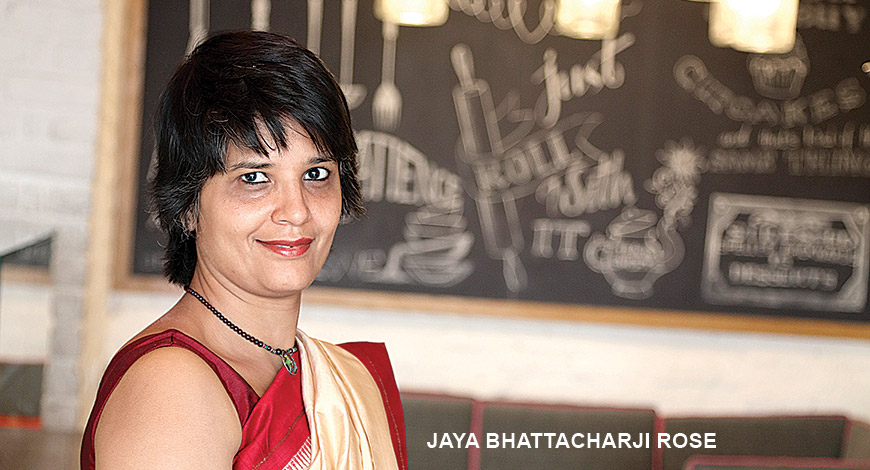
Photographer: Ritesh Sharma

Photographer: Ritesh Sharma Location: Bread & More, NOIDA

JAYA BHATTACHARJI ROSE is an international publishing consultant and blogger
For me, Chitra Banerjee Divakaruni’s books have always elegantly examined multi-cultural identities and what it means to be an Indian, an American or a desi (people from the Indian sub-continent or South Asia who live abroad). Her stories engage with the immigrant story specifically from the point of view of the woman. In Before We Visit The Goddess, young Tara epitomises the new generation of American-Indians, not ABCD (American Born Confused Desis) anymore but with a distinct identity of their own. The novel examines these many layers of cultures, interweaving the traditional and contemporary. It is also the first time men and women play an equal role in her story.

To her credit, Divakaruni never presents a utopian scenario focusing only on women and excluding any engagement with men and society. Instead she details the daily negotiations and choices women face that slowly help them develop into strong personalities. The popularity of her books is evident: The Palace of Illusions was among the top 3 bestsellers at the World Book Fair.


Divakaruni’s next book is going to be worth looking out, as it is about Sita.


This article was published in BW Businessworld issue dated ‘March 20, 2017’ with cover story titled ‘Most Influential Women 2017’

Censorship, state and formation of literature

A Stasi official observing the interrogation of the lover of an East German playwright whose loyalty to the state is questioned, in Florian Henckel von Donnersmarck’s film The Lives of Others, 2006

An extract from the New York Review of Books review by Timothy Garton Ash of Censors at Work: How States Shaped Literature by Robert Darnton” ( 23 October 2014)

I have only once met a censor on active duty. In the spring of 1989, my friends at the newly founded Polish opposition newspaper Gazeta Wyborcza let me take a cartoon up to the in-house censor at the printing house of the main Communist Party daily, on whose weary old presses Solidarity’s organ for the dismantlement of communism was now being produced. I knocked on the door, only to find a bored-looking woman in a floral dress, with a cigarette on her lip and a glass of tea at hand. She slowly scanned the cartoon and the article to which it related, as if to demonstrate that she could read, and then stamped her approval on the back of the cartoon.

My taskmistress showed few obvious signs of being an intellectual, but one of the leitmotifs of Robert Darnton’s new book is how intellectually sophisticated censors have often been. Drawing on original archival research, he offers three fine-grained, ethnographic (his word) studies of censors at work: in Bourbon France, British India, and Communist East Germany. In eighteenth-century France, the censors were not just writers manqués; many were writers themselves. They included men like F.-A. Paradis de Moncrif, a playwright, poet, and member of the Académie française. To be listed as a Censeur du Roi in the Almanach royal was a badge of honor. These royal censors initialed every page of a manuscript as they perused it, making helpful suggestions along the way, like a publisher’s editor. Their reports often read like literary reviews. One of them, M. Secousse, solicitously approved an anthology of legal texts that he himself had edited—thus giving a whole new meaning to the term “self-censorship.”

In British India, the censors—not formally so called—were scholars and gentlemen, either British members of the elite Indian Civil Service (the “heaven born”) or their learned Indian colleagues. Harinath De, a candidate for the post of imperial librarian in Calcutta in 1906,

had mastered Latin, Greek, German, French, Italian, Spanish, Sanskrit, Pali, Arabic, Persian, Urdu, Hindi, Bengali, Oriya, Marathi and Guzerati, along with some Provençal, Portuguese, Romanian, Dutch, Danish, Anglo-Saxon, Old and Middle High German, and a smattering of Hebrew, Turkish and Chinese. He got the job.

Besides being a librarian, that job involved contributing summary reviews to an extraordinary printed catalog of every book published in the Raj from 1868 onward. It included more than 200,000 titles by 1905. Although given to describing anything with erotic content, including the hanky-panky of Hindu gods, as “filthy,” these literary monitors were often highly appreciative of the works under review, especially when the authors showed some virtuosity of style and depth of scholarship.

In the summer of 1990, Darnton, the lifelong historian of books and censorship, had the thrill of finally meeting two real-life censors. In East Berlin, the capital of the soon-to-be-history German Democratic Republic, he found Frau Horn and Herr Wesener, both holders of advanced degrees in German literature, eager to explain how they had struggled to defend their writers against oppressive, narrow-minded higher-ups in the Party, including an apparent dragon woman called Ursula Ragwitz. The censors even justified the already defunct Berlin Wall on the grounds that it had preserved the GDR as a Leseland, a land of readers and reading. Darnton then plunges with gusto into the Communist Party archives, to discover “how literature was managed at the highest levels of the GDR.”

He gives instances of harsh repression from all three places and times. Thus, an eighteenth-century chapter of English PEN could have taken up the case of Marie-Madeleine Bonafon, a princess’s chambermaid, who was walled up, first in the Bastille and then in a convent, for a total of thirteen and a half years. Her crime? To have written Tanastès, a book about the king’s love life, thinly disguised as a fairy tale. In 1759, major works of the Enlightenment, including Voltaire’s poem on natural religion and Diderot’s Pensées philosophiques, were “lacerated and burned by the public hangman at the foot of the great staircase of the Parlement” in Paris.

In British India, civilized tolerance of native literature turned to oppression in the early years of the twentieth century, as Indian nationalist protests grew following the partition of Bengal. A wandering minstrel called Mukanda Lal Das was sentenced to three years’ “rigorous imprisonment” for singing his subversive “White Rat Song,” with lyrics that come out in the official British translation like this:

Do you know, Deputy Babu, now your head is under the boots of the Feringhees, that they have ruined your caste and honor and carried away your riches cleverly?

In East Germany, Walter Janka suffered five years of solitary confinement for being too much involved with György Lukacs in 1956.

Yet such outright persecution is not Darnton’s main theme. As his subtitle suggests, what really interests him is “how states shaped literature.” They have generally done so, he argues, through processes of complex negotiation. In eighteenth-century France, censors made suggestions on grounds of taste and literary form; they also ensured that no well-placed aristocrats received unwelcome attention and that compliments to the king were sufficiently euphuistic. Different levels of authorization were available, from the full royal privilege to a “tacit permission.”

In East Germany, elaborate quadrilles were danced by censors, high-level apparatchiks, editors, and, not least, writers. The celebrated novelist Christa Wolf had sufficient clout to insist that a very exceptional ellipsis in square brackets be printed at seven points in her 1983 novel Kassandra, indicating censored passages. This of course sent readers scurrying to the West German edition, which visitors smuggled into the country. Having found the offending words, they typed them up on paper slips and gave these to friends for insertion at the correct place. Among its scattering of striking illustrations, Censors at Work reproduces one such ellipsis on the East German printed page and corresponding typewritten slip.

Klaus Höpcke, the deputy minister for publishing and the book trade (a state position, and therefore subordinated to higher Party authorities), seems to have spent almost as much time in the 1980s fending off the Party leaders above him as he did curbing the writers below. He received an official Party reprimand for allowing Volker Braun’s Hinze-Kunze-Roman, the scabrous story of an apparatchik and his chauffeur, to be published, albeit in a carefully “negotiated” form. Finally, in a flash of late defiance, Deputy Minister Höpcke even supported an East German PEN resolution protesting against the arrest of one Václav Havel in Czechoslovakia in the spring of 1989.

Some celebrated writers do not emerge trailing clouds of glory from the cold-eyed files of censorship. Voltaire, that legendary champion of free speech, apparently tried to get the royal censors to suppress the works of his enemies. It was the censor-in-chief who, while he might not have agreed with what Voltaire’s enemies said, defended their right to say it.

The office of the East German Politburo member responsible for culture, Kurt Hager, “kept long lists of writers who sent in requests for visas, cars, better living conditions, and intervention to get their children into universities.” A plea by the writer Volker Braun to be allowed a subscription to the leading West German liberal weekly Die Zeit went all the way up to Hager, with a supportive letter from the deputy minister, who argued that this would provide Braun with materials for a novel satirizing capitalism. In the course of tough negotiations with senior cultural apparatchiks in the mid-1970s, Braun is even recorded as saying that Hager was “a kind of idol for him.” Can we credit him with irony? Perhaps. Writers who have never faced such pressures should not be too quick to judge. And yet one feels a distinct spasm of disgust.

17 March 2017 

Web Analytics Made Easy -
StatCounter