Here is the entire note by the translator, Daisy Rockwell, from her recent translation of Khadija Mastur’s Aangan, translated as The Women’s Courtyard. It has been published by Penguin Random House, 2018.
The note has been excerped with the publisher’s permission.
The Women’s Courtyard has been translated before as The Inner Courtyard, by Neelam Hussain,
and published by Kali for Women in 2001. Retranslation is still a rarity in the
context of modern South Asian literature but the practice enriches the field of
translation, offering readers different prisms through which to read a text.
When I choose to retranslate a work, it is usually because I feel I have
something substantially different to offer from the previous translator or
translators. All the same, I draw comfort and inspiration from the work of
previous translators, who may have seen things differently than I did and send
me scurrying back to my dictionaries and expert friends for more information.
Khadija Mastur’s writing style is spare and elegant. Unlike many Urdu authors she does not favour heavily ornamented writing and turns of phrase full of literary allusions. I felt inspired to reproduce this clarity in English, after seeing that Hussain’s translation struggled with this quality, attempting to elevate the language to a more formal register of English than was used in Urdu. See, for example, Mastur’s description of Safdar Bhai, and the two contrasting translations, below:
Mastur:
Safdar Bhai kitne vajīha magar kaisī
maskīn sūrat ke the.
Rockwell:
Safdar looked so handsome, but so meek.
Hussain:
How tall and well built Safdar Bhai had been and yet how diffident his mien.
Not only
does Hussain divide descriptive adjectives into phrases, but in the case of the
second phrase, maskīn sūrat ke, she
introduces a flowery and somewhat archaic-sounding descriptor, ‘how diffident
his mien’.
These
embroideries of the original, in which Hussain seeks to somehow augment the
original text, stretch even to ordinary narrative sentences, such as the following:
Mastur:
Dūr kahīñ se ghaṛiyāl ke gyārah bajāne kī
āvāz ā rahī thī.
Rockwell:
From somewhere far off came the sound of the bell striking eleven.
Hussain:
A distant clock struck the hour. The sound of its measured strokes rolled over
her. It was the eleventh hour of the night.
Here,
Hussain’s rendition conveys a breathless dramatic tension that is absent from
the original, which merely alerts us to the passage of time.
Hussain
also occasionally inserts new ideas into the text, such as below, where she
actually adds foreshadowing to the original sentence that describes Aliya
worrying about her sister Tehmina Apa:
Mastur:
Rāt kā qissā bār bār yād ātā aur voh
anjām ke khauf se ek lafz bhī na paṛh saktī thī.
Rockwell:
She kept thinking about what had occurred the night before, and was so fearful
of what might happen she couldn’t read a single word.
Hussain:
The inexorable end of Apa’s fated love was before her eyes and she was unable
to concentrate on her work.
Mastur
merely writes of Aliya’s ‘anjām kā khauf,’
her fear of the outcome, whereas Hussain announces to us that Tehmina’s ‘fated
love’ is coming to an ‘inexorable end’. This embellishment on the original text
both spoils the suspense of the story and romanticizes Tehmina’s love for
Safdar by referring to it as a ‘fated love’.
Strangely—perhaps
by accident—a pivotal passage is missing from Hussain’s translation. I can
attest as a translator that it is far too easy to drop bits of a text in the
course of translation. The phone rings, the dog must be let out, one’s
attention is divided—and there goes a paragraph. Usually these mistakes can be
rectified in editing, when one notices that something is missing or when a
transition between paragraphs makes no sense. An extra set of eyes helps too.
In this case, the passage in question is Jameel’s first physical assault on
Aliya. Aliya has been reading about the horrors of Ghengis Khan and his army,
when Jameel comes to speak with her. She tries to make him go away, or stick to
the topic of her exams, when he grabs her and kisses her (or more—the text is
not entirely clear on this point, but it reads clearly as sexual assault).
After this she feels shaken and defiled.
Finally, language changes, cultural norms change and politics change. All great works deserve multiple translations, and English can only be enriched by multiple versions of classic South Asian texts. With this fresh translation, a new generation of readers will be introduced to The Women’s Courtyard, and perhaps a few who know some Urdu will take the plunge and try reading the book in the original.
Lists are subjective. Reading lists are even more difficult to cobble. Today my list consists of the following books. A few days later it may change ever so slightly. But these are the books that have stayed with me over the months.
On 4 September 2017, a group of volunteers led by Harsh Mander travelled across eight states of India on a journey of shared suffering, atonement and love in the Karwan e Mohabbat, or Caravan of Love. It was a call to conscience, an attempt to seek out and support families whose loved ones had become victims of hate attacks in various parts of the country. Along the way they met families of victims who had been lynched as well as some of those who had managed to survive the lynching. The bus travelled through the states, meeting with people and listening to their testimonies. It is a searingly painful account of the terror inflicted in civil society that has seen a horrific escalation in recent months.
The book is clearly divided into sections consisting of an account of the journey based upon the daily updates Harsh Mander wrote every night. It is followed by a collection of essays by people who travelled in the bus. There is also a selection of testimonies recorded by journalist Natasha Badhwar of her fellow passengers. Many of whom joined only for a few days but were shattered by what they saw and heard.
Reconciliation is powerful and it is certainly not easy to read knowing full well that this is the violence we live with every day. The seemingly normalcy of activity we may witness in our daily lives is just a mirage for the visceral hatred and hostility that exists for “others”. It is a witnessing of the breakdown of the secular fabric of India and a polarisation along communal lines that is ( for want of a better word) depressing. Given below are a few lines from the introduction written by human rights activist Harsh Mander followed by an extract by Prabhir Vishnu Poruthiyil. Prabhir who was on the bus is an assistant professor at the Indian Institute of Management Tiruchirapalli (IIMT), India. The extract is being used with the permission of the publishers.
Everywhere, the Karwan found minorities living in endemic and lingering fear, and with hate and state violence, resigned to these as normalised elements of everyday living.
…..
Our consistent finding was that families hit by hate violence were bereft of protection and justice from the state. In the case of almost all the fifty-odd families we met during our travel through eight states, the police had registered criminal charges gainst the victims, treating teh accused with kid gloves, leaving their bail applications unopposed, or erasing their crimes altogether.
. . .
More worrying by far was our finding that the police had increasingly taken on the work of lynch mobs. There were tens of instances of the police executing Muslim men, alleging that they were cattle smugglers or dangerous criminals, often claiming that they had fired at the police. Unlike mob lynching, murderous extrajudicial action has barely registered on the national conscience. It is as though marjoritarian public opinion first outsourced its hate violence to lynch mobs, and lynch mobs in BJP-ruled states like UP, Haryana and Rajasthan are now outsourcing it onwards to the police. ( Introduction, p.x-xi)
Prabhir Vishnu Poruthiyil is an assistant professor at theIndian Institute of Management Tiruchirapalli (IIMT), India. He teachesbusiness ethics and his research is focused on the influence of business oninequalities and the rise of religious fundamentalism.
Like many others, I grew up with the usual doseof religiosity and nationalism. But I was also enrolled in a Hindu school (Chinmaya Vidyalaya) that injected an additional dose of Hindu supremacy. Therewas a short phase in my life (jobless, in my mid-twenties) when I went aboutexploring and trying to understand and justify Hinduism. I am the kind of person who tends to immerse himself fully to understand and make sense of theworld. My exploration brought me in close contact with gurus in various ashrams and bhajan groups. I learned Vedic chanting, studied Hindu theology, and even dallied with the idea of becoming a monk. I interacted with groups and individuals committed to Hindutva and attempted to see the world from their perspective (many remain my friends). I could not put my finger on it then, butI was deeply uncomfortable with what I later realised was unadulterated hatred and a stifling resistance to questioning and reason.
Around this time, in 2004, I was admitted into a masters and then a PhD programme in the Netherlands. Lectures by my teachers and exposure to the lives of classmates and refugees with personal experiences of life in theocratic regimes accelerated my disgust with religious nationalism of all kinds. Exposure to liberal political philosophy and to Dutch society made me appreciate the benefits of living in a place run on democratic and rational principles. As my education both in and outside the classroom progressed, my fascination with extreme perspectives rapidly diminished andturned into concern and disgust. It was, however, a visit to Auschwitz in 2012 that made me realise how easy it was for a society to be sufficiently intoxicated by supremacist world views to justify the annihilation of those deemed inferior. That a human tragedy on this scale had happened in the same society that had made incredible contributions to art, philosophy and music was unthinkable.
Over time, I have lost what remains of my beliefin the supernatural and purged myself of superstitions. I would now call myself a rationalist or secular humanist. Ibelieve that the irrationality promoted by religion is a barrier to progress and that religion is unnecessary for morality, and not a guarantee of it.
When I returned to India in 2013 to join the IIM, I did not expect religious nationalism to influence my research in, andteaching of, business ethics. My focus was on inequality. With the BJP’s victory in 2014 and the support of the corporate sector for the party, it became impossible to disentangle business ethics from religious nationalism. Istarted research on a paper on how religious nationalism emerges and whatbusiness schools could do to resist its advance.
When the lynchings began, more than thepsychology of the vigilantes and their victims, my sociological interest waspiqued by the nonchalance and even the endorsement of cow-vigilantism by many people I cared for, particularly among my family, friends, colleagues andstudents. Their unwillingness to recognise bigotry for what it was and rejectpolitical leaders who create an atmosphere of hate resembled the attitudes prevalent in Germany during the Nazi era. It disturbed me deeply to see sectarianism slowly taking hold of persons I loved. I started to worry that the possibility of concentration camps being built in India was no longer a gross exaggeration.
In the meantime, I had initiated a conversation with Harsh Mander. I wished to invite him to give a lecture at the IIM inTrichy. When the Karwan e Mohabbat was announced, I felt it was important to take part. I wanted to see for myself and talk about it to my friends and family and to students in my classes. The experience of looking into the eyesof persons who had lost loved ones was emotionally tough. After each meeting, my mind was constantly wondering how human beings could allow such tragedies to happen. A quote by Gandhi kept ricocheting in my brain: ‘It has always been a mystery to me how men can feel themselves honoured by the humiliation of their fellow beings.’
Looking back now, the memories and emotions of my visits to Auschwitz and of the victims of Hindutva are difficult to distinguish. The same helplessness, resentment and fear captured in the countless pictures of Jews subjected to the Holocaust seem to be reflected inthe eyes of the victims of cow-vigilantism. In contemporary India, I worry it may be unnecessary to build a standalone Auschwitz to implement a sectarian agenda. Terror has been decentralised and imposed through a variety of spaces. The entire country now risks being transformed into one large concentration camp.
How do we push back? Being a committed rationalist, my first instinct is to train citizens to use their reasoning and the language of liberalism and human rights to push back against bigotry andreligious nationalism. But the inroads made by Hindu nationalism into thepsyche can make it difficult for liberal vocabularies to reverse. The languageof ‘human rights’ and ‘freedom of speech’ can be branded as alien and hence ridiculed and dismissed. Furthermore, there are studies that show how groups tend to cling more firmly to their beliefs when threatened by outsiders.
Observant Hindus can be convinced more easily that sectarian hate and bigotry goes against the grain of Hinduism. The definition of Hinduism could be expanded to encompass empathy and compassion.This strategy would require formulating something like the liberation theologythat emerged in Latin America to challenge the interlocking interests of thebusiness elite and the top echelons of the Church that perpetuated inequality.
Excerpted with permission from RECONCILIATION:Karwan e Mohabbat’s Journey of Solidarity through a Wounded India, Harsh Mander, Natasha Badhwar and John Dayal, Context, Westland 2018.
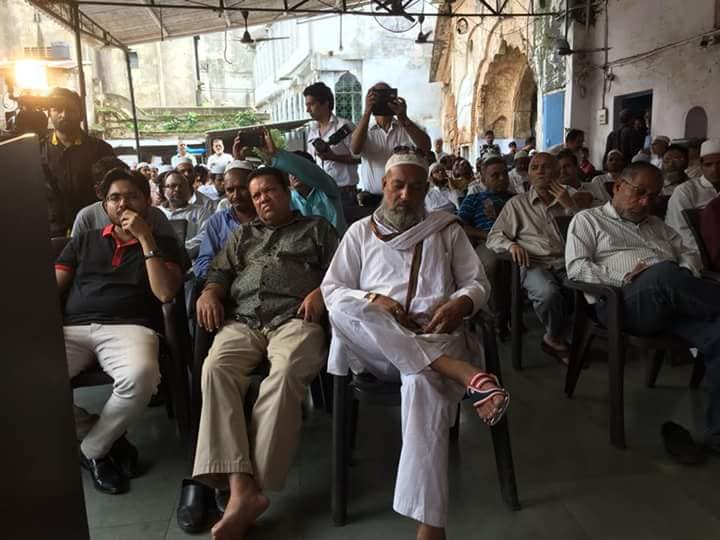
The pictures in the gallery are from Karwan e Mohabbat‘s Facebook page.
The Hindi translation of Jairam Ramesh’s book on “Indira Gandhi” has been released by OUP today. It has been translated by Anchit Pandey and published under the hugely successful ILPP (Indian Languages Publishing Programme) launched by Sugata Ghosh, Director, Global Academic Publishing. The book was first commissioned in English by Dharini Bhaskar for Simon & Schuster India.
Gavin Bishop at the New Zealand High Commissioner’s residence. Photographer: Satadru Mukherjee
In December 2018, award-winning New Zealand children’s writer Gavin Bishop was invited to India by the New Zealand High Commission for an author tour. Gavin Bishop is an award winning children’s picture book writer and illustrator who lives and works in Christchurch, New Zealand. As author and illustrator of nearly 60 books his work ranges from original stories to retellings of Maori myths, European fairy stories, and nursery rhymes.
Gavin Bishop participated in the Bookaroo Children’s Literature Festival as well as travelled with his publisher’s, Scholastic India, to various schools for exciting interactions. I met Mr Bishop and his wife, Vivien, at the New Zealand Deputy High Commissioner’s, Suzannah Jessep, residence. It was a lovely evening of freewheeling conversation about books and publishing, children’s literature, creating picture books and the power of stories. Excerpts of an interview are given below.
Here is a picture taken at the Deputy High Commissioner’s residence along with Gavin Bishop. It has been uploaded on the Facebook page of the New Zealand High Commission to India
How would you define a children’sbook especially a picture book as you make them the most often?
A children’s book is one that speaks honestly to childrenwithout pretentions. The worst kind of books are those that pretendto be for children but are really aimed at the parent or adult reading the bookto the child.
Apicture-book is one where the pictures and words tell a story, ‘hand-in-hand’.Neither the pictures nor the text are ’top-dog’, neither one is moreimportant than the other. Both parts have separate jobs to do to tell thestory. The picture book is my passion. It offers so many artistic and literarychallenges that I could never exhaust them all in a single lifetime. Manypublishers, mostly in the USA, have said to me that picture-books arequite simply for children who can’t read yet. I can’t think of anything furtherfrom the truth. There are lots of examples of picture books that work at manylevels and can be re-read over and over again by children of all ages. Ithink my version of The House that Jack Built that looks atthe colonisation of New Zealand by the British in the early 19th century, is a picture book that appeals to older children, children who can certainly read. Many New Zealand schools use this book at upper levels to talkabout the history of this country.
2. How do you select the stories you choose to write about? Where did you hear the stories that you write about in your books?
For stories, I constantly revisit all the terrific folktales, myths and legends ofthe New Zealand Maori as well those from Europe. When I rewrite a story, I tryas much as possible not the change the plot or the outcome. If it isa little frightening, I leave it like that. But if I think aparticular story is more suited to adults, as many traditional storiesare, then I don’t choose it. There are lots of adventures for example, that the Maori demi-god Maui has, that I think are extremely interesting but theycontain adult elements that a child does not to be confronted with yet.
My childhood is another very deep pool full of memories and stories that I diveinto from time to time.
Most of my books take a long time to produce. My pictures are often full of detailand are drawn by hand on paper as opposed to beingcomputer-generated. If I am to live with a creation for most of a year, Ihave to be convinced from the start that the story is worthwhile and willadd something to a child’s life. I know that sounds lofty, but I really believe that as a writer for children my obligation is to present a young reader with stories and ideas that they will find interesting and perhaps have not heard of.
Another huge source of inspiration is reading. I try to read a lot of fiction. Movies are a good source of ideas too. In fact a movie is rather like a picture book except instead of text as in a book, you have dialogue. Some of the movies I seen over the years have never left me. I have beenparticularly inspired by movies I saw as a young adult. Films by Fellini, Bergman, Pasolini and Altman showed me how stories can be told using vivid imagery and characters.
3. Did you consciously choose the style of writing for children as you do in your longer pieces of fiction –simple sentences, very short chapters, precise descriptions with few polysyllabic words?
When I write I do keep in mind that I am writing for children. But this is onlyreflected in the style and format. I try not to modify the story or the humour which can result in ‘talking-down’ to the reader. Although I usesimple sentences and short chapters I don’t shy away from difficult words if I think they are the right ones for the job. When I wrote Piano Rock I probably had 7 or 8-year-old readers in mind. I have been heartened by thenumber of young boys who have written to me to say Piano Rock is the first book they have read right through. I would like to think that thiswas because of the content, but I suspect it had something to do with thefact the book is full of short sentences and quite a few pictures. It is very non-threatening to a reluctant reader. No sooner have you started a chapter than you find yourself finishing it.
4. Piano Rock and Teddy One-Eye focus a bit on the stories narrated to you by your mother and grandmother but your repertoire indicates that this love for stories go fardeeper. When did this love for stories begin and do you still collectstories?
These two books are about me. They are my autobiographies, even though the second one waswritten by my 68-year-old teddy bear. I vividly remember sitting with my grandmother by the fire listening to her reading me stories and singing strange little songs that she plucked out of her memories of when she was a child. One I remember more than all the others, and one I included in Piano Rock was – “Old Mrs Bumblebee said to me the other day, comeand have a cup of tea on the back veranda.” That’s all there is to it, but at the age of 3 or 4 I found it for some reason, intriguing. I can remember trying to make sense of it byputting it into the context of our neighbourhood. “Did Mrs McQuirter overthe back fence invite us over for a cup of tea?” I wondered quietly to myself.
This little ditty has been with me all of my life and I have, in my quest to find itsorigin, mentioned it to lots of people. All have replied they had never heardof it until one day at a talk I was giving an Indian woman stood up in theaudience and said she had heard it in India when she was child.Perhaps the word ‘veranda’ is a clue? The mystery deepens……,
5. How would you define a compelling story?
The best
stories are the ones that become part of you for the rest of your
life. I think this happens more often in childhood, therefore it is even
more important for a children’s writer to put everything they have into
producing the best story they can.
6. The imagery in your books is fantastic. It’s almost as if the imagery used complements the illustration. Was that deliberate or an unconscious act?
I am a very visual person and when I’m writing I see everything that is happening in my mind’s eye. I plan my text and illustrations carefully to begin with but after that, when it comes to painting and writing, I rely a great deal on my subconscious. I follow my gut-instinct and often cannot tell whether a picture or a piece of writing has worked until I distance myself from it by leaving itfor some time and not looking at it.
7. How do you conceptualise a book?Is it taking into account the text and the illustration? How does the illustration process evolve?
To beginwith I am directed by format. If it is a picture book, then I know from thebeginning it will most likely have 32 pages. I generally begin with the storyand write it with the length of the book in mind. I have now developed a spare writing style for this sort of book where I deliberately keep description for example, to a minimum so as to allow plenty of room for the illustrations to tell their parts of the story. Sometimes I jot down little ideas for the pictures in the margin as I write. The process at this stage of the book is quite measured. Once the text reaches a stage that I thinkis workable, I draw up a storyboard, a page by page plan from cover to cover ofthe whole book. I usually keep this small, drawing the whole thing onto a single A2 sheet of paper, so that when it comes to putting images into place on the miniature pages I cannot get into too much detail. This results in stronger compositions when these little pictures are increased tofull size later, when I make a dummy. I work in pencil which I go overwith ink. The dummy is based on the page size supplied by the publisher afterreceiving a quote from the printer. I make a dummy with 10 sheets of paperfolded in half. That gives you 32 pages plus endpapers and cover. Next I print off the text and glue it into place throughout the book. This instantly showsme how much space is left for the illustrations. The next couple of months arespent enlarging and drawing the pictures from the storyboard into the dummy. This is really where all the hard work begins. If it is a historical story I do most of my research at this stage.
A completed dummy is useful for showing your publisher what you have in mind for the book it also provides a detailed guide for the next process of producing the finished art work. From the start to publication a picture book usually takes a year.
8. How does your Maori ancestry inform your art of storytelling and fascination of folk tales?
My Maori ancestry tells me who I am and where I belong. Aotearoa/New Zealand is myturangawaewae, my place to stand in the world. I have European ancestry as well and that has given me literature and language but to know that some of my tupuna/ancestors have lived in the South Pacific for thousands of years and I live here now, gives me a great sense of belonging. My mother’s name was Irihapeti Hinepau and her father gave her those names because they areancestral names. I have a large number of relatives in Aotearoa who trace theirancestry back to people in the past who have these names too. Maori myths and legends are as rich and profound as any in the world, yet when I was a child we were told more about the myths and legends from Greece and Rome than the stories from our part of the world. New Zealand has for too long suffered from a cultural cringe, always looking North to the rest of the world for affirmation. As a re-teller of Maori myths for children I want to help the next generation become proud of being part of this country. I want them to know their stories and be made strong by them.
9. How did you get into bookmaking? Have you collaborated with other writers and illustrators?
In the 1960s I went to the University of Canterbury School of Fine Arts and studied painting. While I was there I was fortunate to be taught by Russell Clark, a well-known New Zealand artist with a particular interest inillustration. He saw I was interested in children’s picture books and he encouraged me to pursue that interest. It was not until the late 1970s that I did something about this interest and tried writing my first book, Bidibidi.
My ideal project is one where I write and illustrate my own book, but I have, from time to time, worked with others. Some years ago I wrote about 30 or 40 ‘readers’. Because a lack of time these were illustrated by a series of international artists and published all over the world.
I have also illustrated books for other writers. I have done quite a few with Joy Cowley, the most successful being the Snake and Lizard series. And Margaret Mahy and I worked on what was probably her last book before she died — Mister Whistler.
10. Do your books travel to other book markets in English and have they been translated?
My books have been sold all over the world, particularly in England, Australia and the USA. Some of my books have been translated into Spanish, French, Italian, Danish and other European languages. Recently my books have become very popular in Asia and several of my recent publications appearin Korean, Mandarin and Japanese editions.
Some ofmy books, such as Kiwi Moon and Hinepau have been adapted for the stage. Kiwi Moon travelled nationally as puppet theatre and the third adaption of Hinepau was performed entirely in Maori.
But oneof my biggest creative challenges was writing the story and designing the sets and costumes for two ballets for the Royal New Zealand Ballet Company. Although they were pitched at an audience of children they were performed by the regular company of dancers with whom I got to work. Original music was composed by a musician friend and the choreography was designed by one of New Zealand’s top dancers. Attending the opening performances of these ballets that were created in consecutive years, were two of the most exciting experiences of my life.
Watch Shantanu Duttagupta, Head of Publishing, Scholastic India interview Gavin Bishop at the New Zealand High Commission.
We met author Gavin Bishop and discussed books, writings and much more!Big Thanks to: New Zealand High Commission to India, Bangladesh, Nepal & Sri Lanka Scholastic New Zealand
Every Monday I post some of the books I have received in the previous week. This post will be in addition to my regular blog posts and newsletter.
In today’s Book Post 22 included are some of the titles I received in the past few weeks and are worth mentioning and not necessarily confined to parcels received last week.
I felt a Funeral, in my Brain, And Mourners to and fro Kept treading – treading – till it seemed That Sense was breaking through –
And then I heard them lift a Box And creak across my Soul With those same Boots of Lead, again, Then Space – began to toll,
And when they all were seated, A Service, like a Drum – Kept beating – beating – till I thought My mind was going numb –
As all the Heavens were a Bell, And Being, but an Ear, And I, and Silence, some strange Race, Wrecked, solitary, here –
And then a Plank in Reason, broke, And I dropped down, and down – And hit a World, at every plunge, And Finished knowing – then –
Emily Dickinson ( 1896)
Queer young adult novelist Will Walton’s second novel I feel a Funeral in my Brain is an astounding piece of writing. Editor of the PUSH imprint at Scholastic and legendary author himself, David Leviathan sums it up well as a “brilliant and bonkers melding of poetry and prose“.
To briefly sum up the book (if possible!) is that it is about a grieving Avery whose life is topsy-turvy at the moment. He is wheel-chair bound for a while due to an injury caused in an car accident when his mother was driving whether under the influence of alcohol or not is unclear. Avery is also figuring out his sexuality while exploring a relationship with his best friend/classmate/neighbour while looking after his alcoholic mother, living with a grandfather who too has his own set of challenges and discovering his anchor in the world of poetry/poets who came and went leaving a trail of their own set of complicated challenges.
I feel a Funeral in my Brain is obviously a tribute to the great American poets including to Emily Dickinson as is evident in its direct reference in the book title but the novel itself is equally experimental in form. Depending on how the young protagonist Avery is feeling the rhythm of the text reflects his mood. Complicated and not an easy read yet once you immerse yourself in it and do not read it with the expectations of a traditional reader, it will leave you thinking and wondering about a lot of issues.
Universally adored children’s writer Julia Donaldson toured India in January 2018. The reception she received was heartwarming. Wherever she went there were crowds of excited children and parents. Even at the specially organised event by Scholastic India of school librarians and teachers there were many who while learning from Julia Donaldson’s performance were completely star struck — you could see it in their eyes and later when innumerable group photographs were being clicked. It was an incredible experience to witness.
Here is an article I wrote about Julia Donaldson’s trip in January. It was written days after her departure from India but never was published till today. It was an honour to meet Julia Donaldson for her humility shone through as did her vast amounts of experience in inculcating the love of reading in children. She was keen on telling a good story to the children and infecting them with the joy of reading. While being a fantastic storyteller she also shared her experience of working on the technically-sound phonetic books like the Oxford Reading Tree ( ORT) books that are introduced as part of school curriculums worldwide. According to her it was a big learning curve for it taught her how to focus on telling a story within the limited number of consonants prescribed for a particular level without losing her trademark touch of creating rhyming and play books.
Note: Follow the links embedded in each title and it leads to the book page on Amazon India.
Julia Donaldson MBE and former UK Children’s Laureate is to the world of picture books what Stephen King is to horror stories and both have an enviable fan base. Like Ed Sheeran, Julia too began her career busking. She enjoys performing and always has a repertoire in mind before going on stage but willingly adapts if the occasion demands it. As Julia says “audiences and moods vary depending on whether you are performing in a bar, a street or in schools.” She usually performs with her husband Malcolm who accompanies her on the guitar. Their thorough professionalism at managing crowds was evident after a performance ended when Malcolm picked up his guitar and sang while going up and down the queues of eager yet restless folks awaiting their turn to have their books autographed by Julia.
When Julia Donaldson’s tour of India was announced excited adults squeaked “Her picture books are fabulous! The illustrations! AndGruffalo…Will he be there as well?” Chirrups of delight from the children who became eager volunteers at every performance! She would call upon children from the audience to come up on stage to play minor roles in the stories she enacted such as Superworm, The Ugly Five,andWhat the Ladybird Heard. Ideally Julia prefers it if her audiences have read some of her “play books” in advance as it enriches the experience. This fear was put to rest in India. Whichever city she visited the enthusiastic crowds of children and adults alike sang with her. It was like being at a pop concert where the hysteria of the audiences upon seeing Julia Donaldson in flesh was worth witnessing.
The crowds in India were far larger than any she has performed before anywhere else in the world. Yet the warm, cuddly, grandmotherly figure with a radiant smile that lit up her already twinkling eyes remained unperturbed. She performed happily even though some of her little extras decided to plonk themselves on stage to read the pile of picture books placed in a pile rather than participate in the sing-along! Despite battling terrible bronchitis Julia Donaldson managed to mesmerise folks with her storytelling. Certainly she had sophisticated props; mostly recognizable characters sketched by her long time illustrator Axel Scheffler, yet she relied mostly upon vast dollops of imagination to make her stories come alive.
Julia Donaldson’s magnificently magical storytelling is technically perfect in using rhythm and wordplay. She demonstrated to teachers that while sharing light-hearted stories with new learners it is easy to convert a simple classroom into a vibrant one with music and colour. A happy child learns fast. The importance of reading is critical to her and has always been — she taught her younger sister to read! Of the nearly 200 books Julia Donaldson has written the bulk are phonic readers; requiring her to blend vowels and consonants precisely according to early learning rules of phonetics. This is in keeping with her fascination for sound patterns and letter stories.
Julia Donaldson grew up in a home filled with music and poetry with her grandmother instilling a lifelong passion for Edward Lear’s nonsense language —in The Giants and the Joneses Julia invented Groilish! (Later to her delight she was commissioned to write a sequel to Lear’s “Ówl and the Pussycat”.) Age 5 she was presented by her father, a still treasured edition, of The Book of Thousand Poems inculcating in her a dream to a poet/lyricist. Her mother would play a version of “antakshri”, encouraging her daughter to find a word beginning with the last syllable of a word she had uttered. All of which helped Julia while writing her books in blank verse.
In the 1970s she worked in a publishing firm while contributing songs and plays to radio. One of these was A Squash and A Squeeze which an editor recollected two decades later persuading Julia to turn it into a picture book.
Julia Donaldson’s fascination lies in experimenting with well-known folktales. In the Gruffalo it was the retelling of an ancient Eastern tale where a little girl goes into the forest and tames a tiger that follows her meekly home. But Julia was stuck for an appropriate rhyming word for “tiger” so used “Grrr… “ Rest they say is history! She recalls fondly that her sons could never cross a bridge without enacting the Three Billy Goats, now she hears of picnic expeditions that revolve around a Gruffalo hunt!
Her books have sold millions of copies worldwide, translated into many languages. She structures each book carefully paying close attention to her conclusions: “She does not like rosy endings that tell the child that it was all a dream. Sealed endings are not to her liking.” In 2014, 40p of every pound spent on buying picture books in UK, went to Julia Donaldson. It was more than spent on Harry Potter books! On Christmas Day 2017 The Highway Ratpremiered on television as an animated film, fulfilling an annual ritual of converting a Julia Donaldson picture book into film since 2012 when Room on the Broomwas nominated for an Academy Award. ( For Christmas 2018 it will be Zogand for Christmas 2019 The Snail and the Whaleare to be adapted.)
Running on the Cracksis the only young adult novel she has written. It has her characteristic gentle empathetic touch without underplaying hard issues such as immigrants, mental health, sexual predators and runaway kids. Even so “she would rather make picture books that allow her the freedom to play with words that get made in a shorter time than writing a novel which takes some effort.”
Ultimately Julia Donaldson firmly believes that children should read a variety of genres including comics – give them anything that appeals to them!
Alice’s rabbit hole began when she entered her father’s library and picked up one of the books she was forbidden to read. In it, the words were flavoured with anger and terror and beauty and everything she hadn’t tasted yet in her young life. People revolting, war, famine, anger at the aristocracy, compassionate philosophers writing famous ideas and wild theories.
Wonderland emerged when Alice found her love for reading, and even better, acting on what she read. …
She scorned the idea that young ladies of that time should not do what she did. Make change and make waves and create a world more equal for everyone that lives in it. She was more concerned about making a change and in every little way she could find, she would.
Wild Embers, pp. 68-69
Nikita Gill is a British-Indian writer and poet living in the south of England. With a huge online following, her words have entranced hearts and minds all over the world. Wild Embers (2017) was her first book. I discovered the hugely popular Instapoet poetry in print, not on social media. It were the print editions that caught my attention primarily because her book publicists sent the beautifully designed editions of Wild Embers and Fierce Fairytales & Other Stories to Stir Your Soul. Strong poetry that is a pleasure to read for its sharply articulated ideas and representation of strong, independent, and thinking women characters especially in the retelling of the age-old fairytales. In fact Fierce Fairytales was whisked away by my young daughter as her own! I was a little surprised at her action as I was not sure how much of the poetry she would understand. Yet she surprised me pleasantly by getting the gist of the stories. She may not have got the layered meaning but she got the gist. It speaks volumes of Nikita Gill’s skill as a poet to be able to connect across generations. Unsurprisingly she has a legion of followers on social media: Facebook (109k), Instagram ( 478K), Twitter ( 26.6K) and Tumblr
Hachette India helped faciliate this email interview.
1. How and why did you decide to become a poet?
When I was 13 years old, I was introduced to the work of Robert Frost through English class. There was something incredible in capturing such a wide span of emotion inside a single poem that rattled my soul and I felt a deep connection with it. Soon after, my nani (maternal grandmother) gave me my very own copy of Sukhmani Sahib and the hymns and verses there made me realise how poetry and prayer were not dissimilar, each one crafted from air to create something beautiful in and of itself. This was what made me fall in love with and want to write poetry.
2. How long does it take you to write a poem?
Genuinely speaking I am never done writing my poems. I think it was Da Vinci who said, “Art is never finished, only abandoned.”, and I resonate with that deeply. I frequent my old journals often, and rewrite pieces that I wrote years ago. I have a fondness for visiting an old thought with a fresh mind and a newer heart. I edit my manuscripts over and over again until I have to give them up. On a good day, a first draft will take about 6 hours, and rewrites take longer.
3. You are a huge success on social media. You are one of the few Instapoets who is known worldwide with a celebrity following too. But traditionally publishers are hesitant to publish poetry for the book gets easily read in a store or can be easily copied. How do you manage your poetry posts online from being plagiarized or shared without acknowledgement?
There are battles you can fight and battles you can’t. Plagiarism is a difficult thing to battle when your intellectual property is out on the internet. People get inspired by things, when we are finding our voices, our work tends to be clichéd. The easiest way for me is to write new things which I’m not seeing done around me right now. Fairytales verse retellings, writing about my very specific experiences with Partition and being Kashmiri and Punjabi, and my love for the night sky. The point is to keep reinventing yourself and keeping your head above the water. It’s also the only way to become a better creator.
4. Your primary audience are on social media. Do you find writing poetry for publication on paper is any way different to putting out posts in cyberspace? How does it affect your style of poetry? Would you say that writing for an online audience is predominantly performance poetry but it’s tone has to change for consumption in print? Do you edit the poems before the print publication or do you publish the poems as was first put out on social media?
It’s interesting because I always thought my primary audience was on social media. But my sales figures show an even split between bookstores and internet sales. Social media is also a very different realm than to paper. You’re fostering a community there. Thoughts, ideas, friendships – also there is close interaction with your audience which you don’t get with a book. I have always said that the community in the comments section is the most magnetic thing about posting your work, unfiltered, online. I wouldn’t call it performance simply because performance poetry is such a beautiful craft in and of itself (the poets on Button who are powerhouses for instance). I would call it “confessionalist bite-sized poetry” which exists to cause a reaction, a thought, a feeling. When I write for a book, the work is edited and reedited many times before I am happy with the story it tells, whereas on the digital platform, I predominantly share excerpts or aphorisms.
5. Do you find that interacting regularly with your readers on social media influences your poetry as well as selection of themes?
I think I have a huge responsibility towards my readers to ensure my platform remains a safe space for them to share their experiences. My first allegiance is to marginalized people and survivors of trauma and I ensure posts contain trigger warnings. I don’t let it affect my work for the simple reason that the people who follow me only follow me because they enjoy the work I already put out. I need to be true to myself to be true to them. I don’t post at any particular time of the day or daily. Just when I have a fleeting thought to put something up or create something. It’s all so much more organic that way.
6. Who are the poets who have influenced you the most?
I have a fascination for the works of Emily Dickson, Maya Angelou, Sharon Olds, Lucille Clifton, Rabindranath Tagore, Amrita Pritam, Walt Whitman, Anne Carson, Emily Berry – this list is non exhaustive. I think the more older poetry we read, the better we learn how to truly see that poetry is a very vast subject and means very different things for different people.
7. What are the forms of poetry you prefer to read and write in?
I like to read every form of poetry – there are so many genres to enjoy and such a rich world of poets to discover. Recently, I’ve been experimenting more and more with lyric poetry and moving away from free verse which has been my form for so long. Lyric poetry is far more based on regular meter and it’s teaching me a lot to try and learn how to write it.
8. Your poems seem to be in free verse with a “fludity” about the stories. Do you “work” at this craft or does it evolve on its own when you are writing?
It does evolve on its own. I have to often stop myself from rhyming but the poem does exactly what it wants to do without permission from me. I’ve found that it is best not to fight it, fighting it leads to writers block. So I just go with it instead. And then edit like I am own worst critic (because truly, I am. I don’t know anyone who has ever sworn or yelled at me as much as my inner critic has.).
9. Jesuit priest and poet Gerard Manley Hopkins was very clear that his poetry was meant to be meditative and it is the reason why he developed the inscape technique. It forces the reader to engage with the poems. Whereas your poetry is far easier to read but the ideas of love, feminism and independent women that you share are powerful. Do you, like Hopkins, wish for something equally transformative wrought in the reader after engaging with your poetry?
Absolutely, but I do think that will take time. I am still young in my writing journey and discovering my voice. To be truly transformative is to not only find your voice but have complete of command over it. Whilst I have discovered what I want to say, what messages I want to put out, I feel like I am just at the very beginning of honing my craft. I feel like language shouldn’t be something that is overly difficult to read, but it should make the reader feel changed when they have read a thought a certain way.
10. How did wonderfully sharp and witty Fierce Fairytales & Other Stories to Stir your Soul come about?
I think Fierce Fairytales was something I was always meant to write. The idea within the book all germinates from a single thought: the incredible magic we seek in our environments, in other people, is already within us, and we must seek it out. This idea has been within all my books but with Fierce Fairytales I got to explore it, and tell the stories of the villains who I genuinely believe have so much more to say than just “we are evil people doing evil things”. I enjoyed writing this book thoroughly, so much so that it has been the seeds for multiple new projects which are presently in development.
Every Monday I post some of the books I have received in the previous week. Embedded in the book covers and post will also be links to buy the books on Amazon India. This post will be in addition to my regular blog posts and newsletter.
In today’s Book Post 21 included are some of the titles I received in the past few weeks and are worth mentioning and not necessarily confined to parcels received last week.






 of strong, independent, and thinking women characters especially in the retelling of the age-old fairytales. In fact Fierce Fairytales was whisked away by my young daughter as her own! I was a little surprised at her action as I was not sure how much of the poetry she would understand. Yet she surprised me pleasantly by getting the gist of the stories. She may not have got the layered meaning but she got the gist. It speaks volumes of Nikita Gill’s skill as a poet to be able to connect across generations. Unsurprisingly she has a legion of followers on social media:


