The Time Of The Peacock by Siddharth Chowdhury is fabulous. It is published by Aleph Book Company. Fiction that is thinly veiled account of contemporary Indian publishing is always very welcome. But a story/s like this that smartly begins like a “straightforward” story in English, slowly disappears into a fascinating literary rabbit hole of diverse landscapes and cultures and conversations that India has to offer. It requires extraordinary skill sets as a writer to put the spotlight on publishing as we know it today in India and then make mincemeat of it by upturning the smooth English narrative style by slipping into dialects. The plot is deftly contextualised within the disturbing socio-political landscape of India where the publishing world becomes an excuse to dip in and dip out of stories and socio-economic classes, thereby at times highlighting the narrowness of the books being published that at times fail to mirror their society. It is a story that is very reminiscent of Elif Batuman ‘s magnificent novel The Idiot, in which the author transformed not just the protagonist but the reader too with the astonishing storytelling, a combination of the plot and literary techniques that slowly developed, layer by layer, as the student in the novel acquired the requisite academic skills. Similarly with The Time of the Peacock, the reader is left emotionally drained but in a satisfying way. In all likelihood it will be a book that will be read, critically analysed, dissected and assume academic importance in the years to come.
This is an utterly charming, sweet, heartwarming novel about two shy men — Leonard and Hungry Paul. Why he is called “Hungry” is never explained. Both are single and both continue to inhabit their parents home — a deed that in itself is unusual for adult men. Leonard ghostwrites children’s encyclopaedias and genuinely loves his work as these kinds of books gave him joy in his childhood. He is passionate about his writing and factchecking. Whereas Hungry Paul likes to be mostly at home with his parents and sometimes is called in to help with the local postoffice. Leonard has recently lost his mother and misses her but continues to meet Hungry Paul regularly. The friends meet in peaceful silence and are happy to have meandering conversations while playing board games. There is a gentleness to the story which seems to reflect the slow, ordinariness of their lives. But it does not rankle anyone, least of all the characters themselves. They are at peace being who they are. A sentiment that Leonard shares when wooing his soon-to-be girlfriend Shelley. He reminds her that anyone can say beautiful things at any point but that is not real and does not prove anything. Most importantly he says, “I am not scared to be myself.”
This novel is full of lovely insights about character and of course creating books, such as:
Encyclopaedias were books you were meant to immerse yourself in. They created their own worlds with magical pairings of writers and illustrators, using short exciting prose with memorable tableaux, drawn in a way that was meant to look lifelike but not so detailed that a young seven-year-old couldn’t attempt to copy the picture themselves. Yes, they were factual books, but they weren’t just books of facts. They were storytelling books that used the world around us merely as a starting point, as kindling for a child’s imagination.
He had always pictured the author and illustrator as intrepid, inseparable friends who wrote the books about facts they had discovered themselves. The books were written and illustrated with such a personal touch that it was hard to imagine that the people involved had not actually seen all the animals and shared campfires with all the tribes in the pictures. As a child, they showed him what life could be like: an adventure undertaken in the name of curiosity alone. He had resolved to do everything in those books: climb Mount Everest, swim in a shark cage, walk on a tightrope over Niagara Falls, and pull himself out of quicksand.
( pp. 63-64)
Leonard and Hungry Paul by Ronan Hession is a sleeper hit for Bluemoose Books— it is the perfect healing read during the pandemic. It has generated a lot of chatter on social media with everyone who has read it, recommending it to others, creating the best kind of buzz: word-of-mouth publicity. No wonder it has been selected as the 2021 One Dublin One Book choice in April!
In 2019, en route to attending the Jaipur Literature Festival, Nikesh Shukla lost his necklace at Heathrow Airport. It was very precious as it contained some of his mother’s ashes. He was extremely distraught. I happened to meet him as well and his grief was palpable. I will not forget that shattered look of his. He was numb. He put out a tweet announcing the loss of his locket. The power of social media being what it is, after more than 10,000 retweets, the necklace was discovered. At least that is what this article states: https://www.indiatoday.in/…/author-loses-necklace-with…
Brown Baby is Nikesh Shukla’s memoir that’s opening line refers to his mother’s death. It is a powerful, all-consuming moment in his life and he forever returns to it in his book. The loss of a dear one, especially a parent, is devastating. Shukla’s mother passed away due to lung cancer and once the death knell had been sounded by the oncologist, the family was heartbroken. A grief and despair that took ages and ages to get back their lives to some semblance of normalcy. The structure of Brown Baby is ostensibly a conversation with his elder daughter, Ganga, who seems to have been born after his mother died but he also uses the book as a reason to talk about racism in UK in minute detail. It is an interesting space for him to explore as he realises the immense responsibility that comes with becoming a parent. How much does one teach the munchkins, how do they navigate their world, how do they straddle worlds etc? He reminiscences how his mother brought up his sisters and him — children of Asian origin growing up in a white country. How they learned to preserve their culture ( food forming a large part of their life) and yet learned how to survive racist slurs and develop identities of their own. While his anger in the first half of the book is understandable and how much of it defines him as an author, publisher and parent today, some of it is also self-defeating. His arguments for being a minority because of his skin colour in a country where white is privileged are based on firsthand experience and other facts he has collected, but he makes the same majoritarian mistake that he is accusing the whites of not recognising the variety of cultures that now exist in modern UK. For example, he falls into the same trap by eliding the definition of India being linked to Hinduism whereas Hindus constitute the majority. He says, “In India, the Ganges river is worshipped as representative of the goddess Ganga.” A true statement that would have read as a more powerful statement if he had clarified by adding that “In India, the Ganges river is worshipped [by the Hindus]…”. In this day and age, when everyone is super-sensitive about identity and cultures, it stands to reason that someone like Nikesh Shukla who is very influential globally in the world of letters would be a little more careful in the choice of his words. He has a responsibility not only towards his daughter who he is introducing to their Indian roots, but also to his multi-cultural readers and the Indian diaspora. His word would carry more weight if he recognised these finer distinctions. In India, all of us are different shades of brown, but thrive in a syncretic and casteist culture, so it is not as easy to make these distinctions between white and brown, but these different identities exist. Yet, we manage to live.
The second half of Brown Baby is far calmer and easier to read. He discusses in detail what it means to talk in Hindi, to be a Hindu in Britain, be an Asian etc. There is a fascinating anecdote he shares about submitting a manuscript to a literary agent who dismisses it for not being authentic Asian. Understandably it makes Shukla hopping mad. Anyone would be under such circumstances. Fortunately he puts this anger to good use and has established The Good Literary Agency with Julia Kingsford.
Inspired by a desire to increase opportunities for representation for all writers under-represented in mainstream publishing, we are focused on discovering, developing and launching the careers of writers of colour, disability, working class, LGBTQ+ and anyone who feels their story is not being told in the mainstream.
It also explains this passage in the concluding pages of Brown Baby:
What does it mean to be British when conversations around the subject have their core in protecting Britain’s whiteness? When the multiculturalism ‘debate’, if you wish to call it such doesn’t scratch any deeper than ‘saris, steel bands and samosas’. Where debate events by sixth form debate clubs like the Institue of Ideas present multiculturalism as a threat to the West, as something worth of debate, as if we never got past that basic point, as if the only conversation we can have about immigration and the place of people of colour in society is about their inherent threat to Western values, rather than how we come to a decision about what an inclusive Britishness looks like.
Nikesh Shukla’s heart is in the right place. He knows how to channel his anger that wells up due to the injustice and discrimination he has either faced or witnessed. He wishes to correct some of these social ills by ensuring that his daughters generation learns to be proud of their identities. A spirit his mother imbued him with as well. At the same time by speaking clearly on these issues and offering an inclusive and diverse publishing platform to others, he hopes to create enough of a difference in the mainstream that will enable everyone to be recognised as equals, irrespective of colour, religion, sexuality etc. The mantra in his memoir seems to be that it is imperative everyone learns to be humane to others. This sensitive understanding needs to prevail. It is only then racist/casteist/communal attitudes will be tackled. Otherwise they will continue to exist for generations.
A pile of Dorling Kindersley books that Sarah has amassed over the years. They form the core of her library. An absolutely brilliant set of books that are created by teams of experts. Each page layout is done with care to detail, facts, and matching the text with the image. Children of today are #visuallearners and are fortunate to live in an age where books exist that are profusely illustrated with photographs. So they get doses of reality, a visual mapping, while learning becomes an enjoyable experience. These encyclopaedias are so packed with information but the pictures hold prominence in every layout. An interesting methodology to book design as the child immerses themselves in the book, absorbed by the visual richness and slowly, over a period of time, familiarises herself with the text. It is important to note that the text never dumbs down the facts. It presents them as is.
Some of these books were gifted to Sarah when she was 7+ and my goodness, how they magically transformed her reading experience. She would sit for hours looking at the pictures, flipping pages and as her #literacyskills became stronger, she began to make sense of of text too and identify more about the creatures, plants, organisms, experiments, objects, geography, weather, etc presented in the books. These books snapped her out of only being absorbed by picture books and story books. There is some merit in kids being allowed their free time to.do exactly as they please, whether it is daydreaming or flipping through books. They get lost in their own little dream worlds. These moments of daze are crucial to their growth as it is increasingly being documented that the #brain grows in such moments with the nerves connecting, synapses finding new routes. These magnificent volumes are storytelling with a difference. The child visually maps her world. She is incredible to be growing up in a world where these images are easily available. For instance, the book on Oceans has gorgeous pictures that do not make the watery world mysterious. Whereas we grew up in a world where Jacques Cousteau was still discovering the wonders of the deep. This particular volume has a preface by Fabien Cousteau, s/o Jacques Costeau.
During the pandemic, when children were confined at home and had to attend classes remotely, these DK books proved to be extremely useful resource material to have handy. Sure, the Internet exists. It is a vast ocean of readily available information but it is not the same thing as paper editions. Learning and reading in many ways is a sensual exercise. The brain needs to be tickled to come alive and absorb. Kids are surrounded by visuals and learn better if provided sensual opportunities of learning. They need to be left alone to slowly see, observe, ponder over and make connections for themselves. Large format, richly illustrated books like this permit the children to lie down on their tummies and stare into the book. Many peaceful hours can be spent like this without the parents getting frantic about excessive time spent on electronic devices or worrying about which links the children will click upon leading them to external websites etc. Books like this, developed by established brands, are good investments as they are sound on their factchecking and photographs used. It is ethicalpublishing too as every image or text used is always credited. It makes for reliable information that can be shared easily with children.
Of course these books are priced on the higher side but are an excellent addition to any home or school library. I understand the reasons for the expense and do not grudge it at all. I would rather buy one of these books than multiple volumes of different reading abilities to say explain the human body to the child. Children are incapable of grasping more than they can at any given time and slowly grow into these books. But it is incredible watching their growth as one fine day comes that magical moment when everything comes together. Now we are at a stage whereas parents we have to be very careful about identifying animals or fish as Sarah knows the exact species and names them accurately.
During remote learning I found it convenient to consult these books and explain the basic concepts of energy, periodic table, life cycle of rocks, vegetation belts, the various systems of the human body, etc. It was possible to let Sarah browse through the books and get a grasp of the concepts her teachers were introducing in their virtual classrooms. But when the teacher is reduced to a tiny box on a computer screen and valiantly attempts to draw sketches on her computer screen to explain to her class, it works but only to a limited extent. A substantial part of the heavy lifting of ensuring the child understood the concept is left upon the parents — this has been particularly evident during the pandemic. It is as if parents were assisting the schoolteachers in “minding the gap” between acquiring information and learning. Even so, once the kids begin returning to school, this kind of “blended” learning is here to stay. Schools are preferring to adopt the #hybridlearning — mix of digital and physical classes. But somewhere the balance has to be also struck between print books and online resources as well. This is were publishing brands like Dorling Kindersley India prove incredibly useful.
Raza Mir’s debut novel, Murder At TheMushaira, is a charming historical fiction set in Delhi, 1857. It is set brilliantly in the midst of the 1857 Uprising when Indian soldiers — both Muslims and Hindus —- revolted against the British for insisting upon the use of cartridges in their rifles that were rumoured to be coated with pig/cow fat. All the major people of the time are resurrected in this languidly-told, detailed story about the murder of Sukhan Khairabadi in the haveli of Nawab Iftikhar Hasan. It throws the Brits into a bit of a tizz as Khairabadi had been hired to spy for them. But these are tense times in the city with many stories intertwined. Even the locals are unsure whom they can trust or not. Meanwhile the poet laureate Mirza Ghalib is entrusted with the task of investigating the murder. It is a bit of a bumble in the manner he is appointed but it seems to work out in everyone’s favour. It makes for a very interesting landscape as the reader is left guessing till practically the very end of the story about the identity of the murderer. The storytelling style is caught between two worlds of literary canons — Urdu and English. There is the slow, many times conversational propelling of plot, minute descriptions and male-dominated storytellers, although fortunately in this story, many women come across as very strong and sharp characters. They definitely know how to hold their own — across the social spectrum. So whether it is the spouses of the Nawab or the poet Ghalib, to the lesser mortals, lower down in the social pecking order, the women have a voice, share much of of gossip and control many of the finances and thus manage the men in their lives. It is a very modern take on what may or may not have happened in the past but it is an enjoyable aspect. The English literature canon makes its presence felt by the recreation of a Victorian novel in its sumptuousness, asides, social commentaries and the clever insertions of the authorial voice tucking itself sneakily into the plot or judging characters. It is fun.If it were possible to deem it so, Murder at the Mushaira is like a literary pietra dura. Incredibly packed with descriptions that make the reader pause in amazement at the beauty. It could be anything stemming from the architecture or description of clothes etc. There is so much to appreciate that I am very sure filmmakers are already beating their way to the author/publisher’s door to be the first to option for this book. But more than anything else, reading this book is like a breath of fresh air where communities intermingle freely, without any edges. The characters respect each other’s communal identities and have a fair understanding of the cultural practices to be observed. There is no wilful ignorance instead a gracious acceptance. Something that is sadly lacking in today’s day and age, not just in the way people conduct themselves but also in contemporary literature that is being mostly created in favour of one or the other community. Fortunately, green shoots of recovery are noticeable with conversations in online discussion forums or even in stray examples of publications that celebrate the syncretic beauty of our Indian culture. Murder at the Mushaira is very reminiscent of Abir Mukherjee and Arjun Gaind’s first murder mysteries set during British India. Perhaps Raza Mir too can be persuaded to create this into a series? It is well worth exploring!!
Meanwhile kudos to Aleph Book Company for nurturing this book over some years before deciding to publish it. The time spent on developing this book has been well spent. It is utterly scrumptious!
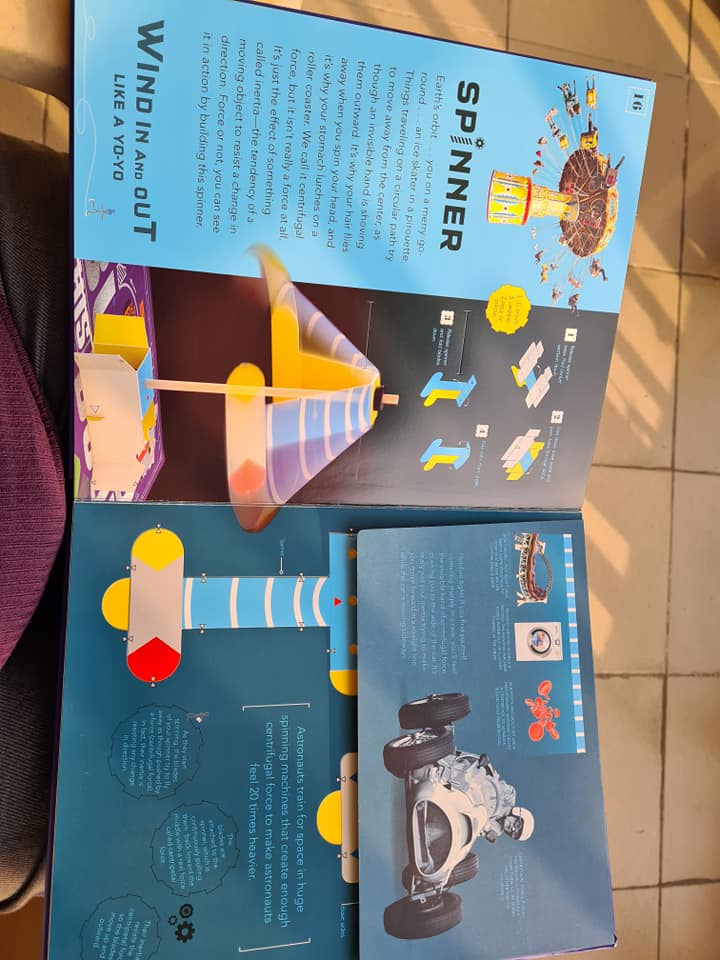
Build This Book by David Eckold has incredible book design to teach young minds the principles of physics. Concepts like lever, bridge ( to defy gravity), balance, winch, joints and links, turbine, spinner and potential energy are defined followed by instructions on how to make a model demonstrating the principle. The models are developed by children by punching out cards of each page. Interestingly, the perforated outlines are created in such a manner so as not to spoil the next page. There is a card backing to each design.
And then you have sights such as this one that I captured today of my daughter building models while attending online classes.
So much thought and detail to precision has gone into creating this book. Extraordinary! These are exactly the kind of tools one requires to nurture a child. More so now during the pandemic when children have been engaged in long-distance learning and do not necessarily have access to their classroom/ school resources.
I have spent an incredible four days (26-29 Jan 2021) in a webinar, spread across four countries and multiple time zones. The participants included 8 academics, 5 NGO reps, 21 students and 3 media consultants. It was organised and chaired by Siobhan Lambert-Hurley, Prof. of Global History, University of Sheffield, to discuss Female Literacy and Empowerment in the sub-continent through Life Writing.
“Life writing” is a loose term as it is documenting lives of women who do not necessarily document their lives in the straightforward linear narrative that is so often associated with predominant narratives. These are life stories created out of bits of evidence and stories gathered from the community and strung together to at times rescue women’s histories from the past or cobble together contemporary accounts. It is exciting, adventurous, relies on documentation and oral histories and is tough to define within the rules of traditional biographies. All of us gathered virtually to discuss material created so far, some of it has been made into draft stories, and we tried figuring out how best to work with the existing material to create these stories, perhaps even in a publishable format. There is a huge range of skill strengths and experiences in this team. This has to be garnered and capitalised upon in a constructive manner. The point being of sharing histories of women for future generations, something that Siobhan has been passionate for years!
It was fascinating hearing the learnings gleaned by the students and the partner organisations. The stories that have been created and the immense possibilities that lie in making these available to children, neo-literates and women in multiple languages, including Hindi, Urdu and English. The challenges that exist in making these available easily to many people and in many formats — print and digital. More importantly, passing on the learnings of the student in gathering oral histories, creating stories, learning to illustrate for children’s stories, creating a range of products, if necessary, translating them as well and learning about copyright.
So much was shared and discussed that it is impossible to put down in a few words. Hopefully the project will move beyond the pilot stage which has been incredibly successful in ensuring that most of the goals it set, were met.
Published in 2010 by Routledge, Gujarat beyond Gandhi: Identity, Conflict and Society, edited by Nalin Mehta and Mona G. Mehta is worth reading a decade later. The essays in the volume are varied and pick on different aspects of Gujarat. But it is the essay by Nalin Mehta that is truly worth spending time over. Much of what he documents at the state level is now being played out at the national level. Entitled “Ashis Nandy vs. the state of Gujarat: authoritarian developmentally, democracy and the politics of Narendra Modi”, Mehta plots in a detailed manner how this case against Nandy was filed by a “private citizen” against Nandy and Times of India (2008), where an article bemoaning the ‘culture of Gujarat politics’ and the middle classes for the state’s communal division, had been published. TOI distanced itself from the case. Nandy pointed out that this was a far cry from his experience with Khushwant Singh as the editor of Illustrated Weekly who fought the case slapped against them. Anyway, as Mehta adds, this “was a unique battle that was crucial for Indian public life across several different registers”. Prescient observation.
Reflecting on the issues raised by the case, Nandy rightly went on to argue that it was symptomatic of a larger Emergency-like culture and a disconnect with liberal cultures of intellectual dissent:
I was surprised because of the flimsiness of the case. I was surprised by the instances they cite in the police notice . . . they are not only trivial, they are comical. . .
This book, especially this essay, deserve to be resurrected from the graveyard of prohibitively expensive academic publications and made available to a wider audience. Conversations that essays like this can trigger must happen in real time and not decades later. Analyse. Debate. Discuss. Most importantly, testimonies such as this by people who have witnessed significant socio-political events and offered their opinion immediately, ensure that living histories are extensively shared and may perhaps unleash other memories. People will not feel isolated. Also, a collective feeling of sharing an experience may help develop a life force of its own to battle destructive energies.
In the Feb 2021 of the Seminar Magazine ( #738, ROAD TO JUSTICE: a symposium on thinking through the rule of law), I have reviewed noted feminist economist Devaki Jain’s memoir, The Brass Notebook. Here is the original url. I am also C&P the text below.
***
The Brass Notebook ( Speaking Tiger Books) is renowned feminist economist Devaki Jain’s memoir. Her life has been blessed with rich experiences given the freedom her father allowed her, which was unusual for the time. She had been fortunate that her Tamil Brahmin father did not impose the same restrictions and rituals upon her as he did on her elder sisters when it came to education, marriage, travel among others. Astonishingly she was even permitted by her father to stay alone in London after he had taken her there on an official trip as a companion.
Her trip was eventful; she managed to spend a few days with the then High Commissioner of India, Vijay Lakshmi Pandit. Later, Devaki attended a two-week seminar organized by the Quakers in Saarbrucken, Germany. There she met a Dane who persuaded her to accompany him. His plan was to hitchhike to England after taking a short detour to Copenhagen and then Sweden. Devaki agreed. Later she did an overland trip from England to India with another friend. She does remark in amazed wonder that ‘Looking back, it is surprising how little my father resisted.’ At this time, charmed by the idea of attending Oxford University, even though the admission process was over, she was admitted to Ruskin College, a relatively ‘new’ college that catered mostly to the working class and offered subjects like economics and industrial relations.
Years later when she met the principal H.D. Hughes and asked him why he had let her in, his reply was ‘Pure amusement …at the sight of this evidently upper class Indian girl in her early twenties, asking desperately to be allowed to study alongside men and women in their thirties with more than ten years of hard manual labour behind them. How, he said, could he resist such a social experiment?’
Devaki’s adventurous spirit permitted her to challenge her boundaries constantly. She did this even by marrying out of her caste to the prominent Gandhian, L.C. Jain, a Jain from Rajasthan. It was this very feistiness that enabled her to very early on in her life begin to question inherited traditions of culture and knowledge. For instance, in one of her earliest publications, an essay, ‘The Social Image’, that she wrote for Seminar (‘The Indian Woman’, # 52, December 1963, pp 20-23), she states categorically that the social image of women is mostly a patriarchal construct that is enabled by their veneration of the panchkanyas – Sita, Ahalya, Draupadi, Tara and Mandadori. She argues that this imagery fails to accommodate many women who fall outside ‘this Sita orbit’. This neglect creates both environmental and internal pressures. For example, the woman who stays unmarried and follows a career is considered an aberration. Instead she sought for the celebration of more rebellious women in the ancient Hindu traditions, women who stood up for themselves, and didn’t define themselves in relation to men: Amrapali, a cultured and worldly courtesan; Gargi, an ancient philosopher; Avaiyar, a Tamil poet and scholar, among others.
Later she was fortunate to have her values endorsed while she was enrolled at St. Anne’s College for her PPE course. Her tutors, Iris Murdoch, Peter Ady, Jenifer Hart: three supremely intellectual women, took her seriously as a fellow thinker – a respectful intellectual engagement. ‘I was a woman among other women, and we were bound by ties of intellectual sympathy. I was being valued for my intelligence, hard work and achievement.’ A bond of sisterhood that she learned to value later as an economist and at the helm of Institute of Social Studies Trust (ISST).
Devaki Jain is known for recognizing the value of a woman’s labour in real economic terms, whether towards the national economy or in the personal space. It was a slow and methodical process as she accrued experience as an economist, first by writing The Democratic Alternative at Minoo Masani’s invitation. Later as a lecturer in the Economics department, Miranda House, University of Delhi, she taught public finance. She would often walk across to the Delhi School of Economics to converse with eminent economists like Amartya Sen, K.N. Raj, Sukhamoy Chakraborty, and Jagdish Bhagwati to name a few. By 1972, she quit the university and the Indian Council for Social Science Research (ICSSR) helped her set up a new field-based project on the unrecognized contribution of women to the economy. Later she was commissioned by Sheila Dhar, Director, Publications Division, to edit Indian Women, to coincide with the UN International Year of Women, 1975. Contributors included, among others, Andre Beteille, Veena Das, Ashok Rudra, Romila Thapar, and Qurratulain Hyder. Ester Boserup, working on women in African agriculture, demonstrated the significance of gender roles in social analysis. Ashish Bose, a demographer, presented for the first time the falling sex ratio in India. The ratio declined from 972 females per 1000 males (1901) to 930/1000 (1971), prompting Amartya Sen to coin the phrase ‘India’s missing women’. Women of many different kinds were described in ‘Indian Women’: nuns, teachers, nurses, students, matriarchs. Later the Government of India also set up a committee to report on the status of women in India entitled ‘Towards Equality’.
This project pushed her into exploring her hunch that ‘the official figures on women’s participation in work were seriously underestimating the facts on the ground; I also suspected that what lay behind this underestimation was a deep methodological flaw in the approach to measurement.’ Her proposal to Raj Krishna’s Institute of Social Studies Trust (ISST) brought together her two interests – growing fascination with women’s role in labour, and her specialization in statistics. Her findings that the measurements were all wrong and much of the time data on women’s economic contribution was not even being collected. She also discovered that the female work participation rates were in fact higher than participation rates for men amongst the landless in India, ‘landless’ being a proxy for extreme poverty. This challenged the long-held belief that the main breadwinner of a household was generally a man.
The string of accomplishments Devaki Jain garnered are endless. For instance, she was one of three women who was invited to participate in Julius Nyere’s twenty-eight member South Commission. It was constituted to give voice to the shared perspective of the South, drawn from the experience of Non-Aligned Movement countries, and not simply imported from northern models that may or may not be suited to the conditions of these societies. She has worked with various national and international agencies committed to a gendered understanding of economics. Her strong friendships with well known feminists like Gloria Steinem and Alice Walker, have only strengthened her perspective on women’s rights. In fact, it is the fundamental principle that she agrees with and so heartily endorses Walker’s view that there is no problem in being called a ‘feminist’ or a ‘womanist’, whatever it takes for women’s liberation to be recognized and for a woman to earn her freedom – that is all that matters.
In keeping with her strong characteristic of recognizing her self-worth and preserving her dignity, she documents the sexual harassment she faced from her maternal uncle and later by a well known Swedish economist at Balliol College, Oxford in 1958. She was interviewed for the job to be his junior research assistant from Asia to work on his magnum opus, a three-volume work on development. She had been interviewed at the home of the then Swedish Ambassador to the UK, Alvar Myrdal. Reflecting upon the incident in the wake of the #MeToo movement, Jain realizes that in 1958 she had no recourse to retribution as there is now for women who work for men and are sexually harassed. Different age, different rules. But why a doyen of feminism like her chooses not to reveal the name of the aggressor, when she doesn’t hide the specific familial relationship with her maternal uncle (who she also doesn’t name) is puzzling. At any rate, it was her choice to make and must be respected.
The title, The Brass Notebook, has been inspired by Doris Lessing’s The Golden Notebook where Devaki Jain uses ‘brass’ as for her it has warm associations with her childhood, but it is also ‘a hardier, homelier metal than gold. It represents not perfection or unity, but an honourable imperfection consistent with my own limits.’ This clearheaded understanding of what it means to be a woman, chart her own career and who values her labour were pathbreaking concepts then and to some extent are even now – nearly six decades later. The Brass Notebook is a snapshot of a life well lived by a pioneering feminist and an excellent role model for subsequent generations.
Dr SanjayGupta’s new book, Keep Sharp, is an absorbing read about how to keep oneself fit and healthy, especially our brains. He shares the widely held belief that grey matter stops developing in early adulthood. But now new theories say that that is no longer true. The brain can remain sharp if encouraged to do so by adopting better lifestyle behaviour such as regular exercise, eating home cooked food ( preferably slow cooked and less reliance on takeaways), meditating, reading more, less of digital consumption and definitely hydrating more with regular water than sugar-based drinks. His concern stems from the growing number of people who are diagnosed with dementia, a condition for which no known cure exists as of now, but cannot be ruled out in the near future given the rate at which medical science is advancing. Dr Gupta, who has travelled widely as a reporter with the CNN and continues to practice as a brain surgeon recognises the urgent need to appeal to people while they are healthy to take charge of their lives. He is very keen that folks wrought a change in their life now with the hope that it will mean a better old age. He also focuses on caregivers or as they are defined as now, ” invisible second patients” and the need to understand the stress that they imbibe. Caregiver burnout is very real and hence, self-care is critical. Perhaps it’s design in the book is unintentional but the message that comes across is that devastating impact of caregiving is akin to being in a war zone. But he states often enough in the book that “I’ve noted that the people who live better– and longer — are the ones who hold on to hope.”
I like the way he has likened caregivers to “invisible second patients”. Apparently it is parlance commonly used in the medical fraternity. It has not been coined by him. But at least he has made it visible to the lay reader and I think by doing so, it has been a phenomenal act upon his part. It is almost cathartic for a medical professional to recognise how stressful caregiving can be.
Having been a caregiver myself for many years, it’s heartening to read an experienced doctor confirm many of the practices that one has unwittingly woven as regular practice into one’s life. For example, eating a balanced diet, preferring slow cooked homefood to commercial food, no snacking, water vs juices/sodas, daily exercise, reading etc. Perhaps it happened by witnessing the slow degeneration of a healthy individual. A large part of the cargiving is taken up by creating the right meals and exercise. So basic. As he constantly emphasises in his book that these are some aspects of one’s cargiving that should be non-negotiable. Everyone is busy but not busy enough to fit in some self-care on a daily basis. It helps in the long run as he can affirm from the patients he meets or the autopsies he has conducted and reviewed the state of brains.
Dr Gupta has created as 12-week brain training programme that may sound easy or tough depending on the nature of one’s current lifestyle. But it is doable. Worth exploring.