Urdu Posts

Jaya’s newsletter 8 ( 14 Feb 2017)

It has been a hectic few weeks as January is peak season for book-related activities such as the immensely successful world book fair held in New Delhi, literary festivals and book launches. The National Book Trust launched what promises to be a great platform — Brahmaputra Literary Festival, Guwahati. An important announcements was by Jacks Thomas, Director, London Book Fair wherein she announced a spotlight on India at the fair, March 2017.  In fact, the Bookaroo Trust – Festival of Children’s Literature (India) has been nominated in the category of The Literary Festival Award of International Excellence Awards 2017. (It is an incredible list with fantabulous publishing professionals such as Marcia Lynx Qualey for her blog, Arablit; Anna Soler-Pontas for her literary agency and many, many more!) Meanwhile in publishing news from India, Durga Raghunath, co-founder and CEO, Juggernaut Books has quit within months of the launch of the phone book app.

In other exciting news new Dead Sea Scrolls caves have been discovered; in an antiquarian heist books worth more than £2 m have been stolen; incredible foresight State Library of Western Australia has acquired the complete set of research documents preliminary sketches and 17 original artworks from Frane Lessac’s Simpson and his Donkey, Uruena, a small town in Spain that has a bookstore for every 16 people  and community libraries are thriving in India!

Some of the notable literary prize announcements made were the longlist for the 2017 International Dylan Thomas Prize, the longlist for the richest short story prize by The Sunday Times EFG Short Story Award and the highest Moroccan cultural award has been given to Chinese novelist, Liu Zhenyun.

Since it has been a few weeks since the last newsletter the links have piled up. Here goes:

  1. 2017 Reading Order, Asian Age
  2. There’s a pair of bills that aim to create a copyright small claims court in the U.S. Here’s a breakdown of one
  3. Lord Jeffery Archer on his Clifton Chronicles
  4. An interview with award-winning Indonesian writer Eka Kurniawan
  5. Pakistani Author Bilal Tanweer on his recent translation of the classic Love in Chakiwara
  6. Book review of Kohinoor by William Dalrymple and Anita Anand
  7. An article on the award-winning book Eye Spy: On Indian Modern Art
  8. Michael Bhaskar, co-founder, Canelo, on the power of Curation
  9. Faber CEO speaks out after winning indie trade publisher of the year
  10. Scott Esposito’s tribute to John Berger in LitHub
  11. An interview with Charlie Redmayne, Harper Collins CEO
  12. Obituary by Rakhshanda Jalil for Salma Siddiqui, the Last of the Bombay Progressive Writers.
  13. Wonderful article by Mary Beard on “The public voice of women
  14. Enter the madcap fictional world of Lithuanian illustrator Egle Zvirblyte
  15. Salil Tripathi on “Illuminating evening with Prabodh Parikh at Farbas Gujarati Sabha
  16. The World Is Never Just Politics: A Conversation with Javier Marías
  17. George Szirtes on “Translation – and migration – is the lifeblood of culture
  18. Syrian writer Nadine Kaadan on welcoming refugees and diverse books
  19. Zhou Youguang, Who Made Writing Chinese as Simple as ABC, Dies at 111
  20. Legendary manga creator Jiro Taniguchi dies
  21. Pakistani fire fighter Mohammed Ayub has been quietly working in his spare time to give children from Islamabad’s slums an education and a better chance at life.
  22. #booktofilm
    1. Lion the memoir written by Saroo Brierley has been nominated for six Oscars. I met Saroo Brierley at the Australian High Commission on 3 February 2017. 
    2. Rachel Weisz to play real-life gender-fluid Victorian doctor based on Rachel Holmes book
    3. Robert Redford and Jane Fonda to star in Netflix’s adaptation of Kent Haruf’s incredibly magnificent book Our Souls at Night
    4. Saikat Majumdar says “Exciting news for 2017! #TheFirebird, due out in paperback this February, will be made into a film by #BedabrataPain, the National Award winning director of Chittagong, starring #ManojBajpayee and #NawazuddinSiddiqi. As the writing of the screenplay gets underway, we debate the ideal language for the film. Hindi, Bengali, English? A mix? Dubbed? Voice over?
    5. 7-hour audio book that feels like a movie: Julianne Moore, Ben Stiller and 166 Other People Will Narrate George Saunders’ New Book – Lincoln in the Bardo.
    6. Doctor Strange director Scott Derrickson on creating those jaw-dropping visual effects

New Arrivals ( Personal and review copies acquired)

  • Jerry Pinto Murder in Mahim 
  • Guru T. Ladakhi Monk on a Hill 
  • Bhaswati Bhattacharya Much Ado over Coffee: Indian Coffee House Then and Now 
  • George Saunders Lincoln in the Bardo 
  • Katie Hickman The House at Bishopsgate 
  • Joanna Cannon The Trouble with Goats and Sheep 
  • Herman Koch Dear Mr M 
  • Sudha Menon She, Diva or She-Devil: The Smart Career Woman’s Survival Guide 
  • Zuni Chopra The House that Spoke 
  • Neelima Dalmia Adhar The Secret Diary of Kasturba 
  • Haroon Khalid Walking with Nanak 
  • Manobi Bandhopadhyay A Gift of Goddess Lakshmi: A Candid Biography of India’s First Transgender Principal 
  • Ira Mukhopadhyay Heroines: Powerful Indian Women of Myth & History 
  • Sumana Roy How I Became A Tree 
  • Invisible Libraries 

14 February 2017 

Interview with Pakistani Author Bilal Tanweer on his recent translation of the classic “Love in Chakiwara”

( This interview was first published in Bookwitty on 7 January 2017. The book has been published by Pan Macmillan India. ) 

Muhammad Khalid Akhtar (1920–2002), modern Urdu literature’s great master, worked as an electrical engineer in Karachi and began writing while still in service. He was a prolific writer whose oeuvre consisted of novels, short stories, essays, reviews, parodies and travelogues. His short story Khoya hua ufaq (written in 1943) was published by noted writer Saadat Hasan Manto in 1953. He is also known for his translations into Urdu of Alice in Wonderland and Alice through the Looking Glass. He was awarded the Aalmi Farogh-e Urdu Award for lifetime achievement by Majlis Farogh-e-Adab, Doha. Although he is known as an Urdu writer, Dawn newspaper published an article in which in a letter to his friend Mohammad Kazim dated July 11, 1954, when Khalid Akhtar was in his mid-30s, he wrote ‘Urdu is my darling, but after so many years, I have yet to learn the craft of using it properly. My vocabulary is limited. Even today the thought comes in English and has to be delivered in Urdu. I have to make a conscious effort to convey an idea in Urdu. Every sentence is an effort, an agony.’

According to well-known Pakistani writer, Musharraf Ali Farooqi, Khalid Akhtar’s earliest writings were parodies written in English. When they first met, Farooqi was 24 and Khalid Akhtar 72. Khalid Akhtar quietly began to mentor Farooqi by encouraging him to read and lending him books from his personal library and later being his first reader/critic. Farooqi recalled that Khalid Akhtar “mentioned to me that some well-meaning people who had read my Urdu prose, and knowing of his influence with me, had suggested to him that he should persuade me to write in Urdu. I told him that I had decided to write in English be­cause most of the fiction I read was either originally written in English, or was translated into it, and when I thought of writing something it became difficult not to think in the language I read all the time. He knew the problem and told me that his first writings were in Eng­lish too, but persuaded by friends to write in Urdu, he gave up writing in English.”

Nearly fifty years after Chakiwara main Visal (1964) was published, the English translation along with three other stories, The Smiling Buddha, The Love Meter and The Downfall of Seth Tanwari, based in Chakiwara, a Karachi neighbourhood, was just published by PanMacmillan India as Love in Chakiwara and other misadventures. The smooth translation of these stories from Urdu to English is by noted Pakistani writer Bilal Tanweer. In the title story (which is more a novella), Love in Chakiwara, the writing is reminiscent of Jonathan Swift’s satirical wit. Oddly enough, Swift’s humorous writing style perfected to an art form a few centuries earlier is a befitting literary technique used by Khalid Akhtar when recreating the sights, sounds and conversations of a Karachi neighbourhood. The credit for these stories in pitch perfect English translation, seemingly Swiftian, most definitely goes to Bilal Tanweer who labored long and hard with this collection of stories.

Tanweer teaches creative writing at Lahore University of Management Sciences. His short stories, essays, and poetry have been published by Granta, Critical Muslim, Life’s Too Short Literary Review: New Writing From Pakistan, Vallum, Dawn, The Express Tribune, The News on Sunday, and The Caravan (India); his translations from the Urdu have appeared in Words Without Borders and The Annual of Urdu Studies. In 2010 he received the PEN Translation Fund Grant for Chakiwara chronicles; in 2011 he was selected as a Granta New Voice.

Following are excerpts of an interview conducted with Bilal Tanweer.

Bilal Tanweer
Bilal Tanweer

Why did you select Chakiwara main Visal to translate? Which of the stories included in this collection did you enjoy translating the most?

Credit goes to [noted Pakistani writer] Musharraf Ali Farooqi who recommended that I read the book and take on the project. I translated an excerpt from another story by Muhammad Khalid Akhtar, which was published in Words Without Borders, and received a positive response from the readers. That encouraged me to undertake a longer project, which has taken some six years.

How many times did you read the original story in Urdu before you began the translation?

During my last translation project, I realized that the translated text becomes choppy and loses its flow if you continually pause to look up words. So now I begin by reading the whole text first to get a sense of the tonality of the text. Then I read the chapter which I have to translate, underlining all the words that are confusing to me, or that could be translated several ways. Then I look up unknown or confusing words. I also try to find solutions for words whose translation could be difficult or tricky. Once all this is done, I begin translating. I try to work quickly without taking too many breaks; it really helps preserve the flow of the text.

What is your translation routine? Do the methodologies of writing and revising differ considerably between translated literature and original fiction?

Yes, they do. With translation you are focusing mostly on language. So revisions are limited to make the best linguistic choices. With writing, everything is up for revision.

When and why did you venture into translations?

I was a student in New York living on a slim stipend when I saw an advertisement for a $5000 translation prize. I thought I should have a crack at it. I did not win the prize but I realized translating was a lot of fun—much more than I had imagined. So I carried on.

Urdu literature is known for its rich embellishments and exaggerated descriptions. Are these easily translated into English?

Usually these poetic flourishes are not easy to translate. These were particularly a problem in my last project of Ibn-e Safi’s work where prose is playful, and contains many allusions from Urdu poetry. With Khalid Akhtar, the problem did not arise because he writes in a more “urban” prose where the use of poetic exaggerations are ironic, which can be communicated to the reader.

Fictional landscapes such as Thomas Hardy’s Wessex and R K Narayan’s Malgudi become permanent fixtures in a reader’s mind. Muhammad Khalid Akhtar’s Chakiwara is similar. As a novelist yourself would you ever consider creating such a landscape and use it consistently in your fiction? What are the pros and cons of doing so?

I am a strong believer in the dictum that great fiction is fiction of place. Great writing emerges from deep engagement with specific places, and Chakiwara is no exception to this.

14 February 2017 

An Interview with Daisy Rockwell, Author, Artist and a Hindi-Urdu Translator

This interview was first published on Bookwitty.com on 20 December 2016 ) 

Daisy Rockwell is an artist, writer and Hindi-Urdu translator living in the United States. Rockwell grew up in a family of artists in western Massachusetts. From 1992-2006, she made a detour into academia, from which she emerged with a PhD in South Asian literature, a book on the Hindi author Upendranath Ashk and a mild case of depression. Upendranath Ashk was a Hindi writer, based in Allahabad, who began publishing in pre-Independent India but soon, due to his irascible temperament chose to self-publish much of his later work. Daisy Rockwell met the Hindi writer on a few occasions in the 1990s and began translating his fiction with his permission. Unfortunately Ashk never saw Daisy Rockwell’s publications. Daisy Rockwell’s diligent dedication to the task shines through the quality of the English translations that were ultimately published. The translated literature is a pure delight to read; smooth and evocative of the early and mid-twentieth India they are set in.

Rockwell has written The Little Book of Terror, a volume of paintings and essays on the global war on terror (Foxhead Books, 2012), and her novel Taste was published by Foxhead Books in April 2014. Her translation of Ashk’s well-known novel about the evolution of a writer Girti Divarein was published by Penguin India as Falling Walls (2015), her collection of translations of selected stories by Ashk, Hats and Doctors ( 2013); and her new translation of Bhisham Sahni’s legendary novel about the partition of India, Tamas ( 2016).

An Interview with Daisy Rockwell, Author, Artist and a Hindi-Urdu Translator - Image 1
An Interview with Daisy Rockwell, Author, Artist and a Hindi-Urdu Translator - Image 2

How did you choose Hindi to be the language to master and translate from?

I wandered into Hindi in college and never really wandered out again. I loved learning languages and had studied French, Latin, ancient Greek, and German. I wanted something less familiar and happened to take a social sciences course with Susanne Hoeber Rudolph, who spoke of her life doing research in India, so I decided to sign up for Hindi. Translation was something one had to do anyway in graduate school, but I was fortunate to take a translation seminar with AK Ramanujan shortly before his death, and that illuminating experience has stayed with me always.

How do you select a text to translate?

It’s hard to say. Often a text chooses you, rather than vice versa. I wrote my doctoral dissertation about Upendranath Ashk, and always wanted to translate his work, though that project fell by the wayside. Eventually I took it up again because it wouldn’t let me go.

Do you have any basic guidelines that you follow while translating? For instance is it crucial to convey the authentic form of Hindi used in the language of origin or is it important to stress readability in the destination language?

What’s important to me is that the translation reads as well as the original, and that the reader in English can get the same feeling from it that the Hindi reader might (despite the vastly different reading contexts).

If the text you decide to work upon has been translated before into English, do you ever read it or do you like to approach your project with a fresh perspective?

I would never retranslate something that was already done well. I first check the existing translation against the Hindi in the opening chapter. If I decide to retranslate it, I keep the other translations at hand and consult with them, as though I were sitting among friends. Even if I think the previous translator did poorly, I recognize that he or she may see things in ways that would escape me, or know things I don’t know. Translation is a lonely business, and the other translators keep me company. I argue with them, listen to them, curse at them, and lean on them. Much of Hindi literature has not been translated, however, so retranslation is actually a rare luxury.

What has been the most exciting challenge you have encountered while translating Hindi?

Translation is almost always challenging, but rarely exciting.

What form of Hindi are you most comfortable with? Does it belong to a particular period of Hindi literature?

Because of Ashk and Bhisham Sahni, I have become really strong in 1930’s-40’s Punjabi-centric Hindi. I know all kinds of architectural details and articles of clothing and turns of phrase. Oddly, contemporary writing can be much more difficult for me.

Does translating Hindi while based in USA create any cultural challenges or is the immersion in your text so complete that your geographical location is immaterial?

It’s terribly challenging, but Twitter and social media have changed things dramatically. Much of the translating I’ve done would be difficult in India or Pakistan as well, without the reach of social media. There is much in novels of the earlier part of the 20th century that cannot be found in dictionaries nor in contemporary discourse. It’s not stuff most people know. I have to hunt high and low for definitions of some terms, and I depend greatly on my twitter friends for help in this regard.

Do you think it is “easier” to publish translations of Hindi literature as compared to when you first started in the 1990s? If yes, what are the possible reasons for this growing interest?

It is easier to publish them in India. In the US, I have yet to find a publisher for any of my translations. In India there is definitely a growing interest in translations and a growing respect for non-English language literatures. I am not sure how this happened, but I am thankful for it, and all signs point to continued growth in publication and interest.

How do you define “original text” as opposed to the “transcreations” authors such as Bhisham Sahni and Upendranath Ashk undertook with their own works when translating into English — a style not uncommon among many bilingual writers? Won’t the “revisions” to the text done later by the authors themselves be considered as “original” text? Which version do you opt to use in your translation?

I think bilingual authors should avoid translating their own work as much as possible. It seems most writers cannot withstand the temptation to alter the original while translating. They are the author, after all, so they have the right–but in doing so they deprive the English readers of the original text. At times, they alter the original beyond recognition, as in the sad case of Qurratulain Hyder’s translations River of Fire and Fireflies in the Mist. It is also often the case that bilingual people are rarely the same writer in two languages. Sahni translated Tamas himself, for example, but his English writing style was brittle and high-brow; though he knew English extremely well, he didn’t know the kind of English that Tamas would have been written in. The Hindi of Tamas is strikingly clear, succinct, and unadorned. His translation was unable to capture that. Hyder’s English was also perfect, but she clearly believed that the material must be presented differently to English readers and changed her works in sometimes very peculiar ways. And despite the fact that her English was perfect, I don’t believe that she wrote as well in English as she did in Urdu. It wasn’t a matter of being correct or not, but a matter of flow and style. In the case of the Sahni family, there was recognition that their father’s translation did not quite capture the spirit and they generously gave permission to retranslate. Sadly, Hyder’s heirs, following her wishes, refuse to grant permission to anyone to retranslate the books, so they remain off-limits to English readers, except for in their transcreated versions.

Your two creative pursuits — painting and translations can be exacting and very fulfilling. Do they in any way influence each other? For instance if you are tussling with a particularly challenging piece of translation does it get reflected in your painting and vice versa?

I’d like to think they’re connected, but if they are, the connection is not clear to me. I’ve occasionally illustrated translations or discussions of translation, but most of the time they are quite separate in my mind.

Is your preference only for literary fiction or would you try pulp fiction or even poetry in the future?

I’ve always been a high literature kind of gal. I never read pulp fiction (except for Blaft’s Tamil Pulp Fiction!) at all. There are plenty of translators who could do that, at any rate, but classics, in particular, require a great deal of reflection and research, and that’s where my niche lies. I have been translating some poetry lately though, such as Shubham Shree’s Poetry Management, and Avinash Mishra’s untranslatable poems on Hindi orthography . I’ve also been translating some poetry by Mangalesh Dabral, which has not yet been published.

An Interview with Daisy Rockwell, Author, Artist and a Hindi-Urdu Translator - Image 3


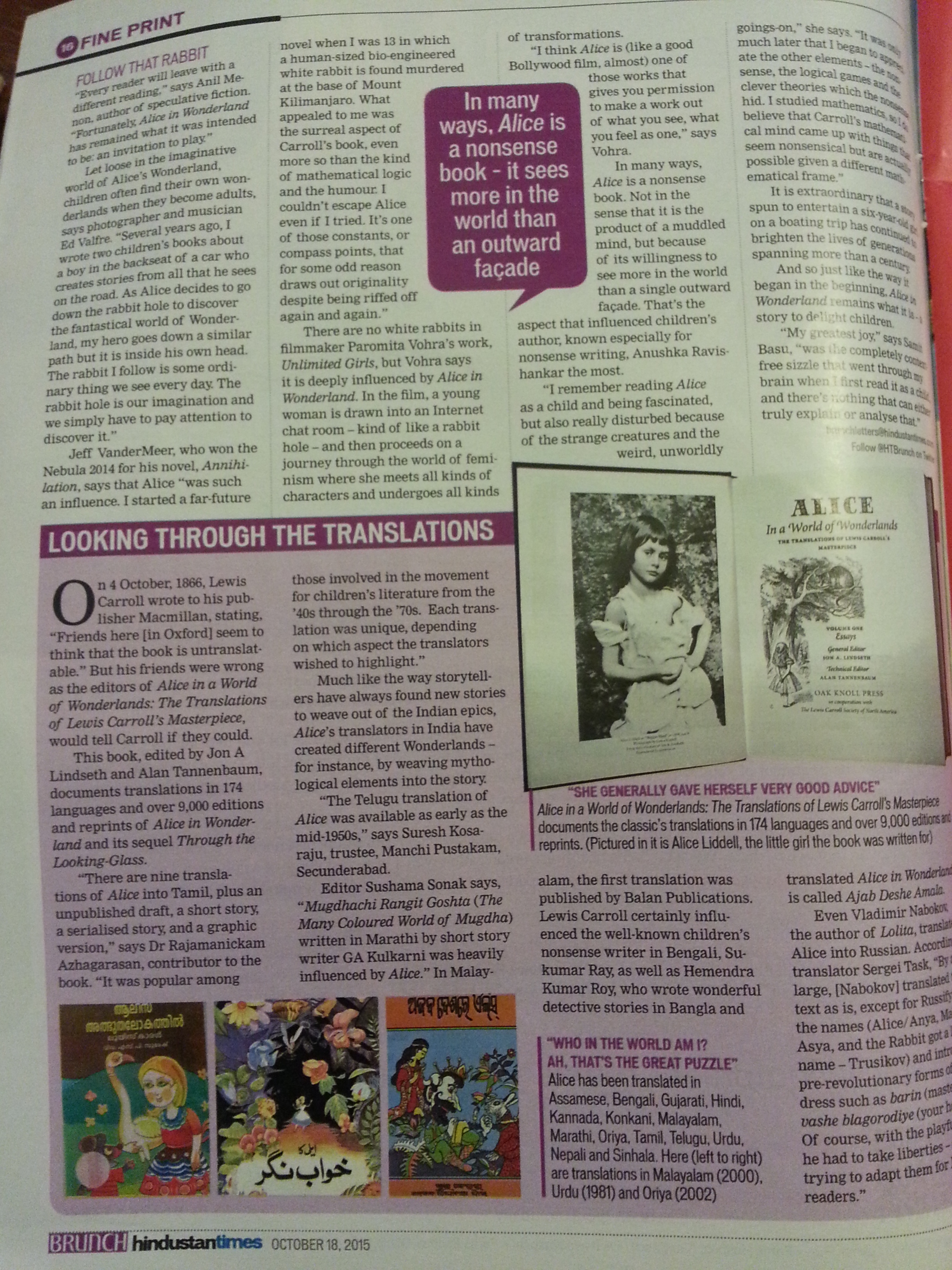
“Alice in Wonderland” continues to inspire readers across the world

( My article on Alice in Wonderland has been published in Hindustan Times popular and widely circulated Sunday 20151018_065049supplement Brunch on 18 October 2015. It is a generous two-page spread in print20151018_065100 with the title “Curiouser And Curiouser”. I am c&p the text from the digital version here. The original url can be viewed at: http://www.hindustantimes.com/brunch/alice-in-wonderland-continues-to-inspire-readers-across-the-world/story-NKnM2TiOACiTMXQXtUI51M.html )

Scottish writer George MacDonald persuaded Carroll to self-publish Alice. It had been tested out on the MacDonald children by their mother – and the family loved it. (Above, Carroll with Mrs MacDonald and her children.) (Getty Images/Science Source)

Who’d have thought a self-published story written for the daughters of a friend would become a world classic, eagerly bought, borrowed and downloaded even now, 150 years later?

 Alice in Wonderland was written in 1865 by Charles Lutwidge Dodgson, a mathematics professor at Oxford, better known by his pen name, Lewis Carroll. He wrote it for Lorina, Alice and Edith, the three daughters of his friend, Reverend Henry Liddell.

Start of many things

Alice in Wonderland is about a girl named Alice who falls down a rabbit hole in pursuit of the White Rabbit and discovers a nonsensically delightful world with colourful characters like the Red Queen, the Mad Hatter, the Cheshire Cat and the March Hare. More writers, artists and creators all over the world have credited Alice as an inspiration than any other book, thanks to its imaginative world filled with fantastic linguistic acrobatics in rhyme and prose.

That the book should have emerged in the staid Victorian era of verbose and righteous prose says much for the power of creativity. Carroll was persuaded to publish Alice with his own illustrations, by Scottish author and poet, George MacDonald.

The story had been tested out on the MacDonald children by their mother. The family thoroughly enjoyed the tale, and Carroll self-published it. Then, it was edited and published by Alexander Macmillan.

Alice, coverLewis Carroll requested the well-known artist of Punch, Sir John Tenniel to create the illustrations, many of which were ultimately based on the original drawings made by the author. To commemorate the 150th year of its publication, Macmillan, the original publisher, has produced a scrumptious edition of The Complete Alice, with the original Tenniel illustrations in full colour. It is unusual for a publisher to be celebrating 150 years of a text, but Alice in Wonderland is perceived to be “a world text”.

Alice in Wonderland is about a girl named Alice who falls down a rabbit hole in pursuit of the White Rabbit. On the left is an illustration of the character by Carroll himself, and next to it (right) by Tenniel. (Photos: Stapleton Collection/Corbis, The Print Collector/Corbis)

“It’s one of those texts that IS, like Shakespeare,” says graphic novelist Samit Basu. “Its constant reinterpretations in everything, from zombie comics to action-fantasy novels, have kept the original text alive, and that’s the greatest thing that can happen to any book.”

This is evident by the text’s vast influence across creative platforms and genres – storytelling, play on words, visual arts, filmmakers, still photography and translations.

According to filmmaker and author Devashish Makhija, a lot of motifs from Alice have been uncannily replicated across the world. “Tweedledum and Tweedledee seem to have inspired Herge’s Thompson and Thomson in Tintin,” he says. “Batman’s Joker seems to have shades of the Mad Hatter, at least in his inexplicable (but profound) reliance on creating some sort of chaos in anything he communicates.”

And there’s more. When Alice fell down a rabbit hole to discover a topsy-turvy world, Makhija argues, she opened a clear story-telling device for creators of the future. “The ‘hole’ – although in existence before this book – was used pointedly for the first time as a portal connecting two dimensions through which a character ‘travels’.

It has since been used in versions in almost ALL of fantasy writing: the wardrobe in CS Lewis’s Narnia series, the square drawn with chalk in Pan’s Labyrinth, platform 93/4 inHarry Potter, the bridge of Terabithia, HG Wells’s time machine and even the bathtub in Anurag Kashyap’s No Smoking.”

Follow that rabbit

“Every reader will leave with a different reading,” says Anil Menon, author of speculative fiction. “Fortunately, Alice in Wonderland has remained what it was intended to be: an invitation to play.”

Let loose in the imaginative world of Alice’s Wonderland, children often find their own wonderlands when they become adults, says photographer and musician Ed Valfre. “Several years ago, I wrote two children’s books about a boy in the backseat of a car who creates stories from all that he sees on the road. As Alice decides to go down the rabbit hole to discover the fantastical world of Wonderland, my hero goes down a similar path but it is inside his own head. The rabbit I follow is some ordinary thing we see every day. The rabbit hole is our imagination and we simply have to pay attention to discover it.”

Jeff VanderMeer, who won the Nebula 2014 for his novel, Annihilation, says that Alice “was such an influence. I Jeff Vandermeer, Southern Reach Trilogy, Rabbit Totem, illustrated by Jeremy Zerfossstarted a far-future novel when I was 13 in which a human-sized bio-engineered white rabbit is found murdered at the base of Mount Kilimanjaro. What appealed to me was the surreal aspect of Carroll’s book, even more so than the kind of mathematical logic and the humour. I couldn’t escape Alice even if I tried. It’s one of those constants, or compass points, that for some odd reason draws out originality despite being riffed off again and again.”

There are no white rabbits in filmmaker Paromita Vohra’s work, Unlimited Girls, but Vohra says it is deeply influenced by Alice in Wonderland. In the film, a young woman is drawn into an Internet chat room – kind of like a rabbit hole – and then proceeds on a journey through the world of feminism where she meets all kinds of characters and undergoes all kinds of transformations.

“I think Alice is (like a good Bollywood film, almost) one of those works that gives you permission to make a work out of what you see, what you feel as one,” says Vohra.

In many ways, Alice is a nonsense book. Not in the sense that it is the product of a muddled mind, but because of its willingness to see more in the world than a single outward façade. That’s the aspect that influenced children’s author, known especially for nonsense writing, Anushka Ravishankar the most.

“I remember reading Alice as a child and being fascinated, but also really disturbed because of the strange creatures and the weird, unworldly goings-on,” she says. “It was only much later that I began to appreciate the other elements – the nonsense, the logical games and the clever theories which the nonsense hid. I studied mathematics, so I do believe that Carroll’s mathematical mind came up with things that seem nonsensical but are actually possible given a different mathematical frame.”

It is extraordinary that a story spun to entertain a six-year-old girl on a boating trip has continued to brighten the lives of generations spanning more than a century.

And so just like the way it began in the beginning, Alice in Wonderland remains what it is – a story to delight children.

“My greatest joy,” says Samit Basu, “was the completely context-free sizzle that went through my brain when I first read it as a child, and there’s nothing that can either truly explain or analyse that.”

**

Looking back through translations

On 4 October, 1866, Lewis Carroll wrote to his publisher Macmillan, stating, “Friends here [in Oxford] seem to think that the book is untranslatable.” But his friends were wrong as the editors of Alice in a World of Wonderlands: The Translations of Lewis Carroll’s Masterpiece, would tell Carroll if they could.

Alice in a World of Wonderlands: The Translations of Lewis Carroll’s Masterpiece documents the classic’s translations in 174 languages and over 9,000 editions and reprints. (Pictured in it is Alice Liddell, the little girl the book was written for)

This book, edited by Jon A Lindseth and Alan Tannenbaum, documents translations in 174 languages and over 9,000 editions and reprints of Alice in Wonderland and its sequel Through the Looking-Glass.

“There are nine translations of Alice into Tamil, plus an unpublished draft, a short story, a serialised story, and a graphic version,” says Dr Rajamanickam Azhagarasan, contributor to the book. “It was popular among those involved in the movement for children’s literature from the ’40s through the ’70s. Each translation was unique, depending on which aspect the translators wished to highlight.”

Alice has been translated in Assamese, Bengali, Gujarati, Hindi, Kannada, Konkani, Malayalam, Marathi, Oriya, Tamil, Telugu, Urdu, Nepali and Sinhala. Here (left to right) are translations in Malayalam (2000), Urdu (1981) and Oriya (2002).

Much like the way storytellers have always found new stories to weave out of the Indian epics, Alice’s translators in India have created different Wonderlands – for instance, by weaving mythological elements into the story.

“The Telugu translation of Alice was available as early as the mid-1950s,” says Suresh Kosaraju, trustee, Manchi Pustakam, Secunderabad.

Editor Sushama Sonak says, “Mugdhachi Rangit Goshta (The Many Coloured World of Mugdha) written in Marathi by short story writer GA Kulkarni was heavily influenced by Alice.”

In Malayalam, the first translation was published by Balan Publications. Lewis Carroll certainly influenced the well-known children’s nonsense writer in Bengali, Sukumar Ray, as well as Hemendra Kumar Roy, who wrote wonderful detective stories in Bangla and translated Alice in Wonderland: it is called Ajab Deshe Amala.

Even Vladimir Nabokov, the author of Lolita, translated Alice into Russian. According to translator Sergei Task, “By and large, [Nabokov] translated the text as is, except for Russifying the names (Alice/Anya, Mabel/Asya, and the Rabbit got a last name – Trusikov) and introducing pre-revolutionary forms of address such as barin (master) and vashe blagorodiye (your honour). Of course, with the playful verses, he had to take liberties – again, trying to adapt them for Russian readers.”

18 October 2015 

Muztar Khairabadi’s Khirman


Muztar Khairabadi. Photo: Jayachandran/Mint

Muztar Khairabadi. Photo: Jayachandran/Mint

The Mint published a review by Rakhshanda Jalil on Muztar Khairabadi’s Khirman, now better known as Javed Akhtar’s grandfather. She gives a fantastic account of how the poems were discovered. Slowly, spread over many years, Muztar Khairabadi body of work was put together by collecting poems from personal collections and libraries. Authenticating the poems too was a labour of love. Last week the book was finally published and released in New Delhi, India. This is a good article to Poemsread. http://www.livemint.com/Leisure/tde1HlP7hIatV65Icjbl6N/Lounge-Review-Muztar-Khairabadis-Khirman.html ( 12 Sept 2015)
InvitationSadly what is missing are the book details. From what I hear this particular book has been self-published. Limited copies have been printed and priced at an exorbitant price of Rs 10,000. The book was released by the Vice President of India.

14 September 2015 


On travel writing and translations

Between WorldsIn recent months I have read two books of travel writing translated from Urdu and Bengali respectively. They were first written a century apart but the English translations were made available six months of each other. The two books are:

1. Yusuf Khan Kambalposh Between Worlds: The Travels of Yusuf Khan Kambalposh, translated and edited by Mushirul Hasan and Nishat Zaidi, published by Oxford University Press ( 2014). Original title: Tarikh-i-Yusufi (1837-38), first published by Naval Kishore Press ( 1898)

2. Syed Mujtaba Ali In a land far from home: A Bengali in Afghanistan translated by Nazes Afroz, published by Speaking Tiger ( 2015). Original title: Deshe Bidishe, first published in 1948

There is something fascinating about accessing the past through contemporary literature. Making translations of such texts available to a modern audience is a commendable effort since many such texts are tucked away in personal collections, archives, and libraries. Selecting an “appropriate” text for a 21-century reader is dependant on a variety of factors — not just on the book’s own merit. It is probably relevance of the text being translated. For instance, Between Worlds, is about thirty-three-year-old Yusuf Khan Kambalposh who decides to visit England. He had no patronage, was not dependent on anyone for financial support or for social contracts but made the journey on his own. He was in London to see Queen Victoria being coronated. All though he often wrote in Persian, this travelogue was written in Urdu, a fascinating choice given the time it was written in. But it also shows the impact the Delhi Vernacular Translation Society ( 1843) had in popularising the language among the masses of readers in North India. Most translations were made available in Urdu. It is also a significant travelogue since it is a rare perspective offered by an Indian and not necessarily from a Colonial perspective. It is also about Victorian England at a time when modern literature about Queen Victoria is gaining importance.

With In a land far from home there is a firsthand account of a non-Afghan, a Bengali traveller, having travelled so far North, living in land_far_from_home_coverAfghanistan, witnessing a tumultuous period of history. It is when the reformist King Amanullah tried to steer his country towards modernity by encouraging education for girls and giving them the choice of removing the burqa. Branded a ‘kafir’, Amanullah was overthrown by the bandit leader Bacha-e-Saqao. ( An extract from the book may be read on Caravan magazine’s website: http://www.caravanmagazine.in/vantage/why-bengali-traveller-was-flummoxed-afghani-hospitality . )

Both the translated texts are worth reading from an academic point of view. They are footnoted and with plenty of prefatory material. Fascinating for the old world they reveal especially when seen through the prism of contemporary socio-political-economic conditions in these regions. Otherwise not easy to read. Somehow I found a few travelogues written by women easier to read particularly a lovely one All the Roads are Open: the Afghan journey by Annermarie Schwarzenbach (translated by Isabel Fargo Cole). She too is in Afghanistan at the time of Amanullah’s reign but her account is easier to relate to, probably because these were meant as regular dispatches to various newspapers in Germany. ( https://jayabhattacharjirose.com/blog/of-women-travellers-and-writing/ )

Having said that the anecdote about the massacre of sunbathing turtles on the high seas to be later made into a feast of kebabs in Between Worlds is just the reason why one picks up travel books. To get a random detail that is not commonly heard of but will forever remain embedded in one’s brain as a piece of trivial but astounding information.

6 May 2015


Ali Akbar Natiq, “What will you give for this beauty?”

BeautyWhat will you give for this beauty? is Ali Akbar Natiq’s debut collection of short stories. It is set in the Punjab countryside with tales about ordinary people, ordinary lives, with preoccupations of marriage, love, impact of Partition, feuds, religious differences and discontent, gossip, courtesans, storytellers, liars and cheats etc. Yet how everyone overcomes odds to survive.

Ali Akbar Natiq began working as a mason, specializing in domes and minarets, to contribute to the family income while he read widely in Urdu and Arabic. Somehow the flavour of Urdu short stories seeps through this particular collection. Its description of the common people, of commonplace occurrences, an exaggerated and embellished style of storytelling with unexpected twists to the story. Through it all there is a constant recognition and respect that this is God’s world we inhabit. It is never clearly spelled out but exists. It is evident in the book title, which seems to be a play on the innumerable references in the Quran and the Old Testament where it is constantly reiterated that this world’s splendour has been created by God, its beauty exists everywhere even when God seems to provide one only with sorrow, ashes and despair. The stories have been translated mostly by Ali Madeeh Hashmi, but also by Awais Aftab and Mohammed Hanif.

What will you give for this beauty? is a fine collection.

Ali Akbar Natiq What Will You Give for this Beauty? Translated by Ali Madeeh Hashmi. Hamish Hamilton, an imprint of Penguin Books, India, 2015. Hb. pp. 215. Rs. 399. 

Who will win the DSC Prize for South Asian Literature? (13 January 2015)

DSC shortlistAccording to the vision statement, the DSC Prize for South Asian Literature celebrates the rich and varied world of literature of the South Asian region. Authors could belong to this region through birth or be of any ethnicity but the writing should pertain to the South Asian region in terms of content and theme. The prize brings South Asian writing to a new global audience through a celebration of the achievements of South Asian writers, and aims to raise awareness of South Asian culture around the world. This year the award will be announced on 22 January 2015, at the Jaipur Literature Festival, Diggi Palace, Jaipur.

The DSC Prize for South Asian Shortlist 2015 consists of:

1. Bilal Tanweer: The Scatter Here is Too Great (Vintage Books/Random House, India)
2 Jhumpa Lahiri: The Lowland (Vintage Books/Random House, India)
3. Kamila Shamsie: A God in Every Stone (Bloomsbury, India)
4. Romesh Gunesekera: Noontide Toll (Hamish Hamilton/Penguin, India)
5. Shamsur Rahman Faruqi: The Mirror of Beauty (Penguin Books, India)

( http://dscprize.com/global/updates/five-novels-make-shortlist-dsc-prize-2015.html )

The jury consists of Keki Daruwala (Chairperson), John Freeman, Maithree Wickramasinghe, Michael Worton and Razi Ahmed.

All the novels shortlisted for the award are unique. They put the spotlight on South Asian writing talent. From debut novelist ( Bilal Tanweer) to seasoned writers ( Jhumpa Lahiri, Romesh Gunesekera and Kamila Shamsie) and one in translation – Shamsur Rahman Faruqui, the shortlist is a good representation of the spectrum of contemporary South Asian literature in English. Three of the five novelists– Jhumpa Lahiri, Romesh Gunesekera and Kamila Shamsie–reside abroad, representing South Asian diaspora yet infusing their stories with a “foreign perspective”, a fascinating aspect of this shortlist. It probably hails the arrival of South Asian fiction on an international literary map. The three novels — The Lowland, Noontide Toll and A God in Every Stone are firmly set in South Asia but with the style and sophistication evident in international fiction, i.e. detailing a story in a very specific region and time, culturally distinct, yet making it familiar to the contemporary reader by dwelling upon subjects that are of immediate socio-political concern. For instance, The Lowland is ostensibly about the Naxalite movement in West Bengal, India and the displacement it causes in families; A God in Every Stone is about an archaeological dig in Peshawar in the period around World War I and Noontide Toll is about the violent civil unrest between the Sinhala and Tamils in Sri Lanka. Yet all three novels are infused with the writers’ preoccupation with war, the immediate impact it has on a society and the transformation it brings about over time. The literary techniques they use to discuss the ideas that dominate such conversations — a straightforward novel (The Lowland), a bunch of interlinked short stories narrated by a driver ( who is at ease in the Tamil and Sinhala quarters, although his identity is never revealed) and the yoking of historical fiction with creation of a myth as evident in Kamila Shamsie’s A God in Every Stone. All three novelists wear their research lightly, yet these novels fall into the category of eminently readable fiction, where every time the story is read something new is discovered.

Bilal Tanweer who won the Shakti Bhatt First Book Prize 2014 for his wonderful novel, The Scatter Here is Too Great. Set in Karachi, it is about the violence faced on a daily basis. (Obviously there is much more to the story too!) Whereas Shamsur Rahman Faruqi’s novel The Mirror of Beauty, translated by him from Urdu into English is primarily about Begum Wazir Khanam with many other scrumptious details about lifestyles, craftspeople, and different parts of India. It is written in a slow, meandering style of old-fashioned historical fiction. The writer has tried to translocate the Urdu style of writing into the English version and he even “transcreated” the story for his English readers—all fascinating experiments in literary technique, so worth being mentioned on a prestigious literary prize shortlist.

Of all the five novels shortlisted for this award, my bet is on Kamila Shamsie winning the prize. Her novel has set the story in Peshawar in the early twentieth century. The preoccupations of the story are also those of present day AfPak, the commemoration of World War I, but also with the status of Muslims, the idea of war, with accurate historical details such as the presence of Indian soldiers in the Brighton hospital, the non-violent struggle for freedom in Peshawar and the massacre at Qissa Khwani Bazaar. But the true coup de grace is the original creation of Myth of Scylax — to be original in creating a myth, but placing it so effectively in the region to make it seem as if it is an age-old myth, passed on from generation to generation.

13 January 2015


Literati – “Stories on Conflict”

Literati – “Stories on Conflict”

( My monthly column, Literati, in the Hindu Literary Review was published online ( 2 August 2014) and in print ( 3 August 2014). Here is the url http://www.thehindu.com/books/literary-review/stories-on-conflict/article6274928.ece . I am also c&p the text below. )

 Jaya Bhattacharji RoseOff late images of conflict dominate digital and print media– injured children, rubble, weeping people, vehicles blown apart, graphic photographs from war zones. We live in a culture of war, impossible to get away from. What is frightening is the daily engagement we have with this violence, to make it a backdrop and a “normal” part of our lives. The threshold of our receptivity to it is lowering; the “appetite” for violence seems to be increasing.

Take partition of the sub-continent in 1947.  Vishwajyoti Ghosh, curator of the brilliant anthology of graphic stories with contributions from three countries, This Side, That Side, remarks, “Partition is so much a part of the lives of South Asians.” It exists in living memory. Generations have been brought up on family lore, detailing experiences about Partition, the consequences and the struggle it took refugees to make a new life. For many years, there was silence. Then in India the communal riots of 1984 following the assassination of Mrs Indira Gandhi happened. For many people of the older generation who had experienced the break-up of British India it opened a Pandora box of memories; stories came tumbling out. It was with the pioneers of Partition studies–Ritu Menon, Kamla Bhasin and Urvashi Butalia–that this tumultuous time in history began to make its mark in literature.

Contemporary sub-continental literature comprises of storytellers who probably grew up listening to stories about conflict in their regions. It is evident in the variety, vibrancy and strength discernible in South Asian writing with distinct styles emerging from the nations. There is something in the flavour of writing; maybe linked to the socio-political evolution of the countries post-conflict—Partition or civil unrest. In India, there is the emergence of fiction and nonfiction writers who have a sharp perspective to offer, informed by their personal experiences, who are recording a historical (and painful) moment. Recent examples are Rahul Pandita’s Our Moon has Blood Clots, Amandeep Sandhu’s Roll of Honour, Chitrita Banerji’s Mirror City, Sujata Massey’sThe City of Palaces, Sudipto Das’s The Ekkos Clan,  Shahnaz Bashir’s The Half Mother and Samanth Subramanian’s The Divided Land , a travelogue about post-war Sri Lanka. In Sri Lankn literature conflict is a constant backdrop, places and names are not necessarily always revealed or easily identified, but the stories are written with care and sensitivity. Shyam Selvadurai in his introduction to the fascinating anthology of varied examples of Sri Lankan literature, Many Roads to Paradise writes “In a post-war situation, this anthology provides an opportunity to build bridges across the divided communities by allowing Sri Lankans access to the thoughts, experiences, history and cultural mores of their fellow countrymen, of which they have remained largely ignorant due to linguistic divides.” Contributors include Shehan Karunatilaka ( The Chinaman), Nayomi Munaweera (Island of a Thousand Mirrors) and Ashok Ferrey ( The Colpetty People and  The Professional). Bangladeshi writers writing in a similar vein are Shaheen Akhtar’s The Search ( translated by Ella Dutta), Mahmudul Haque’s Black Ice (translated by Mahmud Rahman), Tahmima Anam The  Good Muslim and Neamat Imam’s The Black Coat. Pakistani Nadeem Aslam’s last novel Blind Man’s Garden is a searing account of the war in Afghanistan and its devastating effect on the lives of ordinary people. In his interview with Claire Chambers for British Muslim Fictions, Nadeem Aslam said his “alphabet doesn’t only have 26 letters, but also the 32 of the Urdu alphabet, so I have a total of 58 letters at my disposal”.  Kamila Shamsie’s A God in Every Stone uses fiction (the story is set during the World Wars) to comment upon contemporary socio-political events (Peshawar). Earlier this year Romesh Gunaseekera told me while discussing his latest novel, Noontide Toll “All over the world, including in India, people are trying to grapple with the memory of conflicts, and trying to find a way in which language can help us understand history without being trapped in it.”

From Homer’s The Odyssey onwards, recording war through stories has been an important literary tradition in conveying information and other uses. Today, with conflict news coming in from every corner of the world and 2014 being the centenary year of World War I, publishers are focusing upon war-related literature, even for children. For instance, Duckbill Books new imprint, NOW series about children in conflict has been launched with the haunting Waiting Mor, set in Kabul and inspired by a true story. Paro Anand’s No Gun’s at my Son’s Funeral was one of the first stories written in India for young adults that dealt with war, children and Kashmir; it is soon to be made into a feature film. All though ninety years after the first book was published Richmal Crompton’s Just William series, about a mischievous 11-year-old boy set during WWI, continues to be a bestseller! The culture of war has been inextricably linked to literature and media. As the protagonist, Adolf Hitler says in Timur Vermes must-read debut novel Look Who’s Back “after only a handful of days in this modern epoch, I had gained access to the broadcast media, a vehicle for propaganda”.

2 August 2014 

Zia Haider Rahman, “In the Light of What We Know”

Zia Haider Rahman, “In the Light of What We Know”

( My review of Zia Haider Rahman’s debut novel, In the Light of What we Know, has been published in the Hindu Literary Review on 6 July 2014. Here is the url: http://www.thehindu.com/books/literary-review/two-worlds-apart/article6180418.ece . I am also c&p the text below.)

in the light of what we know - zia haider rahmanBefore 9/11, I was invisible, unsexed. How is it that after 9/11 suddenly I was noticed – not just noticed, but attractive, given the second look, sized up, even winked at? Was that the incidental effect of no longer being of a piece with the background of being noticed, or was it sicker than that? Was this person among us no longer the meek Indian, the meek Pakistani, the sepoy, but fully man? Before 9/11, I was hidden behind the wall of colonial guilt after having been emasculated by a history of subjugation. ( p.20)

Many people do know quite a lot about Bangladesh. They happen to be living in the region. I don’t think Indians and Pakistanis are quite ignorant about Bangladesh as the people you have in mind, and they make up a fifth of the world.

What about writing for a Western audience? I asked.

Bridging two cultures?

Why not?

How well will a book about modern India sell to a Western audience, a  non-fiction book about this shocking economic trend-bucking phenomenon, if it were written by an Indian?

You could write against that, with one foot in the East and the other in the West. ( p. 320-1)

In the Light of What We Know is about two male friends, an unnamed narrator and Zafar, who first met as students at Oxford. Zafar is of Bangladeshi origin and his family is not very well off; unlike the narrator is from an affluent Pakistani family whose parents are academics, equally comfortable with the intelligentsia, politicians and high Society of New York as they are in Cambridge. The two friends after graduation went on to become bankers, soon to go their separate ways and lose touch with each other. The book consists of a long, meandering conversation with the men exchanging notes about their past, their careers, their families and their experiences since they last met in New York, when they were colleagues with bright futures at a financial firm. This meeting takes place in London, September 2008. There are moments when the narrator supplements the information with extensive notes he has read in Zafar’s diaries. At times it seems to meander into digressions (also lengthy epigraphs and extensive footnotes) that are packed with discussions revolving around cartography and the quality of translations (“Both of them face the same problem, namely, that they cannot capture everything exactly and they have to give up some things in order to convey anything at all.”); about war, atrocities committed during conflicts, experiences of an insider ( irregular) dealings in trading derivatives with the bankers who were the brains of these operations becoming collateral damage,  discussions about philosophers such as Erich Fromm the Jewish German American philosopher, Western Classical music, science and mathematics such as Gödel’s Incompleteness Theorem, a theorem of mathematical logic about the impossibility of proving certain truths.

There is a story, albeit a thin one. It is about the relationship between two friends, a Pakistani and a Bangladeshi, two nationalities, belonging to two different parts of society yet it is a sense of belonging to the Indian subcontinent that keeps them together. Otherwise they have very little in common. Urdu, spoken in Pakistan and by Zafar’s parents, is not the narrator’s “mother tongue” so they resort to using English. These young men are representative of their generation—a South Asian professional of the diaspora—a close attachment and understanding of their own history, but acquire the sophistication required to move with grace in different societies. Along the way these young men become intellectual jukeboxes with sufficient bytes of information and cultural titbits to be accepted in various pockets of the world. It is like being a participant of a cultural tsunami. They encounter people of other nationalities who are like them too—Arab Muslims, Wahabi, Sunni, Israeli and Russian, Pakistani Christians, Arab Christians, Palestinian Christians, Coptic Christians, Englishmen who were in the Burma War—who in all likelihood have an equally complicated mixed bag of religious, cultural and nationalistic considerations to think about.

Read In the Light of What We Know as a middle class reader of twenty-first century experimental literature. Have no expectations of it being a novel of the classical form—a structured, chronologically told, multi-layered story. It is not. It is probably a biography, but even the narrator is not quite sure what to term it—“current enterprise” or “present undertaking”. The Internet is creating a new kind of fiction where sections of a novel that would work very well as an independent digital long read are being embedded in the architecture of the printed story. Zia Haider Rahman’s first fiction is a sound example of South Asian literature becoming a global novel, not necessarily an immigrant novel. It is at the cusp of the Anglophone novel infused with the confidence and characteristic of South Asian literary fiction. It is unapologetic about its style and is best read like a stream of consciousness set in an absurd drama. The novel could have been reduced by at least 100 pages without any harm done, yet it is a forceful debut—definitely one of the new and promising writers of 2014.

6 July 2014 

Zia Haider Rahman In the Light of What We Know Picador India, New Delhi, 2014. Hb. Pp. 560 Rs. 599 

Web Analytics Made Easy -
StatCounter