Penguin Random House India Posts

“India’s Forests: Revisiting Nature and History”, An interview with the editors, Arupjyoti Saikia and Mahesh Rangarajan

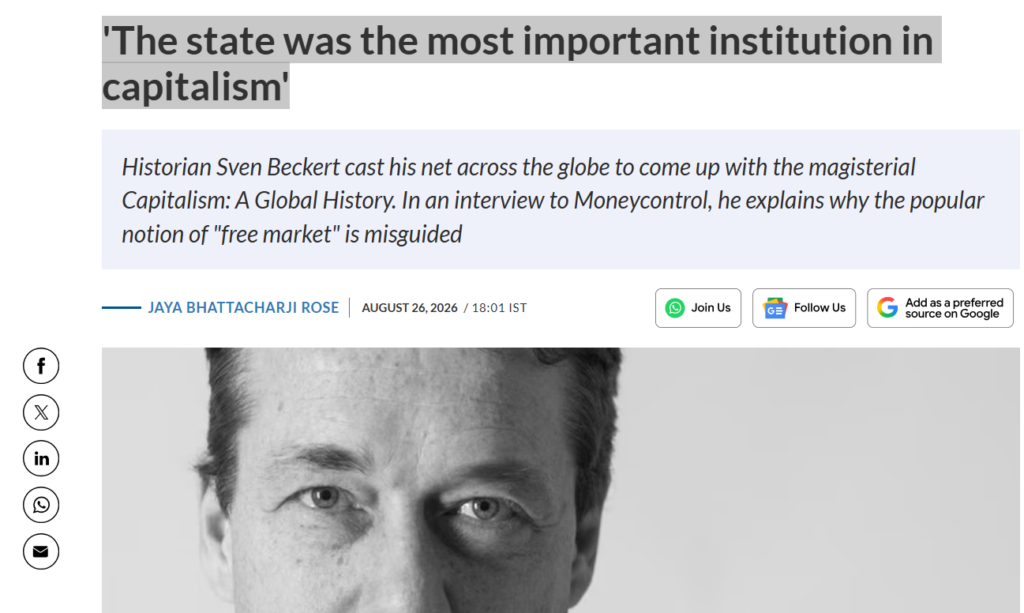
This interview with the editors was published on Moneycontrol on 29 April 2026. Here is the screenshot of the header. Given that many readers outside India are unable to access the interview easily, I am copy-pasting it here.

Arupjyoti Saikia & Mahesh Rangarajan (Eds.) India’s Forests: Revisiting Nature and History Vintage Books, an imprint of Penguin Random House India, 2026. Hb. Pp.360.
India’s Forests brings together essays by some of the country’s leading scholars with a fresh view of nature and history. These reappraisals of Indian forests and their many lives in past and present matter more than ever today. Born of years of sustained reflection, the essays here view forests not as passive unchanging backdrops to the past but as living, contested spaces.
Forests were shaped and in turn deeply influenced by power, culture and society. They could mean very different things to different people who often were in contest over meaning as much as control of the space or the resource. The volume spans from prehistory through ancient and early modern India into the present. It is also alive to the impact of the colonial era while tracing the changing fortunes of tribal and hill peoples. They are ecological lifelines and sites of legend, memory, and scientific knowledge. Material remains and life cycles of animals and plants matter, so too do social and literary imaginations.
Forests have been continually redefined through conflict, negotiation, and care. Attentive to the changing meanings across time and place, the book asks us fundamental and unsettling questions: what are forests for?

Contributors include: Shibani Bose “ ‘Digging’ Tales from Sylvan Trails: Perspectives from Archaeology”; Kumkum Roy, “People, Produce and the Political: Engaging with the Forest through the Arthashastra”; Aloka Parasher Sen “Multiple ‘Forests’ and Changing Borderlands: The Varied Indian Landscapes in Early India”; Meera Anna Oommen & Kathleen D. Morrison “Famines, Flagships and Floods: Historical and Contemporary Identities of Central Travancore’s Eastern Forest Frontier”; Mayank Kumar “Forest and Communities: Negotiations of Early Modern Monsoon Ecologies in India”; Divyabhanusinh “The Lion and the Unicorn: Fighting for Survival”; Sudha Vasan “Shifting Cultivator, Peasant, Forest-Dweller: Legacies and Landscapes of Improvement in the Baigachak”; Mukul Sharma “’God of the First Class’: Politics of Sacred Groves and Sarna in Jharkhand” and Vasudha Pande “Interrogating Ram Guha’s The Unquiet Woods: Thirty Years Later”.

Harini Nagendra, director, School of Climate Change and Sustainability, Azim Premji Universityendorses it saying “India’s Forests is a grand tour of the shifting forms, shapes and meanings taken by the country’s woods and jungles across the great arc of history. This integrative volume synthesizes information from a fascinating array of sources, from Mesolithic cave art and the Arthashastra to field trips and contemporary wildlife surveys; and captures a wide range of geographies from the Himalayas to the forests of Kerala. A must-read for anyone seeking a deeper understanding of the role forests play in our cultures, histories and imaginations.”

Arupjyoti Saikia is a professor of history at the Indian Institute of Technology Guwahati. He held the Agrarian Studies Programme Fellowship at Yale University, and visiting fellow positions a Cambridge University and the School of Oriental and African Studies (SOAS), University of London. His research spans across the economic, political and ecological histories of Assam. His published works include Forests and Ecological History of Assam, 1826 to 2000 AD (2011), The Unquiet River: A Biography of the Brahmaputra (2019) and The Quest for Modern Assam: A History, 1942–2000 (2023).

Mahesh Rangarajan is professor of history and environmental studies and chair of the HDFC Archives of Contemporary India at Ashoka University in Haryana. Previously, he has taught at Cornell University, University of Delhi, Krea University and the National Centre for Biological Sciences, Bengaluru. His notable works include Fencing the Forest (1996) and Nature and Nation (2015). He has edited the Oxford Anthology of Indian Wildlife (1999) and Environmental Issues in India (2007). His co-edited works include Shifting Ground (2014) and At Nature’s Edge (2018).

The following interview with the authors was conducted via email. It was lightly edited before publication.

  1. How do you define a forest? Has the definition changed over the years? Who defines it? What is it today as recognised by the government of India and international authorities? Also, what are the different technical definitions of a forest as determined by these bodies?

MR & AS: The book India’s Forests makes clear that ‘forest’ is, as one of our authors Kathleen Morrison puts it, a “vexed object, poorly defined yet meaningfully rich”. Forest is a space conceived differently across disciplines, eras, and political systems. For instance, in ancient India, forests had many roles. Each shaped by their use and location. The Arthashastra distinguished hasti vana, the area for elephants, from mriga vana, forests for enjoyment, organising woodlands by their strategic and economic value. If Sanskrit texts drew a clear line between grama, the organised village, and aranya, the wild forest, Tamil Sangam poetry described a continuous landscape where hills, bushes, and thick forests blended, reflecting human feelings and mixing wild and farmed land. More changes came in the later centuries.

The colonial period set legal limits on forests. The Indian Forest Act of 1878 turned forests into government-run lands, defined not by their trees but by who owned and controlled them. Forests became a political site instead of living nature. A major change came in more recent time. The Supreme Court of India expanded the definition of forests to include all wooded areas, regardless of ownership or classification in the Godavarman judgment of 1996. This important decision shifted the focus from official documents to the natural environment. This sparked strong debate about the future of communities living in forests without legal ownership. 

India’s Forests takes on the challenge of defining ‘forest’ clearly. Forests in this book cover a wide variety of landscapes, from rich rainforests to dry thorn forests and tall-grass savannahs, excluding only deserts and the tallest mountains. Forests are living nature made not just of trees but also herbs, fungi, orchids, and macro-fauna embedded in socio-cultural matrices. The book does not specify the exact technical definition used by the government though such reports are referred to as an important source of current government data. The idea of forests has made many journeys across time, space, ancient texts or modern legal lenses. This helps to secure the legal and proprietary lens of colonial rule, to the ecologically expansive definitions of recent times. Even now, the meaning of ‘forest’ is still considered by scientists, lawmakers, forest conservators, and activists-conservationists.

2. How did this book come about? How long was it in the making? What was the principle defining the commissioning of the articles? What are the key issues in this narrative that you wished to highlight? 

MR: We chose a range from prehistory to the current era and while all regions and ecotypes could not be covered, we have attempted to get a collection that is original, thoughtful, critical and stimulating. The occasion was the anniversary of the publication of a key work, The Unquiet Woods by Ramachandra Guha in 1989 a foundational work on environmental history, mainly a study of the Chipko movement. The essays engage with themes opened up by the book but in a critical if appreciative light. Much has happened in the study of forest histories in the last 35 years or so and we try in the introduction to look back and in the volume to point possible ways to go forward with fresh lines of enquiry.

AS: As Mahesh mentioned, Ramachandra Guha’s The Unquiet Woods opened up many layers of India’s pasts through the bright lenses of our nature, specially the woodlands. Since then, an enormous corpus of works have critically investigated India’s forested pasts. This trend continues to grow. These works’ geographical range and temporal scale is wide and deep! Equally historians have now explored newer archives and have engaged with newer methods inspired by other scholarly disciplines. All of these have helped us to get a nuanced understanding of India’s complex pasts and their evolving relations with the environment. We also wanted our readers to discover India’s forests as living landscapes shaped by agriculture and the ever-shifting worlds of trade across centuries and regions. We thought of bringing some of these newer works into one single frame which can help us to give a collective view of India’s forested pasts.

3. How will these academic essays on the history of India’s forests and Nature at various points of history help in future environmental action? How do you propose to bridge the communication gaps between this impressive evidence collated and action on the ground? 

MR: Such a work can inform debate, as it is not prescriptive or a call to action directly. But all authors are sensitive to these concerns and some have engaged with the issues for long, years even decades.  There is no short cut method to reaching out and we will try. Initial responses are very positive.

AS: Readers find here not prescriptions, but a firmer and a clearer picture of the variegated life of India’s forests. The essays in this book reveal that India’s forests have always been alive with activity and meaning. Far from being silent backdrops, these woodlands have witnessed centuries of struggle, bargaining, survival, and authority, stretching from the detailed forest classifications of the Arthashastra to the major changes brought by the Forest Rights Act of 2006. They go on to suggest that today’s decisions about conservation, community rights, and the restoration of ecosystems are quietly guided by echoes from centuries past. The creation of colonial forest reserves, the gradual loss of traditional rights, and the privileging of timber over biodiversity did not simply happen; they were crafted by history. The past of India’s forests may not hand us a roadmap, but it does reveal the pitfalls that once tripped up those who came before us.

4. What are the pros and cons of the colonial narrative for ecological histories that we inherited? How did it affect the development of a region, conservation methods, and impacted human behaviour. 

MR: There is no one unified colonial or imperial narrative.  Just as there is no one global or national one today. Certainly not on the forest. The colonial interlude in India was still critical in many ways.

There were indeed Abharanyas (forest reserves) in early India and in early modern India, there were hunting reserves, such as the well-known shikar gahs of the Mughals. Landed groups had pig sticking grounds. But the extent and scale and scope of state forestry was never of the level of imperial China. In this sense the kind of property rights with state forestry in the later years of the East India Company and then under Crown rule post 1858 was far more intrusive.

In order to secure the forest land and its wealth, there was a legal frame and an executive branch for taking land over. This was like enclosure (not literally with fences) but through punitive actions and penalties. There was a major attempt via silviculture to upgrade forest stock to yields more timber and other forests products. This meant many strictures on hunting, fishing, grazing collection and on opening up fresh land for cultivation. This enclosure of commons and open access lands had deep even wrenching effects that are felt to this day. A remarkable administrative accomplishment, the Imperial Forest Service secured the forest and protected it. But it was not conservation for its own sake but in service of empire.

AS: I agree with Mahesh that the colonial era left behind not only vast stretches of forest but also lasting scars on the people who had cared for these lands for generations. But that narrative cannot be so straightforward and each part of India will tell something different. There were undeniable gains: from the 1860s, new laws and policies curbed deforestation and established the framework of forest departments, protected zones, and wildlife safeguards that independent India would later expand. Without this groundwork, the dramatic and yet stable resurgence of the lion in Gir and the greater one-horned rhinoceros in Assam would have been unimaginable.

But these gains came at a steep price. Colonial forestry put profits above conservation [though this was not too simple] or timber above the rich diversity of life, replacing the trees that villages relied on with fast-growing, marketable trees which produced logs. Swidden cultivation simply was branded as a criminal act while pastoralists lost their age-old rights to graze in mountain meadows. Generations of customary rights vanished with a single law. Forests became sites for extraction, stripped of the intricate and emotive bonds that communities had woven over centuries. This imbalance still lingers in many ways but so is the challenging legacies of our environmental past.

5. India’s Forests focuses on the history of an age-old culture of peasant-pastoral wisdom that has been eroded by modernity, consumerism and a variety of vested interests.  Will the preservation and the commendable efforts of keeping this knowledge visible in academic discourses impact key stakeholders, policymakers, perhaps result in afforestation practices? 

MR: Kings, peasants, land owners, merchants and forest peoples looked at forests in different, often contrary ways. There were also times their interests or ideas coincided. It is true industry, commerce and so on have transformed not only forests but the earth system since the late 18th century, the time Britain embarked on the Industrial Revolution and eastern India came under the East India Company. The colonial era had far reached impact on animals, peoples and trees and plants and water as much as on land. What is notable, and this matters, is that the Western Ghats were a source of pepper and ivory makings it way to Rome 2000 years ago so the exchange economy is not new even if modern capitalism is. Oommen and Morrison show pepper collectors in the hills and ivory hunters and the ecosystems very much part of wider networks. In similar ways, the work of Dr Mayank Kumar on the early modern era shows how Rajasthan had records on conflict and control over animals and trees in rural areas by dominant groups and state authorities. There was still room to manoeuvre because peoples beyond or the edge of cultivated arable mattered to rulers. Their knowledge and wealth (animal or other produce) was taken and ties were not equal. But the kind of fixity of property, tenure and settling in the colonial and British imperial era had a ferocity all of its own. It is well illustrated in the novels of Bibhuti Bhushan Bandopadhyay on the clearance of the forest and the later continuities in the works of Mahasweta Devi.

This is of course a short response. For the richness of the stories the book has many voices, explores many forest paths and tracks.

On the last, time will tell. We are delighted at the early reception to the work and hopeful it will help inform if in small way the wider debate. This is not a book about what to set right and how. That calls for a different kind of book and work.

It is meant to be wake up call on ways of thinking most so about what forests mean and why issues of how to relate to nature are as much about the past as the future. How we got here matters no matter where we may want to go. The forests of today are as much as product of human history as of biological processes.

AS: The book does not paint a rosy picture of a missing rural landscape. Instead, India’s Forests reveals how peasant and forest communities were always entangled with power. That they bargained with kings, paid taxes, endured punishments, and constantly adapted. The essays in this book encourage readers to confront the many histories of India’s forests. As Mukul Sharma demonstrates in this volume, India’s sacred groves are also sites of contest, hierarchy, and ecological complexity, as well as a resounding tool for conservation templates. We cannot afford to overlook these tangled pasts, or risk falling into the old colonial trap of imposing one-size-fits-all solutions on richly varied lands and peoples.

As said earlier, one can think of the jhum farmers in the highlands of India’s North East. They observed the land’s slope, soil moisture, rainfall patterns, ecological pasts, and the many worlds of insects before deciding where to burn and where to grow. This complex ecological practice and wisdom had developed over many generations. Anthropological works of the 20th century provided a clearer, more detailed understanding of such ecological practices. The British imperial foresters called it wasteful and tried to stop it. What was challenged there was not just a farming method but a whole way of understanding how to live with forests. 

The essays in this book argue that such intimate encounters with nature were never unchanging or perfect. They changed, adapted, or regularly dealt with power at every step. Along with the measures adopted by the state, the rhinoceroses in Kaziranga also survived because the peasant communities knew about this flooded and forested habitat. For the peasant communities, the wet grasslands of the Brahmaputra floodplain are socio-ecological formations which they understood intimately. India’s Forests thus offers the readers a more critical view about human and nature relations.

6. Where and how did we lose our traditional knowledge bases, especially that exists within our culture? They have a deeper understanding than outsiders who impose their views. What proportion of these information repositories that exist in a micro-culture, stories, cultivation practices etc can we recover?

MR: This is best I defer to Prof Saikia.

AS: The loss happened in layers. Colonial legislation quickly criminalised community forest practices. Postcolonial development deepened the wound. We cannot recover everything. But the epistemological framework survives: the understanding that forests are social-ecological relationships, not timber warehouses.

7. Why are we moving or have we already developed an economy of exclusion and inequality at the cost of depriving traditional knowledge? What are the rights of local communities? Can these be exercised, enforced and implemented?  (As is being done in Brazil, if I am not mistaken.)

A lot of this can be traced to the legal frame, the practice and norms of imperial forestry instituted the 1860s and 1870s on wards. In the early years, while the most senior Inspector General was German for 35 years almost in many provinces, they got former military men to take charge. So, exclusion was built in very early. It was not and cannot be total as labour was required for a variety of reasons, such as cutting fire lines, making roads and felling trees. Until the Forest Rights Act of 2006, the rights of Scheduled Tribes and Other Forest Dwellers had no real legal space. Since then, it has been an uphill struggle between the official mind set and the securing of rights. It is important to acknowledge here that the Act had unanimous support not merely as critics feel to give away land or forest for votes but as a corrective. The land reform process of cultivable land of the 1950s had no counterpart for over 60 years with regard to forests.

Brazil has had a different history and the nature of indigeneity is different. It also has far fewer people in say the Amazon than India’s forests. Closer to home one can look at Nepal that has far more decentralised and participatory approaches via vis parks, forests and water than almost anywhere in India. But there are attempts at change in many cases at the state level so there are grounds for hope yet.

AS: I agree with Mahesh that India’s land reform programme including the abolition of zamindari in the 1950s which were largely done based on the political inspiration of India’s freedom movement had little parallel since then. Mahesh rightly highlighted that the exclusion was not accidental — it was architectured. Colonial forestry-built inequality into its legal foundations, erasing customary rights and replacing multi-layered community relationships with a single extractive logic serving the colonial state. Independent India largely inherited this framework with very limited transformation. The Forest Rights Act of 2006, we do need to note, was a historic corrective. It recognised for the first time both individual and community rights of forest dwellers — but implementation remains bitterly contested. There is little doubt that decentralised forest governance can deliver desirable results.

8. Forest cover has reduced to 21% in India. CSR efforts to plant trees in different parts of the country have been an ongoing practice for a while now. But do these initiatives in any way, take into account the symbiotic relationship between local communities and the forest that are outlined in the book? Will these planting drives help us recover our forests? 

MR: Having not directly worked on this, cannot say much. But replanting is not the same as regeneration. A mixed multi species formation is different from a plantation. A lot of work by ecologists in fact shows this and it might help value protection and prevention over plantation. The latter is needed but as a complement.

AS: The choice of species may of course not at all be in accord with livelihoods. The late Anil Agarwal illustrated how different regions have key trees for livelihood and ecology such as khejri in the Thar desert, banj and moru oak in the western Himalaya, Mahu and tendu in Central India and the peninsular highlands and one might add the Palmyra Palm on the Coromandel coast. These are not planted often but are grown or grow and if fostered with care yield multiple benefits and also play a role ecologically.

9. India’s Forests outlines the significance of forests to communities that has been mentioned in texts like the Arthashastra or preserving the practice of sacred groves in Jharkhand. People had a vested interest in preservation of Nature. We need forests to maintain our climate and weather patterns, most notably, our unique monsoon. This is imperative given the rapid climate change. Yet, large chunks of forests are being cleared for mining, growing cash crops, land banks, and urbanisation. How do we bring back this sense of belonging and enable a collective action to preserve rather than it becoming only the purview of environmental activists/academics? 

MR: Just to be clear, the Arthashastra is about extending and expanding the state role in and over the forest. The aranya or vana is not beyond the ambit of power but extending authority was a challenge. While enumerating multiple productive roles of the forest and kinds of forests, and kinds of peoples, there is a clear sense of power and hierarchy. This is especially clear with the Atavika Rajas or forest chiefs who are to be loyal and guard borders. Ashoka no less in an Edict warns that those who do not behave and obey will be punished.

The collective sense you refer to is strongest perhaps in hill, forest and Adivasi or Scheduled Tribe societies. One of the things we have to be careful about is not to romanticise or generalise. There are many who see this is as either/or choice national park or sacred grove or state versus community.

There is no doubt much to learn from local and communitarian ideas and practices, most so in keeping the systems productive and habitable over long periods. The actions you refer to such as mining and industry are often giving priority to short term extraction without much thought to the biota, top soil or water or to those they displace directly or indirectly. A different way of seeing is the starting point surely. Aside from specific cases or protests, a more holistic appreciation of ecologies and also of producer knowledge. The latter is helpful because if one thinks of mahua or tendu so important in central and main land India, you get a different view of the forest as entity than simply as land for mining.

Scholars and others are learning from real life situations and practices. Yes of course, there should be more informed discussion and the level of awareness all round of the linkages and connections needs to be part of larger discourse.

AS: Think of India’s many highland communities, who named their forest areas not by how much wood they could get but by the spirits living there, or the Van Gujjars of the Shivalik foothills, whose seasonal moves followed not government borders but the memory of grass and pastures. These were not just old traditions; they were exact, proven, living maps for survival. What replaced them when British imperial forestry began was a different kind of exactness the surveyor’s chain, the forest section number, the mining rights planned in colonial offices far from the sound of rain on sal leaves. The hills of Meghalaya lost not just trees and bushes but also a whole way of understanding nature when jhum cycles were restricted by official rules.

Despite those challenges across India, community-owned forests today protect biodiversity, while others struggle to do the same. For many, the Khasi clan’s ancestral forest remains a more effectively conserved landscape than many protected areas. 

The starting point is neither nostalgia nor laws alone; it is listening. When a floodplain dweller describes flood patterns along a river in eastern India, she is sharing climate information that no satellite has yet recorded. 

10. Forest / environment has a specific vocabulary. Why is it not more in vogue? Will it not help preserve and respect trees and forests if people recognise and understand their environment?

MR: In general, yes. But there are different terms in various regions, jangal in Hindustani is common parlance, Kadu in Tamil. Once you get to the local level, there are variety of terms for different kinds of uncultivated land scape: the rakhs for instance in central and western India is a grassland that may be dotted with trees. These were often cleared away and cultivated after independence though vital for diverse fauna and flora and for local livelihoods especially the rural poor. Similarly, despite the Kadu/Nadu dichotomy in Tamil, goat droppings (from their browse off grass, shrubs and herbs) was prized for the nutrient value for the cultivated land.

The problem is in a narrow view if you like a monochromatic view of a multifaceted entity. The forest can be habitat for bats and birds, mammals and insects, and diverse flora. It is not simply waste land to be carved up for cultivation or for industrial projects.

With all their faults, this was realised as early as the 1830s by some East India company surgeons as studied by the late great Dr Richard Grove. The early links of forests and climate were also first drawn in the Indian Ocean by such men and they were men. It is a different matter such ideas were not always acted on and when so only partially.

We still have an immense challenge when forests are viewed only in terms of timer i.e. Net Potential Value or NPV. Useful for forest products it hardly captures or does justice to multiple ecological and social functions or roles or relationships.

AS: Language moulds the way we see, and when words vanish, entire worlds slip away. The people of Arunachal Pradesh hold a treasury of names for forests along the mountain slopes, each term capturing the moisture, soil, seasons and how people relate these to them. Reduce all this to just ‘forest cover, and you erase a living map of relationships between humans and the natural world. When a place loses its name, it is already halfway to being lost.  Despite odds, these forest vocabularies survive in song or in rituals. Their return to the mainstream will be greatly helpful. This is what the earth desperately needs.

11. With the rapid technological growth, especially as the demand for AI grows exponentially, tech companies are being given permission to construct data centres in urban areas as well as agricultural and in some cases, forests. These centres are land, fresh water, and mineral guzzlers. Is there hope for the future of forests in this dismal context?   

MR: Modern industry and this certainly include AI very prominently so did not and does not budget for water. Not only is surface water scarce much of the year in most of India, ground water takes years to accumulate and has to be renewed as it is used. Meeting drinking eater view renewal is possible but more that calls for prudence.

On the other count, if you take a longer view, there has been woodland retreat and resurgence in the past. If we have more productive agriculture and more water prudent forms of use, both urban and rural, given there are less cattle now and pastoralism contrary to popular image can integrate with open land, scrub and open land ecosystems, there is lot of ground for hope.

It is important to note the success of grassroots regeneration of ecologies and also the positive government community partnerships. None are ideal and multiple challenges remain.

But you are correct the resource destructive path way is not prudent or just in such a land mostly of long dry and short wet seasons. Maybe we should look at this from the long-term perspective say a long-lived tree than a human life span. That will give sense of perspective a balance sheet cannot.

AS: I agree with Mahesh.

30 April 2026

Interview with Sonora Jha on “Intemperance: A Novel”

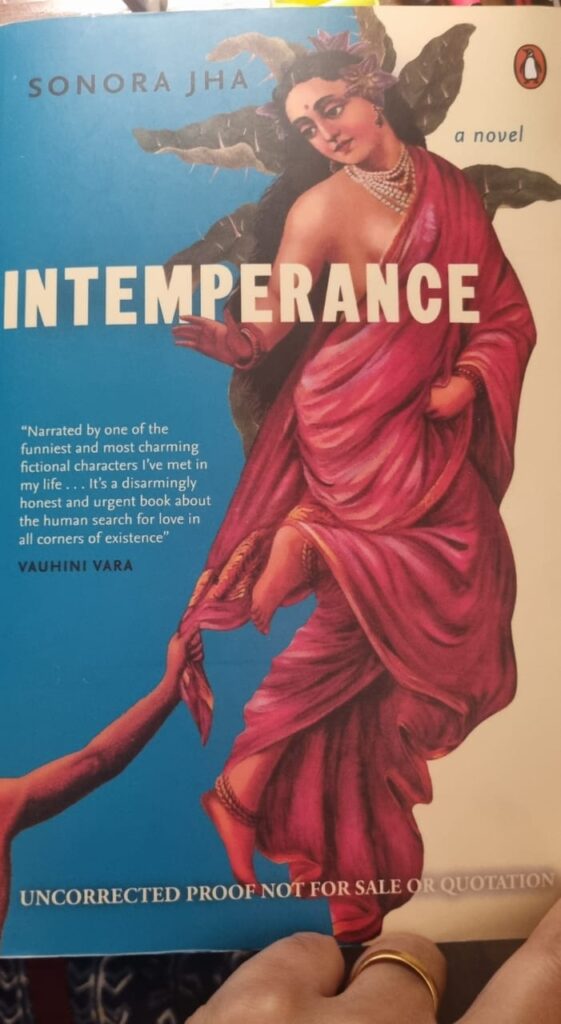
For Moneycontrol, I interviewed Sonora Jha on latest publication Intemperance: A Novel. It is published by Penguin Random House India.

Here is the interview:

Sonora Jha is the author of the novels The Laughter and Foreign, and the memoir How to Raise a Feminist Son. She won the AutHer Award for Fiction 2024 for The Laughter.  After a career as a journalist covering crime, politics, and culture in India and Singapore, she moved to the United States to earn a PhD in media and public affairs. Sonora and her work have been featured in the New York Times and literary anthologies, on the BBC, and elsewhere. She is a Loyola Endowed Professor at Seattle University and lives in Seattle.

Her latest novel, Intemperance, is a love story. It is about a middle-aged, twice-divorced, Seattle-based professor, who decides to hold a swayamvar for herself as a fifty-fifth birthday celebration. She decides to lean upon her Hindu roots and resurrect a matrimonial tradition that is no longer practiced but remembered. It is an event held by the bride-to-be’s family where prospective male suitors are invited. Either the suitors line up for the bride to view. The person she likes, she garlands as her betrothed. Alternatively, the assembled suitors have to perform a series of tasks to prove themselves. These could be in the form of one challenging task or multiple rounds. The winner gets the hand of the bride.

The woman, a renowned and respected intellectual in an American town who had once declared she was “past such petty matters as love,” knows she is now setting herself up for widespread societal ridicule. To her surprise, a cast of characters shows up to support her call―a wedding planner looking for the next enchanting thing, a disability rights activist making a documentary film, and even, begrudgingly, her own young adult son. The Men’s Rights Movement protests her project, angry at her objectification of men. She must also reckon with a brutal love story in her ancestry that was endangered by the caste system―a story that placed a generational curse on those in the family who show an intemperance of spirit. As her whole plan spirals into a spectacle, the woman embarks on a journey to decide what feat her suitor must perform to be worthy of her wrinkling hand. What feat will define a newer, better masculinity? What feat will it take for her to trust in the tenderness of love?

Intemperance is at once a satirical feminist folktale and a meditation on how we might reach past all sense and still find love. It is published by Penguin Random House India.

The following interview with Sonora Jha was conducted via email.

  1. What was the genesis of Intemperance? 

    After my last book, The Laughter, which was a dark satire, I found myself longing to write a love story. I started to toy with the idea of a protagonist who plans a swayamvar in middle age, and then I read bell hooks’ brilliant philosophy on love and marriage in Communion: The Female Search for Love. It all came together for me as I crafted a protagonist who makes the search for love a fiendishly playful act.

    2. Why did you choose the title Intemperance? Why not How to live like a Feminist: A Memoir and a Manifesto, echoing your book How to Raise a Feminist Son: A Memoir and Manifesto (2021)? 

    Well, that was a memoir, and this is fiction. And this is not a manifesto either. The word “Intemperance” fit perfectly the practice of living unabashedly as a woman, living past the cautions of moderation and temperance.

    3. For a writer, what is the difference between memoir, autofiction and literary fiction? 

    I believe there’s a bit of one’s own lived experience in every writer’s work, even if the writer is writing fiction from thin air. The norms of memoir dictate, though, that you hew close to fact. With autofiction, you can use your own life as a diving board and make leaps into fiction. This novel of mine is more fiction than autofiction.

    4. When does the authorial narrative and the protagonist’s “I” merge, if at all? 

    It varies for every writer and every work. Kazuo Ishiguro’s The Remains of the Day uses the first-person “I,” but it’s clearly not Ishiguro writing about himself (he’s writing in the first-person voice of Stevens, an English Butler). In my novel, the “I” is the voice of an unnamed narrator, and I let some of my own ideas and interiority swim into hers even though the plot and characters in the story are not from my own life.

    5. Transplanting an ancient Hindu wedding practice like a swayamvar into modern times is a way of testing your feminist ideas, is it not? Although conducting a swayamvar is like reality television today. 

    Yes, I decided to sharpen the concept of the swayamvar from a contemporary lens of power and agency. I decided to play with it. The protagonist encounters goddesses and princesses from Hindu mythology (as well as one character from Homer’s Odyssey) in the form of present-day people who either warn her against having a swayamvar or cheer her on. The book, however, becomes less about the spectacle and more about the journey, both inward and outward.

    6. With every edit of the manuscript, does your feminism become stronger and sharper or does it have to be turned down a notch or two so as to be heard by a vast audience? 

    I didn’t set out to write a “feminist novel.” I set out to write a novel about a woman looking for love. The search for a true and beautiful love for a cis-gender, heterosexual woman today seems to me and several others to require a feminist way of loving, for her as well as for the man she seeks. I believe a vast audience exists for novels about love and novels with feminist stories. Men, women, non-binary people, everyone is aching for love and for fresh love stories with intemperate characters.

    7. On p.167 you ask if “reclusiveness is allowed for women”? So, is it? 

    The protagonist wonders about this. I don’t. I believe healthy doses of solitude and reclusiveness should be everyone’s right to have. I claim these for myself. If more women claim time for themselves, we will have more delicious, richer partnerships.

    8. Your novel has the classic structure of a novel and yet it has many elements of folklore and oral narratives with the interspersing of many micro-stories. Although, the presence of Alokendra and Heera’s story is much more than that. Please comment. 

    Thank you for appreciating that. I wanted to populate the novel with friends, found family, and community. People of all genders and sexuality. Gods and mortals. Sinners and saints. The fearful and the intemperate. I wanted to also show that the protagonist has a tradition in her ancestry where people loved passionately against all rules and against all odds. Placing a queer, inter-caste love story in the litchi orchards of 1895 Bihar gave me much joy as a writer. The protagonist is who she is today because of all the love that came before.

    9. A love story involving an elaborate wedding is the perfect formula for a successful book. So how many conversations and backstories did it take to create this incredibly perceptive feminist commentary to the swayamvar, in itself on the threshold of a very patriarchal institution —matrimony? 

    Subverting the idea of a swayamvar, stealing it away from the patriarchs and their collaborations (kings marrying off their daughters to other kings), making contemporary men in Seattle perform feats for the hand of an aging, twice-divorced women in her sexual prime…all this just spilled out of me. But yes, I am an academic with a journalistic background, so of course I did a lot of research into these practices and also into caste and disability and more. One of the continued conversations that was invaluable to me was with author and journalist Yashica Dutt, who wrote Coming Out as Dalit.

    10. Will you ever consider dramatising this for theatre, say along the lines of Eve Ensler’s The Vagina Monologues

      I hadn’t considered that, but that’s a wonderful idea.

      31 Oct 2025

      “India in Triangles: The Incredible Story of How India was Mapped and the Himalayas Measured” by Shruthi Rao and Meera Iyer

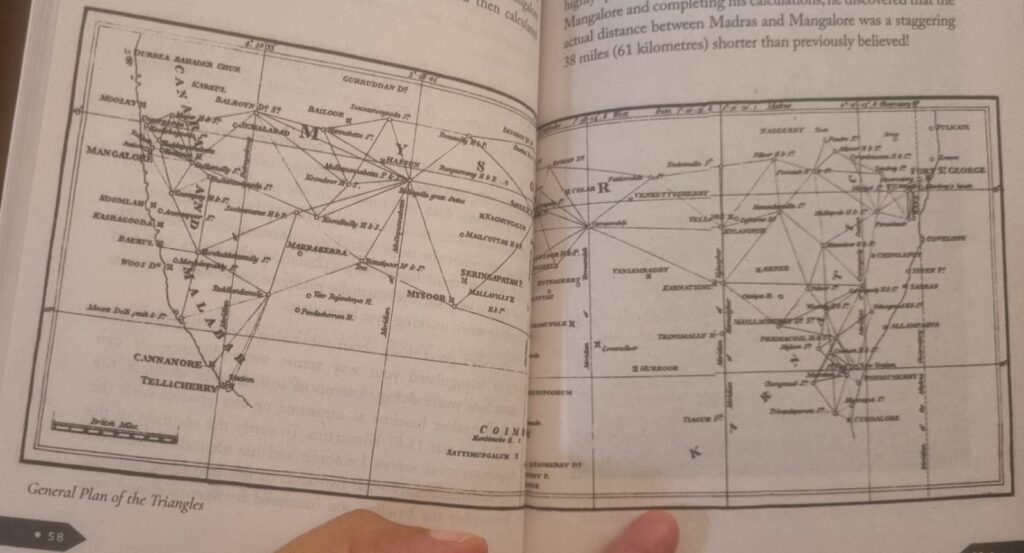
      The Great Trigonometrical Survey (GTS), an ambitious mission in the nineteenth century to map India using triangulation―a brilliant method that helped them measure every inch with accuracy. Along the way, they calculated the height of the world’s tallest mountain and revealed the true shape of the earth. The survey lasted nearly a hundred years and was led by several men, including William Lambton, George Everest and Andrew Waugh. But it wasn’t just them—thousands of people worked on this massive project.

      India in Triangles is a fascinating account of the survey in India. The authors are able to share an important piece of history without dumbing down any information, even though the intended target audience is for young adults. This is the kind of book that will work supremely well in the crossover market for its readability, accessibility to information, listing and acquisition of the heavy equipment used in the mapping and of course, the stories involving the key people. It is a slim volume that is easily read like a thrilling adventure story. The fascination with which these pioneers chose to map the subcontinent does not dim with time.

      Read an extract from the book on Moneycontrol. It is published by Puffin Books, Penguin Random House India.

      Shruthi Rao has a master’s degree in energy engineering, and worked in the IT industry before she started writing. She is the author of multiple books such as 10 Indian Women Who Were the First to Do What They Did ,20 Indians Who Changed the World, Manya Learns to Roar, among others. She lives in the San Francisco Bay Area, and loves books, desserts, trees, benches, science and long walks.

      Meera Iyer loves listening to, researching and writing about stories of people and places, buildings and streets. She volunteers with the Indian National Trust for Art and Cultural Heritage (INTACH) to help protect and celebrate Bengaluru’s history and heritage. She loves coffee, dark chocolate and potsherds.

      15 August 2025

      “India in Triangles: The incredible story of how India was mapped and the Himalayas measured” by Shruthi Rao and Meera Iyer

      India in Triangles is a truly fascinating account about the Great Trigonometrical Survey of India in the nineteenth century. It was a mission to map India by the British using triangulation. A method that helped them measure every inch with accuracy. Along the way, they calculated the height of the world’s tallest mountain and revealed the true shape of the earth.

      Shruthi Rao and Meera Iyer tell a riveting tale of how India was mapped. It is an extraordinary story that incorporates mini biographies of the key people like William Lambton, George Everest, and Radhanath Sikdar, to name some. The authors have used scientific data, mathematical descriptions and historical details that could have fallen into the dangerous trap of being a complicated account; instead it is lucidy, swiftly moving, and despite being packed with information, it is immensely readable. They have also managed to create a text that does not dumb down its tone as if that is the only way for speaking to children. This book will work in the cross over market.

      There are illustrations of the instruments used and even of the maps created. Unfortunately, some of the maps are quite unreadable and like black blotches of newsprint.

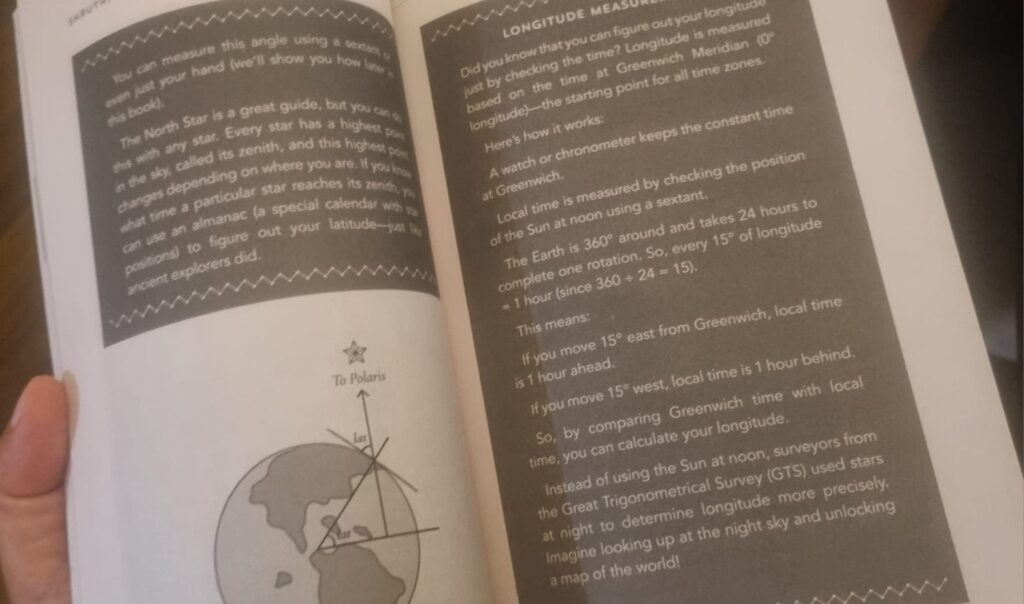
      While I get the importance of watching costs in producing a book, surely, exceptions to the rule could have been in the case of India in Triangles. Firstly, when reproducing maps in a book, avoid doing a double page spread where the map falls into the gutter. Consider, printing the map in a folded paper. Make the experience immersive, tactile, and legible. Let the target audience know what it means to open a folded map and pore over it. Secondly, avoid using blurry, black and white print. Try and spend time with the design, even if the original reproduction of the map is of poor quality, and attempt to sharpen the image. It will take many hours to fix but ultimately, it will be worth it. When a book is a pleasure to read, the word spreads very quickly. Finally, even if this title is meant as children’s literature, surely there could have been an attempt to make the information in the boxes easier to read (or just do away with them!). To put faint white print on a dark background is uninteresting, dull and makes the text very difficult to read. Why is the joy taken out of reading because of the constant emphasis on cost? Surely, a decent balance can be struck between the two factors.

      Sadly, this delightful book, has been printed on poor quality paper, that is rough to touch and is reminiscent of school textbooks. So, even if the layout, dimensions, and content of the book is not the same as the textbook, the memories that it throws up while holding such a book can mar the reading pleasure.

      Reading a book is not just about reading the words on the page. Avoid making it into a workmanlike experience that is inevitably equated with reading school curricula. Reading should not be a chore. It should be a memorable pleasure and most certainly, when it is a book on the mapping of the Indian subcontinent. Tweaking a few design elements, looking at options in the market within the budget, to produce a low cost publishing may take a while to cobble but it will be worth it. It just requires a wee bit of imagination and a confident boldness, matching the astonishing clarity and perfect tenor with which the authors write. Their storytelling is filled with immense joy bordering on almost childish glee at stringing together the stories that make up this sparkling narrative.

      This book is going to sell well. It will have a long tail.

      All said and done, read it. It is published by Puffin Books, Penguin Random House India.

      23 July 2025

      “Is a River Alive?” by Robert Macfarlane

      This magnificent book arrived in the post today. I am going to read it asap. Meanwhile, I figured I should post the book blurb. It is published by Penguin Random House India.

      From celebrated writer Robert Macfarlane comes this brilliant, perspective-shifting new book – which answers a resounding yes to the question of its title.

      At its heart is a single, transformative idea: that rivers are not mere matter for human use, but living beings – who should be recognized as such in both imagination and law. Is a River Alive? takes the reader on an exhilarating exploration of the past, present and futures of this ancient, urgent concept.

      The book flows first to northern Ecuador, where a miraculous cloud-forest and its rivers are threatened by goldmining.

      Then, to the wounded rivers, creeks and lagoons of southern India, where a desperate battle to save the lives of these waterbodies is under way.

      And finally, to north-eastern Quebec, where a spectacular wild river – the Mutehekau or Magpie – is being defended from death by damming in a river-rights campaign.

      At once Macfarlane’s most personal and most political book to date, Is a River Alive? will open hearts, spark debates and lead us to the revelation that our fate flows with that of rivers – and always has.

      ROBERT MACFARLANE is internationally renowned for his writing on nature, people and place. His bestselling books include UnderlandLandmarksThe Old WaysThe Wild Places and Mountains of the Mind, as well as the book-length prose-poem, Ness. His work has been translated into more than thirty languages, won many prizes around the world and been widely adapted for film, music, theatre, radio and dance. He has also written operas, plays, and films including River and Mountain, both narrated by Willem Dafoe. He has collaborated closely with artists including Olafur Eliasson and Stanley Donwood, and with the artist Jackie Morris he co-created the internationally bestselling books of nature-poetry and art, The Lost Words and The Lost Spells. As a lyricist and performer, he has written albums and songs with musicians including Cosmo Sheldrake, Julie Fowlis and Johnny Flynn, with whom he has released two albums, Lost In The Cedar Wood and The Moon Also Rises. In 2017, the American Academy of Arts and Letters awarded him the E.M. Forster Prize for Literature, and in 2023 in Toronto he was the inaugural winner of the Weston International Award for a body of work in the field of nonfiction. He is a Fellow of Emmanuel College, Cambridge.

      “Robert Macfarlane is a once-in-a-generation virtuoso, and I don’t know when his kaleidoscopic language and world-expanding scholarship have been used to more potent effect than in this impassioned, resounding affirmative to the title’s urgent question.”
      —JOHN VAILLANT, author of Fire Weather

      Is a River Alive? is itself a river of poetic prose, an invitation to get onboard and float through the rapids of encounters with places and people, the eddies of ideas, to navigate the resurgence of indigenous worldviews through three extraordinary journeys recounted with a vividness that lifts readers out of themselves and into these waterscapes. Read it for pleasure, read it for illumination, read it for confirmation that our world is changing in wonderful as well as terrible ways.”
      —REBECCA SOLNIT, author of Orwell’s Roses

      “This book is a beautiful, wild exploration of an ancient idea: that rivers are living participants in a living world. Robert Macfarlane’s astonishing telling of the lives of three rivers reveals how these vital flow forms have the power not only to shape and reshape the planet, but also our thoughts, feelings, and worldviews. Is a River Alive? is a breathtaking work that speaks powerfully to this moment of crisis and transformation.”
      MERLIN SHELDRAKE, author of Entangled Life

      Is a River Alive? is one of the best books I’ve read in a very long time—exciting, brilliantly comprehensive, mind-altering. In one of its many stunning moments, Macfarlane describes the myriad rivers trapped and buried under the concrete of our cities. ‘Daylighting’ occurs on those rare occasions when these ghost-rivers are dug out & released to the surface to feel the sun, to expand—majestic creatures—and spread life once again. To read this book is to feel your ghosted soul undergo such ‘daylighting’—metaphysical, political, emotional, linguistic. Any soul going dormant, any citizen going numb, will be revivified and propelled back to their essential core, where rage, wonder, and imagination intertwine, and a powerful hope for the earth arises. A spellbinding, life-changing work.”
      —JORIE GRAHAM, Pulitzer Prize-winning poet

      Is a River Alive? is a beautifully written, poetic testament to the vitality of the Earth and the forms of politics that can be based upon that premise.”
      —AMITAV GHOSH, author of Sea of Poppies

      “Like its subject, Is a River Alive? is a work of flow and counter-flow. It is lyrical, evocative, closely observed and deeply moving. Robert Macfarlane offers new ways to think and, just as importantly, feel about the majestic and mysterious non-human world.”
      —ELIZABETH KOLBERT, author of The Sixth Extinction 

      3 June 2025

      “GeoTechnography: Mapping Our Digital Societies” by Samir Saran and Anirban Sarma

      In an era defined by rapid technological change, a seismic shift is underway, one that is transforming every aspect of our lives. From the rise of digital platforms that mediate our interactions–with markets, with governments and perhaps most importantly with each other– to the growing tension between our online personas and our real-world identities, the forces of technology, geography and society are colliding in ways we are only beginning to understand. Even as technology opens up new opportunities for civic engagement, it simultaneously disrupts the very foundations of societal cohesion.

      The digital age has given rise to a new stage for global drama–one where surveillance, misinformation and the erosion of trust in multilateral institutions are playing out in real time. But as these forces evolve, so too must our understanding of how societies can navigate them. Will digital societies endure, or are they doomed to collapse under the weight of their own contradictions? Can democracy as we know it survive in a world where power is increasingly concentrated in the hands of a few tech giants? And as nations grapple with the changing dynamics of governance, how will international norms, laws and institutions adapt? In GeoTechnoGraphy, Samir Saran and Anirban Sarma offer a compelling analysis of the forces reshaping the modern world. Drawing on groundbreaking research and incisive insights, they examine how the convergence of geography and technology —geotechnography — is rewriting the rules of power. The book excerpt that has been published here is an excellent primer to the term “geotechnography”. Read the chapter excerpt on Moneycontrol.

      It is a portmanteau word that cleverly describes the coming together of spatial distances as examined by geographers and the world of technology. It is true that technological advancements in the twenty-first century have broken past geo-political barriers to create online/cloud communities. It raises many questions about our realities, identities, security, data management as well as of responsibilities. This is the crux of the discussion in GeoTechnoGraphy. There are plenty of examples offered to illustrate the eight chapters.

      These are worth listing as they are illuminating about the flux in this relationship between tech giants, technology, politicians/governments/nation states, and individuals. The chapters are: “Children of Our Landscape: Geography, Affinity and the Rules-Based Order”, “The Death of Geography? Cyberspace, Borderless Worlds and the New Tribalism”, “The Mediated Self: A New Relationship with the World”, “From Censers to Censors: Is Big Tech the New Clergy?”, “Achilles’ Last Stand: The Resuscitation of Autonomy”, “Apocalypse Now: Will Digital Societies Survive?”, “Terminated? AI and Our Human Future”, and “Rebooting History: A Rules-Based Order for the Digital Age”. Mukesh D. Ambani, Chairman and Managing Director, Reliance Industries Ltd., says that “GeoTechnoGraphy explores the dual forces shaping our future: the transformative potential of technology on society and the perils of the contest for dominance. A book that is as timely as it is thought-provoking”.

      Marietje Schaake, Fellow, Standford University says that “This must-read book guides us through the dramatic changes of our time”. Nandan Nilekani, Cofounder and Chairman, Infosys, and Founding Chairman, UIDAI (Aadhar) says that it is “A bold and visionary work that offers a profound rethinking of the forces shaping our world.” Undoubtedly, GeoTechnoGraphy requires pauses between reading so as to gather one’s thoughts but it is worth spending time with. Buy it. Read it. Think about it. Reflect upon it. Samir Saran is the President of the Observer Research Foundation (ORF). His research focuses on issues of global governance, climate change and energy policy, technology and media, and India’s foreign policy. As ORF’s President and member of the Foundation’s Board, he provides strategic direction and leadership to the foundation’s multiple centres on fundraising, research projects, platform design and outreach initiatives including stakeholder engagement.

      He curates the Raisina Dialogue, India’s annual flagship platform on geopolitics and geo-economics, and is the founder of CyFy, India’s annual conference on cybersecurity and internet governance. Samir is the Chair of World Economic Forum’s Global Future Council on Geopolitics and a member of WEF Global Risks Advisory Board. He has served as a Commissioner of The Global Commission on the Stability of Cyberspace. He is a member of the Board of Directors at ORF America. He is also a part of Board of Governors of The East West Centre. Samir has authored four books, edited important journals and publications and written several academic papers and book chapters. He is featured regularly in Indian and international print and broadcast media. His latest publications include The New World Disorder and The Indian Imperative with Shashi Tharoor, Pax Sinica: Implications for the Indian Dawn with Akhil Deo and Raisina Chronicles: India’s Global Public Square with India’s External Affairs Minister, S. Jaishankar. Anirban Sarma is Deputy Director of ORF Kolkata and a Senior Fellow at ORF’s Centre for New Economic Diplomacy. He is also Chair of the Think20 Task Force on ‘Our Common Digital Future’. Anirban’s research focuses on the use of technology for sustainable development, the digital economy, the media, and international cybersecurity cooperation. In the tech-for-development space, his research has explored issues around online safety, the future of work, digital public infrastructure, data for development, digital health, cleantech, and women’s empowerment and inclusion, among other areas. Anirban was formerly the Chief International Outreach and Communications Officer at the National Digital Library of India, a flagship project of the Ministry of Education. He earlier served at UNESCO for over eight years, designing and managing UNESCO’s initiatives on ICTs, access to information and media development across South Asia. He has also worked at Weber Shandwick, a global public affairs agency, supporting projects for leading clients at the firm’s Centre of Excellence.

      12 May 2025

      Tuesday Reads ( Vol 3), 25 June 2019

      Dear Reader,

      I have just finished reading Amitav Ghosh’s magnificent novel Gun Island. It is about Dinanath Datta, a rare books seller whose life gets entangled with an ancient legend about the goddess of snakes, Manasa Devi. It is a fascinating story that begins in the Sunderbans to New York to Venice. Gun Island has a fantastic cast of characters but it is also a story very relevant to our times for its focus on the situation of migrants and climate change.

      At the New Delhi book launch held on 13 June 2019, India Habitat Centre, Amitav Ghosh was in conversation with Raghu Karnad. It was a very special evening as it occurred two days after the untimely demise of the playwright, Girish Karnad. So the book launch morphed into this public memorial for Girish Karnad too. It began with the new Jnanpith winner Amitav Ghosh’s tribute to another Jnanpith winner Girish Karnad. The conversation began with Raghu Karnad, son of Girish Karnad, saying, “My father was a chronicler of Karnataka and of this country, I consider you to be a chronicler of this planet. Interconnecting the countless parts we are in the midst of but miss. They are forces of language, war, or even eco-system.” These opening remarks triggered off a fascinating conversation about “unlikely coincidences” and “meaningful resonances” that exist between space and time. Also what does it mean to try and rationalise events that defy rationalist thinking but at times it is impossible to do so. A significant proportion of Gun Island dwells upon the global migrant crisis. During the conversation Amitav Ghosh commented that “the central literary question is how do you talk about the slow violence that eats itself into peoples lives and never finds its way into newspapers? In the papers every day there are so many reports about violence but this slow violence does not get attention. We have learned to turn our eyes away from it. The issue is how do we find ourselves back to recognise the violence unfolding around us. Poetry is better able to respond to the catastrophe and cataclysm we see around us. Poetry does not have that commitment. Poetry has always responded to every natural event. You see it in Byron and in pre-modern Indian poetry which is not poetry for the sake of poetry — it is devotional. We have to find ourselves back to that…back to being able to talk about other things apart from us.”

      Gun Island is an unputdownable book. It will sell well but more so because of the old fashioned word-of-mouth recommendations. At the book launch there were whispers overheard of Amitav Ghosh probably being a contender for the Nobel Prize for Literature in the coming years. Who knows?! But for now it would be interesting to see if this book makes it to the shortlist of the more prominent literary prizes around the world like The Booker Prize. It is certainly a book that cannot be ignored!

      Of all the books I read in the past week Gun Island was exceptional.

      More anon,

      JAYA

      25 June 2019

      “The Begum: A Portrait of Ra’ana Liaquat Ali Khan, Pakistan’s Pioneering First Lady”

      The Begum: A Portrait of Ra’ana Liaquat Ali Khan, Pakistan’s Pioneering First Lady by Deepa Agarwal and Tehmina Aziz Ayub is a good account of a fascinating woman. Begum Ra’ana Liaquat Ali Khan’s life mirrors the history of the subcontinent. Namita Gokhale, writer and co-director, Jaipur Literature Festival, wrote a wonderful introduction to the book. The following extracts from the introduction have been published with permission of the publisher, Penguin Random House India.

      ****

      Reflecting on how and what to write while introducing this important biography, I wonder once again if it is one or two books I have before me. This collaborative account, co-authored by Deepa Agarwal and Tahmina Ayub, mirrors the fissures and fault lines that divided Begum Ra’ana Liaquat Ali Khan’s life into two astonishingly symmetrical halves. A well-researched portrayal of an intrepid and passionate woman, it presents her personal narrative and political convictions, and mirrors the history of the subcontinent, in a timeline truncated by the uncompromising contours of the Radcliffe Line.

      Sir Cyril Radcliffe arrived in India on 8 July 1947. The eminent barrister was given all of five weeks to divide up a nation, a culture, a people. His brief was to ‘demarcate the boundaries of the two parts of the Punjab on the basis of ascertaining the contiguous majority areas of Muslims and non-Muslims’. A handful of men—five persons in each ‘boundary commission’ for Bengal in the east and Punjab in the west—worked day and night on a hurried and ignominious exit from an increasingly precarious and unstable empire. Equal representation given to politicians from the Indian National Congress and the Muslim League, each hostile and intractable in their positions, only added to the tensions.

      In New Delhi, at 8 Hardinge Road, a sprightly forty-three year-old woman, all of five feet tall, was hastily putting together some personal belongings. Begum Ra’ana Liaquat Ali Khan was preparing to depart in a government aeroplane for Karachi airport, where her husband Nawabzada Liaquat Ali Khan was soon to be sworn in as the first prime minister of Pakistan.

      The future first lady was leaving her magnificent double storeyed home, set in three acres of garden, for an unknown and uncertain life in a newly formed nation. This elegant colonial bungalow (now 8 Tilak Marg) had been her home since her marriage. Both her sons, Ashraf and Akber, had been born here. 8 Hardinge Road had become the focal hub for the activities of the Muslim League. Her husband had been appointed finance minister of the interim government, and indeed the papers for the interim budget presented on 2 February 1946 had been taken directly from his home to Parliament House.

      Not so far away, at 10 Aurangzeb Road, Muhammad Ali Jinnah had also made preparations to depart Delhi, and India. However, he had been more pragmatic than the idealistic and high-minded Liaquat Ali and had sold his house to the industrialist Ramkrishna Dalmia for Rs 3 lakh. Liaquat and his wife Ra’ana, on other hand, had decided to gift their home to Pakistan—it was to become the residence of the new nation’s future high commissioner. ‘Gul-i-Ra’ana’, the bungalow that her adoring husband had named after her, would henceforth be known as ‘Pakistan House’. Their vast and eclectic library was also gifted to the new nation in which they had invested their hopes and lives.

      What were the thoughts and emotions that jostled in her mind and heart as she observed all that she had struggled for come to fruition, even as the looming shadow of Partition prepared to bathe the two nations in a fierce spasm of blood and sacrifice?

      Begum Ra’ana Liaquat Ali Khan, born Irene Ruth Margaret Pant on 13 February 1905, to an apostate Brahmin lineage, was a practising Christian until 1933. After her marriage, she converted to Islam and was renamed Gul-i-Ra’ana. This fiercely independent lady, who carried her myriad identities within a core self of unchanging conviction, departed this world on 13 June 1990, by which time she was known, recognized and honoured as ‘Madar-e-Pakistan’ or ‘Mother of Pakistan’.

      The first half of her life was spent in undivided India, where she transited two religious identities, and repudiated a third, albeit through her grandfather. With almost mathematical precision, her eighty-six years were divided into forty-three years plus some months in each of her two lives. She was an intimate witness to history—the two nations, the bifurcation of East and West Pakistan, the creation of Bangladesh, the course of the Cold War, the rise of Gorbachev, and the increasingly unequivocal hold of the army in Pakistan. From Jinnah, through Zulfikar Bhutto and to General Zia-ul-Haq, she spoke her mind and held her own.

      Before her marriage, she was a professor of economics in Delhi’s prestigious Indraprastha College. Her doctoral thesis had been on women in agriculture in rural Uttar Pradesh. Begum Ra’ana was an important, even crucial, catalyst to Jinnah’s return to politics and the unfolding of the ‘two-nation theory’. In the summer of 1933, she and her husband met Jinnah in his home in Hampstead and appealed to him to return to India. Unafraid to champion difficult causes, she was radical in her attempts to bring about gender equity within the Islamic State of Pakistan and unflinching in her defence of her friend Zulfikar Ali Bhutto when he was facing the gallows. And at all times, she was charming and gracious as an accomplished diplomat and stateswoman.

      Where then did she get her steely resolve and infinite reserve of strength? How did she negotiate the transitions and transformations of history with such seeming ease? I have always been fascinated by this formidable woman, and her ability to stand tall in an overwhelmingly patriarchal society even after losing her husband, with no grown male—or indeed female—relatives to support her in the newly birthed nation of Pakistan.

      Begum Ra’ana was born Irene Pant. We share maiden surnames, and a common ancestry. I was born Namita Pant, and a faded family tree documents these connections, with a branch of it cryptically cut off. With his conversion to Christianity, her grandfather Taradutt Pant had placed himself outside the pale of caste and kinship. Yet whenever I encountered the half-told stories of Begum Ra’ana, I could sense the mountain grit in her, the legendary strength that comes so naturally to Kumaoni women. There was also a strong family resemblance—to my sister, to several of my aunts. I wanted to know more about her, to understand her as a determined woman, a thinking, feeling human, a creature of her times and circumstances.

      ….

      29 May 2019

      “The Journey Of Indian Publishing” by Jaya Bhattacharji Rose

      I recently contributed to How to Get Published in India edited by Meghna Pant. The first half is a detailed handbook by Meghna Pant on how to get published but the second half includes essays by Jeffrey Archer, Twinkle Khanna, Ashwin Sanghi, Namita Gokhale, Arunava Sinha, Ravi Subramanian et al.

      Here is the essay I wrote:

      ****

      AS LONG as I can recall I have wanted to be a publisher.  My first ‘publication’ was a short story in a newspaper when I was a child. Over the years I published book reviews and articles on the publishing industry, such as on the Nai Sarak book market in the heart of old Delhi.  These articles were print editions. Back then, owning a computer at home was still a rarity.

      In the 1990s, I guest-edited special issues of  The Book Review on children’s and young adult literature at a time when this genre was not even considered a category worth taking note of. Putting together an issue meant using the landline phone preferably during office hours to call publishers/reviewers, or posting letters by snail mail to publishers within India and abroad, hoping some books would arrive in due course. For instance, the first Harry Potter novel came to me via a friend in Chicago who wrote, “Read this. It’s a book about a wizard that is selling very well.” The next couple of volumes were impossible to get, for at least a few months in India. By the fifth volume, Bloomsbury UK sent me a review copy before the release date, for it was not yet available in India. For the seventh volume a simultaneous release had been organised worldwide. I got my copy the same day from Penguin India, as it was released by Bloomsbury in London (at the time Bloomsbury was still being represented by Penguin India). Publication of this series transformed how the children’s literature market was viewed worldwide.

      To add variety to these special issues of The Book Review I commissioned stories, translations from Indian regional languages (mostly short stories for children), solicited poems, and received lovely ones such as an original poem by Ruskin Bond. All contributions were written in longhand and sent by snail mail, which I would then transfer on to my mother’s 486 computer using Word Perfect software. These articles were printed on a dot matrix printer, backups were made on floppies, and then sent for production. Soon rumours began of a bunch of bright Stanford students who were launching Google. No one was clear what it meant. Meanwhile, the Indian government launched dial-up Internet (mostly unreliable connectivity); nevertheless, we subscribed, although there were few people to send emails to!

      The Daryaganj  Sunday  Bazaar where second-hand books were sold was the place to get treasures and international editions. This was unlike today, where there’s instant gratification via online retail platforms, such as Amazon and Flipkart, fulfilled usually by local offices of multi-national publishing firms. Before 2000, and the digital boom, most of these did not exist as independent firms in India. Apart from Oxford University Press, some publishers had a presence in India via partnerships: TATA McGraw Hill, HarperCollins with Rupa, and Penguin India with Anand Bazaar Patrika.

      From the 1980s, independent presses began to be established like Kali for Women, Tulika and KATHA. 1990s onwards, especially in the noughts, many more appeared— Leftword Books, Three Essays, TARA Books, A&A Trust, Karadi Tales, Navayana, Duckbill Books, Yoda Press, Women Unlimited, Zubaan etc. All this while, publishing houses established by families at the time of Independence or a little before, like Rajpal & Sons, Rajkamal Prakashan, Vani Prakashan etc continued to do their good work in Hindi publishing. Government organisations like the National Book Trust (NBT) and the Sahitya Akademi were doing sterling work in making literature available from other regional languages, while encouraging children’s literature. The NBT organised the bi-annual world book fair (WBF) in Delhi every January. The prominent visibility in the international English language markets of regional language writers, such as Tamil writers Perumal Murugan and Salma (published by Kalachuvadu), so evident today, was a rare phenomenon back then.

      In 2000, I wrote the first book market report of India for Publisher’s Association UK. Since little data existed then, estimating values and size was challenging. So, I created the report based on innumerable conversations with industry veterans and some confidential documents. For years thereafter data from the report was being quoted, as little information on this growing market existed. (Now, of course, with Nielsen Book Scan mapping Indian publishing regularly, we know exact figures, such as: the industry is worth approximately $6 billion.) I was also relatively ‘new’ to publishing having recently joined feminist publisher Urvashi Butalia’s Zubaan. It was an exciting time to be in publishing. Email had arrived. Internet connectivity had sped up processes of communication and production. It was possible to reach out to readers and new markets with regular e-newsletters. Yet, print formats still ruled.

      By now multinational publishing houses such as Penguin Random House India, Scholastic India, Pan Macmillan, HarperCollins  India, Hachette India, Simon & Schuster India had opened offices in India. These included academic firms like Wiley, Taylor & Francis, Springer, and Pearson too. E-books took a little longer to arrive but they did. Increasingly digital bundles of journal subscriptions began to be sold to institutions by academic publishers, with digital formats favoured over print editions.

      Today, easy access to the Internet has exploded the ways of publishing. The Indian publishing industry is thriving with self-publishing estimated to be approximately 35% of all business. Genres such as translations, women’s writing and children’s literature, that were barely considered earlier, are now strong focus areas for publishers. Regional languages are vibrant markets and cross-pollination of translations is actively encouraged. Literary festivals and book launches are thriving. Literary agents have become staple features of the landscape. Book fairs in schools are regular features of school calendars. Titles released worldwide are simultaneously available in India. Online opportunities have made books available in 2 and 3-tier towns of India, which lack physical bookstores. These conveniences are helping bolster readership and fostering a core book market. Now the World Book Fair is held annually and has morphed into a trade fair, frequented by international delegations, with many constructive business transactions happening on the sidelines. In February 2018 the International Publishers Association Congress was held in India after a gap of 25 years! No wonder India is considered the third largest English language book market of the world! With many regional language markets, India consists of diverse markets within a market. It is set to grow. This hasn’t gone unnoticed. In 2017, Livres Canada Books commissioned me to write a report on the Indian book market and the opportunities available for Canadian publishers. This is despite the fact that countries like Canada, whose literature consists mostly of books from France and New York, are typically least interested in other markets.

      As an independent publishing consultant I often write on literature and the business of publishing on my blog … an opportunity that was unthinkable before the Internet boom. At the time of writing the visitor counter on my blog had crossed 5.5 million. The future of publishing is exciting particularly with neural computing transforming the translation landscape and making literature from different cultures rapidly available. Artificial Intelligence (AI) is being experimented with to create short stories. Technological advancements such as print-on-demand are reducing warehousing costs, augmented reality  is adding a magical element to traditional forms of storytelling, smartphones with processing chips of 8GB RAM and storage capacities of 256GB seamlessly synchronised with emails and online cloud storage are adding to the heady mix of publishing. Content consumption is happening on electronic devices AND print. E-readers like Kindle are a new form of mechanised process, which are democratizing the publishing process in a manner seen first with Gutenberg and hand presses, and later with the Industrial Revolution and its steam operated printing presses. 

      The future of publishing is crazily unpredictable and incredibly exciting! 

      3 Feb 2019

      A Note on “The Women’s Courtyard” Translation by Daisy Rockwell

      Here is the entire note by the translator, Daisy Rockwell, from her recent translation of Khadija Mastur’s Aangan, translated as The Women’s Courtyard. It has been published by Penguin Random House, 2018. 

      The note has been excerped with the publisher’s permission. 

      The Women’s Courtyard has been translated before as The Inner Courtyard, by Neelam Hussain, and published by Kali for Women in 2001. Retranslation is still a rarity in the context of modern South Asian literature but the practice enriches the field of translation, offering readers different prisms through which to read a text. When I choose to retranslate a work, it is usually because I feel I have something substantially different to offer from the previous translator or translators. All the same, I draw comfort and inspiration from the work of previous translators, who may have seen things differently than I did and send me scurrying back to my dictionaries and expert friends for more information.

      Khadija Mastur’s writing style is spare and elegant. Unlike many Urdu authors she does not favour heavily ornamented writing and turns of phrase full of literary allusions. I felt inspired to reproduce this clarity in English, after seeing that Hussain’s translation struggled with this quality, attempting to elevate the language to a more formal register of English than was used in Urdu. See, for example, Mastur’s description of Safdar Bhai, and the two contrasting translations, below:

      Mastur: Safdar Bhai kitne vajīha magar kaisī maskīn sūrat ke the.

      Rockwell: Safdar looked so handsome, but so meek.

      Hussain: How tall and well built Safdar Bhai had been and yet how diffident his mien.

      Not only does Hussain divide descriptive adjectives into phrases, but in the case of the second phrase, maskīn sūrat ke, she introduces a flowery and somewhat archaic-sounding descriptor, ‘how diffident his mien’.

      These embroideries of the original, in which Hussain seeks to somehow augment the original text, stretch even to ordinary narrative sentences, such as the following:

      Mastur: Dūr kahīñ se ghaṛiyāl ke gyārah bajāne kī āvāz ā rahī thī.

      Rockwell: From somewhere far off came the sound of the bell striking eleven.

      Hussain: A distant clock struck the hour. The sound of its measured strokes rolled over her. It was the eleventh hour of the night.

      Here, Hussain’s rendition conveys a breathless dramatic tension that is absent from the original, which merely alerts us to the passage of time.

      Hussain also occasionally inserts new ideas into the text, such as below, where she actually adds foreshadowing to the original sentence that describes Aliya worrying about her sister Tehmina Apa:

      Mastur: Rāt kā qissā bār bār yād ātā aur voh anjām ke khauf se ek lafz bhī na paṛh saktī thī.

      Rockwell: She kept thinking about what had occurred the night before, and was so fearful of what might happen she couldn’t read a single word.

      Hussain: The inexorable end of Apa’s fated love was before her eyes and she was unable to concentrate on her work.

      Mastur merely writes of Aliya’s ‘anjām kā khauf,’ her fear of the outcome, whereas Hussain announces to us that Tehmina’s ‘fated love’ is coming to an ‘inexorable end’. This embellishment on the original text both spoils the suspense of the story and romanticizes Tehmina’s love for Safdar by referring to it as a ‘fated love’.

      Strangely—perhaps by accident—a pivotal passage is missing from Hussain’s translation. I can attest as a translator that it is far too easy to drop bits of a text in the course of translation. The phone rings, the dog must be let out, one’s attention is divided—and there goes a paragraph. Usually these mistakes can be rectified in editing, when one notices that something is missing or when a transition between paragraphs makes no sense. An extra set of eyes helps too. In this case, the passage in question is Jameel’s first physical assault on Aliya. Aliya has been reading about the horrors of Ghengis Khan and his army, when Jameel comes to speak with her. She tries to make him go away, or stick to the topic of her exams, when he grabs her and kisses her (or more—the text is not entirely clear on this point, but it reads clearly as sexual assault). After this she feels shaken and defiled.

      Finally, language changes, cultural norms change and politics change. All great works deserve multiple translations, and English can only be enriched by multiple versions of classic South Asian texts. With this fresh translation, a new generation of readers will be introduced to The Women’s Courtyard, and perhaps a few who know some Urdu will take the plunge and try reading the book in the original.

      3 January 2019

      Web Analytics Made Easy -
StatCounter