moneycontrol Posts

“GeoTechnography: Mapping Our Digital Societies” by Samir Saran and Anirban Sarma

In an era defined by rapid technological change, a seismic shift is underway, one that is transforming every aspect of our lives. From the rise of digital platforms that mediate our interactions–with markets, with governments and perhaps most importantly with each other– to the growing tension between our online personas and our real-world identities, the forces of technology, geography and society are colliding in ways we are only beginning to understand. Even as technology opens up new opportunities for civic engagement, it simultaneously disrupts the very foundations of societal cohesion.

The digital age has given rise to a new stage for global drama–one where surveillance, misinformation and the erosion of trust in multilateral institutions are playing out in real time. But as these forces evolve, so too must our understanding of how societies can navigate them. Will digital societies endure, or are they doomed to collapse under the weight of their own contradictions? Can democracy as we know it survive in a world where power is increasingly concentrated in the hands of a few tech giants? And as nations grapple with the changing dynamics of governance, how will international norms, laws and institutions adapt? In GeoTechnoGraphy, Samir Saran and Anirban Sarma offer a compelling analysis of the forces reshaping the modern world. Drawing on groundbreaking research and incisive insights, they examine how the convergence of geography and technology —geotechnography — is rewriting the rules of power. The book excerpt that has been published here is an excellent primer to the term “geotechnography”. Read the chapter excerpt on Moneycontrol.

It is a portmanteau word that cleverly describes the coming together of spatial distances as examined by geographers and the world of technology. It is true that technological advancements in the twenty-first century have broken past geo-political barriers to create online/cloud communities. It raises many questions about our realities, identities, security, data management as well as of responsibilities. This is the crux of the discussion in GeoTechnoGraphy. There are plenty of examples offered to illustrate the eight chapters.

These are worth listing as they are illuminating about the flux in this relationship between tech giants, technology, politicians/governments/nation states, and individuals. The chapters are: “Children of Our Landscape: Geography, Affinity and the Rules-Based Order”, “The Death of Geography? Cyberspace, Borderless Worlds and the New Tribalism”, “The Mediated Self: A New Relationship with the World”, “From Censers to Censors: Is Big Tech the New Clergy?”, “Achilles’ Last Stand: The Resuscitation of Autonomy”, “Apocalypse Now: Will Digital Societies Survive?”, “Terminated? AI and Our Human Future”, and “Rebooting History: A Rules-Based Order for the Digital Age”. Mukesh D. Ambani, Chairman and Managing Director, Reliance Industries Ltd., says that “GeoTechnoGraphy explores the dual forces shaping our future: the transformative potential of technology on society and the perils of the contest for dominance. A book that is as timely as it is thought-provoking”.

Marietje Schaake, Fellow, Standford University says that “This must-read book guides us through the dramatic changes of our time”. Nandan Nilekani, Cofounder and Chairman, Infosys, and Founding Chairman, UIDAI (Aadhar) says that it is “A bold and visionary work that offers a profound rethinking of the forces shaping our world.” Undoubtedly, GeoTechnoGraphy requires pauses between reading so as to gather one’s thoughts but it is worth spending time with. Buy it. Read it. Think about it. Reflect upon it. Samir Saran is the President of the Observer Research Foundation (ORF). His research focuses on issues of global governance, climate change and energy policy, technology and media, and India’s foreign policy. As ORF’s President and member of the Foundation’s Board, he provides strategic direction and leadership to the foundation’s multiple centres on fundraising, research projects, platform design and outreach initiatives including stakeholder engagement.

He curates the Raisina Dialogue, India’s annual flagship platform on geopolitics and geo-economics, and is the founder of CyFy, India’s annual conference on cybersecurity and internet governance. Samir is the Chair of World Economic Forum’s Global Future Council on Geopolitics and a member of WEF Global Risks Advisory Board. He has served as a Commissioner of The Global Commission on the Stability of Cyberspace. He is a member of the Board of Directors at ORF America. He is also a part of Board of Governors of The East West Centre. Samir has authored four books, edited important journals and publications and written several academic papers and book chapters. He is featured regularly in Indian and international print and broadcast media. His latest publications include The New World Disorder and The Indian Imperative with Shashi Tharoor, Pax Sinica: Implications for the Indian Dawn with Akhil Deo and Raisina Chronicles: India’s Global Public Square with India’s External Affairs Minister, S. Jaishankar. Anirban Sarma is Deputy Director of ORF Kolkata and a Senior Fellow at ORF’s Centre for New Economic Diplomacy. He is also Chair of the Think20 Task Force on ‘Our Common Digital Future’. Anirban’s research focuses on the use of technology for sustainable development, the digital economy, the media, and international cybersecurity cooperation. In the tech-for-development space, his research has explored issues around online safety, the future of work, digital public infrastructure, data for development, digital health, cleantech, and women’s empowerment and inclusion, among other areas. Anirban was formerly the Chief International Outreach and Communications Officer at the National Digital Library of India, a flagship project of the Ministry of Education. He earlier served at UNESCO for over eight years, designing and managing UNESCO’s initiatives on ICTs, access to information and media development across South Asia. He has also worked at Weber Shandwick, a global public affairs agency, supporting projects for leading clients at the firm’s Centre of Excellence.

12 May 2025

“Ananda: An Exploration of Cannabis in India” by Karan Madhok

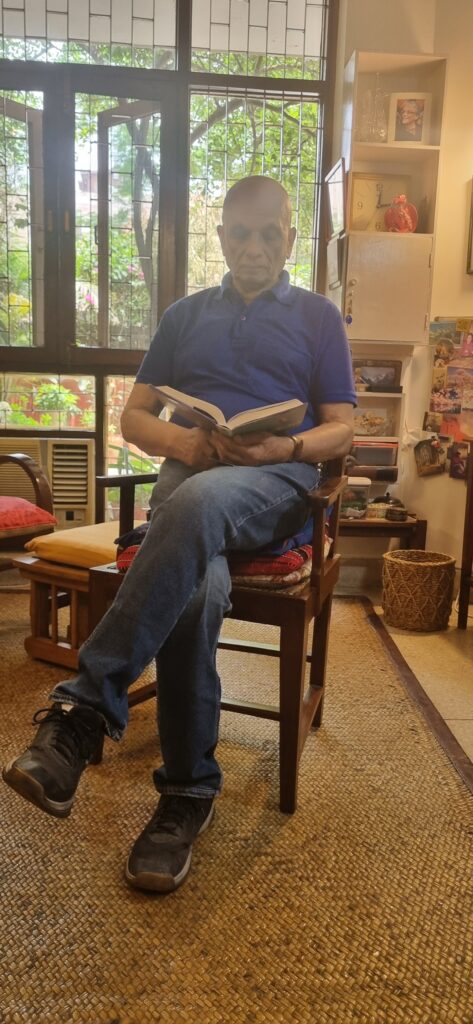
. This is so perfect. Romesh Bhattacharji , former Narcotics Commissioner of India, reading #KaranMadhok‘s book, “Ananda: An Exploration of Cannabis in India”.

Aleph Book Company

Upon spotting this picture on Facebook, Karan Madhok shared it on his wall saying, “This is a wonderful full circle moment: I quoted India’s former Narcotics commissioner Romesh Bhattacharji in my book – glad to see he’s got his hands on a copy.”

Cannabis, or ganja, is practically as old as recorded Indian civilization, with references to the plant being found in some of India’s earliest written texts and myths. Native strains of the plant are as common as rice or millet in many Indian states, and can often be found growing wild in the countryside. In scriptures and in the opinion of enthusiasts, ganja is said to provide ananda (bliss) or vijaya (victory) over the cares and ills of the world. Cannabis is best known as a recreational drug but it has a myriad other uses as well.

In this lively, well-researched, humorous, and occasionally trippy account of ganja, Karan Madhok looks at every aspect of the cannabis plant: botanical, spiritual, medical, and recreational. Madhok hits the road in search of cannabis strains around the country, including a visit to the Himalayan hamlet that is home to the world-renowned Malana Cream (which has inspired various counterculture movements); looks for the mythical Idukki Gold in Kerala; seeks the Sheelavathi variety in the Andhra/ Orissa region; portrays the travails of addicts, and details the shadowy world of gangsters and suppliers; hangs out with devotees who openly consume bhang and other derivatives of ganja; and visits hospitals and clinics which use the drug for a wide range of therapeutics.

Besides the factual and eye-opening research into every aspect of the narcotic, the author contemplates the concepts of freedom, creativity, spirituality, and paranoia associated with the drug, and examines the upside and problems of decriminalizing ganja in India. Ananda, the first major study of cannabis in India, is entertaining, and enlightening—it is the perfect introduction to an integral aspect of the country that has often got a bad rap and is imperfectly understood.

Read an excerpt from the book on Moneycontrol.

Karan Madhok’s debut novel, A Beautiful Decay, was published in 2022. His creative work and journalism have appeared in Epiphany, Sycamore Review, Bombay Review, SLAM Magazine, Fifty Two, The Caravan, Scroll, among others.

Karan is the editor and co-founder of the Indian arts and culture website The Chakkar. He is a graduate of the MFA programme from the American University in Washington D.C.

10 May 2025

Web Analytics Made Easy -
StatCounter