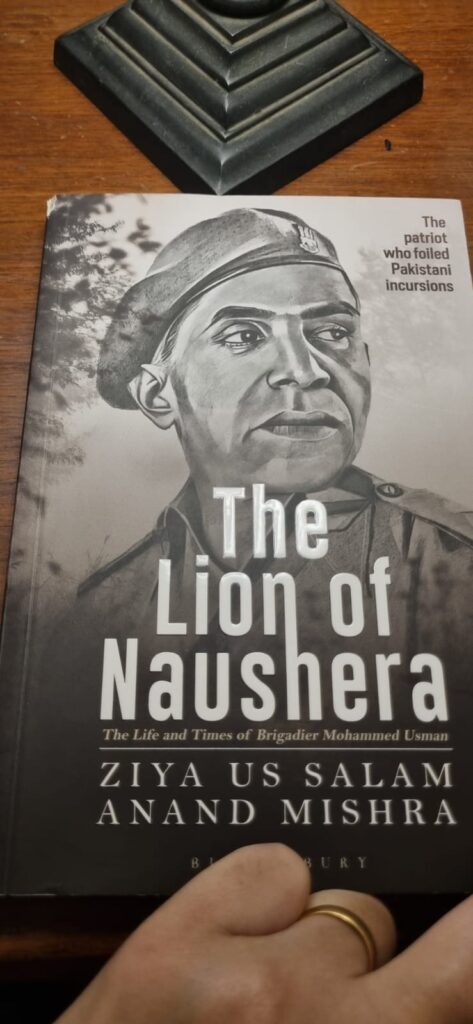
Within weeks of India gaining independence, Kashmir resembled a battlefield because of Pakistan’s repeated incursions to capture the Muslim-dominated princely state. Towering among the soldiers who fought with grit and gumption to foil Pakistan’s designs was Brigadier Mohammed Usman, who chose to remain in pluralist India. Sadly, he lost his life twelve days shy of his thirty-sixth birthday, fighting Pakistani forces. The newly born nation saluted the fearless warrior conferring on him the sobriquet ‘the Lion of Naushera’ for his bravery.
While some heroes have been duly and gratefully feted, others have not always got their due. The Lion of Naushera is an attempt to clear some of the debts we owe to Brigadier Usman. Not only does it tell the story of the brave soldier, it also presents a multifaceted narrative of India – of how people of all faiths, castes and regions fought for the independence of the country and protected its borders.
Ziya Us Salam is an eminent journalist and a widely published author. A literary and social commentator, Salam has examined critical subjects through his books Women in Masjid: A Quest for Justice (Bloomsbury 2019), Nikah Halala: Sleeping with a Stranger (Bloomsbury 2020) and Being Muslim in Hindu India: A Critical View (HarperCollins 2024). His other books include Of Saffron Flags and Skullcaps: Hindutva, Muslim Identity and the Idea of India (Sage 2018), which deals with challenges to the idea of India, and Lynch Files: The Forgotten Saga of Victims of Hate Crime (Sage 2019), which focuses on the victims of hate and violence.
Anand Mishra is currently a political editor. As a senior journalist who has travelled across north India to cover key political developments and elections, tracking the evolution of political parties across the spectrum — left, right and centre — in the national capital and the states in the Hindi speaking belt.
Hailing from Gaya in Bihar, Mishra is an English literature graduate. His poems have been published in national and international publications.
From the earliest human wanderings to the rise of the digital nomad
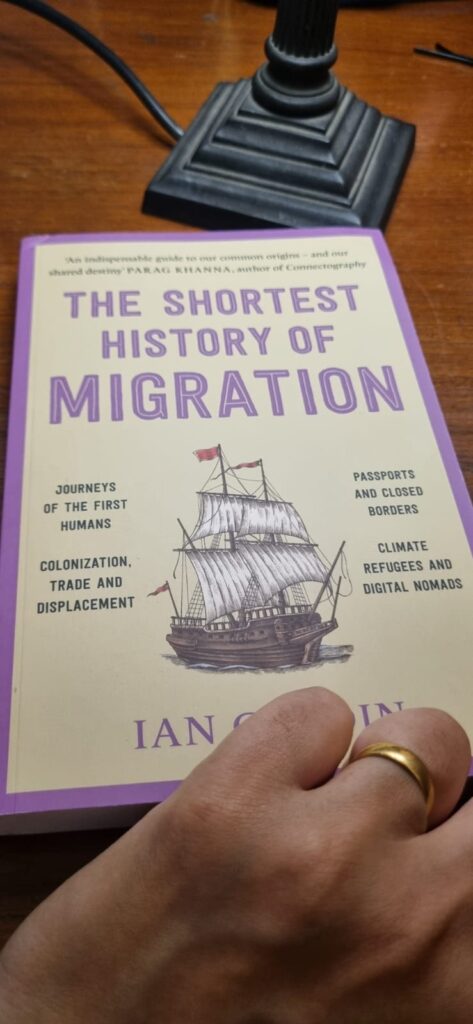
For hundreds of thousands of years, the ability of Homo sapiens to travel across vast distances and adapt to new environments has been key to their survival as a species. Yet this deep migratory impulse is being tested like never before as governments build ever-stronger walls that adversely impact the lives of migrants and the well-being of our societies.
In The Shortest History of Migration (published by PanMacmillan India), visionary thinker and a migrant himself, Ian Goldin chronicles the movement of peoples that spans every age and continent to arrive at the heart of what truly makes us human. He recounts strange, terrible and uplifting tales of migrants past and present, examining the legacies of empire, slavery and war. Learn about how the first humans originating in Africa populated the world; the exchange of knowledge, food, language and religion through migration, and the exploited migrant populations that built the modern Western world, only to be shut out of it.
Finally, Goldin turns his attention to today’s increasingly fragmented world, bringing together historical evidence and recent data to suggest how we might create a more humane future where we can reap the tremendous benefits that migration has to offer.
Ian Goldin is Professor of Globalisation and Development at the University of Oxford, Fellow at Balliol College, Oxford University, was the founding Director of Oxford University’s Oxford Martin School, and leads its research programmes on Technological and Economic Change, Future of Work and Future of Development.
He has an MSc from the London School of Economics, and a MA and Doctorate from the University of Oxford.
From 1996 to 2001, he was chief executive and managing director of the Development Bank of Southern Africa (DBSA) and at that time also served as an adviser to President Nelson Mandela.
From 2001 to 2006 Ian was Vice President of the World Bank and the Group’s Director of Policy and Special Representative at the United Nations. Previously, Ian served as Principal Economist at the EBRD and the Director of Programmes at the OECD Development Centre.
He has been knighted by the French Government and received numerous awards. He has published over 60 journal articles and 23 books. His most recent is Rescue: From Global Crisis to a Better World. His previous books include Terra Incognita: 100 Maps to Survive the Next 100 Years, Age of Discovery: Navigating the Storms of Our Second Renaissance and The Butterfly Defect: Why Globalization Creates Systemic Risks and What to Do, in which he predicted that a pandemic was the most likely cause of the next financial crisis. Other books include: Development: A Very Short Introduction; and Is the Planet Full? He has authored and presented three BBC Documentary Series After The Crash; Will AI Kill Development? and The Pandemic that Changed the World. He has provided advisory services to the IMF, UN, EU, OECD and has served as a non-executive Director on six globally listed companies. Ian is an acclaimed speaker at TED, Google Zeitgeist, WEF and other meetings and is Chair of the core-econ.org initiative to transform economics.
From the icy oceans of our poles to remote coral islands, Sir David Attenborough has filmed in every ocean habitat on planet earth. In fact, he is known to be (probably one of the rare few) who has been engaged with all kinds of audio-visual technology, across formats, from the time television was launched till date (2025). In his centenary year, with long-term collaborator Colin Butfield, he shares the story of our last great, critical wilderness, and the one which shapes the land we live on, regulates our climate and creates the air we breathe.
Through one hundred years, eight unique ocean habitats, countless intriguing species – and through personal stories, history and cutting-edge science — Ocean uncovers the mystery, the wonder and the frailty of the most unexplored habitat on our planet. And it shows its remarkable resilience: it is the part of our world that can, and in some cases has, recovered the fastest, and in our lifetimes we could see a fully restored marine world, even richer and more spectacular than we could possibly hope, if we act now.
Ocean: Earth’s Last Wilderness (published by Hachette India) is the book accompanying the last film that Sir Attenborough will ever make. In India it was released on 8 May 2025 by Jio Hotstar. We are honoured that Sir Attenborough gave us permission to publish this book extract on Moneycontrol. It is from the opening chapter wherein he ruminates about the discoveries in the oceans that have been noticed and documented by humans. The vast advancements in technology have helped tremendously. Whether it is the ability to scan the depths of the ocean and map the ocean bed to relying upon satellite imagery to spot sea mounts.
In this chapter, Sir Attenborough uses the lifetime of a blue whale – some ninety years — as a handy benchmark to mark the timeline of modern ocean discovery. Apparently, blue whales have been recorded in all the ocean basins; only the frozen parts of the Arctic and Southern Ocean were out of their reach, something that he is convinced will surely change over the coming years as whale numbers recover and the sea ice retreats. Ocean is a fascinating film and an equally fascinating book. For once, the print product accompanying a film is perfect.
It is a book almost a century in the making, but one that has never been more urgently needed.
Sir David Attenborough is a broadcaster and naturalist whose television career is now in its seventh decade. After studying Natural Sciences at Cambridge and a brief stint in publishing, he joined the BBC in 1952 and spent ten years making documentary programmes of all kinds, including the Zoo Quest series. In 1965, he was appointed Controller of a new network, BBC2, and then, after four years became editorially responsible for both BBC1 and BBC2.
After eight years of administration, he returned to programme-making to write and present a thirteen-part series, Life on Earth, which surveyed the evolutionary history of animals and plants. This was followed by many other series which, between them, surveyed almost every aspect of life on earth.
Colin Butfield is co-founder of Studio Silverback, Executive Producer of the WWF’s Our Planet project and an advisor for the Earthshot Prize.
Believer’s Dilemma concludes Abhishek Choudhary’s landmark two-part study of Atal Behari Vajpayee (1924–2018), the RSS propagandist who established himself as an imaginative moderate, drawing the Hindu Right from the fringes to displace Congress as the natural party of power.
This magisterial second volume combines new archival documents with revealing interviews to present an unsentimental history of India’s ongoing political moment, beginning with the short-lived Janata coalition and the Vajpayee–Morarji Desai tussle to steer foreign policy; Mrs Gandhi’s ad-hocism in Assam, Punjab and Kashmir; Rajiv’s cynical turn toward the Hindu vote; Vajpayee’s failure to secularize the newborn BJP; the Sangh Parivar’s meticulous plan to raze the Babri, and much more. Choudhary traces these machinations of the previous half-century to cast fresh light on major events from Vajpayee’s term in office (1998–2004), including his desperation to conduct nuclear tests; his cold pragmatism and heartbreak in negotiating with Pakistan and China; his wide range of emotional strengths, which allowed him to manage an unwieldy thirteen-party coalition and turn India into a multi-party democracy; his role in propping India up as a potential superpower and embedding capitalist aspiration into its socio-political imagination.
According to historian, Ramachandra Guha, this is “the finest biography of an Indian prime minister that I have read”.
Mapping the evolution of the Sangh Parivar, this book reveals a deeper pattern in Vajpayee’s character: his reflexive loyalty to his ideological family in moments of crisis – be it the 1983 Assam riots, the 1992 Babri aftermath, the 2002 Gujarat riots, or his tragic last public appearance in 2008, when the stroke-battered patriarch voted against the Indo-US nuclear deal he had earlier helped seed.
A decade in the making, Believer’s Dilemma is an original and psychologically insightful take on the Hindu Right and its first prime minister.
Today, in the evening, this extract was embedded in Nalin Mehta’s The Editor’s Pick newsletter that is circulated to nearly one million subscribers.
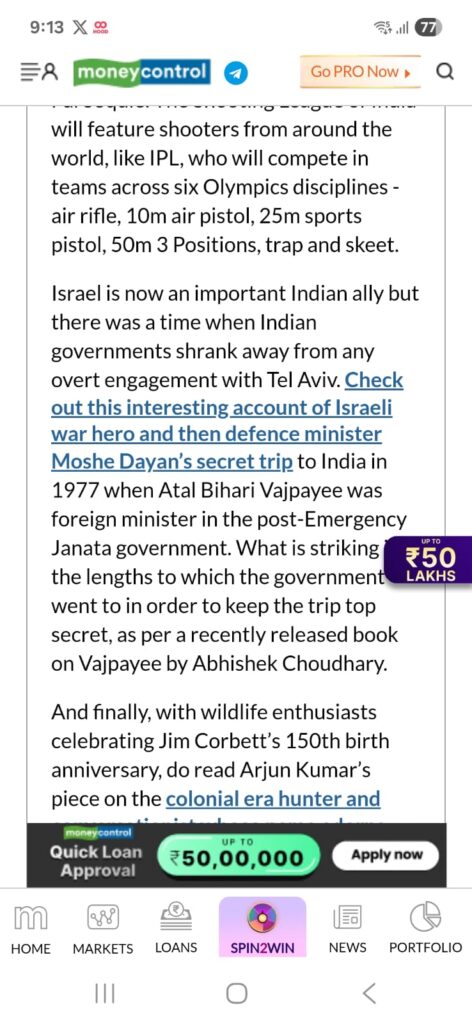
Israel is now an important Indian ally but there was a time when Indian governments shrank away from any overt engagement with Tel Aviv. Check out this interesting account of Israeli war hero and then defence minister Moshe Dayan’s secret trip to India in 1977 when Atal Bihari Vajpayee was foreign minister in the post-Emergency Janata government. What is striking is the lengths to which the government went to in order to keep the trip top secret, as per a recently released book on Vajpayee by Abhishek Choudhary.
Abhishek Choudhary studied economics in Delhi and Chennai, followed by brief stints in nonprofits and journalism. He was awarded the NIF Fellowship in 2017 to research former prime minister Vajpayee’s life. During the winter of 2021–22, he was a scholar-in-residence at the International Centre Goa. He lives in Delhi.
‘A compelling, highly readable account of the earliest phase of English presence in India’ NANDINI DAS, author of Courting India
When the first English travellers in India encountered an unimaginable superpower, their meetings would change the world.
Before the East India Company and before the British Empire, England was a pariah state. Seeking better fortunes, 16th and 17th century merchants, pilgrims and outcasts ventured to the kingdom of the mighty Mughals, attempting to sell coarse woollen broadcloth along the silk roads; playing courtiers in the Mughal palaces in pursuit of love; or simply touring the sub-continent in search of an elephant to ride.
Into this golden realm went Father Thomas Stephens, a Catholic fleeing his home; the merchant Ralph Fitch looking for jewels in the markets of Delhi; and John Mildenhall, an adventurer revelling in the highwire politics of the Mughal elite. It was a land ruled from the palatial towers by women – the formidable Empress Nur Jahan Begim, the enterprising Queen Mother Maryam al-Zamani, and the intrepid Princess Jahanara Begim. Their collision of worlds helped connect East and West, launching a tempestuous period of globalisation spanning from the Chinese opium trade to the slave trade in the Americas.
Drawing on rich, original sources, Lubaaba Al-Azami traces the origins of a relationship between two nations – one outsider and one superpower – whose cultures remain inextricably linked to this day.
Dr Lubaaba Al-Azami is a cultural historian and Lecturer in Shakespeare and Early Modern Literature at the University of Manchester. Lubaaba is also Founding Editor of Medieval and Early Modern Orients (MEMOs, memorients.com), a transnational digital platform on premodern encounters between England and the Islamic Worlds.
A history of modern South Asia told through five partitions that reshaped it.
As recently as 1928, a vast swathe of Asia–India, Pakistan, Bangladesh, Burma, Nepal, Bhutan, Yemen, Oman, the UAE, Qatar, Bahrain and Kuwait–were bound together under a single imperial banner, an entity known officially as the ‘Indian Empire’, or more simply as the Raj.
It was the British Empire’s crown jewel, a vast dominion stretching from the Red Sea to the jungles of Southeast Asia, home to a quarter of the world’s population and encompassing the largest Hindu, Muslim, Sikh and Zoroastrian communities on the planet. Its people used the Indian rupee, were issued passports stamped ‘Indian Empire’, and were guarded by armies garrisoned forts from the Bab el-Mandab to the Himalayas.
And then, in the space of just fifty years, the Indian Empire shattered. Five partitions tore it apart, carving out new nations, redrawing maps, and leaving behind a legacy of war, exile and division.
The book has been published by Harper Collins India.
Sam Dalrymple is a Delhi-raised Scottish historian, film-maker and multimedia producer. He graduated from Oxford University as a Persian and Sanskrit scholar. In 2018, he co-founded Project Dastaan, a peace-building initiative that reconnects refugees displaced by the 1947 Partition of India. His debut film, Child of Empire, premiered at the Sundance Film Festival in 2022 and his animated series, Lost Migrations, sold out at the British Film Institute the same year. His work has been published in the New York Times, Spectator and featured in TIME, The New Yorker and TheEconomist. He is a columnist for Architectural Digest and, in 2025, Travel & Leisure named him ‘Champion of the Travel Narrative’. Shattered Lands is his first book.
The Ghadar Movement was conceived in 1913 in the United States of America by Lala Har Dayal, Kartar Singh Sarabha, Sohan Singh Bhakna, Harnam Singh Tundilat and others, all of them Indian immigrants in the US. Inspired by Tilak, Savarkar, Madam Cama, Shyamaji Krishnavarma and others, the Ghadar plan was to smuggle arms to India and incite Indians in the British-Indian Army to mutiny. Many Ghadarites, most of them from Punjab, came back to India from the US in order to participate in the struggle. In India, revolutionaries like Rash Behari Bose and Vishnu Ganesh Pingle joined them.
Owing to lapses in planning and the presence of informers in their midst, the plan ultimately failed and the British came down very heavily on the conspirators.
Some like Kartar Singh Sarabha (who inspired a young Bhagat Singh) were sentenced to death for their part in the struggle. Many others suffered long and cruel jail sentences in the Andamans.
Rana Preet Gill is a Veterinary Officer with the Animal Husbandry Department of Punjab Government. She has authored four books―three novels―Those College Years, The Misadventures of a Vet, Maya and a collection of middles titled Finding Julia. Her articles and short stories have been published in The Tribune, Hindustan Times, The Hindu, The Statesman, The New Indian Express, Deccan Herald, The Hitavada, Daily Post, Women’s Era, Commonwealth Writers Journal, Himal and others.
‘Absolutely riveting’ Peter Frankopan, author of The Silk Roads ‘Disturbing and enlightening’ Chris Miller, author of Chip War ‘Hugely important’ Rana Foroohar, author of Makers and Takers ‘A once-in-a-generation read’ Robert D. Kaplan, author of Waste Land
As Trump wages a tariff war with China, seeking to boost domestic electronics manufacturing, this book offers an unparalleled insight into why his strategy is embarrassingly naïve.
Apple isn’t just a brand; it’s the world’s most valuable company and creator of the 21st century’s defining product. The iPhone has revolutionized the way we live, work and connect. But Apple is now a victim of its own success, caught in the middle of a new Cold War between two superpowers.
On the brink of bankruptcy in 1996, Apple adopted an outsourcing strategy. By 2003 it was lured to China by the promise of affordable, ubiquitous labour. As the iPod and iPhone transformed Apple’s fortunes, their sophisticated production played a seminal role in financing, training, supervising and supplying Chinese manufacturers – skills Beijing is now weaponizing against the West.
Investigative journalist Patrick McGee draws on 200 interviews with former Apple executives and engineers to reveal how Cupertino’s choice to anchor its supply chain in China has increasingly made it vulnerable to the regime’s whims. Both an insider’s historical account and a cautionary tale, Apple in China is the first history of Apple to go beyond the biographies of its top executives and set the iPhone’s global domination within an increasingly fraught geopolitical context.
Read an extract from the book on Moneycontrol. The book has been published by Simon & Schuster India.
Listen to our conversation on TOI Bookmark* podcast.
Review
‘Apple is more than the world’s greatest company. It is integral to the whole culture of globalisation. Patrick McGee not only narrates the epic history of Apple, but explains how, in effect, it got taken over by China, the world’s greatest illiberal power. To call this book a page-turner is almost to diminish its importance. It is a once-in-a-generation read‘ — Robert D. Kaplan, author of the New York Times bestseller The Revenge of Geography and the forthcoming Waste Land: A World in Permanent Crisis, and Robert Strausz-Hupé Chair in Geopolitics at the Foreign Policy Research Institute
‘Absolutely riveting. An extraordinary story, expertly told – and one that has important implications for Apple, for tech and for global geoeconomics.’ — Peter Frankopan, Professor of Global History at Oxford and author of the bestselling The Silk Roads
‘Deeply researched, disturbing and enlightening, Apple in China reveals how Apple enabled China’s rise, seemingly at the cost of its own future. In these pages we watch as the world’s most profitable company gets outmaneuvered by the world’s most powerful dictator. Using an impressively broad palette, McGee paints a picture of Apple CEO Tim Cook resolutely trying to save costs by placing nearly all of the company’s advanced manufacturing base in Beijing’s grip, only to find it impossible to wriggle free’ — Chris Miller, New York Times bestselling author of Chip War
‘A masterpiece of investigative journalism, replete with revelations. Every iPhone owner will want to read this book, but no Apple employee will risk being seen with it. McGee shows how China played the long game, convincing Apple to invest on an unprecedented scale and, inadvertently, help build its grand authoritarian project. This book is a warning for anyone eager to do business in hostile countries.’ — Geoffrey Cain, author of Samsung Rising and The Perfect Police State, and a former sanctions investigator for the US Congress
‘There is little doubt that Big Tech companies – like the world’s richest and most influential one, Apple – wield as much power as many nation states. But what’s less well known is how these companies are themselves manipulated by the Chinese state for its own economic and political ends. In this hugely important new book, Patrick McGee shows us how Apple’s quest for wealth and power in China may in the end be the undoing both of the company and of America’s quest for technology supremacy’ — Rana Foroohar, Financial Times Global Business Columnist, CNN Global Economic Analyst, and author of Makers and Takers: The Rise of Finance and the Fall of American Business
‘A tour-de-force account of how the world’s most influential company empowered the inexorable rise of the regime that now shapes its – and our – future. Paced like a thriller and spanning the years from before Steve Jobs’s fateful decision to outsource production to more recent times which shine a fresh spotlight on Tim Cook’s careful wooing of Donald Trump, Apple in Chinacaptures every twist and turn of the tech giant’s off-kilter and decidedly off-script relationship with the authoritarian state. What will surprise many is how China ensnared a corporate titan by matching and then surpassing its knack for ruthless efficiency and global dominance’ — Megan Murphy, former Editor in Chief of Bloomberg BusinessWeek
‘A masterful and deeply reported portrayal of how Apple gained China and lost its soul’ — Isaac Stone Fish, author of America Second and CEO of Strategy Risks
Patrick McGee has been a journalist with the Financial Times since 2013, reporting from Hong Kong, Germany, and California. He led the FT’s Apple coverage from 2019 to 2023 and won a San Francisco Press Club Award for his deep dive into Apple’s HR problems. Previously, he was a bond reporter at The Wall Street Journal in New York. He has a Master’s in Global Diplomacy from SOAS, University of London, and a degree in Religious Studies from the University of Toronto. He resides in the Bay Area with his wife and two daughters.
6 June 2025
*TOI Bookmark is a weekly podcast on literature and publishing. TOI is an acronym for the Times of India (TOI) which is the world’s largest newspaper and India’s No. 1 digital news platform with over 3 billion page views per month. The TOI website is one of the most visited news sites in the world with 200 million unique monthly visitors and about 1.6 billion monthly page views. TOI is the world’s largest English newspaper with a daily circulation of more than 4 million copies, across many editions, and is read daily by approximately 13.5 million readers. The podcasts are promoted across all TOI platforms. I have recorded more than 142+ sessions with Jnanpith, Padma Bhushan, and Padma Shree awardees, International Booker Prize winners, Booker Prize winners, Women’s Prize for Fiction, Nobel Laureates, Pulitzer Prize, Stella Prize, AutHer Awards, Erasmus Prize, BAFTA etc. Sometimes the podcast interviews are carried across all editions of the print paper with a QR code embedded in it.
Some of the authors who have been interviewed are: Banu Mushtaq, Deepa Bhashti, Samantha Harvey, Jenny Erpenbeck, Michael Hoffman, Paul Murray, V. V. Ganeshananthan, Hisham Matar, Anita Desai, Amitava Kumar, Hari Kunzro, Venki Ramakishnan, Siddhartha Deb, Elaine Feeney, Manjula Padmanabhan, NYRB Classics editor and founder Edwin Frank, Jonathan Escoffery, Joya Chatterji, Arati Kumar-Rao, Paul Lynch, Dr Kathryn Mannix, Cat Bohannon, Sebastian Barry, Shabnam Minwalla, Paul Harding, Ayobami Adebayo, Pradeep Sebastian, G N Devy, Angela Saini, Manav Kaul, Amitav Ghosh, Damodar Mauzo, Boria Majumdar, Geetanjali Mishra, William Dalrymple, Abdulrazak Gurnah, Dr Rachel Clark, Charlotte Wood, Catherine Chidgey, Andrew Miller, Sam Dalrymple, and Annie Ernaux.
The first of our organs to form, the last to die, the heart is both a simple pump and the symbol of all that makes us human: as long as it continues to beat, we hope.
One summer day, nine-year-old Keira suffered catastrophic injuries in a car accident. Though her brain and the rest of her body began to shut down, her heart continued to beat. In an act of extraordinary generosity, Keira’s parents and siblings agreed that she would have wanted to be an organ donor. Meanwhile nine-year-old Max had been hospitalised for nearly a year with a virus that was causing his young heart to fail. When Max’s parents received the call they had been hoping for, they knew it came at a terrible cost to another family.
This is the unforgettable story of how one family’s grief transformed into a lifesaving gift. With tremendous compassion and clarity, Dr Rachel Clarke relates the urgent journey of Keira’s heart and explores the history of the remarkable medical innovations that made it possible, stretching back over a century and involving the knowledge and dedication not just of surgeons but of countless physicians, immunologists, nurses and scientists.
The Story of a Heart is a testament to compassion for the dying, the many ways we honour our loved ones, and the tenacity of love. It has been published by Hachette India.
Dr. Rachel Clarke won the Women’s Prize for Nonfiction 2025. Her book, Story of a Heart: Two Families, One Heart, and the Medical Miracle That Saved a Child’s Life (published by Hachette India) is very well written and extremely moving in parts. She achieves a remarkable balance between telling the account of a heart transplant in two kids (for which one had to lose her life), changing the organ donation law in the UK, and sharing the history of heart transplants — it is fifty years since the South African cardiologist Christiaan Barnard conducted the world’s first human-to-human heart transplant operation.
It was a privilege speaking with Dr. Clarke on TOI Bookmark.
Here is a snippet from the conversation:
I think the heart of good medicine and an essential requirement of every good doctor, is the ability to really listen to your patents, really care about them as human beings. Not just as somebody with a failing liver, failing heart. You need to care about human beings. You need to be curious about their life; their story and you need to attend very very closely to what they say. And actually, a lot of those are traits of a good writer as well and a good journalist, particularly a nonfiction writer.
Also, read an extract from the book on Moneycontrol.
Dr. Rachel Clarke is a palliative care doctor and author of three London Sunday Times bestselling books, including Dear Life, which was shortlisted for the Costa Biography Award, longlisted for the Baillie Gifford Prize, and chosen as a BBC Radio 4 Book of the Week. Prior to medical school, she worked as a broadcast journalist. She writes for many publications, including the New York Times, London Guardian, and the London Sunday Times, and she makes regular television and radio appearances on outlets including the BBC, among others.
A sea change is occurring—a change so monumental that it is making us re-invent the traditional ideas of where work is done, when work is done, why work is done, and even what work itself is.
We have a choice. We can either be reactive and struggle to adjust to transformational events on the fly, or we can be proactive and control the narrative—reinventing work to align with the evolving environment. Futurist Rishad Tobaccowala has had a highly successful career because he has anticipated and capitalized on emerging trends. In Rethinking Work, Rishad outlines the reasons why being proactive in this era of unprecedented change is the only way organizations will survive and thrive. Schools, banks, law firms, startups, medical offices—every sector will be affected by the current or soon-to-be-emerging trends and events that Rishad describes in this invaluable guide.
Learn to thrive in a world where the who, what, why, where, when and how of work will be transformed:
Who will people work for? A growing number of people are choosing to work for themselves while others are opting for greater control over who they work for. This will lead to more options both for employees and employers on how to structure their work.
What will organizations look like? Like nothing in the past. We will no longer have a single organizational model or design but instead have a wide range of operating styles, structures and sizes.
Why will people work? Two-thirds of workers under 30 are combining different gigs to not only satisfy their financial needs but to their own personal satisfaction and sense of purpose
Where will people work? In the metaverse. At home. In morphing offices that bear little resemblance to traditional workspaces. With team members in other countries and customers on other continents.
When will people work? Whenever. The 9-5 workday is already passing as efficiency lessens in importance to innovation, disruption, and agility.
How will leadership change? We are evolving to a new type of leadership from management focused to growth, agility and learning focused.
While there are many points to ponder over in this book, it is worth mentioning that it would be advisable to always remember that this book is written within a US context, so take from it whatever you deem fit for your context. The book has been published by HarperCollins Publishers India.
When I was growing up in India my parents took me to book stores every weekend and I became a voracious reader and decided I wanted to be a writer. My parents steered me to mathematics instead and said one day when you have something useful to say you can become a writer.
After a 38 year career in marketing, strategy and change management across the world for the Publicis Groupe and for its many clients I have finally written my first book. Early readers have indicated that yes I have something useful to say and so I hope you will too.
My book aims to help readers feel, think and see differently so they can grow their companies, their teams and themselves in these transformative times. It hopes to be a resource and an operating manual of sorts to thrive in a world where both technology and humanity are key.
Every chapter of my book can be read in any order. Think of it as a Spotify Playlist with a theme about how to integrate the story and the spreadsheet as the spine that runs through the book.
Chapters include 1) How to Upgrade Your Mental Operating System, 2) Why Change Sucks and 3) How to Lead With Soul.
This book is not about marketing but a combination of business insights and hopefully wisdom. To write it I spent two years doing research and combined it with my four decades of learning working across different industries and clients.