Interview Posts

“India’s Forests: Revisiting Nature and History”, An interview with the editors, Arupjyoti Saikia and Mahesh Rangarajan

This interview with the editors was published on Moneycontrol on 29 April 2026. Here is the screenshot of the header. Given that many readers outside India are unable to access the interview easily, I am copy-pasting it here.
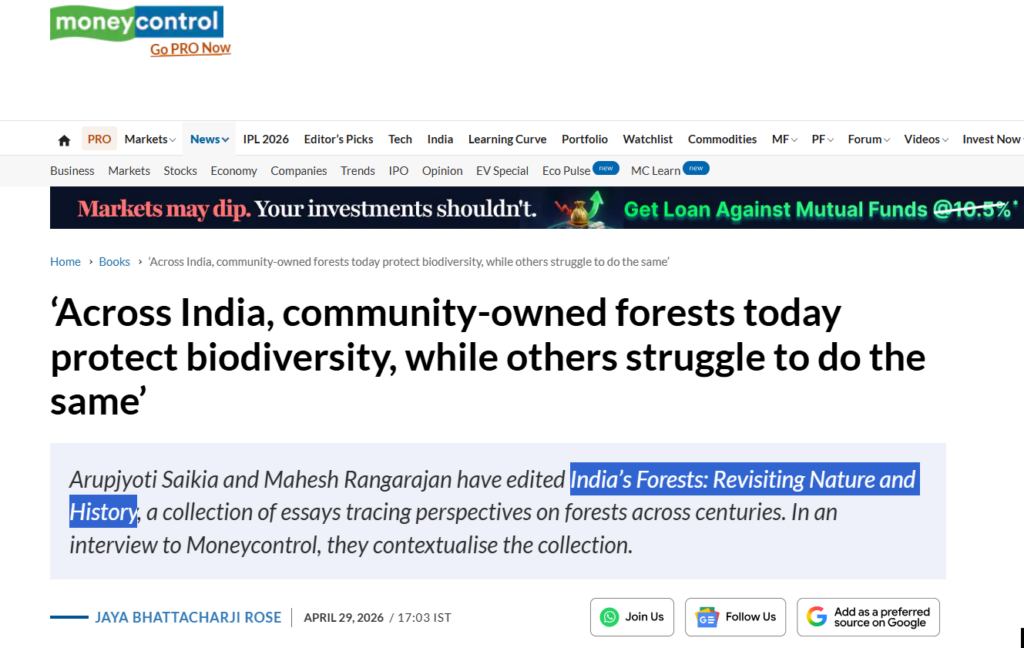
Arupjyoti Saikia & Mahesh Rangarajan (Eds.) India’s Forests: Revisiting Nature and History Vintage Books, an imprint of Penguin Random House India, 2026. Hb. Pp.360.

India’s Forests brings together essays by some of the country’s leading scholars with a fresh view of nature and history. These reappraisals of Indian forests and their many lives in past and present matter more than ever today. Born of years of sustained reflection, the essays here view forests not as passive unchanging backdrops to the past but as living, contested spaces.
Forests were shaped and in turn deeply influenced by power, culture and society. They could mean very different things to different people who often were in contest over meaning as much as control of the space or the resource. The volume spans from prehistory through ancient and early modern India into the present. It is also alive to the impact of the colonial era while tracing the changing fortunes of tribal and hill peoples. They are ecological lifelines and sites of legend, memory, and scientific knowledge. Material remains and life cycles of animals and plants matter, so too do social and literary imaginations.
Forests have been continually redefined through conflict, negotiation, and care. Attentive to the changing meanings across time and place, the book asks us fundamental and unsettling questions: what are forests for?

Contributors include: Shibani Bose “ ‘Digging’ Tales from Sylvan Trails: Perspectives from Archaeology”; Kumkum Roy, “People, Produce and the Political: Engaging with the Forest through the Arthashastra”; Aloka Parasher Sen “Multiple ‘Forests’ and Changing Borderlands: The Varied Indian Landscapes in Early India”; Meera Anna Oommen & Kathleen D. Morrison “Famines, Flagships and Floods: Historical and Contemporary Identities of Central Travancore’s Eastern Forest Frontier”; Mayank Kumar “Forest and Communities: Negotiations of Early Modern Monsoon Ecologies in India”; Divyabhanusinh “The Lion and the Unicorn: Fighting for Survival”; Sudha Vasan “Shifting Cultivator, Peasant, Forest-Dweller: Legacies and Landscapes of Improvement in the Baigachak”; Mukul Sharma “’God of the First Class’: Politics of Sacred Groves and Sarna in Jharkhand” and Vasudha Pande “Interrogating Ram Guha’s The Unquiet Woods: Thirty Years Later”.

Harini Nagendra, director, School of Climate Change and Sustainability, Azim Premji Universityendorses it saying “India’s Forests is a grand tour of the shifting forms, shapes and meanings taken by the country’s woods and jungles across the great arc of history. This integrative volume synthesizes information from a fascinating array of sources, from Mesolithic cave art and the Arthashastra to field trips and contemporary wildlife surveys; and captures a wide range of geographies from the Himalayas to the forests of Kerala. A must-read for anyone seeking a deeper understanding of the role forests play in our cultures, histories and imaginations.”

Arupjyoti Saikia is a professor of history at the Indian Institute of Technology Guwahati. He held the Agrarian Studies Programme Fellowship at Yale University, and visiting fellow positions a Cambridge University and the School of Oriental and African Studies (SOAS), University of London. His research spans across the economic, political and ecological histories of Assam. His published works include Forests and Ecological History of Assam, 1826 to 2000 AD (2011), The Unquiet River: A Biography of the Brahmaputra (2019) and The Quest for Modern Assam: A History, 1942–2000 (2023).

Mahesh Rangarajan is professor of history and environmental studies and chair of the HDFC Archives of Contemporary India at Ashoka University in Haryana. Previously, he has taught at Cornell University, University of Delhi, Krea University and the National Centre for Biological Sciences, Bengaluru. His notable works include Fencing the Forest (1996) and Nature and Nation (2015). He has edited the Oxford Anthology of Indian Wildlife (1999) and Environmental Issues in India (2007). His co-edited works include Shifting Ground (2014) and At Nature’s Edge (2018).

The following interview with the authors was conducted via email. It was lightly edited before publication.

  1. How do you define a forest? Has the definition changed over the years? Who defines it? What is it today as recognised by the government of India and international authorities? Also, what are the different technical definitions of a forest as determined by these bodies?

MR & AS: The book India’s Forests makes clear that ‘forest’ is, as one of our authors Kathleen Morrison puts it, a “vexed object, poorly defined yet meaningfully rich”. Forest is a space conceived differently across disciplines, eras, and political systems. For instance, in ancient India, forests had many roles. Each shaped by their use and location. The Arthashastra distinguished hasti vana, the area for elephants, from mriga vana, forests for enjoyment, organising woodlands by their strategic and economic value. If Sanskrit texts drew a clear line between grama, the organised village, and aranya, the wild forest, Tamil Sangam poetry described a continuous landscape where hills, bushes, and thick forests blended, reflecting human feelings and mixing wild and farmed land. More changes came in the later centuries.

The colonial period set legal limits on forests. The Indian Forest Act of 1878 turned forests into government-run lands, defined not by their trees but by who owned and controlled them. Forests became a political site instead of living nature. A major change came in more recent time. The Supreme Court of India expanded the definition of forests to include all wooded areas, regardless of ownership or classification in the Godavarman judgment of 1996. This important decision shifted the focus from official documents to the natural environment. This sparked strong debate about the future of communities living in forests without legal ownership. 

India’s Forests takes on the challenge of defining ‘forest’ clearly. Forests in this book cover a wide variety of landscapes, from rich rainforests to dry thorn forests and tall-grass savannahs, excluding only deserts and the tallest mountains. Forests are living nature made not just of trees but also herbs, fungi, orchids, and macro-fauna embedded in socio-cultural matrices. The book does not specify the exact technical definition used by the government though such reports are referred to as an important source of current government data. The idea of forests has made many journeys across time, space, ancient texts or modern legal lenses. This helps to secure the legal and proprietary lens of colonial rule, to the ecologically expansive definitions of recent times. Even now, the meaning of ‘forest’ is still considered by scientists, lawmakers, forest conservators, and activists-conservationists.

2. How did this book come about? How long was it in the making? What was the principle defining the commissioning of the articles? What are the key issues in this narrative that you wished to highlight? 

MR: We chose a range from prehistory to the current era and while all regions and ecotypes could not be covered, we have attempted to get a collection that is original, thoughtful, critical and stimulating. The occasion was the anniversary of the publication of a key work, The Unquiet Woods by Ramachandra Guha in 1989 a foundational work on environmental history, mainly a study of the Chipko movement. The essays engage with themes opened up by the book but in a critical if appreciative light. Much has happened in the study of forest histories in the last 35 years or so and we try in the introduction to look back and in the volume to point possible ways to go forward with fresh lines of enquiry.

AS: As Mahesh mentioned, Ramachandra Guha’s The Unquiet Woods opened up many layers of India’s pasts through the bright lenses of our nature, specially the woodlands. Since then, an enormous corpus of works have critically investigated India’s forested pasts. This trend continues to grow. These works’ geographical range and temporal scale is wide and deep! Equally historians have now explored newer archives and have engaged with newer methods inspired by other scholarly disciplines. All of these have helped us to get a nuanced understanding of India’s complex pasts and their evolving relations with the environment. We also wanted our readers to discover India’s forests as living landscapes shaped by agriculture and the ever-shifting worlds of trade across centuries and regions. We thought of bringing some of these newer works into one single frame which can help us to give a collective view of India’s forested pasts.

3. How will these academic essays on the history of India’s forests and Nature at various points of history help in future environmental action? How do you propose to bridge the communication gaps between this impressive evidence collated and action on the ground? 

MR: Such a work can inform debate, as it is not prescriptive or a call to action directly. But all authors are sensitive to these concerns and some have engaged with the issues for long, years even decades.  There is no short cut method to reaching out and we will try. Initial responses are very positive.

AS: Readers find here not prescriptions, but a firmer and a clearer picture of the variegated life of India’s forests. The essays in this book reveal that India’s forests have always been alive with activity and meaning. Far from being silent backdrops, these woodlands have witnessed centuries of struggle, bargaining, survival, and authority, stretching from the detailed forest classifications of the Arthashastra to the major changes brought by the Forest Rights Act of 2006. They go on to suggest that today’s decisions about conservation, community rights, and the restoration of ecosystems are quietly guided by echoes from centuries past. The creation of colonial forest reserves, the gradual loss of traditional rights, and the privileging of timber over biodiversity did not simply happen; they were crafted by history. The past of India’s forests may not hand us a roadmap, but it does reveal the pitfalls that once tripped up those who came before us.

4. What are the pros and cons of the colonial narrative for ecological histories that we inherited? How did it affect the development of a region, conservation methods, and impacted human behaviour. 

MR: There is no one unified colonial or imperial narrative.  Just as there is no one global or national one today. Certainly not on the forest. The colonial interlude in India was still critical in many ways.

There were indeed Abharanyas (forest reserves) in early India and in early modern India, there were hunting reserves, such as the well-known shikar gahs of the Mughals. Landed groups had pig sticking grounds. But the extent and scale and scope of state forestry was never of the level of imperial China. In this sense the kind of property rights with state forestry in the later years of the East India Company and then under Crown rule post 1858 was far more intrusive.

In order to secure the forest land and its wealth, there was a legal frame and an executive branch for taking land over. This was like enclosure (not literally with fences) but through punitive actions and penalties. There was a major attempt via silviculture to upgrade forest stock to yields more timber and other forests products. This meant many strictures on hunting, fishing, grazing collection and on opening up fresh land for cultivation. This enclosure of commons and open access lands had deep even wrenching effects that are felt to this day. A remarkable administrative accomplishment, the Imperial Forest Service secured the forest and protected it. But it was not conservation for its own sake but in service of empire.

AS: I agree with Mahesh that the colonial era left behind not only vast stretches of forest but also lasting scars on the people who had cared for these lands for generations. But that narrative cannot be so straightforward and each part of India will tell something different. There were undeniable gains: from the 1860s, new laws and policies curbed deforestation and established the framework of forest departments, protected zones, and wildlife safeguards that independent India would later expand. Without this groundwork, the dramatic and yet stable resurgence of the lion in Gir and the greater one-horned rhinoceros in Assam would have been unimaginable.

But these gains came at a steep price. Colonial forestry put profits above conservation [though this was not too simple] or timber above the rich diversity of life, replacing the trees that villages relied on with fast-growing, marketable trees which produced logs. Swidden cultivation simply was branded as a criminal act while pastoralists lost their age-old rights to graze in mountain meadows. Generations of customary rights vanished with a single law. Forests became sites for extraction, stripped of the intricate and emotive bonds that communities had woven over centuries. This imbalance still lingers in many ways but so is the challenging legacies of our environmental past.

5. India’s Forests focuses on the history of an age-old culture of peasant-pastoral wisdom that has been eroded by modernity, consumerism and a variety of vested interests.  Will the preservation and the commendable efforts of keeping this knowledge visible in academic discourses impact key stakeholders, policymakers, perhaps result in afforestation practices? 

MR: Kings, peasants, land owners, merchants and forest peoples looked at forests in different, often contrary ways. There were also times their interests or ideas coincided. It is true industry, commerce and so on have transformed not only forests but the earth system since the late 18th century, the time Britain embarked on the Industrial Revolution and eastern India came under the East India Company. The colonial era had far reached impact on animals, peoples and trees and plants and water as much as on land. What is notable, and this matters, is that the Western Ghats were a source of pepper and ivory makings it way to Rome 2000 years ago so the exchange economy is not new even if modern capitalism is. Oommen and Morrison show pepper collectors in the hills and ivory hunters and the ecosystems very much part of wider networks. In similar ways, the work of Dr Mayank Kumar on the early modern era shows how Rajasthan had records on conflict and control over animals and trees in rural areas by dominant groups and state authorities. There was still room to manoeuvre because peoples beyond or the edge of cultivated arable mattered to rulers. Their knowledge and wealth (animal or other produce) was taken and ties were not equal. But the kind of fixity of property, tenure and settling in the colonial and British imperial era had a ferocity all of its own. It is well illustrated in the novels of Bibhuti Bhushan Bandopadhyay on the clearance of the forest and the later continuities in the works of Mahasweta Devi.

This is of course a short response. For the richness of the stories the book has many voices, explores many forest paths and tracks.

On the last, time will tell. We are delighted at the early reception to the work and hopeful it will help inform if in small way the wider debate. This is not a book about what to set right and how. That calls for a different kind of book and work.

It is meant to be wake up call on ways of thinking most so about what forests mean and why issues of how to relate to nature are as much about the past as the future. How we got here matters no matter where we may want to go. The forests of today are as much as product of human history as of biological processes.

AS: The book does not paint a rosy picture of a missing rural landscape. Instead, India’s Forests reveals how peasant and forest communities were always entangled with power. That they bargained with kings, paid taxes, endured punishments, and constantly adapted. The essays in this book encourage readers to confront the many histories of India’s forests. As Mukul Sharma demonstrates in this volume, India’s sacred groves are also sites of contest, hierarchy, and ecological complexity, as well as a resounding tool for conservation templates. We cannot afford to overlook these tangled pasts, or risk falling into the old colonial trap of imposing one-size-fits-all solutions on richly varied lands and peoples.

As said earlier, one can think of the jhum farmers in the highlands of India’s North East. They observed the land’s slope, soil moisture, rainfall patterns, ecological pasts, and the many worlds of insects before deciding where to burn and where to grow. This complex ecological practice and wisdom had developed over many generations. Anthropological works of the 20th century provided a clearer, more detailed understanding of such ecological practices. The British imperial foresters called it wasteful and tried to stop it. What was challenged there was not just a farming method but a whole way of understanding how to live with forests. 

The essays in this book argue that such intimate encounters with nature were never unchanging or perfect. They changed, adapted, or regularly dealt with power at every step. Along with the measures adopted by the state, the rhinoceroses in Kaziranga also survived because the peasant communities knew about this flooded and forested habitat. For the peasant communities, the wet grasslands of the Brahmaputra floodplain are socio-ecological formations which they understood intimately. India’s Forests thus offers the readers a more critical view about human and nature relations.

6. Where and how did we lose our traditional knowledge bases, especially that exists within our culture? They have a deeper understanding than outsiders who impose their views. What proportion of these information repositories that exist in a micro-culture, stories, cultivation practices etc can we recover?

MR: This is best I defer to Prof Saikia.

AS: The loss happened in layers. Colonial legislation quickly criminalised community forest practices. Postcolonial development deepened the wound. We cannot recover everything. But the epistemological framework survives: the understanding that forests are social-ecological relationships, not timber warehouses.

7. Why are we moving or have we already developed an economy of exclusion and inequality at the cost of depriving traditional knowledge? What are the rights of local communities? Can these be exercised, enforced and implemented?  (As is being done in Brazil, if I am not mistaken.)

A lot of this can be traced to the legal frame, the practice and norms of imperial forestry instituted the 1860s and 1870s on wards. In the early years, while the most senior Inspector General was German for 35 years almost in many provinces, they got former military men to take charge. So, exclusion was built in very early. It was not and cannot be total as labour was required for a variety of reasons, such as cutting fire lines, making roads and felling trees. Until the Forest Rights Act of 2006, the rights of Scheduled Tribes and Other Forest Dwellers had no real legal space. Since then, it has been an uphill struggle between the official mind set and the securing of rights. It is important to acknowledge here that the Act had unanimous support not merely as critics feel to give away land or forest for votes but as a corrective. The land reform process of cultivable land of the 1950s had no counterpart for over 60 years with regard to forests.

Brazil has had a different history and the nature of indigeneity is different. It also has far fewer people in say the Amazon than India’s forests. Closer to home one can look at Nepal that has far more decentralised and participatory approaches via vis parks, forests and water than almost anywhere in India. But there are attempts at change in many cases at the state level so there are grounds for hope yet.

AS: I agree with Mahesh that India’s land reform programme including the abolition of zamindari in the 1950s which were largely done based on the political inspiration of India’s freedom movement had little parallel since then. Mahesh rightly highlighted that the exclusion was not accidental — it was architectured. Colonial forestry-built inequality into its legal foundations, erasing customary rights and replacing multi-layered community relationships with a single extractive logic serving the colonial state. Independent India largely inherited this framework with very limited transformation. The Forest Rights Act of 2006, we do need to note, was a historic corrective. It recognised for the first time both individual and community rights of forest dwellers — but implementation remains bitterly contested. There is little doubt that decentralised forest governance can deliver desirable results.

8. Forest cover has reduced to 21% in India. CSR efforts to plant trees in different parts of the country have been an ongoing practice for a while now. But do these initiatives in any way, take into account the symbiotic relationship between local communities and the forest that are outlined in the book? Will these planting drives help us recover our forests? 

MR: Having not directly worked on this, cannot say much. But replanting is not the same as regeneration. A mixed multi species formation is different from a plantation. A lot of work by ecologists in fact shows this and it might help value protection and prevention over plantation. The latter is needed but as a complement.

AS: The choice of species may of course not at all be in accord with livelihoods. The late Anil Agarwal illustrated how different regions have key trees for livelihood and ecology such as khejri in the Thar desert, banj and moru oak in the western Himalaya, Mahu and tendu in Central India and the peninsular highlands and one might add the Palmyra Palm on the Coromandel coast. These are not planted often but are grown or grow and if fostered with care yield multiple benefits and also play a role ecologically.

9. India’s Forests outlines the significance of forests to communities that has been mentioned in texts like the Arthashastra or preserving the practice of sacred groves in Jharkhand. People had a vested interest in preservation of Nature. We need forests to maintain our climate and weather patterns, most notably, our unique monsoon. This is imperative given the rapid climate change. Yet, large chunks of forests are being cleared for mining, growing cash crops, land banks, and urbanisation. How do we bring back this sense of belonging and enable a collective action to preserve rather than it becoming only the purview of environmental activists/academics? 

MR: Just to be clear, the Arthashastra is about extending and expanding the state role in and over the forest. The aranya or vana is not beyond the ambit of power but extending authority was a challenge. While enumerating multiple productive roles of the forest and kinds of forests, and kinds of peoples, there is a clear sense of power and hierarchy. This is especially clear with the Atavika Rajas or forest chiefs who are to be loyal and guard borders. Ashoka no less in an Edict warns that those who do not behave and obey will be punished.

The collective sense you refer to is strongest perhaps in hill, forest and Adivasi or Scheduled Tribe societies. One of the things we have to be careful about is not to romanticise or generalise. There are many who see this is as either/or choice national park or sacred grove or state versus community.

There is no doubt much to learn from local and communitarian ideas and practices, most so in keeping the systems productive and habitable over long periods. The actions you refer to such as mining and industry are often giving priority to short term extraction without much thought to the biota, top soil or water or to those they displace directly or indirectly. A different way of seeing is the starting point surely. Aside from specific cases or protests, a more holistic appreciation of ecologies and also of producer knowledge. The latter is helpful because if one thinks of mahua or tendu so important in central and main land India, you get a different view of the forest as entity than simply as land for mining.

Scholars and others are learning from real life situations and practices. Yes of course, there should be more informed discussion and the level of awareness all round of the linkages and connections needs to be part of larger discourse.

AS: Think of India’s many highland communities, who named their forest areas not by how much wood they could get but by the spirits living there, or the Van Gujjars of the Shivalik foothills, whose seasonal moves followed not government borders but the memory of grass and pastures. These were not just old traditions; they were exact, proven, living maps for survival. What replaced them when British imperial forestry began was a different kind of exactness the surveyor’s chain, the forest section number, the mining rights planned in colonial offices far from the sound of rain on sal leaves. The hills of Meghalaya lost not just trees and bushes but also a whole way of understanding nature when jhum cycles were restricted by official rules.

Despite those challenges across India, community-owned forests today protect biodiversity, while others struggle to do the same. For many, the Khasi clan’s ancestral forest remains a more effectively conserved landscape than many protected areas. 

The starting point is neither nostalgia nor laws alone; it is listening. When a floodplain dweller describes flood patterns along a river in eastern India, she is sharing climate information that no satellite has yet recorded. 

10. Forest / environment has a specific vocabulary. Why is it not more in vogue? Will it not help preserve and respect trees and forests if people recognise and understand their environment?

MR: In general, yes. But there are different terms in various regions, jangal in Hindustani is common parlance, Kadu in Tamil. Once you get to the local level, there are variety of terms for different kinds of uncultivated land scape: the rakhs for instance in central and western India is a grassland that may be dotted with trees. These were often cleared away and cultivated after independence though vital for diverse fauna and flora and for local livelihoods especially the rural poor. Similarly, despite the Kadu/Nadu dichotomy in Tamil, goat droppings (from their browse off grass, shrubs and herbs) was prized for the nutrient value for the cultivated land.

The problem is in a narrow view if you like a monochromatic view of a multifaceted entity. The forest can be habitat for bats and birds, mammals and insects, and diverse flora. It is not simply waste land to be carved up for cultivation or for industrial projects.

With all their faults, this was realised as early as the 1830s by some East India company surgeons as studied by the late great Dr Richard Grove. The early links of forests and climate were also first drawn in the Indian Ocean by such men and they were men. It is a different matter such ideas were not always acted on and when so only partially.

We still have an immense challenge when forests are viewed only in terms of timer i.e. Net Potential Value or NPV. Useful for forest products it hardly captures or does justice to multiple ecological and social functions or roles or relationships.

AS: Language moulds the way we see, and when words vanish, entire worlds slip away. The people of Arunachal Pradesh hold a treasury of names for forests along the mountain slopes, each term capturing the moisture, soil, seasons and how people relate these to them. Reduce all this to just ‘forest cover, and you erase a living map of relationships between humans and the natural world. When a place loses its name, it is already halfway to being lost.  Despite odds, these forest vocabularies survive in song or in rituals. Their return to the mainstream will be greatly helpful. This is what the earth desperately needs.

11. With the rapid technological growth, especially as the demand for AI grows exponentially, tech companies are being given permission to construct data centres in urban areas as well as agricultural and in some cases, forests. These centres are land, fresh water, and mineral guzzlers. Is there hope for the future of forests in this dismal context?   

MR: Modern industry and this certainly include AI very prominently so did not and does not budget for water. Not only is surface water scarce much of the year in most of India, ground water takes years to accumulate and has to be renewed as it is used. Meeting drinking eater view renewal is possible but more that calls for prudence.

On the other count, if you take a longer view, there has been woodland retreat and resurgence in the past. If we have more productive agriculture and more water prudent forms of use, both urban and rural, given there are less cattle now and pastoralism contrary to popular image can integrate with open land, scrub and open land ecosystems, there is lot of ground for hope.

It is important to note the success of grassroots regeneration of ecologies and also the positive government community partnerships. None are ideal and multiple challenges remain.

But you are correct the resource destructive path way is not prudent or just in such a land mostly of long dry and short wet seasons. Maybe we should look at this from the long-term perspective say a long-lived tree than a human life span. That will give sense of perspective a balance sheet cannot.

AS: I agree with Mahesh.

30 April 2026

Interview with Aditya Iyengar

Aditya Iyengar

Retelling of Indian mythology by Indian novelists is proving to be quite an interesting exercise as it is allows the modern storyteller to choose and stress upon different aspects of the epics. Aditya Iyengar is one such writer. He writes Indian mythological and historical tales through the eyes of often unexplored and peripheral characters. His works include – The Thirteenth Day, Palace of Assassins, A Broken Sun, The Conqueror and Bhumika. His novel Bhumika was longlisted for the Mathrubhumi Book of the Year 2020. He lives in Mumbai.

  1. How did you get into professional writing?

I’ve always been a voracious reader. But I think somewhere in my mid-twenties, I decided I wanted to attempt to write a novel. I think the confidence came after reading Arun Kolatkar’s poetry and Kiran Nagarkar’s seminal Cuckold. Somehow these made me feel that I could express myself through the English language but in an Indian idiom in a manner that felt entirely natural. 

I’ve always been fond of mythology, historical and science fiction, so I knew I wanted to attempt one of these genres. I don’t remember why I decided to write a mythological retelling over the other genres. Perhaps because the story I had for my first novel (The Thirteenth Day) was the clearest in my head. Anyway, it took me a few years to actually develop it into something resembling a coherent narrative. 

I don’t write for a living. I have a day job that doesn’t involve creative writing (though creative writing as a skill comes in handy in virtually every trade). It’s a conscious call I’ve taken to take the pressure off my writing. Also, the writing life is a lonely one, and natural introverts like me would never meet people if they decided to stay at home and write all day.   

2. What appeals to you in telling the kind of stories that you choose to tell? Stories that are based in myth? 

I’m a huge fan of mythological retellings and historical fiction. The past, whether it’s historical or epic, is strange and exciting territory There’s something about reading about characters from the past or from epic fiction and feeling a human kinship with them. In a way it reminds one that we are all connected, and through the years have had the same motivations.   

3. How did you develop a passion for mythology? Are there any favourite retellings of the mythological tales that appeal to you?

Growing up, I was very fascinated by historical and mythological stories. I’m not sure why. I’ve certainly never analysed it. Some kids are interested in sports, some find science projects fun – I just really enjoyed reading history and mythology. My childhood fascination for the past (both historical and epic), I think, came out through my novels. Some of my favourite mythological retellings have been K.M. Munshi’s wonderful Krishnavatara, C Rajagopalachari and Kamala Subramaniam’s retellings of the Mahabharata, and Colleen McCullough’s The Song of Troy (which is based on the Illiad).

4. How do you plan your novels? 
I used to be a rigorous planner. I made notes for chapters, listed out characters, motivations, and tried to find what Vince Gilligan, the head writer of Breaking Bad calls “where the character’s head is at”.
I’ve written five novels. My preparatory notes have reduced for each novel to the point that I wrote Bhumika with only a broad story in mind, and no chapter-wise road map.
I’ve come to the conclusion that every novel requires a different process of planning. But if you have a broad story in your head, the details can be worked out as you write the novel. One doesn’t necessarily need to work out details before they start the novel, though it can be helpful even if one does.

5. What is your daily discipline to write?

I don’t write every day. I only write when I’m working on a project. Mostly, I get up early, work on my book for a little while, then head for work. Sometimes, I come back from the office and work for a bit too. On weekends, I wake up early and work till about 5 pm, after which I turn off my laptop.

I sit on a rocking chair, and balance my laptop on my lap and type. I don’t eat or drink anything except at meal times, and I end up eating very little if I’m absorbed in my work. I don’t read or watch anything on the telly during these times too. It’s a fairly hermit-like existence. Write, Go to Office, Return, Eat, Sleep and Repeat. Of course, such a lifestyle is unsustainable, so I normally write and finish novels within a few months. I have a healthy respect for deadlines, so I set myself a schedule and try hard to stick to it.  

6. How much research does a book entail?

The level of research really depends on the novel. For my historical fiction novel – The Conqueror, I needed to read up on the Chola kingdom and the Srivijaya empire in Indonesia. I read a number of books and many academic papers and articles before I began writing the novel. A lot of my research was also shaped by the elements I wanted to include in the novel – for example, I wanted to write about one of the characters getting heavily drunk so I did research on the kinds of liquors that were available in those times.

For my Mahabharata and Ramayana novels, the research is limited since I already know most of the events through childhood retellings (Thanks, Mom!). Though I have also read some incredible translations that have helped shape my perspective. My mytho-fantasy series on Ashwatthama starts after the events of the Mahabharata and is entirely fictional.     

7. What has changed in your writing style from the first book to the present one?
 
I’d like to believe my style is now more compact. I can express myself with fewer words. Also, I’m more confident using the full toolkit of punctuation marks. When I began, I would only use full-stops and abhorred any use of exclamation marks or colons and semi-colons. While I’m still very, very judicious about how I sprinkle those exclamations, I’ve learned how they can be used appropriately, for maximum effect.  

8. Are there any particular darlings in your writing that you have had to kill off knowing it is for the good of the manuscript? Does it hurt to take these decisions? 

Oh no, I absolutely couldn’t kill any of my darlings. Take some meat off them, yes – but what is the point of writing for pleasure if you have to kill your darlings?  

9. Why create Bhumika in the way you did when the trend seems to be to retell stories in the way we have inherited the narratives?  

I think our ideas of the purity of inherited narratives are not accurate. There have been several retellings and re-interpretations of the epics over the years and across different regions all over the country. I’d like to believe I’m following in a grand tradition of re-interpreting stories to make them more contemporary, like so many writers better than me have done before.

10. When do you find the time to read?

I don’t really read anymore. Not like I used to at any rate. I’m currently plodding through Richard Eaton’s A Social History of The Deccan, which is a tragedy because it is such a lovely book that I would finish it in a few days under normal circumstances. These days, between the job and daily chores, I find all my time going in the business of the day. I try reading in snatches of time – before going to bed or after finishing my work or before breakfast – and hastily devour as much of the book as possible. It’s almost become like having a clandestine lover. You meet with great difficulty, away from the eyes of the world, and cherish every moment together.  

11. How many more novels have you drafted?

I’ve written a novel set in the film industry – it’s a dark comedy, but it’s languishing on my desktop because I haven’t had the time to do a FINAL FINAL.doc edit. Other than that, I have a few ideas for novels (two historical and one mythological) that I have yet to begin working on.  

23 April 2020

An interview with Chitra Banerjee Divakurni about “The Forest of Enchantment”

Chitra Banerjee Divakurni and I first met some years ago when I had to interview her at CMYK bookstore, Mehrchand market, New Delhi. Ever since then we have remained in touch and I have enjoyed reading and interviewing Chitra’s books published over the years. This time too I read The Forest of Enchantment and discovered that the book was unexpected. Given below is an extract from our email correspondence as a background to the interview that follows.

Dear Chitra,

It has been such a pleasure to read your latest novel, The Forest of Enchantment. It was unexpected too. Over the years you have raised readers expectations to create strong women. Women who learn to make choices while in the prime of life or later while reflecting upon their lives as they age. The reader is privy to the heroine’s inner thoughts and formulates for his/herself an image of a strong woman. In the long run perhaps these heroines offer a role model of behaviour to many of your readers. I do not know for certain but I am sure it does have an impact when a hugely successful author like yourself is read worldwide. This was obvious in what you did in Palace of Illusions too. As the author you had inserted yourself many times in the narrative (at least that is how I recall it) but allowed the heroine her ground too. To my mind that was the turning point in your writing. Surely and steadily your heroines through a combination of action and inner thought processes began to evolve and offer a new generation of readers a fresh new way of approaching life. More so when modern life is not so stable anymore and inevitably cuts across cultures and continents. Physical movements happen (a truth many women learn to accept as part of their life’s journey), so the experience of migration while traumatic itself is an experience that the woman has been “trained” from girlhood to foresee and brave. It will happen. It has to happen. At least for millions of those women who are taught in childhood that marriage is a social milestone they must cross. But it is the marital life that you excel in detailing, Chitra.

Then you create The Forest of Enchantment. In the first few pages I felt it was a writer’s treatise on how to approach a retelling of a well-established story. It is oh! so tricky “converting” an oral tradition into the written and fixed narrative on the printed page. Your opening pages are like the opening invocation to the powers-that-be before embarking on a spiritual journey or like a prayer seeking blessings before telling the story as you wish to. It is a story to make your own. It left me with a mixed bag of feelings. Your retelling of Sita’s story comes precisely a decade after your super bestseller about Draupadi, The Palace of Illusions. I was expecting a Sita more along the lines of Draupadi. Gently strong — a quality that one does tend to associate with the two women. And then you create a woman who at first glance comes across as compliant, ever humble and always giving of herself. Exemplary qualities for any individual to possess, irrespective of gender, but these are what Sita is classically associated with. You imbue your character Sita with them as well. The story crafted reiterates this at every step of the way. To read this novel immediately after the #MeToo movement as a reader in the modern age has a disquieting impact. Then I decided to read it from your perspective of writing it. I have no idea if that last sentence makes sense. I decided to drop all my expectations of this book based on your previous heroines and read trying to align myself with your meditative discipline of writing and focused attention to detail, hoping I will learn something new. Perhaps I did. Perhaps I did not. But what I did discover was that it is best to pay heed to Sita, feel to some degree what she experiences, and it is like coming to terms with the battering women get through life. They learn to make their choices but also compromise a lot in the long run for the peace of those around them especially their husbands. It is a conservative approach that many enlightened women may not agree with but at some levels I suspect I understand why you chose this option. Was it a conscious choice to capitulate to an acceptable version of Sita rather than challenge it any way as say Volga has done with her retellings? As I said in my opening remarks that The Forest of Enchantment was unexpected. Nevertheless, it did give my much to dwell upon for which I have to be ever grateful to you.

****

Chitra Banerjee Divakurni’s reply:

Thank you dear Jaya for reading so carefully and for your very thoughtful comments and questions. I have lots of answers. And also for your support of my work and your friendship from ever since we first met.

Fondly, Chitra

****

1.      Why did it take you so long to write about Sita considering you wrote about Draupadi a decade ago?

Sita is a very different character. Where D is flamboyant and direct and headlong in the way she fights injustice, and not above doing wrong things herself when overcome by anger and the desire for revenge, Sita is an old soul and much more complex in her approach to problems. I had to grow myself to understand her particular kind of strength, because I had grown up resisting her as an icon. But hers is the strength of endurance, of never giving up or giving in, no matter how few external choices are available. It is the strength that flourishes and makes space for itself even in the most hostile of environments–much like a tree that grows amidst rocks and stones. It does not stray from its principles. Together, D and S provide Indian women with two complementary ways of being strong and self-respecting in the world. Sita’s way may not seem as exciting at first, but upon reflection one realizes, I hope, that it is the way more suited to, and more doable, for most women–in India and in the world. Because often we, too, are struggling to thrive in unhospitable circumstances. And we, too, would like to be good human beings in the process.

 Sita isn’t defiant by nature, but when faced with dire situations she is perhaps stronger than Draupadi is. For centuries, patriarchy has chosen to interpret her quietness as meekness. I hope I’ve managed to show in my novel that it isn’t so. What is it but her inner strength, and her conviction, that prevents Ravan from harming her once she is in his power? What but her inner strength allows her to stand up to Ram and say that he cannot dictate how she will lead her life, even if he rejects her? She is the one who calls for the fire into which she walks at the end of the battle in Lanka. She is the one who pulls herself together when abandoned in the forest, to promise herself and her unborn sons that she will bring them up as the best of princes–and the best of men, who will know how women should be treated. She is the one who refuses to compromise and speaks her mind in the court of Ayodhya before she chooses to leave this mortal earth and the happiness of queenship, family, husband and children.  She does it because she has deeply-held values and stands up for them. And she does it without anger or vengefulness because she has come to realize that these are destructive–and ultimately useless–emotions. I don’t think Draupadi could have done it.

It took me ten years of contemplation to realize all this. 

2.      Why is the Bengali Krittibasi Ramayan from the fifteenth century your favourite? What are the elements in it that stand out for you as exceptional?

The Krittibasi Ramayan is much more interested in Sita’s inner life and gives us more of her thoughts than Valmiki. It portrays little intimate moments in her life.  It portrays Ravan as a more nuanced character. It also doesn’t shy away from depicting disquieting scenes like the mutilation of Surpanakha in a way that makes us question the act. I was attracted to all these things. 

3.      Did your crafting of your women protagonists drain or enrich you as the case maybe in understanding the character of Sita better?

The immediate writing is draining because it is so consuming. But ultimately, understanding my characters always enriches me. Certainly this is true of Sita’s character.

4.      Sita is beloved to many. Hindus consider her to be the epitome of an ideal woman.  As a result did the creation of her character for The Forests of Enchantment become a tough negotiating act for you? How do you retell a story that has been told for centuries and yet make it so much your own?

Yes, exactly these reasons made this a challenging book to write. As I read and re-read the Ramayana, I felt that we haven’t understood Sita properly. We’ve interpreted her actions in the way that patriarchy finds most useful. I tried to make the story my own by examining–and feeling–Sita’s motives. One simple instance: when she “follows” Ram to the forest, she is generally judged to be a “pativrata” who follows her husband wherever he might go. But really, when you look at the scene in both Valmiki and Krittibas, she is going against what all her elders are asking/telling her to do. Ram, Kaushalya–everyone–says, please stay in the palace. She says, “No. I want to be by the side of my beloved. I want to live the same life, experience the same adventures. I love him and refuse to be parted from him.” It is an action of great agency and rather romantic. So, ultimately, Sita is also very human. Another example: The things she says to Lakshman when she thinks Ram is in danger when he goes after the golden deer! The way she accuses him of desiring her!

5.      When do you stop reading past narratives and create your own?

When I feel they have missed something important. But in the case of our epics, it is important for me to stay with the original story line. Otherwise readers might (rightly) say, “You are just making up this story. It has nothing to do with the ‘real’ Sita.” It is also more challenging to transform the reader’s understanding of a character without changing much of anything external about her life and, instead, illuminating her thoughts and motives. This is why, although I really enjoy and admire writers such as Volga, I don’t want to write that kind of story.

6.      On p.2 of the novel Valmiki says “I wrote what the divine showed me.” Is this a sentiment that you share too with regard to your writings?

I truly believe I couldn’t write even one word without divine help. Like a flute that makes music only when the master musician blows into it. But sometimes the holes are blocked (ego? ignorance? lack of effort?) and the music doesn’t come out sounding so good. Then I have to rewrite!

7.      Will you record your own audio book of this story? If not who would you like to have as the voice actor?

No, I have no interest in doing that. Better to have a professional. I’d love to know who readers think would be a good narrator. 

8.      Over the years has your writing style changed as you tackled the crafting the inner self of your women characters?

Yes, it changes with each book. It has something to do with the subject matter and the narrator. I can’t really explain it. I spend a lot of time in the first chapter trying to find the book’s “voice.”

9.      How have your readers responded to the two books published exactly a decade apart but both dealing with the Mahabharata and Ramayana epics? Any noticeable shifts in readers responses to The Palace of Illusions and The Forest of Enchantment?  

Some readers like Draupadi better, some like Sita more. Many write to me that they have re-read Palace numerous times. But more (hundreds!) of women have written to me saying the story of Sita in Forest has made them weep and changed something deep in themselves. I am grateful for that. 

10.  Your fiction is known to explore the different aspects of love. Do you have a testament of love?

Forest is particularly focused on trying to make sense of the amazing and complicated emotion of love. I think my current understanding of love is what Sita realizes at the end of the novel: love and forgiveness have to go hand in hand. (This doesn’t mean that you will accept wrongdoing, only that you forgive the wrongdoer. In any case, I believe more and more than vengeance is a hugely harmful emotion). And that the best, truest love is between mothers and young children–because they want nothing except to make each other happy. 

10 July 2019

“A Clutch of Indian Masterpieces”, an interview with David Davidar, Kitaabnama

Jaya Bhattacharji Rose, Episode 85, Kitaabnama, 10 April 2015An interview with writer, publisher and anthologist, David Davidar regarding his new book, A Clutch of Indian Masterpieces. It is a collection of 39 short stories by Indian writers. It consists of translations and those written originally in English and has been published by Aleph Book 20150811_090538Company. This episode of Kitaabnama was recorded on 10 April 2015.

Kitaabnama is a weekly programme on national television, Doordarshan. Conceived by writer and literary activist Namita Gokhale, the programme will have a participatory and inclusive format and showcase the multilingual diversity of Indian Literature. Addressing literary issues of contemporary through dialogue and conversation, Kitaabnama features books, readings and encounters with writers from the spheres of Hindi, English and various Indian languages, as well as guest appearances from International names and voices.

11 August 2015

An interview in Storizen, Feb 2014

An interview in Storizen, Feb 2014

Jaya Bhattacharji Rose An interview with me published in Storizen, February 2014. It is an online literary magazine focusing upon Indian fiction in English. Here is the url: http://issuu.com/storizen/docs/feb2014/48

11 March 2014 

Jeet Thayil, “Narcopolis” — a review and an interview, Feb 2012

Jeet Thayil, “Narcopolis” — a review and an interview, Feb 2012

(Congratulations to Jeet Thayil for being shortlisted for the ManBooker Prize yesterday. I am reproducing a review and an interview with him that was published earlier in the year.)

Baptised into One Body

Narcopolis’ has created a new benchmark in literary fiction. Kudos to Jeet Thayil for having made a neat transition from verse to prose

Narcopolis

Jeet Thayil

Faber and Faber Limited, London

Pages: 304

Price: 499

Year: 2011

Narcopolis is a ground-breaking novel in the use of language, structure of its prose and content. Zeenat is a eunuch who leads the story, by meeting all the other characters in the book. The action is set in Rashid’s opium den on Shuklaji Street, in Old Bombay. All shades of humanity stop by. The air is thick with narcotic fumes. It is peppered with interesting conversation, led mostly by Zeenat. She is a neo-literate, who, by the end of the novel, is a voracious reader who reads anything that comes her way. There is a Bengali, a drug-addict too, of whom Jeet Thayil says in a recent Facebook post that “he appears with his name unchanged. I knew him about 30 years ago in Shuklaji Street, Bombay. I’d heard of Pablo’s (Bartholomew’s) photo, and then I finally saw it and the intervening years disappeared.”

There is Mr Lee, the Chinaman who settled in Bombay. After escaping persecution from Communist China he operated a legendary opium den. Upon his death he bequeathed Zeenat a couple of exquisitely crafted handmade opium pipes that were at least 500 years old. These helped Zeenat forge a new relationship with Rashid and made his business prosper like never before.

According to the omniscient narrator, the novel is by, “a thinking someone who’s writing these words, who’s arranging time in a logical chronological sequence, someone with an overall plan, an engineer-god in the machine, well, that isn’t the I who’s telling this story, that’s the I who’s being told, thinking of my first pipe at Rashid’s, trawling my head for images, a face, a bit of music, or the sound of someone’s voice, trying to remember whether it was like, the past, recall it as I would the landscape and light of a foreign country, because that’s what it is, not fiction or dead history but a place you lived in once and cannot return to…” He goes on to say that “…my memory is like blotting paper, my full-of-holes, porous, shreddable non-memory, remembering details from 30 years ago …” (but) …“I’m not separating but connecting, I’m giving in to the lovely stories.”

Narcopolis is a multi-layered novel, quite unlike any other in contemporary literary fiction. Probably, being a poet first, helps Jeet Thayil in the structure of his prose. There are instances when parts of the story read as if it were poetry. The introduction to the novel is a paragraph of seven pages, but it is not dull to read. In other sections, it is as if one is reading performance poetry. The passage has a strong rhythm, a well-defined story of its own (contributes to the main narrative, but works well as a standalone too) and has a chorus (quite unusual for prose).

It is fascinating to read how the author incorporates various literary discourses in Narcopolis, with delicious references to the dadas of the English literature canon like John Ruskin and TS Eliot. The overwhelming presence of classical literature like the Bible and Illiad seem to have influenced the writing. There are strong echoes of a fundamental teaching of Christ that everyone – all the minorities like the Gentiles, the circumcised, and prostitutes – are equal for God. “For by one Spirit are we all baptized into one body, whether we be Jews or Gentiles, whether we be bond or free; and have been all made to drink into one Spirit.” In the structure of the novel itself, of a story within a story, and the balanced structure with Mr Lee’s autobiographical account forming the centerpiece, it is reminiscent of the Illiad. Is it a mere coincidence that the narrator reveals his name as Ullis? There are moments that create a physical reaction, quite like any other I have experienced while reading fiction, but I would attribute it to the power of the author’s writing.

The importance of the urban landscape and historical events like the 1991 communal riots in Mumbai form a neat backdrop to the novel. Unlike other fiction, where the socio-political climate intrudes forcefully, this one abstains, as if life carries on normally. For an addict, it is the next fix that is of paramount importance, nothing else really. The novel is powerful, but also very disturbing to read. Maybe the reader’s sensibilities are lulled into an artificial sense of well-being with plenty of literary fiction that abounds. So much so that even ‘conflict fiction’ is easier to stomach, but the everyday rawness and jagged edges of this text is what probably adds to the disturbance.

Narcopolis is a book that has created a new benchmark in literary fiction. Kudos to Jeet Thayil for having made a clever and a neat transition from verse to prose.

‘Most Indian publishers rejected the manuscript’

Author Jeet Thayil in conversation with Jaya Bhattacharji Rose, via e-mail

Being a poet and a performance poet, has it influenced your style of writing prose?
A novel is a different sort of animal. It has its own engine. Unlike a poem, which can be written in a burst, a novel requires sustained work. You have to be physically fit and you have to live in your mind for long periods of time.

With all first novels, there is always a strong semi-autobiographical sense. Is it true of Narcopolis as well?
There is an autobiographical element in Narcopolis, but it is hidden in the story and it isn’t important. This is why the narrator is treated like a cipher, he is the least well-developed character in the novel.

Your novel is replete with characters who would normally be dismissed as inconsequential, invisibilised or totally marginalised by society. But here you have given them centre stage. I don’t know why, but the teachings of Christ keep resounding in my mind while reading the novel. Am I way off the mark to be making this connection?
You’re not off the mark. Religion is a constant in the book, specifically, Hinduism, Islam and Christianity. It is a kind of narrative thread.

I find it very peculiar that Dimple/Zeenat who begins the novel as a neo-literate, by the end of the novel is reading reams and reams of anything that she can lay her hands upon. Why so? Or is this a strong autobiographical element making its presence felt?
Dimple’s character, and the growth of her character is, in many ways, the point of the novel. There’s nothing autobiographical about it. She’s a ‘charismatic autodidact’ who chooses reading as a way to escape narrowness. She reads every day and reads everything she can find, and later, as soporo, she puts her reading to good use.

I have always found it a pleasure to read your writing. You are so very correct in the use of language. Now, I see it unfurl in this novel. I cannot think of too many other instances in fiction, where the words leap out at you in rhythm (for instance, p. 23-24). Or, the introduction. It is an interior monologue, the prose is more like poetry. Apart from Henry James, I cannot recall any other prose that has such large chunks of matter clumped together, yet suck you in immediately into the text. Am I right or wrong? Have you consciously or subconsciously tinkered with the prose structure as if it were poetry?
I worked hard on the language, by that I mean, on the sentences. I often read them aloud to get the rhythm right. I don’t think it has anything to do with poetry or prose, it’s just writing to the best of one’s ability.

This kind of multilayered reading is today reserved for poetry. So, I am glad to see it in prose. Recently, your book was termed as a cult in the making. But was that your intention?
It wasn’t my intention to write ‘an instant cult classic’, but I understand what he’s getting at. This is not the kind of novel that will find its readers, or reviewers, in the first few months of its existence. It will find its readership in time, or so I hope.

Could you please explain why do you have such a long break in China? I have read it twice and have not understood its purpose at all! Unless you are merely playing with time and “giving into the lovely stories”. The China section is a crucial part of the story.
In the first four decades of the 19th century, Bombay became India’s premier metropolis, because of the opium trade. The East India Company and a small group of Parsi ship owners transformed the city from a collection of malarial islands to India’s financial capital. How can you write a history of opium in Bombay and skip the connection with China? I was lucky in a way. I grew up in Hong Kong and I was familiar with the Chinese. Also, I’d lived in Bombay for many years. I was uniquely, if accidentally, placed to tell the story.

I have heard that this manuscript received numerous rejection slips, but ultimately your agent, David Godwin, sold it for a neat sum at FBF 2010. Is that correct? Was this edited considerably after you submitted it for publication or was it accepted, without any major change?
Most Indian publishers rejected the manuscript. It was depressing at the time, but it turned out to be a stroke of luck. The manuscript was picked up by an editor, Lee Brackstone, and a publishing house, Faber, who were and are passionate about the book. I’m glad it went to the right house.

From the print issue of Hardnews : FEBRUARY 2012
http://www.hardnewsmedia.com/2012/02/4374

Web Analytics Made Easy -
StatCounter