Daughters Opera is an inter-cultural contemporary performance work that brings women from diverse backgrounds, cultures and languages in a cross-artform setting.
The opera invites an audience to a conversation about systemic violence and the globally shared experience of women and girls who have undergone trauma and resistance. The performance of the all-female cast aims to address the ongoing everyday acts of gender violence, such as forced labour, infanticide, and injury alongside the expressive form of Portuguese fado music, and live experimental electronics.
Daughters Opera is directed by Anuradha Kapur with libretto written by Tammy Brennan. Music composed by David Chisholm and scenography by Deepan Sivaraman. Movement language and choreography by Victoria Hunt.
Tammy Brennan, Producer and Librettist, Daugthers Opera
Daughters Opera is performed by: Shilpika Bordoloi, Persephone Brennan, Samara Chopra, Aivale Cole, Bhumisuta Das, Melodi Dorcas, Uma Katju, Aashima Mahajan, Kimberly Rodrigues, Ritika Singh and Vanessa Varghese, and Purnima Yengkokpam.
Musicians: Eduardo Baltar Soares, Miranda Hill and Mauricio Carrasco. Live Electronics: Marco Cher-Gibard.
Devising of Hindi Text: Geetanjali Shree. Costume: Marty Jay. Lighting Design: Ben Hughes; Production Dramaturgy: Purav Goswami; Film and Video Design: Kate Blackmore and Midhun Mohan. Production Manager: Taha Abdul Majeed. Scenography Fabrication: Sarthak Narula and Ujjwal Kumar.
The opera is produced by Tammy Brennan and is a direct call to action to address Safety for Women worldwide, and is part of a larger social activism artwork, The Daughters Opera Project.
The world premiere is at The Black Box, Okhla, New Delhi from 3- 5 Jan 2020. For more information, please contact, Tammy Brennan, Producer and Librettist: tammybrennan@gmail.com .
Picture by Arpita Das, Founder-Publisher, Yoda Press
On the morning of 11 November 2019, Christine Cornet, Attachée Débat d’Idées et Livre, Institut français India/Embassy of France, invited a few of us Indian publishing professionals to address the visiting delegation. The aim was to give the French visitors a bird’s eye-view of the Indian book market with specific aspects highlighted such as regional language publishing, literary prizes, and literature festivals.
I had been invited to address the gathering on the publishing market of India. I chose to dwell on the characteristics of the publishing market in India along with some important points to consider from the point of view of the French publishers.
In March 2020, India will be the “Guest of Honour” at the Paris Book Fair and in January 2022 France will be the “Guest of Honour” at the New Delhi World Book Fair. This reciprocal invitation for this collaboration was announced during the official visit of President E. Macron in India in March 2018 when he met Prime Minister N. Modi. As a run up to this event, the French Book Office invited a delegation of journalists and cultural experts to visit India and meet publishing professionals. As a run up to this event, the French Book Office invited a delegation of journalists and cultural experts to visit India and meet publishing professionals. The delegation consisted of journalists and cultural experts: Eve Charrin (Marianne and Books), Gladys Marivat (LiRE magazine), Lorraine Rossignol (Télérama), Sophie Landrin (Le Monde correspondent for India and South Asia — Pakistan, Bangladesh, Nepal, Bhutan, Sri Lanka, Maldives), Catherine Fruchon (Radio France Internationale and editor-in-chief/ host of the show Littérature Sans Frontières ), Christian Longchamp ( Artistic advisor and playwright, and co-programmer of the annual multidisciplinary festival ARSMONDO, Opéra national du Rhin, Strasbourg), Sébastien Fresneau ( VP Book and Entertainment Events at Reed Exhibitions France and General Manager of Livre Paris, the Paris Book Fair) and Néguine Mohsseni ( Press Attachée, Institut Français, Paris).
Here are some of the salient points of the roundtable.
Indian Book Market
India is geographically deemed as a sub-continent. It is
large. Politically it is a federal structure with a centre and state
governments. The population is over 1.3 billion people. 22 languages are
recognised officially by the Constitution of India and English is not one of
them; instead it is the lingua franca. Interestingly language spoken changes
ever so slightly every 20 kms, making it impossible to consider India as a
homogenous book market as there are so many languages and scripts to consider.
The Indian publishing industry consists of multiple players.
There are publishing agencies like the National Book Trust and the Sahitya
Akademi (the organisation for literature) that were established by the
government, soon after Independence in 1947. Apart from these the well-known
multi-national players exists and a number of independent publishers. Of late
the self-publishing market is a growing segment that has resulted in a lot of
people getting their works published and new vendors are being established.
Bookselling happens through brick-and-mortar stores as well
as online such as Amazon and Flipkart. Online retail allows many
customers/readers to access books from Tier 2 and 3 towns which was not
possible earlier. According to Nielsen BookScan, the estimated value of the
Indian book industry is approximately US$6.3 billion. It has been more or less
at this position since the last Nielsen report of 2015. This is for various
factors, most immediate being – GST
(July 2016) and demonetisation (Nov 2017). Despite this the book market in
India is undoubtedly growing and there is a book hunger. Again this is for
multiple reasons, some of them being that more than 60% of the Indian
population is under 35 years age, making it young, mostly literate[1]
or still studying, so in need of text/books. The K-12 segment constitutes the
largest segment of the Indian book market as 50% of the population is below the
age of 25 years old. The next segment of interest would be the trade list that
consists of MBS (Mind, Body, Spirit) children’s literature, women writing, literary
fiction, general fiction (mythology, historical fiction, fantasy, romance,
commercial fiction etc.) narrative nonfiction (history, biographies,
commentaries, memoirs etc.), cookery books etc. The children’s literature
market cannot be ignored for in the past decade it has grown phenomenally. This
is not just for the school textbook market but for leisure reading. Some of the
factors contributing to its growth have been the presence of school book fairs,
literary weeks in schools and writing retreats for budding authors, initiatives
started by Scholastic India and now adopted by many other players. Also the
insistence of many schools to include supplementary readers and/or books for
leisure reading alongside the prescribed curriculum. Also, ten years ago, one
of the most popular book festivals for children called Bookaroo was
established. Since then it has spread not only to other parts of the country
but overseas too. The reading public in this country is growing and this is
obvious by the rapid rise of piracy with many of the print editions available
at vendors holding large piles of poorly published editions to sell at
crossroads and temporary stalls seen on pavements.
Book fairs are very popular too. Unlike some of the
international book fairs where the focus is also selling of rights, most fairs
in India function as retail outlets. A book fair becomes an occasion for
customers to throng the stalls buying their supply of books. The customer
profile could vary from individuals, families to institutions browsing looking
for titles amongst the front and backlists and often scrummaging through at the
remaindered/second-hand bookstalls too. The biggest of these is the New Delhi
World Book Fair but then there are many regional book fairs organised too.
A major contributing factor to the book hunger in this
country has been the extraordinary growth in popularity of literature festivals
beginning with the mother of them all – “Jaipur Literature Festival”. It is
organised over a period of five days in January and has many parallel sessions
with domestic and international speakers. This model has been emulated across
the country with versions of it springing up. Apparently more than 80% of the
half million visitors that visit JLF are below the age of 29 years old. This
demographic seems to be more or less consistent for other litfests in the
country with more and more of the young visible in the audience.
Advancements in digital technology have enabled
readers/writers to access books from overseas, participate in online discussion
groups, access literature on their phones/pen drives/ebook readers etc. And
those that like reading the ebook, then purchase the print copy too. Increasingly
it is happening in many scripts.
An indication of the robustness of the publishing are also
the increasing number of business conclaves. Four of the prominent ones are the
CEOSpeak Over Chairman’s Breakfast organised jointly by the National Book Trust
and FICCI (Federation of Indian Chamber of Commerce), PubliCon organised by
FICCI, Jaipur
Book Mark organised by Jaipur Literature Festival and Jumpstart organised
by the German Book Office.
Apart from this there are many literary prizes, including
specific ones focused on children’s writing, women’s writing, fiction, debut
authors, translations etc that have been launched. Some are very lucrative,
even awarding the translator, handsomely.
All said and done, the Indian book market is really many
markets within a market!
French Book Market
The French book market is smaller but equally robust. Some of the key characteristics are its Fixed Book Pricing, its protection of the brick-and-mortar stores from online players like Amazon and the prominent book fairs like Paris Book Fair. Also publishing translations of World Literature into French.
Indo-French
collaboration
The French Book Office’s presence in India has helped foster Indo-French collaborations in the book industry. From sponsoring visits of Indian publishing professionals to France for specific book-related events and vice versa to actively promotes translations and publications of French authors into Indian regional languages under the aegis of the Tagore Publication Assistance Programme (PAP Tagore). French books translated in 2018: 75 titles including 1/3 supported by the Embassy of France. In addition to this the French Institute recently established the Romain Rolland Prize that translates French literature into a regional language. Apart from this consistent soft diplomatic initiative with the active cross-pollination of literature and cultures, the Institut Francais in New Delhi, now facilitated the crossed invitation from the governments of France and India regarding the book fairs. India is the guest of honour at Paris Book Fair 2020 and France will be at the New Delhi World Book Fair in 2022.
A great literary feast awaits the literary communities in
both nations!
[1] According to the Census of India, the definition of “literate” in India is that person who can sign their name.
I met award-winning picture book author and illustrator Ruth Paul at the residence of the New Zealand High Commissioner on 4 Dec 2019 for a tête-à-tête. It was such a pleasure meeting Ruth Paul! I had read a clutch of her marvellous picture books, each with its own distinctive style. I had also heard about Ruth from the legendary children’s writer Gavin Bishop. Befittingly we met in the Sunshine Drawing Room as a distinctive characteristic of Ruth Paul’s picture books is her fondness for light and the manner in which she plays with it in her illustrations. It is fascinating to immerse oneself in the artwork.
Ruth Paul and Jaya Bhattacharji Rose in conversation. Picture taken by Arpita Basu.
Ruth Paul has written and illustrated over 20 picture book titles and is a recent recipient of a New Zealand Arts Foundation Laureate Award (August 2019).
I Am Jellyfish recently won the 2018 award for Best
Picture Book at the New Zealand Book Awards for Children and Young Adults. Mini Whinny: Happy Birthday to Me! illustrated by Ruth and written by
Stacy Gregg is shortlisted for the Best Picture Book Award, 2019. The King’s Bubbles won the Children’s
Choice picture book award in 2008, and five of her books have made the
Storylines Notable Book List over the years.
Stomp was a finalist in the NZ
Post Book Awards 2012, and Bad Dog Flash was
selected for the US Kid’s Indie Next List in 2014. Her books have sold in New
Zealand, Australia, USA, Canada, the UK, China and Korea, with translations in 5
languages. Cookie Boo! Is her first
book to be initially published in the USA, with a Harper Collins USA release in
summer 2020. Ruth’s poetry is included in
A Treasury of NZ Poems for Children, Penguin
Random House NZ 2014. Her original picture book illustrations have contributed
to touring exhibitions for Painted Stories (previously Te Tai Tamariki Trust)
and two are held in the Mazza Collection at the University of Findlay, Ohio.
Ruth lives in an off-grid,
straw-bale house on a farm just outside Wellington, New Zealand. As well as
writing and illustrating children’s picture books, Ruth has worked as a costume
illustrator for Peter Jackson movies. She has two teenaged sons and is actively
involved in her local community, having previously chaired her local Community
Board and School Board of Trustees. Over the years, Ruth achieved a Bachelor of
Arts majoring in English and History from Victoria University, a Diploma in
Visual Communication Design from Wellington Polytech (now Massey University),
and most of a law degree.
Ruth says every new book is a
challenge and presents the opportunity to get better at the craft she
wholeheartedly loves.
***
How do you prefer to introduce yourself
as — picture book author / author-illustrator / illustrator? Which came first
— illustrator or author? And if it is “illustrator” then when did
the transition to “author-illustrator” happen?
I call myself a picture book author and illustrator. A child once called me an “author and alligator”, but my teeth are not so big. I studied design and worked as a commercial illustrator first, illustrating books for a couple of other writers, then eventually wrote my own books. It is more common for author/illustrators to start as illustrators as this appears to be the more time-consuming craft to learn. Now that I do both, however, I’m not so sure.
2. When you envision a picture book — do you write first or do you create illustrations or do both the processes work in tandem?
It used to be that I started with words then added mages later, now it’s more a tandem process. Overall, I try to get a “concept” working first. I see (or wish for) a perfectly formed concept and story – both words and pictures – then I slowly destroy this perfect imagining as I put pen to paper and try to wrestle it into reality. The challenge is to preserve the magic of the story during this process.
3. What are the mediums you prefer to use for illustrations? Do you preserve your art work? Do you rely on digital tools to assist in your illustrations and text design?
I work and have worked in multiple mediums, traditional and digital. Having many techniques available is one of the advantages of previously attending art school. I change my style and technique depending on the needs of the book. Plus, illustrating a 32-page picture book is a big undertaking so I can get bored using the same technique twice in a row. Sometimes I use Photoshop and a Cintiq tablet to draw and I find that digital illustration almost replicates the real mediums and processes now so there’s less of a divide than people think. Whatever medium you use, you still have to be able to draw and compose, to have a sense of colour and communication. I try to change between computer and traditional forms just so I don’t get too reliant on one. I will say that generally publishers prefer me to supply my artwork digitally as opposed to hard-copy now, so that is a cost that needs to considered at the outset.
4. When you embark on a new book project, do you leave book production details to your editors or do you like to be involved in them as well?
I always plan images around words on the page, so I inevitably design the type layout as I go. However, as I use every last minute before book goes to production to work on the images, I leave the typography and final design to the publisher. I am usually always consulted on the final look of things, though often there is little you can change given time constraints. Publishers are very particular about the typefaces they use and you have to give their designers some room to work also.
5. Do your books get translated? If so what are the pros and cons of having picture books translated?
I love seeing my books in translation, but only having one language I usually have no idea what they read like! As some of my stories are in complex rhyme, I can’t imagine they work in any other language. My guess is that the substance not subtlety of the text is translated, for instance, in one of my books a sentence saying “Jump over the hump” in English, with a picture of dinosaurs jumping over tortoises, is (I am told) translated as “Jump over the turtles”. A little less fun, but it does the job.
6. How do you remain so enthusiastic and fresh about storytelling, appealing to a child’s imagination? Do you create picture books with your target audience in mind or is it yourself?
I am an adult writing for the child in myself. Fortunately, the audience for picture books this is both the adult-reader and the child so it shouldn’t be a problem. I myself am easily bored, so I guess that’s where I start when telling a story.
7. What are the essential elements of a picture book? Do you think children’s literature needs to be didactic? Is there a difference in creating picture books for the school market as opposed to those created for leisure reading?
Like most things, I can tell you
what a picture book shouldn’t be more easily that telling you what it should
be. A picture book shouldn’t be boring, ugly, preachy or mean. It should be
intriguing, satisfying and a joy to hold. Obviously books for the school market
have to be educationally correct, whereas a trade picture book need only appeal
to the buyer’s taste. And we all know it is easier to sell a child chips rather
than salad.
I don’t mind books with a message to convey as long as the message is held safely within the story and is not beating it to death with a club. I do like books that leave you with a good “feeling” of some kind, be it safety, quietness or a thought to chew over. I don’t like books that leave a child worried, fearful or over-stuffed.
8. Your sense of perspective especially in the double page spread illustrations is incredible. These seem to have slowly transformed to become the centre point of your later picture books such as The King’s Bubble and I am a Jellyfish. Do you envision your picture books as one long spread or do you see them as a 32-page book at gestation itself?
I am a big fan of the double-page spread. It is a big painting or image with everything in it and I guess I like the logic of a single proposition that conveys all the necessary information. But sometimes vignettes are necessary to explain all the action of a story. The King’s Bubbles was my third book, I Am Jellyfish my sixteenth, but they share a personal sentiment and immersive style even though technically quite different. So I think your question relates to “flow”. I want the child to climb into the world of the book, and I work to make the flow of the page-turn seamless and logical so the spell of that world is not abruptly broken. So – a bit of both?
9. What are the kinds of questions children and adults ask of you? Have you had diverse reactions to the same story?
My favourite question ever was
asked at a school in Delhi just recently. It was “If you could live inside one
of your books, which one would it be?”. I had to really think about the answer
to that. I love that younger kids always want to tell me something about
themselves, rather than ask me questions. I will say “Do you have any questions
about writing a story or drawing pictures? A question is something where you
want to know something from me, and I answer”. Then all the hands will go up
and the first questions are inevitably “I know a story!” or “I’ve got a dog!”
etc. Cute.
Certain books are for certain audiences. I have picture books that are rollicking good yarns to recite or act out with kids, and some that are for one child only while cuddled up and quiet. There is a book for every situation so the trick is not doing a quiet introspective story with a group of 80 school kids, and vice versa.
10. How much research do your picture books require?
Enough to know you’re not wrong. Enough to know there’s a sound basis for your idea. Enough not to overthink and kill the idea. Enough to add flavour and nuance to the story. Reading everything and anything around your subject always helps to not inadvertently repeat what’s been done before and also to add seasoning.
11. What are the kinds of art forms that you appreciate? Which of these do you think work well in children’s literature or would that be immaterial as long as the illustrator is appealing to the reader’s aesthetic sensibility?
I like folk art because it is not elite, is often telling a story and frequently appeals to a child-like sensibility. I love everything in any art from that blows-my-mind – the extraordinary building, the tiny piece of lace, the kids talent show. I am omnivorous when it comes to art and craft and only know that the older I get the less frequently I am ‘moved’, but when I am, the most surprising things will reduce me to tears. I recently cried during a hip-hop performance, and also when looking at a young girls drawing of a monster. I am moved when I see the feeling – be it vulnerability, bravery, fear, love, joy or sorrow in art. Good art can do that.
12. Who are the artists, illustrators and writers that have influenced you?
Now there’s big question. The answer is in the multitudes and the top of the list rotates from year to year with my changing taste. To narrow it down to children’s authors and illustrators, from New Zealand I love the work of the pre-eminents Gavin Bishop and Lynley Dodd; from everywhere else there’s Emma Chichester Clarke, Roger Duvosin, the Provensons, Brian Wildsmith, Freya Blackwood, Etienne Delessert, Brendan Wenzel, Ayano Imai, Sophie Blackall … there is just so many! I can’t answer this properly!
13 December 2019
List of Ruth Paul’s books:
Trade Books:
The Animal Undie Ball Scholastic 2004
The Little White Lie Scholastic 2005
The King’s Bubbles Scholastic 2007
Superpotamus Scholastic 2008
Two Little Pirates Scholastic 2010
Stomp! Scholastic 2011
Hedgehog’s Magic Tricks Walker Books 2012
Red Panda’s Toffee
Apples
Walker Books 2013
Bad Dog Flash Scholastic 2013
My Dinosaur Dad Scholastic 2014
Rabbit’s Hide and Seek Walker Books 2014
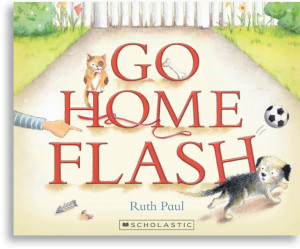
Go Home Flash Scholastic 2014
Bye-Bye Grumpy Fly Scholastic 2015
What’s the Time
Dinosaur?
Scholastic 2015
My Meerkat Mum Scholastic 2017
I Am Jellyfish Penguin Random House
2018
Little Hector and the
Big Blue Whale Penguin
Random House 2018
Mini Whinny, Happy
Birthday to Me!
by Stacy Gregg, illustrated by Ruth Paul, Scholastic NZ 2018
Upcoming Trade Books:
Little Hector and the
Big Idea Penguin
Random House 2019
Mini Whinny: Goody Four
Shoes by
Stacy Gregg, ill. by Ruth Paul,Scholastic
2019
Cookie Boo! Harper Collins USA 2020
Little Hector Meets Maui Penguin Random House
2020.
Mini Whinny: Bad Day at the OK Corral by Stacy Gregg, ill. by Ruth Paul, Scholastic 2020.
Dipankar Mukherjee is the Founder & Director of Readomania, an independent publishing house based in India. Under his stewardship, the house has produced more than 80 books in five years of its existence. Dipankar holds an MBA degree from IIT Madras and has been a management consultant in his professional avatar, working in organisations like IBM and Ernst & Young. Apart from publishing his business interests include a consumer electrical products brand, Aeronova and literary resort, Faraway Renz. He loves traveling and can be found playing with his daughter, if not at work.
Why
did you start Readomania?
An entrepreneur starts with a dream. Mine was, and is, to build a company that is known for creating and curating good content. Readomania was, and is, a manifestation of that dream. There is a lot more content waiting to be discovered. There are a lot of stories that need to be told. We want to be a part of this ecosystem that takes this content, and the stories to a wide audience.
2. What attracted you to publishing?
A publishing house plays a very important role in the society. It can drive narratives, influence points-of-view, and be a catalyst for change. This is what makes publishing a perfect choice for someone who wants to bring out a change for good. I aspire to take Readomania to a position where it can do this effectively, along with being a profitable, sustainable venture.
3. What is the focus of your publishing programme? How many titles have you published so far?
We started in September 2014 and our annual publishing list was streamlined from 2016 onwards. We have published 80 odd titles since 2014. As of now, we publish about 18–24 titles a year. Our list includes literary, midlist, and commercial fiction across multiple genres, short stories, poetry, non-fiction, and children’s fiction. The current focus of our publishing programme is diversity in content. We want to bring in as many flavours as possible. We are delving into mythology retelling, historical fiction, period drama, crime, thriller, romance, short stories, poetry, children’s fiction, humour etc.
4. How do you decide what to publish? Do you commission books or select manuscripts from unsolicited submissions? Or do you look at what agents supply?
Publishing a
book is like making a movie, it is not possible to accurately predict how will
the audience—reader in this case—react. Though the uncertainty is less for
books.
Selection is
based on a potent mix of analysis, instincts, and market trends. Analysis
focuses on the content, market trends on the genre and competition. Instincts
are hard to define but is based on experience, author interaction, and a bit of
in-built bias.
We still don’t have fat budgets for commissioning books, so that has still not started. We do, however, discuss projects and potential books with our existing authors and take them forward. Manuscript selections also happen from unsolicited submissions and those that come through agents.
5. Do you think there is an appetite for print books or is the preference for digital books increasing? What are your comments on the digital versus print debate?
Print is winning this debate by a
significant margin. I don’t think this will change much in the near future.
There will definitely be better adoption of digital formats (text and audio)
but that may not dent the market for print books.
Device fatigue is setting in. People want to stop looking at the blue screen. As the awareness for this increases, I feel print books will take up the gap left by some of these devices. However, this may not happen for first time readers. Many of them may directly start reading on a device.
6. Do you look at translations too? If so how does the translations programme operate?
We want to look at translations as well. But we have not started as yet.
7. What is your average day like?
I wake up in a
room full of books and start reading with a cup of coffee next to me. I then go
to a nice bistro, eat some nice food and drink coffee and read more. I then go
to a nice park, sit below a tree, read some more and drink some nice chai from
the local fellow, until it’s time to go back home. Back there, I sit next to my
window and read, until I fall asleep.
Well, I can always dream about this kind of a life. Reality though is a little different. My regular schedule includes sales and collection follow ups, editorial discussions, an hour on social media, an hour on online reading, marketing discussions, and author discussions.
8. How do you distribute books? Via online retail or brick and mortar stores? Why did you start an online store on your website? Isn’t that rather unusual for an indie publisher?
Distribution has been strong for us, at least amongst indie publishers. I think we have done this well. We distribute through all possible modes. For brick and mortar stores, we work with the regular distributors like IBD, Prakash, Variety and Jaico. In addition, we directly sell on Amazon, are represented on Flipkart and as you mentioned sell through our website as well. Our own website is also a very big channel for sales. Since we are very active on social media, it is easy to drive sales through our own website.
9. What is the kind of publicity you invest in? Do book launches help you sell books?
Publicity is a
nemesis for indie publishers. The ROI on publicity is questionable and hence we
are careful treading this path. We use a lot of online resources, bloggers’
community, and outreach for marketing. We do work with the stores and on
Amazon. We still have some work to do in PR and co-branding concepts. However,
we keep trying out different methods of communication and branding for books.
Some work, some don’t.
As for book launches, in my opinion they do not recover the investment made and are a drag on our resources. A book launch, or any event for that matter, works well only when there is a good PR angle.
10. What are your thoughts about the Indian book industry? Is it growing or not? What are the pain points if any? What makes this book market stand apart from the others?
Deciphering the
Indian book industry is quite a challenge, especially the trade book segment.
There is growth. However, that growth may not be real. Many systemic issues lead
to this problem. First amongst them is the concept of Sale-Or-Return. How does
one explain growth when returns can potentially come after the financial year
is closed? Does one go back and revise growth figures?
However, there
are a lot of positives that do point to the growth-story. Many more titles are
coming up, online sales are strong, and sentiments are good.
As far as pain-points are concerned, there are a select few that I would like to mention, both on cost side and revenue side. On cost side we have GST, payment terms that publishers have with distributors and distribution margins as major issues. The cost pressures have significantly increased. On the revenue side, I think there is over-supply of books. If I may say, India is now a land of more writers than readers. This coupled with shrinking shelf space makes it difficult to reach out to the readers. The power may be shifting away from publishers to distributors or platforms like Amazon, especially since distributors and platforms are now operating as monopolies.
11. What are the changes you have seen in publishing since you began Readomania? What are the genres that sell the most amongst your readers/customers and do you think these align with the more popular buying sentiments amongst Indian readers?
Since our
inception, quite a few things have changed. I have seen the self-publishing
industry grow significantly over the years. There has been a good growth in new
genres like true-crime, celebrity-autobiographies, bureaucrat narratives.
Growth in the regional language publishing and demand for translations also is
a positive change. For publishers, a big revenue stream has opened up through
rise in book-to-screen deals. However, there has been a fall in per-title print
runs. I also feel there is now an overload of marketing content for readers and
a big boom in book-marketers who promise the moon but not sales.
Popular genres
for us include mythology, historical fiction, non-fiction, and light reads. I
think the market too would have a similar trend.
12. What are your future plans for Readomania?
We are just five years old and we have many miles more to go. Readomania aspires to be one of the top five publishing brands in the country with a strong list, a few international awards in our kitty, and be the publisher of choice for authors and readers.
The Gangster’s Gita by Agni Sreedhar is a slim book. It is a conversation between a hit man and his victim. They are waiting for the appointed time of the killing which will be indicated by the hit man’s boss. While biding their time the two men start conversing. The “victim” is a hit man too. So call this conversation a kind of swapping professional notes or just sharing thoughts as the end draws near. Even so the calm and composed manner in which it is narrated, even by making allowances for the written word, the last few pages come as a jolt. At times it feels as if it is two men merely chatting across the lawns of the farmhouse where the hostage has been spirited away and not that the victim is standing on the balcony of a locked room looking down upon the hit man who is sweating it out doing his daily routine of exercises. For inexplicable reasons they start conversing, knowing full well that their breaking their profession’s codes of conduct. It is not advisable to become too familiar with each other in this nasty business.
Set in the Bangalore underworld of the ‘90s, The Gangster’s Gita—published in Kannada as Edegarike is set to become an instant cult classic in English. The writer is an ex-gangster, Agni Sreedhar, who also won the Sahitya Akademi award for his memoir — My Days in the Underworld: Rise of the Bangalore Mafia. His column in a Kannada paper was called “Editorial from Behind Bars” which he wrote while incarcerated in Bellary jail. Apparently in the literary circles of Karnataka it was well known that before Agni Sreedhar strayed into a world of crime, he was a voracious reader and deeply influenced by Albert Camus and Carlos Castaneda. Once he famously asked a friend to get him Camus’ The Outsider to re-read in jail.
It is impossible to share the gist of the freewheeling conversation between the two men except to say that this book is worth reading. Also it is hard to distinguish how much of this is fiction and how much the truth. An extraordinary book. It is a book that will travel well overseas too as a fine example of World Literature. It exists. Read it. Mull over it. You will not regret it.
2019 is proving to be a year of debut writing. Perhaps it is also an indication of the disruption that digital technology has made of print publishing. It is becoming more and more expensive to publish and if the advance against royalties is also included for publishing established names, then the unit cost of printing a book escalates. Perhaps this is one of the reasons why 2019 has been the year of debuts. Presumably publishers feel that the ROI on a debut author can be easily absorbed in their P/L sheets. Who knows?! Fact is, extraordinary amounts of literature across the globe by debut writers has been published in the past year. Some of it is stupendous. Three worth highlighting in this blog post are: Varun Thomas Mathew’s The Black Dwarves of the Good Little Bay , Nana Oforiatta Ayim’s The God Child and Rehana Munir’s Paper Moon. Three very distinct voices. Three distinct stories. All three debut writers who will shine in the future.
Varun Thomas Mathew is a lawyer by profession but has written a dystopic novel set in the near future where all humanity in India seems to be concentrated in a towering structure called Bombadrome. It is inhabited by people who have no memory and hence no sense of history. They have no recollection if this place was once called Bom Bahia or Bombay or Mumbai. It is a colony where there are specific functions allocated to each section. Occupiers of each section are identified by their uniform. Every task, evey person has a specific role that is designated by the powers that be and there seems to be no existence of free will. It is a “memoir” being written by a former bureaucrat called Convent Godse. The Black Dwarves are manual scavengers who resorted to splashing buckets of filth on to walls to create “arresting art”. Thus capturing the imagination of the media. But the black dwarves are like multiple versions of the real-life Banksy. Despite the Police Commissioner claiming to have arrested the Black Dwarves, a movement arose that could not be ignored. Like this there are many instances in the immediate past that Convent Godse has witnessed and finally opts to write them down. Another one is of the flautist who would stand at the Gateway of India playing tunes that “made passers-by of different religions fall in love” — love jihad. Convent Godse seems to retain a sense of perspective and sanity as he chooses to stay outside the boundary walls of Bombadrome. One of the people incarcerated in the medical quadrant who is a witness to the current chief minister’s past atrocities and the day the politician gains power, the witness “loses his mind” and is taken away. This is a sharply told tale that despite being set in the near future is horribly close to present realities. It is a powerful debut for sometimes fiction thinly masks the truth. Read it. Perhaps one day Man Booker Prize winner Paul Beatty and Varun Thomas Mathew can be encouraged to have a heart to heart talk about the literature they make and what propels them to write these extraordinary stories.
Nana Oforiatta Ayim is a Ghanaian writer, art historian and filmmaker whose debut novel is The God Child. It is about Ghanian expatriate Maya who is brought up in Germany and England. Later she is joined by her cousin from her mother’s side, Kojo. Maya’s mother belongs to a Ghanian royal family and is fairly regal in her ways. The children are close. So when Kojo is bullied, Maya is a witness and his confidante. Later as an adult she visits Kojo in Accra where he is trying to put together a museum that will revive their past royal glory. He is working very hard to put it together but tragedy strikes. Once again, Maya is a mute witness to a dream shattering. As with most debut novels, there is always a strong autobiographical element. The God Child is no different with Kojo’s drive to establish a museum in Accra is closely aligned to Ayim’s project of establishing an open-source encyclopedia of African history. Ayim’s fascination with art history resulted in her being the curator of the African pavilion at this year’s Venice Biennale. As with the link to the lecture posted below, Ayim’s debut novel is preoccupied with the different ways of seeing. The protagonist of the novel is equally at ease in Germany, England and Ghana but Maya is constantly made to feel an outsider. The insidious racism that exists in society is horrendous. Kojo and she bear the brunt of it. Ayim has an unabashed critical filmmaker’s lens to talk about society across three lands — Germany, UK and Ghana. The clash of cultures and the insidious and deep seated racism which continues to persist in the poshest of places. Also the complete unacceptance of these so-called developed nations to accept the stories of children from Ghana, simply because they are black and speak of being descendants of kings and living in palaces. It is to the white world a myth that the blacks weave. The writer shares unpleasant truths which will not go down well in the polite world which speaks constantly of diversity and inclusivity but when it comes to practice what they preach is unable to truly accept wholeheartedly how difficult it is to embrace differences. I also like the surety with which the author writes in three languages — English, German and the African dialect, Twi, without necessarily explaining it immediately or contextualising it. It is much like the French used by Wodehouse in his novels. You either know it or don’t, so most readers learned to skip those passages and yet enjoyed the storytelling. Same here. As she says in this TED Talk that she has the power to define her own narrative — “We deserve to be in this place“. It shows a calm and confident writer who has been dissed in the early reviews for writing a “promising but uneven novel” — which it is not. Far from it. Read it for yourself. Unsurprisingly, Ayim has dedicated her novel to John Berger.
The last debut novel under discussion is Rehana Munir’s fabulous Paper Moon. It is about Fiza inheritance from her absent father stipulating that she run a bookstore. Well, she is left a lump sum of money to do whatever she likes but he would love it if she made his dream of running a bookshop come true. This is an idea that she too has been secretly nursing but once the possibilities exist she quickly swings into action. Practically overnight from a quiet, good college girl who listens to whatever her mother, an ex-Jazz singer has to say, Fiza becomes a businesswoman. She sets up a bookshop in a old Bandra mansion. It is named after the popular Jazz song, “It’s Only a Paper Moon“. It is an enterprise that is thrilling, allows for a variety of visitors to troop in, it is a peek into the bookselling trade and getting books on consignment from the distributors etc. More than that it gives her the opportunity to introspect her own life, her relationships with her ex-boyfriend, Dhruv and the mysterious stranger who frequents her store, to the wide network ( safety net) of well-wishers. Paper Moon is written in a beautifully restrained manner making it hard to believe that this is a debut voice. The characters are so well etched. The plot moves at a controlled pace. There seem to be no awkward edges in the storytelling or clunky pieces in the plot. What is truly refreshing is the confidence with which Rehana Munir presents life in Mumbai and Goa for what it is — with its diversity, the ease with which everyone is comfortable with each other’s beliefs and practices. There are no apologies or fear presented. It is normal life. This despite her belonging to a generation that may have not witnessed the World Wars or the horrific aftermath of Indian Independence — the communal riots which accompanied the partition of the subcontinent. But while “contemplating the post 9/11 world… . Babri Masjid happened, dividing Fiza’s city forever. Not there was the gore and gloom of Gujarat. Every generation thought of itself as unique. Of negotiating historical events without precedent or the possibility of recurrence. Yet, how was this rapid descent into madness any different from the countless ones that had previously occurred?” This is the undercurrent affecting everyone and yet life carries on. Surprisingly Rehana Munir’s narrative, albeit fiction, affirms that if we see around us, life is different to what is told to us in hegemonic discourses which are increasingly being controlled by politicians. Much like what Hans Rosling laid out in Factfulness. Both are equally hopeful books in an otherwise depressingly dystopic age. Rehana Munir’s Paper Moon is a story that deserves to be converted to film without compromising on the story at all in the screen adapatation. It must run as is. Paper Moon leaves such a happy space in one’s mind of hope and joy for the future. And it is not a book I would classify as Up lit. It is good old-fashioned storytelling. Share it widely. Give it the love it deserves. Gift it happily.
I read Elton John’s autobiography Me that has been written with the assistance of journalist Alexis Petridis. It is so full of enjoyable trivia about the music scene. There is not much about the business of music except for passing references to his hunt for a reliable manager or how he founded his own company, Rocket, and discovered new talent. He readily admits he was good at discovering talent and not necessarily nurturing new talent. He talks about his upbringing and never once is his family left out of the narrative. They are always present in his story. It is not as if stardom went to his mind and he forgot his roots.
It is also a memoir that documents his coming out as gay and then his stratospheric rise as a performer. Outrageous acts that helped him become more of the man he was. It also points out that gayness and being gay was not fashionable then as it is now and yet when he came out to his friends or dressed flamboyantly, the circles he moved in did not bat an eyelid. Interestingly he was always so astonished at his meteoric fame that when he began to hobnob with the rich and famous, he could not get over the excitement. A memorable line in the book is about the door of his green room opening and musicians of The Band trooping in. He was astonished. He says it was as if the record sleeves of his music collection had come to life. There are so many instances like this. All along it is so obvious that he simply had the talent to play the piano and he had no qualms catering to the masses as long as it made Bernie Taupin and him money. Even so, they were very critical of some of their very commercially successful songs and albums.
What I find extraordinary is the confident voice. Also he
has no problem damning people. I do not know if it is that he has been more
than fifty years at the top of his profession that he really could not care
less about what others think of him. He has a very refreshing way of talking
except that after a while it begins to pall and you begin to wonder when will
the showman be done with this gig. Even his arguments with his mother and her
bad behaviour on the day of his civil partnership with David Furnish is so much
domestic drama detail. Quite unnecessary. It is of course delightful to come
across anecdotes of Elton John doing drugs with John Lennon in a hotel in USA
when there is a knock on the door. It is Andy Warhol which astounds Elton John
who is still very starry eyed about the business but John Lennon does not allow
Elton John to open the door as Warhol is known to always carry a camera and
Lennon did not want a picture of two rock stars doing drugs becoming known
publicly. There is another delightful one of Elton John and his then partner
sitting by their swimming pool in their London home when they spotted an old
lady cycle up their driveway. They thought she looked very much like Katherine
Hepburn. And lo and behold, it was her. She had been told by a neighbour, whose
guest she was, go across to Elton John’s home where you can use his swimming
pool. 🙂
I wish there had been an interview or an essay by the
Guardian journalist who helped ghost write this book. He has captured Elton John’s
voice marvellously well. But there are so many questions I would like to know
for instance, how on earth did Elton John remember so many details over the
past decades? How much of this is really accurate? Did he research this for a
while as a passing reference to his being awarded a star on Hollywood Walk of
Fame is available on YouTube? How long was this book in the making? How many
interview sessions and how many hours of tape were recorded? How many pages of
transcript were there? This is the kind of autobiography that Richard Holmes is
not exactly fond of the step-by-step account of a person’s life but I suppose a
super star’s life cannot be hid. It is so much gossip and at the same time I
get the feeling that much of the gossipy sections of the book are mainly about
those who are long dead and gone and cannot really speak up for themselves.
On the other hand, compare this autobiography with that of Karan Johar. Both are showmen. Both had their autobiographies ghost written. These books were created after innumerable interview sessions. But Elton John’s maybe frivolous and champagne chatter but it is definitely not insipidly thin as Karan Johar’s book is. I also liked the fact that Elton John is respects himself tremendously — as it should be. In his first live-in relationship, his partner was violent and was known to have a bad temper. Elton John tolerated him because he was in love. But the day the partner hit Elton in their own home and Elton John’s nose was bleeding and face was scratched, Elton John swore he would not remain in an abusive relationship. The self-realisation of a DV victim is so critical irrespective of genders.
I would think an ideal book launch or a panel discussion should be between The Boss and Elton John. Both of them have written autobiographies that seem to ring true. Bruce Springsteen’s biography is stupendous especially his account of his childhood. Both musicians come from tough backgrounds, the Boss more than Elton John. Yet they were astounding successes and it would be fascinating to hear them in conversation with each other about deciding on how much of their life should they make public, what is the best balance to strike, is less more or do you give your fan base more or less how you perform on stage etc. It could be moderated by another book man who comes from as impoverished circumstances as Bruce Springsteen, Damian Barr, and he too has written a tremendous memoir.
Regrettably except for a stray reference and that was because the paper dedicated a section to “celebrity memoirs”, Me has been overlooked in most year-end recommended reading lists. Sad. Nevertheless, read it for yourself. It is a rollicking read!
The publisher, Stefan Tobler, very kindly sent a reading copy of the award-winning Love that I read in one fell swoop. I could not put it down. It is set in the space of one night when a mother comes home tired after work and her nine-year-old son cannot help but wonder how his mother intends on celebrating his birthday the day after. Instead curiously enough mother and son wander away from their home and end up drifting through the night separately with their own adventures to tell. Here are edited excerpts of my letter to Stefan Tobler written in a dreamlike state upon finishing the novella. Read on.
Dear Stefan, Thank you for sharing the extraordinarily novella, Love. I read it in one fell swoop. Love was impossible to put down. There is something so remarkably restrained about Hanne Ørstavik’s writing. It defies imagination that the love between a single mother and her soon-to-be nine year old son can be so complicated but it is just that, isn’t it — complicated? Hanne gets into the mind spaces of the two characters in a way that is extraordinary for whatever they are thinking about — the mother about finding love and companionship with another man and the son weaving a simple dream about a birthday cake. Hanne captures their dreams so well. Their inner thoughts. A small detail shared at the beginning of the story is that the mother is preparing a meal for her son. She is caring. Yet one cannot help wonder after the story is over “is she?” More so how can a mother, however tired she is, forget to check in upon her son and tuck him into bed? If she had then the story would not have progressed in the manner that it did. And then the reader is immediately forced to correct the harsh judgment of the mother’s character for it is uncalled for. The mother too is entitled to her me-time. As for the boy, he does have quite an adventure. It is like a small adventure tale for children as found in classic children’s literature tucked into a grown-up tale. So while the story about the child is being told it is like a good old-fashioned story with details about his dreams; it is so expertly told that it shakes the reader when the passages about his mother are slipped in. I do not know even know when the merging of the two adventures begins in the text. It is so smoooooooooooth! What I found incredible was how the arrangement of the text echoes real feelings of a mother and child. There is an interweaving of text while layering the emotions. After a while the two narratives merge into one not necessarily as a literary technique but the effortless merging of the two experiences in the same time but different places is quite extraordinary. Perhaps it is a feat of the fabulous translation by Martin Aitken. He is able to make it an easy read that at times in the destination language. At times one forgets that this is a translation that is being read and not an original work in English. If there are any interviews with him regarding the translation or any between the writer and translator, please let me know. I have not come across as any with specific reference to Love. I only found readings that they did together at NBA finals. What I would be curious to know is if Martin Aitken’s experience as Karl Knausgaard’s translator have had any bearing upon his translation of such a feminine novel. It is that particular intersection as a translator and deliverer of a writer’s fiction that I would be truly interested in knowing about? Also does gender really matter in the manner of writing and how does a translator make these nuances available or does he just focus on the task at hand? Ultimately the translator has to be given much credit too for creating such an extraordinary translation…and for me that is simply defined by the readability factor combined with the retaining all the particular cultural details that exist in the original text. I did find his Asymptote interview which is brilliant but does not answer any of the questions I have. I would like to hear/read a conversation between the writer and translator. I truly think it is needed. There are so many intersections that can emerge from this conversation apart from the 2-decade gap between the publication of the original story and the translation. More so when Indian literary prizes that recognise translations have a cap on the year of original publication and the translation into English. Originally one of the literary prize managements had insisted upon it being not more than three years since the original publication in a regional language. But under advice from publishers this year the rule had been extended to seven years but in all likelihood it would soon revert to three years as no one in the management could understand why translations took so long! To my mind the observation was so wrong as it was a) naive b) it was symptomatic of the neural translation age and the awkward machine translations available in real time and ultimately c) what would the organising committee have to say about books similar to Love that were published in India after a very long gap from the original publication? Thank you for sharing such a beauty, Stefan! Warmly,
Book Post 51 includes some of the titles received in the past few weeks. Wherever available Amazon’s Kindle widget has been embedded in the blog post. It will allow you to browse through the book before you decide to buy it.