
Roli Books Catalogue 2022-23

Thank you, Priya Kapoor and Kapil Kapoor for an incredibly stunning Roli Books catalogue! Congratulations, for a fine list.


1 May 2022
Thank you, Priya Kapoor and Kapil Kapoor for an incredibly stunning Roli Books catalogue! Congratulations, for a fine list.
1 May 2022

Guarded by Dragons: Encounters with Rare Books and Rare People is an excellent collection of essays/memoir by well-known rare books collector, Rick Gekoski. There is an essay about his early forays into book collecting with special editions of D. H. Lawrence. A moment of self-dohbt when he is unsure whether he is a collector or a dealer. Soon enough it is clarified when his rare books begin to sell at good prices. There are essays about his encounters with publishers regarding publishing histories and archival material. One of them is regarding Toby Faber and their long drawn “discussion” on the former chairman, Charles Monteith’s correspondence with poet Philip Larkin. For a while, it involved legal counsel too. Another one involves the publishing legacy of the legendary Victor Gollancz. His firm had decided to dispose of the volumes of books, letters with authors, and files that were lying in a warehouse. The slow process of disposing of the collection in bits and pieces rather than its entirety hurts to read . Another essay involves Gekoski being asked by Ted Hughes to return a precious book once owned by his late wife, Sylvia Plath. There are many other instances recorded in this book of Gekoski’s attempt to trade in rare books or even manage a charity auction for PEN.
It is fascinating to read the book for its stories but also for the sharp understanding that commercial interests are never too far away from cultural predilection of publishing books. One of the throwaway lines in an essay is how hardback literary fiction is of little value to rare book collectors. The books are only appreciated at the time of publication and then on a reader’s bookshelf. Value accorded to rare books comes from a variety of factors such as limited print run, circumstances under which the book was published, rarity of the event, uniqueness of the manuscript, or even ensuring the provenance of the book is confirmed by the author and publisher at the time of printing and not later, scribbled in ink. Value of the books also rises if units are customised by the author. Excellent insights about business of book publishing.
PS I have a copy of the autobiography that Victor Gollancz wrote to his grandson in the early 1950s.

1 May 2022

Started reading Young Mungo by Douglas Stuart. The long awaited second novel by the Booker Prize winner. His first novel, “#ShuggieBain” has exceeded a million copies sale. In fact, he received the PanMacmillan Golden Pan Award for achieving this glorious sales figure.
Unusually, but understandably, the Indian/South Asian edition of the book uses the cover design of the American edition, not the British. Publishers need to be cognizant of sensibilities in the local book market. Pan Macmillan India made the right decision. Douglas Stuart is a fabulous writer. Sometimes tactful decisions need to be made in the interests of business. Here is hoping that Young Mungo sells consistently.


1 May 2022

Jeff Hawkins is a tech entrepreneur, computer pioneer, and a neuroscientist. He was the co-founder of Palm Pilot, handheld computing. He is the cofounder of Numenta, a neuroscience research company and founder of the Redwood Neuroscience Institute. The intersection of neuroscience and technology fascinates him but it is the manner in which the human brain operates that interests him the most. In A Thousand Brains, Jeff Hawkins ( Basic Books, Hachette India) answers two of life’s most important questions: What is intelligence? How do brains create it?
For centuries now, the concept of tabula rasa has been discussed. It basically states that babies are born in this world with their minds as a blank slate. Slowly, over a period of time, their brain collects information and stores it. How this happens has been a mystery and will continue to be for a long time to come. There is another theory too that if the brain is kept stimulated, age becomes just a number, as the neurons continue to make new connections. (In fact, Dr Sanjay Gupta, the CNN journalist, makes a strong case for this in Keep Sharp.) Jeff Hawkins and his colleagues have formed a new theory of intelligence called the Thousand Brains Theory. They argue that the brain uses maplike structures called reference frames to build models of the world — not just one but hundreds of thousands, which then vote together to reach a consensus.
A key discovery that Jeff Hawkins made was that the organ of intelligence is the neocortex. The human neocortex is particularly large, occupying about 70% of the volume of our brain. It wraps around the older parts of the brain such that when you look at the human brain, most of what you see is the neocortex ( with its characteristic folds and creases), with bits of the old brain and the spinal cord sticking out at the bottom. Almost all the capabilities that we think of as intelligence — such as vision, language, music, math, science, and engineering — are created by the neocortex. It consists of millions of neurons, many more connections between the neurons called synapses and several kilometres of axons and dendrites. It consists of many vertical cortical columns that are critical in mapping the world for the individual. But each column maps only a certain number of reference frames. The brain has the uncanny ability to connect with each region, enabling it form a holistic picture. The ability to form these conenctions is determined by our genes. So, when a child is born, its neocortex is a tabula rasa. The brain has 150,000 cortical columns where each column is a sensory-motor system. It is a learning machine. These columns are complementary to each other. Basically, Hawkins argues that the Thousand Brain Theory explains how we learn and recognize objects. It also states that there are thousands of models for every object perceived by the individual in their brain. Finally, the theory shows how the neocortex learns three-dimensional models of objects using reference frames.
Bulk of this book is devoted to discussing the Thousand Brains Theory of Intelligence suggesting that the future of machine intelligence is going to be substantially different from what most AI practioners are thinking today. AI is currently undergoing a renaissance. It is one of the hottest fields in technology. The field is dominated by artificial neural networks, although they are nothing like the networks of neurons we see in brains. Hawkins argues that the future of AI will be based on different principles than those used today, principles that most closely mimic the brain. The aim should be to build truly intelligent machines and he sees the shift of AI towards brain-based principles as inevitable.
A fundamental characteristic of the human brain is that it is constantly learning. As a result, humans are flexible in what we learn. Deep learning AI systems exhibit almost no flexibility. A Go-playing computer may play the game better than any human,but it can’t do anything else. A self-driving car may be a safer driver than any human, but it can’t play Go or fix a flat tire.
The long-term goal of AI research is to create machines that exhibit human-like intelligence — machines that can rapidly learn new tasks, seeanalogies between different tasks, and flexibly solve new problems. this goal is called “artificial general intelligence”, or AGI, to distinguish it from today’s limited AI.
It is not clear where, when, and how intelligent machines will be made or how will they be used; but it may be easier to define the attributes that determine an intellignt being. These attributes are: the ability to learn continuously, learning via movement, the ability of the neocortex to create multiple models that are complementary and thus provide flexibility ( “mental agility”?), and finally, using general-purpose reference frames to store knowledge. Hence, we as humans are intelligent not because we can do one thing particularly well, but because we can learn to do practically anything. The extreme flexibility of human intelligence requires the aforementioned attributes.
The future of machine intelligence is hard to predict but an important component of its behaviour would be safety. According to Hawkins ( who does NOT like science fiction stories), the three laws of robotics as defined by Isaac Asimov are like a safety protocol but don’t necessarily apply to all forms of machine intelligence:
It is really impossible to say how long or when these changes will occur, if at all. It is certain that machines are here to stay. Humans and machines have to co-exist. But I could not help pondering over a key fact. It is not discussed in the book, but I think it can easily be surmised.
The Internet was invented to share files between scientific and military computers. It was previously done manually. In recent years, tech entrepreneurs have created massive social media platforms that are user-based. These tech platforms rely upon their websites proving useful to multiple users, at the same time. It is a constant buzz of activity. It is also a bunch of algorithms, written by a team of programmers determining how users can be encouraged to use the platform except that they do not reckon with how rapidly individuals can reprogramme their behaviours. Thereby also changing their expectations of the platform. This is probably the reason for digital strategists unable to work on anything more than a three month-time frame as opposed to earlier times when it was possible to work on 1-3 year strategies. No more. The older strategies presumed a certain amount of stability. Now, with so many human brains plugged into one platform simultaneously can result in the creation of a supercomputer whose size and intelligence is unimaginable. It is gargantuan! Also, just as many social media sites are discovering that people are sinking deeper into the platform to create little bubbles of communities, are happy being within those spaces, and in all likelihood, creating their own micro-histories. It is only IF these communities choose to communicate with each other, that connections can be created and larger communities can be formed. To what purpose, is still unclear, but they can exhibit behaviour that is like a single-celled large organism or it can be construed as herd mentality. Similarly, the neocortex is the intelligence organ of the individual, it consists of numerous cortical columns/users that map reference frames; these exist and are complementary but do not necessarily communicate with each other. IF they do, then it is for the benefit of the individual in building up knowledge and using their intelligence to assess the situation. So, while many tech giants are fascinated by AI and its applications, it is perhaps the study of human behaviour affected by AI and its response in real time that should be investigated in greater depth. Changes are happening at such a rapid pace in the digital world, they are probably not driven as much by algorithms and AI as many would like to believe, but it is the response of many individuals that are forcing the Internet/social media platforms to transform. The Thousand Brain theory illustrates the significance of the neocortex and its identification as the intelligent organ in our body, but if this theory is applied to the Internet wherein many individuals are like many thousand brains multiplied many times over, can you imagine the speed at which the digital landscape will evolve? No wonder Hawkins is not very amused at the current state of AI. It simply cannot keep pace with the human brain. It will take time, if at all.
A Thousand Brains: A New Theory of Intelligence by Jeff Hawkins is an astonishing book. Perhaps there are more like it in the market but the lucidity with which this is written is splendid. It makes extremely difficult concepts manageable as well as recognising the limitations of what can be included in the book or not. It will be influencing tech discourse for a very long time to come. Don’t miss reading it.
2 May 2022

In recent days and weeks, I have read a pile of books but not had the time to write individual posts. So, perhaps it is best to create a combined blog post.
The two debut novels that I read were poles apart in tone and pace. The first debut novel is The Elements of Fog by Boudhayan Sen ( Juggernaut Books) is an unexpected pleasant surprise. It is a combination of old-fashioned ( read nineteenth century) novel and a twenty-first century contemporary fiction. It is a reflection of the plot too that is set apart in time by a century and a half. The common factor being that the story is set in a high school/boarding school that was set up in a hill station near Madurai. It is a love story that is very well told. Perhaps Boudhayan Sen will follow it up with another novel/ a collection of short stories that is equally well paced. The second debut novel is The Shotgun Wedding by Suchandra Roychowdhury ( Aleph Book Company) that is a fast-paced, comic, romance novel. It is more in the ilk of commercial fiction, noisy with chattering dialogue propelling the plot, easily read; with the potential of spawniing back stories,and perhaps Malgudi Days-like stories. Who knows?! Time will tell.


The two collections of prose and poetry are also very diverse. Why do you fear my way so much? : Poems and Letters from Prison by G. N. Saibaba ( Speaking Tiger Books) is very powerful. Most of the poems were written in the form of letters to his wife to avoid censoring by the prison authorities. Saibaba is an academic and an activist who is confined to a wheelchair and has been incarcerated since 2014. In 2017, he was sentenced to life imprisonment for his links to a banned organisation, CPI-Maoist.


The second is an anthology Khushk Zubaan, Bebaak Jigar: Of Dry Tongues and Brave Hearts that has been edited by Reema Ahmad and Semeen Ali (published by Red River). It consists of poetry, fiction, non-fiction, and artworks. Red River publications go from strength to strength. This particular anthology when it was first published had a limited print run as the publisher, Dibyajyoti Sarma, was unsure whether it would sell. It sold so fast that a second print run had to be done within a month. The publications in this frontlist are experimental, grungy, and generous as many voices — established and new — are offered a platform with equal grace and respect. Of Dry Tongues and Brave Hearts is no different. It explores the theme of “ghar-bahir” or “in the home and outside”. All the contributors are women even though it may not be clear from the bios published in the book. Because the editors did not want to foreground gender, instead the focus is on the individual identities, the myriad voices. This book is meant for everyone. Do read it.

Perhaps at this point, it may be appropriate to mention Elena Ferrante’s new book, In the Margins: On the Pleasures of Reading and Writing, translated from the Italian by Ann Goldstein and published by Europa Editions. The four essays included in this book are the Eco Lectures that the author wrote. In November 2021, the actress Manuela Mandracchia, in the guise of Elena Ferrante, presented the lectures at the Teatro Arena del Sole in Bologna, together with ERT, Emilia Romagna Teatro. There are many pearls of wisdom that Ferrante shares with regard to close reading of texts, her own writing craft and experience of reading some of her favourite writers such as Dante, Emily Dickinson, Gertrude Stein, Ingebord Bachmann, and others. There are many portions in my copy of the book that I have underlined heavily. There is a particular section that is worth sharing:
…in order to devote ourselves to literary work must we subscribe to the great scroll of writing? Yes. Writing inevitably has to reckong with other writing, and it’s from the terrain of the already written that the sentence might jump out that sets in motion a small admirable book or the great book that displays a trajectory and constructs a unique world of words, characters, and conflicts.
If that’s true for the male “I” who writes, it’s even more so for the female. A woman who wants to write has unavoidably to deal not only with the entire literary patrimony she’s been brought up on and in virtue of which she wants to and can express herself but with the fact that that patrimony is essentially male and by its nature doesn’t provide true female sentences. Since I was six my “I” brought up on male writing also has had to incorporate a kind of writing by women for women that belonged to it, was appropriate to it — writing in itself minor precisely because it was barely known by men, and considered by them something for women, that is, inessential. I’ve known in my life very cultured men who not only had not read Elsa Morante or Natalia Ginzburg or Anna Maria Ortese but had never read Jane Austen, the Bronte sisters, Virginia Woolf. And I myself, as a girl, wished to avoid as far as possible writing by women: I felt I had different ambitions.
(p. 76-78)
Suddenly, the title is illuminating. It is not merely about being a professional writer preoccupied with the craft of writing but metaphorically, it is about being a woman and a writer. It is incredible how the same stuff has been said over and over again and yet, it seems new. Read the book.

The idea of writing and what it takes to write are eternal questions. In the new age of publishing, “content” works in multiple ways. No longer is it necessary to first publish a book before exploring other platforms. The next two books belong to this category. Both are publications stemming from talks delivered over the radio and short stories shared on YouTube. The first is by well-known ornithologist, Dr Salim Ali called Words for Birds. It is a collection of radio broadcasts that have been edited by Tara Gandhi. It has been published by Black Kite (an imprint of Permanent Black) in collaboration with Ashoka University and distributed by Hachette India. These broadcasts are from 1941 to 1980 with the bulk being spanning 1950s-60s. It is an interesting exercise reading the essays as there is a gentle pace to them, much as one would hear over the radio, enunciate slowly and clearly to be heard. The idea being to communicate. The second one is The Stories We Tell by noted mythologist Devdutt Pattanaik ( published by Aleph Book Company). It consists of short stories that originated in a webcast that Pattanaik began from 21 March to 31 May 2020. It was in the early days of India’s countrywide lockdown to combat Covid-19. He says:
People were terrified of the virus and I wanted to life their spirits by telling them stories from our mythology that would make them less anxious. At these stories were told from 4pm to 5pm, around teatime, I named my webcast “Teatime Tales”. I genuinely believed the lockdown would end in a few weeks, but it became clear that we would remain indoors for a long time. I knew I would not be able to sustaing the enterprise endlessly. So, I decided to end it gracefully after seventy-two episodes. [ Seventy-two being an important number across cultures. He elaborates upon it beautifully in the book.]
These are very short, short stories. Very easily read. The sentences are short. The ideas develop slowly and methodically. There is no cluttering. The conversion of the oral into print has been done very well. The stories retain their capacity to be read out aloud. Also, as with many age-old stories and folklore, these stories narrated by Pattanaik lend themselves to be expanded and embellished. In his introduction, he provides a general description as “our mythology” and since his name is synonymous with mostly retelling of the Hindu epics, many readers would probably expect more of the same. Extraordinarily enough, Pattanaik displays extensive knowledge and understanding of other faiths too. Slim book, easily shared and presented.


Ultimately, it is the Internet that has made the revival and dissemination of literature possible. Earlier, a few copies were printed and circulated. But now, there is mass distribution of books and content — whether legitimately or pirated versions is not the point right now. The fact is literature is available to many, many people. Physical and ebooks can be bought online. Payments are made. Today, we take digital payments for granted but there was a time, in the not too distant past, that this concept did not even exist. In the 1990s, people were experimenting with the idea but it was not taken too seriously. Then, came along a bunch of youngsters, from 19 to their early 20s, who felt that this was worth investigating. The Founders by Jimmy Soni is about these young men such as Max Levichin, Reed Hastings, Elon Musk and Peter Thiel. It is a book that is full of details regarding the fintech startup, surving the dot com bubble and its ultimate sale to eBay for US$1.5 billion — at a time when such figures were unheard of and certainly not for technology. This story is told at a furious pace, it is intoxicating reading about the highs and lows of the founders, but it is also seeped in masculinity. It confirms the belief that professionalism is a philosophy that is acceptable when imbued with patriarchy and makes no allowances for women and other responsibilities of life. It is almost as if one has to be wedded to the job and even in a marriage there is more leeway than these startups provide. On a separate note, I had emailed Jimmy Soni a bunch of questions for an interview on my blog. He had agreed in principle but then chose not to acknowledge the email, later asked the person who had set up the interview if he could change my questions, then suggested that one of the questions was incorrect but would not say which one and ultimately, he refused to do the interview. Here are the questions. Despite this unfortunate glitch, I would recommend The Founders.

Finally, an integral feature of the Internet is the search option. It is a critical part of the world wide web. It enables information to be discovered and shared. This is done by searching a vast index that the search engines maintain. It is nothing more basic than that — a feature that has been a significant part of the codex for more than 800 years, is now a fundamental feature of the Internet. So despite technological advancements being made, certain characteristics remain and continue to be adopted and adapted to new frameworks. Read more about it in this incredibly fascinating account by Dennis Duncan in Index, A History of the . I loved this book!

A vast and eclectic selection of books to choose from!
4 April 2022

Upon reading this fascinating book about the founders of the fintech company PayPal, I sent off a bunch of questions to the author, Jimmy Soni. At first he agreed to do the interview via email but then he refused to do so. He never offered me an explanation, nor did he acknowledge my emails. Nevertheless, I would recommend his book as a detailed account of the group of young men who are in many ways responsibile for ushering in the Internet revolution by enabling digital payments. They were to be later nicknamed as “PayPal Mafia”.
For the record, here are the questions that I posed to Jimmy Soni:
I still maintain it is a good book. Worth reading.
4 April 2022

Glossy: The Inside Story of Vogue by Nina-Sophia Miralles is a fascinating history of the iconic fashion magazine, Vogue. ( It is published by Quercus and distributed by Hachette India.) Vogue was founded in 1892 in New York by Arthur Turnure. He wanted to launch a high-quality weekly journal. “With one paper he seduced two social groups: middle-class readers would buy it so they could finally see what the rich and distinguished were up to and upper class readers would buy it to feed their egos.” After his death in 1906, the magazine was going through a hard time. Conde Nast who had had his eye on it for a while, proposed to the widow of Arthur Turnure to buy it. The deal was finalised in 1907. Ever since then, Vogue has remained a part of the Conde Nast group of publications. Even when the Newhouse family took over the group, Vogue remained.
Glossy is an extraordinary story about the survival of this magazine for more than a century, with many of its editors working for decades, including the war years. The transformations in the content of the magazine as a response to the times. From its first launch, in the fin de siecle, where it was filled with high society news and gossip, to offering advice to women about rationing and recognising women as a key part of the workforce (1914- 1940s) and to post-war years (1950s) trying to achieve the balance between the variety of readers across age-groups. The 1960s and ’70s proved to be testing times for the magazine as it took into account the rise of the women’s movement, braced itself for arguments about sexism, fashion and patriarchal expectations etc. Yet, at the same time, an editor like Diana Vreeland spent obnoxious amounts of money in organising a photoshoot in Japan with models draped in fur — “The Great Fur Caravan“. It cost $1 million that in current terms is approximately $7.5 million. The 1980s and 90s brought about another fundamental change in the magazine as it began to access a larger group of readers and the advertisement revenue it brought in was substantial. In the twenty-first century, the magazine was launched in many more countries. It expanded into new markets that would earlier have not been considered as a possibility. Also, the management structure was changed and for the first time an “outsider” was brought in as CEO of the company so as to create a media empire for the future. Roger Lynch, the former head of Pandora, a music streaming service, with a strong entertainment and tech background was appointed. This is the new age and now the fashion industry is estimated to be worth $1 trillion.
This book is a repository of information regarding the evolution of the magazine, editorial inputs, production challenges, experiments with writers and photographers, changing attitudes towards models and managing markets. The Newhouse mantra is that the bottomline is always about profits. The history of the magazine is inextricably linked with the personalities of its editors, photographers, art directors, writers and some models especially in recent years. Many of the editors are legendary such as Edna Woolman Chase, Dorothy Todd, Michel de Brunhoff, Edmonde Charles-Roux, Diana Veerland, Grace Mirabella, Anna Wintour, Alexandra Shulman, Emmanuelle Alt and Edward Enninful. While the author delves into minute details with many of the editors of the past, Miralles is a tad disappointing when recounting tales of editors such as Anna Wintour. It is almost as if Wintour continues to be a power to reckon with and it is best that not much is said about her. There are other careless lapses such as mentioning Donyale Luna as the first black model on the cover of 1966 British Vogue but omitting to mentioning the name of the first black model on the cover of the 1974 American Vogue — Beverly Johnson. The next time a black model made it to the cover was Gail O’Neill (1986) and Naomi Campbell (1987). So, the Feb 2022 cover of supermodel Naomi Campbell holding her baby girl is pathbreaking.

Despite the few shortcomings, Glossy is an immensely readably and brilliant account of the establishment, sustainability and survival of a women’s magazine through the ages. It has had a fair mix of contributors. The managment has made mistakes but it has learned to adapt and flourish. It may be a well-defined fashion magazine but it certainly cannot be ignored. If I could, I would show how extensively dog-eared and heavily underlined my copy of the book is!
27 March 2022

It has been more than a week since I finished reading the astonishing debut novel The Love Songs of W. E. B. Du Bois by poet Honoree Fanonne Jeffers ( published by Harper Collins). I am still in awe of it. It is not going to dissipate for a long, long time. It is two-hundred years of African-American history told through the account of a fictional family based in Georgia. Bulk of the novel is narrated by or involves Ailey Pearl Garfield. A young girl, who along with her two sisters, have been reared in the North, in the City, but spend summers in the small Georgia town of Chicasetta. It is where their mother’s family have lived ever since their ancestors arrived from Africa in bondage. It was originally Indian land that was then appropriated by the white settlers. There is a slow, unfolding pace to the story. It is not just another black history narrated but the author builds upon the basic premise of scholar Du Bois when he wrote about the problem of race in America and what he called “double-consciousness”, a sensitivity that every African American possesses in order to survive. It is hard to encapsulate in a few lines the gist of this book except to say that it is a phenomenal account of history, it is fictional but it is built around actual events and people, and once done reading it, there is a magnificent plotting of a timeline that is not going to go away easily. It is a combination of historical events, evolution of language and a growing awareness amongst the youth to push back against the systemic racism that they encounter daily. It is also a sobering lesson on how not to blame their past for the present as the three sisters discover. At one level, their lives are representative of the manner in which narratives can be built. Either you blame your past for your present as the eldest sister Lydia did or you make the best of the opportunities that come your way as the other two sisters — Ailey and Coco did. Lydia became a drug addict and died of it. Ailey and Coco became an academic and a doctor, respectively. They chose to move on but not in a cold-hearted manner. They did not reject their past. Ailey studied it, understood her lineage and then developed it further to explore her identity.
After a while, none of the names make sense. But the rhythm of the text lulls one into being mesmerised by the story. In fact, Honoree said in an interview that her editor read all her poems and insisted on editing this text according to those poems:
My editor Erin Wicks is a genius, and the world needs to know.
She’s a young white woman, so I didn’t know how working with her would turn out. But she allowed me to be my full, authentic self. When the book was sold, I was afraid that somebody was going to try to make me be something else or explain myself to white readers. But she just kept pushing me to just keep it real.
But, yeah, the book that was sold was 450 pages.
I know this sounds cheesy, but Erin and I just have this miraculous simpatico [relationship] that I didn’t expect. She’s white and young, and I’m of a particular generation and from the Deep South. But she’s just really empathetic and kind. She’s aware of Black political issues. She’s just great. For example, Erin bought every single one of my poetry books and read them. So, when we started going through line edits, she could mimic my language and tone as she was condensing sentences.
The Love Song of W. E. B. Du Bois invokes the scholar all the time, especially in the well-chosen epigraphs to every section, but it is the writing that is astonishing. It is at the intersection of feminism, American history, women’s histories, identities, systemic racism, etc. It is an incredibly powerful novel that changes the reader once done reading it. Appropriately it won the National Book Critics Circle Award 2021 for fiction.
Most reviews of the book have been unable to share the story structure as it is impossible to do so. Apart from gushing about the beauty of the writing, magnificence of the tale and the sheer extraordinary craftsmanship, there is little else one can do.
Read The Love Songs of W. E. B. Du Bois.
20 March 2022
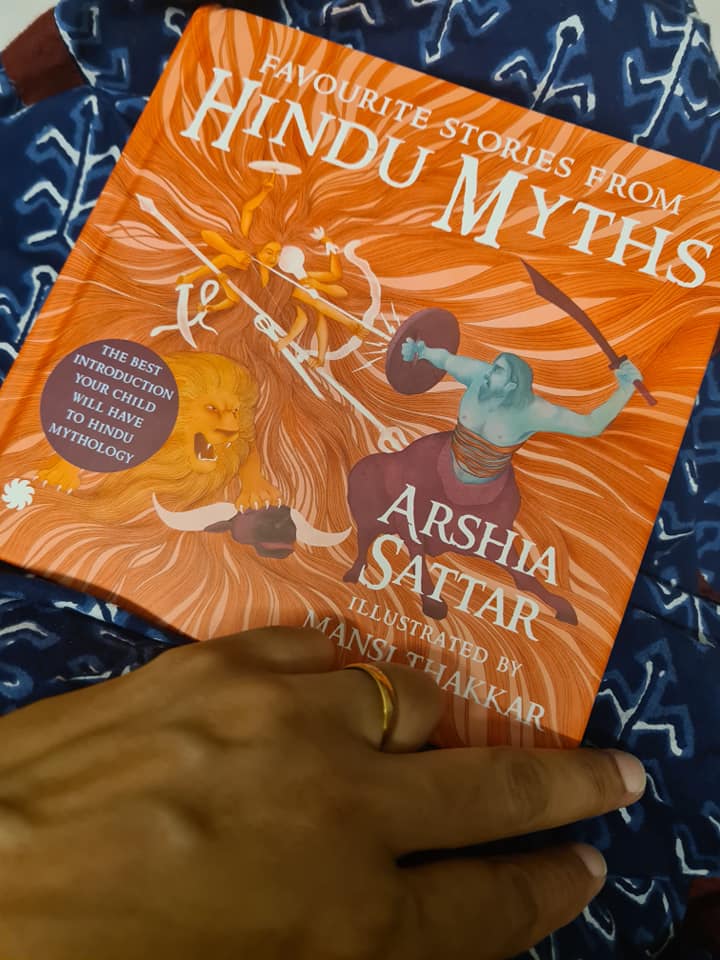
Arshia Sattar’s retelling of the Sanskrit epics are always worth reading. She has a PH.D in classical Indian literatures from the University of Chicago. Her abridged translation of Valmiki’s Ramayana is regarded as one of the definitive presentations of the epic in English. She has written a number of books on Hindu mythology for younger readers including the bestselling Ramayana for Children, Mahabharata for Children and Adventures with Hanuman.
Favourite Stories from Hindu myths is her latest offering. This absolutely delicious book is published by Juggernaut Kids. As with the previous publications by Arshia Sattar, the stories are so beautifully and simply retold. It is almost as if one’s childhood memories of being told the stories by an adult come alive. It is always remarkable at how the transference of the oral tradition to the print seems effortless but is not. It definitely not could not have been easy for these very popular tales such as “The Churning of the Ocean”, “Narasimha the Man Lion”, “Fine-Feathered Garuda” and “Bhagiratha Brings the Ganga to Earth” as everyone has their own way of narrating or remembering the story. Arshia Sattar’s touch is very special. She ensures that the key elements of every story are passed on but at the same time, the storytelling has her distinctive stamp of shortish sentences. Hardly any sub-clauses. Wonderfully descriptive. Very visual. Plenty of action. Yet, as with all oral traditions, she is able to provide spaces to the reader/narrator to embellish the story a bit more when reading it out aloud. The choice is the reader’s to either stick to the text that has been provided or add a little more.
The gorgeous illustrations by Mansi Thakkar are bold, bright, and stunning. The very European art sensibility in the excessive use of pastel shades and an almost watercolour-like effect for stories are an interesting touch for stories that are most often associated with garishly loud colours.
This is a wonderful hardback volume of stories, reasonably priced, will make for excellent gifts in the upcoming festival season. Share it widely.
It is a truth universally acknowledged that the best stories are to be found in the holy scriptures of various religions. It is time to make them more easily accessible without prejudice. Hopefully then there will be less scope for vilifying the other but a sensitive understanding and respect for another culture. Syncreticism is the bedrock of Indian democracy. There is no doubt that Juggernaut Kids will do an equally fine job for stories from other faiths too.


16 March 2022


Extraordinary news. Nalin Mehta’s “TheNewBJP” is in the ninth week of being a bestseller. It is rare by publishing standards globally to have a nonfiction narrative to retain its spot at number one. It is truly special given that this book is a mix storytelling, data, indices, charts, interviews and analysis. There are more than 200 pages of appendices. “The New BJP” is a non-partisan account of the history of the BJP. It is being read across the spectrum. Booksellers are saying that at least one or two customers talk about it every day and recommend it to others as a “must read book”. Political analysts, journalists, and academics are using arguments such as the women voter base, caste, and social welfare as if these were commonly known factors contributing to the extraordinary rise of this political party. Even the indices that were mentioned for the first time in the book — Mehta-Singh Index, PollNiti and Narad Index — have been widely accepted. Whereas these were outlined for the first time clearly by Nalin Mehta in his book, published on 3 Jan 2022. The impact factor of “The New BJP” has been phenomenal. Ace Literary Consulting is very proud to be representing Nalin Mehta.