Jaya Posts

Scholastic India presents LEGO (R) books!

LEGO


RedBarLogo_CMYK (1)

From 30 May 2016, Scholastic India will be selling LEGO (R) books in India. Some of the highlights include —

LEGO CityLEGO (R) City,

LEGO Friends


LEGO (R) Friends and books related to the

LEGO (R) movie. The Indian editions will be reasonably priced. Some examples are:

Lego Book 2Lego Book 1LEGO Book 3Lego Book 4Lego Book 5

For more information contact:

Shailee Chauhan: schauhan@scholastic.co.in

and

Shantanu Duttagupta: sduttagupta@scholastic.co.in

The books can be bought at :https://www.amazon.in/l/10227604031

11 May 2016

Ashwin Sanghi’s fascinating story from self-publishing to traditional publishing


Earlier in 2016, Amazon bought a significant minority stake in Westland.  
 ( Ashwin Sanghi and I were discussing publishing, his pseudonymn “Shawn Higins” and his own amazing success story. His first novel The Rozabal Line was published by Lulu.com. Later an Indian publishing house based in Chennai, Westland, offered to publish his book. His latest novel Sialkot Saga has recently been released. http://bit.ly/1UEe1lq

Read on about Ashwin’s incredible story. This extract is from the first draft of 13 Steps to Bloody Good Luck and has been reproduced with permission. )

Extract from original manuscript of “13 Steps to Bloody Good Luck”

After being rejected by most publishers, I had self-published my first novel The Rozabal Line via a US-based self-publishing platform called Lulu.com which had just set up shop. The year was 2007. There was no Kindle and self-publishing meant POD (Print on Demand) in which the book is listed on websites and a customer order triggers a printing and delivery of the book. I designed my own book cover and hired a freelance editor to work on the manuscript before I uploaded the PDF to Lulu’s server.
The average self-published book sells 57 copies during its lifetime (the long tail is very long indeed). I started blogging and became active on social media. I created a YouTube trailer for the book and managed to sell 900 copies in the first year. I was one of Lulu’s best selling authors even with those meagre numbers!
I soon realized that the platform was selling my books only via American online retail channels such as Amazon.com (the India channel did not exist) and BN.com. My titles remained unavailable in India. My attempts to get published the traditional way in India had come to nought and I was at a dead end.
I started visiting bookstores to find out if they would be willing to stock my books but they refused. They said that they would only deal with distributors. Unfortunately I knew none of the distributors. My mother knew someone at a publishing company and was happy to introduce us. Unfortunately that person’s company had already decided to decline my work (like many others), but she introduced me to Vivek Ahuja, who had worked for eighteen years with a large book distribution entity in India, UBSPD.
The incredibly helpful Vivek advised that I would have to import my books from the US and supply them on consignment basis to a few Indian distributors. Giving me a list of some 75 Indian distributors, he advised me to write to each of them individually, enclosing a copy of my book. One of the distributors on that list was East West Books. No one called or replied to my letters and books.
Months later, I received a call from a lady who introduced herself as Hemu Ramaiah. I did not know it at that time, but she was the founder of Landmark Book Stores and her company had just created a joint venture called Westland with East West Books. Hemu said that she had loved The Rozabal Line that I had sent to East West, but it would be impossible to import the book from America and then expect to sell it in the Indian market at a reasonable price. Would I be willing to republish it in India? I jumped with joy at her question. I had been turned down by almost every publisher on the planet by then.
Hemu then introduced me to Gautam Padmanabhan, CEO of Westland (my current publisher). Gautam liked the book but was not sure about its commercial viability. He created a target group of ten readers (including his own father) to read the book and give feedback. Luckily for me, the majority opinion was favourable.
We signed a contract two weeks later. There were two conditions attached. One: that we do a fresh edit of the book. Two: that I drop my pseudonym.
The first print run was 2000 copies and we sold that lot in four weeks. We went into a second print run and have not stopped ordering reprints since then.
11 May 2016

Chitra Bannerjee Divakurni “Before We Visit the Goddess”

ChitraOne day, in the kitchen at the back of the store, I held in my  hand a new recipe I had perfected, the sweet I would go on to name after my dead mother. I took a bite of the conch-shaped dessert, the palest, most elegant mango color. The smooth, creamy flavor of fruit and milk, sugar and saffron mingled and melted on my tongue. Satisfaction overwhelmed me. This was something I had achieved myself, without having to depend on anyone. No one could take it away. … That’s what it really means to be a fortunate lamp. 

Before We Visit the Goddess is Chitra Bannerjee Divakurni’s latest novel and sixteenth publication. Simply put it is in the fashionable mould of contemporary fiction to have a five-generation saga. It predominantly details the lives of the second, third and fourth generation of women — Bela, Sabitri and Tara. But there is always much much more tucked into the stories about the grandmother, mother and daughter. A strong characteristic of Divakurni’s novels are the exploration of relationships between women, the inter-generational gap, the challenges and victories every woman experiences and the cultural differences of living in India and USA.

To her credit Divakurni creates charmingly and deceptively “simple” women-centric novels. A utopian scenario is never presented which focuses only upon women at the exclusion of any engagement with men and society. Instead she details the daily negotiations and choices women face that slowly develop their strong personalities. For instance, it could be timid homemaker Bela’s insistence of taking her late husband’s firm to court to seek compensation for his death in a factory fire and to everyone’s surprise winning. With the earnings she established a sweet shop in her mother’s name — Durga Sweets. Or Sabitri’s warm friendship with her gay neighbour, Kevin, who by just being a good person helps her to establish herself as a food blogger successfully. Even bright Tara who disappears from her family’s life after her parents divorce except for a stray phone call or two has quite an adventurous decade. It includes working at a secondhand store called Nearly New Necessities, becoming a drug addict, being sacked from jobs for being a kleptomaniac, babysitting an Indian grandmother transplanted to America who feels as if she is “being buried alive” or driving an Indian academic to a temple in Pearland to equally catastrophic and cathartic consequences. Yet what is admirable about these women is despite the humiliations and hardships they have borne, they strive on.

In Before We Visit the Goddess the author takes the different phases of life in her stride without blunting or sentimentalising any of the experiences. For instance the hurt and pain of the young Bela is searing. So is the loneliness, whimsical and wretched behaviour of Leelamoyi, her wealthy benefactress. As with many successful writers they evolve with each book written. In Divakurni’s case her trademark fiction of the world of Bengali women remains steadfast but in this sixteenth book the inter-generational differences are created magnificently. Her book is also timely for it being published when a debate rages in USA whether to replace the word “India” with “South Asia” in school history textbooks. According to New York Times, “The dispute centers on whether the region that includes modern-day India, Pakistan and Nepal should be referred to as India or as South Asia, to represent the plurality of cultures there — particularly because India was not a nation-state until 1947. It also touches on how the culture of the region is portrayed, including women’s role in society and the vestiges of the caste system. It might seem somewhat arcane. But it has prompted petition drives, as well as a #DontEraseIndia social media campaign and a battle of opinion pieces.” ( 4 May 2016, http://www.nytimes.com/2016/05/06/us/debate-erupts-over-californias-india-history-curriculum.html?_r=0 ) Whereas Chitra Bannerjee Divakurni’s books elegantly examine identity — what it means to be an Indian, an American or a desi. In Before We Visit the Goddess young Tara epitomizes the new generation of American-Indians– not ABCD any more but with a distinct identity of their own. As a diplomat told me recently she may be of Indian origin but has no roots or family in the country and has not had for generations. So a posting in this country is as much of an exciting new adventure as it is for anyone else visiting India for the first time.

Chitra Bannerjee Divakurni’s stories are ageing gracefully with her. Read Before We Visit the Goddess. 

Chitra Bannerjee Divakurni Before We Visit the Goddess Simon & Schuster, London, 2016. Hb. Pp. 210. Rs 499 / £ 16.99

8 May 2016


Kannada, Konkani, English: Memories, Texts and Distances

On 23 April 2016 Vivek Shanbhag and I were invited by Namita Gokhale, co-director, Jaipur Literature Festival to be in conversation at the Apeejay Languages Festival 2016, Oxford Bookstore, Connaught Place, New Delhi. We were to discuss his recently translated novel from Kannada to English, Ghachar Ghochar, as part of the topic, “Kannada, Konkani, English: Memories, Texts and Distances”. Before we began the discussion I read out a note contextualising the conversation. I realised that Vivek Shanbhag and I had spent a while chatting a few days earlier and would happily fall into a chat easily. Hence the note which was passed by Vivek Shanbhag too. With his permission I am publishing it here. 

Kannada, Konkani, English: Memories, Texts and Distances 

Vivek Shanbhag 1Vivek Shanbhag is a noted writer, editor and translator. For seven years while holding a busy day job he edited a literary journal of Kannada writing called Desh Kala. It was phenomenal in the impact it had in discovering new writers. It is probably the only contemporary journal in an Indian regional language that continues to be talked about in English and now edited excerpts of it are to be published.

Although he has been a name in Kannada and other literary circles for a while, few probably know his mother tongue is Konkani. A language that can be written in five different scripts –Devanagari, Roman, Kannada, Malayalam, and Persian.  (Now it is the Devnagari script that is accepted officially by state governments. )Yet Vivek Shanbhag chooses to write in Kannada. And he is not alone in this comfortable oscillation between mother tongue and the language of professional writing. I gather from him it is common practice among the Kannada, Marathi, Telugu writers. For instance, one of the finest Marathi short story writers G. A. Kulkarni was a Kannadiga; Girish Karnad’s mother tongue is Konkani but he writes Vivek Shanbhag 2in Kannada and the list goes on.

Earlier this year the English translation of Vivek’s fine novella Ghachar Ghochar was published by HarperCollins India. It has been translated by Srinath Perur. It was the only translated text from an Indian regional language included in the special edition of Granta on India ( 2015) edited by Ian Jack. “Ghachar Ghochar” is a nonsensical phrase yet the story is an impressively crafted vignette of a middle class family in Karnataka. Peppered with sufficient local characteristics for it to be representative of a Kannadiga family with universal issues such as socio-eco mobility & status of women. It is no wonder that this novella has caught the English readers by storm.

And yet,

Ghachar GhocharWhen you read Ghachar Ghochar it reads like the finest example of world literature. By world literature I mean translations of literary fiction from various cultures. It reads smoothly in the destination language of English but translation purists tell me exasperatedly that it does not retain the “flavour” of the original Kannada text.

One last point. I believe that “cultures” are not necessarily defined by political boundaries but geo-political formations. Under the British this region fell under the Bombay and Madras presidencies. Today it is bordered by the Arabian Sea, Goa, Maharashtra, Telangana, Andhra Pradesh, Tamil Nadu and Kerala. Kannada is the official language of Karnataka and spoken by about 66.26% of the people as of 2001. Other linguistic minorities in the state are Urdu (10.54%), Telugu (7.03%), Tamil (3.57%), Marathi (3.6%), Tulu (3.0%), Hindi (2.56%), Konkani (1.46%), Malayalam (1.33%) and Kodava Takk (0.3%).

With this note Vivek and I launched into our conversation. It touched upon various aspects of translation, Kannada literature, how is Kannada literature defined, the significance of literary awards, the process of translation, etc. 

6 May 2016

Dalit Literature in English

Justice for JishaOn 29 April 2016, Jisha, a dalit student of Government Law College, Ernakulam, Kerala, was raped and murdered. Jisha was found at her home which stands on Purambokku Bhumi (PDW land) in Iringol Rayamangalam Kanalbund, in Perumbavur district in Kerala. As per the post-mortem and primary police investigation, 30 stab wounds were found on the law student’s body. Investigation has shown that the wounds were made by a sharp object which which the rapists brutalised her face, chin, neck and also her stomach. Her body was found with her entrails exposed as the assailants had cut open her stomach. It is a fatal injury to the back of her head that caused the death, post-mortem report reveals. Jisha’s body was discovered by her mother, Rajeswari when she returned from her work as a house-help at 8.30 pm on April 28. Jisha has been a regular student at the Government law college and was preparing for examination when she was murdered. (The hashtag #JusticeForJisha has been created but it has not begun to trend so far on Twitter.)

This is horrific news. The horror of the rape. The horror of sexual violence. The horror of violence. What is far worse is the visceral hatred directed towards Dalits — a section of society that continue to be ostracised by caste-conscious Indians. Many consider it to be a politically incorrect term but there is no denying that the practise of untouchability exists. Humiliation on a daily basis against dalits is not unheard of. It could be physical, social, economic, mental, health/nourishment or denying access to resources. The myriad ways in which it is perpetrated on dalits defeats imagination. Consider a small example. The recent banning of beef in India also deprives Dalits of their primary source of protein. Beef is cheap and easily available. The dalits belong to a section of society that cuts across religions. What is astounding is that the quantum ( and relentlessness) of violence against this community is impossible for any sane individual to comprehend and yet it is practised daily.

“Fortunately” now texts exist by and about Dalits. An introduction to Thunderstorm by Ratan Kumar ThunderstormSambharia ( Hachette India, 2016) explains it was the concatenation of events — printing technology + freedom struggle for Indian Independence from the colonial rulers which played a vital role in the social awakening of communities. This made a significant contribution to the creation of a specific literary genre that eventually came to be identified as Dalit Literature. As a result over the years a decent body of work has been made available in the form of songs, poetry, fiction ( short stories and novels), memoirs Hatred in the Bellyand biographies. Some publishing houses in India have been actively publishing this literature and commentaries of it– Macmillan India (in the 1990s with Bama’s memoir Karukku), Orient Longman/ OBS, OUP India, Zubaan, Navayana, Adivaani, Speaking Tiger and Penguin Random House. And then there are the incredible successes of self-published books such as Hatred in the Belly ( http://amzn.to/1Y7zhy7 ). It sold out within few days of it being made available online. Even the recently released novel Pyre by Perumal Murugan ( translated Pyreby Aniruddhan Vasudevan) carefully sidesteps naming castes but there are enough cultural indicators embedded in the story to make it apparent that Saroja, the bride, is a Dalit and hence the hostile reception she receives in her husband’s village. Noted Kannada writer and editor of the short-lived literary magazine Desh Kala, Vivek Shanbhag, told me at the Oxford Apeejay Languages Festival ( 23 April 2016) that in Karnataka the second-generation of Dalit writers are evident now. This literature represents part of the diversity Indian publishing has to offer.

Recently a bunch of dalit literature texts have been creating quite an impact on contemporary Indian Literature. To give a bird’s-eye view of this specific literary landscape, some random examples:

  1. ZubaanThe Oxford India Anthology of Telugu Dalit Writing ( edited by K. Purushotham, Gita Ramaswamy, and Gogu Shyamala), OUP India
  2. The Oxford India Anthology of Tamil Dalit Writing ( edited by Ravikumar and R. Azhagarasan), OUP India
  3. The Oxford India Anthology of Malayalam Dalit Writing ( edited by M. Dasan, V. Pratibha, Pradeepan Pampirikunnu and C.S. Chandrika), OUP IndiaJerry Pinto
  4. Ratan Kumar Sambharia Thunderstorm: Dalit Stories ( translated by Mridul Bhasin), Hachette India
  5. Daya Pawar Baluta ( translated by Jerry Pinto and winner of 2016 Windham-Campbell Prize), Speaking Tiger
  6. Nirupama Dutt The Ballad of Bant Singh: A Qissa of Courage, Speaking Tiger
  7. Perumal Murugan Pyre ( translated by Aniruddhan Vasudevan), Penguin Random House India
  8. Sharmila Rege Writing Caste, Writing Gender: Narrating Dalit Woman’s Testimonios, Zubaan

Telugu DalitTamil Dalit LiteratureMalayalam Dalit LiteratureQissaIn this context it is worth reading what the well-known second-generation Dalit politician, Mrs. Meira Kumar, former Lok Sabha Speaker, Parliament of India, had to say about Dalit Literature.

Great literature, the classics, is time-tested, invariably painted on large canvases and are stories that have shaped generations. And then there are books like Amritlal Nagar’s Nachyo Bahut Gopal, which are revolutionary and made a significant impact on me. I object to the classification of literature like this as Dalit Literature. It is the sort of label designed to keep a book in its so-called place. By assigning labels to writing as anarchists, we try to push them further out into the fringe.  ( In Tehelka, 2012.  http://www.tehelka.com/2012/12/i-am-drawn-to-strong-women-characters-jane-austen-made-a-huge-impact-on-me/ )

Dalit Literature Festival

The first edition of Dalit Literature Festival will be held on 6-7 December, 2016 in New Delhi. ( http://dalitliteraturefestival.com/ ).

Sadly with all these active dialogues, the growing awareness, cultural extravaganzas, the hostility towards Dalits continues to be deeply embedded in society and violent attacks such as on Jisha are a dark reality. What is far worse is the deafening silence against many of these acts that are unrecorded.

4 May 2016

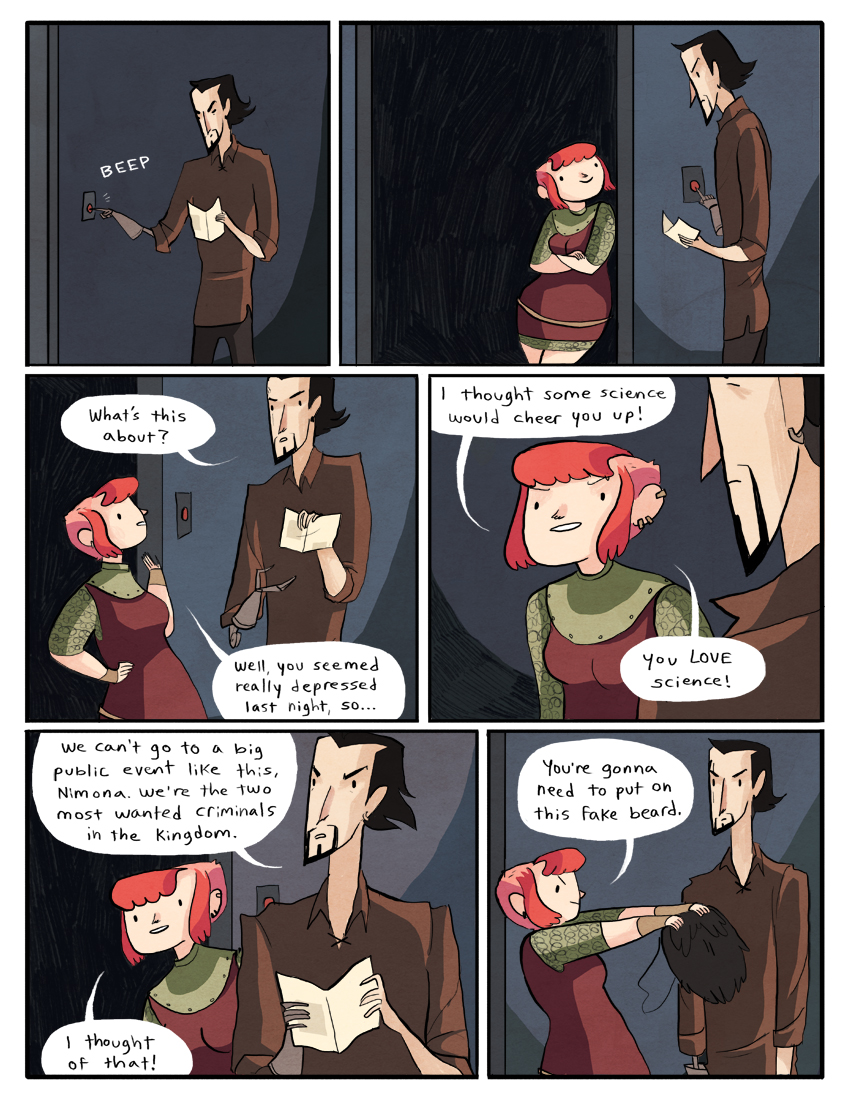
Noelle Stevenson, “Nimona”

nimoina-coverNoelle Stevenson’s debut graphic novel Nimona is about a young shape shifter who is a badass sidekick to super villain, Lord Blackheart. It is utterly delightful for its romp through the world of evil. Nimona for all her evilness comes across as a super-confident young girl who is not deterred by any challenge. Sometimes even Lord nimona2Blackheart is taken aback by her boldness.

According to Wikipedia, Nimona is a fantasy comic by the American comics writer and artist Noelle Stevenson. Stevenson started Nimona as a webcomic while a student at Maryland Institute College of Art. The comic was first published in June 2012 and doubled as Stevenson’s senior thesis. HarperCollins published the webcomic as a young adult graphic novel Noelle Stevenson in May 2015.  In June 2015, 20th Century Fox Animation acquired the rights for an animated feature film adaptation. It has won a few awards and was shortlisted for the National Book Award 2015. ypl_nba2015pg

It is a book about a mighty girl. Meant to be owned. Savoured. Read over and over again.

Noelle Stevenson Nimona HarperTeen, an imprint of HarperCollinsPublishers, New York, 2015. Pb. pp. 270 $12.99

18 April 2016 

Meg Rosoff, “Jonathan Unleashed”

Award-winning young adult writer Meg Rosoff is a brilliant writer. No wonder she has been awarded the Astrid Lindgren Memorial Award ( ALMA) this year or what is fondly referred to as the Nobel Prize for Children’s Literature, given its whoppingly delicious prize money of £430,000. It is given to an author for their body of work. ( http://www.theguardian.com/books/2016/apr/05/meg-rosoff-wins-astrid-lindgren-memorial-award-how-i-live-now ) What is particularly satisfying is that such a passionately ferocious storyteller is conferred the award for her work in young adult literature within weeks of the publication of her first adult trade novel, Jonathan Unleashed.

Jonathan Unleashed is about Jonathan Trefoil, in his twenties, living in New York, working in an advertising firm that he does not particularly relish but the saving grace in his life are the two dogs he is babysitting. Dante and Sissy belong to Jonathan’s brother who has had to relocate to Dubai for a job. Thrown into this mix are his girlfriend who does not particularly care for the menagerie, a vet and old school friend/colleague. His girlfriend persuades him to get married online since her magazine will sponsor it. He has a breakdown with the pressures of work and a love-life that is nerve-wracking — Jonathan has a better sleep at night cuddled up in bed with Sissy, the cocker spaniel, than his girlfriend! It is a Meg Rosoffromance novel with the rawness and honesty of young adult writing and at a quick pace that is never dull to read. Meg Rosoff gets the various emotions of dogs ever so well. Not surprising given her love for the four-legged beasts. The relationship between humans and dogs is superbly executed and can only be written by one who has lived and observed dogs closely. Jonathan Unleashed is hilarious and impossible to put down.

Read it.

Meg Rosoff Jonathan Unleashed Bloomsbury, London, 2016. Pb. pp.280 Rs 499 

18 April 2016 


Pam Munzo Ryan “Echo: A Novel”

ECHO-medalYour fate is not yet sealed,

Even in the darkest night, a star will shine, 

A bell will chime, a path will be revealed. 

Award-winning writer Pam Munzo Ryan’s Echo is a stupendous book. It is four stories intertwined, much like a symphony coming together in the last movement and hence, “a novel”. The first three stories are about four children — Friedrich Schmidt ( Oct 1933, Trossingen, Baden-Wurttemberg, Germany), orphans Mike and Frankie Flannery ( June 1935, Philadelphia County, Pennsylvania, USA) and Ivy Maria Lopez ( December 1942, Southern California, USA). Each story focuses on their love of music, playing the harmonica, piano and flute exquisitely.  It is a beautiful space the children create with their talent at a time of grim reality — concentration camps, rise of Hitler, persecution of Jews and the marginalised, the Great Depression, state of orphanages, adoption, the captivity of American Japanese after Pearl Harbour by the government, segregation of Mexican children in schools, etc. There is a touch of magical realism which seems to be perfectly acceptable in young adult fiction (but would have been nitpicked about in adult trade literature such as Yann Martel and Kazuo Ishiguro’s recent novels). The magical thread binding the stories has an extraordinary fairytale element to it. It is the harmonica presented to the craftsman Otto when he was a child by the three princesses Eins, Zwei and Drei upon whom a spell has been cast by a witch. Once Otto as an adult decides to donate the harmonica it is found by the other children — Friedrich when he worked as an apprentice at the local harmonica factory, Frankie who had dreams of playing in Alfred Hoxie’s then-famous Philadelphia Harmonica Band of Wizards, and later Ivy Maria Lopez who uses it to perform in her school orchestra. In 1951 the young musicians perform Gershwin together at Carnegie Hall.

Ivy felt as if she’d been touched by magic. Her eyes caught the glances of other musicians. And it was clear they felt it, too. 

Who can explain it?

Who can tell you why?

Fools give you reasons,

Wise men never try.

Some enchanted evening. . .

Tonight there was a brilliance in the hall, a communion of spirits, as if Ivy and the conductor and the pianist and the orchestra and everyone in the audience were one, breathing in and out to the same tempo, feeling one another’s strength and vision, filling with beauty and light, glowing beneath the same stars. . .

. . . and connected by the same silken thread. 

Here is a wonderful profile from Kirkus Reviews of Pam Munzo Ryan ( https://www.kirkusreviews.com/features/pam-munoz-ryan/)

Echo is written for young adults but it is a magical book that will appeal across ages. Appreciate it for its inspired storytelling or read it as a conversation starter in classrooms but read it you must.

Pam Munzo Ryan Echo: A Novel Decorations by Dinara Mirtalipova. Scholastic Press, An imprint of Scholastic, New York, 2015. Hb. 

16 April 2016

Zainab Sulaiman, “Simply Nanju”

Simply NanjuZainab Sulaiman’s book Simply Nanju is about a young differently-abled boy and his classmates. All of them have a bunch of challenges but have caring teachers and didis who tend to the children during school hours. This is a story with good diversity in the representation of communities albeit restricted to a narrow socio-economic class. Every single character’s story has been sensitively created by the author. A story about differently-abled children is an excellent idea given the paucity of literature in this area.

It is also timely given the debates about the ‘Accessible India Campaign’ and the Central government having released the ‘Inclusiveness and Accessibility Index’ that measures the actions and attitudes of different organisations towards people with disabilities.  ( HT Editorial, 6 April 2016, http://www.hindustantimes.com/editorials/government-must-remove-the-barriers-and-fast-track-the-disability-bill/story-0r7PDbg8ghLa54JlSEkykO.html )

The editorial continues to say:

The United Nations pegs the disabled in India at 15% of the population but the census of India fixes it at just 2.2%. This means there are many who do not get access to the State benefits that are due to them. One of the main reasons why the numbers are low is that the enumerators often don’t ask the right questions; families tend to hide those who suffer from mental illness; and sometimes they are unaware of challenges like autism. To redress this situation, the government needs to pump in more money on public awareness programmes and train enumerators better.

Last, but not the least, political parties must stop dillydallying on the passage of the Rights of Persons with Disabilities Bill, 2014, which is pending in Parliament. The Bill replaces the Persons with Disabilities (Equal Opportunities, Protection of Rights and Full Participation) Act, 1995. Instead of seven disabilities specified in the Act, the Bill covers 19 conditions. The Bill is being brought in to fulfil obligations under an international treaty. Many have criticised the Bill, saying that it’s not perfect — but then no Bill is. At least this has expanded the number of disabilities and that is a step forward and will give many more disabled people access to opportunities and funds that are earmarked for them.

There are sweet touches of incorporating lingo spouted by the kids such as “Shutyamouth!” and “Tensioning”. Children tend to experiment wildly and it is not easy to transfer it on to texts but Zainab Sulaiman has. As she tells Archit Taneja in a fabulous blog post on the Duckbill website “I did get some of the lingo from the kids I worked with at a school. It’s an interesting jumble of their mother tongue and what they learned at school. As teachers, we would try really hard to change this and make them speak “proper English”. However, I’ll admit that I cracked up every time they used them. I secretly wanted them to talk more like that! ” ( https://theduckbillblog.wordpress.com/2016/04/04/zainab-sulaiman-interviewed-by-archit-taneja/ )

The story is a gentle whodunnit story of trying to discover who is the culprit responsible for stealing notebooks in class. Unfortunately this story is a flat and standard narrative of children’s literature, not very nuanced and far too noisy relying on many conversations to propel the plot forward. Also the premise of the book relying only on children of financially challenged backgrounds with stereotypical characteristics of domestic violence, child abuse, alcoholics etc is a little difficult to digest. It would have been preferable if the book focused on differently-abled children and brought out the challenges by creating a landscape that would resonate with readers of all age-groups and social standing. Despite every good intention and experience of the author working as a special educator this book will only further alienate such children. Young middle class readers ( who are presumably the prime target group) will read it as pure fiction and move on little realising that such individuals exist around them too. If the purpose of literature is to help sensitise grave issues such as disabled children Simply Nanju is a book that falls far short of expectations. Yet sell it will. Probably even get adopted as supplementary texts in schools since there is little or no literature on the subject. It will make an excellent conversation starter encouraging debates in schools.

All said and done it is a book that must be read.

Zainab Sulaiman Simply Nanju Duckbill Books, Chennai, 2016. Pb. pp. 122. Rs. 199

Mary Beard, “SPQR: A History of Ancient Rome”


I have spent a good deal of the past fifty years of my life with these ‘first millennium Romans’. I have learnt their languages as well as I can. I have read a good deal of the literature they have left us ( no one has read it all), and I have studied some of the hundreds of thousands of books and papers written over the centuries about them, from Machiavelli and Gibbon to Gore Vidal and beyond. I have tried to decipher the words they carved into stone, and I have dug them up, quite literally, on wet, windy and unglamourous archaeological sites in Roman Britain. And I have wondered for a long time about how best to tell Rome’s story and to explain why I think it matters. … .

I no longer think, as I once naively did, that we have much to learn directly from the Romans — or, for that matter, from the ancient Greeks, or from any other ancient civilisation. We do not need to read of the difficulties of the Roman legions in Mesopotamia or against the Parthians to understand why modern military interventions in western Asia might be ill advised. … .

But I am more and more convinced that we have an enormous amount to learn — as much about ourselves as about the past — by engaging with the history of the Romans, their poetry and prose, their controversies and arguments. Western culture has a varied inheritance. Happily, we are not the heirs of the classical past alone. Nevertheless, since the Renaissance at least, many of our fundamental assumptions about power, citizenship, responsibility, political violence, empire, luxury and beauty have been formed, and tested, in dialogue with the Romans and their writing. 

We do not want to follow Cicero’s example, but this clash with the bankrupt aristocrat, or popular revolutionary, with which I started this book still underlies our views of the rights of the citizen and still provides a language for political dissent: “Quo usque tandem abutere, Catilina, patientia nostra?’ The idea of ‘desolation’ masquerading as ‘peace’, as Tacitus put into the mouths of Rome’s British enemies, still echoes in modern critiques of imperialism. And the lurid voices that are attributed to the most memorable Roman emperors have always raised the question of where autocratic excess ends and a reign of terror begins. 

(Mary Beard, SPQR, p. 534-6)

SPQR: A History of Ancient Rome by Mary Beard takes its title from a famous Roman Romecatchphrase, Senatus PopulusQue Romanus, ‘The Senate and People of SPQRRome’. For a scholar who has lived with her subject for nearly half a century to produce a clean narrative and create a thoroughly readable book, not packing it with jargon is indeed very commendable. As she says in the opening pages of the book her intention is to write a story that “has to be a bold work of reconstruction, which must squeeze individual pieces of evidence — a single fragment of pottery, or a few letters inscribed on stone”. What is truly incredible with crystal clear clarity she make innumerable connections with the literature (written material, myths and oral legends) left by the Romans to the evidence found at archaeological sites and linking it to contemporary politics. Not for a moment does it become dull. One of my favourite examples is how she analyses the founding myth or legend of Rome to the legend of Romulus and Remus, linking it to Cicero, and interestingly enough to Benito Mussolini. Apparently the nurturing wolf was an addition made in the fifteenth century explicitly to capture the founding myth Wolf and baby twinsand baby twins. But copies of the famous image are found all over the world thanks to Mussolini who distributed them far and wide as a symbol of Romanita. Later she adds that Livy was one of the Roman sceptics who tried to rationalise this particularly implausible aspect of the tale. “The Latin word for ‘wolf’ ( lupa) was also used as a colloquial term for ‘prostitute’ ( lupanare was one standard term for ‘brothel’). Could it be that a local whore rather than a local wild beast had found and tended the twins?” ( p.59) Similarly throughout the book there are many more examples of such absorbing detail. Whether it be about marriage, politics, elections, citizenship, status of women, adoption, warfare, military, trade, migration etc.

For those in Italy and Britain who live surrounded by Roman ruins and have constant engagement with Roman history this book must be utterly fascinating. Mary Beard has a wonderful agreeable style of writing that makes the history of ancient Rome accessible to everyone. It is not a prerequisite that a fair understanding of the history is required. And yet she has packed SPQR with a detailed bibliography, a timeline, an index and plenty of illustrations/photographs that it can work for the lay reader or the scholar.

In India most Indians go about their daily lives doing exactly what this book is spelling out — talking about the huge impact mythology and ancient literature has had through the ages and in modern times. Indians do it all the time with their oral traditions, myths, folklore and ancient texts. A testimony to this is the immensely successful commercial fiction. It is a fine art by contemporary storytellers to create fantastical stories that blend the modern with the ancient and myth with history. Since these writers are not historians like Mary Beard they take full advantage of their creative license to spin imaginative yarns. Whereas Mary Beard points out in the utterly fascinating SPQR that there is sufficient empirical evidence at ancient Roman archaeological sites whether in Italy or abroad to prove much of the written records inherited over two millennia is more or less authentic.

SPQR has been on the list for many literary prizes including the inaugural British Book Industry Awards, in the adult category for the 10th IBW Book Award and a finalist for the National Book Critics Circle — deservedly so!

Mary Beard SPQR: A History of Ancient Rome Profile Books, London, 2015. Hb. pp. 600 Rs 2250 ( Distributed in India by Hachette India) 

5 April 2016


Web Analytics Made Easy -
StatCounter