translation Posts

“The Lost Daughter” by Elena Ferrante

The Lost Daughter by Italian writer Elena Ferrante is about forty-eight-year-old Leda, an English Literature teacher, who is on holiday in southern Italy. ( It has been translated by Ann Goldstein and published by Europa Editions.) While at the beach, she meets a Neopolitan family that eerily reminds her of her own childhood. Large group, multi-generational, raucous, talking nonstop, and unforgettable. They exist. They manage to be noticed. A couple of the women, Nina and Rosaria, befriend Leda. The novella revolves around the disappearance of Nina’s daughter Elena’s doll and the unusually large proportions it assumes in the story — for propelling the plot forward and the significance it assumes for Leda. The doll vanishes at the same time as Elena had also disappeared from the beach and a manhunt had been organised for her. Fortunately, Leda spotted the child crying by herself, in the midst of a crowd where no one seemed to be perturbed by the little girl’s anxiety. She returns the little girl to her relieved mother.

The Lost Daughter as a title is a true reflection of the story’s contents. At the same time, it becomes a metaphor at multiple levels for the daughters that Leda left with their father, her complicated relationship with her own mother, the doll that Elena would look after as if she were her own child, and of course as a figure of speech for the many, many women who are left stranded, lonely, without anyone caring for them and scrubbing the women of all identity — making them just one more nameless person in a crowd, part of one’s background.

What had I done that was so terrible, in the end. Years earlier, I had been a girl who felt lost, this was true. All the hopes of youth seemed to have been destroyed, I seemed to be falling backward towards my mother, my grandmother, the chain of mute or angry women I came from. Missed opportunities….I was frustrated.
….
This is particularly true for many women when they enter motherhood and are expected to be the good, fulfilling mother from the moment the “creature” inside them begins to develop. It is a “shattering” experience that leaves the women in “turmoil”. It is an exhausting process that leaves the mother/individual little time for herself as she has to fend for the babies.

I hadn’t been able to open a book for months; I was exhausted and angry; there was never enough money, I barely slept.

Physical tiredness is a magnifying glass….Love requires energy, I had none left.

The incidents in the story become a trigger for Leda to reflect upon her past, her relationships especially those with her daughters and years later, trying to fathom why she left them at the ages of four and six years old. She abandoned Bianca and Marta and had nothing to do with them for three years. She had been persuaded by her professor to attend an international conference in London on E.M.Forster. There, amongst her peers, she realised she was being recognised as an upcoming young scholar whose works were already being cited by other specialists.

I was overwhelmed by myself. I, I, I: I am this, I can do this, I must do this.
Sometimes you have to escape in order not to die.


Reading, writing have always been my way of soothing myself.

“I loved them too much and it seemed to me that love for them would keep me from becoming myself.”…
“And how did you feel without them?”
“Good. It was as if my whole life had crumbled, and the pieces were falling freely in all directions with a sense of contentment.”
“You didn’t feel sad?”
“No, I was too taken up by own life. But I had a weight right here, as if I had a stomachache. And my heart skipped a beat whenever I heard a child call Mama.”


Then Leda returned to her family for a few years.
..I realized that I wasn’t capable of creating anything of my own that could truly equal them.

“So you returned for love of your daughters.”
“No, I returned for the same reason I left: for love of myself.”


At the moment, this book, has got a new lease of life as it has been adapted to the screen and is available on Netflix. It has Oscar-winner Olivia Coleman playing the lead role. The film is actress Maggie Gyllenhal’s debut as a film director and she has already won awards for it. The film adaptation is true to the book in representing many of the incidents, otherwise it takes many liberties. For instance, the family on the beach in the film are not Neopolitan as is stressed in the book and is the fundamental reason for triggering many memories for Leda. Even Olivia Coleman comes across as a much older woman than the forty-eight-year-old character in the book. The maturity levels of the two women — the character in the book and that played on screen — impact the storytelling. But there is no doubt that the film is a brilliant artistic interpretation by very strong, thinking, women professionals on how these characters need to be played. No more. Reading the book and watching the film are two very independent acts and witnessing of two very distinct creative performances, two works of art.

Many of the reviews of the film are applauding it and very rightly so. But by not including the book in their articles, critics are doing a disservice to the book and to women’s literature. It is stories like The Lost Daughter that make the ideas and principles of various women’s movements accessible to the ordinary reader. Leda is a possible role model by articulating clearly the reasons for her choices. The complexity of these decisions is evident in the last few lines of the story when Leda’s daughters, now based in Toronto with their father, call their mother, shouting gaily into her ear:

“Mama, what are you doing, why haven’t you called? Won’t you at least let us know if you’re alive or dead?”
Deeply moved, I murmured:
“I’m dead, but I’m fine.”

Read The Lost Daughter.

6 Feb 2022
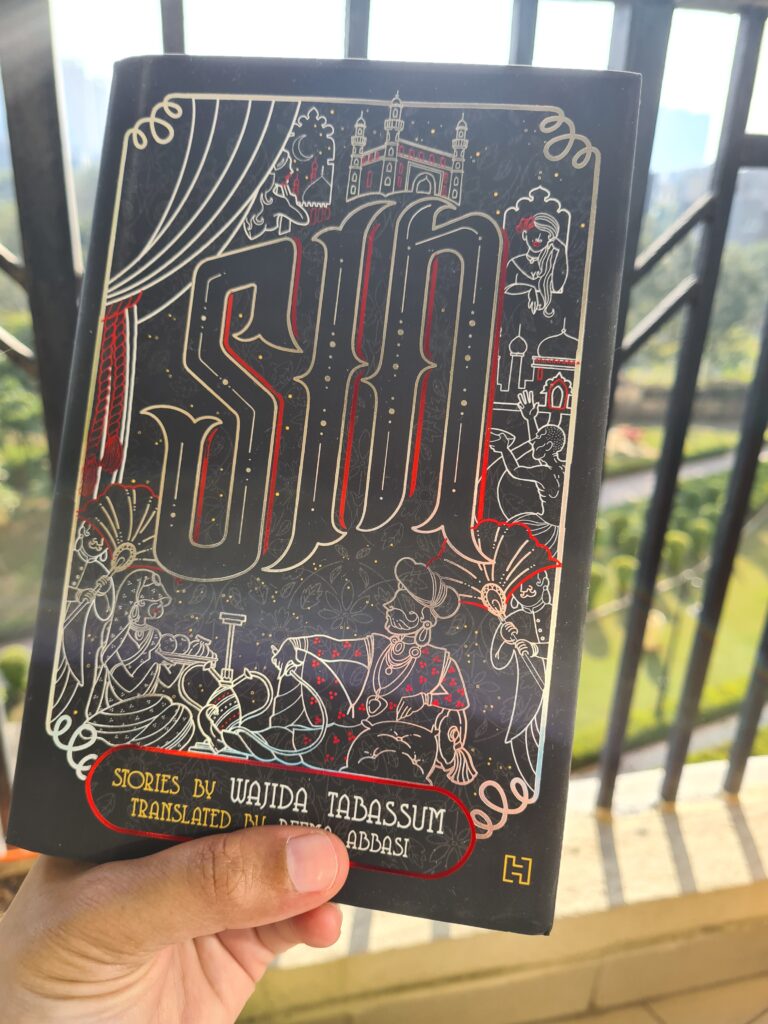
“Sin” by Wajida Tabassum, translated from the Urdu by Reema Abbasi

This is a Muslim Syed girl from a family where liberties for women were thought odious. My father forbade us to attend school and purdah was our bounden duty. My parents passed away when I was three years old and a paternal uncle persuaded our grandmother to educate us. She relented, keeping a lidless eye on each of us.

My third sister was bright and obstinate, with great love for books. She listened intently to every story, which slowly became an obsession. At only three, she forced Nani to enroll her in a school. As time went by, she read, and with her passion came to a gradual swell.

Several magazines — Shamaa, Jamalistaan, Ariyavarat, Kaamyaab and more — could be found in our house. I leafed through them, attentive OR clutching on to every word. The groceries were wrapped in pages torn out of magazines and I read every line on them. They were more exciting than journals. I took them into obscure corners to scan through the incomplete stories. It felt like all the knowledge in the world was mine.

I have a Master of Arts degree and the impulse to know every word ever written soars as despeerately as it did when I was a girl in the fifth standard. However, my passion was tied to our situation. To us, money was a lofty reverie, like a gulp of the sun. The desire to go to markets, exploer bookshops and buy literature caved before our meagre means.

….

I could not buy a book. When I asked for one, she refused and said that such books were unsuitable for girls from aristocratic families. Nani had vowed to keep us away from them … .

Books were my source of light and warmth.

… A book was always with me. My novels snug in school books, I basked in their language and immersive imagery through the exams too. …

books became my refuge and my friends. In school, my performance was seen as exemplary and pleased teached accepted my many requests for books from the library. These became the happiest days of my life. I would go through a book in two hours and would immediately pick up another one.

….In Hyderabad, the rules of our library were rigid and the shrunked stock of books hit me the hardest. Once a week, a girl could get one book at a time. ….
One morning, I was humming in class and a girl at the opposite desk said, “Wajida, please sing a little louder.”
My were were fixed on Munshi Premchand’s Godaan in her hand.
“On one condition,” I replied.
“What?”

“I will sing for you if you lend me your book,” I negotiated.

She agreed. I sang.

The next moment, her book was in my hands. Soon after, books flowed to me. I sang to get them and girls from other classes began making similar deals with me — books for songs. I was relentless. The world spread out in an immense space, crowded with writers and varied themes. The ones I read in my harsh circumstances brought smiles and pride. However, as I write these lines, I am sad to think that this, like a sip of air, was a trivial scale.

Wajida Tabassum’s ( 16 March 1935 – 7 December 2011) was an Urdu writer. She was known for her “audacious and semi-erotic stories and her formidable power of storytelling”. She was born into an aristocratic family but her parents lost their wealth and died very young too. By the time she was three, Wajida Tabassum was an orphan. Her maternal grandmother, Nani, brought up the eight children. These were tough times and they were poor. Wajida Tabassum was a voracious reader with a flair for writing and she put it to good use by contributing short stories to magazines. Soon, she was being spoken of and as she mentions in her autobiographical essay, “Meri Kahaani” ( My Story), that soon the very same relatives who had earlier shunned them, were now readily acknowledging her.

Sin is a collection of nineteen short stories translated by Reema Abbasi ( Hachette India). It also marks the first time that Wajida Tabassum’s stories are being translated into English. According to the translator, the four sections in thevolume deal with “dark, debauched and tragic aspects of life and are structured on the theme of the ‘deadly sins’, namely, lust, pride, greed and envy. The stories are translated competently though at times certain Urdu words could do with a little more explanation through the context. Unfortunately, I did not maintain a list while reading but kept wondering about the meaning of the words. Having said that, the stories are well translated. Structurally to place “My Story” in the middle of the book is a very good idea as it provides a break from the stories. In many ways, the stories seem bold by contemporary standards of writing as well. But clubbing so many together seems to diminish their oomph factor. Perhaps, if they had been arranged chronologically, according to the date of publication, then the growth of the writer would also have been evident. For now, the stories are enjoyable but in small doses.

Once the stories are read, then Wajida Tabassum’s rant about be open to stories rather than being led by the nose becomes obvious in paragraphs such as this about endorsements. She is so clear about her views.

In our literature, forewords have become customary. I feel they lean our readers in a certain direction, which is worrying. Why do we need a renowned name to endorse our work to the extent that critique is printed onthe dust cover? I have many letters from celebrated writers, who applaud my work. Many of them are dear to me. They would compose a preface in an instant. But I disagree with the idea. The foreword to me is a diversion for the reader’s mind and a tool of cheap publicity. When someone wants to move ahead, they should walk without a crutch. Even if they means taking an uneasy road to the last stop.

This kind of sharp clarity is required in more and more writers of today. Perhaps the resurrection of a powerful women writer such as Wajida Tabassum in English will ensure that not only is she read far and wide but she inspires and influences new generations of writers to share their opinions in an equally forthright manner.

Sin is definitely a collection of short stories worth recommending.

2 Feb 2022

Manon Uphoff’s “Falling is like Flying”

Manon Uphoff’s Falling is like Flying is her first book translated from Dutch into English and published by Pushkin Press. The translator is Sam Garrett. This book of hers is autobiographical to the extent that she documents her childhood, the trauma she and her other twelve siblings faced with the Minotaur ( her father), her resilience and the magnificent ending in a gathering of the sisters ( “the witches’ sabbath”) reminiscing before they returned to their respective homes:

“Then it’s home again, home again astride the broom-mobile where we put on our disguises of writer, artist, housewife, single parent, senior citizen of independent means.”

It is a powerful account of a violent and abusive home. Uphoff began recalling details on the day her eldest sister died. It was an upwelling of painful memories that could not be suppressed any more. Her story had to be told.

“Excuse me for going on about myself for so long. I feel as though I need to tell you what I was and what I wanted to be, before descending step by step to the first place I ever lived. Of which I was reminded in those cheerless days when the beat of an old, familiar drum grew louder and louder.

Yes, turmoil, and alarum. . . . and then ignition.”

In the book, the most horrific incidents are never explicitly described but there are references made to them. Also, Uphoff relies extensively on literary references, including in the naming of some of her siblings, almost as if she is distancing herself to a few degrees from her memories. It may be a literary device that she uses to her advantage in telling her story but this act of the narrator distancing themselves at the precise moment of recounting a traumatic incident is a defense mechanism found often in survivor’s testimonies. They usually speak on the third person but Uphoff chooses to speak via a range of literary frameworks. Even so, the power of the storytelling or the incidents she narrates are not diminished. Parts of the book are vile and nauseating to read. At times, I had to put the book down as it was becoming difficult to read and I would discover that I was holding my breath. So much violence perpetrated constantly within the “safe” confines of a family home are despicable. Even offering the rationale at the beginning of the book that Uphoff’s father had been born in 1914 and grew to adulthood during the two world wars, is insufficient reason for the abuse he perpetrated upon his young family. The only time Manon Uphoff confronted her mother about the truth regarding the Minotaur especially since she had been plagued by terrifying nightmares; her mother’s response was to collapse on tears and never again was the topic ever broached.

Uphoff asks the reader helplessly,

“So tell me. What’s a girl got to do?”

In Uphoff’s case, she writes. She wrote this book. There is so much to unpack in “Falling is Like Flying”. A memoir. A devastating story about child abuse. Patriarchy at its worst on display. A dysfunctional family where some of the children went on to replicate some of it in their lives as well. The fact that Uphoff has the insight and literary knowhow to tell an extremely personal and difficult story makes this book an absorbing read. The triumphant ending where she upturns many of the preconceived notions about women using terminology such as witches that are usually hurled as slurs by society ( and was often used to describe her eldest sister), Uphoff reclaims for herself and her sisters a space and identity. The siblings speak frankly about the abuse they faced and agree to gather every year for a meal on their father’s death anniversary. It is a very liberating act to break these shackles. Life will never repair the physical and mental trauma that this family has to live with, but they can certainly begin to heal.

This is an unforgettable book. Slim. Excruciatingly painful to read in parts.

Read it you must.

17 Oct 2022

In conversation with 2021 International Booker Prize winners David Diop and Anna Moschovakis, 3 Sept 2021

On 3 Sept 2021, I moderated a conversation with the 2021 International Booker winners David Diop and his translator from French to English, Anna Moschovakis for the book At Night All Blood is Black. It was conducted in two languages — French and English. This was organised in collaboration with the French Embassy in India/ French Book Office and UPES University. It was the inaugural event for Espace France at UPES. It was also an exclusive as this was the first ( and so far the only) event that had been organised in India/South Asia with David Diop and Anna Moschovakis. This event assumed significance for another special reason: France is the Guest of Honour at the New Delhi World Book Fair, Jan 2022 and India at the Paris Book Fair, April 2022.

The International Booker Prize is one of the most prestigious and richest literary prizes in the world @ US$ 50,000. It is meant exclusively for literature in translation/world literature. The author and the translator share the prize equally.

David Diop is a French-Senegalese writer who spent most of his childhood in Senegal before returning to France for his studies. In 1998, he became a professor of literature at the Université de Pau et des pays de l’Adour. In 2018, he won the prestigious French literary award, Prix Goncourt des lycéens, for his first novel, Frère d’ame. It was published by the renowned French publishing firm, Éditions du Seuil. In 2021, he won the International Booker Prize. The English translation, At Night All Blood Is Black. has been published by the fabulous independent press Pushkin Press, UK.

Anna Moschovakis is a Greek American poet, author, and translator. She divides her time between the USA and Greece. Moschovakis is a founding member of Bushel Collective and the publishing collective Ugly Duckling Presse. She is a faculty member of Bard College’s Milton Avery Graduate School of the Arts, as well as an adjunct associate professor in the Writing MFA program at Pratt Institute. Her writing has appeared in eminent literary journals such as The Paris Review, The Believer and The Iowa Review. Moschovakis’ book of poetry, You and Three Others Are Approaching a Lake, won the James Laughlin Award in 2011. Her first novel, Eleanor, or, The Rejection of the Progress of Love, was published in 2018.

It turned out to be a phenomenal success! We had over 500+ registerations on Zoom for the event. As happens with these events, ultimately only a smaller proportion sign in and attend the event. So approximately 150+ people logged in to watch the conversation in real time. Interestingly enough we discovered that except for about 5 or 6 people, everyone stayed glued to their screens for the entire duration of the discussion. This is unusual given that internet fatigue has set in during the pandemic. We had participants joining across time zones in real time —Canada, USA, UK, France, Germany, Nepal, India and Australia. For the next few days, the organisers were getting correspondence from a wide range of people lauding them. The impact factor was fantastic as the remarks were coming in from academics, institution heads, students, translators, journalists, readers, publishers etc. It was cutting across communities. In fact, while we were on air, the French Institute in India received a request to translate the novel into Hindi! This, after it was announced at the event that under the Publication Assistance Programme (PAP Tagore) of the IFI, the novel is already being translated into Malayalam ( DC Books) and Tamil ( Kalachuvadu)

Here are some comments:

Vidya Vencatesan à Conférenciers et participants (6:31 PM)
M. Diop vous êtes au programme de maîtrise depuis deux ans, succès inouï
Excellante initiative par IFI. FELICITATIONS!!
Sukrita Paul Kumar à Conférenciers (6:52 PM)
Very perceptive questions, Jaya
Jyotsna Paliwal à Conférenciers et participants (7:07 PM)
émerveillant, Merci bcp!
Carol Barreto Miranda à Conférenciers et participants (7:07 PM)
Superbe!!! Extraordinaire!!
Jayanti Pandey à Conférenciers (7:07 PM)
Merci beaucoup
Prof. Dipa Chakrabarti à Conférenciers et participants (7:07 PM)
Super David et Anna!!!
Preeti Bhutani à Conférenciers (7:07 PM)
très intense. Super!
Rohit Kumar à Conférenciers et participants (7:08 PM)

it’s the best catchy Title I ever encountered!!
HARSHALI Harshali à Conférenciers et participants (7:09 PM)
Bravo!! émerveillant
Dhritiman Das à Conférenciers (7:09 PM)
Thank you for this extraordinary opportunity to get introduced to the stream of consciousness method.
Gaurav Arya à Conférenciers (7:14 PM)
Fabulously put together panel, with so many varied perspectives are threading so seamlessly
Surely the experiences of men and women for WW I will be different, since women were not recruited as soldiers then. Women were left behind, caring for the sick and wounded, or grieving for loved ones lost.
Aslam Khan à Conférenciers et participants (7:23 PM)
what a wonderful discussion, thanks to the writer, translator and specially the organisers ❤
Shauna Singh Baldwin à Conférenciers (7:25 PM)
The senegalese soldiers were going into a battle for their colonial masters — this has not been documented before. Did you know the major differences between the Senegalese soldiers feelings in contrast to their French masters before or was that revealed by your research?
Mandira Sen à Conférenciers et participants (7:34 PM)
Fascinating, much to learn and think about
Thanks for organizing this. Mandira Sen
Anaheeta Irani à Conférenciers et participants (7:34 PM)
Merci.C’etait excellent
Chandan Kumar à Conférenciers et participants (7:34 PM)
Very informative session ..Merci de vous
Maitrayi Nag à Conférenciers (7:35 PM)
Oui, j’ai beaucoup aimé.
Nidhi Singh à Conférenciers (7:35 PM)
excellent session.. thankyou to organisers
Kamala Narasimhan à Conférenciers et participants (7:36 PM)
Thanks to David and Anna for their interaction and also to Jaya for moderating brilliantly. A special thanks to Uma for interpreting so wonderfully David! And thanks also to IFI for organising this!
Namrata Singhvi à Conférenciers et participants (7:37 PM)
Merci beaucoup ! Une discussion très intéressante !
Carol Barreto Miranda à Conférenciers et participants (7:37 PM)
Recit bouleversant! Grande impatience de lire le roman prochainement.
Chris Raja à Conférenciers et participants (7:38 PM)
Thank you very much David and Jaya. Best wishes from Melbourne
My Anglo Indian grandfather was involved in WW1
Elsa mathews à Conférenciers et participants (7:41 PM)
beautiful discussion!
lot to learn
Ena Panda à Conférenciers et participants (7:41 PM)
Very interesting discussion since we got to explore the book through the writer and the translator! Thank you Insititut Français
Prof. Dipa Chakrabarti à Conférenciers et participants (7:41 PM)
Merci Christine pour avoir organise cet evenement!!

Some messages that came in separately:

Very interesting discussion since we got to explore the book through the writer and the translator! Thank you Insititut Français!

Good morning. It was a wonderful conversation last evening. You steered it along very well. I really enjoyed it. ?

I enjoyed this conversation. I wish it could have gone on for another hour!

fantastic event it was. and was so accomodating for a naive like me. simple english. understandable; felt the connect wth author/ Translator and more with the audience. swift as breeze. i many time dont get converstaions but this was so easy and right from the heart. bulls eye it was.

More power to you and such wonderful lectures. God knows the poor students need such knowledge that frees them and gives them joy. I also liked Anna and her candid unaffected responses. So lovely! A five-star event overall, in my most humble opinion!! ??

***

Watch the conversation on Facebook. The panelists include David Diop, Anna Moschokovis, Uma Sridhar (translator), Dr. Christine Cornet, Attachée Livre et débat d’idées, Institut français India/Embassy of France and Jaya Bhattacharji Rose, co-founder, ACE Literary Consulting and Associate Professor, School of Modern Media Studies, UPES University.

The UPES University posted a fabulous blog post on the conversation by Ekta Kashyap, “David Diop’s guide to writing an award-winning novel” (15 September 2021). It is an account of the conversation with an edited version of the transcript. Well worth reading!

This was a tremendous event as we spoke in two languages, it moved seamlessly between the languages even though I do not speak French but we had Uma Sridhar translating for us brilliantly. It seemed as if we were having an excellent in-depth conversation about war literature, the canon of war literature, whether the gender of the writer makes a difference to the style of storytelling, translations, working with nonfiction material and converting it into fiction, use of folklore and magic realism etc. I am not listing the questions here but it is best that you hear the recording on Facebook. We covered a fair bit of ground and if time had permitted us, we would have spoken longer. Alas, it was not to be! Perhaps another time.

Many thanks to the French Institute in India, the French Embassy in India, UPES University, and Editions du Seuil for collaborating to organise this exclusive event in South Asia.

27 Sept 2021

“Mother of Invention: How Good Ideas get Ignored in an Economy built for Men” by Katrine Marcal, translated from the Swedish by Alex Fleming

Bestselling author Katrine Marcal’s latest offering, Mother of Invention: How Good Ideas get Ignored in an Economy built for Men ( William Collins, HarperCollins India) is very clearly about the importance of women in contributing to specific economic systems that have gone on to transform social behaviour/history. It has been a sexist understanding, recording and reading of histories that have credited men with the success of certain innovations, whereas Katrine proves with her detailed readings of some of the historic global events has been that the contribution of women was undeniable. Unfortunately, it was not understood sufficiently, recorded or interpreted by men who designed, controlled and managed systems. Take for instance, the absurd case of the seamstresses and Nasa’s inability to approve the space suit, even though they could see that it was far superior to the rest. Their internal assessment recorded that no other suit even came a close second. Yet, because there were no engineers on the job, recording the designs that the women were creating using 4,000 pieces of cloth and using a single-hole sewing machine to ensure precision of their lines, NASA rejected the space suit. It was only after the manufacturing company chose to hire a team of engineers to “translate” a perfectly understable sewing job into gobbledygook, that the NASA top brass was satisfied and gave their approval to the space suit which was eventually worn by Neil Armstrong and Buzz Aldrin when they walked on the moon! Meanwhile the seamstresses themselves scoffed at the pages and pages of material and said they did not have the time to wade through it. The point the author makes is that because sewing was considered a “soft” skill, irrespective of the fact that it had existed for as long as civilization, but was mostly perceived as a woman’s expertise, it was dismissed. It did not have the masculine touch of being presented in technical jargon and thereby making it seem worthwhile. I was reading about Benz and his invention of a horseless carriage and how he was stupid about exploiting it commercially. It required the brilliance of his wife, who sneaked out the car from their garage with her teenage sons, and then drove it to visit her mother, 90 miles away. They drove at the top speed of 16 miles/hour, with many breakdowns along the way. One of them requiring her hat pin to fix. In another when the brakes were heating up, she stopped at a cobbler and asked for a leather strap to be put around the brakes. She reached her mother’s home triumphantly 15 hours later. Many of her innovations of that day are still used in cars. And also thanks to her proving that the horseless carriage could be driven and was safe, the machine became a commercial success. But no one remembers her name, they only remember her husband, who soon became the second half of “Mercedes Benz”.

Her name? Bertha.

How is that for a gendered perspective on an age-old story?!

There are many more such stories in the book. Also a fascinating overview of recent theories about economies from a gendered and a non-gendered perspective. Katrine Marcal dissects these popular statements/books by male “thought leaders” such as Yuval Noah Harari, Jordan Peterson, Nassim Taleb et al. She concludes that it is imperative to include women in narratives because the moment it is done, the ground beneath us shifts and a new and a truer history emerges.

Katrine has a nuanced reading of the importance of women in history. She has really done a fine job of rescuing women and done them a massive service. She has balanced the accounts as it were to show how integral they are part of any economy. They are equal contributors in making society successful and businesses successful, thereby being essential contributors to the economy. There is a wonderful account in this book on the history of venture capitalism and whalers of the nineteenth century and how many of those concepts have been transplanted decades later to modern businesses. Sadly though, in more cases than one would like, these venture capitalists continue to igmore the contribution made by women to various economies. This is a gender balanced reading of economic history. By this narrative, Katrine is trying to upend the sexist narrative of economy that has been passed through generations and conveyed as the absolute truth.

It is a good book. Much along the lines of what Angela Saini has done for science, Katrine Marcal has done for women and innovation.

1 August 2021

“My Life and Struggle: The Autobiography of Abdul Ghaffar Khan” by the Frontier Gandhi, translated from the Pashtu by Imtiaz Ahmad Sahibzada

My Life and Struggle: The Autobiography of Abdul Ghaffar Khan by the Frontier Gandhi ( Roli Books) has been translated from the Pukhto by ex-bureaucrat Imtiaz Ahmad Sahibzada. This book recounts the life of the freedom fighter till 1947 when the subcontinent gained its Independence from the British colonial rulers. Considering Bacha Khan or Badshah Khan ( as some Indians like to call him) lived till 1988, nearly 47 years of his life is missing from this text. Nevertheless it is an important book as it maps a part of history, especially of a community, of the North-West Frontier of British India ( now in Pakistan), of which not sufficient is known. Along with Mahatma Gandhi and like his non-violent movement, Frontier Gandhi too started the Khudai Khidmatgar (Servants of God) movement from 1930-47. They were the key allies of the Congress who formed three governments in the NWFP. The original Pashto edition was first published in 1983 when Bacha Khan was 93 years old.

This is a seminal piece of writing. It has to be respected for the text that was created when Frontier Gandhi chose to dictate it. It captures that moment in time and has an authoritative air about it. Definitely, a tenor as if it is being spoken out aloud for the benefit of a larger audience. Whoever took the notes and compiled it into this book, probably never fact checked or assessed the manuscript for internal consistencies.

For instance, these conflicting comments about weddings and consent. P. 2 “We do not marry our children to wealth as we consider decency, capability and dignity more important in a marriage. Nor do we marry them without their consent.”

P.33 “Our weddings are very joyous occasions. With the coming of age of a boy in the family, a search for a fiancee for him would begin. No one asks for the consent of the girl or the boy.”

It makes him an unreliable narrator if he slips on a simple fact like this but it is also hard to doubt his testimony about participating in the freedom struggle that has been recorded in this book.

Important book!

1 August 2021

“Cloud Cuckoo Land” by Anthony Doerr

She works as much from memory as from the manuscript, and inside the little stone cottage, something happens: the sick child is in her lap, his forehead sheened with sweat, opens his eyes. When Aethon is accidentally transformed into an ass and the other boys burst into laughter, he smiles. When Aethon reaches the frozen edge of the world, he bites his fingernails. And when Aethon finally reaches the gates of the city in the clouds, tears sprint to his eyes.

The lamp spits, the oil drawing low, and all three boys beg her to go on.

“Please,” they say, and their eyes glitter in the light. “tell us what he saw inside the goddess’s magical book.”

“It sat,” she says, “on a golden pedestal so ornate it looked as if it were made by the smith-god himself. When Aethon peered into it, as though into some magical well, he saw the heavens and the earth and all its lands scattered around the ocean, and all the animals and birds upon it. The cities were full of lanterns and gardens, and he could faintly hear music and singing, and he saw a wedding in one city with girls in bright linen robes, and boys with gold swords on silver belts, jumping through rings, doing handsprings and leaping and dancing in time. But on the next page he saw dark, flaming cities in which men were slaughtered in their fields, their wives enslaved in chains, and their children pitched over the walls onto pikes. He saw demons, and hounds eating corpses, and when he bent his ear low to the pages, he could hear the wailing. And as he looked, turning the leaf over and back, Aethon saw that the cities on both sides of the page, the dark ones and the bright ones, were one and the same, and he was afraid.”

The lamp sputters out; the chimney moans; the children draw closer around her. Omeir rewraps the book, and Anna holds their youngest son against her breast, and dreams of bright clean light falling on the pale walls of the city, and when they wake, late into the morning, the boy’s fever is gone.

Anthony Doerr’s Cloud Cuckoo Land ( HarperCollins India) is his first novel in seven years. It flits between three periods of history — past is 1450s Constantinople, the clash between Christianity and Islam and is a story of young Anna and Omeir; the present is in the twenty-first century and is primarily about Zeno Ninis, an eighty-six-year-old veteran of the Korean war who has made it his life’s mission to translate Diogenes’s book  on Aethon and later help a bunch of fifth graders stage a dramatised version of it at their local library; and the future is of young Konstance who believes she is many millions of miles away from Earth, on a starship, in a community of modified humans. Time is measured in terms of “Mission Years”. The common thread running through these three stories is Aethon’s story.

Anna first discovers the Greek manuscript in an abandoned monastery in Thessaly and steals it, hoping to sell it to a bunch of men who have come from Urbino. Their lord and Count dreams of “erecting a library to surpass the pope’s, a library to contain every text ever written, a library to last until the end of time, and his books will be free to anyone who can read them.” Anna steals it but then discovers that the men from Urbino have fled upon hearing news of impending war. So, she keeps the book. Over time, she discovers the power of storytelling as she reads out the ancient Greek script to her sons and illiterate husband, Omeir. The family is convinced it has a healing power especially after seeing the positive effect it has on the sick children as their mother reads out aloud from the text. After Anna’s death, Omeir decides to take the book to Urbino as a gift to the Count. He remains clueless to its import but realises that it must be special enough for Anna to have treasured it for so long.

Zeno Ninis, on the other hand, while a prisoner of war befriends a British soldier, Rex, who is a scholar of the Classics. Rex teaches Greek to Zeno by scribbling in the sand or in the frost in their prison camp. Over time, once they have returned to their respective homes, Zeno finds refuge in the library at Lakeport, Idaho. He associates it with comfort and security ever since the two sisters who were the librarians too, welcomed him as a child.  Zeno returns to it as an adult, a veteran, and begins to translate. All the while Rex’s words haunt Zeno: “I know why those librarians read the old stories to you. Because if it’s told well enough, for as long as the story lasts, you get to slip the trap.” While involved in the task of translating Aethon’s story, the current librarian requests Zeno to help manage the kids by narrating the story of his book. The kids are enthralled. So much so that they decide to stage a play based on the script. They are undeterred by the fact that large chunks of the original text are missing or are faded. Zeno has to use his imagination to supply the bridges in the narrative. In this he is ably supported by the kids who happily scribble in the margins, offering Aethon the explorer, new lines such as “The world as it is is enough.” Perceptive comment out of the mouth of babes!

Konstance is a young girl, living on the ship, Argos. She is not permitted to access the library on board unless she reaches a certain age. When she does, she goes through an initiation ceremony witnessed by many aboard the ship. Ultimately, she is given access using VR technology that enables her to browse through shelf after shelf of books, most of which come flying to her. If she wishes to “read” any, the characters pop out like a pop-up book but are holograms that are as wispish and transparent as air. The only book that seems to fascinate Konstance is the Atlas for which she is mocked by her peers. They say it is old fashioned but Konstance is charmed by the fact that by walking into its pages she discovers new parts of the world, cultures, its histories and geographies. Her curiosity is also kindled by the blue and gold hardback on her father’s night table. It is a copy of Zeno Ninis’s transslation. Slowly, she begins reading it and transcribing it for herself. It influences the way she thinks. Unlike her community, Konstance and to some extent, her father, are the only two who query or have independent thoughts. They do not necessarily follow the herd mentality. Even the super computer Sybil dissuades Konstance from spending too much time in the library. But she is curious and wants to investigate the events of February, 20, 2020. “Who were the five children in the Lakeport Public Library saved by Zero Ninis?”

An incident had occurred at the library when a young man, probably autistic, Seymour, walked into the library with the intention of blowing it up. He had a bag full of crude homemade bombs. He was extremely distressed at the destruction to Nature, especially habitats of owls, whom he felt close to. He understood the intricacies of climate change and was convinced that man and his destructive sensibilities were destroying Earth. By blowing up the library Seymour hoped to make a statement. But he had not reckoned with Zeno being at the library.

In Cloud Cuckoo Land, a story that has survived centuries about Aethon continues to be passed on from generation to generation, even via translations. In fact, the three storylines are interspersed with excerpts of Zeno Nini’s translation of the text. The length varies from a few broken sentences to paragraphs. Doerr makes a sly comment on the art of translation too when Konstance is browsing through the library:

The translations…mostly bewilder: either they’re boring and laborious, spangled with footnotes, or they’re too fragmented to many any sense of.

Even Doerr becomes more and more adept at telling Aethon’s story with every passing page. Almost as if he is practising what he feels, stories have the capacity to live beyond their original tellers.

Doerr’s Cloud Cuckoo Land is a term borrowed from Aristophanes The Birds written in 414 B.C., almost 2500 years ago. It describes a mythical city based in the clouds. But more than the referencing by a modern storyteller to an ancient storyteller, it is the testimony to the astonishing staying power of storytelling. The ability to stick. The ability to be retold. The ability to be shared and become one with the narrator. The tenacity of stories is evident in how they intermingle with the memories of the person. More importantly, the stories become a repository of hope and goodwill. It reminds the listeners that as time moves on, life goes on too. Destruction of nature, communal wars, and marauding armies happen. But at the same time, stories record moments of joy, happiness, beauty and splendour. Books like men die. They need nurturing. Yet, books have the uncanny ability of outliving their creators if they are left with those who respect the printed books. It is possible. It is this insistence of Doerr upon the tangible object rather than the excitement at having millions of books at our fingertips in a digital library that is so comforting, given that we ourselves live in a time where digital formats are being peddled as superior to print. But it is not always the case, is it? With digital rights management and other requirements of upgrading hardware and software to access a digital format, and the recurring cost involved in keeping the information accessible, it is the print format that reigns supreme — it is a one-time cost, it is inherited, it develops a sentimental value that is precious to the owners as it the physical book offers a connect to their ancestors, and finally, as it is passed on from generation to generation, it influences the hearts and minds of others. Digital formats, in comparison, are sterile. Books transmit ideas. They make us think for ourselves.

Cloud Cuckoo Land is a triumph. It is definitely an ode to libraries and books, the printed format vs digital.  But it is also a prayer, a belief in the nourishing power of storytelling. It is Anthony Doerr’s first novel in seven years, his first since winning the Pulitzer Prize (2015) for the exquisite All the Light We Cannot See (published, 2014). His critically-acclaimed 2014 novel All the Light We Cannot See sold 1.8 million copies across editions in British Commonwealth and 9.3 million copies worldwide. The publishers will be selling many copies of Cloud Cuckoo Land despite its bulk as the story is so rejuvenating and astonishingly relevant at the same time. Many will buy the book as it is the first novel since Doerr won the Pulitzer Prize but this book will attract many new readers. It is to be released on 28 Sept 2021.

Get it!

Scholastic’s LGBTQIA+ YAlit

It is rare, even now in these liberal and emancipated times, for a publishing house to have a dedicated imprint to LGBTQIA+ literature. Under the excellent leadership and forward thinking of the late CEO and son of the founder, Dick Robinson, Scholastic launched such an imprint for its school and trade market — Arthur A. Levine Books. It was an imprint at the firm from 1996 – 2019. After that Arthur Levine left Scholastic to form Levine Querido. Having said that, the fact that Scholastic launched such a specific imprint was commendable. They did it well before it became fashionable or even before other firms became very active in commissioning same sex literature for young adults. This kind of literature is perhaps not very easy for many readers to “get into” as it requires an open heartedness, a sensitivity and an acceptance of different kinds of sexuality without any prejudice. But once you read these books, it changes your outlook on life. These books are astonishing to read as they not only delve into this niche space of teenage sexuality but also experiment with the literary form — prose, poetry, mixing prose and poetry or even graphic novels. Even with Arthur Levine’s departure from the firm, the legacy continues with the launch of a new imprint called PUSH, an imprint for teens, launched by David Leviathan. It is no longer an exclusive imprint for LGBTQIA+ literature but that in itself is a testament to how far we have come since the fin de siecle of the twentieth century, of being more accepting of diversity.

This was first published on my Facebook and Instagram accounts. It was on the last day of #PrideMonth.

30 June 2021

“Charanik” by Mohanlal Gangopadhyay, translated by Jayanta Sengupta

Writer Mohanlal Gangopadhyay’s Charanik: The Walker was first published in Bengali in 1942. It is an account of his walking tour of Czechoslovakia during his summer break in 1937. At the time, Gangopadhyay was studying at the London School of Economics, London. So he was able to plan a holiday in Europe with a friend, Mirek.

Charanik is a lovely, calm, account of these three months. The writer records their stay in various youth hostels or at the home of hospitable peasants. Along with Mirek, he would walk a few hours every day. They visited beautiful valleys, hills, glacial caves etc. They visited local fairs such as at Uherske Hradiste, visited the worle-famous primeval forests of Ruthenia, trekked in the High Tatras, visited the Demanovska Ice Cave with its magnificent stalactites and stalagmites that had only been discovered twenty years earlier, they went looking for Hribis mushrooms, they visited Poprad Lake etc. They lived off the land plucking wild berries, strawberries, apples, bilberries and mushrooms to eat. Using fresh spring or river water to brew hot tea for their soups or tea. Every night, if possible, the duo halted at a youth hostel, where only basic amenities were provided. Yet, it was comforting to a bunch of exhausted travellers. To the writer, carrying a rucksack with essentials on his back instead of relying on a porter or even halting at these hostels was a steep learning curve as he had no clue how to make his bed, fold his clothes or even wash them regularly. He was so used to having staff assist in domestic chores. But it did not deter him. He learned fast and enjoyed the experience.

The book has been translated by Jayanta Sengupta who first read the Bengali edition as a school student. He enjoyed the book so much that when he visited Europe for the first time, he decided to do so with a shoestring Charanik-like budget.

Mohanlal Gangopadhyay came from an illustrious family. His father was the writer Manilal Gangopadhyay and his mother, Karuna, was the daughter of Abanindranath Tagore. Surprisingly, the writer chooses in this book to not mention anything about Adolf Hitler, who was already in power in Germany. Nor that the Germans in Czechoslovakia were demanding the right to autonomy, which led directly to the Munich Pact being signed between Hitler and Neville Chamberlain in September 1938; as a result, parts of Czechoslovakia would be handed over to Nazi Germany. Despite meeting people every day at the youth hostels, mostly walkers and trekkers like themselves, Gangopadhyay never mentions politics. Instead his descriptions are idyllic. Incredible to think that he had the ability to spend pages describing streams, mountains, forests, views from mountain tops and the unfortunate events of being caught in a sudden freezing downpour, in the middle of nowhere. But as the translator points out that now the map of Czechoslovakia has changed drastically over the past few decades. For one, the Czech Republic and Slovenia are independent nations. Ruthenia had not really existed as an independent nation. Many of the other places referred to in the book can now be found in the maps of Hungary, Poland, Ukraine and other countries.

Charanik is a soothing book to read. It has been translated beautifully. There is a gentle pace to the narrative that is very calming. It is illustrated with black and white photographs taken and sketches made by the author’s wife, Milada Ganguli.

Read the book.

12 June 2021

“Legal Fiction” by Chandan Pandey

Chandan Pandey’s Legal Fiction, translated from the Hindi by Bharatbhooshan Tiwari, published by HarperCollins India is a devastating novella. The original novella, Vaidhanik Galp, was published by Rajkamal Prakashan in 2020. It is ostensibly about the narrator/protagonist Arjun Kumar helping his ex-girlfriend. Anasuya. He receives an unexpected phone call from her, after many years of silence, as she is worried about her husband Rafique Neel who has disappeared. Rafique is a college professor and theatre director in the mofussil town of Noma on the UP-Bihar border. It is a fictitious town created by the writer but he is very clear that it is a town much like those found in Eastern UP. Arjun leaves as soon as he can for Noma. Once he arrives in the town, he discovers that Anasuya is seven months pregnant and living in a one room apartment. Also, that the town is full of hoardings, mostly advertising pilgrimages inviting Hindus to Mount Kailash, Amarnath, and Vaishno Devi. Or inviting people to a bhandara or a religious feast. Inevitably it is only a few who are in-charge of providing services or responsible for various establishments in the area. A name that exists on most of the hoardings are Amit Jain, Treasurer, Mangal Morcha and Amit Malviya. These hoardings are very similar in colour, layouts and messaging. They flank both sides of the main road as if closing in upon the passer by. The bombardment of only one kind of messaging is peculiar and Arjun notices it immediately. He reaches the police station to help Anasuya file an FIR for a missing person except it proves to be a very difficult task. Apart from the resistance that they face from the police but also the unnecessary violence directed at Anasuya such as poking her in pregnant belly. It is rattling for Arjun who is unable to comprehend it and would not have believed it if he had not witnessed it. Ultimately they get a signed document from the local police stating that their complaint has been registered. But it does not end there. They do not get the help required to locate Anasuya’s missing husband. While on his way to Noma, Arjun had also read a missing person’s report in the newspaper regarding a local college girl called Janaki Dubey. When he arrives in Noma, he hears unsavoury murmurs about there being a possible romantic entanglement between Rafique and Janaki, some attributing it to “Love Jihad”. Later, the truth is blurred further when a well-meaning police officer shows a WhatsApp video clip on his phone to Arjun as evidence of this budding romance between teacher and student. When Arjun mentions this to the other students of Rafique, they are dismissive saying that in all likelihood it was a recording of a play that they had staged. When truth is messed with in this manner, reality becomes unsettling and scary.

Arjun tries to piece together Rafique Neel’s past via his diary. Anasuya had hidden it from the raiding police team by placing it in the water tank of the pot. Despite being covered in plastic, the diary had become sopping wet. After laboriously separating the pages and hanging them up to dry on a makeshift line made of his shirts strung together, Arjun discovered that many of the diary entries are from 2015. A year that in the mind of many readers would immediatly recalling memories of the terrifying lynching episodes that have not seemed to abate. In the diary, Rafique mostly documents his theatre initiatives with the student. The last and longest entry that has been preserved is a record of Rafique and his students visit to the police constable, Amandeep’s home. He had rescued Niyaz from a lynch mob. It is a conversation that Rafique reports where the incident is discussed as well as if it were to be staged, who would play the various roles. By the time he is able to read these posts, Arjun is familiar with the people these characters are mentioned or modelled upon. He has also discovered that “they” are stalking him virutally when he is casually asked during the course of a conversation to remove his Facebook post. It is a post that he had uploaded before reaching Nom seeking any information regarding the whereabouts of Rafique Neel. Later he realises that they are also watching him 24×7 by having someone follow him. It is a small town where everyone knows everyone else and news travels very fast; yet, he is watched closely. Arjun wishes to register a human rights violation case but is unable to unless using the “good offices” of his brother-in-law, Ravi Bhayyia, who works in the Union Home Ministry. Arjun is a writer whom everyone wishes to fete and are enthusiastic about organising a public ceremony felicitating him. But while piecing together Rafique’s diary he discovers a dark truth about the township and its folks. The hatemongering that they encourage. The insidious manner in which everyone seems to be in cahoots. The reaction to reading this is story is almost physical. It is nauseating.

The translation by Bharatibhooshan Tiwari is superb. The lack of resolution in the novel is chilling. It ends like a play does, at a climax, leaving the audience questioning many of the motives. It is a literary technique not necessarily associated with prose. Yet, it works phenomenally well in this novella. Perhaps because it is so close to our reality.

In the Lallantop interview, Chandan Pandey makes it very clear that selecting the name of the son of the local goon in Nom as “Amit Malviya” was purely coincidental that it is also the name of the current BJP IT Cell leader. It was unintentional. Chandan Pandey is very worried about the hate mongering narrative that has overtaken our country. He will always bat for humanity and living together in peace. He believes that there has been a systematic change in the manner in which mobs are also constructed today. He refers to it as organised crime. It is in a similar fashion that he dwells for some time upon the hoardings in his fictional town, Nom. It is a form of gaslighting. He wished to highlight the manner in which a few people control the discourse. He also mentions that his father who was a Railway police officer impressed upon them that if it is not written down, it does not exist.

While Legal Fiction refers to Niyaz who was saved from being lynched by Amandeep, a police officer, the book is dedicated to Gagandeep Singh too who saved a Muslim youth from being lynched under similar circumstances in 2018. Here is the clip that went viral on social media.

Here is the fabulous interview by Rishabh with Chandan Pandey. It is on Kitabwala, Lalantop’s YouTube channel.

Legal Fiction is a novella that will leave the reader asking many questions. It is alarming. Disconcerting. Terrifying. The unsolved disappearance of Rafique, Janaki and a couple of other students is shocking but as in real life, we are left as helpless and mute spectators watching this drama unfold. It is the throttling of democracy, free speech, public theatre and free will that is mind numbing. Read it for the precise manner in which Chandan Pandey builds the story, making every part of the story seem plausible.

As the noted writer Amitava Kumar says, “This is like Kafka in Deoria. Or Camus in the cow belt. But more accurate to say that Legal Fiction is an urgent, literary report about how truth goes missing in our land. I read it with a racing heart.”

Precisely. So did I.

It will be released in June 2021.

6 May 2021

Web Analytics Made Easy -
StatCounter