TOI Bookmark Posts

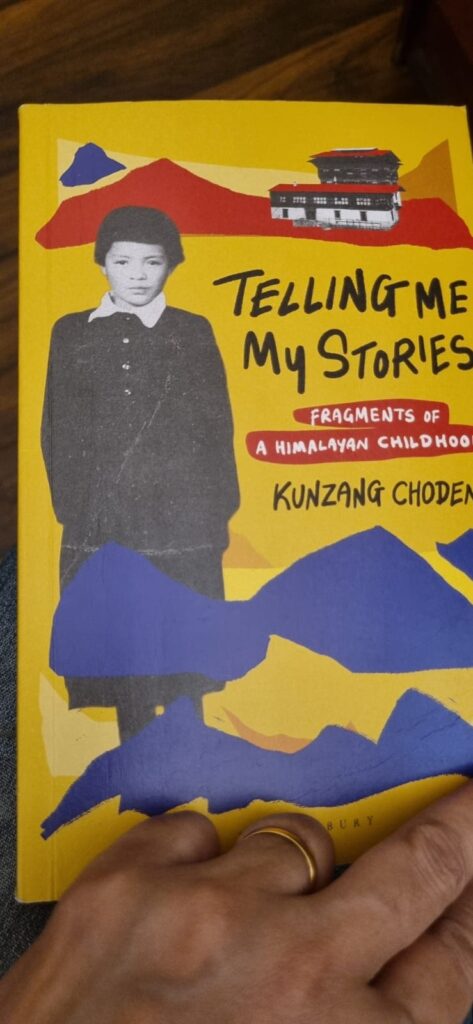
“Telling Me My Stories: Fragments of a Himalayan Childhood” by Kunzang Choden

My first introduction to Kunzang Choden was when her manuscript The Circle of Karma was placed on my desk. It was one of the first novels that I edited and thoroughly enjoyed doing so as well. It was also the first book that was placed on the Penguin/Zubaan joint imprint. It was a project that we poured our heart and soul into. We even created a micro-author website for Kunzang to promote her and the book. It was delightful. It was experimental and unheard of. This was in 2004 or so, when the internet was still in its nascent stages and we were using dialup modems to connect to the world wide web. Later, when I organised the book launch at the British Council, New Delhi, it was an incredible experience. The auditorium was packed. Some of us were left standing outside in the foyer. It is then that I noticed a quiet young man standing near the front door, flanked by a bunch of smartly dressed men. It was the then prince and now King of Bhutan, Jigme Khesar Namgyel Wangchuck. He had just finished or was about to finish studying at the University of Oxford. It was extraordinary to see him at the event. But if you read Kunzang’s latest book, Telling Me My Stories ( published by Bloomsbury India), her association with the royal family is explained. Kunzang’s mother was related to the royal family.

I interviewed Kunzang Choden for TOI Bookmark. Here is the Spotify link:

Telling Me My Stories is a stunning memoir that truly exemplifies the title of the book. It is almost as if Kunzang has taken these fragments of stories that she heard, or were passed down generation to generation, and has tried to create a coherent narrative about her family. She was orphaned at a very young age — her father passed away when she was 9 and her mother a couple of years later. Over the years, Kunzang heard stories about them, or was handed pieces of their belongings by various relatives that made her want to patch together their stories. She has done a fine job in this book.

Her skill as a storyteller and as a collector of forgotten Bhutanese folktales and retelling them has become an important art form. Probably in many ways it enabled and empowered her to share the history of her family in the way she has done so. She focussed on herself and her ancestors, shared their stories pleasantly, gleaning facts from bits and pieces of oral testimonies and memories shared by those who knew her family in the past. The conversion of oral tales into the written word, providing a coherent narrative to the story is not as easy as it looks when read. It requires patience, persistence, and plenty of research to connect the dots and produce a chronological narrative. This is what Kunzang has achieved in Telling Me My Stories.

While weaving together her ancestral history particularly that of her parents, she also achieves a remarkable feat of documenting the change in Bhutan: from a closed nation, relying on a barter economy to becoming the modern country it is today. She refers to the various social reforms that the government instituted, including sponsoring Bhutanese children to be educated in India. Kunzang was one of those who benefitted from this scheme even though it entailed a 15-day trek from Bhumthang to Kalimpong. Quite an introduction to a new life when you are merely a nine-year-old girl, leaving home for the first time.

I truly enjoyed reading Telling Me My Stories.
Listen to our conversation on TOI Bookmark. It is available on Spotify.
Here is a snippet:

I mention somewhere that the death of our parents came to us in such a blasé way and we never really had the time and the opportunity to absorb it, to mourn it, to understand it, and it stayed with me. You are right, it is kind of like a healing process for me to write about it, talking to myself about it, and going through the whole process. The time we learned about the deaths and how we had nobody to really help us or guide us. Even to help us to mourn, to cry, to hold us or explain things to us. We sort of just developed, my brothers and I, developed our own coping strategies and that sort of stays embedded in my psyche.

29 August 2025
Kavitha Rao’s books

Kavitha Rao is a London-based author and journalist. Her work has appeared in the Guardian, New York Times, South China Morning Post, Mint, The Hindu and various other publications. She is the bestselling author of Lady Doctors. Spies, Lies and Allies is her latest books and is published by Westland Books.

We spoke on TOI Bookmark regarding her Spies, Lies and Allies. Here is a snippet:

Well, you just sink yourself in it. I mean when you are writing historical fiction this book is curious because as you pointed out, it has won a couple of prizes for historical fiction and both those prizes have a rule which is that it has got to be set sixty years before the date of publication. So, we were just kind of over a line. I don’t claim to be an expert, there is a lot of smoke and mirror involved, you try to get a feel and a sense of what it might have been. So yes it is research, reading, and the kind of stuff a scholar might recognise, but we are not scholars.  

Listen to our conversation on the Times of India website and Spotify:

TOI Bookmark is a weekly podcast on literature and publishing. TOI is an acronym for the Times of India (TOI) which is the world’s largest newspaper and India’s No. 1 digital news platform with over 3 billion page views per month. The TOI website is one of the most visited news sites in the world with 200 million unique monthly visitors and about 1.6 billion monthly page views. TOI is the world’s largest English newspaper with a daily circulation of more than 4 million copies, across many editions, and is read daily by approximately 13.5 million readers. The podcasts are promoted across all TOI platforms. I have recorded more than 145+ sessions with Jnanpith, Padma Bhushan, and Padma Shree awardees, International Booker Prize winners, Booker Prize winners, Women’s Prize for Fiction, Nobel Laureates, Pulitzer Prize, Stella Prize, AutHer Awards, Erasmus Prize, BAFTA etc. Sometimes the podcast interviews are carried across all editions of the print paper with a QR code embedded in it.

Some of the authors who have been interviewed are: Banu Mushtaq, Deepa Bhashti, Samantha Harvey, Jenny Erpenbeck, Michael Hoffman, Paul Murray, V. V. Ganeshananthan, Hisham Matar, Anita Desai, Amitava Kumar, Hari Kunzro, Venki Ramakishnan, Siddhartha Deb, Elaine Feeney, Manjula Padmanabhan, NYRB Classics editor and founder Edwin Frank, Jonathan Escoffery, Joya Chatterji, Arati Kumar-Rao, Paul Lynch, Dr Kathryn Mannix, Cat Bohannon, Sebastian Barry, Shabnam Minwalla, Paul Harding, Ayobami Adebayo, Pradeep Sebastian, G N Devy, Angela Saini, Manav Kaul, Amitav Ghosh, Damodar Mauzo, Boria Majumdar, Geetanjali Mishra, William Dalrymple, Abdulrazak Gurnah, Dr Rachel Clarke, Charlotte Wood, Catherine Chidgey, Andrew Miller, Sam Dalrymple, and Annie Ernaux.

22 August 2025

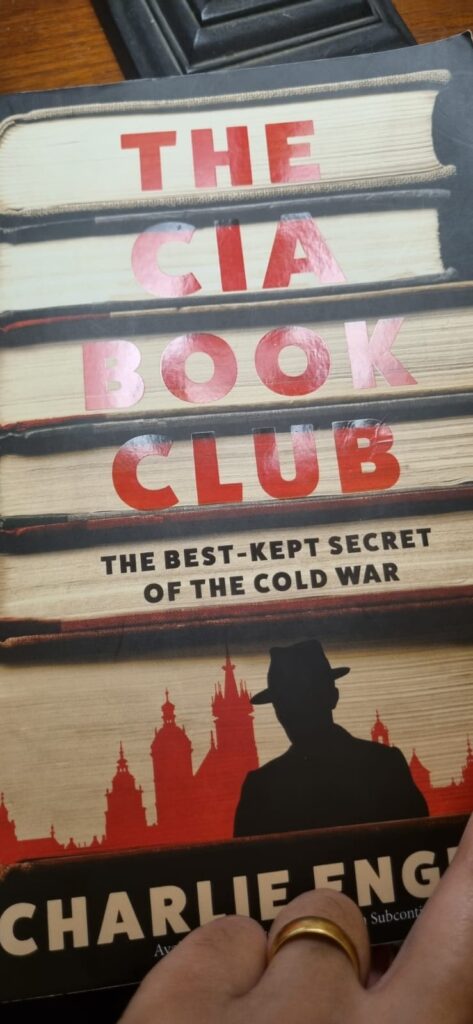
“The CIA Book Club: The Best Kept Secret of the Cold War”

The CIA Book Club: The Best Kept Secret of the Cold War by Charlie English is an extraordinary book. It is the account of the CIA Book Club that ran for decades. It’s sole purpose was to get literature and provide support to people in Eastern Bloc.

Charlie English began writing this book in January 2020 and spent nearly five years on it. The research entailed interviewing many of the people involved in running this programme, particularly in Poland, where it was most successful. He interviewed many people and accessed whatever declassified documents that he could, although many are still inaccessible. He even managed to speak to some former CIA personnel but was only offered as much information as they could legally provide.

The CIA Book Club argues that the cultural and ideological warfare that the CIA promoted via the books programme enabled the fall of the Iron Curtain and crumbling of the former communist countries. There are incredible titbits in this book that could have only been gained by having numerous conversations and with people remembering what they did, saw, and experienced. This is not a book that is based on dry documentation and research and trawling big data. In fact, one of the interviewees remarked that Charlie English’s interviewing style reminded them of the communist-era interrogation! Anyway, it was worth it if it meant unearthing a slice of history that was largely hidden. Another fact that was amusing was because the state and its secret police were misogynistic, they could not believe that women could be recruited in political activism or participate in underground publishing and dissemination of newspapers and books. So, even when facing leading women activists of the movement, the police would ignore them and mostly arrest the men. As a result, the programme thrived since the women were free to pursue whatever they wished to.

I spoke to Charlie Englishi earlier today for TOI Bookmark. Here is the conversation on Spotify:

18 August 2025

“The Land in Winter” by Andrew Miller

Andrew Miller is longlisted for The Booker Prize 2025. His novel, “The Land in Winter”, is a gorgeous historical fiction set in the terrible winter of 1962/63. It has already won the Walter Scott Prize for Historical Fiction 2025 and Winston Graham Historical Prize 2025.

I have always enjoyed reading his novels. So, it was a privilege to converse with him. A freewheeling conversation about historical fiction and writing.

Here is a snippet:

“Well, you just sink yourself in it. I mean when you are writing historical fiction this book is curious because as you pointed out, it has won a couple of prizes for historical fiction and both those prizes have a rule which is that it has got to be set sixty years before the date of publication. So, we were just kind of over a line. I don’t claim to be an expert, there is a lot of smoke and mirror involved, you try to get a feel and a sense of what it might have been. So yes it is research, reading, and the kind of stuff a scholar might recognise, but we are not scholars.”

We recorded this TOI Bookmark episode a few days before his longlisting for The Booker Prize was announced.

TOI Bookmark is a weekly podcast on literature and publishing. TOI is an acronym for the Times of India (TOI) which is the world’s largest newspaper and India’s No. 1 digital news platform with over 3 billion page views per month. The TOI website is one of the most visited news sites in the world with 200 million unique monthly visitors and about 1.6 billion monthly page views. TOI is the world’s largest English newspaper with a daily circulation of more than 4 million copies, across many editions, and is read daily by approximately 13.5 million readers. The podcasts are promoted across all TOI platforms. I have recorded more than 142+ sessions with Jnanpith, Padma Bhushan, and Padma Shree awardees, International Booker Prize winners, Booker Prize winners, Women’s Prize for Fiction, Nobel Laureates, Pulitzer Prize, Stella Prize, AutHer Awards, Erasmus Prize, BAFTA etc. Sometimes the podcast interviews are carried across all editions of the print paper with a QR code embedded in it.

Some of the authors who have been interviewed are: Banu Mushtaq, Deepa Bhashti, Samantha Harvey, Jenny Erpenbeck, Michael Hoffman, Paul Murray, V. V. Ganeshananthan, Hisham Matar, Anita Desai, Amitava Kumar, Hari Kunzro, Venki Ramakishnan, Siddhartha Deb, Elaine Feeney, Manjula Padmanabhan, NYRB Classics editor and founder Edwin Frank, Jonathan Escoffery, Joya Chatterji, Arati Kumar-Rao, Paul Lynch, Dr Kathryn Mannix, Cat Bohannon, Sebastian Barry, Shabnam Minwalla, Paul Harding, Ayobami Adebayo, Pradeep Sebastian, G N Devy, Angela Saini, Manav Kaul, Amitav Ghosh, Damodar Mauzo, Boria Majumdar, Geetanjali Mishra, William Dalrymple, Abdulrazak Gurnah, Dr Rachel Clark, Charlotte Wood, Catherine Chidgey, Andrew Miller, Sam Dalrymple, and Annie Ernaux.

TOI Bookmark: Murzban Shroff

Murzban Shroff is a Mumbai-based writer. He has published his fiction with over 75 literary journals in the U.S. and UK. His stories have appeared in innumerable literary journals such as The Gettysburg ReviewThe Minnesota ReviewThe Saturday Evening PostChicago TribuneLitMagManoa, and World Literature Today. He is the recipient of the John Gilgun Fiction Award and the Bacopa Review Fiction Award. He holds seven Pushcart Prize nominations, among the most honoured short story prizes in the U.S.

His story collection, Breathless in Bombay, was shortlisted for the Commonwealth Writers’ Prize in the best debut category from Europe and South Asia, and rated by the Guardian as among the ten best Mumbai books. His novel, Waiting for Jonathan Koshy, was a finalist for the Horatio Nelson Fiction Prize and has been published in India, China, and the U.S. His India collection, Third Eye Rising, featured on the Esquire list of Best Books of 2021.

Shroff’s latest book, Muses Over Mumbai, a collection of 17 full-length stories, has received glowing endorsements from male writers such as Salman Rushdie, Jonathan Franzen, Robert Olen Butler, Ben Fountain, Amit Chaudhuri, and Jeet Thayil. It is published by Bloomsbury India.

I interviewed him on TOI Bookmark. Here is a snippet from the conversation:

I reserve the short story form for my issue-based fiction because I feel that when I am covering a territory like Mumbai, it is very difficult to have an overarching theme and weave it into a single piece of work. I feel Mumbai works best as a polyphony of class and cultures. There are multiple issues working at multiple levels; how do you best represent the diversity. Let me expand a bit on that, Jaya. If you look at Muses of Mumbai it has seventeen stories, out of which two are almost novellas, which means that they are about 15-17,000 words. Now each story is completely different from the other, not only in terms of subject matter and characters but also socio-economics and in terms of writing styles. Some I have used elements like memoir writing, used elements like essay, like whimsy. So the styles themselves represent the diversity and that is why I think the short story form works marvellously because short story is a marvellously promiscuous form of writing.

Listen to it on Spotify:

TOI Bookmark is a weekly podcast on literature and publishing. TOI is an acronym for the Times of India (TOI) which is the world’s largest newspaper and India’s No. 1 digital news platform with over 3 billion page views per month. The TOI website is one of the most visited news sites in the world with 200 million unique monthly visitors and about 1.6 billion monthly page views. TOI is the world’s largest English newspaper with a daily circulation of more than 4 million copies, across many editions, and is read daily by approximately 13.5 million readers. The podcasts are promoted across all TOI platforms. Till date, I have recorded more than 138+ sessions with Jnanpith, Padma Bhushan, and Padma Shree awardees, International Booker Prize winners, Booker Prize winners, Women’s Prize for Fiction and Non-fiction, Nobel Laureates, Pulitzer Prize, Stella Prize, AutHer Awards, Erasmus Prize, BAFTA etc. Sometimes the podcast interviews are carried across all editions of the print paper with a QR code embedded in it.

Some of the authors who have been interviewed are: Banu Mushtaq, Deepa Bhashti, Samantha Harvey, Jenny Erpenbeck, Michael Hoffman, Paul Murray, V. V. Ganeshananthan, Hisham Matar, Anita Desai, Amitava Kumar, Hari Kunzro, Venki Ramakishnan, Siddhartha Deb, Elaine Feeney, Manjula Padmanabhan, NYRB Classics editor and founder Edwin Frank, Jonathan Escoffery, Joya Chatterji, Arati Kumar-Rao, Paul Lynch, Dr Kathryn Mannix, Cat Bohannon, Sebastian Barry, Shabnam Minwalla, Paul Harding, Ayobami Adebayo, Pradeep Sebastian, G N Devy, Angela Saini, Manav Kaul, Amitav Ghosh, Damodar Mauzo, Boria Majumdar, Geetanjali Mishra, Viet Thanh Nguyen, William Dalrymple, Abdulrazak Gurnah, and Annie Ernaux.

7 July 2025

TOI Bookmark: Profs. Anjali Nerlekar and Ulka Anjaria

Anjali Nerlekar is Associate Professor at Rutgers University, and coeditor of Modernism/ Modernity. Most recently, she co-edited the Oxford Handbook of Modern Indian Literatures in 2024. She is the author of Bombay Modern: Arun Kolatkar and Bilingual Literary Culture (NUP, 2016; Speaking Tiger, 2017), and has also coedited a special double issue of Journal of Postcolonial Writing on “The Worlds of Bombay Poetry” and a special issue of South Asia: A Journal of South Asian Studies on “Postcolonial Archives.” She also continues the work of building “The Bombay Poets’ Archive” at the Rare Manuscripts Collection at Cornell University. Her research interests include Her research interests include multilingual Indian modernisms; modern Marathi literature; Indian English literature; Indo-Caribbean literature; translation studies; Caribbean and postcolonial studies; and Indian print culture.

Ulka Anjaria is Professor of English and Barbara Mandel Professor of Humanities at Brandeis University. She is also Director of the Mandel Center for the Humanities at Brandeis. Her research interests include South Asian literature and film, realism, and the global novel. She is the author of Realism in the Twentieth-Century Indian Novel: Colonial Difference and Literary Form (2012), Reading India Now: Contemporary Formations in Literature and Popular Culture (2019), and Understanding Bollywood: The Grammar of Hindi Cinema (2021), along with essays and chapters in several journals and volumes. She is the editor of A History of the Indian Novel in English (2015) and co-editor (with Anjali Nerlekar) of The Oxford Handbook of Modern Indian Literatures (2024). She is currently working on a monograph tentatively titled Bad Mothers, on gender, caste, and modernism in 20th-century Indian literature.

Recently, they co-edited The Oxford Handbook of Modern Indian Literatures (Oxford Handbooks), published in India by Oxford University Press.

The Oxford Handbook of Modern Indian Literatures refutes the Anglocentrism of much literary criticism of the global South by examining “Indian Literature” as a multilingual, dialogic, and plural space constituted by both continuities and divergences. In forty-three chapters and with a team of scholars who exemplify the method of historically situated and theoretically rigorous literary criticism, this volume shows how the idea of Indian literature is a relational and comparative concept. Through readings of a vast diversity of multilingual literature in a range of genres, the chapters highlight contact zones and interchanges across seemingly sedimented boundaries. The Handbook provides an overview of the current state of modern Indian writing and features a range of texts and approaches from across India’s many languages and literary traditions, examining and amplifying recent critical attention to the multilingualism that is at the base of any curation of what could be termed, with qualification, “Indian Literatures.” The book ranges from the 19th century to the 21st, with especial focus on the centrality of gender and caste to Indian modernism and new generic formations such as graphic novels, autofiction, and videogames.

It was a pleasure speaking with the two professors on TOI Bookmark. Here is a snippet from the conversation:

One of the conversations we had when we went to India and talked to students about this book in September [2024], one of the questions students had was how can you subsume, and this was an example, how can you subsume Tamil Modernism under India? So we tried to explain as if we already know the term what India is? But in the actual chapters and in the actual work follows, its gets queried, dismantled, reformulated. For example, Tamil Modernism or the question of Tamil is featured here but then we also talk about Tamil in Sri Lanka and Tamil in Singapore. A chapter goes across India and Singapore. The border, contact zones of the borders is another concept that we always kept in mind. This idea of relationality and contact zones from which we started looking at the idea of what it is that is Indian or what that it is modern for example?

Listen to it on Spotify:

TOI Bookmark is a weekly podcast on literature and publishing. TOI is an acronym for the Times of India (TOI) which is the world’s largest newspaper and India’s No. 1 digital news platform with over 3 billion page views per month. The TOI website is one of the most visited news sites in the world with 200 million unique monthly visitors and about 1.6 billion monthly page views. TOI is the world’s largest English newspaper with a daily circulation of more than 4 million copies, across many editions, and is read daily by approximately 13.5 million readers. The podcasts are promoted across all TOI platforms. I have recorded more than 138+ sessions with Jnanpith, Padma Bhushan, and Padma Shree awardees, International Booker Prize winners, Booker Prize winners, Women’s Prize for Fiction, Nobel Laureates, Pulitzer Prize, Stella Prize, AutHer Awards, Erasmus Prize, BAFTA etc. Sometimes the podcast interviews are carried across all editions of the print paper with a QR code embedded in it.

Some of the authors who have been interviewed are: Banu Mushtaq, Deepa Bhashti, Samantha Harvey, Jenny Erpenbeck, Michael Hoffman, Paul Murray, V. V. Ganeshananthan, Hisham Matar, Anita Desai, Amitava Kumar, Hari Kunzro, Venki Ramakishnan, Siddhartha Deb, Elaine Feeney, Manjula Padmanabhan, NYRB Classics editor and founder Edwin Frank, Jonathan Escoffery, Joya Chatterji, Arati Kumar-Rao, Paul Lynch, Dr Kathryn Mannix, Cat Bohannon, Sebastian Barry, Shabnam Minwalla, Paul Harding, Ayobami Adebayo, Pradeep Sebastian, G N Devy, Angela Saini, Manav Kaul, Amitav Ghosh, Damodar Mauzo, Boria Majumdar, Geetanjali Mishra, Viet Thanh Nguyen, William Dalrymple, Abdulrazak Gurnah, and Annie Ernaux.

7 July 2025

A tale of “TOI Bookmark” and “Bookmarks”

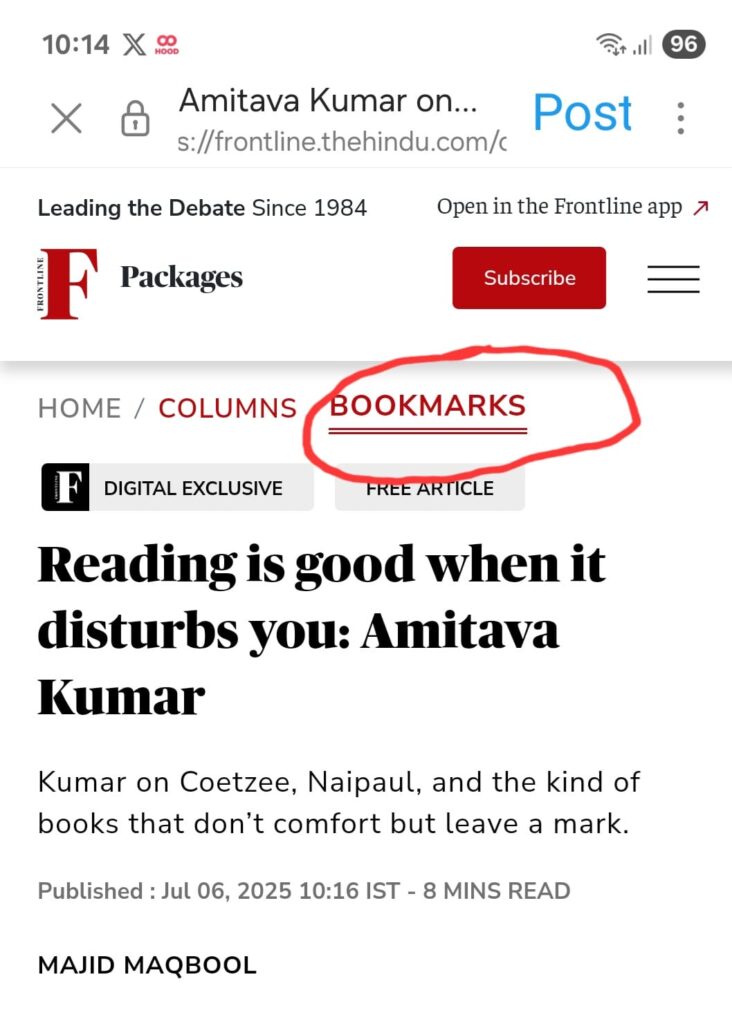
On Sunday, 6 July 2025, I spotted a new column being announced by The Hindu called “Bookmarks”. It’s aim is to feature prominent writers, public intellectuals, scholars, activists, etc – talking about books that have shaped their lives and worldview. This is good news. The more spaces that open up in mainstream media for writers/books, the better it is for the publishing ecosystem.

Here is the image from The Frontline website:

A couple of years ago, I began a podcast series with the Times of India called “TOI Bookmark”. TOI Bookmark is a weekly podcast on literature and publishing. TOI is an acronym for the Times of India (TOI) which is the world’s largest newspaper and India’s No. 1 digital news platform with over 3 billion page views per month. The TOI website is one of the most visited news sites in the world with 200 million unique monthly visitors and about 1.6 billion monthly page views. TOI is the world’s largest English newspaper with a daily circulation of more than 4 million copies, across many editions, and is read daily by approximately 13.5 million readers. The podcasts are promoted across all TOI platforms. Till date, I have recorded more than 138+ sessions with Jnanpith, Padma Bhushan, and Padma Shree awardees, International Booker Prize winners, Booker Prize winners, Women’s Prize for Fiction and Non-fiction, Nobel Laureates, Pulitzer Prize, Stella Prize, AutHer Awards, Erasmus Prize, BAFTA etc. Sometimes the podcast interviews are carried across all editions of the print paper with a QR code embedded in it.

Some of the authors who have been interviewed are: Banu Mushtaq, Deepa Bhashti, Samantha Harvey, Jenny Erpenbeck, Michael Hoffman, Paul Murray, V. V. Ganeshananthan, Hisham Matar, Anita Desai, Amitava Kumar, Hari Kunzro, Venki Ramakishnan, Siddhartha Deb, Elaine Feeney, Manjula Padmanabhan, NYRB Classics editor and founder Edwin Frank, Jonathan Escoffery, Joya Chatterji, Arati Kumar-Rao, Paul Lynch, Dr Kathryn Mannix, Cat Bohannon, Sebastian Barry, Shabnam Minwalla, Paul Harding, Ayobami Adebayo, Pradeep Sebastian, G N Devy, Angela Saini, Manav Kaul, Amitav Ghosh, Damodar Mauzo, Boria Majumdar, Geetanjali Mishra, Viet Thanh Nguyen, Rachel Clark, William Dalrymple, Abdulrazak Gurnah, and Annie Ernaux.  

TOI Bookmark is available on the Times of India website and on Spotify too. Sometimes, links to it are published in the print media. For example, my conversation with Nobel laureate, Annie Ernaux.

Here is the logo from the Spotify channel:

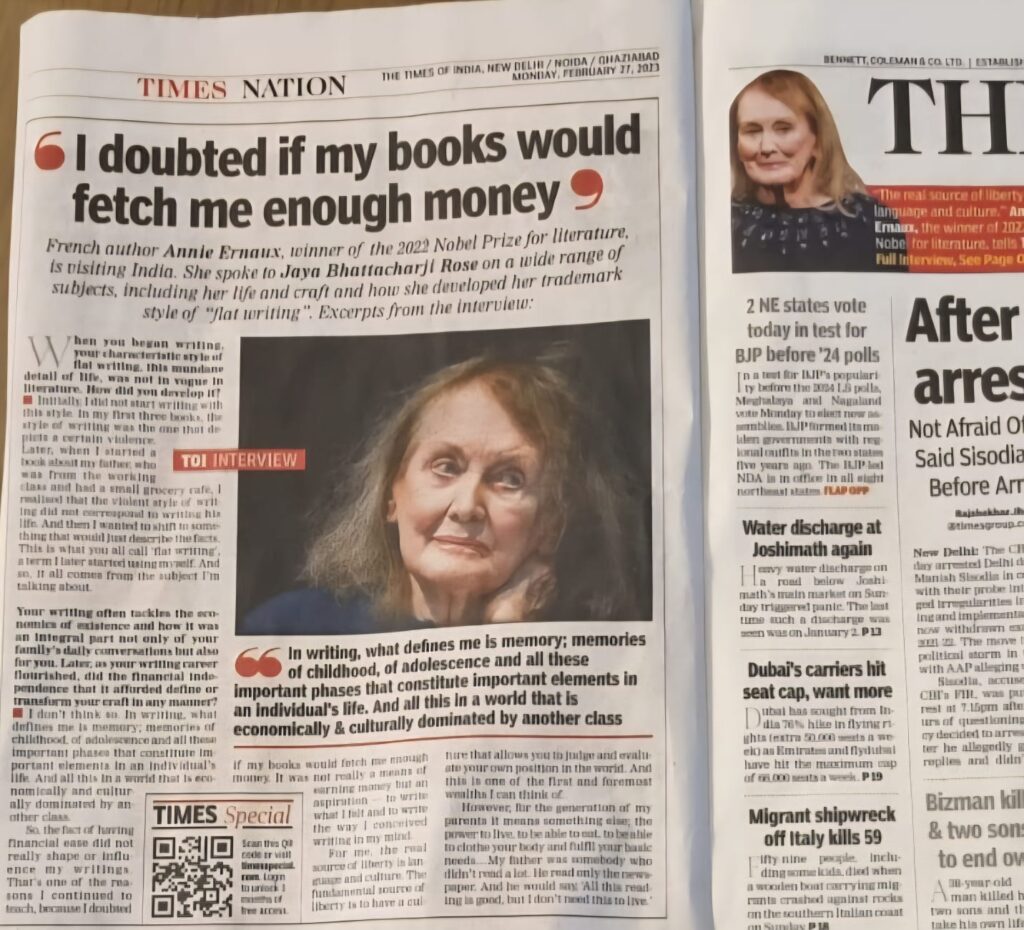
Here is an example of how the interviews are carried in print. This is an interview with Annie Ernaux from 2023.

Imitation is the best form of flattery. So of all the words in the English language that The Hindu could use to describe their new column of author conversation, to pick “Bookmark(s)” is rather amusing. I look forward to reading the Frontline interviews.

7 July 2025

TOI Bookmark podcast with Andaleeb Wajid

Andaleeb Wajid is a hybrid author, having published nearly 50 novels in the past 15 years. Andaleeb enjoys writing in a number of different genres such as young adult, romance, and horror. Andaleeb’s YA novel “Asmara’s Summer” was adapted for screen to become “Dil, Dosti, Dilemma” on Amazon Prime and other works are in the process of being optioned or adapted. Her YA novel, “The Henna Start-up” is the winner of the Neev Literature Festival Award 2024, Crossword Book Award 2024, and TOI Auther Award 2025, along with receiving honourable mention at the BK Awards, 2024.

She recently published her moving memoir “Learning to Make Tea for One: Reflections on Love, Loss and Healing”, published by Speaking Tiger Books.

I have known Andaleeb for years. It is absolutely marvellous to witness her growth as an author year on year. Hence, recording an episode of TOI Bookmark was extra special.

Here is a snippet from the conversation:

I really enjoy writing fiction. So, nonfiction as a rule I don’t like to approach. But this was different because I have also put so much of myself into the book. Which was why it was so difficult to write. When I write fiction I do tend to put parts of myself into the book but those are very miniscule parts. And this book took huge chunks of me. And I think it was supposed to be healing but at that time it did not feel that way. Now maybe in a couple of months I will be able to look at it.

TOI Bookmark is a weekly podcast on literature and publishing. TOI is an acronym for the Times of India (TOI) which is the world’s largest newspaper and India’s No. 1 digital news platform with over 3 billion page views per month. The TOI website is one of the most visited news sites in the world with 200 million unique monthly visitors and about 1.6 billion monthly page views. TOI is the world’s largest English newspaper with a daily circulation of more than 4 million copies, across many editions, and is read daily by approximately 13.5 million readers. The podcasts are promoted across all TOI platforms. I have recorded more than 138+ sessions with Jnanpith, Padma Bhushan, and Padma Shree awardees, International Booker Prize winners, Booker Prize winners, Women’s Prize for Fiction, Nobel Laureates, Pulitzer Prize, Stella Prize, AutHer Awards, Erasmus Prize, BAFTA etc. Sometimes the podcast interviews are carried across all editions of the print paper with a QR code embedded in it.

Some of the authors who have been interviewed are: Banu Mushtaq, Deepa Bhashti, Samantha Harvey, Jenny Erpenbeck, Michael Hoffman, Paul Murray, V. V. Ganeshananthan, Hisham Matar, Anita Desai, Amitava Kumar, Hari Kunzro, Venki Ramakishnan, Siddhartha Deb, Elaine Feeney, Manjula Padmanabhan, NYRB Classics editor and founder Edwin Frank, Jonathan Escoffery, Joya Chatterji, Arati Kumar-Rao, Paul Lynch, Dr Kathryn Mannix, Cat Bohannon, Sebastian Barry, Shabnam Minwalla, Paul Harding, Ayobami Adebayo, Pradeep Sebastian, G N Devy, Angela Saini, Manav Kaul, Amitav Ghosh, Damodar Mauzo, Boria Majumdar, Geetanjali Mishra, Viet Thanh Nguyen, William Dalrymple, Abdulrazak Gurnah, and Annie Ernaux.

2 July 2025

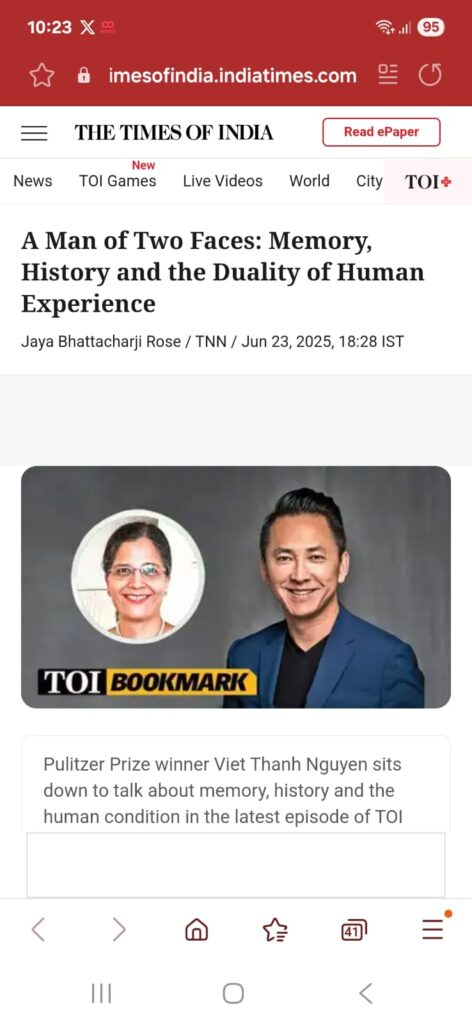
“A Man of Two Faces” by Viet Thanh Nguyen

Award-winning writer and academic Viet Thanh Nguyen is a name that many in the literary world are familiar with. As a Vietnamese-American, he is acutely aware of his two identities and the histories he carries within himself. This is one of the recurring themes of his memoir, A Man of Two Faces. He has written plenty of books, most notably his Pulitzer Prize for Fiction 2016 The Sympathiser. It was recently turned into a TV series with Park Chan-wook and Robert Downey Jr. His books are published in India by Hachette India.

In 2023-24, Viet Thanh Nguyen delivered the prestigious Norton Lectures. In the lectures as well as in the discussions that follow, he addresses many of the aspects of being an immigrant in the USA that are at the heart of his moving memoir A Man of Two Faces.

We have recorded more than 134 episodes of TOI Bookmark. Each one is special and memorable. Every conversation is unique. It was an honour and a privilege to record this episode with Viet Thanh Nguyen. He is exceptionally busy with a demanding schedule. Yet, once we had figured out a mutually convenient time to record, across time zones, days and dates, he was immensely courteous and gave us his focussed attention. It did not seem as if he had been in back-to-back meetings/interviews during the day. It was Memorial Weekend in the USA, but he was working.

It was a fascinating conversation about reading and writing memoirs while discussing his book A Man of Two Faces. Also, how he had to think through himself, think through the history of his family that he was dealing with, and think through the language he was going to use.

Read an extract from the book published on Moneycontrol.

Incidentally, 30 April 2025 marked fifty years since the conclusion of the Vietnam War.

Listen to the podcast on Spotify:

TOI Bookmark is a weekly podcast on literature and publishing. TOI is an acronym for the Times of India (TOI) which is the world’s largest newspaper and India’s No. 1 digital news platform with over 3 billion page views per month. The TOI website is one of the most visited news sites in the world with 200 million unique monthly visitors and about 1.6 billion monthly page views. TOI is the world’s largest English newspaper with a daily circulation of more than 4 million copies, across many editions, and is read daily by approximately 13.5 million readers. The podcasts are promoted across all TOI platforms. I have recorded more than 134+ sessions with Jnanpith, Padma Bhushan and Padma Shree awardees, International Booker Prize winners, Booker Prize winners, Women’s Prize for Fiction, Nobel Laureates, Pulitzer Prize, Stella Prize, AutHer Awards, Erasmus Prize, BAFTA, Walter Scott Prize for Historical Fiction etc. Sometimes the podcast interviews are carried across all editions of the print paper with a QR code embedded in it.

Some of the authors who have been interviewed are: Banu Mushtaq, Deepa Bhashti, Samantha Harvey, Jenny Erpenbeck, Michael Hoffman, Paul Murray, V. V. Ganeshananthan, Hisham Matar, Anita Desai, Amitava Kumar, Hari Kunzro, Venki Ramakishnan, Siddhartha Deb, Elaine Feeney, Manjula Padmanabhan, NYRB Classics editor and founder Edwin Frank, Jonathan Escoffery, Joya Chatterji, Arati Kumar-Rao, Paul Lynch, Dr Kathryn Mannix, Cat Bohannon, Sebastian Barry, Shabnam Minwalla, Paul Harding, Ayobami Adebayo, Pradeep Sebastian, G N Devy, Angela Saini, Manav Kaul, Amitav Ghosh, Damodar Mauzo, Boria Majumdar, Geetanjali Mishra, Viet Thanh Nguyen, William Dalrymple, Abdulrazak Gurnah, and Annie Ernaux.  

16 June 2025

Jeet Thayil’s “The Elsewhereans: A Documentary Novel”

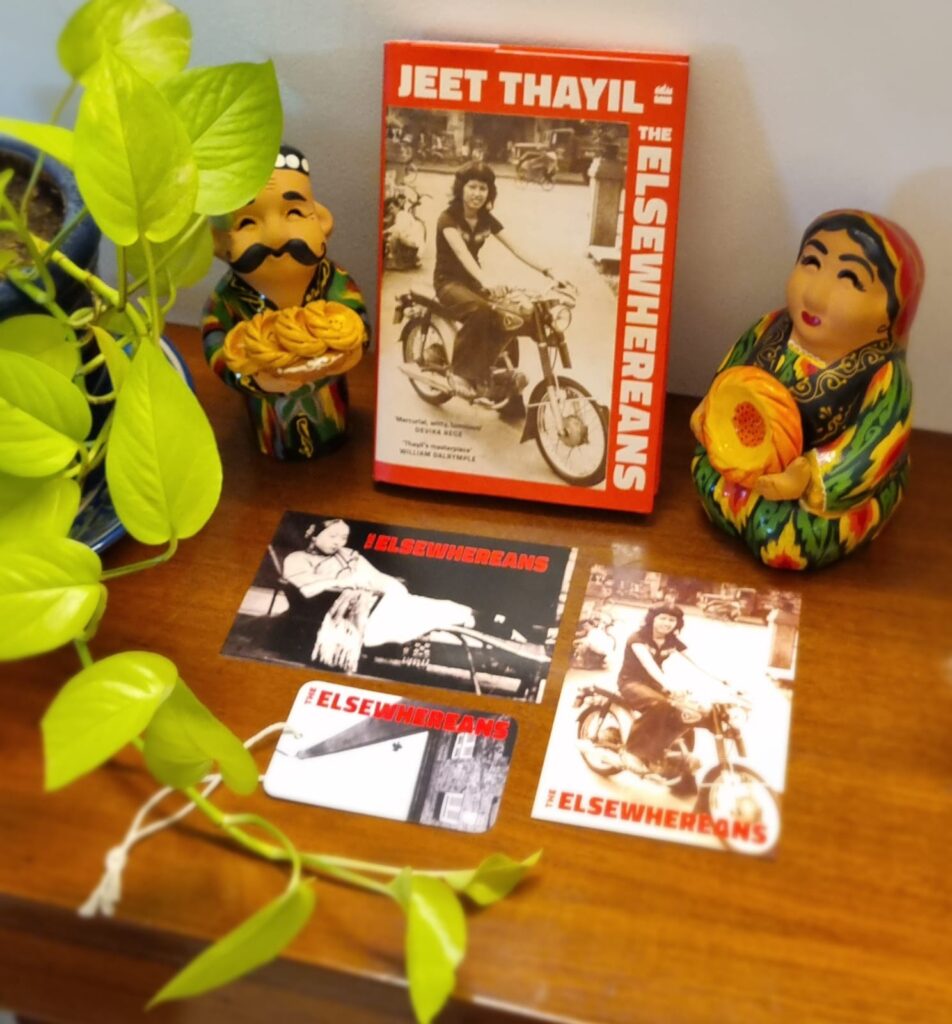
Jeet Thayil’s new novel The Elsewhereans: A Documentary Novel is being released by HarperCollins India on 23 June 2025. Jeet has been incredibly prolific in the past few months. He has published two volumes of poems including his stupendous collection I’ll have it Here. There are poems in this volume that bear witness to our new world. Jeet’s poetry is outstanding. The rhythm and performance element are pitch perfect with the words he finds to express his emotions. Hence, his novels are equally fascinating. Always expect the unexpected from Jeet where prose is concerned.

Here is the Spotify link to the TOI Bookmark podcast that I recorded with Jeet earlier this year.

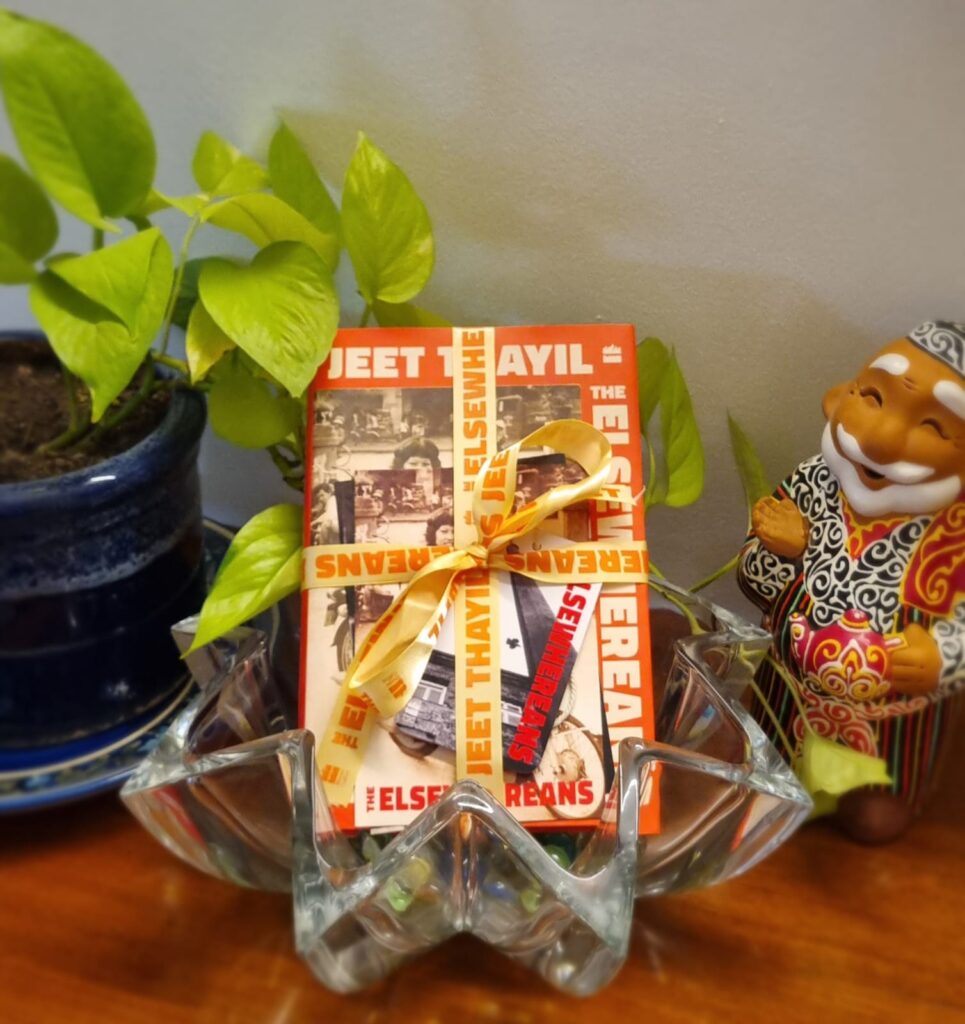
I have just received an advance copy of his novel from the publishers and look forward to reading it asap.

‘Mercurial, witty, luminous’ – DEVIKA REGE

‘Thayil’s masterpiece’ – WILLIAM DALRYMPLE

Jeet Thayil’s The Elsewhereans is a genre-defying novel that melds fiction, travelogue, memoir, a ghost story, a family saga, photographs and much else into a tale that unfolds across continents and decades.

From the backwaters of Kerala to the streets of Bombay, Hong Kong, Paris and beyond, Thayil maps the restless lives of those shaped by separation – both the ones who leave and the ones left behind.

A hypnotic meditation on migration, loss, and the fragile threads of identity from one of the most brilliant voices in contemporary literature, The Elsewhereans is a novel of retrieval and reinvention – an elegy for vanished worlds, and a reckoning with the histories we inherit.

The Elsewhereans is a wonderfully rich evocation of the era of decolonization and non-alignment, and the peripatetic lives and multiple perspectives that it made possible. Reading it, I felt like I was meeting many ghosts from my own past.’ AMITAV GHOSH

‘Like the “river of three rivers” at its heart, The Elsewhereans surges forward in multiple narrative currents: autofiction, Kunstlerroman, mourning diary. Dispensing with conventional notions of plot, Thayil draws on real and imagined archives, testimonies and anecdotes to trace the wanderings of a family from Kerala to places as disparate as Bombay, Hanoi, Paris, Elmau and Algeciras. But it is above all his sentences – mercurial, witty, luminous – that pull us through each new and unexpected encounter. The result is a hauntingly lyrical meditation on migration, belonging and grief. The Elsewhereans is Thayil at his finest yet.’ DEVIKA REGE

‘How can a book so melancholy also be so exhilarating? The Elsewhereans blurs timezones and timelines as it traces the wanderings of a family across rivers and oceans, across silences and stories. It is equally attentive to the politics of nation-building and family caretaking. The centre of this dazzling spiral novel is deep love, examined with ruthless poetic precision, and found to be flawed but essential for survival.’ SHAHNAZ HABIB

‘Jeet Thayil just keeps getting better and better: this is writing of great skill and precision, charm and warmth, beauty and wit, taut as a coiled spring, laced with pin-sharp, pitch-perfect dialogue. The Elsewhereans could well be Thayil’s masterpiece.’ WILLIAM DALRYMPLE

Jeet Thayil is a poet, novelist, librettist and musician. He was born into a Syrian Christian family in Kerala. As a boy, he travelled through much of the Indian subcontinent and Southeast Asia with his father, T.J.S. George, a writer and editor. He worked as a journalist for twenty-one years in Bombay, Bangalore, Hong Kong and New York City. In 2005, he began to write fiction. The first instalment of his Bombay Trilogy, Narcopolis, was shortlisted for the Booker Prize, won the DSC Prize, and became a bestseller. His book of poems These Errors Are Correct won the Sahitya Akademi Award. His musical collaborations include the opera Babur in London. His essays, poetry and short fiction have appeared in The New York Review of Books, Granta, TLS, Esquire, The London Magazine, The Guardian and The Paris Review, among other venues. Jeet Thayil’s most recent book of poems is I’ll Have It Here.

16 June 2025

Web Analytics Made Easy -
StatCounter