The first spirit Sanjoy Roy encountered was one that haunted his ancestral house in Calcutta; he was five then. A few years later, the otherworldly made its presence felt again in his parents’ sprawling bungalow in Lutyens’ Delhi. Over the decades that followed, he and his family and friends have come across a variety of apparitions, spectres and phantoms in diverse locations both in India and abroad. Some of these beings are benign or at most mischievous, but others–lost, disturbed souls–are angrier and have to be placated.
For Sanjoy, his ability to sense and interact with the supernatural is not something remarkable, but part of his everyday reality. As he sees it, there is perhaps a dimension parallel to ours, one that is teeming with spirits and souls. There’s a Ghost in My Room is a fascinating travelogue through that mysterious world.
Rich in period detail, humour and adventure, this unusual memoir makes for a compelling read and is sure to enthrall both the haunted-world sceptic and those who believe.
I interviewed him for TOI Bookmark. Here is the Spotify link.
Sanjoy K. Roy is Managing Director of Teamwork Arts, which produces over thirty highly acclaimed performing arts, visual arts and literary festivals across forty cities including the world’s largest literary gathering: the annual Jaipur Literature Festival.
Journalist Nayanima Basu had a ringside view of the total collapse of the republic of Afghanistan at the hands of the Taliban. From 8 to 17 August 2021, based in Kabul but travelling outside and talking to Afghans across the political spectrum, she sent despatches of the Taliban sweeping through the country, with provinces falling one after another. Covering a hostile war zone, a woman all alone, she saw the fall of Kabul in real time and managed to get out on the last flight by negotiating with Taliban bosses. Basu transports us to the heart of the action with her vivid narration and precise descriptions of what was happening in Afghanistan at large and Kabul in particular. Through her astonishing account of how she did her reporting – from asking gun-toting civilians for help to find her way back to her hotel and being chided by the hotel employees to stay safe in an iron room to being the only Indian journalist to ever interview the ‘Butcher of Kabul’ – Basu tells the story of not just the wreckage of the country’s present but also of the contentious past that lead to it.
Nayanima Basu has penned a truly gripping first person account of the dramatic fall of Afghanistan to the Taliban in August 2021. It reflects her indomitable courage in the face of acute and ever-present danger and her unfailing commitment to professionalism as a journalist. This is outstanding reporting but within a frame of deep political and historical familiarity with a truly complex country.- Shyam Saran, former Foreign Secretary of India
Nayanima Basu has given us a lively and informed account of her stay in Afghanistan at a pivotal moment, just as the Taliban took over the country in 2021. More than a diary of travel in a dangerous, exciting and exotic place, this book is an explanation of a phenomenon, the return of the Taliban, with which the world has yet to come to terms. Its consequences are still playing out, making this a valuable contribution to understanding the increasingly complex geopolitics of India’s periphery.- Shivshankar Menon, Former National Security Advisor and Foreign Secretary of India
An honest and poignant account of what unfolded in August 2021 in Afghanistan, which the world is still grappling with…What makes this book distinctive is the simple narration of an extremely difficult period that once again brought the Taliban back in power.- A.S. Dulat, former Head of Research and Analysis Wing and Special Director, Intelligence Bureau
Nayanima Basu is a New Delhi–based journalist covering foreign policy and strategic and security affairs with nearly two decades of experience. A major in history from the University of Delhi, Nayanima has been professionally associated with several media organisations such as the IANS, Business Standard, The Hindu Group, ThePrint and ABP Network. She has covered stories such as the assassination of former Pakistan prime minister Benazir Bhutto, India’s crucial years at the World Trade Organization (WTO), the global financial recession, India’s evolving ties with its difficult neighbours like Pakistan and China, and bilateral and multilateral summits. In the course of her reportage, she has also interviewed several key Indian and international political and military figures.
p.21-22 I remember that moment when my constructed, conditioned versions of ‘self’ started dissolving, the disguises started peeling off.
It was the last morning of the retreat, which also happened to be my forty0seventh birthday. The previous evening, I had been sitting on a bench facing the river and the hill on the other side of it. I could see the cave where George Harrison had once hung out with Maharishi Mahesh Yogi. A quiet mist ascended from the water and I felt my eyes tearing. It may have been from sadness or joy, or both, or neither. The aquamarine water and the emerald green hill in the distance turned into Impressionist art in my blurred vision. I blinked a few time and saw a speck of tangerine in the distance. As it came closer, the object morphed into a monk.
Then, the bells started to chime. First one, and then many, in symphonic unison, little and big bells that hung at the entrances of temples all around, until they reached a crescendo, distant but also simultaneously vibrating within me.
I remembered what a qawwali singer at Ajmer Sharif had once told me: Music is always an offering in temples and churches and mausoleums.
‘This is why you find a bell at the entrance in places of worship. And this is why we sing in the dargah or in the gurudwara,’ he said, pausing to engage with his spittoon. ‘Even when a dacoit is about to attack someone, and he hears a temple bell, he will involuntarily stop in his tracks, even if only for a moment. This is kachcha jadoo, primordial magic.’ And back he went to his music, belting out more boisterous Allahoos.
It felt like I was in a timeless space. I could have been sitting there centuries ago, or at some point in the future. It didn’t really matter. Our version of the ‘self’ are all clay, mutable, and therefore capable of what psychologists call neuroplasticity: the human being’s inherent potential to transform into anything they wish to be. A rogue bandit can become a saint; a warrior king could become a Buddhist monk.
p. 75 Before women had access to therapy, they often turned to religion and gurus to help them navigate difficult families. My ma-in-law Hardevi battled the trauma of early widowhood and overbearing patriarchy by turning to god. But rather than sitting passively in front of a statue, she found her way to the non-ritualistic altar of Vedanta philosophy. she studied the Bhagvad Gita and translated it into Sindhi, patiently writing in the Arabic script, for she had attended school in pre-Partition Karachi.
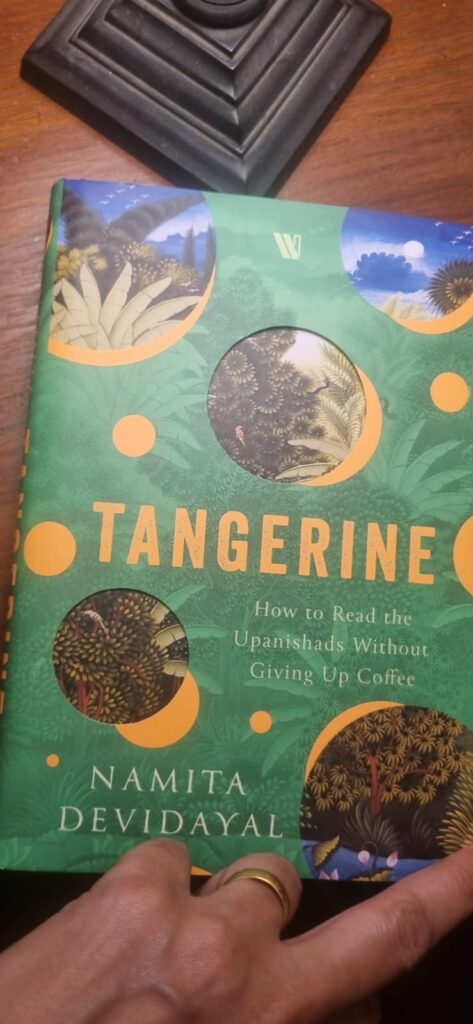
Senior journalist and musician Namita Devidayal’s latest book, Tangerine: How to Read the Upanishads Without Giving Up Coffee is a memoir about her finding peace and tranquility and shedding unnecessary baggage. In short, it is the the self-help book that she avoids reading but wrote one herself. Honestly speaking, it is much more. It is deliciousness poured into words with generous sprinkling of wisdom and the elegant manner in which she straddles cultures while writing is superb. She makes visible that many of prefer to keep hidden. A sense of familiarity and ease to be who we are in this modern age. We live, borrow, and breathe many experiences — call them faith, call them culture, call them whatever you will — but many individuals prefer to either shush about different aspects of their life or not acknowledge it all. Spiritual sustenance being a very key part of Namita’s existence and that she does not shy away from discussing. It does create some awkward moments for her in social gatherings or even with her son when she wants to pursue her readings of the Upanishads and has many questions to ask, but given the times that we live in, people misinterpret her genuine queries and think that she has crossed over to the other side and is being irrational. She is not. She is interested. She wants to know. Hence, this book. It does not matter if you are an atheist or a believer, it is a book that you will devour and not forget in a hurry.
Tangerine is published by Westland Books. The exquisitely designedcover, with its peekaboo circles in the dust jacket highlighting the moonlit night sky and plenty of green vegetation has been designed by Saurabh Garge.
I interviewed Namita for TOI Bookmark. Here is the Spotify link:
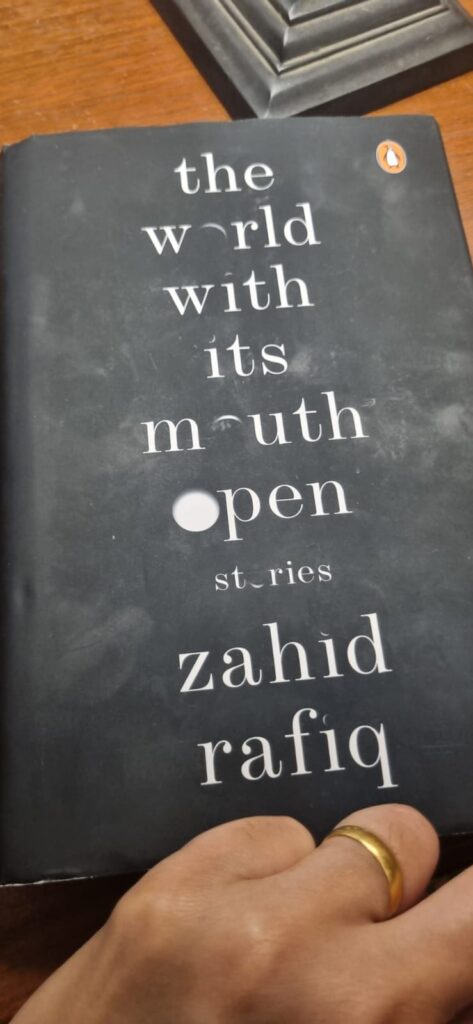
I had been hearing all good things about The World With Its Mouth Open for a while now. It lives up to its expectations. It is never an easy task, especially for a debut writer, to produce eleven short stories and every single one of them unusual in its tone, literary style, and subject matter. I cannot help but wonder if Zahid Rafiq shifts effortlessly in his thinking and writing between two languages — English and Kashmiri. Reading the stories in English, the structured sentences, turn of phrases, use of literary techniques, experimentation with the form, and the ability to play with voices is of a confident writer and speaker of the language. Yet, when it comes to dialogue and some observations of the local terrain, particularly in the change of rhythm in the words, or even the repetition, I felt as if the author was relying considerably on Kashmiri for expression and structure of conveying emotion and feeling. There were times when it almost felt as if there were elements used from fairy tales and fables, to some degree even oral narratives. I can only attribute it to being evident when there was a slight shift in the rhythm and unexpectedness of what came in the text, with echoes of what I recalled from reading such fairy tales or being told stories by elders. When I posed this to Zahid, he said that he was unable to articulate now, long after the book has been published as to what exactly he was doing because he was so immersed in the storytelling that he did what he felt best. Nor can he understand where the variation in style came. It just did. We recorded a freewheeling conversation for an episode of TOI Bookmark. Unfortunately, it was on a day when Zahid was battling a viral fever and was under the weather.
I spoke to Zahid for TOI Bookmark. Here is the Spotify link:
Book blurb
In eleven stories, The World With Its Mouth Open maps the inner lives of the people of Kashmir as they walk the uncertain terrain of their days, fractured from years of war. From a shopkeeper’s encounter with a mannequin, to an expectant mother walking on a precarious road, to a young boy wavering between dreams and reality, to two dogs wandering the city, these stories weave in larger, devastating themes of loss, grief, violence, longing, and injustice with the threads of smaller, everyday realities that confront the characters’ lives in profound ways. Although the stories circle the darker aspects of life, they are―at the same time―an attempt to run into life, into humor, into beauty, into another person who can offer refuge, if momentarily.
Zahid Rafiq’s The World With Its Mouth Open is a powerful collection announcing the arrival of a new voice that bears witness to the human condition with nuance, heart, humor, and incredible insight.
Zahid is a writer living in Srinagar, Kashmir. He did his BA at Kashmir University, studied journalism as a Fulbright scholar at the University of California, Berkeley. As a journalist, he wrote for Indian and international publications including The New York Times, Christian Science Monitor, the BBC, Vice, Al Jazeera, Foreign Policy, and others. Rafiq completed his MFA in fiction at Cornell University and has been a teaching fellow in the Humanities at Bard College.
The World with Its Mouth Open (published by Penguin India) is his first book.
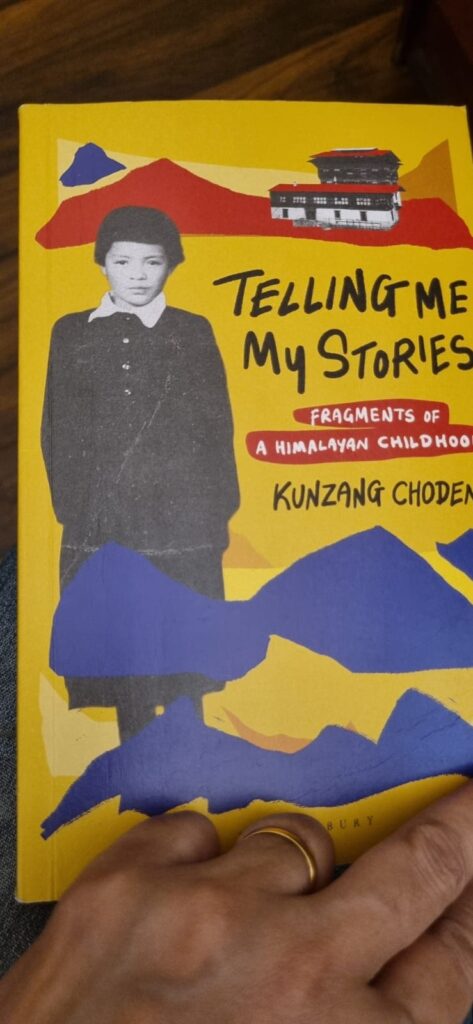
My first introduction to Kunzang Choden was when her manuscript The Circle of Karma was placed on my desk. It was one of the first novels that I edited and thoroughly enjoyed doing so as well. It was also the first book that was placed on the Penguin/Zubaan joint imprint. It was a project that we poured our heart and soul into. We even created a micro-author website for Kunzang to promote her and the book. It was delightful. It was experimental and unheard of. This was in 2004 or so, when the internet was still in its nascent stages and we were using dialup modems to connect to the world wide web. Later, when I organised the book launch at the British Council, New Delhi, it was an incredible experience. The auditorium was packed. Some of us were left standing outside in the foyer. It is then that I noticed a quiet young man standing near the front door, flanked by a bunch of smartly dressed men. It was the then prince and now King of Bhutan, Jigme Khesar Namgyel Wangchuck. He had just finished or was about to finish studying at the University of Oxford. It was extraordinary to see him at the event. But if you read Kunzang’s latest book, Telling Me My Stories ( published by Bloomsbury India), her association with the royal family is explained. Kunzang’s mother was related to the royal family.
I interviewed Kunzang Choden for TOI Bookmark. Here is the Spotify link:
Telling Me My Stories is a stunning memoir that truly exemplifies the title of the book. It is almost as if Kunzang has taken these fragments of stories that she heard, or were passed down generation to generation, and has tried to create a coherent narrative about her family. She was orphaned at a very young age — her father passed away when she was 9 and her mother a couple of years later. Over the years, Kunzang heard stories about them, or was handed pieces of their belongings by various relatives that made her want to patch together their stories. She has done a fine job in this book.
Her skill as a storyteller and as a collector of forgotten Bhutanese folktales and retelling them has become an important art form. Probably in many ways it enabled and empowered her to share the history of her family in the way she has done so. She focussed on herself and her ancestors, shared their stories pleasantly, gleaning facts from bits and pieces of oral testimonies and memories shared by those who knew her family in the past. The conversion of oral tales into the written word, providing a coherent narrative to the story is not as easy as it looks when read. It requires patience, persistence, and plenty of research to connect the dots and produce a chronological narrative. This is what Kunzang has achieved in Telling Me My Stories.
While weaving together her ancestral history particularly that of her parents, she also achieves a remarkable feat of documenting the change in Bhutan: from a closed nation, relying on a barter economy to becoming the modern country it is today. She refers to the various social reforms that the government instituted, including sponsoring Bhutanese children to be educated in India. Kunzang was one of those who benefitted from this scheme even though it entailed a 15-day trek from Bhumthang to Kalimpong. Quite an introduction to a new life when you are merely a nine-year-old girl, leaving home for the first time.
I truly enjoyed reading Telling Me My Stories.
Listen to our conversation on TOI Bookmark. It is available on Spotify. Here is a snippet:
I mention somewhere that the death of our parents came to us in such a blasé way and we never really had the time and the opportunity to absorb it, to mourn it, to understand it, and it stayed with me. You are right, it is kind of like a healing process for me to write about it, talking to myself about it, and going through the whole process. The time we learned about the deaths and how we had nobody to really help us or guide us. Even to help us to mourn, to cry, to hold us or explain things to us. We sort of just developed, my brothers and I, developed our own coping strategies and that sort of stays embedded in my psyche.
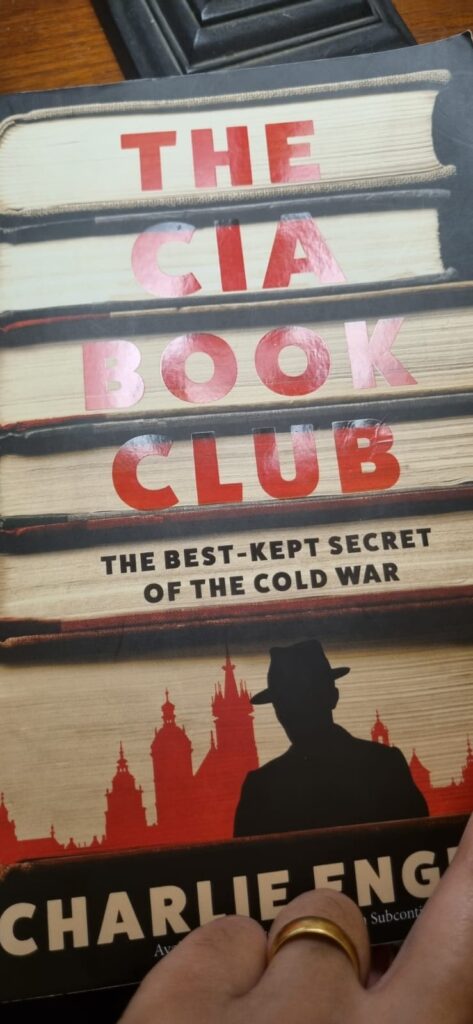
The CIA Book Club: The Best Kept Secret of the Cold War by Charlie English is an extraordinary book. It is the account of the CIA Book Club that ran for decades. It’s sole purpose was to get literature and provide support to people in Eastern Bloc.
Charlie English began writing this book in January 2020 and spent nearly five years on it. The research entailed interviewing many of the people involved in running this programme, particularly in Poland, where it was most successful. He interviewed many people and accessed whatever declassified documents that he could, although many are still inaccessible. He even managed to speak to some former CIA personnel but was only offered as much information as they could legally provide.
The CIA Book Club argues that the cultural and ideological warfare that the CIA promoted via the books programme enabled the fall of the Iron Curtain and crumbling of the former communist countries. There are incredible titbits in this book that could have only been gained by having numerous conversations and with people remembering what they did, saw, and experienced. This is not a book that is based on dry documentation and research and trawling big data. In fact, one of the interviewees remarked that Charlie English’s interviewing style reminded them of the communist-era interrogation! Anyway, it was worth it if it meant unearthing a slice of history that was largely hidden. Another fact that was amusing was because the state and its secret police were misogynistic, they could not believe that women could be recruited in political activism or participate in underground publishing and dissemination of newspapers and books. So, even when facing leading women activists of the movement, the police would ignore them and mostly arrest the men. As a result, the programme thrived since the women were free to pursue whatever they wished to.
I spoke to Charlie Englishi earlier today for TOI Bookmark. Here is the conversation on Spotify:
Award-winning writer and academic Viet Thanh Nguyen is a name that many in the literary world are familiar with. As a Vietnamese-American, he is acutely aware of his two identities and the histories he carries within himself. This is one of the recurring themes of his memoir, A Man of Two Faces. He has written plenty of books, most notably his Pulitzer Prize for Fiction 2016 The Sympathiser. It was recently turned into a TV series with Park Chan-wook and Robert Downey Jr. His books are published in India by Hachette India.
In 2023-24, Viet Thanh Nguyen delivered the prestigious Norton Lectures. In the lectures as well as in the discussions that follow, he addresses many of the aspects of being an immigrant in the USA that are at the heart of his moving memoir A Man of Two Faces.
We have recorded more than 134 episodes of TOI Bookmark. Each one is special and memorable. Every conversation is unique. It was an honour and a privilege to record this episode with Viet Thanh Nguyen. He is exceptionally busy with a demanding schedule. Yet, once we had figured out a mutually convenient time to record, across time zones, days and dates, he was immensely courteous and gave us his focussed attention. It did not seem as if he had been in back-to-back meetings/interviews during the day. It was Memorial Weekend in the USA, but he was working.
It was a fascinating conversation about reading and writing memoirs while discussing his book A Man of Two Faces. Also, how he had to think through himself, think through the history of his family that he was dealing with, and think through the language he was going to use.
Incidentally, 30 April 2025 marked fifty years since the conclusion of the Vietnam War.
Listen to the podcast on Spotify:
TOI Bookmark is a weekly podcast on literature and publishing. TOI is an acronym for the Times of India (TOI) which is the world’s largest newspaper and India’s No. 1 digital news platform with over 3 billion page views per month. The TOI website is one of the most visited news sites in the world with 200 million unique monthly visitors and about 1.6 billion monthly page views. TOI is the world’s largest English newspaper with a daily circulation of more than 4 million copies, across many editions, and is read daily by approximately 13.5 million readers. The podcasts are promoted across all TOI platforms. I have recorded more than 134+ sessions with Jnanpith, Padma Bhushan and Padma Shree awardees, International Booker Prize winners, Booker Prize winners, Women’s Prize for Fiction, Nobel Laureates, Pulitzer Prize, Stella Prize, AutHer Awards, Erasmus Prize, BAFTA, Walter Scott Prize for Historical Fiction etc. Sometimes the podcast interviews are carried across all editions of the print paper with a QR code embedded in it.
Some of the authors who have been interviewed are: Banu Mushtaq, Deepa Bhashti, Samantha Harvey, Jenny Erpenbeck, Michael Hoffman, Paul Murray, V. V. Ganeshananthan, Hisham Matar, Anita Desai, Amitava Kumar, Hari Kunzro, Venki Ramakishnan, Siddhartha Deb, Elaine Feeney, Manjula Padmanabhan, NYRB Classics editor and founder Edwin Frank, Jonathan Escoffery, Joya Chatterji, Arati Kumar-Rao, Paul Lynch, Dr Kathryn Mannix, Cat Bohannon, Sebastian Barry, Shabnam Minwalla, Paul Harding, Ayobami Adebayo, Pradeep Sebastian, G N Devy, Angela Saini, Manav Kaul, Amitav Ghosh, Damodar Mauzo, Boria Majumdar, Geetanjali Mishra, Viet Thanh Nguyen, William Dalrymple, Abdulrazak Gurnah, and Annie Ernaux.
The first of our organs to form, the last to die, the heart is both a simple pump and the symbol of all that makes us human: as long as it continues to beat, we hope.
One summer day, nine-year-old Keira suffered catastrophic injuries in a car accident. Though her brain and the rest of her body began to shut down, her heart continued to beat. In an act of extraordinary generosity, Keira’s parents and siblings agreed that she would have wanted to be an organ donor. Meanwhile nine-year-old Max had been hospitalised for nearly a year with a virus that was causing his young heart to fail. When Max’s parents received the call they had been hoping for, they knew it came at a terrible cost to another family.
This is the unforgettable story of how one family’s grief transformed into a lifesaving gift. With tremendous compassion and clarity, Dr Rachel Clarke relates the urgent journey of Keira’s heart and explores the history of the remarkable medical innovations that made it possible, stretching back over a century and involving the knowledge and dedication not just of surgeons but of countless physicians, immunologists, nurses and scientists.
The Story of a Heart is a testament to compassion for the dying, the many ways we honour our loved ones, and the tenacity of love. It has been published by Hachette India.
Dr. Rachel Clarke won the Women’s Prize for Nonfiction 2025. Her book, Story of a Heart: Two Families, One Heart, and the Medical Miracle That Saved a Child’s Life (published by Hachette India) is very well written and extremely moving in parts. She achieves a remarkable balance between telling the account of a heart transplant in two kids (for which one had to lose her life), changing the organ donation law in the UK, and sharing the history of heart transplants — it is fifty years since the South African cardiologist Christiaan Barnard conducted the world’s first human-to-human heart transplant operation.
It was a privilege speaking with Dr. Clarke on TOI Bookmark.
Here is a snippet from the conversation:
I think the heart of good medicine and an essential requirement of every good doctor, is the ability to really listen to your patents, really care about them as human beings. Not just as somebody with a failing liver, failing heart. You need to care about human beings. You need to be curious about their life; their story and you need to attend very very closely to what they say. And actually, a lot of those are traits of a good writer as well and a good journalist, particularly a nonfiction writer.
Also, read an extract from the book on Moneycontrol.
Dr. Rachel Clarke is a palliative care doctor and author of three London Sunday Times bestselling books, including Dear Life, which was shortlisted for the Costa Biography Award, longlisted for the Baillie Gifford Prize, and chosen as a BBC Radio 4 Book of the Week. Prior to medical school, she worked as a broadcast journalist. She writes for many publications, including the New York Times, London Guardian, and the London Sunday Times, and she makes regular television and radio appearances on outlets including the BBC, among others.
Chokepoint Capitalism: How big tech and big content captured creative labour markets, and how we’ll win them back by Rebecca Giblon and Cory Doctorow (Scribe Publications) is a must read. Whether you are a digital entrepreneur or a service provider or an employee, or a digital creator and a consumer, this is an essential read. It is incredible on every page, so many pennies drop in understanding the digital world we inhabit. The commercials, the hungry desire of many “digital entrepreneurs” in providing platforms for users, supposedly enabling the creative workers to use these for their individual expression, but the platform owners having the first mover advantage / exploit to use the massive volume of IPR being created in multiple ways. The authors prefer to dwell upon the hourglass-shaped markets, “with customers paying money at one end, suppliers and workers creating value at the other, and a small number of predatory rentiers controlling access in the middle. Creators earn little from the culture they produce not because of platforms per se — even if tech platforms are the major culprits right now — but because their supply chains are colonial by powerful corporations who co-opt most of its value.”
The authors discuss in detail in the first section if the book how big business captured culture, how Amazon took over books, how news got broken, why streaming doesn’t pay, why Spotify wants you to rely on playlists, why seven thousand Hollywood writers fired their agents, why Fortnite sued Apple and about YouTube chokepoints. The second section is entitled “braking anticompetitive wheels” with chapters on ideas lying around, transparency rights, collective action, time limits on copyright contracts, radical interoperability, minimum wages for creative work, collective ownership and uniting against chokepoint capitalism.
Read this book. Use it. Take it to heart. This is one of those big idea books that will appeal to many and will make many creative workers think. Remember content is the oil of the twenty-first century. Sobering thought when digital entrepreneurs realise that there is economic opportunity in every deep dive on the net; it is to the tune of a minimum $1 billion.
The most successful organizations see the entire map of functional links to understand the context within which each decision is made. They don’t look elsewhere for answers, but find their own. This is a fundamental principle of strategy. Strategic success doesn’t just benefit from being different from others. It requires it. If you aren’t different in business, you’ll die.
The Content Trap by Bharat Anand
*****
For a while now it has been said that content is the oil of twenty-first century. Many are under the ( false) assumption that being visible on various social media platforms will make their businesses/initiatives flourish. Well it is not true. Many assume ( again false) that strategising and using digital tools is easily achieved whereas it is equally if not tougher than working in the real world. The Internet gives the false impression that because it is digital, work is invisibilised and there is little tangible result. The truth is the parallel world which exists in cyberspace is a complicated and intricate web of connections. Even after making allowances for the existence of bots and other automated tools on the web the fact is a legitimate user is easily profiled and they are rapidly perceived as influencers.
Recently published books by Bharat Anand’s The Content Trap, Venkat Venkatraman’s The Digital Matrix , Lindsay Herbert’s Digital Transformation and a slightly older but seminal theory, “Online Gravity“, proposed by Paul X. McCarthy ( 2015) in his book of the same name are powerful for the way in which they understand and lay bare the “rules” governing online digital strategies.
First and foremost fact that comes through in analysis of the digital space is that it is constantly evolving. Having said that the digital medium can be a powerful tool to use, to amplify one’s work/business, if done methodically and strategically. Blasting information out into cyberspace is ineffective. The idea is to remain original and fresh in one’s approach at making information available and by extension the business one is engaged in while retaining a distinct identity and being aware of the diffrentiation factor between you and your competititors. It is imperative to have a network of connections that inevitably help in disseminating information further. At the same time be clear that you know your business thoroughly, the economics that govern it and who is your target audience/customer. It is only then that the digital space will benefit you. All the while remembering that it is still a hybrid market which means there are fixed costs that need to be taken into account; so it would be wise to know your customer. Otherwise wading into cyberspace, offloading content about your work, assuming it will transform one’s business will be nothing short of a trap.
Despite the existence of these conveniences, digital tools remain just that — tools! Unless you curate your content regularly; adopt new strategies, adapt them for your requirement and help transform your business; always remember that the real and digital worlds co-exist parallelly but also to a large degree mirror each other. The human brain discerns plenty even though we may not like to give it its due credit. So despite all its sophistication the digital world is an ecosystem where users exhibit a herd mentality by trusting influencers and amplifying the content by disseminating the information through their networks. The digital matrix mantra is : Product + service +platform + solution. The seven laws of online gravity reiterate this while stressing the significance of it being “naturally global”, applicable to “intangible goods” whilst embracing the “big winners” and analysing “data”.
The assumption that digital is disruptive happens while discussing examples such as collapse of Blockbuster by Netflix and its recommendation algorithms, the launch of Amazon’s Kindle and ebook pricing in USA, the success of musical streaming subscription service – Spotify and turnaround of the fortunes of print-media firm Schibsted,Oslo. The truth is the two parallel universes of reality and digital are not mutually exclusive instead are in a symbiotic relationship. Hence it is crucial to collaborate / develop partnerships / expand and strengthen networks digitally and in real life too as this helps in overcoming the proficiency gap that may occur in businesses which are trying to scale up or innovate.
These bunch of books are truly stupendous publications of 2017 and need to be read over and over again, shared and ideas discussed for begetting more innovations.