Ramachandra Guha Posts

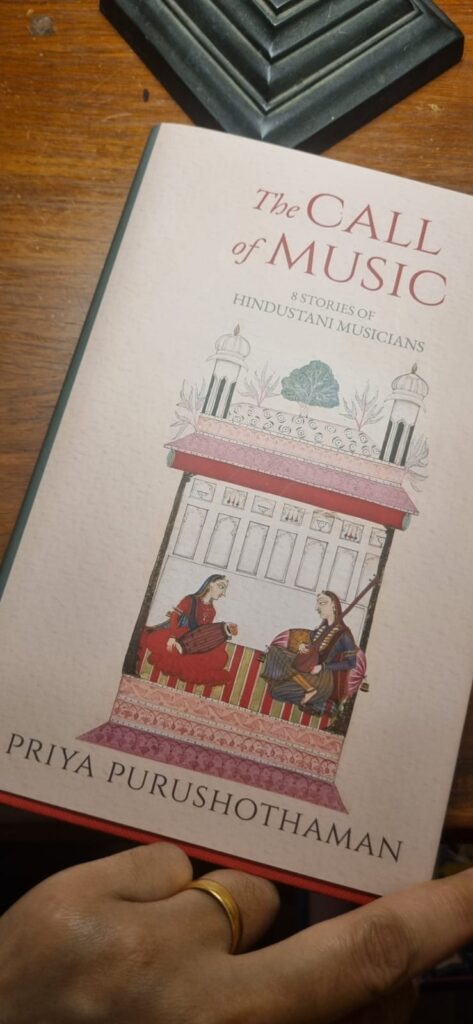
“The Call of Music: 8 Stories of Hindustani Musicians” by Priya Purushothaman

The Call of Music: 8 Stories of Hindustani Musicians ( Hachette India) is gorgeous. It is accessible to even the non-Indian classical music listener. More importantly, the sensitivity, understanding, and empathy with which Priya Purushothaman is stunning. Her elegant writing is gracious and dignified as she profiles a fellow musician. She is right when she says in her introduction that it is critical for the younger musicians to be profiled as well. Here is an extract from the introduction:

During the pandemic, when the transiency of life took on an entirely new dimension, I felt an urgent need to document the inner stories of serious practitioners of music, some of whom are not in the limelight. If you’re part of the music world, chances are that you’ve heard such stories through fellowmusicians, perpetuating the casula culture of sharing oral histories that blur the boundaries between rumour, legend, and fact. I wondered about all the stories I wouldn’t get to hear or read, out of sheer lack of access or documentation. This compelled me to seek these individuals and see if they would give me the privilege of sharing a slice of their lives, coming together as something akin to an ethnographic survey of select Hindustani musicians in the twenty-first century.

Normally, such collections would only feature senior artistes, senior by age, that is. I chose to include a spectrum of ages in this collection. Though the culture of Hindustani music glorifies age as a virtue — and certainly age often comes with wisdom and experience — I have also felt that this confines younger musicians to a permanent place of inadequacy. What a young artiste may lack in experience, they may compensate for in freshness of perspective. It is also not always the case that young artistes lack experience, because many musicians begin training at a very young age. By their thirties, they have been in the business for decades. I believe there is much value in hearing the thoughts of younger generation performers — to inspire other youngsters who may be looking up to them, and also to acknowledge that wisdom is not a function of time but of depth of experience and capacity for reflection.

The first musician featured, Alam Khan, reminds of an old soul trapped in a young man’s body. He is wise beyond his years, having immersed full time in this world since his teenage years. He carries the legacy of his father, Ustad Ali Akbar Khan, with tremendous humility, reverence, and responsibility. His deep commitment to musical honesty made me ponder the question of intention and awareness as we make music.

Shubhada Paradkar is an indomitable musical spirit whose music negotiates the lively spirit of the Agra and Gwalior gharanas, while challenging the notions of gender in music.

Kala Ramnath’s journey to becoming a world renowned violinist is filled with a lifetime of consistent effort and a quest for a unique, individual voice by innovating on an instrument that was introduced quite late into the Hindustani music firmament.

Rumi Harish turns all conventions of Hindustani msuci upside down with his radical interrogation of concepts of gender and voice through his lived truths in music and activism.

The youngest musician in this collection is Suhail Yusuf Khan, a sarangi player who has performed around the globe, collaborated across genres, and become the first hereditary musician to earn a PhD in Ethnomusicology. Suhail opened my eyes to issues of caste and discrimination as a Mirasi musician.

Shubha Joshi has dedicated her lifetime to mastering the multitude of forms that comprise Hindustani music, deconstructing notions of the feminine voice while intentionally carving her own unique sound.

Yogesh Samsi speaks a complex language of tabla that has evolved through momentous historical moments of both loss and ingenuity. As a master soloist and accompanist, he shows the path to a future of aesthetic and intellectual music.

It is my hope that those who take the time to read his book will gain an insider’s view into the creative processes of music making — the gruelling effort, dedicatio, and sacrifice that make a musician — as well as the undeniable presence of social issues in the world of classical music. Often, musicians choose their path not out of choice, but from a persistent inner call, a driving necessity for their existence. Perhaps after reading these stories, you, the reader, will appreciate the complex life of a musician the next time you hear a piece of music or attend a concert.

I began flipping through this book on a whim, but before I knew what was what, I was immersed in reading the profiles and was able to shut out the world. It is the rare author who can achieve that with their writing. Priya Purushothaman does. The ability to write about a subject that not everyone is familiar with and yet with such elegance create bridges of communication between Hindustani music and the readers is an extraordinary talent. I sincerely hope that she will write more of these long profiles. These must be taxing to write and emotionally draining but the end result is superb.

Book blurb

The Call of Music traces the journeys of eight singular voices in Hindustani music – some acclaimed performers, others quiet torchbearers who create, teach and sustain the tradition far from the public eye. From the narrow lanes of Kashipur to the sweeping hills of San Rafael, these artists emerge from vastly different worlds, yet each has devoted their life to music with unflinching conviction and artistic courage.

Among them are the heirs of musical legacies, grappling with the weight of inheritance; vocalists who challenge gendered assumptions embedded in the tradition; instrumentalists who reimagine the expressive possibilities of their craft; a sarangi player navigating the complexities of caste and faith; and a tabla maestro bridging a lineage ruptured by Partition.

As these musicians forge their identities within a classical tradition, they reveal an artform not only enduring, but continually transforming – connecting generations, reshaping boundaries and resonating anew. What binds them is a profound surrender to the art, a deep-seated devotion that transcends convention and circumstance. Together, they form a luminous, emotionally textured portrait of a musical legacy – rooted and radically alive.

‘This is a rich and beautiful meditation on the greatest of our art forms. Herself an exceptionally gifted vocalist, Priya Purushothaman writes with elegance and empathy about the life and vocation of eight musicians of different backgrounds, whom she has known or studied with. While attentive to questions of caste, gender and religion, Priya never lets her focus waver from the “practice“ of classical music, of what it means to devote oneself to learning, listening, absorbing, practising and performing. As a lover of our shastriya sangeet I found this book utterly compelling. So will readers with a more general interest in narrative non-fiction, and those seeking to make of their profession a calling.’ – Ramachandra Guha

‘Introducing readers to the lives, personalities, strengths, challenges, and music of eight artists who have inspired her over the years, Priya Purushothaman’s writing reflects in totality the rigour and introspection that has marked her journey as a singer.’ – Shubha Mudgal

‘The Call of Music is one of those rare books that forces us to see ourselves for who we are. In this collection of stories, Priya Purushothaman allows us to accompany musicians and learn from the intricate threads that stitch together their identity and life experience with making music. She brings together musicians from very different social and philosophical spaces and lets each of their stories flow into another, subtly initiating a conversation between them. This book is, in its essence, about finding and retaining one’s own voice. For us, the readers, these are moments of personal reflection.’ – T.M. Krishna

Priya Purushothaman is a reputed Hindustani vocalist. She is trained in the style of the Agra gharana, and has performed in major venues in India and abroad. She is also the author of Living Music: Conversations with Pandit Dinkar Kaikini. Priya is interested in documenting stories of musicians and their creative processes from her perspective as a practitioner. Her music can be heard at www.priyapurushothaman.com.
20 Sept 2025

Vinay Sitapati “Half-Lion: How P.V. Narasimha Rao transformed India”

Narasimhudu1Ramu Damodaran remembers the moment of change. ‘The first time I got a sense of how self-assured he was becoming was when he started referring to himself in third person. He would say, “This is a situation where the prime minister has to act.” That’s when I knew.’ ( p.198)

Vinay Sitapati’s Half-Lion: How P.V. Narasimha Rao transformed India is a biography of the former prime minister of India. In order to write it the author interviewed many people (some who wished to remain anonymous) and was given access to the private papers of Mr Rao by his family. In the acknowledgements he is grateful to the politician’s family for helping him access the papers “without expecting a hagiography”. In some senses Half-Lion is a straightforward biography documenting the birth-to-death life of a prominent politician despite its overly dramatic opening chapter entitled “Half-burnt body”. Vinay Sitapati meticulously ( at times tediously) records moments in Mr Rao’s life from a landowner-turned-politician of Andhra Pradesh to a powerful politician in Delhi including the few occasions when he was sidelined in politics. Yet it is a fact that Mr Rao was the home minister in 1984 when India ( particularly Delhi) experienced horrendous communal riots following the assassination of Prime Minister Indira Gandhi and later when he himself became prime minister, the Babri Masjid was destroyed leading to widespread communal clashes across India. It was a significant moment in the history of independent India since it marked the rise of the right wing Hindutva forces. Despite this horrendous track record that forever changed the secular fabric of the country there is an undeniable whiff of admiration in Vinay Sitapati’s account of the former prime minister’s role in ushering in liberalisation and transforming the country from a mixed economy and its socialist values of self-reliance to that of free trade. The fact is Mr Rao had no other option except to bring in economic reforms with Manmohan Singh as his finance minister. As journalist Mihir Sharma points out in his column:

…look at his great supposed achievement: the liberalisations of 1991.

The truth is this: in 1991, India had no choice but to reform. Rajiv Gandhi’s over-spending and the oil price crisis pushed India into a corner. Our autarkic industrial and economic policies were unsustainable. Any prime minister with a horizon of more than a few months in office, unlike Rao’s predecessor Chandra Shekhar, would have had to begin the process of opening up India.

What is particularly shameful, however, about calling Rao the “architect of reform” is that Rao did not just do the least he could – but he did it in a craven and dishonourable manner that has doomed the reform process in the decades since.

But did he not provide “political cover” to his team of reformers? No. The centrepoint of the first reform Budget, in 1991, was reform of fertiliser subsidies, which had grown tenfold in cost over the previous decade. The Budget speech quite bluntly reads: “with effect from this evening… there will be an increase of 40 per cent, on an average, in price” of fertiliser. It’s said Manmohan Singh even got Rao’s consent to this particularly difficult reform – the only part of the original 1991 reform process that was actually politically tough – in writing! Naturally, the moment that his Congress MPs raised their eyebrows at this, Rao abandoned his commitment, and it was rolled back. So much for the myth of “political cover”. It has little or no basis in reality.

( Mihir S. Sharma “Don’t praise Rao” Business Standard, 24 June 2016.  http://www.business-standard.com/article/opinion/don-t-praise-rao-116062400651_1.html )

The purpose of a biography is to not only record the life of its subject but place it within context. More often than not a biography serves another purpose — that of presenting a period in history as being continuous and particularly in the history of a nation to be stable. As Michael Holroyd points out the golden period of writing literary biographies in Great Britain began in the 1950s and continued till the late 1990s. ( Paris Review, Summer 2013, No. 205 http://www.theparisreview.org/interviews/6223/the-art-of-biography-no-3-michael-holroyd).  It is no coincidence that the art of writing biographies that required considerable scholarship and research began in UK soon after the end of World War II. It was a period of reconstruction and establishing the image of united Britain, one nation. Biographies of eminent people helped bolster this image considerably by seeping into the collective consciousness of people. In addition the scope of these biographies allowed exploration and understanding of contemporary historical, socio-political and economic events too. Similarly it is to be hoped that this was part of Vinay Sitapati’s intention with his Half-Lion since the life of Rao coincides with the birth of independent India, a geo-political entity and a significant player in international politics. Also for the many centuries of its existence India till 1947 had never existed like this as one nation state, a united entity, and certainly not for so long — nearly seven decades. So the significance of biographies particularly of politicians takes on a completely new dimension. In fact “in Telenagana, the TRS has adopted Rao as a local icon in a newly formed state looking for regional heroes. Starting in 2014, the Telengana state government has chosen to officially celebrate his birth anniversary in Hyderabad every year. It has announced that Rao’s life will be taught to schoolchildren, and a district and university renamed after him. In 2015, the new BJP Central government built a memorial ghat for Rao in Delhi.” (p.7)

Vinay Sitapati does what a classical biographer would do — “footstepping” in the wake of his subject to determine and recreate a life. But he lacks the craftsmanship of a true biographer in being unable to journey in to the interior life of his subject while being wholly aware of the historical and geographic. Nor is there any moment of self-awareness presumably because the biographer is too much in awe of his subject. Unfortunately despite the magnificent revelations about the internal workings of the Congress party or that of the tenuous relationship between Sonia Gandhi and Mr Rao, Half-Lion blurs the very fine line between a biography and a hagiography. This is a book that will continue to create the ripples it has caused with its publication in late June 2016 and it will be no surprise if this book is optioned for a film.

I interviewed Vinay Sitapati on 4 July 2016 via email. Here is the interview:

  1. Why Rao? Even after reading your book I am curious to know why this politician? The connect between you and him is missing in Half-Lion and a book of this magnitude requires that pivotal link to keep you going through such a humungous project. 

I am a Bandra boy, and have memories growing up through the changes of liberalisation. But I wanted this book to not be about me. The word “I” is not used in the book, and I wanted it to be an honest, objective book, undiluted by the personal impressions I had of the man. I am not a Telugu-speaker, nor did I know Rao. I am just like millions of Indians who were affected by his policies. The power of the book is in this neutrality. I only relied on evidence gleaned from documentary research and interviews, without having any personal opinions or biases. But if you ask me one emotion that kept me going, it was anger: anger that a man as consequential as Rao has been completely ignored by history.

  1. How many drafts did it take to write Half-Lion?

I completed research and writing of this book in a year. I began in April 2015. After 5 months of research, I began writing. Ramachandra Guha had told me that it takes him about 10-12 days to write a 30-page chapter, once all the research is there. It took me the same. I then circulated the draft of each chapter to about 11 people – from writers and MBA-types to hard-core academics. Their varied feedback both enriched the book and made it accessible to a wide range of readers.

  1. Before embarking on this project did you research the debates revolving around biographies? 

I read about 20 political biographies before I began. I was especially influenced by the book Deng Xiaoping and the Transformation of China by the Harvard historian Ezra Vogel. There were two big debates on biography writing that I learnt from. One: what is the balance between scholarship and accessiblity. This is an academic book, with more than 1100 footnotes. But I’ve also tried to make it fun and simple to read. The second debate was between policy and personality. How much of the book should be about political and policy changes, how much about Rao’s personal life and quirks. Again, I’ve aimed for a balance.

4.Would you want this book turned to a biopic? Or has the book already been optioned for a film? 

I have not yet got an offer, but Rao’s life is ripe for a movie. Imagine: in April 1991 he is closing his bank accounts to become a Hindu monk. Two months later, he is the leader of the world’s largest democracy. You can’t make that script up.

  1. What do you intend to do with the archive you have created while researching this book especially the innumerable interviews you did? 

I have done more than 110 interviews. But more than that, it is Rao’s personal archives which are a national treasure. I’m working with his family to put everything online. That way, can access every single thing Rao wrote – public and private – from anywhere in the world. I feel I owe it to my country.

Vinay Sitapati Half-Lion: How P.V. Narasimha Rao transformed India Viking, Penguin Random House, 2016. Hb. pp.390 Rs 699 

17 July 2016


Sunil Khilnani’s “Incarnations”


Even the terms used to describe the famous Indian uprising against the British in 1857 are political positions. Was it a mutiny, or India’s First War of Independence? Rebellion or uprising? A nationalist movement or a string of local protests?

p.243, “Lakshmi Bai, Rani of Jhansi: Bad-ass Queen (1828-1858)”

‘A society, almost necessarily, begins every success story with the chapter that most advantages itself,’ the American public intellectual Ta-Nehisi Coates recently argued regarding mythic constructions of liberation all over the world. ‘[C]hapters are almost always rendered as the singular action of exceptional individuals.’ In modern India’s myth of finally, formally confronting its brutal history of case, Bhimrao Ambedkar is that exceptional individual. But every Great Man story is also a story of circumstance. Had India not been devastated by Partition, the formidable lawyer and scholar who led the untouchables might not have become the founding father most meaningful to ordinary Indians today.

p.468 “Ambedkar: Building Palaces on Dung Heaps (1891-1956)”

Sikri’s battlements, palaces, shrines proclaim imperial grandeur. But its airy pavilions and halls share little in common with the heavy monumentalism of Versaille or the Habsburg seats of power. Parts of the city have the feeling of a tent encampment, except that the animal skins and wood frames have been replaced by stone and marble, carved with great skill by local craftsmen. Walking through this now desolate cityscape in the dry heat, you might feel, at certain turns, as if you were in one of M.C. Escher’s drawing, reworked with the stark surrealism of Giorgio de Chirico. It’s like touring the physical manifestation of a mind — the expansive, syncretic mind of its creator: Akbar, the greatest of the Mughal emperors. 

p. 165 “Akbar: The World and the Bridge ( 1542-1605)

Sunil Khilnani’s magnificent Incarnations: India in 50 Lives gives a bird’s-eye view of history via the short account of people through their ages. The fifty people profiled are those who left a significant stamp in the socio-cultural-political and economic make-up of this land evident in modern India –a nation state that is very complicated, multi-layered. These biographical accounts written like “non-fiction short stories” detail the life and achievements of the person being profiled while placing them neatly in their historical and contemporary context. Incarnations has been published to coincide with the BBC Radio 4 series http://www.bbc.co.uk/programmes/b05rptbv. The principle of arrangement of this book is probably borrowed from another extremely popular BBC Radio 4 series + sumptiously produced book by Neil MacGregor, then director of the British Museum, on A History of the World in 100 Objects  ( http://www.bbc.co.uk/programmes/b00nrtd2/episodes/downloads ).

Yet Incarnations is very much in the tradition of books written trying to make history accessible to the lay reader. To document history in this fashion probably began with Jawaharlal Nehru’s Glimpses of World History to many accounts at chronicling this fascinating sub-continent by authors like Amartya Sen, Jean Dreze, Shashi Tharoor, Ramachandra Guha, Patrick French, Bipin Chandra, Romila Thapar, Percival Spear, Narayani Gupta, Subhadra Sen Gupta ( for children) et al. There were many volumes that were published to coincide with the fiftieth year of Independence but it is for the first time that a historian like Sunil Khilnani has put together an account that incorporates even lesser known individuals such as Malik Ambar the African slave who become powerful political force to contend with.

We live in a noisy, reactionary and surprisingly ahistorical world where lies and misinterpretations get amplified rapidly using social media platforms. So to have a book recount landmark moments in history through well-written biographies is a crucial and much appreciated contribution to social discourse. The style of writing is wonderfully catchy beginning with the chapter headings. For instance, Rani Lakshmi Bai, the queen who is almost revered for her resistance to the British colonial rulers in the nineteenth century with Indian school children even today being taught to memorise poems extolling her heroism; she is simply referred to as the “Bad-Ass Queen”. The list of contents is a delight to read. Similarly are the introductory paragraphs to every chapter –packed with facts, information and incorporating the broad spectrum of views on how the moment in history being discussed in the chapter has been perceived. It is a remarkable example of immense scholarship with a fine sensibility of being able to communicate with a non-academic audience. Peppered in the book are cross-references to other chapters illustrated by the names being marked in bold, a neat technique taken from academic publications and inserted into a trade title.

Outlook magazine’s 19 February 2016 issue focussed on Sunil Khilnani’s book with generous extracts from the book along with an in-depth interview by Satish Padmanabhan. Here is a link to the special issue and interview: http://www.outlookindia.com/magazine/issue/11449 and http://www.outlookindia.com/magazine/story/self-criticism-and-not-glib-self-congratulation-is-the-deepest-form-of-patriotis/296684 .

For all the stupendous historical detailing in each biography there are some disturbingly jallianwala-baghpuzzling glossing over historical facts. For instance not referring to General Dyer by name instead saying “the officer” ( p.437) or referring to the campaign of installing Gandhi’s statue in London ( 2015) led by Lord Meghnad Desai and his wife, Lady Kishwar Desai but once again not pinning it in history by taking any names. Baffling since General Dyer is well-remembered in India and the 14 March 2015topiary at Jallianwala Bagh nevers allows anyone to forget the dastardly massacre. Similarly, the campaign to instal Gandhi’s statue was a very political and public event splashed across worldwide media with David Cameron PM, UK and Arun Jaitley, Union Finance Minister, India, Gopal Krishna Gandhi, Amitabh Bachchan,  Lord Meghnad Desai and Lady Kishwar Desai attending the unveiling of the statue. So it does leaves a tiny lingering of doubt about the other bits of history that may have been silenced. Even so, this is is a splendid book and must be read.

Sunil Khilnani Incarnations: India in 50 Lives Allen Lane, an imprint of Penguin Books, Penguin Random House, UK, 2016. Hb. pp. 636 Rs. 999

9 March 2016


Web Analytics Made Easy -
StatCounter