picture book Posts

Interview with Likla Lall
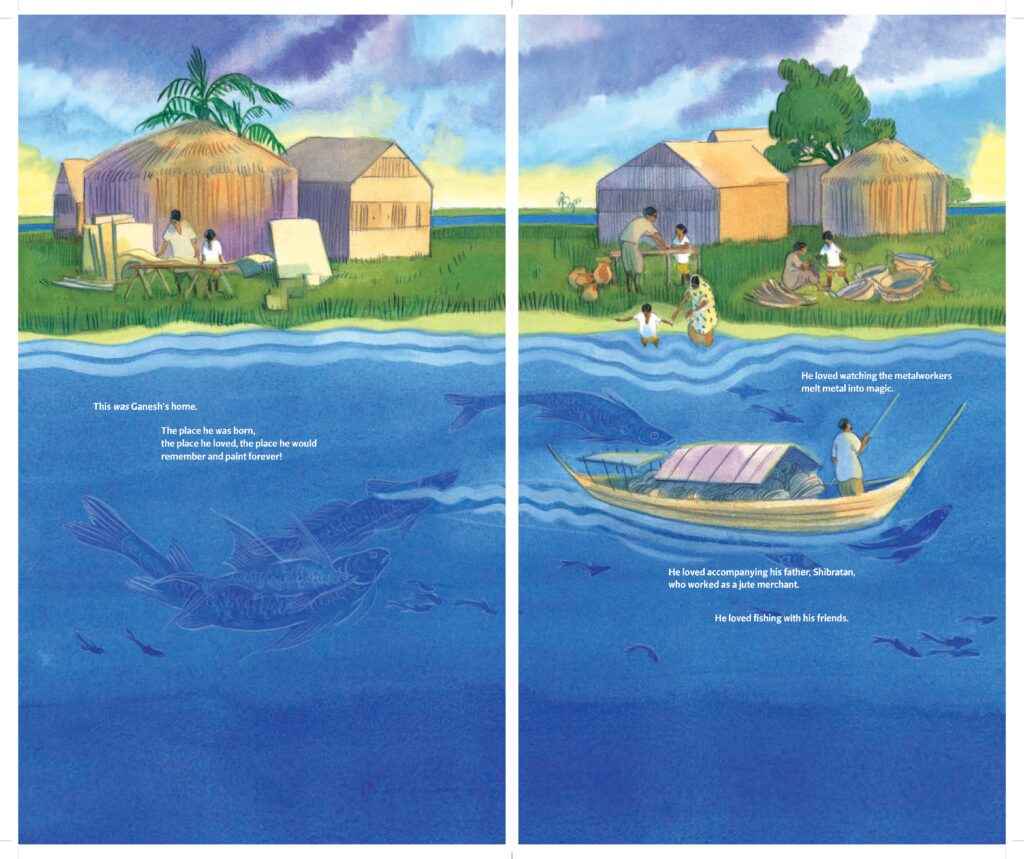
The following interview with Likla Lall was conducted for Moneycontrol (15 April 2026).

Likla Lall (Author) & Eva Sánchez Gómez (Illustrator) Ganesh Haloi: Colours of Home ART1ST, Pb. 2025

Ganesh Haloi: Colours of Home (2025), is a fascinating picture biography of the artist Ganesh Haloi. It narrates his life history simply and it is multi-layered that readers of all ages can appreciate it. The text is soaked in the art work in a manner that is readable, relevant, and resonates with the art on display. So, the connections offered are once again at multiple levels. Depending on which of the senses of the reader is tickled, it is an introduction to the heart and soul of what defines Ganesh Haloi’s work. Then from there, the reader may move on to different aspects of the story and the beauteous book production supports it impressively. The art work is inspired by Ganesh Haloi’s style including a wonderful three pages that briefly seem to emulate the tunnel books of the nineteenth century. In this book, they replicate the frescoes of the Ajanta Ellora caves that have deeply influenced Haloi. This is a book that weaves within it historical facts, such as that of the Partition of the Indian subcontinent; it is always anchored in time with dates in the artist’s life mentioned and innumerable concepts significantly that of the idea of home — the refugee camp called Cooper Camp, railway platform at Howrah station or Government College of Art and Craft, Calcutta or the caves of Ajanta and Ellora that ultimately shaped Haloi’s art. Ganesh Haloi contains a workbook section wherein the younger readers, can familiarise themselves with the various forms of art, taking inspiration from “ordinary” objects around them and learning to observe before reimagining it with their creative impulse. The end papers of the book provide a mini catalogue of the prominent paintings by Ganesh Haloi, providing thumbnail reproductions and the provenance; thereby gracefully educating readers on how to appreciate and recognise art. It is a legacy worth cherishing.

Published by Art1st and Kiran Nadar Museum of Art, supported by aKaR pRaKaR (Research Partner) and Institut Ramon Llull (with an illustration grant), written by Likla Lall, illustrated by Eva Sánchez Gómez and designed by Rohina Thapar. Art1st Books, reaches beyond art history to the cultural history of India, helping children in various cultural contexts make a personal connection to this heritage. The book is a part Art1sts’t Art Exploration Series. The series delves into the lives, particularly the childhood, of eminent artists. It explores the artists’ work and philosophy, approach and methodology, success and failure, in a story format, to engage and inspire children to in turn create their own art.

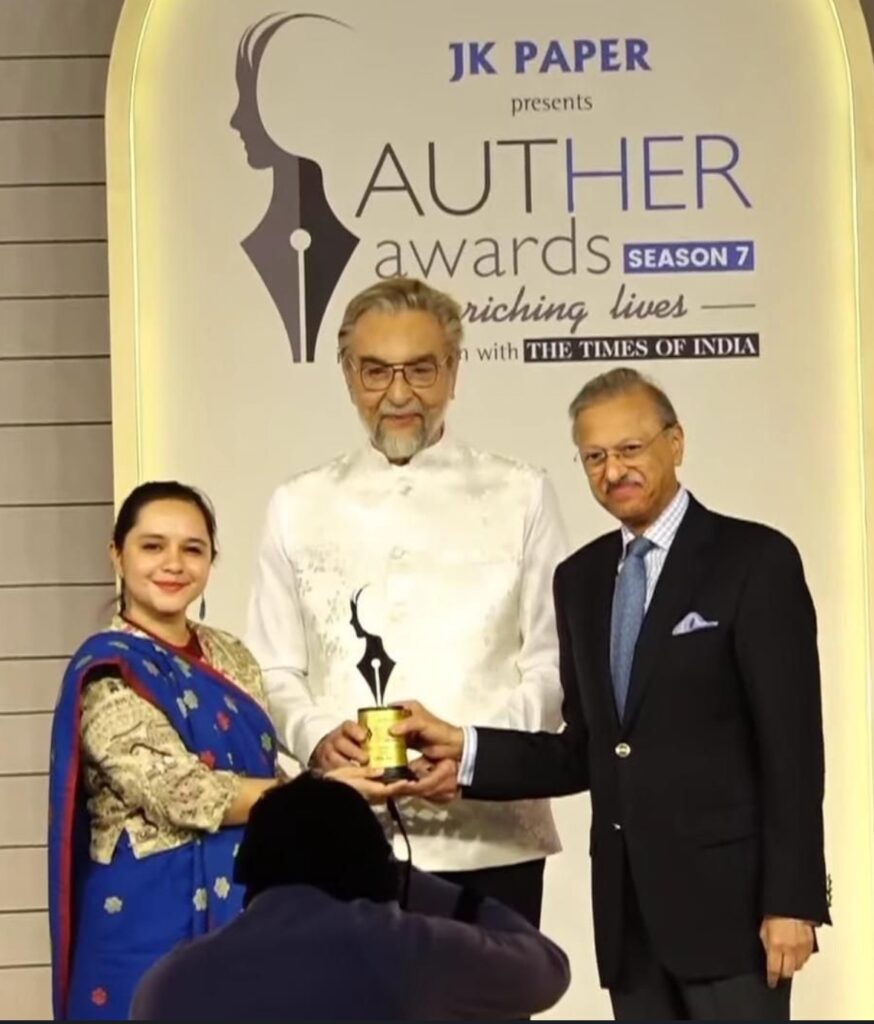
With Art1st, Likla Lall has been writing children’s books about art, including award-winning Art is a Verb and Somnath Hore: Wounds. She writes about the Self (with Little Light), on adventures (with PanicNot!) and comics on nature and mythology (with her sister and illustrator Keya Lall). She won the Best Children’s Literature AutHER Award 2026 for Ganesh Haloi. It was also selected for the BRAW Amazing Bookshelf – part of the Bologna Ragazzi Award 2026.

Eva Sánchez Gómez graduated with her Fine Arts degree from University of Barcelona. Now she lives and draws in La Garriga. She has illustrated more than thirty novels and picture books for publishers from different countries.

Rohina Thapar is a multi-disciplinary designer working at the intersection of communication, product, & brand. Rohina and Likla work together on Khel Theory, a collective that creates interactive educational material. 

The following interview with Likla Lall was conducted via email.

  1. How did this book come about?

Ganesh Haloi: Colours of Home is a part of Art1st’s Artist Exploration series that takes on the format of a picture book biography, along with an exploration of the artist’s work. The series aims to make artists approachable to young readers and inspire them to create their own art. The series began with Raza’s Bindu, but has since covered important Indian artists like Abanindranath Tagore, Somnath Hore, Ganesh Pyne, Jamini Roy, most recently Ganesh Haloi and many others. Our collaboration with the Kiran Nadar Museum Art and Akar Prakar has guided our choice of artists for this series. Reena and Abhijith Lath of Akar Prakar, especially, have a close and long relationship with Ganesh Haloi, and have been instrumental in guiding the research for this book. 

  • Whose story is this? If it is an amalgamation, then how much research did it involve? What were the primary sources used? Sometimes it almost feels as if you are referring to diaries/letters of the artist. Has Ganesh Haloi seen your book? What has he said about it?

The research for this book began with reading as much as possible about the Ganesh Haloi. We were grateful to access Naishabder Chitrakar, a biography of the artist, edited by Prakash Das. It includes essays on various aspects of his life, from his childhood to his entry into the world of art, his philosophy and pedagogy on art, and some of his poems, which gave me such clear insight into the way his mind works. I was also fortunate to meet and interview him several times, a delightful experience. He was in equal parts cheerful, poetic and kind as he led me through his home and his works. He patiently received various drafts of the story and was always encouraging.  The very last page of the story is a direct quote from him. One of the first few copies of the books was received by him and his family in Calcutta. In fact, I called him the day after winning at the AutHer Awards 2026 to share the news, and he was ever-joyful, inviting me once again to visit them in Kolkata. 

  • Brevity of text is the hallmark of this story. There is so much history to unpack in every sentence. How did you balance the words, facts, concept, and readability for all ages?

It is a task to condense an entire life story into a short story for children. For me, the next step is to arrive at a concept that brings it all together. As I read through the various and distinct parts of Ganesh Haloi’s journey, as well as immersed myself in his vibrant artwork, I began to imagine capturing this in a museum or gallery, much as his art is often displayed. What stuck were these four distinct places that defined him — four places with distinct memories, colours, ecologies and experiences. The illustrations invite the reader to dive into each place and see it through his eyes. The text pulls you through the narrative, guiding you through time and towards the next stop on the journey. And balancing in the space where word and picture meet are the emotions of this journey, of a child turning into a young man. And once you’ve read through the story, you’re invited to see the works for yourself and make your connections to it. These pages are crafted to include history, introspection, curiosity and expression. The instructions are easy to follow, but not dull, leaving room for artistic interpretation; after all, our readers are artists, no matter what age. 

  • It is more than complemented by the layers of artwork. Was this conceptualised digitally? Please share the ideation process and the various iterations. 

The Art1st process of book creation is extremely collaborative. The writer (Likla), illustrator (Eva) and designer (Rohina) have worked together previously on Abanindranath’s House of Stories, and have a beautiful working rhythm between them, executed across geographies. The research isn’t simply for the text and story, but to build visual references for this particular time period in Bengal. ‘What did people wear? Were there photographs and illustrations of Calcutta? Which fish call the Brahmaputra their home?’ Eva is a brilliant illustrator based in Spain, with a keen sense of visual narrative. Her wonderful imagination is perfectly paired with her skills with coloured pencils. She brought each of the four places in the book to life with her vibrant colours. She imagined the fabrication of the book: the many layers of the Ajanta Caves, or the never-ending spreads of the dismal Cooper’s Camp. We’re grateful for the support of Institut Ramon Llull in making this inter-national collaboration possible. 

  • Did the design evolve to fit the content? How do you ensure that your instructions are followed 100% while it is in production? The pages are shaped differently. There are cutouts arranged in the manner of tunnel books.  

The next part of the book-making is the design. Each of us brings a different perspective as we ‘read’ the works of Ganesh Haloi. Bangalore-based Rohina has designed several Art1st books, amongst other creative design projects. Her task was to integrate these various threads (the text, illustration, artworks and activities) and weave them into a coherent and self-encompassing world. She has a fine mastery over the shapes of paper as they fold, open, and even pop right out of the book. There is a long process of testing of pages, redesigning, colour correcting, and sample prints before the book is ready to go. Our print partners are Maharashtra-based Prudent Art & Fab. They painstakingly assemble each complex section of the book to create a piece of magic you can hold in your hands. 

  • Was the text tested thoroughly before being edited and then discussing design layouts? What did it involve? 

The text went through various iterations under the watchful eye of our editor, Ayushi Saxena. The biggest challenge was to wrangle and bring down the word count: there’s always so much more to say! As the illustration and design came together, we could see the shape we were making. It became easier to trust the collaboration of text and picture and kill some of our darlings. 

  • Art1st specialises in making biographies of prominent Indian artists in a pictorial format with worksheets provided to help learn the basic brushstrokes/ideology of the artist featured. It is the same for Ganesh Haloi too. What were the key details that you wished to incorporate and did and/or were challenged to do so?

This series follows an effective pedagogical design. The first part is the story, where one reads about the life of the artist. In the second part, one is presented with the artist’s works and provocations to look deeper. And finally, one is encouraged to create, through activities inspired by the artist’s process. Ganesh Haloi, as an artist, has a wonderful ability to capture the unseen. His works present abstract-looking landscapes that seem incredibly familiar in their essence. He has developed a language of his own that captures the rhythms of the unseen, the movement of the wind, the whispers of the rivers and the sensation of colour. These are some of the ideas that rest within the pages of this book, through questions and activities. 

  • Good children’s literature works at multiple levels and is timeless. It cuts across generations and ages. Thankfully, your text does not specify the age group it is meant for. Nevertheless, when working on the draft, how do you determine the target audience? What is it that you seek?

While the series is meant for children aged 8-12, our decade-long experience has repeatedly shown us that art really does transcend age. I have found adults absolutely enchanted by my first book Art is a Verb and its curious paper play. Similarly, adults are quick to admit in a safe space created for children that they haven’t heard of a particular artist or an art form, and the books playfully encourage them to read. Conversely, there is a notion that art belongs to adults, and yet, children of all ages are enchanted by art and quick to share their observations. There is a pedagogical base that guides the creation of the book (the structure, language, font size and so on), but it isn’t prescriptive, rather immersive. There is a freedom to allow the book to turn into the creature it is meant to be. 

  • How do you incorporate big ideas of free will, independent thinking, being a dreamer while focusing on turning thought into action, being imaginative, freedom of expression, idea of home, etc?

In retrospect, it is possible to decipher themes and learnings in the book, but to me, the process of creation was simpler. I was guided by the life story of an amazing artist. I tried to represent in the truest way possible way the circumstances of Haloi’s life: his birth in Jamalpur, the partition of the Indian subcontinent at the time of Independence in 1947 and the seeking of a new home in Calcutta (as it was known then), his life experience as a teacher and so on, knowing that it will resonate with the reader. Art-making, too, can be contemplated on and understood in so many ways. The absolute imagination of an artist brave enough to confront a blank canvas. The almost-alchemical understanding of materials as they turn pigments and paper into entirely new worlds. Their preoccupations as they consider the same subjects from different angles, repeating symbols, colours and ideas in an attempt to express the world. Once more, as a writer of art, I am guided by the art and by the artist, and I choose to follow and retrace their colourful paths. 

  1. How do you devise the worksheets? What is the intent? Can these be replicated in a classroom or are dependent on the individual text? What results have such experiments shown in the past?

Art1st has a pedagogical division that works with schools and educational organisations. It was from this work that Ritu Khoda (founder of Art1st) saw the gap in and need for books about Indian art for Indian children. We try to create the activity pages in a direct and DIY manner, well aware that not all readers have the same access to art environments or educators. For educators, we often offer a workshop or guide on how to use the books in their classrooms, if required. It is a practice for the book creators to conduct workshops at festivals, schools, libraries and foundations. A huge reason is the advocacy for art education, which is often treated as a secondary subject in STEM-first systems. I am often surprised by the responses. For example, our book Somnath Hore: Wounds came out as the COVID-19 lockdown was lifted. Our engagements around the idea of wounds, catharsis and healing created a safe space for people to share their own wounds and find connection. Colours of Home has been a lovely opportunity to step into ‘abstract’ art, often confusing them, but also giving them the freedom to explore beyond their assumed boundaries of art. 
22 April 2026

“The Big Thoughts of Little Luv” by Karan Johar

Bollywood filmmaker Karan Johar has written his first picture book for children — The Big Thoughts of Little Luv ( Juggernaut Books). It stems from his experience of being a single parent to his twins, Yash and Roohi. In his preface to the story, Karan Johar states that his family debunks the notion of a traditional family as he is a single parent to his children, born through surrogacy. His mother also helps look after the twins. It is a sweet little story that attempts to challenge the very gendered notions of bringing up kids and permitting them their freedom to explore and develop as individuals in their own right.

But I have a couple of quibbles with this book. Children are very sharp and perceptive readers. They are also very literal minded. So when Karan Johar declares that he is a “proud mom”, the illustrations of the woman in the story fulfilling the role of a mother are pretty confusing. Secondly, he insists on referring to his set of “mixed twins” which is wrong. A boy and girl pair of twins is always referred to as fraternal twins. Mixed twins are non-identical twins born to multi-racial families and differ in skin colour and other traits considered to be racial features. This muddle is carried forth in the story where in the opening line Luv says “I am confused. Everyone says my twin, Kusha, and I are just the same.” Again, this is wrong. Fraternal twins are never identical. Boy and girl twins are always fraternal. Same sex twins maybe fraternal as well. Being a fraternal twin myself, these silly lapses in storytelling are plain annoying as it is perpetuating the myth of twins being freak shows and having this uncanny ability of being same-same.

Having said that I am pleased that Karan Johar has made his foray into storytelling for children. Ever since I first read his memoir-essay about learning how to tackle his stammer with his drama teacher, I have always wondered why he never wrote more often. I wish he did. Hope he writes regularly in the future, perhaps for a slightly older readership. He will be excellent at it.

11 Jan 2021

Interview with Neha J. Hiranandani on “Girl Power!”

Ever since the phenomenal success of Rebel Girls some years ago there has been a proliferation of books tom-tomming about the achievement of girls/ women, many of whom whose contribution to their respective sectors has been silenced for an extremely long time —an unforgivable act. Yet with the popularisation of movements like #MeToo and the visibility of such girl-centric literature in popular culture has made a remarkable case for many more such books to appear. The danger lies falling into the trap of emulating a successful formula and creating a damp squib or creating a triumphant collection such former journalist Neha J. Hiranandani’s feisty Girl Power!

It is a challenging task to visually and succinctly represent a core idea, more so an idea that seemingly goes against the “norm”. And this is why Girl Power! is so magnificent. It stands out from much else that in this space for it puts together beautifully a profile that has charmed the author. It is as if the woman whom Neha Hiranandani is writing about has really moved her in some way. Otherwise the absence of living legends such as activists Aruna Roy & Medha Patkar, writer Arundhati Roy, historian Romila Thapar, wrestler Vinesh Phogat etc remains inexplicable. For there seems to be no other explanation, save Neha’s subjectivity, for this very disparate collection of women profiled in Girl Power!

Neha Hiranandani’s fascination for her project manifests itself in the funky descriptor she offers after every name. It is super cool, so in keeping with the loud, assertive and sparkly book cover as if to say, “We women are proud of our achievement and are here to stay!” It effectively communicates her passion with younger readers.

****

Neha J Hiranandani is a writer whose columns have appeared in The Indian Express, Huffington Post, NDTV, and Vogue among others. She holds degrees in Literature and Education from Wellesley College and Harvard University.

Here are lightly edited excerpts of an interview conducted via email:

1.How did the idea of doing Girl Power! come to you?

My 7-year-old daughter, Zoya absolutely loved Rebel Girls. As a mother, I was so happy to see her being inspired by incredible women from around the world. But then one day she came to me clutching her beloved copy of Rebel Girls and asked sadly “Does India only have two rebels?” pointing to Mary Kom and Rani Laxmibai. Of course I immediately wanted to tell her all about the phenomenal women that India has had – our rule breakers, our mavericks, our smashers of ceilings. We spent the next few months discovering these women together. It was magnificent! I quickly realized that these were stories that all our girls – and even our boys – should hear.

2. There is a deluge of women-centric profiles in the market. Why is Girl Power! special?

I was very lucky to work with an incredible artist – Niloufer Wadia – whose illustrations have brought these stories to life. Unlike other books which follow a standard ‘one-page text + one-page illustration’ format, Niloufer and I wanted the text and the illustrations to work together. And so, every page of Girl Power! has the story and the artwork talking to one another which makes for an incredible reading experience.  That, and I think the selection of women is very special!

3. How did you identify the women profiled in the book? Whom did you have to drop from your original list and why?

This was easily my favourite part of the project! I was clear that this wasn’t going to be just a list of accomplished Indian women – the women in this book had to be mavericks, ceiling smashers! And so I set about finding the stories and really, what stories they are! Every story made me feel me proud to be Indian all over again. You will meet a spy princess who parachuted into France, a warrior queen who defended India from the Portugese six times! There’s Subhasini Mistry who worked as a maid before winning a Padma Bhushan for healthcare, and Chandro Tomar, the octogenarian sharpshooter, popularly known as Revolver Dadi. Of course, there are some household names as well including PV Sindhu and Priyanka Chopra.  But personally, I am very proud of the untold stories. They were so exciting to discover!

I have tried to be as inclusive as possible. Girl Power! includes stories from across the country, across industries and across time periods. I also tried to pick stories that had an identifiable ‘Kodak moment’ that could be written coherently in 300 words or less. This is easier said than done, especially given that all of these women have led very layered and nuanced lives!

With that said, I am the first to admit that this is not an exhaustive list – that would run into volumes and is well beyond the scope of this project.

4. The descriptor used as a subtitle in every chapter encapsulates the spirit of the woman profiled vividly. For example, “Raga Rockstar” for M S Subbulakshmi, “Accidental Entrepreneur” for Kiran Mazumdar-Shaw, “Rule Breaker” for Dakshayani Velayudhan, “Inspirational Archer” for Deepika Kumari, or “Daredevil Doctor” for Anandibai Joshee. How did you come up with these fascinating descriptions?

These women have led such interesting lives, it would be a failing on my part to not give them interesting descriptors!

5. Girl Power! comes across as a broad sweep of profiling women across socio-economic classes giving the impression as if popular stories were incorporated. What kind of research methodology did you employ particularly what were the oral histories that you accessed?

This book will always be special to me for so many reasons. And perhaps, the most important one is that it connected me to many incredible people – men and women – who I’m grateful to have met. Apart from the internet research and the scouting in libraries, I knew that many of the stories were going to come from conversations. And so they did! Over cups of tea in the most unlikely of places – from railway stations to parks – I have spoken to people about the women who have moved them, inspired them. Some of the stories didn’t work out because I couldn’t confirm their factual accuracy but others did. For many parts of the book, I wanted to move beyond the well-known women and tell stories of ordinary women who have done extraordinary things. It was in that quest – of finding the ordinary-extraordinary woman – that our unmatched recounting of oral histories became important. Sometimes, it’s just about having the conversation!

6. Every chapter consists of a sprinkling of quotes by the women profiled. Such as ‘As long as I moved around with Mankeshaw [her husband], people did not take me seriously,” said Homai Vyarawalla, the photographer or “No field of work belongs to any gender”, says Harshini, the firefighter or actress Priyanka Chopra attributes her success to following the three Fs – “by being fierce, by being fearless and by being flawed”. Where are these quotes from as there are no bibliographical details provided?

Along with the team at Scholastic India, I was meticulous in making sure that every fact was double-checked. Many times this meant watching several documentaries for a 5 word-quote or finding obscure books and articles in dusty libraries. While there is no bibliography in the book, we have maintained an exhaustive back-of-house bibliography! So for instance, the quote by Homai Vyarwalla is from an article in the Hindu, the one from Harshini Kanhekar is from an interview with Jovita Aranha, and the one by Priyanka Chopra is from a lecture she gave on ‘Breaking the Glass Ceiling: Chasing a Dream’ at a Penguin event back in 2017.

7. Some profiles make passing references such as to Amrita Shergill’s “South Indian trilogy” or Dipa Karmakar’s “new book” or to a “rifle club” in Chandro Tomar’s neighbourhood which her granddaughter was attending – all very intriguing and remains unexplained? Was it a deliberate intent on your part to leave these as is to encourage inquisitive readers to delve into some research of their own?

Absolutely! This book gives a quick insight into the lives of these incredible women. It provides the ‘hook’ of an interesting time in that woman’s life to lure the reader in. The ultimate idea is that a child finds that ‘Kodak moment’ interesting and says “Hey, that’s cool I didn’t know that but now I want to find out more.”

8. How important is the picture book format to communicate with young readers particularly when it is a critical idea such as challenging rules, mostly patriarchal, to pursue your dreams?

I think it’s critical! Visuals go a long way in keeping a young reader interested and this is especially so in a format like Girl Power!’s where the text and illustration talk to each other on every page.

9. With this book are you addressing both boys and girls? What impact do you hope to create?

One might assume that this book is only addressed to young girls. That would be a terrible mistake. In fact, if anything, I think this book is critical for our young boys. For far too long, our boys have seen us in certain roles – as a mother, as a wife etc. It’s time for them to see Indian women succeeding in places that were traditionally demarcated as ‘men only zones’ – as wrestlers, as scientists, as entrepreneurs! If nothing else, it will help them understand what’s coming down the pike in the future!

10. Were these stories tested on younger readers before publication? If so what was their reaction? Did you incorporate any of their suggestions in the manuscript?

My daughter and her friends were invaluable as I wrote Girl Power! Those kids were my first editors! During play dates, I would read out entire stories and meticulously comb through their suggestions. Many profiles – such as Rani Abbakka – were rewritten on the basis of these editorial inputs! Several times, the kids wanted more details on an event or character that they found interesting. So for instance, in the Rani Abbakka profile, they wanted to know exactly how she defeated the Portuguese armada. That’s when I knew I had to include the part about how Abbakka secretly gathered her best soldiers in the middle of the night. The kids were fascinated when I told them that Abbakka instructed her soldiers to attack with hundreds of coconut torches and agnivaan– flaming arrows dipped in oil – all at the same time. The arrows lit up the night sky setting the Portuguese ships ablaze. These inputs brought so much colour and detail to the profiles and I’m so grateful to the kids! I think it was those inputs that have sharpened the profiles and created the final product.

11. Did you work closely with the illustrator? Did you help the illustrator select an image upon which to build the illustration?

Niloufer Wadia is a wonderful, prolific illustrator who can handle many different artistic styles with ease. I did make suggestions for some profiles; for example, Bula Chowdhury is an ace swimmer who once said “I should have been born a fish.” And so for Bula, I asked Niloufer if we could create something dream-like with Bula in the waves, half-woman and half-fish, almost a mermaid. That is easily one of my favourite illustrations in the book. For other profiles, Niloufer created something breathtaking on her own; Priyanka Chopra’s illustration is half from an iconic Hindi movie in traditional Indian attire and half FBI agent, a character from her show Quantico. That was all Niloufer!

12. Would you describe yourself as a feminist or as someone who feels strongly about women’s issues?

To my mind, there is no other way to be!

To buy on Amazon India: https://amzn.to/2MI0zN9

14 October 2019

Book Post 36: 21 April – 19 May 2019 / Childlit and Yalit list

Book Post 36 focuses on childlit and yalit.

20 May 2019

“Get Off That Camel!” and “Cat’s Egg”

Get Off That Camel! and Cat’s Egg are two picture books published by Karadi Tales.

Get Off That Camel is a delightful tale about little Meena who is obsessed by her pet camel and refuses to get off it’s back. She attends school sitting atop her camel, she visits the library where fortunately the height at which she is perched enables her to search for books placed in the topmost bookshelves, she goes jogging in the park with her father but all the time astride her pet, accompanies her mother to the supermarket with her camel creating havoc among the aisles and so on. Her love for camels began as an infant when she was given a stuffed camel toy to cuddle with in bed. Her parents did it innocently enough little realising the unfortunate sequence of events it would unleash. It was only when the doctor examined the camel declaring “This poor animal is exhausted”, did Meena agree to climb down and let the camel live in a stable. After all Meena was a kind girl. Get Off The Camel! is an adorable picture book with beautifully designed clear illustrations. Apart from the sweet story it works marvellously well in teaching little readers about empathy and to be a little less self-centred. The only reservation about the storytelling are the roles of the parents with the mother being responsible for the grocery shopping while the father is focused on jogging and teaching his daughter about leading a healthy life. While it may be quite a simple representation of what is often seen in reality, it is still a little disconcerting as it seems to enforce well-known narratives rather than offering little readers alternative role models.

Cat’s Egg is a modern day Easter tale about a cat who is convinced she has laid an egg which will soon hatch. Cat is adamant the egg she found in her bed. So she sits atop it in the hope it will soon hatch her kittens. Despite the Dog, Crow, Magpie, and Turtle telling her otherwise, Cat refuses to listen. It is only when it is pointed out to her gently by the Turtle that the egg is turning damp, does the Cat realise there is something truly amiss with the soggy egg. It is then that Dog and Cat figure out the truth. The Cat has mistaken a chocolate Easter egg for an egg. A truly mixed-up cat if there was one! Warm and sweetly told tale introducing multiple concepts of birth, nurturing, friendships and the Christian tradition of celebrating Easter. Of course the tale is focused on the commercial aspect of how Easter is celebrated with plenty of confectionary particularly Easter eggs rather than the concept of Christians celebrating the festival in commemoration of the resurrection of Christ, a new beginning, a new life — a fact that the egg symbolises. A slightly mixed-up tale like the Cat but it does not take away from the pure joy of storytelling.

Get Off The Camel! and Cat’s Egg are marvellous picture books. Wonderful additions to any book collection.

A. H. Benjamin Get Off That Camel! Illustrated by Krishna Bala Shenoi. Karadi Tale, Chennai, 2019. Hb. pp. 32. Rs. 399

Aparna Karthikeyan Cat’s Egg Illustrated by Christine Kastl. Karadi Tale, Chennai, 2019. Hb. pp. 32. Rs. 399

22 March 2019

“Poppy Field” by Michael Morpurgo, illustrated by Michael Foreman

Michael Morpurgo needs no introduction as a writer and nor does the illustrator, Michael Foreman. It is a formidable creative team that has together produced some magnificent books for children in the past. Morpurgo’s stories inevitably deal with stories set in conflict zones whether set way back in the past or in the more contemporary conflicts. This time too Poppy Field focuses on World War One. It is a significant publication as 2018 marks a century since the end of The Great War. Poppy Field is about the origin of using red poppies on Remembrance Sunday and 11 November. It is as always a beautiful story told by Morpurgo that has this quality of immersing the reader in the historical fiction completely. It is done so effectively with minimal details and yet it is a brilliant recreation of the historical landscape. Unlike for adult literature where many more details are provided, in Morpurgo’s landscape there is least amount of detail provided but sufficient markers ensuring that the period of the story cannot be ever mistaken. Poppy Field is the story of four generations. The story is set in a farmland that overlooks farms and poppy fields that were the erstwhile WWI battlefields. Cemeteries and memorials still exist but they are so much a part of the landscape that the present generation barely registers their presence. Martens Markel registers their presence as he often cycles across the fields with his family to visit his father’s grave. Martens father died while ploughing their fields with a tractor that went over an unexploded shell from the war that lay buried for decades in their land. The grandfather is narrating the tale about World War One and the poppy fields to his grandson, Martens Merkel, with references to the fragile piece of paper framed in their home. The framed but crumpled sheet of paper has a poem scribbled upon it with some words scratched out. A poem that would later go on to become very well-known as John McCrue’s “In Flanders Fields”.

Poppy Field is a stupendous hardback picture book that will work for children and adults alike. A hundred years after the war means that few recall the reason why poppies are used remember the many soldiers who lost their lives fighting “on one side of the other, depending simply on where they were born. They fought in a huge and terrible war, the war came to end all wars they called it, which happened so long ago now that no one is old enough to remember it.” The soldiers who lie in the cemetries were born in Britain, Germany, Austria, France, Belgium, Canada, India, New Zealand, Jamaica, Australia, America. The symbolism of using a red poppy to commemorate the fallen soldiers is credited to Moina Michael of the American Legion who two days before armistice was declared read John McCrue’s poem in Ladies’ Home Journal. It moved her tremendously that she promised to “keep the faith” with the fallen American soldiers and to symbolise the promise by always wearing red poppies. The practice was carried across to the United Kingdom by a French lady called Anna Guerin who persuaded the British Legion ( formed in 1921) to have a Poppy Appeal in time for November 11th. Ever since then the red poppies have come to play a crucial role in remembering fallen soldiers not just in the two world wars but other conflicts since then.  Poppies are also seen as a sign of hope — a hope that one day wars will really will stop for ever, and all the nations in the world will be reconciled and live together in peace. Poppy Field has been created in co-operation with the Royal British Legion.

Poppy Field has been published by Scholastic and is a stunning gift.

27 February 2019 


Author speak: Satadru Mukherjee on his debut picture book, “Good Morning India”

Satadru Mukherjee is a photographer, a multi-media whizz and a talented marketing professional, currently working in the corporate sector. Good Morning India is his first picture book. It has been published by Scholastic India.

Good Morning India is a simply told tale of a little girl waking up early in the morning looking forward to her day at school. The unnamed girl is chirpy, her happiness is infectious, as she greets everyone on her way to school. She describes the journey narrating how Abdul Chacha and Pandit Ji are off to their mosque and temple for the day. It is a happy time as she looks forward to spending the day with her friends the super smart Kasheef, the ever joyful Christina and prankster Aman as they board the school bus:

As we play together

Beneath a sky so blue,

We promise to live our lives 

Bound by friendship so true. 

It is a beautiful book filled with light and joy as emphasised by the bright colours used. It also conveys the message of peace with the symbolic presence of a white dove in every frame of the story. What is truly remarkable about this book is that there is nothing out of the ordinary in the description. The slice of India portrayed in Good Morning India is present all around us. It is not confined to a particular region or locality. There are many ways of seeing but we just have to see India for what it is and not with a prejudiced mind. Good Morning India is heartwarming little picture book which will be appreciated by young and old readers, alike!

******

Satadru Mukherjee agreed very kindly to write a short note on why and how this book came to be written. Here it is:

I grew up in Kolkata at the turn of the century, waking up to the sound of the Azaan every morning. (I still do!  Now I stay in Delhi with a mosque quite close by my home.)

I would go to school (the 140+ years old Calcutta Boys’ School) each day and sing hymns, and start off the day with The Lord’s Prayer. Some of my best friends in school (we played football together) were from different religions. We went out pandal hopping during Durga Puja and stayed over at each other’s places. We were all invited for a Biryani feast during Eid celebrations at our Muslim friends’ homes. We are still the closest of friends. 

I was best friends with a gang of boys from the basti (jhuggis as they call them in Delhi) behind out house till the time I was in North Kolkata (till I was 9), and in fact got embroiled in a fist fight with boys from another basti group, till my dad arrived at the scene, caught hold of my ear and dragged me back home. 

During my college I used to save five rupees every day of my pocket money as our weekly treat was at a Muslim eatery called Qayum’s deep in the heart of central Calcutta, where you could get a plate of biryani for fifteen rupees!

Throughout my life, in spite of being brought up in a somewhat orthodox Brahmin family, my brothers and I always saw people and not what religion they belonged to.

When discussing this book with my publisher, we both agreed, given the current political scenario of aggressive polarization in the country Good Morning India should be a book that talks to young children about how all of us, irrespective of religion, can peacefully coexist. While writing this book, and working closely with the illustrators — my brothers Saswata and Susruta, — we really wanted to depict this sense of peaceful coexistence and equality that is the defining trait of India, to the young reader.

Good Morning India is scheduled to be released in mid-February 2019.

21 January 2019 

“Puu”, picture book by CG Salamander and Samidha Gunjal

Manual scavenging and rubbish pickers are a sad reality of our world. Yet these stories are rarely heard. In India it is only recently these stories have begun to make their way into “mainstream” discourses. Of late the newspapers have been reporting of the horrific deaths young men are facing while cleaning sewers. Or via Dalit Literature, an emerging and distinct form of literature, which mostly consists of testimonies for it is extremely difficult even now to offer an analysis on the demeaning life most Dalits lead. Most of this literature is restricted for adult readers which is a beginning but still insufficient. If the sensitivity towards such social ills and hopefully long term change in attitudes towards marginalised communities are to be wrought in society it is perhaps best to address young readers too. Decades earlier Gandhiji tried by renaming the Dalits as “Harijans” as they were at the time commonly referred to as and treated as “Untouchables”. It is exactly this space that comic journalist and fiction writer CG Salamander and  illustrator and animator Samidha Gunjal’s picture book Puu hopes to fill.

In Puu a nameless little girl who is drawn to be similar to other children of her age is shown to be scavenging for “flowers” in garbage dumps, sills and sewers. All the while she dreams of building with her hands recycling waste materials discarded. She is warm and affectionate but her only companions seem to be the pigs living in the garbage. Unfortunately her classmates do not see or are too prejudiced to see this side of her but treat her like a pariah by keeping their distance from her.

Narrated in the first person with minimal text used but laid discreetly within the beautifully designed pages, with a generous profusion of rose pink, does take away from the stinging harshness of the subject. But once immersed in the magical beauty of the book the hard reality of the girl’s circumstances hit the reader. It is immaterial whether this book is used by a primary school reader or older readers, the truth will hit home and it will hit hard. Despite various attempts by civil society groups and the government to encourage inclusive practices, the truth is poverty, economic hardships and social exclusion continue to be a sad fact.

The epigraph encapsulates the authors’ sentiments well:


To all the rationality left in the world.

No one should have to clean, carry or dispose

flowers manually . . .

Not out of homes, not out of streets and not out of sewers. 

Especially not children. 


Read Puu. Share Puu. Buy and distribute copies of it widely.

To buy Puu ( published by Scholastic India) on Amazon India 

Paperback

19 October 2018 


Book Post 11: 16- 22 September 2018

Every Monday I post some of the books I have received in the previous week. Embedded in the book covers and post will also be links to buy the books on Amazon India. This post will be in addition to my regular blog posts and newsletter.

In today’s Book Post 11 I have included some titles that I received in the past few weeks and are worth mentioning and not necessarily confined to parcels received last week.

Enjoy reading!

24 September 2018


Tackling grief with a munchkin and related literature!

A longer version of this article called “What I learned about grieving and how to explain sad rituals to children” was published on my TOI blog called Bibliobibuli .    


A few weeks ago my maternal grandmother, my Nani, passed away. She was the last of my four grandparents and the great-grandmother with whom I grew up. My grandparents and great grandmother were a part of my life. They were also for me examples of living history, my very real connection with the past, to a period of history that stretched as far back to the nineteenth century. Now all of a sudden with Nani’s passing it is gone. All our lives Nani had been an anchor for my brother and me. She was always there for us when we were children and later for our children, her great-grandchildren. If I am feeling bereft you can imagine how the great-granddaughters are feeling.

They have been trying to come to terms with their grief, not quite aware that they are also mourning their Badi Nani. Whether it is their physical reaction or the conversations with the children, both experiences have been spectacular. In terms of the physical absence of their great-grandmother the children are trying to relate it to the recent past. Upon being told that Badi Nani had gone to another place, the youngest child wanted to know why she went when she — this grandchild–had quite regularly given Badi Nani juice. It is incomprehensible for little children that one moment a person exists and next moment vanishes. My eight-year-old daughter Sarah cannot understand why Badi Nani’s bedroom is being cleaned pretty thoroughly. She does not realise tthat it is not only a practical way of disinfecting the room but it is also a ritual that helps the grieving adults to come to terms with the devastating loss. All that my child is concerned about is “but Badi Nani’s special smell will go away from the clothes in her cupboard!” (How do children figure these things out beats me?!)

When we got home after cremating my Nani, my eight-year-old daughter Sarah was curious about what happened to Badi Nani. She is still too young to process the passing away of an individual or even internalise the philosophical concept of mortality and death. Oddly enough the child was restless for most of the night. Early in the morning, around 1am, I had to take her to the swings in the playground. While swinging she suddenly remarked pointing to the night sky shining with stars, “There is Badi Nani. She is the brightest star shining golden in the sky.” Then she was ready for bed and slept deeply till late morning. It was as if she had completed a circle with her great-grandmother.

The following day was the burial of the ashes. Sarah decided to make a card to bury along with the ashes. The card was in shades of bright yellow as Sarah knew that yellow was Badi Nani’s favourite colour. Then of her own accord she added her postal address on it “in case Badi Nani wanted to visit her” and signed it “your loving great-granddaughter”. The reality of the ashes and visiting great-granddaughter later in life was one big mush in my daughter’s head but this slice of magic realism gave the child peace. Astonishing how children negotiate reality!

While pondering over these sad days I thought of the books that have stayed with me regarding grief upon losing a dear one or even how to broach the subject of death. Of course this year’s absolutely marvellous publication is Dr Kathryn Mannix’s We Lost the Art of Talking of Death. In it she shares case studies from her many decades of experience in palliative care. It is a stunning book that everyone should read even if it gets a little difficult to do so at times, but it is very sensitively told. From this attitude towards death as well as nuggets of information can be gleaned to share with the younger children in the family immediately after a bereavement. In children’s literature, some equally memorable fiction are Patrick Ness’s dark but very moving Monster Calls about a boy who is trying come to terms with his dying mother and is kept company by a monster who tells him stories. Sahitya Akademi award winner Paro Anand’s short story “grief (is a beast)” in her latest anthology of short stories for young adults called The Other: Stories of Difference is about the young narrator coming to terms with grief at losing a parent and realising “Grief is a beast which feeds off silence. The more you keep inside, the more you feed the beast.” Haitian-American novelist Edwidge Danticat’s young adult novel Untwine is about Giselle who has to learn to untwine herself from sharing her life with her identical twin Isabelle after the latter’s death in an accident. British poet and storyteller Michael Rosen’s moving picture book written upon the death of his son —  Sad Book. More recently Indian publisher and writer Richa Jha’s sensitively told picture book Boo! When My Sister Died is about a sibling and her family coming to terms with the loss of the sister. Australian children’s writer Ken Spillman’s is an exquisite picture book The Great Storyteller about the grief at the passing of a wise and great storyteller, the elephant, which leaves his friends in the forest devastated. For a while they are incapable of doing anything except to mourn his passing by sharing memories and participating in what can be considered one long wake.

‘When we lost The Great Storyteller, we lost his stories. Every story gives us a new beginning. Each story took us on a fantastic journey. Our imagination made them real.’ 

Slowly they realise that the pain at losing a friend will always exist but with time it will dull. More importantly they can make their own stories and “imagine colourful worlds”. Laughter and cheer returns to the forest being aware that the treasured memory of a beloved companion will never fade even though there is a physical absence of the individual. It is a beautiful book in introducing the concept of death, the accompanying grief and the healing process to children.

In many cultures there are distinct rituals for death which usually help the grieving family come to terms with the loss. More often than not children are shielded from the event by being whisked away during the funeral. Later by way of an explanation for the physical absence of the individual, a simple story is trotted out for the children. The beauty is that the story usually works effectively! So I am curious to know about more the stories, whether folktales, poetry or books, that deal with explaining death to the young.

Do write and share your stories!

25 August 2018 

Web Analytics Made Easy -
StatCounter