Nazi Germany Posts

“Reconciliation: Karwan e Mohabbat’s Journey of Solidarity through a Wounded India”

On 4 September 2017, a group of volunteers led by Harsh Mander travelled across eight states of India on a journey of shared suffering, atonement and love in the Karwan e Mohabbat, or Caravan of Love. It was a call to conscience, an attempt to seek out and support families whose loved ones had become victims of hate attacks in various parts of the country. Along the way they met families of victims who had been lynched as well as some of those who had managed to survive the lynching. The bus travelled through the states, meeting with people and listening to their testimonies. It is a searingly painful account of the terror inflicted in civil society that has seen a horrific escalation in recent months. 

The book is clearly divided into sections consisting of an account of the journey based upon the daily updates Harsh Mander wrote every night. It is followed by a collection of essays by people who travelled in the bus. There is also a selection of testimonies recorded by journalist Natasha Badhwar of her fellow passengers. Many of whom joined only for a few days but were shattered by what they saw and heard. 

Reconciliation is powerful and it is certainly not easy to read knowing full well that this is the violence we live with every day. The seemingly normalcy of activity we may witness in our daily lives is just a mirage for the visceral hatred and hostility that exists for “others”. It is a witnessing of the breakdown of the secular fabric of India and a polarisation along communal lines that is ( for want of a better word) depressing. Given below are a few lines from the introduction written by human rights activist Harsh Mander followed by an extract by Prabhir Vishnu Poruthiyil. Prabhir who was on the bus is an assistant professor at the Indian Institute of Management Tiruchirapalli (IIMT), India. The extract is being used with the permission of the publishers. 

Everywhere, the Karwan found minorities living in endemic and lingering fear, and with hate and state violence, resigned to these as normalised elements of everyday living.

…..

Our consistent finding was that families hit by hate violence were bereft of protection and justice from the state. In the case of almost all the fifty-odd families we met during our travel through eight states, the police had registered criminal charges gainst the victims, treating teh accused with kid gloves, leaving their bail applications unopposed, or erasing their crimes altogether. 

. . . 

More worrying by far was our finding that the police had increasingly taken on the work of lynch mobs. There were tens of instances of the police executing Muslim men, alleging that they were cattle smugglers or dangerous criminals, often claiming that they had fired at the police. Unlike mob lynching, murderous extrajudicial action has barely registered on the national conscience. It is as though marjoritarian public opinion first outsourced its hate violence to lynch mobs, and lynch mobs in BJP-ruled states like UP, Haryana and Rajasthan are now outsourcing it onwards to the police.  ( Introduction, p.x-xi)

Prabhir Vishnu Poruthiyil is an assistant professor at theIndian Institute of Management Tiruchirapalli (IIMT), India. He teachesbusiness ethics and his research is focused on the influence of business oninequalities and the rise of religious fundamentalism.

Like many others, I grew up with the usual doseof religiosity and nationalism. But I was also enrolled in a Hindu school (Chinmaya Vidyalaya) that injected an additional dose of Hindu supremacy. Therewas a short phase in my life (jobless, in my mid-twenties) when I went aboutexploring and trying to understand and justify Hinduism. I am the kind of person who tends to immerse himself fully to understand and make sense of theworld. My exploration brought me in close contact with gurus in various ashrams and bhajan groups. I learned Vedic chanting, studied Hindu theology, and even dallied with the idea of becoming a monk. I interacted with groups and individuals committed to Hindutva and attempted to see the world from their perspective (many remain my friends). I could not put my finger on it then, butI was deeply uncomfortable with what I later realised was unadulterated hatred and a stifling resistance to questioning and reason.

Around this time, in 2004, I was admitted into a masters and then a PhD programme in the Netherlands. Lectures by my teachers and exposure to the lives of classmates and refugees with personal experiences of life in theocratic regimes accelerated my disgust with religious nationalism of all kinds. Exposure to liberal political philosophy and to Dutch society made me appreciate the benefits of living in a place run on democratic and rational principles. As my education both in and outside the classroom progressed, my fascination with extreme perspectives rapidly diminished andturned into concern and disgust. It was, however, a visit to Auschwitz in 2012 that made me realise how easy it was for a society to be sufficiently intoxicated by supremacist world views to justify the annihilation of those deemed inferior. That a human tragedy on this scale had happened in the same society that had made incredible contributions to art, philosophy and music was unthinkable.

Over time, I have lost what remains of my beliefin the supernatural and purged myself of superstitions. I would now call myself a rationalist or secular humanist. Ibelieve that the irrationality promoted by religion is a barrier to progress and that religion is unnecessary for morality, and not a guarantee of it.

When I returned to India in 2013 to join the IIM, I did not expect religious nationalism to influence my research in, andteaching of, business ethics. My focus was on inequality. With the BJP’s victory in 2014 and the support of the corporate sector for the party, it became impossible to disentangle business ethics from religious nationalism. Istarted research on a paper on how religious nationalism emerges and whatbusiness schools could do to resist its advance.

When the lynchings began, more than thepsychology of the vigilantes and their victims, my sociological interest waspiqued by the nonchalance and even the endorsement of cow-vigilantism by many people I cared for, particularly among my family, friends, colleagues andstudents. Their unwillingness to recognise bigotry for what it was and rejectpolitical leaders who create an atmosphere of hate resembled the attitudes prevalent in Germany during the Nazi era. It disturbed me deeply to see sectarianism slowly taking hold of persons I loved. I started to worry that the possibility of concentration camps being built in India was no longer a gross exaggeration.

In the meantime, I had initiated a conversation with Harsh Mander. I wished to invite him to give a lecture at the IIM inTrichy. When the Karwan e Mohabbat was announced, I felt it was important to take part. I wanted to see for myself and talk about it to my friends and family and to students in my classes. The experience of looking into the eyesof persons who had lost loved ones was emotionally tough. After each meeting, my mind was constantly wondering how human beings could allow such tragedies to happen. A quote by Gandhi kept ricocheting in my brain: ‘It has always been a mystery to me how men can feel themselves honoured by the humiliation of their fellow beings.’

Looking back now, the memories and emotions of my visits to Auschwitz and of the victims of Hindutva are difficult to distinguish. The same helplessness, resentment and fear captured in the countless pictures of Jews subjected to the Holocaust seem to be reflected inthe eyes of the victims of cow-vigilantism. In contemporary India, I worry it may be unnecessary to build a standalone Auschwitz to implement a sectarian agenda. Terror has been decentralised and imposed through a variety of spaces. The entire country now risks being transformed into one large concentration camp.

How do we push back? Being a committed rationalist, my first instinct is to train citizens to use their reasoning and the language of liberalism and human rights to push back against bigotry andreligious nationalism. But the inroads made by Hindu nationalism into thepsyche can make it difficult for liberal vocabularies to reverse. The languageof ‘human rights’ and ‘freedom of speech’ can be branded as alien and hence ridiculed and dismissed. Furthermore, there are studies that show how groups tend to cling more firmly to their beliefs when threatened by outsiders.

Observant Hindus can be convinced more easily that sectarian hate and bigotry goes against the grain of Hinduism. The definition of Hinduism could be expanded to encompass empathy and compassion.This strategy would require formulating something like the liberation theologythat emerged in Latin America to challenge the interlocking interests of thebusiness elite and the top echelons of the Church that perpetuated inequality.

Excerpted with permission from RECONCILIATION:Karwan e Mohabbat’s Journey of Solidarity through a Wounded India, Harsh Mander, Natasha Badhwar and John Dayal, Context, Westland 2018. 

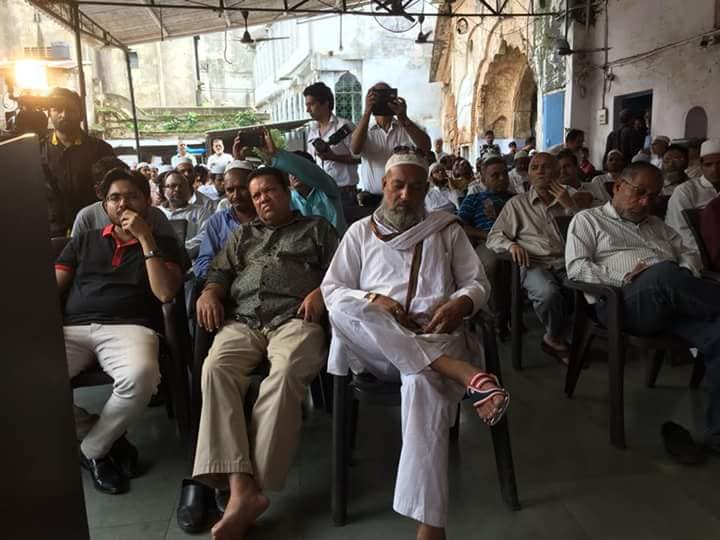
The pictures in the gallery are from Karwan e Mohabbat‘s Facebook page. 

19 December 2018 

“The Free Voice: On Democracy, Culture and the Nation” by Ravish Kumar

The Free Voice: On Democracy, Culture and the Nation by renowned journalist Ravish Kumar is a collection of his essays on the state of the nation and he stresses the importance of how citizens of a functioning democracy must use every space available to them to speak out. Otherwise the new normal is that “the socialization of fear is complete. To be afraid is to be civilised in this new democracy”. Every single essay deserves to be read over and over again but there is a particularly chilling one which he wrote called “Wherever a Mob Gathers Is Hitler’s Germany” drawing parallels between the propoganda by right wing fundamentalists in Nazi Germany and conservative politicians of today, many of whom have a history of being responsibile for pogroms. “Any other narrative was allowed no existence at all. People were steadily moulded by the propoganda and they did not realize they had been transformed into a weapon. Propaganda has only one purpose — the construction of a mob. It is the mob which carries out the killings and blood splatters the clothes of those who make  up the mob. the government and the leaders all appear blameless. No one questions the role of propaganda in bringing mobs together.”

These essays have been translated from Hindi by Chitra Padmanabhan, Anurag Basnet and Ravi Singh. These essays are going to be discussed for a long time to come. Ideally the book should be released with the audio version of these essays being narrated in Hindi by Ravish Kumar. Or release the audio clips online.

The following is an extract from “Being the People” being published here with permission. It is an essay that encourages people to be active citizens of a democracy if they wish to protect their rights. “It is time to stop looking for all sorts of excuses for our ‘lack of strength’, or powerlessness, and face teh reality that this enfeeblement of citizens has come about because we have abandoned dissent and turned to supplication.”

*****

Now once again there is a move to drag history-writing back to the chronicles of kings and queens. It is reckless myth-making, fuelled by the idea of retribution—the ‘faithful’, the ‘true Hindus’, will avenge the deeds, real and imagined, of those who are no longer in our midst. The idea of vengeance persists even though those who exist in the present have nothing to do with that history and are not responsible for any of it.

Through these narratives of the new national curriculum, young hearts are being filled with the flames of hatred; they are being transformed into human bombs walking in our midst. Communalism turns human beings into bombs—we will see this change not just in our neighbour’s child but also in our own. When a youth filled with pure hatred chances upon an ordinary quarrel between two individuals who happen to be from different faiths, he can only see the incident with a communal eye and explode, human bomb that he is. He becomes a participant in the act of killing; part of the crowd that kills a Pehlu Khan or Muhammad Akhlaq or Junaid Khan, knowing he will never be punished by the powers that be. This is the kind of human bomb we have in our midst today. We are no longer a weak-hearted people; now that 1,200 years of slavery and sixty years of sickularism and bad governance are behind us, we have produced our own Jihadi John, who hacks and burns a man to death and releases the video on the internet.

As these human bombs increase in numbers in any society or nation, it is not the state that stands to lose but all of us—our status and power as citizens will correspondingly shrink. When we watch television images of a person beaten to pulp by a crowd—he may be of any religion—the moment at which the victim is overpowered by the crowd leaves us shaken and afraid even though we are watching the news in the safety of our home. We are wary of sharing our feelings on Facebook and hesitate to step out of the house at certain times. We feel intimidated and our civil rights as citizens get eroded.

Our minds are being filled with hatred not only for the sole purpose of perpetuating the hold of a particular party or ideology on power but to ensure the complete decimation of the power that comes with being the citizens of a democracy. I earnestly urge you to keep your child safe from the ill-effects of the new national curriculum on social media and prime-time television, and keep yourself out of its reach as well. The national curriculum is virulent in its theme, and unrelenting. It has a predictable pattern—wherever there is an election, it makes its presence felt. All of us need to have the self-confidence that is part of the consciousness of being the people of a strong civilization, a rich and diverse culture. Just as justice and injustice are part of our present, so it was in the past. We need to learn to deal with it. We should know how to negotiate history. But these debates are pushing us to the farthest extremes; consequently, we are moving inexorably towards communalization—an ever-widening gulf of mistrust with regard to a particular community.

In schools all over Germany, children are educated on how to deal with the blot on their past because of Hitler and his Nazi regime, one of the most evil in all history. This is a stigma that cannot be removed either by tearing out or burning those pages of history, or by running away and hiding from it. I once asked a German journalist if they were overcome by a sense of guilt.

Mentioning that politicians in my country didn’t think twice about casually branding anybody as Hitler, I asked her if that were so in Germany as well. She replied, ‘We are very careful about how we bring Hitler’s name into any debate; only an individual who loses the ability to offer a reasoned and human argument is thought to possess a Hitlerian streak.’

She recalled that around the time the film Schindler’s List, set in Nazi Germany, was released, their teacher spoke to them. This is what the teacher said: ‘The film dwells on the darkest chapter in the history of our nation. Yes, it did happen, but we are not to blame—neither your father nor mine. We ought to be ashamed of this dark chapter of our history and we are, but when we watch the film we shall not be wracked by guilt or anger. Rather, we shall experience a sense of self-confidence that we are no longer trapped in that time; we have come a long way from that juncture and are living in a new age.’

We in India have not educated our citizens on ways to negotiate history. On the contrary, the narrative that is being created as a ‘tradition’, especially through our television channels, is one of inhumanity. Perhaps many will dismiss these words of caution, calling me alarmist. But there will come a time when we will recall these words in distress—if not for ourselves, then for our children, for no one among us wants to see our child pick up a sword to kill a neighbour. Our child may well be saved by the party he owes allegiance to, but we will not get a moment’s sleep knowing that our child is a murderer.

When Pehlu Khan was lynched in Alwar, there was little reaction on the part of society and none from the government. When Junaid Khan was killed on a crowded railway platform, no one came to his aid, and later there were no witnesses, everyone claimed to have been somewhere else, or busy with something so consuming that the cries of a man being butchered and his brothers did not reach them. Examine the damage that was done: two men died, in terror and unimaginable pain. If that does not matter to us, do we think of those who killed and will not be punished? How many were they? Eight? Ten? Twenty? We don’t know, we make no effort to know. Those men, they must have gone home after they killed. What food did they eat that evening? Who cooked it for them? How many greeted them in their mohallas the next morning? There are eight, ten, twenty murderers roaming freely in our society. In another year there may be eight hundred, or twenty thousand. Murder will be normal then. It will be like any other job—like weaving a beautiful carpet or sari, driving a car, tending a garden, writing software or nursing the sick. Killers will emerge among us, kill and come back home after a day’s work. They might be our children, our siblings, our husbands or wives. Have we agreed to this? When we cast our vote, was this the world we chose?

Let us not turn away from what is happening. The future is grim. Due to the ongoing poisonous Hindu-Muslim discourse, human bombs are being prepared in large numbers, out of hatred among the Hindus and out of sheer fear among the Muslims. Our society is poised to reach its nadir. In places with dense populations, communalism will incubate more human bombs.

Ravish Kumar The Free Voice: On Democracy, Culture and the Nation Speaking Tiger, New Delhi, 2018. Hb. pp. 180 Rs.499

11 March 2018 

“She Came from Mariupol” by Natscha Wodinwas ( an extract)

Sie Kam Aus Mariupol by Natscha Wodinwas ( published by Rowohlt Verlag) which has been shortlisted for the 2017 Leipzig Book Fair Prize is by the daughter of deported Ukrainian labourers to Germany. Natscha Wodinwas is based in Berlin.

The following translated English excerpts were sent by Rachel Hildebrandt, translator and publisher, Weyward Sisters Publishing. The English translation of She Came from Mariupol is as yet unpublished.

These passages are being published with permission.

(p.38) The more research I did, the more atrocities I encountered about which hardly anyone seemed to be aware. I was not the only one who was learning about these for the first time. None of my German friends, many of whom I considered enlightened, historically knowledgeable individuals, had any idea how many Nazi camps had once existed within the boundaries of the former German Reich. Some of them guessed around twenty, while others estimated two hundred, a few up to two thousand. According to a study by the Holocaust Memorial Museum in Washington, the number is actually closer to 42,500, not including the smaller and the satellite camps. In an interview with ZEIT published on March 4, 2013, the American historian Geoffrey Megargee, who had contributed to the study, remarked that the horrific number of camps confirmed that almost every German had to have known about the existence of these camps, even if they had not comprehended the extent of the camps or the conditions within them. It was the old story: Nobody knew a thing, despite the fact that with over 42,500 camps the entire country must have functioned like a single gulag.

****

 (pgs 248 to 251) The large-scale deportation of the Ukrainians to Germany was accompanied by a pervasive propaganda effort on the part of the occupiers. At every turn, the Soviet citizens were called to report for work duty in Germany. They were promised paradise there. The brainwashing occurred everywhere: during the opening programs at the cinemas, over all of the radio stations, in the workplaces, at the train stations, in the theaters, on public squares and streets. Large, colorful posters depicted happy Ukrainians working at progressive German workbenches. Smartly dressed Ukrainian domestic servants were pictured whipping up German Sunday cakes. Ukrainian women were especially popular as maids. In 1942, Hitler ordered that half a million of them be employed in German households, which resulted in many German women losing their jobs. The press circulated daily pleas, like this one:

UKRAINIAN WOMEN AND MEN

The Bolshevik commissioners have destroyed your factories and workplaces, and are cutting you off from work and bread. Germany is offering you useful, well-paid employment. In Germany, you will find excellent work and living conditions, and you will be paid according to the tariff and based on your productivity. We take especially good care of the Ukrainian workers. So that they can live in conditions that are suitable to them and can retain their cultural distinctness, separate settlements are being constructed for them. They will provide everything that you would need to live: cinemas, theaters, hospitals, radio stations, swimming pools, etc. The Ukrainians are living in bright, nicely furnished rooms, and they are given the same things to eat as the German workers. Furthermore, the factory canteens cook the specialties of all nations, which is why the Ukrainian workers will find Wareniki, Galuschki, Kwas, etc. on the menus.

Germany is waiting for you! Hundreds of thousands of Ukrainians are already working in free, happy Germany. What about you? During your stay in Germany, we will take good care of your family back home.

(reprinted from a Ukrainian newspaper)

The propaganda was initially effective. Not all of the so-called Ostarbeiter were forcibly deported. At the beginning, many of them reported voluntarily. Gradually the truth about the downright nightmarish work and living conditions in the German Reich trickled back home. At first, letters conveyed hidden messages, for example, in the form of flowers drawn in a letter from a sixteen-year-old to his mother. The flower was the agreed-upon signal that things were not going well for him. As time passed, more and more deported Ukrainians returned from Germany, physically destroyed and shoved off back home, because in their condition they were no longer useful. Their stories quickly cut off the hopeful rush of those volunteering for work duty: a serious problem for the German war industry, since the German men were at the front and no longer there to fill the workplaces.

Meanwhile, the war was requiring a sharp, unrelenting increase in productivity. Germany’s victory would rise or fall on the imported slave laborers from all over Europe, especially from the Soviet Union and particularly from Ukraine. Hitler appointed his model Gauleiter Fritz Sauckel as the General Plenipotentiary for Labor Deployment. The son of a Frankish postal worker and a seamstress, who was later described at the Nuremberg trials as the “greatest and cruelest slaver since the pharaohs,” Sauckel issued the order to “finally shake off the last dregs of sentimental humanitarianism.” And with this command, the human hunt began. Ukraine was the favorite region of operations for the hunters. The Ukrainians, who composed the largest percentage of the “Ostarbeiter,” were perceived as the Slavs of the lowest possible value. The only groups under them in the racial hierarchy were the Sinti, the Roma, and the Jews. They were attacked on the streets, in cinemas and cafes, at streetcar stops, in post offices, anywhere where they could be easily caught. They were hauled out of the homes in raids, dragged from the cellars and sheds where they had tried to hide. They were driven to the train station and transported to Germany in cattle cars. A countless number of them disappeared without a trace with nothing except the clothes on their backs. Able-bodied young men were particularly desirable – entire freight trains full of Ukrainian teenagers rolled daily toward the Reich. After a while, though, the forty- and fifty-year-olds were taken, and eventually, the elderly and weak. The populations of entire villages were deported, including the grandmothers with their grandchildren. The emptied villages were then burnt to the ground. At first, the minimal slave laborer age was twelve, but then it was dropped to ten. And not only that, but in the summer of 1942, all young people in Ukraine between the ages of eighteen and twenty were forced to serve two years of compulsory service in the Reich. Up to ten thousand future forced laborers were shipped to Germany on a daily basis, and according to Fritz Sauckel’s orders, all of these people had to be fed, housed, and treated as cheaply as possible in order to yield the highest possible productivity.

25 February 2017 

Book launch: Mrinal Pande’s “Dhvaniyon ke aalok mein stree” ( 4 January 2016, IHC)

On Monday, 4 January 2016, I attended Hindi publisher Rajkamal Prakashan’s book launch  for noted journalist and writer, Mrinal Pande’s Dhvaniyon ke aalok mein stree . Mrinal Pande has written a nonfiction book about the vast contribution of professional women musicians (largely tawaifs or courtesans till the mid 20thC) to Hindustani classical and semi-classical music in post-1857 India. Most of whom went unmentioned even by famous musicians and Ustads, whom they had lovingly and selflessly tutored and mentored through their early days of penury. The panel includes  journalist Yatendra Mishra, singer Shubha 20160104_190652Mudgal, poet Ashok Vajpeyi, Mrinal Pande and publisher Ashok Maheshwari. The event was introduced by editor Satyanand Nirupam.

I enjoyed the event immensely. Two hours went by so swiftly. I could have heard the conversations some more.

I liked the narrative which emerged from the evening’s chat. Women musicians were a phenomenal influence and in many cases taught men who were to later earn quite a name for themselves. But the focus was not necessarily on the women musicians who have been profiled in the book but many like Shubha Mudgal’s Nani ( maternal grandmother) who yearned to learn music but was not allowed by her father. Instead he insisted she learn the piano. To fulfil her desire of learning Hindustani music Nani had herself photographed holding various Indian musical instruments in the garden. (I am curious though how did the Nani get access to those musical instruments with which she was photographed in the garden?) Or the many rich wives of Bombay boxwallahs or the corporates who were taught music to while their time. It served another purpose too – the male musicians social ambitions of being seeing in the right circles. But the true preservers, inheritors and practitioners of music, were the Hindu and Muslim tawaifs, who kept Hindustani musical traditions alive by performing every night gave music a lease of life. Equally significantly they kept local languages and dialects or “bolis” alive in the Hindi that was commonly known and spoken. They were not averse to borrowing, blending, improvising and creating fresh interpretations as long as music was heard. This for Mrinal Pande is a crucial aspect of the womens musicians contribution to language and musical traditions. Her analysis of Hindi being kept alive since it had not as yet been politicised and hijacked depriving it of its backbone, ie the various bolis some of which were integral to the gharanas. So these remained in the social consciousness. I found this gem fascinating.

Another one was that of women singers graduating from anonymity to establishing their name to a recording. The idea that after the 3.5 minutes of 78 rpm had been cut by the German engineers the women to ensure the correct singer was given due credit said her name at the tail end of the song. It is incredible what technology and different kinds of publishing can do for the identity and self-worth of an individual.

The Union Home Ministry note issued in 1946 when Govind Vallabh Pant who was a minister in the provisional government debarring women singers who had a pesha or were tawaifs from singing. Later Mr Keskar, Minister for Information and Broadcasting, post independence, nullified the government note banning,”women whose personal lives are a public scandal”, in 1952. Suddenly it all made sense to my mind…once again the notion of identity of the women along with the patriarchal tyranny which was implicit in the 1946 order. But when Mr Keskar overturned the order he insisted the religion of singer be evident. All muslim singers were to add the prefix “Begum” and hindu singers had to add the suffix, “Devi”. Now that too is a curious move…identification along religious lines. Not unheard of. It could be considered at par with the star all Jews had to stitch on their coats in Nazi Germany.

I liked the story about Mrinal Pande’s mother, the popular Hindi novelist, “Shivani”, taking her husband’s permission to write and then adopting a pen name. Ironically it is Shivani who now remains alive in people’s minds. I enjoyed Shubha Mudgal’s response about her son being cared for by the extended clan while she was on tour and the astonishment expressed by the Indian diaspora who could not fathom how this was possible — “Had she taken permission from her husband to do so?” Having said that I know these women continue to be rare examples and not necessarily the norm.

Even Yatindra Mishra’s tale about his Dadi (paternal grandmother) not being permitted to sing since it would be frowned upon by society especially now that the family had lost their princely status. Given the context that women musicians were mostly tawaifs this would have really complicated matters for the family. So her father did not allow her to sing saying, “What will people say? They will think we have fallen on such hard times that now the daughter of the house is singing to earn!” Funny how far Indian society has now come with children being encouraged to sing and perform publicly in the hope they can become professional singers, preferably in Bollywood.

I liked how gracefully and tactfully Shubha Mudgal and Mrinal Pande dealt with the comment about “deterioration” of Indian classical musicians performing mobile ring tones and snatches of popular Hollywood musicals. It was fascinating to observe the arguments playing out between the purists and those who were arguing for the evolution of musical traditions such as the examples noted by Ashok Vajpayee. He said sometimes he can identify bits of Gwalior or Bhopal gharanas in modern renditions. Interesting.

Dhvaniyon ke aalok mein stree has been published by Rajkamal Prakashan. It is available in hardback and paperback.

6 January 2016


Siddharth Mukherjee, 27 April 2014

Siddharth Mukherjee, 27 April 2014

Siddharth Mukherjee, 27 April 2014Last night I attended a public lecture at the India International Centre, New Delhi. It was delivered by Siddharth Mukherjee entitled “First they came for Rushdie: Scientific Ambitions in an Age of Censorship”. It was organised by Penguin Books India to celebrate the occasion of Siddharth Mukherjee having received the Padma Shri.  He is a physician, scientist and writer. His book, The Emperor of All Maladies: A Biography of Cancer, won the 2011 Pulitzer Prize. He is currently an assistant professor medicine at Columbia University in New York. Chiki Sarkar, Publisher, Penguin Random House India, announced that her firm would be publishing his forthcoming book–on genes. Penguin invite

The lecture consisted of three distinct sections. He read out two papers. An essay, “The Perfect Last Days of Mr Sengupta”, published in Granta 124: Travel (http://www.granta.com/Archive/124/The-Perfect-Last-Days-of-Mr-Sengupta). It is about his visit to the Cancer centre of All India Institute of Medical Sciences ( AIIMS) based in New Delhi, where he meets a terminally ill patient Mr Sengupta. A precisely written, sensitive and thought-provoking essay about mortality, disease, care giving, and death.

( L-R) Chiki Sarkar, Siddharth Mukherjee, Nirmala George and Jaya Bhattacharji RoseHe followed it up by reading an extract from an unpublished essay. ( I suspect it is from his forthcoming book.) It was about science, scientific thought and research, especially genetics, in Nazi Germany. In a measured manner, calmly Siddharth Mukherjee read out his paper. Not once did his voice waver while he patiently retold the well-known facts of medicine as practiced in Germany.  He talked about Berlin in 1931 and the close link between science and literature. He spoke of the Nazi scientists such as eugenicist Alfred Ploetz who coined the term Rassenhygiene or racial hygiene, Josef Mengel or the Angel of Death who was responsible for the gas chambers in the Auschwitz concentration camps, physicist and Nobel Prize winner ( 1905) Philipp Eduard Anton von Lenard who advocated “Deutsche Physik” as opposed to the ideas of “Jewish physics”, by which he meant chiefly the theories of Albert Einstein, including “the Jewish fraud” of relativity. He spoke of the influence many of these scientists had upon Hitler, even when he was in prison and he wrote of his admiration of them in Mein Kampf. He commented upon the close relationship between the legal wheels that were constantly turning to justify and legitimize these absurdly illogical “scientific” theories, resulting in the enactment of the anti-Jewish statutes called the Nuremberg Race Laws ( 5 Sept 1935) institutionalizing many of the racial theories prevalent in Nazi ideaology. He mentioned the establishment of the Aktion T4 or the euthanasia programme that led to the establishment of  extermination centres where inmates were gassed in carbon monoxide chambers. He cited examples and read out extracts of contemporary accounts by scientists and men of letters such as Christopher Isherwood, of how slowly German society was being slowly and steadily cleansed, sloughing of genetic detritus. He argued that there was sufficient evidence of how this young science propped up a totalitarian regime and the cycle was completed by producing junk science. He  documented the muzzling of free expression, books, media, radio, cabaret were slowly brought under Nazi doctrine. Music such as jazz and swing or the “negro noise” were stopped. There was a slow and methodical decimation of intellectual and cultural freedom. Audience at the Siddharth Mukherjee public lecture

The concluding part of the lecture, Siddharth Mukherjee cited the example of Salman Rushdie not being permitted to attend or even speak via satellite link at the Jaipur Literature Festival 2012. He received death threats. At the time three writers — Hari Kunzro, Ruchir Joshi and Jeet Thayil — tried reading out extracts from the banned text The Satanic Verses but were not permitted to do so. Instead they were advised to leave Jaipur immediately. At the time this episode was met by a “galacial silence” by the powers that be. It was as “all realism without magic”. Since then this kind of literary censorship, a capitulation to bullying, according to Siddharth Mukherjee has become a predictable pattern in Indian society. Wendy Doniger  is the latest victim of literary censorship. For Siddharth Mukherjee there is a symbiotic relationship between science and literature since they co-exist in the same ecosystem. “Science happens in the same fragile place where books happen and plays are enacted. You spoil the ecology of one, you tarnish the soil of the other.”

28 April 2014 

Web Analytics Made Easy -
StatCounter