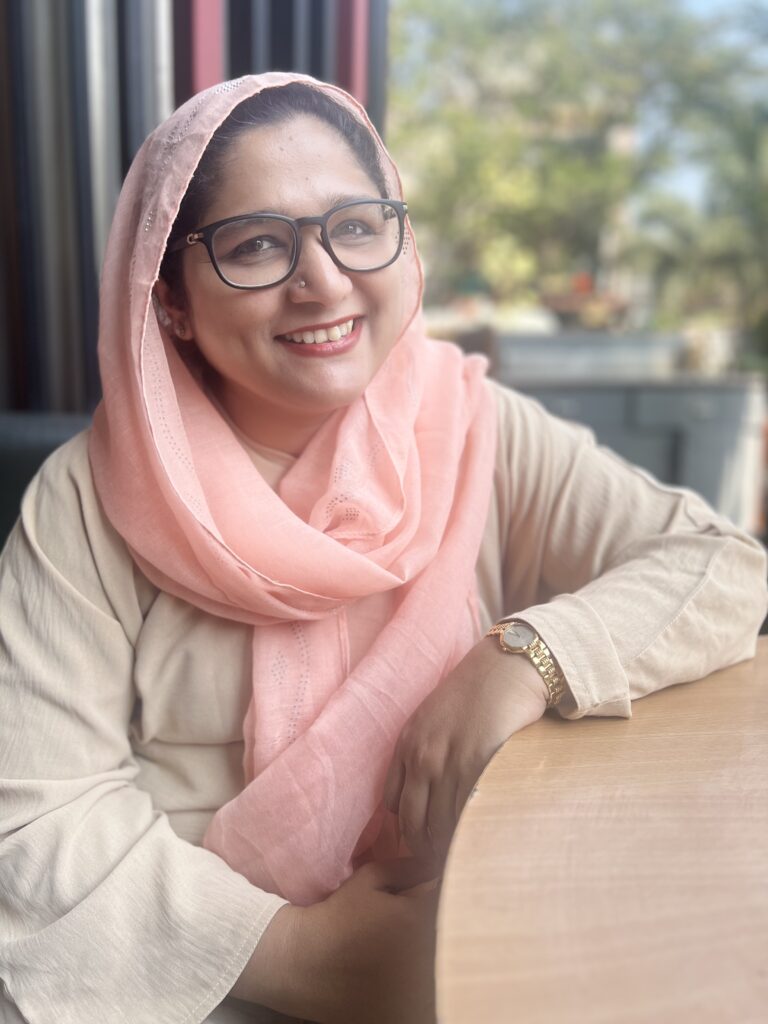
Andaleeb Wajid is a hybrid author, having published nearly 50 novels in the past 15 years. Andaleeb enjoys writing in a number of different genres such as young adult, romance, and horror. Andaleeb’s YA novel “Asmara’s Summer” was adapted for screen to become “Dil, Dosti, Dilemma” on Amazon Prime and other works are in the process of being optioned or adapted. Her YA novel, “The Henna Start-up” is the winner of the Neev Literature Festival Award 2024, Crossword Book Award 2024, and TOI Auther Award 2025, along with receiving honourable mention at the BK Awards, 2024.
She recently published her moving memoir “Learning to Make Tea for One: Reflections on Love, Loss and Healing”, published by Speaking Tiger Books.
I have known Andaleeb for years. It is absolutely marvellous to witness her growth as an author year on year. Hence, recording an episode of TOI Bookmark was extra special.
Here is a snippet from the conversation:
I really enjoy writing fiction. So, nonfiction as a rule I don’t like to approach. But this was different because I have also put so much of myself into the book. Which was why it was so difficult to write. When I write fiction I do tend to put parts of myself into the book but those are very miniscule parts. And this book took huge chunks of me. And I think it was supposed to be healing but at that time it did not feel that way. Now maybe in a couple of months I will be able to look at it.
TOI Bookmark is a weekly podcast on literature and publishing. TOI is an acronym for the Times of India (TOI) which is the world’s largest newspaper and India’s No. 1 digital news platform with over 3 billion page views per month. The TOI website is one of the most visited news sites in the world with 200 million unique monthly visitors and about 1.6 billion monthly page views. TOI is the world’s largest English newspaper with a daily circulation of more than 4 million copies, across many editions, and is read daily by approximately 13.5 million readers. The podcasts are promoted across all TOI platforms. I have recorded more than 138+ sessions with Jnanpith, Padma Bhushan, and Padma Shree awardees, International Booker Prize winners, Booker Prize winners, Women’s Prize for Fiction, Nobel Laureates, Pulitzer Prize, Stella Prize, AutHer Awards, Erasmus Prize, BAFTA etc. Sometimes the podcast interviews are carried across all editions of the print paper with a QR code embedded in it.
Some of the authors who have been interviewed are: Banu Mushtaq, Deepa Bhashti, Samantha Harvey, Jenny Erpenbeck, Michael Hoffman, Paul Murray, V. V. Ganeshananthan, Hisham Matar, Anita Desai, Amitava Kumar, Hari Kunzro, Venki Ramakishnan, Siddhartha Deb, Elaine Feeney, Manjula Padmanabhan, NYRB Classics editor and founder Edwin Frank, Jonathan Escoffery, Joya Chatterji, Arati Kumar-Rao, Paul Lynch, Dr Kathryn Mannix, Cat Bohannon, Sebastian Barry, Shabnam Minwalla, Paul Harding, Ayobami Adebayo, Pradeep Sebastian, G N Devy, Angela Saini, Manav Kaul, Amitav Ghosh, Damodar Mauzo, Boria Majumdar, Geetanjali Mishra, Viet Thanh Nguyen, William Dalrymple, Abdulrazak Gurnah, and Annie Ernaux.
Award-winning writer and academic Viet Thanh Nguyen is a name that many in the literary world are familiar with. As a Vietnamese-American, he is acutely aware of his two identities and the histories he carries within himself. This is one of the recurring themes of his memoir, A Man of Two Faces. He has written plenty of books, most notably his Pulitzer Prize for Fiction 2016 The Sympathiser. It was recently turned into a TV series with Park Chan-wook and Robert Downey Jr. His books are published in India by Hachette India.
In 2023-24, Viet Thanh Nguyen delivered the prestigious Norton Lectures. In the lectures as well as in the discussions that follow, he addresses many of the aspects of being an immigrant in the USA that are at the heart of his moving memoir A Man of Two Faces.
We have recorded more than 134 episodes of TOI Bookmark. Each one is special and memorable. Every conversation is unique. It was an honour and a privilege to record this episode with Viet Thanh Nguyen. He is exceptionally busy with a demanding schedule. Yet, once we had figured out a mutually convenient time to record, across time zones, days and dates, he was immensely courteous and gave us his focussed attention. It did not seem as if he had been in back-to-back meetings/interviews during the day. It was Memorial Weekend in the USA, but he was working.
It was a fascinating conversation about reading and writing memoirs while discussing his book A Man of Two Faces. Also, how he had to think through himself, think through the history of his family that he was dealing with, and think through the language he was going to use.
Incidentally, 30 April 2025 marked fifty years since the conclusion of the Vietnam War.
Listen to the podcast on Spotify:
TOI Bookmark is a weekly podcast on literature and publishing. TOI is an acronym for the Times of India (TOI) which is the world’s largest newspaper and India’s No. 1 digital news platform with over 3 billion page views per month. The TOI website is one of the most visited news sites in the world with 200 million unique monthly visitors and about 1.6 billion monthly page views. TOI is the world’s largest English newspaper with a daily circulation of more than 4 million copies, across many editions, and is read daily by approximately 13.5 million readers. The podcasts are promoted across all TOI platforms. I have recorded more than 134+ sessions with Jnanpith, Padma Bhushan and Padma Shree awardees, International Booker Prize winners, Booker Prize winners, Women’s Prize for Fiction, Nobel Laureates, Pulitzer Prize, Stella Prize, AutHer Awards, Erasmus Prize, BAFTA, Walter Scott Prize for Historical Fiction etc. Sometimes the podcast interviews are carried across all editions of the print paper with a QR code embedded in it.
Some of the authors who have been interviewed are: Banu Mushtaq, Deepa Bhashti, Samantha Harvey, Jenny Erpenbeck, Michael Hoffman, Paul Murray, V. V. Ganeshananthan, Hisham Matar, Anita Desai, Amitava Kumar, Hari Kunzro, Venki Ramakishnan, Siddhartha Deb, Elaine Feeney, Manjula Padmanabhan, NYRB Classics editor and founder Edwin Frank, Jonathan Escoffery, Joya Chatterji, Arati Kumar-Rao, Paul Lynch, Dr Kathryn Mannix, Cat Bohannon, Sebastian Barry, Shabnam Minwalla, Paul Harding, Ayobami Adebayo, Pradeep Sebastian, G N Devy, Angela Saini, Manav Kaul, Amitav Ghosh, Damodar Mauzo, Boria Majumdar, Geetanjali Mishra, Viet Thanh Nguyen, William Dalrymple, Abdulrazak Gurnah, and Annie Ernaux.
‘Absolutely riveting’ Peter Frankopan, author of The Silk Roads ‘Disturbing and enlightening’ Chris Miller, author of Chip War ‘Hugely important’ Rana Foroohar, author of Makers and Takers ‘A once-in-a-generation read’ Robert D. Kaplan, author of Waste Land
As Trump wages a tariff war with China, seeking to boost domestic electronics manufacturing, this book offers an unparalleled insight into why his strategy is embarrassingly naïve.
Apple isn’t just a brand; it’s the world’s most valuable company and creator of the 21st century’s defining product. The iPhone has revolutionized the way we live, work and connect. But Apple is now a victim of its own success, caught in the middle of a new Cold War between two superpowers.
On the brink of bankruptcy in 1996, Apple adopted an outsourcing strategy. By 2003 it was lured to China by the promise of affordable, ubiquitous labour. As the iPod and iPhone transformed Apple’s fortunes, their sophisticated production played a seminal role in financing, training, supervising and supplying Chinese manufacturers – skills Beijing is now weaponizing against the West.
Investigative journalist Patrick McGee draws on 200 interviews with former Apple executives and engineers to reveal how Cupertino’s choice to anchor its supply chain in China has increasingly made it vulnerable to the regime’s whims. Both an insider’s historical account and a cautionary tale, Apple in China is the first history of Apple to go beyond the biographies of its top executives and set the iPhone’s global domination within an increasingly fraught geopolitical context.
Read an extract from the book on Moneycontrol. The book has been published by Simon & Schuster India.
Listen to our conversation on TOI Bookmark* podcast.
Review
‘Apple is more than the world’s greatest company. It is integral to the whole culture of globalisation. Patrick McGee not only narrates the epic history of Apple, but explains how, in effect, it got taken over by China, the world’s greatest illiberal power. To call this book a page-turner is almost to diminish its importance. It is a once-in-a-generation read‘ — Robert D. Kaplan, author of the New York Times bestseller The Revenge of Geography and the forthcoming Waste Land: A World in Permanent Crisis, and Robert Strausz-Hupé Chair in Geopolitics at the Foreign Policy Research Institute
‘Absolutely riveting. An extraordinary story, expertly told – and one that has important implications for Apple, for tech and for global geoeconomics.’ — Peter Frankopan, Professor of Global History at Oxford and author of the bestselling The Silk Roads
‘Deeply researched, disturbing and enlightening, Apple in China reveals how Apple enabled China’s rise, seemingly at the cost of its own future. In these pages we watch as the world’s most profitable company gets outmaneuvered by the world’s most powerful dictator. Using an impressively broad palette, McGee paints a picture of Apple CEO Tim Cook resolutely trying to save costs by placing nearly all of the company’s advanced manufacturing base in Beijing’s grip, only to find it impossible to wriggle free’ — Chris Miller, New York Times bestselling author of Chip War
‘A masterpiece of investigative journalism, replete with revelations. Every iPhone owner will want to read this book, but no Apple employee will risk being seen with it. McGee shows how China played the long game, convincing Apple to invest on an unprecedented scale and, inadvertently, help build its grand authoritarian project. This book is a warning for anyone eager to do business in hostile countries.’ — Geoffrey Cain, author of Samsung Rising and The Perfect Police State, and a former sanctions investigator for the US Congress
‘There is little doubt that Big Tech companies – like the world’s richest and most influential one, Apple – wield as much power as many nation states. But what’s less well known is how these companies are themselves manipulated by the Chinese state for its own economic and political ends. In this hugely important new book, Patrick McGee shows us how Apple’s quest for wealth and power in China may in the end be the undoing both of the company and of America’s quest for technology supremacy’ — Rana Foroohar, Financial Times Global Business Columnist, CNN Global Economic Analyst, and author of Makers and Takers: The Rise of Finance and the Fall of American Business
‘A tour-de-force account of how the world’s most influential company empowered the inexorable rise of the regime that now shapes its – and our – future. Paced like a thriller and spanning the years from before Steve Jobs’s fateful decision to outsource production to more recent times which shine a fresh spotlight on Tim Cook’s careful wooing of Donald Trump, Apple in Chinacaptures every twist and turn of the tech giant’s off-kilter and decidedly off-script relationship with the authoritarian state. What will surprise many is how China ensnared a corporate titan by matching and then surpassing its knack for ruthless efficiency and global dominance’ — Megan Murphy, former Editor in Chief of Bloomberg BusinessWeek
‘A masterful and deeply reported portrayal of how Apple gained China and lost its soul’ — Isaac Stone Fish, author of America Second and CEO of Strategy Risks
Patrick McGee has been a journalist with the Financial Times since 2013, reporting from Hong Kong, Germany, and California. He led the FT’s Apple coverage from 2019 to 2023 and won a San Francisco Press Club Award for his deep dive into Apple’s HR problems. Previously, he was a bond reporter at The Wall Street Journal in New York. He has a Master’s in Global Diplomacy from SOAS, University of London, and a degree in Religious Studies from the University of Toronto. He resides in the Bay Area with his wife and two daughters.
6 June 2025
*TOI Bookmark is a weekly podcast on literature and publishing. TOI is an acronym for the Times of India (TOI) which is the world’s largest newspaper and India’s No. 1 digital news platform with over 3 billion page views per month. The TOI website is one of the most visited news sites in the world with 200 million unique monthly visitors and about 1.6 billion monthly page views. TOI is the world’s largest English newspaper with a daily circulation of more than 4 million copies, across many editions, and is read daily by approximately 13.5 million readers. The podcasts are promoted across all TOI platforms. I have recorded more than 142+ sessions with Jnanpith, Padma Bhushan, and Padma Shree awardees, International Booker Prize winners, Booker Prize winners, Women’s Prize for Fiction, Nobel Laureates, Pulitzer Prize, Stella Prize, AutHer Awards, Erasmus Prize, BAFTA etc. Sometimes the podcast interviews are carried across all editions of the print paper with a QR code embedded in it.
Some of the authors who have been interviewed are: Banu Mushtaq, Deepa Bhashti, Samantha Harvey, Jenny Erpenbeck, Michael Hoffman, Paul Murray, V. V. Ganeshananthan, Hisham Matar, Anita Desai, Amitava Kumar, Hari Kunzro, Venki Ramakishnan, Siddhartha Deb, Elaine Feeney, Manjula Padmanabhan, NYRB Classics editor and founder Edwin Frank, Jonathan Escoffery, Joya Chatterji, Arati Kumar-Rao, Paul Lynch, Dr Kathryn Mannix, Cat Bohannon, Sebastian Barry, Shabnam Minwalla, Paul Harding, Ayobami Adebayo, Pradeep Sebastian, G N Devy, Angela Saini, Manav Kaul, Amitav Ghosh, Damodar Mauzo, Boria Majumdar, Geetanjali Mishra, William Dalrymple, Abdulrazak Gurnah, Dr Rachel Clark, Charlotte Wood, Catherine Chidgey, Andrew Miller, Sam Dalrymple, and Annie Ernaux.
Recording every episode of TOI Bookmark is an honour and a privilege. I get to speak with incredible writers and publishing professionals around the world. This interview with Hisham Matar was truly special. I have read every single book that he has written so far. My Friends was exceptionally good and I devoured it in one sitting.
Here is a snippet from the conversation:
Going through… if you have ever lived through a moment of great political upheaval and rupture in your country and therefor you have experienced it beside and alongside people whom you know very well, whom you have grown up with, and known for a very long time. I am sure many of your listeners can find many examples in their mind of this. What’s fascinating is that some of those people will agree with you totally about you know what is a hopeful future and how might it look like but then you notice over the years that each one of you ends up in a different place. I think part of the question isn’t ethics or ideology or political persuasion but it is actually questions of temperament. And within political conversations it is impossible to talk about this because nobody knows what you are talking about, but we all know what is temperament. For example, some of our friends are excited by argument and they get really heated up, and I have other friends who grow poetic saying arguments will convince no one. They think that in order to get to the truth, you have to have a different kind of conversation. And they tend to be quieter perhaps and more reluctant. So those are questions of temperament. And I think, I have always thought of the novel really, the novel really is the place for human temperament. Here, I am focussing more on questions of politics, but of course these questions touch and they do deal with these characters, questions of belonging, what love is, friendship is, intimacy is. They affect all of these.
Listen to it on Spotify:
TOI Bookmark is a weekly podcast on literature and publishing. TOI is an acronym for the Times of India (TOI) which is the world’s largest newspaper and India’s No. 1 digital news platform with over 3 billion page views per month. The TOI website is one of the most visited news sites in the world with 200 million unique monthly visitors and about 1.6 billion monthly page views. TOI is the world’s largest English newspaper with a daily circulation of more than 4 million copies, across many editions, and is read daily by approximately 13.5 million readers. The podcasts are promoted across all TOI platforms. I have recorded more than 130+ sessions with Jnanpith, Padma Bhushan, and Padma Shree awardees, International Booker Prize winners, Booker Prize winners, Women’s Prize for Fiction, Nobel Laureates, Pulitzer Prize, Stella Prize, AutHer Awards, Erasmus Prize, BAFTA etc. Sometimes the podcast interviews are carried across all editions of the print paper with a QR code embedded in it.
Some of the authors who have been interviewed are: Banu Mushtaw, Deepa Bhasthi, Samantha Harvey, Jenny Erpenbeck, Michael Hoffman, Paul Murray, V. V. Ganeshananthan, Hisham Matar, Anita Desai, David Nicholls, Amitava Kumar, Hari Kunzro, Venki Ramakishnan, Siddhartha Deb, Elaine Feeney, Manjula Padmanabhan, NYRB Classics editor and founder Edwin Frank, Jonathan Escoffery, Joya Chatterji, Arati Kumar-Rao, Paul Lynch, Dr Kathryn Mannix, Cat Bohannon, Sebastian Barry, Shabnam Minwalla, Paul Harding, Ayobami Adebayo, Pradeep Sebastian, G N Devy, Angela Saini, Manav Kaul, Amitav Ghosh, Damodar Mauzo, David Walliams, Boria Majumdar, Geetanjali Mishra, William Dalrymple, Abdulrazzak Gurnah, and Annie Ernaux.
To write well you need knowledge that is specific. (p.67 The Blue Book)
…the writer’s job is to reveal where the experiment in living goes wrong.” (p.40 A Time Outside this Time)
It is a privilege to be able to read a writer’s journal soon after reading his latest novel. Amitava Kumar has a way with words. More than that. It is his ability to be able to pour his creative energy into whatever he is writing; it could be a social media post or an essay or a novel. Every piece of writing seems to be written with equal thought and care. This holds true of his latest offerings. Published a few months apart in India, by two different publishers — Aleph and HarperCollins India.
The Blue Book: A Writer’s Journalhas a slow, meandering feel to it. The writer takes the reader through a lovely amble of his musings on writings, his encounters with other writers, the discipline it requires to write, and nuggets of wisdom that other writers may have shared with Amitava Kumar. The book is beautifully illustrated by his watercolour paintings — an art form that he took up during the pandemic. The paintings are vibrant, pure, and he uses bright colours. Curiously, he is constantly experimenting, so there is no fixed style to his compositions. It is impossible to gauge what will come next. But it is the specifics in the painting, whether the detail of a tulip flower or the painting across a newspaper that shows young girls celebrating Holi just above a photograph of the poet, Mahadevi Verma that make Amitava Kumar’s creations all the more interesting. It is his ability to make the reader share immediately his perspective. His way of seeing. Whether the reader has to agree or not is an entirely different matter. But at least the artist has been persuasive enough to highlight his viewpoint. But The Blue Book is also a pandemic journal. Irrespective of all the name dropping and truly wise advice that he shares, it is the astonishing discipline, clarity and peace that is exuded through the book which shines through. It is the gift of time that this wretched pandemic has given to many individuals. It is possible to channel one’s energies into an activity, discover new talents and blossom.
A Time Outside This Timecould not be further from the calm The Blue Book exudes. The novel is scattered. Its structure mimics the shattering experience it is to live in this world of fake news and post-truth. Amitava Kumar opts to tell a few stories, blurring the lines between fact and fiction. It is at times hard to tell if the narrator Satya is Amitava or just Satya. Sometimes it is impossible to tell if this is fiction or a diary of events. It is almost as if it is left to the reader to piece together the narrative and make sense of it. The stories that exist are fine by themselves but interspersing them with Satya’s childhood memories of communal violence or of his adulthood, his marriage, his wife Vaani’s conversations makes it dizzying to read. Apparently, this book is an attempt by Amitava Kumar to write in fiction the challenges caused by fake news and truth. It is unclear whether this is meant to be reportage or a novel. At the best of times, a good writer is deeply dependent upon real experiences. It is the author’s craftsmanship that presents the world to the reader through the prism of fiction. Whereas in A Time Outside This Time the preoccupation of the writer to discuss this new post-truth world where fake news dominates is not very convincing since it is the role of the writer to use art to present reality. Isn’t that a form of artifice, fake news if you will? So how does one read A Time Outside This Time? It is not easy to say.
This is my land, this is my country. No one can come between us. Neither saffron nor green can come in our way.
But, they try to.
Debut author Sabin Iqbal’s The Cliffhangeris about a group of friends Usma, Thaha, Jahangir and Moosa. They are in their late teens and early twenties. Moosa is nineteen years old. The ages of the other friends are not mentioned but it is presumed that they are more or less the same age. They are not very well educated. Inevitably have failed school and are hanging around the cliff near their village. There is little for them to do. They are considered kafirs for their free lifestyle and friendships with foreigners and Hindus like Balannan and Vivekannan. They belong to impoverished homes that rely upon remittances sent home from the Middle East. It is mostly the men of these families that have gone to Dubai in search of work. They occupy the lowest rungs of society abroad as drivers, shop assistants, messengers etc. Work which is unappealing to the younger men in India but who realise that it is a matter of time before they too have to join the expat workforce in the Middle East. It helps bring in a regular income and is any day preferable to the backbreaking task of fishing — the only skill their village of fishermen has known for as long as they can recall.
The Cliffhangers have chosen the middle path. We don’t wear symbols of any faith or religion. We don’t tie threads around our wrists or biceps. We wear trainers, sweatpants or tracksuits or polos, which are brought by our relatives from the Gulf.
It is a village on the coast of Kerala where the population lives in relative peace and harmony though the settlement is distinctly according to communal lines. The Muslims on one side and the Hindus on the other. There are no Christians in this village. This is how it has been; till now.
Our village also has religious and political divisions — though they seem blurred and harmless to an outsider, they are as distinct as right and left, and potentially as harmful to both.
…
So far, the two communities in our village have lived in peace and harmony. It is a delicate peace, which any moment, could crumble like papadums.
The Cliffhangers is a fictional account of how close to the precipice this village is from being torn apart along communal lines. The simmering hatred that manifests itself in by the police picking up the Cliffhanger boys for questioning even if they are innocent. It is just that the shroud of suspicion falls upon these boys most of the time because of their faith. It is never said explicitly but it is understood. A frightening prospect. The boys most often are seen whiling away their time hanging out with tourists, ostensibly to improve their English. So if anything happens to a tourist such as the rape of a young girl or the inexplicable death of an unapologetic HRS supporter like Vishwanathan Thampi, the boys are immediately picked up for questioning. As the Cliffhangers are well aware that as young men with Muslim names, they are a soft target for the police and primary enemies of the HRS ( Hindu Rasthra Sangh). It is a tough and uncertain life. None of this uncertainty is helped by the harrowing news from North India about the lynching of a man suspected of storing beef in his fridge. The Cliffhanger gang is stunned into a worrying silence. Unable to fathom what to make of this dystopic world where you are condemned for your food habits, you are persecuted for your religion –whether observing it or not as the boys discovered for having being caught eating during the day when they should have been fasting during Ramzan, you are lynched if you belong to the “other” in terms of colour, ideology and faith. It is a peculiar world.
Hatred is when you think the other has to be eliminated because of the difference of opinion in faith, customs and ways of life. Or, being the axis of evil as Bush, one of the presidents of America, said.
The Cliffhangers want to be the voice of sanity, albeit our patchy English, in the cacophony of communal insanity that our state has fallen into. As you know, we are not adequately educated to sound profound but we are glad that we are not wrongly educated either to hate the ones under the rival flag. We bear Muslim names and maybe we go to the mosque on Fridays and on Eid, but that’s it. You can cut our vein anyway, I swear to you, none of us have any strain of hatred in us.
This free will is something that the Cliffhangers are beginning to discover they are unable to exercise freely. So much so even SI Devan who would pick them up routinely for questioning ultimately decided to “help” them out in an unsolved case of the rape of a foreign tourist. SI Devan had uncovered the truth that the perpetrator, Balannan, a vendor who sold lemonade but was closely affiliated to the HRS. So recognising the terrifying consequences of arresting the member of the Hindu shaka and the horrific prospect of ripping the social fabric of the fishing village across communal lines, the SI chooses to take the rap himself by the senior police officials. SI Devan closes the file as “inconclusive”. His parting words to the Cliffhangers is the truth but with sinister underpinnings.
Remember, we are living in strange times . . .and, your identity is your enemy!” he said….
When the impetus for a story is the growing hatred of the “other” and the heightened communal tension it unleashes, it becomes frighteningly tough to articulate those fears. Fiction helps in unlocking some of those unnamed fears. Whether as a writer or a reader. But as a writer it helps to be crystal clear in channeling one’s anger and distress at the rapid turn of events. For instance to witness the political machinations of hardliners to further their interests despite locals recognising the foolhardiness of encouraging polarisation among communities. A recognition of each other’s differences is sufficient but to underline it on a daily basis and enforce it using state machinery is a dangerous thought and development. It finally rests upon the free will of the citizens of a democracy to subvert this self-consuming destructive hatred.
“The Cliffhangers” is a name given to the four boys but it works metaphorically too for the precipitous situation Indian democracy finds itself in — whether to retreat from the life-threatening crisis or to take the plunge into the depths of the unknown waters and be destroyed. Despite sagging a bit in the middle of the novel The Cliffhangers is a powerful story for the issues it raises. It would be fascinating to hear a freewheeling conversation between Sabin Iqbal, Tabish Khair, Amitava Kumar and Rana Ayyub on writing fiction and non-fiction in these times.
Every week I post some of the books I have received recently. In today’s Book Post 34 included are some of the titles I have received in the past few weeks.
My review of Amitava Kumar’s The Lovers was published in OPEN Magazine on 25 August 2017. Here is the original url titled “A Passage to America” . I am also c&p the text below.
An immigrant finds his place of mind—like the author himself
AMITAVA KUMAR’S The Lovers is about Kailash, born in Ara, Bihar, who moved to the US in 1990. At college he met his mentor Ehsaan Ali when Kailash enrolled in his ‘Colonial Encounters’ class. To earn a few extra dollars, Kailash worked in a university bookshop. Some of the women he met on campus became good friends, some his lovers. With every woman— Jennifer, Nina, Laura, Maya and Cai Yan—he learned a little more about himself as a man, a lover, a student, a reader and of his culture, whichever one it may be at a given moment. The Lovers works at multiple levels. Superficially the novel explores different shades of love— puppy love, sexual love and marital. At another level it is the platonic and nurturing love between teacher (Ehsaan Ali) and student (Kailash) that is the bedrock of the novel. Ever so slowly and gently, the promising student Kailash blossoms as a teaching assistant and later, writer. ‘The main questions now were about the fiction of the past, the idea I had of myself as a person, and what it meant for me to become a writer.’ The narrator relies heavily upon memory to plot his journey and define his identity—tough since ‘he had become a translated man, no longer able to connect completely with his past.’
The Lovers is an autobiographical novel documenting the trajectory of Kailash aka Kalashnikov or AK47 or AK from the burning plains of India to an intellectual in America, a path very similar to that of the author himself. Kailash may not be Stephen Dedalus but he certainly grows in confidence, wherein his tastes in literature are concerned. It is evident in the structure of the novel. Over the years, from being an Indian student unsure about the literary canon he grew up with, Kailash becomes familiar with examples of international literature such as Gramsci, Tagore, Wittgenstein, Hanif Kureishi, Luis Borges, Agnes Smedley, Toni Morrison, Gabriel Garcia Marquez, Judith Butler, Virginia Woolf, Nazım Hikmet et al. Slowly he incorporates desi writers such as Ismat Chughtai too. He realises that the India he left in the 1990s has changed to become a new India which is disconcertingly unrecognisable and is now part of the global village.
The immigrant novel is in a category of literary fiction which straddles two cultures—the author’s land of birth and adopted country. In The Lovers, despite having had the privilege of getting an American citizenship, Kailash continues to feel lost in his adopted country. ‘My father had grown up in a hut. I knew in my heart that I was closer to a family of peasants than I was to a couple of intellectuals sitting in a restaurant in New York.’ He tries to fit in, but falters at times. Even world literature that exposes him to various cultures fails to help, and leaves him yearning for the holy grail of the ‘hybrid culture that groups of people scattered across the world, removed from their roots, have created in response to alienation and a kind of collective loneliness?’ This is unlike his adventurous friend Pushkin Krishnagrahi, a Brahmin from Gwalior, a member of the new India who was now at home anywhere in the world.
It is significant that The Lovers has been released in the 70th year of Independence for India and Pakistan. As with two lovers, there is an intensely passionate relationship between the two countries which has historically been hostile. In the novel the two countries are represented by its citizens —Ehsan Ali (Pakistan) and Kailash (India) who away from their countries do not harbour any ill feelings towards each other and live in harmony. Ehsan Ali is probably modelled upon the intellectual Eqbal Ahmed, a prominent anti-war activist.
The Lovers is extraordinary craftsmanship, charting the blossoming of a timid new immigrant into a confident writer.
( My article on the preview for JLF 2017 was published on Bookwitty.com on 30 December 2016.)
The first time I attended the Jaipur Literature Festival (JLF) at Diggi Palace Grounds, Jaipur it was small enough so that once could drive the car straight up to the main steps of the building. Today, the parking is a fair distance from the palace and the only way to reach the venue is through multiple barricades and a screening counter. Once inside though, there is a wonderful, festive air with an explosion of colours in the décor, the happy buzz of excited people milling about and conversations streaming through various marquees. Termed one of the greatest literary events, it is also a free one. Since it began, the JLF has welcomed 846,000 visitors, 1874 speakers, conducted 1272 sessions and partnered with more than 1400 organisations.
The JLF is also crucial because it is situated in a geographical space that is at the heart of a significant book market. It is planned soon after the Christmas break and a few months after the Frankfurt Book Fair (FBF) so publishing professionals flying in from around the world can follow up on their FBF conversations and combine them with a holiday in India.
In January 2017, it will be the 10th anniversary of the Jaipur Literature Festival. The three directors since its inception are Sanjoy Roy, Namita Gokhale and William Dalrymple. The festival has evolved over the years to include different elements such as Jaipur BookMark – a B2B platform for publishers, a children’s section and a cultural event every evening. The Festival has expanded internationally to host annual events at London’s Southbank Centre (2014 onwards) and Boulder, Colorado (2015 onwards). In 2017 the Jaipur BookMark will launch a new scheme to support emerging writers and budding authors are invited to apply for a New Writers’ Mentorship Programme: The First Book Club.
The Festival has celebrated and hosted writers from across the globe, ranging from Nobel Laureates and Man Booker Prize winners to debut writers, including Amish Tripathi, Chimamanda Ngozi Adichie, Eleanor Catton, Hanif Kureishi, His Holiness the 14th Dalai Lama, Ian McEwan, JM Coetzee, Margaret Atwood, Mohammed Hanif, Oprah Winfrey, Orhan Pamuk, Pico Iyer, Salman Rushdie, Stephen Fry, Thomas Piketty, Vikram Seth and Wole Soyinka, as well as renowned Indian language writers such as Girish Karnad, Gulzar, Javed Akhtar, MT Vasudevan Nair, Uday Prakash, the late Mahasweta Devi and U.R. Ananthamurthy.
This January, the Jaipur Literature Festival expects to welcome over 250 authors, thinkers, politicians, journalists, and popular culture icons to Jaipur. Sanjoy Roy said “Our prime focus is on history of the world, given that it was the 70 years of India’s Independence [in 2016]. In a new collaboration with the British Library they have loaned us a version of the 1215 AD Magna Carta which will be on view at Diggi Palace. A series of sessions on freedom to dream will look at inspiration for the future. We have a new partnership with The Museum of Modern Art (MoMA) that will look at sessions on art and migration.”
Namita Gokhale added that at the JLF “We are always trying to listen in as many languages as possible. This time there will be speakers from all over Europe and more than 20 Indian regional languages will be showcased.”
Controversies and the JLF also seem to go hand in hand. In 2012 Hari Kunzru, Ruchir Joshi, Amitava Kumar and Jeet Thayil read out passages from Salman Rushdie’s banned book The Satanic Verses and had to leave Jaipur hurriedly before the police arrived to arrest them. Another time the Shell oil company was one of the sponsors, which created a stir since, among other things, it is infamously associated with the tragic execution of Nigerian writer Ken Saro-Wiwa. At the time, the JLF administration said they do not look at the color of money. This year too, there is disappointment already being expressed at representatives of the Hindu fundamentalist group RSS being invited to speak at JLF but as the organizers point out they stand for diversity.
Be that as it may, the 2017 edition of JLF promises to be as exciting as ever. The magnificent line-up of authors includes Paul Beatty, Alan Hollinghurst, Valmik Thapar, Amruta Patil, AN Wilson, Alice Walker, Mark Haddon, Ajay Navaria, Mrinal Pande, Richard Flanagan, Arshia Sattar, Arefa Tehsin, Eka Kurniawan, Tahmima Anam, Chitra Banerjee Divakaruni, Marcos Giralt Torrente, Kyoko Yoshida, David Hare, Margo Jefferson, Deborah Smith, Jeremy Paxman, Hyeonseo Lee, Francesca Orsini, John Keay, Jon Wilson, Kate Tempest, Mihir S. Sharma, Neil MacGregor, Rishi Kapoor, Sholeh Wolpé, Sunil Khilnani, and Vivek Shanbhag. Sessions have been planned on translations, revisiting history, conflict, politics, memoirs, biographies, nature, poetry, spirituality, mythmaking, women writing, travel writing, freedom of expression, children’s literature and book releases.
Some of the prominent sessions are:
Writing the Self: The Art of Memoir: Bee Rowlatt, Brigid Keenan Emma Sky and Hyeonseo Lee in conversation with Samanth Subramanian
Lost in Translation: Francesca Orsini, Deborah Smith, Paulo Lemos Horta and Sholeh Wolpé in conversation with Adam Thirlwell
Migrations: Lila Azam Zanganeh, NoViolet Bulawayo, Sholeh Wolpé and Valzhyna Mort in conversation with Tishani Doshi
The Tamil Story: Imayam Annamalai and Subhashree Krishnaswamy in conversation with Sudha Sadhanand
In Search of a Muse: On Writing Poetry: Anne Waldman, Auður Ava Ólafsdóttir, Ishion Hutchinson, Kate Tempest, Tishani Doshi and Vladimir Lucien in conversation with Ruth Padel
Lost Kingdoms: The Hindu and Buddhist Golden Age in South East Asia: John Guy introduced by Kavita Singh
Before We Visit the Goddess: Chitra Banerjee Divakaruni in conversation with Shrabani Basu
Kohinoor: Anita Anand and William Dalrymple introduced by Swapan Dasgupta
The Dishonourable Company: How the East India Company Took Over India: Giles Milton, John Keay, Jon Wilson, Linda Colley and Shashi Tharoor in conversation with William Dalrymple
Brexit: A.N. Wilson, Andrew Roberts,, Linda Colley, Surjit Bhalla and Timothy Garton Ash in conversation with Jonathan Shainin
Rewriting History: The Art of Historical Fiction: Adam Thirlwell, Alan Hollinghurst and Shazia Omar in conversation with Raghu Karnad
Civil Wars: From Antiquity to ISIS: David Armitage introduced by Raghu Karnad
The Biographer’s Ball: A.N. Wilson, Andrew Roberts, David Cannadine, Lucinda Hawksley, Roy Foster and Suzannah Lipscomb in conversation with Anita Anand
Ardor: On the Vedas: Roberto Calasso in conversation with Devdutt Pattanaik
Things to Leave Behind: Namita Gokhale in conversation with Mrinal Pande and Sunil Sethi
That Which Cannot be Said: Hyeonseo Lee, Kanak Dixit, Sadaf Saaz and Timothy Garton Ash and in conversation with Salil Tripathi
The Art of the Novel: On Writing Fiction: Adam Thirlwell, Alan Hollinghurst, NoViolet Bulawayo and Richard Flanagan in conversation with Manu Joseph
Footloose: The Travel Session: Aarathi Prasad, Bee Rowlatt, Brigid Keenan, Nidhi Dugar and Simon Winchester in conversation with William Dalrymple
I’m writing a memoir, a form that in my mind plays hide-and-seek with the truth. It contains what I imagine and what I remember being told. Absolute veracity is what I am after.
Jenni Diski In Gratitude
Two women writers, Jenni Diski and Cory Taylor, are diagnosed with cancer and its inoperable. Trying to come to terms with the doctor’s grim prognosis is not easy. Suddenly time takes on a different meaning. Jenni Diski began a column for the London Review of Books once her cancer was diagnosed. It was a series a essays that were published reflecting on her life, her birth family, her writing, her school and most significantly her complicated relationship with the Nobel Prize winner, Doris Lessing, who took fifteen-year-old Jennifer Simmonds under her wing. The Australian writer Cory Taylor too spends a while in her memoir, Dying, remembering her mother and the choices she made. In both the memoirs what comes across clearly is that the two dying writers are reflecting upon their past but are also hugely influenced by and acknowledge the presence of the women who made the writers what they are. Jenni Diski had always nursed a desire to be a writer but had not been very focused about it till she met Doris Lessing and was introduced to her world of writers and other creative minds who always made interesting conversation and had ideas to offer. Cory Taylor discovered that her mother had had a dream to be a writer but never achieved it. She writes in Dying : “Writing, even if most of the time you are only doing it in your head, shapes the world, and makes it bearable. …I’m never happier than when I’m writing, or thinking about writing, or watching the world as a writer, and it has been this way from the start.” Three Australian writers including Benjamin Law wrote a beautiful obituary for Cory Taylor in the Guardian terming Dying as a “remarkable gift” for providing a vocabulary and invitation to speak about that “unmentionable thing”, a “monstrous silence” — death. ( 6 July 2016, http://bit.ly/2dPq0Mx ) These sentiments on writing and the gift of the memoir can probably be extended to Jenni Diski and In Gratitude too.
Apart from Jenni Diski’s and Cory Taylor’s preoccupation with writing and their evolution as writers what comes through strongly in both memoirs is the tussle between secular and religious modes of coping with death and its rituals. Also how ill-prepared a secular upbringing makes an individual in understanding burial rites or managing one’s grief once a loved one departs. How does one mourn? The structures of religious rituals seem to take care of the moments of sorrow. There is much to do. Yet the challenge of speaking of death and the process of dying is not easy. Cory Taylor had even contemplated euthanasia and ultimately passed away in hospice care.
In Gratitude and Dying: A memoir put the spotlight on the magnificent leaps medicine and technology have made, in many cases it has prolonged life but with it is the baggage of ethics — whether it is possible to go through the agony of pain while dying a slow death or to end it all swiftly by assisted suicide or euthanasia. These are critical issues not necessarily the focus areas of both books although Cory Taylor confesses in having contemplated euthanasia. While reading the memoirs innumerable questions inevitably arise in a reader’s mind.
Some of the literature published recently has been seminal in contributing to the growing awareness and need to discuss death increasingly in modern times when advancement in medical technology seems to prolong human suffering. Also in an increasingly polarised world between the secular and religious domains bring to the fore the disturbed confusion that reigns in every individual on how to deal with the dying, the finality of death, disposal of the mortal remains and the despair it leaves the distraught survivors in. Some links are:
“Daughters of Australian scientists who took their own lives reflect on their parents’ plan” http://bit.ly/2dDfvc8 ( Jan 2016)
Amitava Kumar’s essay “Pyre” published in Granta ( https://granta.com/pyre/ ) and recently republished in Best American Essays 2016, edited by Jonathan Franzen.
Atul Gawande’s Being Mortal ( 2015)
Paul Kalanithi’s When Breath Becomes Air ( 2016)
Aleksander Hemon’s moving essay on his infant daughter’s brain cancer ( “The Aquarium: A Child’s Isolating Illness” JUNE 13 & 20, 2011 ISSUE http://www.newyorker.com/magazine/2011/06/13/the-aquarium )
Randy Pausch’s The Last Lecture ( 2008, https://www.youtube.com/watch?v=ji5_MqicxSo )
Andrew Solomon’s essay on his mother’s decision to opt for euthanasia ( “A Death of One’s Own” 22 May 1995 http://www.newyorker.com/magazine/1995/05/22/a-death-of-ones-own )
In Gratitude and Dying are strangely comforting while being thought provoking in raising uncomfortable questions about mortality, importance of time, maintenance of familial ties and doing that which pleases or gives the individual peace. Both the memoirs have a confident writing style as if by capturing memories in words the writers are involved a therapeutic process of facing their mortality while the urgency to their writing has an unmistakable strength to its tenor as if no one will have the time to dispute their published words.
Read these books.
Jenni Diski In Gratitude Bloomsbury, London, 2016. Pb. pp. 250 £12.99
Cory Taylor Dying: A Memoir Canongate, London, 2016. Pb. pp. £12.99