Non-fiction Posts

“Glossy: The Inside Story of Vogue” by Nina-Sophia Miralles

Glossy: The Inside Story of Vogue by Nina-Sophia Miralles is a fascinating history of the iconic fashion magazine, Vogue. ( It is published by Quercus and distributed by Hachette India.) Vogue was founded in 1892 in New York by Arthur Turnure. He wanted to launch a high-quality weekly journal. “With one paper he seduced two social groups: middle-class readers would buy it so they could finally see what the rich and distinguished were up to and upper class readers would buy it to feed their egos.” After his death in 1906, the magazine was going through a hard time. Conde Nast who had had his eye on it for a while, proposed to the widow of Arthur Turnure to buy it. The deal was finalised in 1907. Ever since then, Vogue has remained a part of the Conde Nast group of publications. Even when the Newhouse family took over the group, Vogue remained.

Glossy is an extraordinary story about the survival of this magazine for more than a century, with many of its editors working for decades, including the war years. The transformations in the content of the magazine as a response to the times. From its first launch, in the fin de siecle, where it was filled with high society news and gossip, to offering advice to women about rationing and recognising women as a key part of the workforce (1914- 1940s) and to post-war years (1950s) trying to achieve the balance between the variety of readers across age-groups. The 1960s and ’70s proved to be testing times for the magazine as it took into account the rise of the women’s movement, braced itself for arguments about sexism, fashion and patriarchal expectations etc. Yet, at the same time, an editor like Diana Vreeland spent obnoxious amounts of money in organising a photoshoot in Japan with models draped in fur — “The Great Fur Caravan“. It cost $1 million that in current terms is approximately $7.5 million. The 1980s and 90s brought about another fundamental change in the magazine as it began to access a larger group of readers and the advertisement revenue it brought in was substantial. In the twenty-first century, the magazine was launched in many more countries. It expanded into new markets that would earlier have not been considered as a possibility. Also, the management structure was changed and for the first time an “outsider” was brought in as CEO of the company so as to create a media empire for the future. Roger Lynch, the former head of Pandora, a music streaming service, with a strong entertainment and tech background was appointed. This is the new age and now the fashion industry is estimated to be worth $1 trillion.

This book is a repository of information regarding the evolution of the magazine, editorial inputs, production challenges, experiments with writers and photographers, changing attitudes towards models and managing markets. The Newhouse mantra is that the bottomline is always about profits. The history of the magazine is inextricably linked with the personalities of its editors, photographers, art directors, writers and some models especially in recent years. Many of the editors are legendary such as Edna Woolman Chase, Dorothy Todd, Michel de Brunhoff, Edmonde Charles-Roux, Diana Veerland, Grace Mirabella, Anna Wintour, Alexandra Shulman, Emmanuelle Alt and Edward Enninful. While the author delves into minute details with many of the editors of the past, Miralles is a tad disappointing when recounting tales of editors such as Anna Wintour. It is almost as if Wintour continues to be a power to reckon with and it is best that not much is said about her. There are other careless lapses such as mentioning Donyale Luna as the first black model on the cover of 1966 British Vogue but omitting to mentioning the name of the first black model on the cover of the 1974 American Vogue — Beverly Johnson. The next time a black model made it to the cover was Gail O’Neill (1986) and Naomi Campbell (1987). So, the Feb 2022 cover of supermodel Naomi Campbell holding her baby girl is pathbreaking.

Despite the few shortcomings, Glossy is an immensely readably and brilliant account of the establishment, sustainability and survival of a women’s magazine through the ages. It has had a fair mix of contributors. The managment has made mistakes but it has learned to adapt and flourish. It may be a well-defined fashion magazine but it certainly cannot be ignored. If I could, I would show how extensively dog-eared and heavily underlined my copy of the book is!

27 March 2022

“A for Prayagraj: A Short Biography of Allahabad” by Udbhav Agarwal

‘It must have been five or ten years ago,’ Akshat began, unprompted, ‘when Holi fell on a Friday.’ If Chowk ki Holi was famous for its booming processions and rowdy play, then the Chowk Masjid delivered the most teeming morning prayers in Allahabad. The Holi procession was to pass next to the masjid at midday for the muezzin’s call. On the day of, a sea of white kurta’s hesitated as they approached the masjid. From the other end, a colourful brigade staggered forward. A handful of gulal and there would have been blood.

‘It was such a beautiful sight,’ Akshat declared proudly, ‘for the ten minutes, as soon as the azan began, all song-band was immediately halted. People … all people stood in silence. They came, went in for the prayers, came out, the songs began at once.’

One story followed another, as if they were waiting to be summoned. Akshat told me about the parade of horses (‘Duldul ke ghodhe’) that is taken out during Muharram, and the uneventfulness with which a Hindu family (Bachaji’s) paid for it. I learnt that if Muharram and Dussehra fall on the same day in Allahabad, the Muslims don’t lift the bad taziya ( a procession carrying a giant replica of the tomb of Prophet Muhammad’s grandson Hussain) that year. Akshat’s great-grandfather was the only Hindu landlord in the Muslim neighbourhood of Chail. He had such a good relationship with the residents that they gave him the title of Asharfi Lal. Even Akshat grew up referring to him as Asharfi Lal. When his great-grandfather passed away, Akshat remembered, his Muslim neighbours didn’t let his family light a stove in their household. They brought all the food. In fact, for most of his life, Akshat had seen Hindus and Muslims playing Holi together. Even on that fateful Friday years ago.

‘And now?’ I asked him.

These days …’ Akshat snapped in anger, ‘Jai Shri Ram slogans are shouted like a rallying call in the same celebrations.’

What were these stories about? And how had they disarmed Akshat?

In his treatise Awadh Symphony, Aslam Mahmud describes the cosmopolitan fabric of Allahabad under the Mughal empire:

Ganga-Jamuni culture [was] the culture of the plains of Northern India, especially the Doab region of the Ganges and Yamuna rivers, regarded as the cradle of the fusion of Hindu and Muslim cultures. […] While the diversity came with the migration of different groups who settled in this region, the unity came from the peaceful coexistence of these varied communities and cultures. There [were] no fault lines and the mixed social fabric [was] not brittle or fragile. […] Festivals were shared and there was mostly an atmosphere of conviviality.

****

Allahabad or Prayagraj as it has now been rechristened is going to the polls on Sunday, 27 Feb 2022, in the fifth phase of the Uttar Pradesh state elections. It is a crucial election since it unclear whether the present chief minister will return to power with a simple majority or will he and his ruling party, the ultra-nationalist espousing Hindutva politics, the BJP, be given a decent fight at the polls by the opposition especially the Samajwadi party? Will caste be a significant factor or will the rise of communalism affect polling? Will the rising prices of basic commodities be a key factor or will the construction of the Ram temple at Ayodhya surpass all other considerations of daily existence? No one knows. Uttar Pradesh is India’s largest state. It sends the largest number of members to Parliament. It has tradionally been a state that is keenly watched by politicians, psephologists, journalists and of course by Indian citizens themselves. The idea of Indianess is a conundrum. The sub-continent is known for its syncretic culture. Can a hegemonic narrative tear this intricate social construct called India apart? Again, no one can tell.

Allahabad is a city known for hosting the mahakumbh mela, every twelve years. It is also considered to be the site of the confluence of three rivers, triveni sangam, of the Ganga, Yamuna and the mythical river Sarasvati, mentioned in the Rig Veda. It is also known for being the city of rich cultural tradition, a centre of learning, literary stalwarts, origin of many schools of poetry and literature, language and much else. But today, the emphasis is increasingly on its Hindu characteristics, which as political scientist Udbhav Agarwal points out in A for Prayagraj: A Short Biography of Allahabad is only aspect of this incredible city, “…this place, a centripetal force that spools you back?…Yeh shehar kasturi re.”

Read A for Prayagraj: A Short Biography of Allahabad, published by Aleph Book Company. Like the book title itself, perhaps this slim biography will give insights into the syncretic culture that is the soul of our Indianness.

24 Feb 2022

“Uncle Pai” by Rajessh M. Iyer

Uncle Pai: The Man Behind the Iconic Amar Chitra Katha by Rajessh M. Iyer— I began reading this biography of Anant Pai with interest (published by . Instead it borders on being a hagiography and capitulating to modern sensibilities. It would have been a tremendous effort if the author had made an attempt to make it a biography with gravitas, researched the period, the genre and the subject of his book a little more diligently. For instance, elaborated upon the debate triggered by well-known historian Sumit Sarkar in 1993 as the comics promoting a Hindu cultural ideology that helped fundamentalist organisations. The author dismisses this as “this couldn’t be farther from the truth”. It is at such points in the book that the reader wishes a little more effort had been made to research the history of ACK and the phenomenal role of Anant Pai. Instead frustratingly, nothing more is forthcoming. Plus, added a bibliography of materials consulted. I am disappointed as I enjoy reading biographies and always hope to learn more about the period of time in which the person lived. With Anant Pai, it is always a pleasure to read about his legendary contribution to India’s publishing history with the creation of the Amar Chitra Katha comics. These are a series of illustrated stories in the comic book form that are synonymous with tales from the Hindu epics but slowly evolved into also sharing folklore, tales from Indian history, Jataka Tales, stories about Akbar & Birbal, Tenali Rama etc. They were known to be simultaneously published in multiple Indian languages using the model of syndication. Some of the earliest artists and writers who were commissioned to create stories were not amused as their copyright was taken away. Whereas Pai himself stood to gain from the sales of the comics as per the deal struck with the owners of IBH. He was offered a monthly payment as well as a percentage of the sales, making him part-stakeholder in ACK. A win-win situation with hindsight but at the time of signing, Pai accepted the deal on pure faith that he had a good idea of making perennial favourite stories available as comics, modelled upon the popular American series “Classics Illustrated”. Unfortunately, I abandoned reading this book when I came upon the chapter on “illustration styles and Anant Pai’s background”. In It, the author, chooses to dwell upon the Hindu cultural sensibility, the influence of Raja Ravi Verma and calendar art as being some of the prime motivations for ACK’s characteristic style of drawing mythological figures. Years ago, I read a comment by Uncle Pai in an essay where he categorically stated that there had been innumerable influences upon his artwork but there was no denying that he also turned to the big names of Hollywood of the day as models for his characters. “Uncle Pai” does not even so much as have a passing reference to the popular cultural references that may have impacted ACK’s sensibilities. The book could easily have soared as a publishing history but it seems to lumber on. Plus, the boxes of information scattered throughout the text make it very cumbersome to read. They are tantamount to throwaway lines that are too laborious to develop as ideas in the main narrative. Ideally the points and comments made in these boxes should have been incorporated as one text. It would have made for a smoother narrative.

Here’s hoping that the second and revised edition of this book is much improved for we could do with a good biography of the legend Uncle Pai.

23 Sept 2021

Farah Bashir’s “Rumours of Spring: A Girlhood in Kashmir”

Farah Bashir’s memoir Rumours of Spring: A Girlhood in Kashmir ( Harper Collins India) is an extraordinary book. While keeping vigil by her grandmother’s body, the older Farah Bashir recounts her childhood memories of living under siege in Kashmir. These events are interspersed with stories that her grandmother told the young Farah.

I read Rumours of Spring a long time ago but there are some books that make it impossible to write about immediately. This is one of them. This book brought back memories of my trips to Kashmir. I was able to travel to the state with my father as he was a Customs & Central Excise officer and his beat included Jammu & Kashmir when he was posted as Chief Commissioner, Customs, Amritsar. We visited places in the state that were mostly inaccessible. Those trips were unforgettable. The stunning beauty of Kashmir are of course talked about but what really struck me in those trips were to see signs of conflict everywhere. For instance, the empty bottles and tin cans that were strung at regular intervals on barbed wire fencing. These could be around fields or properties or simply rolled up wire being used as barricades. The idea being that if anyone tried crossing these wires, there would be a clatter and a bang and the security forces on patrol would be alerted. The normalisation of this constant state of alert was unsettling. We would only visit the state for a few days at a time but I could never get over the fact that this was the way the locals lived 24×7. There have been many firsthand accounts of living under siege in Kashmir. It never fails to disturb. Farah Bashir’s book is a fine addition to the list. It is particularly unnerving to read it as she recounts much of what is in our living memory. At the same time, it brings back memories of other similar situations. For me, for example, it is witnessing the riots of 1984 in Delhi, after the assassination of the prime minister Indira Gandhi. Recalling the anxiety of my grandparents who had lived through Independence and the subsequent riots. So the moment, news broke, my grandmother sent my brother and me to buy provisions and stock up. My grandfather, N.K. Mukarji, who was a young ( and the last) ICS officer of the Punjab cadre in 1947, helping government teams manage the division of Punjab, was suddenly remembering incidents of 1947 that were eerily similar to 1984. Later, we were staying with our father in Shillong and we witnessed the flag marches the Army carried out and how society was brought to a standstill. Buying basic provisions became a feat to achieve. Much later, I recall watching the demolition of Babri Masjid on television on 6 Dec 1992, followed by the maha artis in Maharashtra and the rising communal tension in Delhi. Then of course, we have had many more incidents of violence that are too horrific to recount. Reading Farah Bashir’s book during the pandemic brought it all back in flurry. But it also made apparent the parallels between our pandemic way of living with that of life in a conflict zone. Without sounding callous, the difficulties in trying to manage daily life while constantly living with uncertainty and never too sure when systems will be brought to a grinding halt, makes the individual anxious. Yet, there are even more chilling parallels between what Farah Bashir witnessed as a child in Kashmir with Nazi Germany. For instance, security forces pulling out men from their home and making them assemble in large fields in an attempt to identify “militants”.

It was during one winter morning in 1990. Ramzan Kaak had gone out to buy bread but was sent back by the troops even before the announcement was made. The announcement, usually made twice, in Urdu and in sometimes Kashmiri, sounded more like a threat: ‘Apne gharoon se baahar niklaliyey. Koi aadmi ghar pe na paaya jaaye.’

Mother, Bobeh and I huddled in our living room, while Ramzan Kaak and Father left the house to be assembled in a large ground of a public school nearby, alongside all the other men from the neighbourhood. The morning passed in a daze, punctuated with the abrupt thuds of doors being slammed and the sound of steel utensils being flung about. Later, of course, these would become the all too familiar ‘crackdown noises’.

That morning we felt completely numb, unable to move around; we didn’t get any work done, nor speak to each other. ‘The trepidation of our turn being next induced a sickness. I felt completely nauseous. Towards afternoon, the troops walked into our courtyard. Mother and Bobeh turned paler upon seeing them. I too must have looked like them. I do remember feeling dizzy and light-headed.

Suddenly, the appearance of our frail neighbour, Ghaffur, added some confusion to the already tense situation. Why was he with them? Both Mother and Bobeh wore a quizzical expression upon seeing him.I too was thoroughly puzzled to see Ghaffur with the troops. But I didn’t dare to ask anyone anything. The expression on his face was unforgettable. He looked almost dead, like a body that was breathing. His face had ashedned, and his lips were taut and white.

After the troops walked nitou our kitchen wearing muddy boots, soiling everything, they flung open the cabinets. Upon discovering the trapdoor on the floor –the voggeh — they went berserk! They ran amok with suspicion, as if they’d unearthed a tunner to the other side of Kashmir, in Pakistan. Quickly, they broke into two batches: one group cordoned off the house from the outside in the courtyard and the other lot disappeared into the voggeh, into what they seemed to assume to be an imaginary escape tunnel. They did not expect it to be an ordinary floor of an ordinary home with ordinary things. They ventured into the ground floor vehemently, and because they couldn’t find anything there, they ransacked the gaan. Suspecting militants to be in hiding behind the gunny sacks, they poked the bayonets of their rifles into them. They slashed upon the large rice bags, callously unleashing rivers of grains on to the part-stone, part-mud storeroom floor. They scattered chunks of coal that were hoarded in large tin drums by overturning them. Perhaps it was the adrenaline from discovering the mysterious door that led them nowhere, or their hurt pride and disappointment for not having recovered any arms, ammunition or even militants from our home. When they left, they left behind nothing but misery that was pasted on to the floors and walls of our house. A misery that couldn’t be wiped away.

Since that first time, Mother remained stoic when the troops searched our house. Soon after they’d leave, she’d take stock of the destruction and then, break down. That afternoon, however, seeing our storage room turned upside-down, we succumbed to a deep despair after. To clean up after the crackdown wasn’t easy. While the scattered wooden logs could be picked up and stacked back into tall columns, the task of separing bits of coal from rice grains brought me to tears of helplessness and frustration.

….

That day in 1990, when Father and Ramzan Kaak returned in the evening, we heaved a sigh of relief. Father didn’t speak much. Ramzan Kaak told us how the men were paraded in front of a Gypsy that had an informer sitting inside, whose job was to identify militants and militant suspects. The latter could be anybody. All of this would be routine in a few month. That day, as Father locked the house, he remarked onthe uselessness of bolts and doors. Even I had understood by then that their safety was by no means guaranteed and that just because the men had been assembled, there was no assurance that they’d return together or return at all.

Each time a house was searched and found ‘clean’ — that is, no arms or ammunition was recovered — a date was inscribed on the facade of the house, usually near the main gate. Our house, being in the heart of downtown, had accumulated nine such dates in less than four months.
(p.96-99)

There are many more passages that I can quote but this long extract is sufficient. It gives a sense of the violence that Farah Bashir and rest of Kashmir faced on a daily basis. The disruption to normal life. Living in constant fear. Living in constant anxiety. Living with uncertainy; not knowing what will come next. Feeling nauseous. This is a neverending cycle that has not as yet come to an end. Decades later, on 29 Jan 2022, Farah Bashir said in a conversation organised by the Hyderabad Literature Festival that for the first time, the various aches and pains she had been experiencing were greatly reduced. The trauma of constantly living in fear had had its physical impact on the child and later adult but writing this book was therapeutic. It had literally helped ease some of her pain. Small mercies in otherwise bleak times.

Read Farah Bashir’s Rumours of Spring. It is unforgettable.

20 Jan 2022

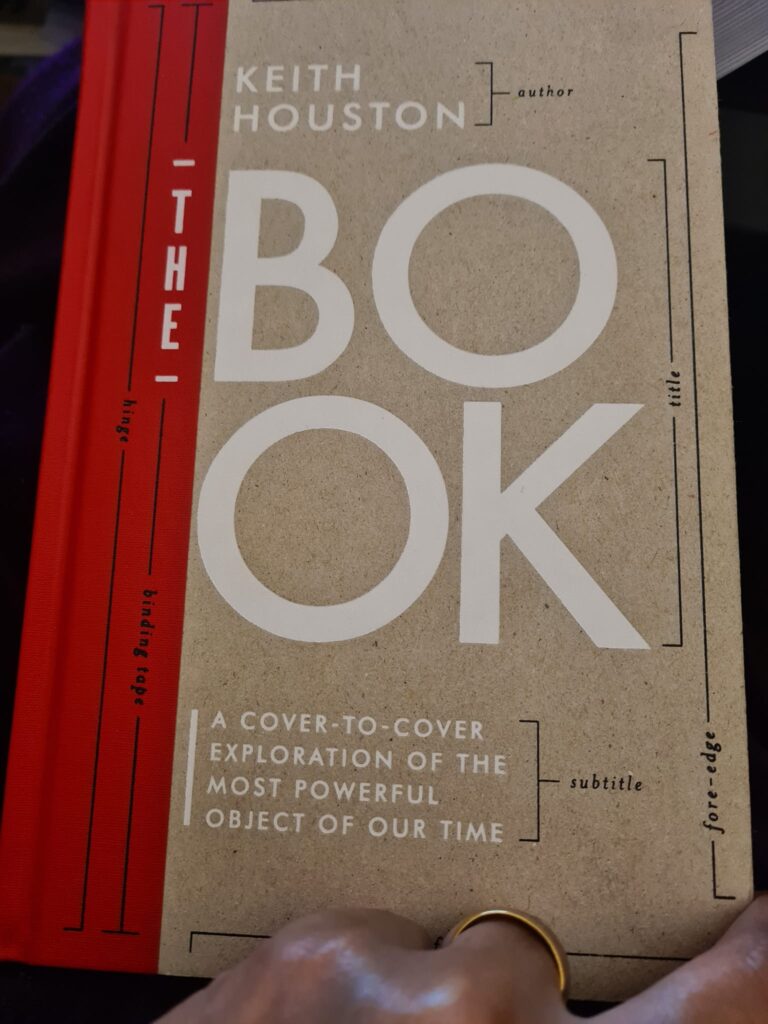
“The Book: A Cover–to–Cover Exploration of the Most Powerful Object of Our Time” by Keith Houston

Books like The Book by Keith Houton will never go out of fashion. It is an informative history about the book. It is very American in its perspective especially when it comes to the history of printing presses and mass prodcution of books/newspapers. The Book needs to be read in conjunction with other histories of the book, printing, publishing and creation of readers/markets especially in the nineteenth century. A fabulous account of mass production of literature and its impact on the reading public during the Victorian Age is by the historian Eric Hobsbawm. Also, William St. Clair on the reading nation during the Romantic Period. To get a lucid account of the book in the sub-continent it is worth reading The Book in India by B S Kesavan ( NBT India) . Similarly, there may be other specific book histories in different nations/regions. It may be worth putting together a list.

Neverthless, The Book by Keith Houston is a fundamental text for the simple, fascinating and information-packed narrative. Excellent stuff!

7 feb 2022

“The Age of AI and our Human Future” by Henry Kissenger, Eric Schmidt and Daniel Huttenlocher

Anything and everything about AI ( Artificial Intelligence) interests me. I read about it. I watch films about it. I am curious about its applications. So, when Henry Kissinger, the former US Secretary of State and a security specialist, co-authors a book on AI with Eric Schmidt, the executive chairman and technical advisor, Google, and Daniel Huttenlocher, inaugural Dean of the MIT Schwarzman College of Computing, I expected a cracker of a book. Alas, The Age of AI and our Human Future was not as cutting edge and futuristic as I had expected it to be. It turned out to be a primer on AI, elaborating upon its history and current debates about it. But there was little insight. I wonder why. Or is it that this book is meant to target the lay person who is curious about AI and would like get a snapshot of the terrain. If that is the case, then it works. Otherwise, for readers like me, who are constantly reading about AI, this was a basic read.

Be that as it may, it will be an essential part of institutional libraries, since the three authors are leaders of their fields and collective knowledge shared in this manner may prove to be useful in the future. It is a way of seeing. A direction.

3 Feb 2022

“Immune”

Philip Dettmer’s Immune is really very well written. Beautifully illustrated. Daughter has whisked it away. I don’t know how much she is comprehending but seems to be liking it. Her new found love in academics is science. She is chuckling while reading the descriptions of the immune system. Now this is really making science accessible!This book has been adapted from Dettmer’s very popular YouTube channel — “Kurzgesagt: In a Nutshell”. It has more than 14 million subscribers that reaches over 30 million viewers every month. He has a team of more than 40 people helping him create the content for the channel, while remaining true to science.It is a really fascinating book. A layman can understand it. A scientist will find it useful.

The detailed bibliography of the papers and books used for research can be found online at: https://kurzgesagt.org/immune-book-sources/

Read it. More so now when everyone is concerned about strengthening their immune systems.

The book has been published by Hodder & Stoughton. It is distributed in India by Hachette India.

24 November 2021

“A Fish in Alien Streams” by Herjinder

A Fish In Alien Streams by Herjinder is an extraordinary book. An account of the introduction of trout by the British. The colonial rulers missed angling as they did “back home”. So they figured out ways in which to transport ova, by sea, in cold conditions to lands as far as Tasmania and India. The Victorian Age was known for some incredible innovations but to discover a viable method of transporting trout ova from Europe to Tasmania and India was astonishing.

I picked up lovely fun facts. One of them being that the original British owners of Kissan jams and sauces were responsible for introducing trout into the sub-continent. Also, how floods have been responsible for dissemination of the fish into the streams of Kashmir, Nilgiris and Sri Lanka. The last interview in the book is with an eighty-three-year-old Jimmy Johnson, an angler. He is a Himachali / Anglo-Indian, whose father, Lt. Col. C. R. Johnson, was one of these British officers who were deeply involved with trout culture farming. But Jimmy learned angling not from his father but by watching the famous angler of the valley, T. Tyson ( the author of “Trout Fishing in Kulu, 1941”). Jimmy’s school was in Mahili, across the river from Katrain where Tyson used to fish virtually every day. And Jimmy would watch the great angler while playing with his friends on the left bank of the river. He started to like Tyson’s ‘game’ more than his own childish ones, seeing it as ‘an interesting game in which delicious lunch and dinner were also guaranteed’.

But in nearly a century since there was abundance of trout in the rivers, the fish is fast disappearing. One of the prime reasons being the rampant construction in the valley and global warming. There are many occasions that Jimmy goes to fish and returns home empty-handed. Yet he renews his angling license annually. In his lifetime, Jimmy has seen trout-abundant rivers to sparsely populated ones now.

It impossible to recapitulate the essence of A Fish in Alien Streams by Herjinder. Suffice to say that this is a wonderful mix of historical narrative and primary source material such as books and interviews. It is very easy to read even if you are not interested in fishing or trouts.

The book cover by Harshad Marathe deserves a special mention. It is unique.

Read it.

2 Nov 2021

“Empire of Pain” by Patrick Radden Keefe

Patrick Radeen Keefe’s award-winning book, Empire of Pain: The Secret History of the Sackler Dynasty is an extraordinary account of the Sackler family. Beginning life in Flatbush, Brooklyn, the three brothers — Arthur, Mortimer and Raymond Sackler — built an empire worth billions of dollars. Their only inheritance from their first-generation immigrant parents was their name. The sons, especially Arthur, ensured that the Sackler name was emblazoned on the walls of prestigious institutions like museums and universities. The brothers, all of whom had trained as doctors, donated generously to the Met, Smithsonian, Columbia University and Harvard University. Few knew where this wealth originated.

Patrick Radden Keefe unravels the stupendous history behind the obscene amounts of wealth that the Sackler family had made. He methodically explains Arthur Sackler’s workaholic nature that enabled him to earn money for his family while he was still in school. The young Arthur was earning sufficient money to feed and keep his family health and safe even during the Depression. Post-war, by which time he was also a qualified doctor, Arthur was practising medicine but also a publicist for pharmaceutical companies such as Pfizer and Roche. The popular demand that Arthur Sackler managed to create for drugs like Terramycin, Valium and Betadine, by running superb marketing campaigns ensured that he was true to his promise to the manufacturing firms that he would make the names of these medicines “household names”. What is truly extraordinary is that Arthur Sackler negotiated deals for himself with the companies that were equivalent to a sliding scale of “royalties” as payment for running the campaigns. So as the companies earned millions of dollars from the sale of the pills, Arthur Sackler’s income rose proportionately ( the manufacturers could not keep pace with the demand!). It meant that the brothers could easily relocate to posher parts of New York. Slowly and steadily, Arthur also began to build one of the largest private collections of Chinese antiques. Soon, the brothers had sufficient money to buy a small, nondescript pharmaceutical company called Purdue Pharma. This became the firm that was used to create and sell drugs. For a long time, the brothers names were linked to selling laxatives and less harmful drugs, very different to what the PR firm they owned was promoting. But it is their development of the OxyContin drug, that was easily available and the basis of the opioid crisis that is truly terrifying. Knowingly, the Sackler family profited billions of dollars while more than 450,000 Americans perished due to this drug — the number far exceeding the combined number of American casualties in all the conflicts since World War II.

There is so much in this book to share that it is impossible to say it all in a short book review. Please read it. Empire of Pain documents the insidious and nefarious ways in which empires are built, economic exploitation of the masses is done in a calculating manner but the powers-that-be are unable to or rather choose not to do anything about it as the Sacklers bribe them. This book is packed with details as to how smoothly the family operated. Most often, Mortimer and Raymond were clueless about the operations as their brother was the mastermind. Yet, as became evident that with Arthur Sackler’s death, the remaining brothers and the younger generations, had inherited the buzz to make money at whatever cost. Arthur Sackler may have negotiated some mind-bogglingly smart deals ( inevitably in his favour) but it was his extended clan that manufactured OxyContin and profited from it. It became harder and harder to pinpoint the Sacklers as being responsible for the healthcare crisis. It required the dogged persistence of the New Yorker reporter, Keefe, to wade through piles and piles of documents, visit archives, interview over 200 people and read correspondence with friends and acquaintances of the Sacklers ( as the brothers were notoriously secretive) to write this comprehensive account. Through it all, no one from the family was ready to speak to him, not even via their lawyer. Yet, he wrote this award-winning book. So far it has won the Baillie Gifford Prize and has been shortlisted for many others.

Empire of Pain is highly recommended.

22 Jan 2022

Web Analytics Made Easy -
StatCounter