
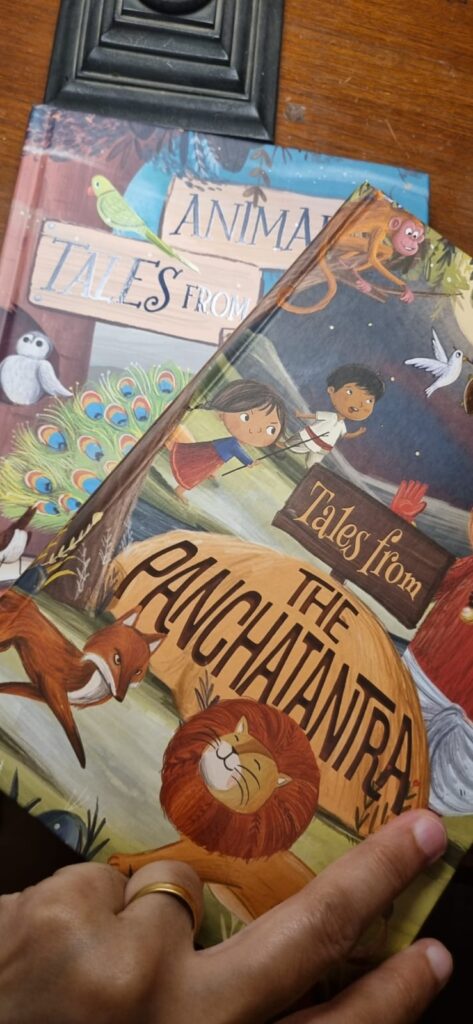
“Animal Tales from India” by Chesta Wadhwani and “Tales from the Panchatantra” by Seher Beg. Both, illustrated by Nayan Bose.
Step into a world where animals talk, trick and teach, where tiny sparrows dream of the big sea and little parrots take on mighty fires. In Timeless Animal Stories from India, every forest hums with laughter and wisdom, every river carries a secret and every creature has a tale to tell. These heart-warming stories, full of wit and wonder, celebrate courage, cleverness and the simple magic of kindness.
Written by Chesta Wadhwani, these stories are perfect for readers aged six and above—and just right for younger children to enjoy at story time too. Brimming with adventure, gentle humour, old-world charm and even wit and wisdom, this collection will be loved by anyone who has ever loved animals or enjoyed listening to their tales.
Chesta Wadhwani is a journalist and writer passionate about stories that explore the connection between nature and the human experience. She studied fiction at Sarah Lawrence College in New York, has written widely for national publications and has contributed to anthologies, including works for children. As the co-author of HUM—When Women Lead for UN Women India, her work is deeply rooted in storytelling that brings the natural world to life.
Step into a world of wisdom, wit, and wonder with this beautifully illustrated collection of 25 timeless tales from the Panchatantra. Meet a brave princess, sly fox, clever hare, and many more unforgettable characters as they navigate thrilling adventures, tricky dilemmas, and unforgettable life lessons. From the Mongoose and the Snake to the Monkey and the Crocodile, these beloved fables have been passed down for generations, teaching kindness, intelligence, and the power of good choices. With vivid full-colour illustrations and engaging storytelling, this stunning book brings ancient wisdom to life. A must-have for every child’s library—perfect for reading alone or sharing with family!
Sahar Beg Oddly enough, the author is not acknowledged on the cover the book nor it there an author blurb available online. But, if I am right, then Sahar Beg is now a young woman who as a teenager would write and comment enthusiastically about children’s and YA literature. (Here, here) In all likelihood, she is another Samhita Arni in the making, who many years ago, retold the Indian epics as a twelve-year-old.
These two books were sent by Red Panda, the children’s imprint of Westland Books. Beautiful editions to look at, even if a tad too heavy to hold. Full page, four colour illustrations complementing the text. Curiously, the illustrator of both the texts is Nayan Bose, about whom there is no description in either the published books nor online. Nor is Nayan Bose acknowledged on the cover of the books. Why? Mysterious. Great idea to publish these two collections. One can never tire of such stories. They can be told and retold umpteen times. But, but, but…
Transferance of oral stories to the written word at the best of times can be challenging. So, I feel a little more effort could have been made, to go that extra mile, to create these stories in a little more child-friendly and definitely easier to read for readaloud. For example, the sentences are too long. The reader will get breathless or just start yawning reading it out aloud. A young listener will tire easily. A neo-literate will struggle to get to the end of a sentence instead of feeling a sense of achievement at having read a description or a piece of action before triumphantly moved on to the next sentence. Why is it that sentences cannot be short and sweet? Why must there be long winded with far too many conjunctions used? Why must there be so many polysyllabic words? Why cannot there be mesmerising joy in the rhythm of words and thus create an engaging text instead of a flat monotone? To top it all, the font used is very turgid. It should be softer and less tighter than it is at present. It is harsh to the eyes. Not at all enticing.
These story books are a good idea, a good effort, available at an affordable price point. and it is truly paisa vasool (value for money as many desi parents would like), but seriously, a little more effort put in to the editing and production, would have ensured a long tail of sales.
19 Sept 2025
