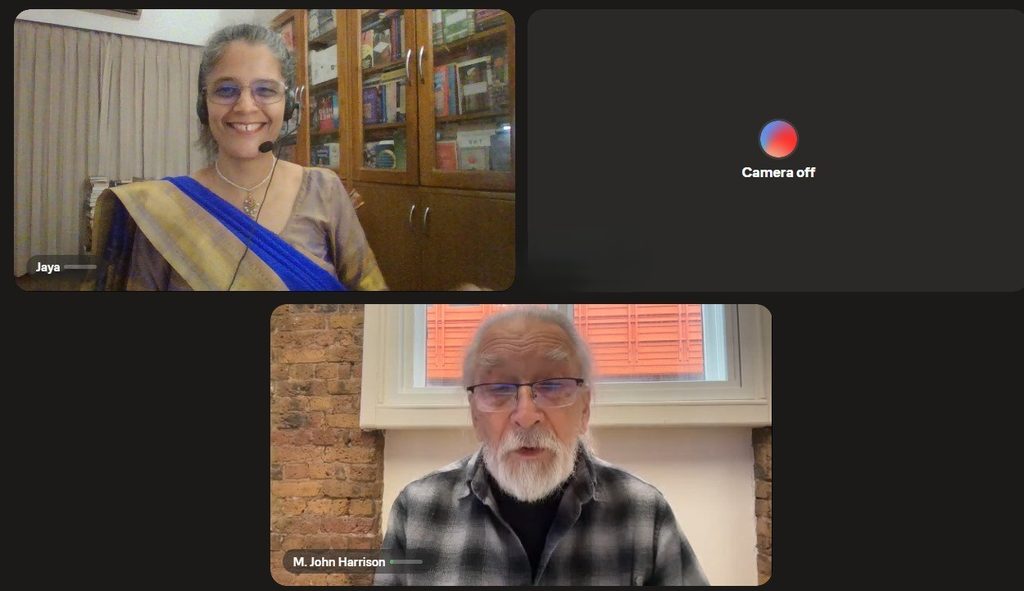
Newly minted Booker Prize 2026 winner, 81-year-old, M. John Harrison and I chatted on the TOI Bookmark* podcast about his novel, The End of Everything within hours of him having won the prize.
Here is the link on Spotify:
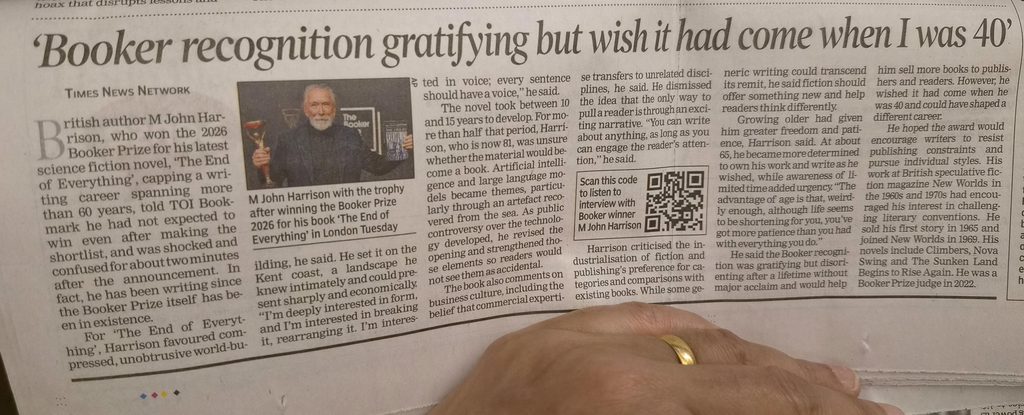
Today, on 12 Nov 2026, an account of the interview was carried in the print edition of The Times of India.
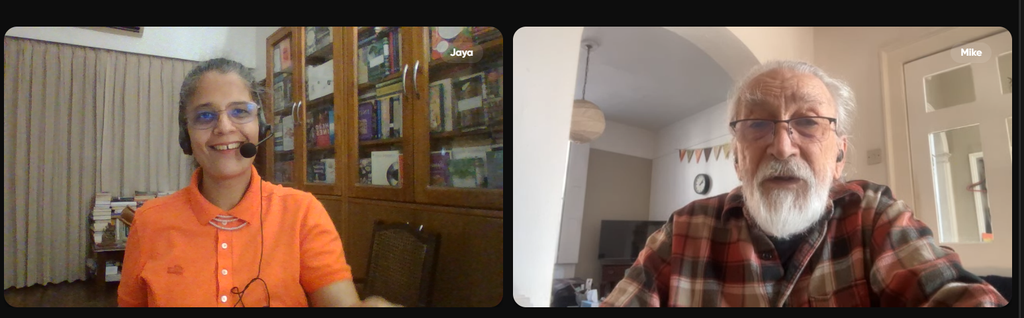
Coincidentally, I had spoken to M. John Harrison in September when he had been longlisted for the prize. The Spotify link:
The book is published by Serpent’s Tail and is distributed in India by Hachette India.
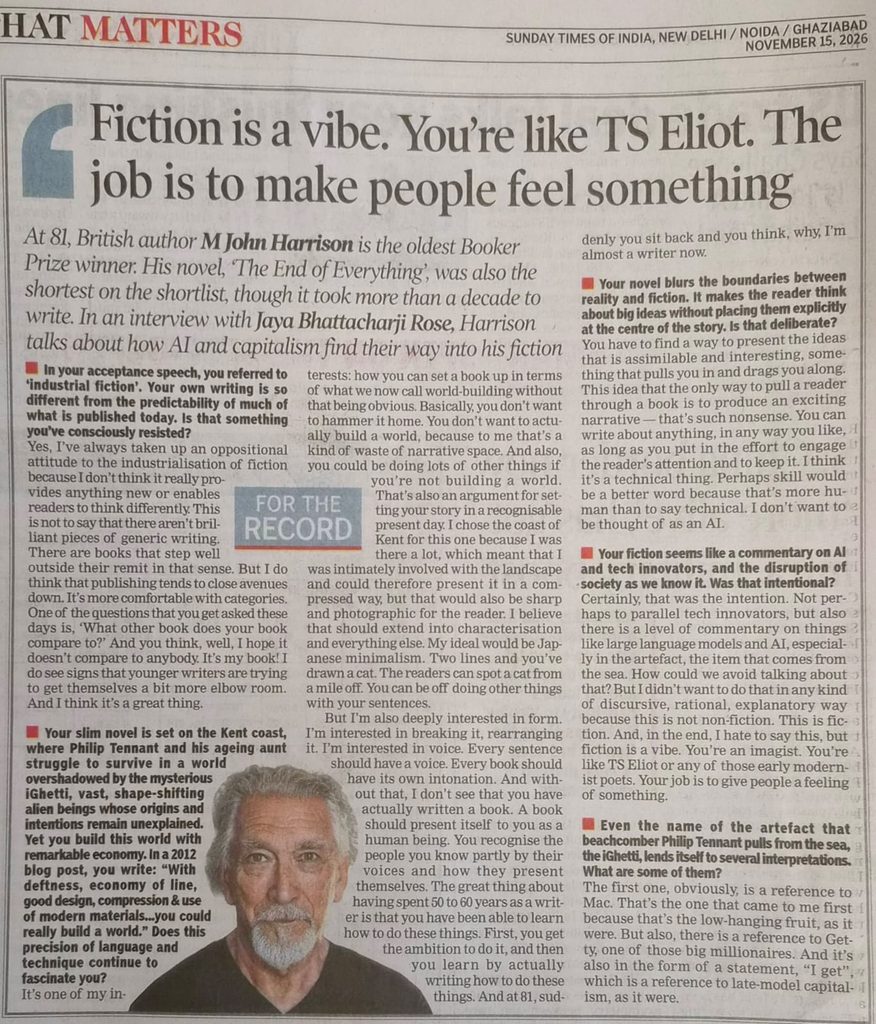
On Sunday, 15 Nov 2026, the Times of India published an extended version of the interview in the print edition of the paper.
*TOI Bookmark is a weekly podcast on literature and publishing. TOI is an acronym for the Times of India (TOI) which is the world’s largest newspaper and India’s No. 1 digital news platform with over 3 billion page views per month. The TOI website is one of the most visited news sites in the world with 200 million unique monthly visitors and about 1.6 billion monthly page views. TOI is the world’s largest English newspaper with a daily circulation of more than 4 million copies, across many editions, and is read daily by approximately 13.5 million readers. The podcasts are promoted across all TOI platforms. I have recorded more than 214+ sessions with Jnanpith, Padma Bhushan, and Padma Shree awardees, International Booker Prize winners, Booker Prize winners, Women’s Prize for Fiction, Nobel Laureates, Pulitzer Prize, Stella Prize, AutHer Awards, Erasmus Prize, BAFTA, Turing Prize, Magsaysay Prize etc. Sometimes the podcast interviews are carried across all editions of the print paper with a QR code embedded in it.
Some of the authors who have been interviewed are: M. John Harrison, Yáng Shuāng-zǐ & Lin King, David Szalay, Banu Mushtaq, Deepa Bhashti, Samantha Harvey, Jenny Erpenbeck, Michael Hoffman, Paul Murray, V. V. Ganeshananthan, Hisham Matar, Anita Desai, Amitava Kumar, Hari Kunzro, Venki Ramakishnan, Siddhartha Deb, Elaine Feeney, Manjula Padmanabhan, Edwin Frank, Jonathan Escoffery, Joya Chatterji, Arati Kumar-Rao, Paul Lynch, Dr Kathryn Mannix, Cat Bohannon, Sebastian Barry, Shabnam Minwalla, Paul Harding, Ayobami Adebayo, Pradeep Sebastian, G N Devy, Angela Saini, Manav Kaul, Amitav Ghosh, Viet Thanh Nguyen, Damodar Mauzo, Geetanjali Mishra, William Dalrymple, Sanjoy Roy, Abdulrazak Gurnah, Andrew Miller, Catherine Chidgey, Dr Rachel Clarke, Charlotte Wood, Megha Majumdar, Kiran Desai, Ken Follett, Philippe Sands, Victoria Bateman, Anuradha Roy, Sir Tim Berners-Lee, Danny Rensch, Anne Beate Hovind, Lyse Doucet, Tayari Jones and Annie Ernaux.
Phillip Tennent makes his living at the tideline, collecting artefacts that wash up from the Channel. It’s been years since the crisis changed everything, but its exact nature remains obscure. Government barely functions, the seas are full of new creatures, Europe has been mislaid. It feels like the end.
Now Phillip has fished out of the water an object he can’t keep. A creature that keeps changing. An artefact he must take inland, before it destroys everything he thinks he knows. The End of Everything is a slyly satirical and unsettling post-apocalyptic adventure into the limits of human understanding from the peerless master of contemporary fiction.
M. John Harrison has been publishing since 1965 although he began writing as a teenager in the 1950s He is a legend especially in the world of speculative fiction. At the age of 82, he is the oldest writer to have been shortlisted for The Booker Prizes 2026 for “The End of Everything” (published by Hachette India). The winner will be announced on 9 Nov 2026. It is a slim novel but it leaves one reeling with the immense possibilities that may exist in humanity’s future. The aliens, iGheti, walking around the community in a near-future south-east England are “monstrously sized, extremely powerful and strange lifeforms” of unknown origin and uncertain purpose. The protagonist, Philip Tennent, lives with his aunt Marnie in the coastal town of Dalston-on-Sea and ekes out a living by collecting – and endeavouring to sell – iGhetti “artefacts” that wash up on the shore. One particular artefact he finds has the potential to change their lives for ever.
It was a pleasure speaking on the TOI Bookmark* podcast with M. John Harrison regarding The End of Everything. This book really makes you think.
M. John Harrison, a genre-defying British author and literary critic. Harrison has been hailed by writers including Olivia Laing, Robert MacFarlane and Neil Gaiman as one of the most brilliant prose stylists alive today. He sold his first story in 1965, and in 1969 joined the staff of the UK speculative fiction magazine New Worlds, where he edited the books pages until 1978.
His novels include Climbers, which won the Boardman Tasker Prize for Mountain Literature in 1989; Nova Swing, which won the Arthur C. Clarke Award in 2007; and The Sunken Land Begins to Rise Again, which won the 2020 Goldsmiths Prize for innovation in fiction. A collection of short stories, You Should Come With Me Now, was published in 2017, and a volume of selected stories written between 1970 and 2020 was published under the title Settling the World.
He has reviewed a broad spread of fiction for the TLS, the Telegraph, the Guardian and the New York Times; co-authored a quartet of fantasy novels about talking cats; and ghostwritten on behalf of a legendary British rock climber. He was a judge of the Booker Prize 2022.
I had the good fortunate of interviewing him in early September. He was shortlisted for The Booker Prize the following week.
Here is the Spotify link:
8 Nov 2026
*TOI Bookmark is a weekly podcast on literature and publishing. TOI is an acronym for the Times of India (TOI) which is the world’s largest newspaper and India’s No. 1 digital news platform with over 3 billion page views per month. The TOI website is one of the most visited news sites in the world with 200 million unique monthly visitors and about 1.6 billion monthly page views. TOI is the world’s largest English newspaper with a daily circulation of more than 4 million copies, across many editions, and is read daily by approximately 13.5 million readers. The podcasts are promoted across all TOI platforms. I have recorded more than 214+ sessions with Jnanpith, Padma Bhushan, and Padma Shree awardees, International Booker Prize winners, Booker Prize winners, Women’s Prize for Fiction, Nobel Laureates, Pulitzer Prize, Stella Prize, AutHer Awards, Erasmus Prize, BAFTA, Turing Prize, Magsaysay Prize etc. Sometimes the podcast interviews are carried across all editions of the print paper with a QR code embedded in it.
Some of the authors who have been interviewed are: Yáng Shuāng-zǐ & Lin King, David Szalay, Banu Mushtaq, Deepa Bhashti, Samantha Harvey, Jenny Erpenbeck, Michael Hoffman, Paul Murray, V. V. Ganeshananthan, Hisham Matar, Anita Desai, Amitava Kumar, Hari Kunzro, Venki Ramakishnan, Siddhartha Deb, Elaine Feeney, Manjula Padmanabhan, Edwin Frank, Jonathan Escoffery, Joya Chatterji, Arati Kumar-Rao, Paul Lynch, Dr Kathryn Mannix, Cat Bohannon, Sebastian Barry, Shabnam Minwalla, Paul Harding, Ayobami Adebayo, Pradeep Sebastian, G N Devy, Angela Saini, Manav Kaul, Amitav Ghosh, Viet Thanh Nguyen, Damodar Mauzo, Geetanjali Mishra, William Dalrymple, Sanjoy Roy, Abdulrazak Gurnah, Andrew Miller, Catherine Chidgey, Dr Rachel Clarke, Charlotte Wood, Megha Majumdar, Kiran Desai, Ken Follett, Philippe Sands, Victoria Bateman, Anuradha Roy, Sir Tim Berners-Lee, Danny Rensch, Anne Beate Hovind, Tayari Jones, Lyse Doucet, M. John Harrison, Luke Kennard, and Annie Ernaux.
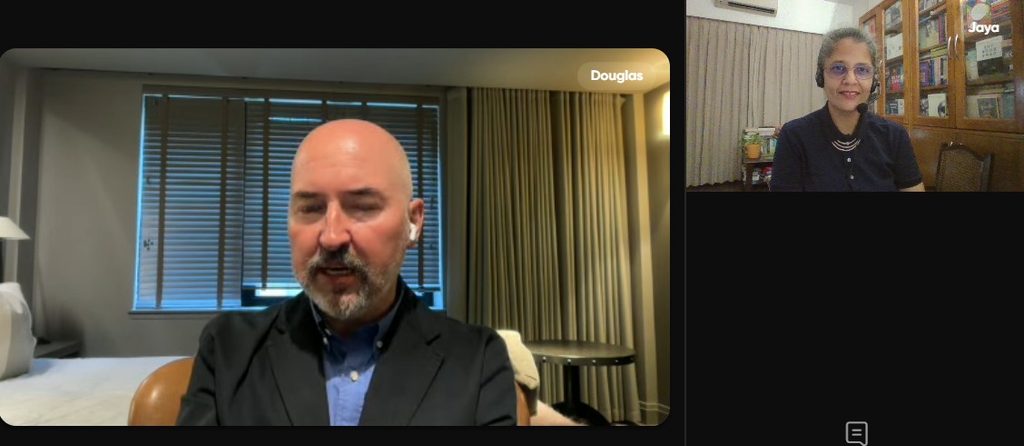
Ever since Douglas Stuart burst upon the literary scene, I have been a huge fan. He writes exceptionally well. So, I was delighted when an opportunity to interview him for the TOI Bookmark* podcast presented itself. Overjoyed is more like it. John of Johns is an outstanding novel. So, to be able to interview the author immediately after having finished it, is a dream come true. We recorded this episode on 19 May 2026. It is published by Pan Macmillan India.
On 7 Nov 2026, Douglas Stuart made history with Waterstones Scottish Book of the Year win by having won it twice. His latest novel, John of John, has claimed the honour six years after his debut, Shuggie Bain, won the same prize in 2020. Now to discover on Monday 9 nov 2026 if he has achieved the same success with The Booker Prize 2026.
I am not even going to try and explain what the novel is about or analyse it. Read it for yourself. Here is a snippet from our conversation:
“I never believe the idea that people of faith are not human first. We are all human and we are all struggling. Whether it is on a moral scale or just on an idea what is life about and why are we here? So, as to paint the nuance of that is part of the idea why I wanted to write the book to really humanise. The modern world looks at the people of faith as if they are a trope or a cliché or just one type of thing. I think novels are a wonderful way to portray, better than painting a portrait, better than cinema, not only do you have the surface and the aesthetic, but you also have the interiority, the moral layer, the historical layer, the desire, the sexual, you have all of it. You can move in temporal directions that you cannot in other forms of capturing human life.”
Listen to it on Spotify:
It is available on Spotify:
From the book blurb:
Out of money and with little to show for his art school education, John-Calum Macleod takes the ferry home to the island of Harris to find that not much has changed except for him. In the windswept croft where he grew up, Cal resumes his old life, caught between the two poles of his childhood: his father John, a sheep farmer, weaver, and pillar of their local Presbyterian church, and his Glaswegian grandmother Ella, who has kept a faltering peace with her son-in-law for decades.
While Cal wonders if any lonely men might be found on the barren hillsides of home, John is dismayed by his son’s long hair and how he seems unwilling to be Saved. As the seasons pass, everything is poised to change as the threads holding together the fragile community become increasingly entangled.
This is a novel worth reading!
8 Nov 2026
*TOI Bookmark is a weekly podcast on literature and publishing. TOI is an acronym for the Times of India (TOI) which is the world’s largest newspaper and India’s No. 1 digital news platform with over 3 billion page views per month. The TOI website is one of the most visited news sites in the world with 200 million unique monthly visitors and about 1.6 billion monthly page views. TOI is the world’s largest English newspaper with a daily circulation of more than 4 million copies, across many editions, and is read daily by approximately 13.5 million readers. The podcasts are promoted across all TOI platforms. I have recorded more than 214+ sessions with Jnanpith, Padma Bhushan, and Padma Shree awardees, International Booker Prize winners, Booker Prize winners, Women’s Prize for Fiction, Nobel Laureates, Pulitzer Prize, Stella Prize, AutHer Awards, Erasmus Prize, BAFTA, Turing Prize, Magsaysay Prize etc. Sometimes the podcast interviews are carried across all editions of the print paper with a QR code embedded in it.
Some of the authors who have been interviewed are: Yáng Shuāng-zǐ & Lin King, David Szalay, Banu Mushtaq, Deepa Bhashti, Samantha Harvey, Jenny Erpenbeck, Michael Hoffman, Paul Murray, V. V. Ganeshananthan, Hisham Matar, Anita Desai, Amitava Kumar, Hari Kunzro, Venki Ramakishnan, Siddhartha Deb, Elaine Feeney, Manjula Padmanabhan, Edwin Frank, Jonathan Escoffery, Joya Chatterji, Arati Kumar-Rao, Paul Lynch, Dr Kathryn Mannix, Cat Bohannon, Sebastian Barry, Shabnam Minwalla, Paul Harding, Ayobami Adebayo, Pradeep Sebastian, G N Devy, Angela Saini, Manav Kaul, Amitav Ghosh, Viet Thanh Nguyen, Damodar Mauzo, Geetanjali Mishra, William Dalrymple, Sanjoy Roy, Abdulrazak Gurnah, Andrew Miller, Catherine Chidgey, Dr Rachel Clarke, Charlotte Wood, Megha Majumdar, Kiran Desai, Ken Follett, Philippe Sands, Victoria Bateman, Anuradha Roy, Sir Tim Berners-Lee, Danny Rensch, Anne Beate Hovind, Tayari Jones, Lyse Doucet, M. John Harrison, Luke Kennard, and Annie Ernaux.
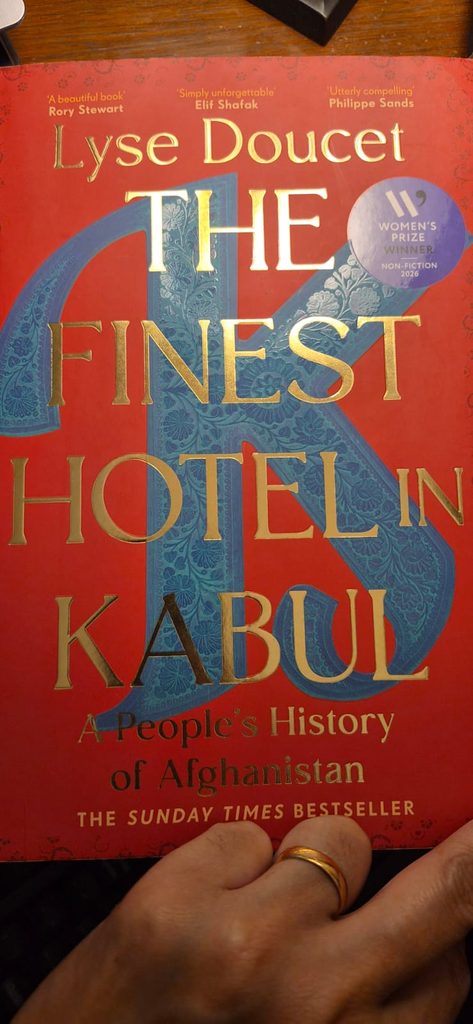
Lyse Doucet is known worldwide as the Chief International Correspondent and senior presenter for the BBC — radio and television. She is an award-winning journalist and now as debut writer too. She won the Women’s Prize for Nonfiction 2026 for her fabulous book The Finest Hotel in Kabul: A People’s History of Afghanistan.
The Finest Hotel in Kabul is an incredible history of Afghanistan of approximately five decades. As Lyse says that “In my lifetime, Afghanistan has been a kingdom, a republic, an Islamic emirate — these changes tell us a story.” She maps the transformations in society via her profiles of individuals, and yet it is a “polyphonic” narrative nonfiction. She delves into the past, she resurrects influential people like the singer Ahmad Zahir and many others. She covers the length and breadth of society. It is incredibly difficult to distil the book into a few lines except to say that it is an accessible account of a nation that has lived and is living through turbulent times. Philippe Sands has justifiably said that it is “utterly compelling” and Elif Shafak has called it “simply unforgettable”. Lyse has been visiting Kabul since 1988. Her familiarity with the people, the terrain, the intricate politics, the understanding of the histories of the politics, the politicians, the warlords etc comes through with a lot of humility, depth, empathy and the desire to channel her multiple experiences and share it with the world. It is truly worth reading.
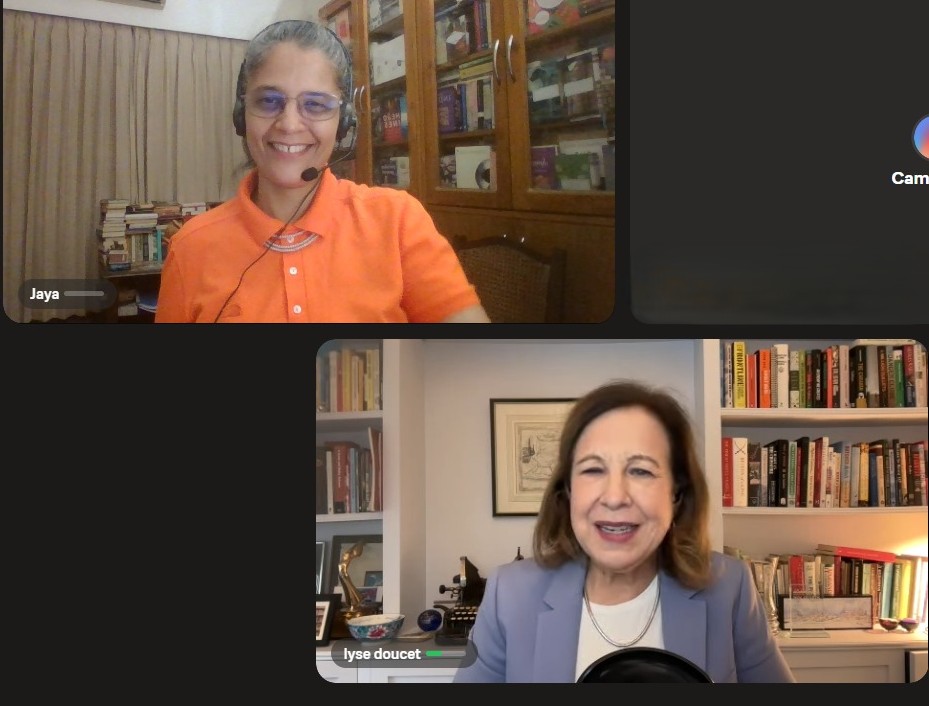
A few days ago, I had the honour and privilege to interview Lyse Doucet for the TOI Bookmark* podcast. I will upload the Spotify link to the interview once it is available. She is an extremely busy journalist but had the grace to make time for us to record an episode of the podcast. More so, when she is no longer promoting her book or recording any podcasts.
7 Nov 2026
*TOI Bookmark is a weekly podcast on literature and publishing. TOI is an acronym for the Times of India (TOI) which is the world’s largest newspaper and India’s No. 1 digital news platform with over 3 billion page views per month. The TOI website is one of the most visited news sites in the world with 200 million unique monthly visitors and about 1.6 billion monthly page views. TOI is the world’s largest English newspaper with a daily circulation of more than 4 million copies, across many editions, and is read daily by approximately 13.5 million readers. The podcasts are promoted across all TOI platforms. I have recorded more than 214+ sessions with Jnanpith, Padma Bhushan, and Padma Shree awardees, International Booker Prize winners, Booker Prize winners, Women’s Prize for Fiction, Nobel Laureates, Pulitzer Prize, Stella Prize, AutHer Awards, Erasmus Prize, BAFTA, Turing Prize, Magsaysay Prize etc. Sometimes the podcast interviews are carried across all editions of the print paper with a QR code embedded in it.
Some of the authors who have been interviewed are: Yáng Shuāng-zǐ & Lin King, David Szalay, Banu Mushtaq, Deepa Bhashti, Samantha Harvey, Jenny Erpenbeck, Michael Hoffman, Paul Murray, V. V. Ganeshananthan, Hisham Matar, Anita Desai, Amitava Kumar, Hari Kunzro, Venki Ramakishnan, Siddhartha Deb, Elaine Feeney, Manjula Padmanabhan, Edwin Frank, Jonathan Escoffery, Joya Chatterji, Arati Kumar-Rao, Paul Lynch, Dr Kathryn Mannix, Cat Bohannon, Sebastian Barry, Shabnam Minwalla, Paul Harding, Ayobami Adebayo, Pradeep Sebastian, G N Devy, Angela Saini, Manav Kaul, Amitav Ghosh, Viet Thanh Nguyen, Damodar Mauzo, Geetanjali Mishra, William Dalrymple, Sanjoy Roy, Abdulrazak Gurnah, Andrew Miller, Catherine Chidgey, Dr Rachel Clarke, Charlotte Wood, Megha Majumdar, Kiran Desai, Ken Follett, Philippe Sands, Victoria Bateman, Anuradha Roy, Sir Tim Berners-Lee, Danny Rensch, Anne Beate Hovind, Tayari Jones, Lyse Doucet, M. John Harrison, Luke Kennard, and Annie Ernaux.
I wrote a review article of Philippe Sands trilogy for Moneycontrol. It was published on 3 Dec 2025.
In 2010, barrister Philippe Sands was invited by the law faculty of a university in the city now known as Lviv, Ukraine, to deliver a public lecture on his work on crimes against humanity and genocide. Lemberg, Lviv, Lvov, and Lwów as it has been known through history are the same place. The name changed according to who commanded the city. It changed hands, no fewer than eight times in the years between 1914 and 1945. Sands had been asked to talk about the cases in which he had been involved, about his academic work on the Nuremberg trials, and about the trials consequences for the modern world. The Nuremberg trials which laid the groundwork for the human rights movement continues to fascinate Sands.
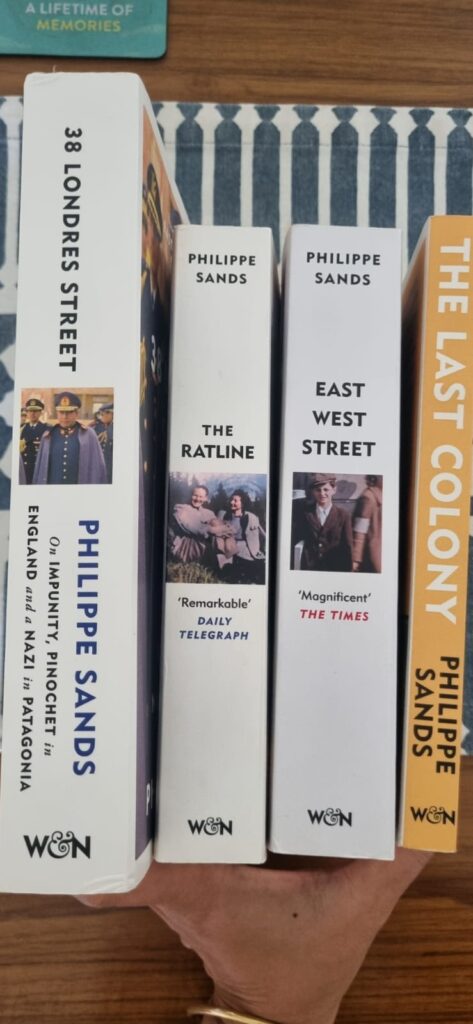
Philippe Sands KC is Professor of Law at University College London and Visiting Professor of Law at Harvard. He is a practising barrister at 11 Kings Bench Walk (KBW), appears as counsel before the International Court of Justice and other international courts and tribunals and sits as an international arbitrator. He has written multiple books but it is his bestselling oral histories that are considered exceptional. These are: East West Street, The Ratline, and 38, Londres Street. Some of these have won awards such as the Baillie Gifford Prize 2016 for East West Street, The Ratline was converted into a BBC podcast series, and now 38 Londres Street has been optioned for a film by Felipe Gálvez with Marvel actor Sebastian Stan in the lead. His books have been translated into more than 30 languages.
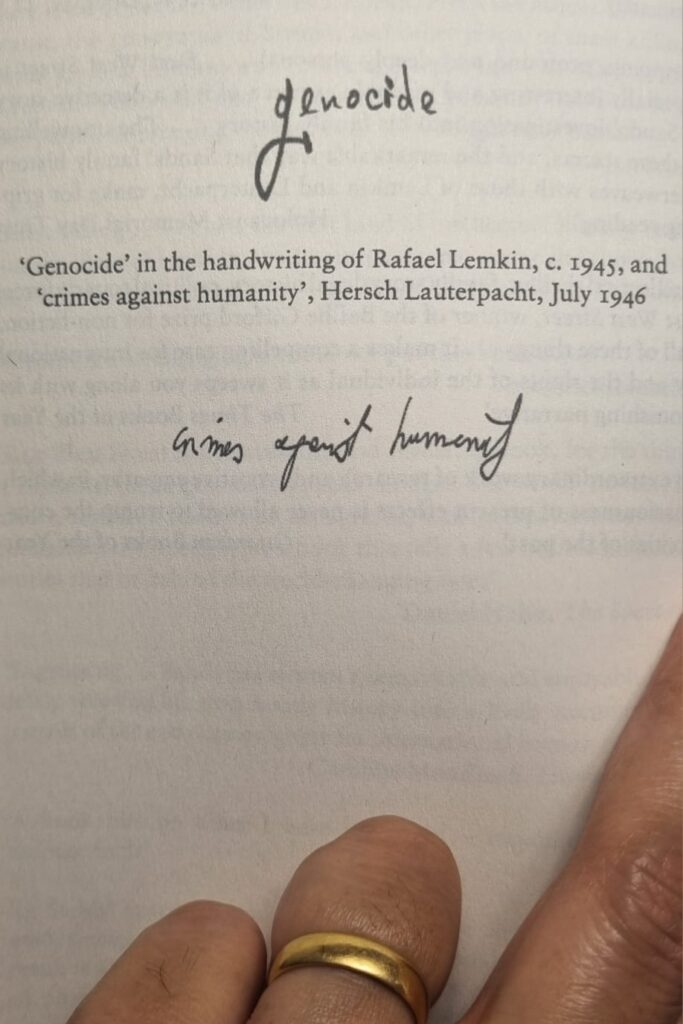
East West Street is a fascinating investigative narrative about two prominent jurists of the Nuremberg trials — Hersch Lauterpacht and Raphael Lemkin. These international criminal trials held by France, the Soviet Union, the United Kingdom, and the United States against leaders of the defeated Nazi Germany for plotting and carrying out invasions of several countries across Europe and committing atrocities against their citizens in the Second World War. Eighty years ago, on 20 November 1945 and 1 October 1946, the International Military Tribunal (IMT) tried 22 of the most important surviving leaders of Nazi Germany in the political, military, and economic spheres, as well as six German organizations. The purpose of the trials was not only to try the defendants but also to assemble irrefutable evidence of Nazi war crimes. Sands blends history with his memoir, his quest to discover the origins of his maternal family, particularly about his grandfather, Leon Buchholz, who never spoke about his past. This is a book about justice being delivered.
The Ratline is an investigation into unearthing the truth behind what happened to leading Nazi Baron Otto Gustav von Wächter who died in Rome in 1949. He was a high-ranking Nazi official, an SS officer who participated in the Final Solution extermination of Jews in Europe. During the occupation of Poland by the Germans, he was Governor of Krakow and responsible for the killing of Polish Jews. In The Ratline, Sands meets with Otto van Wächter’s son, Horst. The book is about them, Horst’s favourable stance of his antisemitic parents and engaging in many conversations with Sands over some years including giving him access to his mother, Charlotte Wächter’s papers. It is an extraordinary achievement given that Sands and Wächter did not shift from their stances but continued to maintain a dialogue. This is a book about trying to comprehend why a Nazi criminal escaped justice and why his son continues to be sympathetic for the evil his father unleashed.
38, Londres Street is the concluding part of the trilogy wherein Sands explores the question of another Nazi, Walther Rauff, and his close proximity to the Chilean dictator Augusto Pinochet. Rauff was the SS Commander who was responsible for the infamous Nazi mobile gas vans and later under the Pinochet regime, was associated with the equally dark “refrigerated trucks” that were linked to the disappearance of people who were vocal against the dictator. In this book, Sands in his trademark style, investigates, travels, and unearths evidence regarding this dark period of Chilean and Nazi Germany histories. But it is also Sands documentation of the impunity with which these criminals can get away with justice. Pinochet, for instance, who on medical grounds was granted pardon by the then British Home Secretary Jack Straw, returns to his homeland instead of being deported to Spain as had been requested and whose first act upon reaching the airport tarmac was to stand up from his wheelchair and walk!
These books designed to be standalone narratives, have inadvertently come to be referred as a “trilogy”. Presumably because the narrative arc governing these three texts is Sands preoccupation with impact of the Nuremberg trials on international justice. More significantly, how did the two definitions coined at this time — “genocide” and “crimes against humanity” — impact contemporary global politics. These are ideas that continue to haunt international law in the twenty-first century. In each book, he explores, questions, and investigates key figures such as Lauterpacht and Lemkin in East West Street, Horst von Wächter in The Ratline and Walther Rauff and Augusto Pinochet in 38 Londres Street. In the texts, Sands uses his legal expertise to present evidence about criminals, jurists, ordinary citizens who are affected by these horrific acts and the idea of justice. The latter is a complicated space to inhabit as Sands narrative determines. For example, justice is meted out to a Nazi criminal like Hans Frank in the Nuremberg trials. Yet, there are those who with impunity escape justice as in the case of Augusto Pinochet and his aide Walther Rauff. Or there are those who inhabit the grey space of not seeing any wrong in acts of genocide particularly in those individuals who perpetrated this. All this despite there being plenty of hard evidence to suggest that these people not only participated but orchestrated the extermination of others. For example, like Otto von Wächter, whose son, Horst von Wächter (Financial Times profile, 2013) who firmly believes that ‘I must find the good in my father. My father was a good man, a liberal who did his best. Others would have been worse’. This is quite unlike Niklas Frank, who when he accompanied Sands to courtroom 600 in Nuremberg, spoke gently and firmly. “This is a happy room, for me, and for the world”. In principle Niklas was against the death penalty but not when it came to his father. And yet, Niklas Frank is the one who introduced Sands to Horst von Wächter. Later, Sands accompanied these two sons of the senior Nazi war criminals as they travelled through Europe to confront the past sins of their fathers. It has been documented in the film called What Our Fathers Did: A Nazi Legacy (2015).
In the summer of 1998, Sands had been peripherally involved in the negotiations that led to the creation of the International Criminal Court (ICC), at a meeting in Rome, and a few months later he worked on the Pinochet case in London. The former president of Chile had claimed immunity from the English courts for charges of genocide and crimes against humanity laid against him by a Spanish prosecutor, and he had lost. In the years that followed, other cases requiring the courts of international justice, like from the former Yugoslavia and Rwanda soon landed on his desk in London. Others followed, relating to allegations in the Congo, Libya, Afghanistan, Chechnya, Iran, Syria and Lebanon, Sierra Leone, Guantánamo, and Iraq. According to Sands, “The long and sad list reflected the failure of good intentions aired in Nuremberg’s courtroom 600.” He continues:
I became involved in several cases of mass killing. Some were argued as crimes against humanity, the killings of individuals on a large scale, and others gave rise to allegations of genocide, the destruction of groups. These two distinct crimes, with their different emphases on the individual and the group, grew side by side, yet over time genocide emerged in the eyes of many as the crime of crimes, a hierarchy that left a suggestion that the killing of large numbers of people as individuals was somehow less terrible. Occasionally, I would pick up hints about the origins and purposes of the two terms and the connection to arguments first made in courtroom 600. Yet I never inquired too deeply as to what had happened at Nuremberg. I knew how these new crimes had come into being, and how they subsequently developed, but little about the personal stories involved, or how they came to be argued in the case against Hans Frank. Nor did I know the personal circumstances in which Hersch Lauterpacht and Rafael Lemkin developed their distinct ideas.
On a map, Lviv is right in the centre of Europe. It stands at the midpoint of imaginary lines, connecting Riga to Athens, Prague to Kiev, Moscow to Venice. It is the epicentre of the fault lines that divided east from west, north from south. In those days, cities such as these, usually had two main streets, one that ran from north to south, the other from east to west. Lembergstrasse or East West Street in Lviv, is where Sands maternal grandfather Leon Buchholz and extended clan hailed from. Later, many of them, including Sands great-grandmother, lost their lives in the Nazi concentration camps. Leon, his wife, and their young daughter, fortunately managed to escape. Leon on a Polish passport and his wife on an Austrian passport.
East West Street: On the Origins of Genocide and the Crimes Against Humanity is an intricately told story. It is packed with information, as Sands digs deeper and deeper into official and personal archives. Surprisingly, he gets ready access and converses regularly even with the descendants of the Nazis. For example, Niklas Frank, whose father, Hans Frank (“The Butcher of Warsaw”) was one of those on trial at Nuremberg and ultimately sentenced to death. To Philippe Sands amazement as he delved deep into research, it became clear that the Nuremberg jurists, his legal hero Hersch Lauterpacht and Raphael Lemkin, whose work was foundational to the discipline of international criminal law, were from the same city as Leon Buchholz. The lawyers coined and defined “genocide” and “crimes against humanity”. This is a thrilling fact for a barrister to discover; to personally be at the intersection of his legal interests and his family history. It allowed Sands to write an incredible memoir. He masterfully interweaves the biographies of Lauterpacht and Lemkin’s with his Jewish lineage. The result is as spy thriller writer, John le Carré called it: “A monumental achievement: profoundly personal, told with love, anger and great precision.”
In fact, there is this brilliant section (Chapter 119) wherein Sands analyses “genocide” and “crimes against humanity” — the fundamental principles of human rights in international law.
Lauterpacht’s draft made no reference to genocide, or to the Nazis, or Germans as a group, or crimes against Jews or Poles, or indeed crimes against any other groups. Lauterpacht set his back against group identity in the law, whether as victim or perpetrator. Why this approach? He never fully explained it, but it struck me as being connected to what he experienced in Lemberg, on the barricades, observing for himself how one group turned against another. Later he saw firsthand how the law’s desire to protect some groups—as reflected in the Polish Minorities Treaty—could create a sharp backlash. Poorly crafted laws could have unintended consequences, provoking the very wrongs they sought to prevent. I was instinctively sympathetic to Lauterpacht’s view, which was motivated by a desire to reinforce the protection of each individual, irrespective of which group he or she happened to belong to, to limit the potent force of tribalism, not reinforce it. By focusing on the individual, not the group, Lauterpacht wanted to diminish the force of intergroup conflict. It was a rational, enlightened view, and also an idealistic one.
The counterargument was put most strongly by Lemkin. Not opposed to individual rights, he nevertheless believed that an excessive focus on individuals was naive, that it ignored the reality of conflict and violence: individuals were targeted because they were members of a particular group, not because of their individual qualities. For Lemkin, the law must reflect true motive and real intent, the forces that explained why certain individuals —from certain targeted groups—were killed. For Lemkin, the focus on groups was the practical approach.
Despite their common origins, and the shared desire for an effective approach, Lauterpacht and Lemkin were sharply divided as to the solutions they proposed to a big question: How could the law help to prevent mass killing? Protect the individual, says Lauterpacht. Protect the group, says Lemkin.
Unsurprisingly as happens in many family histories, there are many twists and turns. Horst von Wächter’s only child, Magdalena, brought up as a firm Catholic, for many years believed her father’s account of her grandfather and sympathised. But recently married, she was trying to understand the family’s past. Then she heard Philippe Sands podcast series The Ratline(BBC, 2018) and wrote to him saying that she concluded that her grandparents “were very aware of what they did and somehow never regretted it”. It is a burdensome family heritage that she was trying to recover from. She complimented Sands on his podcast series and believed that he had portrayed her father Horst “fairly”. Walter Rauff’s grandson had a similar reaction upon reading 38 Londres Street and wrote to Sands appreciating his profile of his grandfather. There seem to have been no familial repercussions there but a rift has been created between Magdalena and Horst. After coming to terms with her family’s Nazi past, she wrote on her social media page, “My grandfather was a mass murderer”. Her father ordered her to remove it but she refused.
The three books are very similar in structure that they posit two individuals in a setting with Sands being very much in the centre of the action. It is almost as if the lines are blurred between the authorial narrator and the litigator. In every text, Sands presents evidence to the reader as he would be expected to present it in the court before the judges and jurors. This could be in the form of texts, personal correspondence, photographs, archival material, documents, or oral testimonies of the survivors and their descendants. Astonishingly, even though he establishes fairly early on in the trilogy that silence is an act of self-preservation amongst the victims/relatives of genocide such as in the case of his own grandfather; even so, he manages to exhibit immense patience and maintain a dialogue with the individuals he interviews. His professionalism can be gauged in the manner in which he continues his conversations even if he does not agree with the interlocutor as becomes obvious in his discussions with Horst von Wächter. He presents his arguments in his narration but leaves it sufficiently open for the reader to come to their own conclusions. It is in all likelihood a challenging balancing act to perform with the written word, but Sands brings his decades of expertise as a barrister to the words on the page. He does tend to explore background details in excruciating minutiae and insists on placing them within the main narrative, but once the reader familiarises themselves with his writing style, it becomes easier and easier to read. It is almost like reading a thriller. It is impossible to put the books down despite the terrifying details that emerge. It is the truth.
The trilogy tackles subjects that are full of alarmingly violent details that were perpetrated by individuals who firmly believed in their acts. For instance, Rudolf Höss, the commandant of Auschwitz, privately told the US army psychologist Dr. Gilbert at the Nuremberg trials that the dominant attitude at Auschwitz was of total indifference. Any other sentiment “never even occurred to us”. This attitude is apparent in all the Nazis profiled in these books. It is immaterial that Sands is discussing facts from the past as disconcertingly these continue to have ramifications upon the present, in the twenty-first century. Most obviously being that of international law debating on “genocide” and “crimes against humanity”. So, despite 38 Londres Street concluding with an ambiguity that is frustrating, at least in the previous two books — East West Street and The Ratline — the younger generation, Niklas Frank and Magdalena provide hope by acknowledging and rejecting the criminal acts perpetrated by their forbears.
It is magnificent research and methodology that are on display. These compactly told narratives will appeal to younger generations of readers as they wish to know more about these despicable moments in history. More so, for the grey areas that exist in bringing the criminals to justice or for that matter how are these stories inherited, preserved — in memory, family histories, and archives.
Given the short lifespan of books, these bestselling oral histories by Philippe Sands will stand the test of time and sell. They are a must read.