NCERT Posts

“Abundant Sense: Rahim – Selected Dohas” by Chandan Sinha

While reading Abundant Sense, I realised how many of Rahim’s doha’s were familiar. These were part of our Hindi curriculum in middle school. We had supplementary books that consisted of prose and poetry. If memory serves me correctly, we had one volume of poetry devoted to Hindi poets like Mahadevi Varma, Dinkar, Suryakant Tripathi (Nirala), Harivansh Rai Bachchan et al. Another volume of poetry consisted of poets like Kabir and Rahim. For prose, we had a fine collection of Premchand’s stories written in the Devnagari script. These were slim texts published by the National Council of Educational Research and Training (NCERT). So, reading Rahim’s doha’s in Abundant Sense brought back memories.

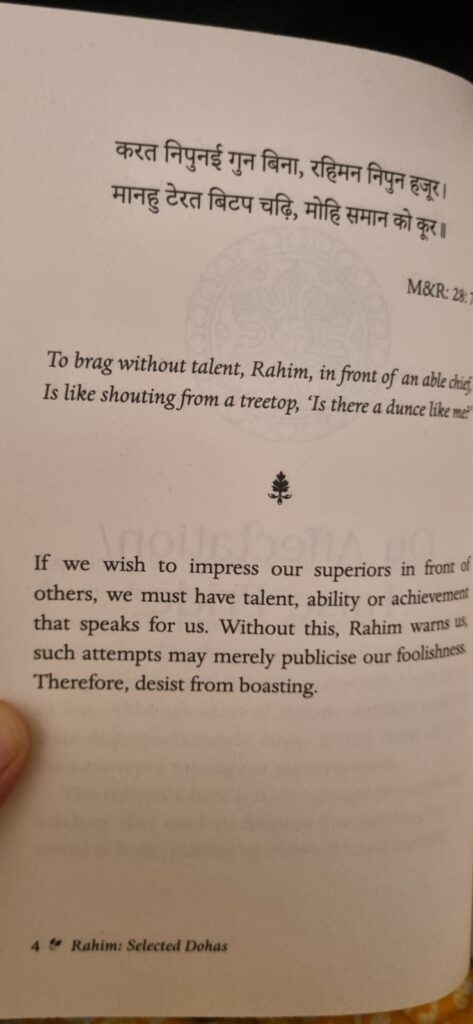
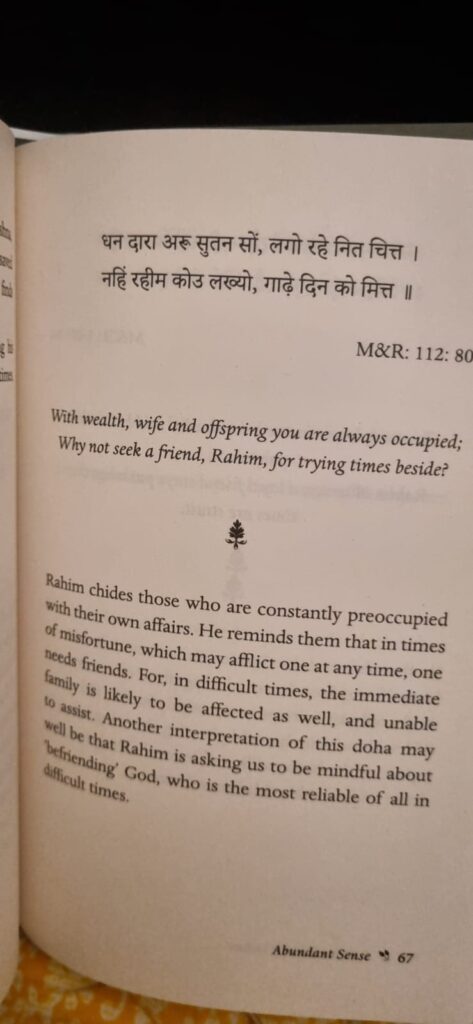
Every page has a doha. The original in Hindi, followed by a literal translation of the couplet and the explanation in English. Here are four examples of these competent translations:
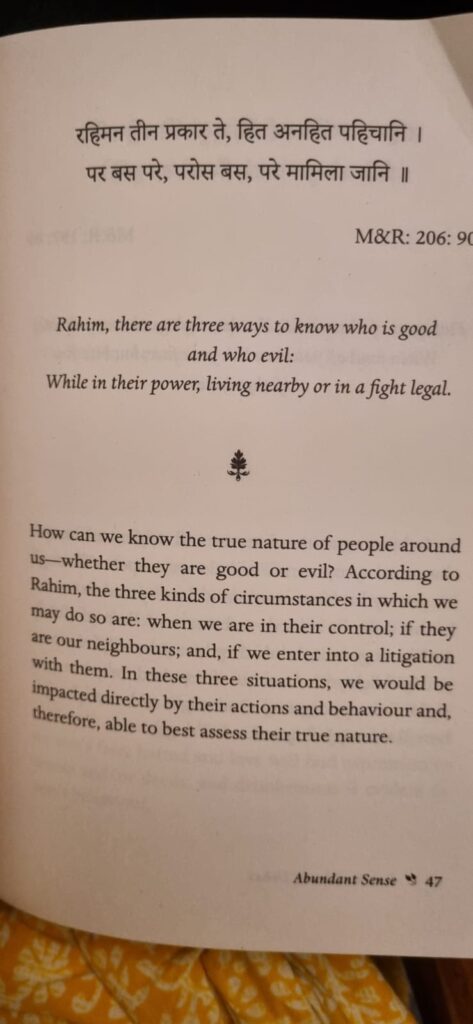
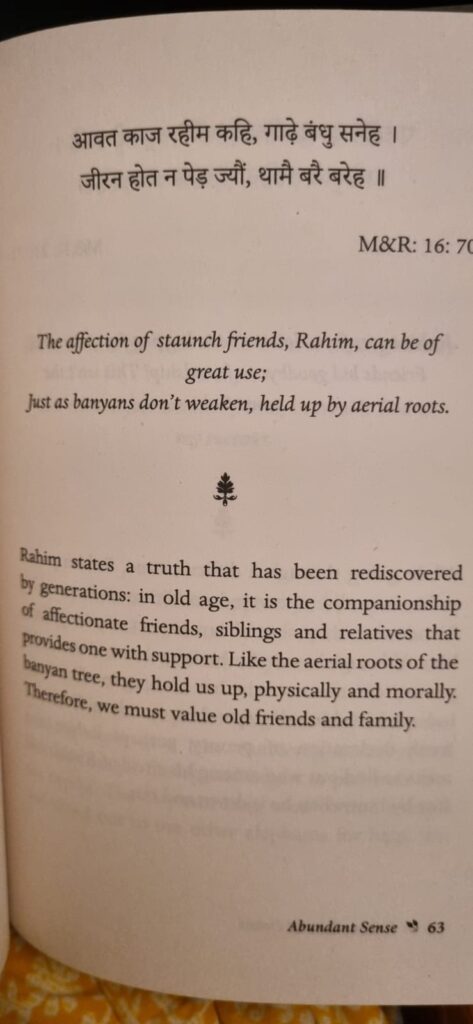
Abundant Sense ( published by Westland Books) is an exquisitely produced book, beginning from the elegant dust jacket to the design layout of every single page. It is generous and a pleasure to read. This is a book that is a keeper but has probably been designed keeping the “gift market” in mind as well. For instance, it would make for an excellent contribution to the Diwali hampers that are circulated.

Book blurb

Abdur Rahim Khan-i-Khanan was a remarkable man, a navaratna in Akbar’s court—warrior, general, administrator, minister, scholar, polyglot, translator and poet. But, today, he is remembered primarily as a poet, a fact evident in his mausoleum in Delhi, now partially restored, which introduces him thus: ‘Rahim was famous for his dohas and Persian translation of the Ramayana.’

Rahim’s life saw wild swings of fate; he knew glory and ignominy, power and insignificance, and above all, loss. Born into wealth and nobility, he was yet finely attuned to the lives and needs of the common man. And four centuries later, his dohas, or couplets, are still invoked, still on the tongue of ordinary folk.

This thoughtfully compiled volume is the first substantial body of translations of Rahim’s dohas, comprising more than half of the 290 dohas he has written. Chandan Sinha’s translation breaks with the modern tendency to use free verse, working instead with meter and rhyme to strongly evoke the original, especially its memorability. Accompanied by brief explanations of each verse as well as the original in Devanagari, Abundant Sense is a tribute to one of the greats of Indian history and literature.

A writer, translator and former civil servant, Chandan Sinha read English Literature at St. Stephen’s College, Delhi, and Public Administration at the Universities of South Carolina and Syracuse in the USA. In 2023 he superannuated from the Indian Administrative Service as Director General of the National Archives of India.

Sinha writes in both English and Hindi. He has published articles in various journals and is the author of three books: Public Sector Reforms in India: New Role of the District Officer (Sage, 2007); Kindling of an Insurrection: Notes from Junglemahals (Routledge, 2013) and The Vision of Wisdom, Kabir: Selected Sakhis (Rupa, 2020).

The present work is the second in a series of translations of Hindi poetry from the early modern period in India.

27 July 2025

National Book Promotion Policy: Where Are We? ( Nov 2011)

National Book Promotion Policy: Where Are We? ( Nov 2011)

PubSpeak, Jaya

( My comments on the Indian Government’s National Book Promotion Policy. This is from my column, PubSpeak, in BusinessWorld, 18 Nov 2011. The original url is: http://www.businessworld.in/en/storypage/-/bw/national-book-promotion-policy-where-are-we/r361073.37487/page/0 )

The Indian government’s National Book Promotion Policy enshrines a number of good ideas that are bound to have a positive impact on the publishing industry

The demand for books is being propelled by India’s 8.8 per cent growth in 2010 and the reading habits of the burgeoning Indian middle class. Publishers forecast India will be the biggest English language book-buying market in the world. Today, it is the third largest after the US and the UK; but ahead of major Asian competitors such as China and Japan. The good news is that India is poised on the cusp of a great educational revolution. Today, if one averages seven textbooks per literate student, the agencies of the Indian government print 1.8 billion books per year. Plus another two billion exercise notebooks. The downside however, is that more than seven million children in India drop out from schools. And all they need is a book. For that to happen, these books have to be created. In India, the government has made a commitment of $7.56 billion every year for a period of five years and has set aside $3.33 billion for 2010-11. Today, the demand drivers for education are based on the fact that it’s a young nation which has a population of 400 million between the age group of 5 to 24. Of this, 220 million attend schools and colleges. The “guesstimate” for the Indian book publishing is US$1.9 billion. Of this, educational books and higher educational books dominate 60 per cent of the market share. Some of the other prominent segments or lists are trade/fiction, business and dictionaries. There are 19,000 publishers in the country. Trade books account for 30 per cent of output by value (at Rs 4,200 crore), of which local publishing makes Rs 700 crore. Trade in English-language publishing-including fiction, non-fiction, and textbooks-is equivalent to Rs 9,800 crore of the total value of Rs 14,000 crore.

These are only some of the statistics that are being bandied about the Indian publishing industry. A publishing eco-system in any territory is vast and complicated. The verticals in it are not as clear as in any other industry, but this unique interdependence between different departments in a publishing firm is also its strength. Editors are dependent upon sales and marketing departments to keep them informed about reading trends in the market and bookstores and if there is any growing demand. Similarly, editors are able to commission and select manuscripts that not only cater to existing demands, but anticipate and predict future trends. In order to allow for such experiments to happen, editors and their publishing houses are dependent upon decisions like the recent Government of India’s draft National Book Promotion policy. Policies, such as these, help in creating and sustaining new markets which in turn, help in the growth of the industry.

For this first article in a series devoted to the publishing industry (domestic and international), its various aspects and the business thereof, I will focus on the National Book Promotion Policy. There are some good ideas enshrined in the policy that are bound to have a positive impact on the industry. For instance, strengthening the library movement; making books available for the differently-abled, women, children and in the rural areas; collecting authentic statistics about books and publishing; promotion of reading habit; fostering a translation programme; offering reasonable postal rates and elimination/reduction of duties and finally, capitalising upon technological changes.

In order to be effective and link publishers with the intended readership, there must be a census of the book industry in India, beginning with who is originating, to who is writing, and who is reading. If this is undertaken first, it will determine everything else. Equally, we need to study what our national institutions such as the National Library, NBT, NCERT, Raja Ram Mohun Roy Foundation, Sahitya Akademi etc. achieved in all these years. Similar initiatives like this have been implemented with a fair degree of success in countries such as Australia, Singapore and Canada. Australia has a grants system at national and state levels and they have proved very beneficial. Writers compete for grants under criteria that do not exclude emerging writers. In India, project grants awarded on merit and timelines (for the author) would greatly assist the development of works and writers.

The Canadian Council is one example of where this has been achieved successfully. I will quote (with permission) an excerpt from an e-mail that I received from Shauna Singh Baldwin. My experience with a great National Book Promotion Policy that works is the Canadian System. The Canada Council is an independent agency that makes grants to writers from tax money. I have served three times on the grant juries for writers, and found them fabulously objective. They have three grants — to emerging, mid-career and advanced writers. The Canada Council administers the Governor General’s prizes (like the Sahitya Akademi) for the past 75 years and having served on that jury in 2008 and read 137 novels submitted by publishers, I can tell you GG award money is hard won. The Canada Council also funds publishers and what is really important as an example to India: translators in other countries. For instance, my novels were published in Dutch by de Geuss in Holland under a grant from the Canada Council. The Canada Council pays for writers’ honorariums at readings – not a lot, but enough to promote the concept of respect for the artist. As you know, if you don’t pay for work, you won’t value it.

It is a combination of various kinds of initiatives that will strengthen the publishing eco-system in India and make it an integral part of the global publishing industry. Different aspects of this industry will be discussed in subsequent articles. – See more at: http://www.businessworld.in/en/storypage/-/bw/national-book-promotion-policy-where-are-we/r361073.37487/page/0#sthash.eILAfoem.dpuf

Web Analytics Made Easy -
StatCounter