John Murray Posts

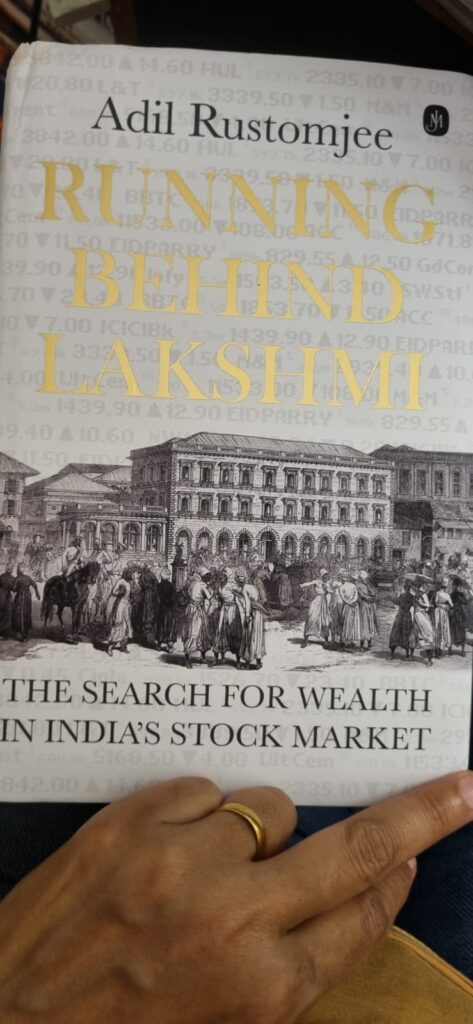
“Running behind Lakshmi: The Search for Wealth in India’s Stock Market” by Adil Rustomjee

From banyan trees to electronic screens – the authoritative account of India’s stock market over two centuries. For millions of people, the stock market is the canvas on which are sketched fantasies of riches, of lives transformed. Yet, the history and methods of one of modern India’s most transformative forces remain underexplored till now.

Starting from the early nineteenth century, when a few banias traded shares under banyan trees, to the Cotton and Share Mania occasioned by the American Civil War, to the decades of marking time during the Nehruvian Era, to 1991’s great unshackling that made the market accessible to the public, all the way to the market cycles of the new millennium, Running behind Lakshmi brings India’s stock market into focus. It has been published by John Murray / Hachette India.

By combining archival sources with observations and expertise forged through immersion in the markets, Adil Rustomjee provides a wide-ranging account that is equal parts analytical history, financial practice, and market lore. Brimming with pioneers and adventurers, grand rivalries and petty jealousies, scams and scandals, this is the story of a nation and a people told through a lens that’s never been used, but is more relevant than ever.

Read an extract from the book on Moneycontrol.

After a career in international development and markets, Adil Rustomjee discovered his life’s work as a chronicler of India’s stock markets. The idea for the book came when he stumbled upon the BSE archives during the time he had an office in the exchange’s building. These nuggets of history were just lying around, but a substantial account had yet to be written about an equity market that was over two centuries old.

17 Oct 2025

“Fluke: Chance, Chaos, and Why Everything We Do Matters” by Brian Klaas

A provocative new vision of how our world really works – and why chance determines everything.

In Fluke, myth-shattering social scientist Brian Klaas deep-dives into the phenomenon of randomness, unpicking our neat and tidy storybook version of events to reveal a reality far wilder and more fascinating than we have dared to consider. The bewildering truth is that but for a few incidental changes, our lives – and our societies – would be radically different.

Offering an entirely new perspective, Fluke explores how our world really works, driven by strange interactions and random events. How much difference does our decision to hit the snooze button make? Did one couple’s vacation really change the course of the twentieth century? What are the smallest accidents that have tilted the course of history itself?

The mind-bending lessons of this phenomenon challenge our beliefs about the very workings of the world. From the evolution of human biology and natural disasters to the impact of global events on supply chain disruptions, every detail matters because of the web of connectivity that envelops us. So what if, by exploding our illusion of control, we can make better decisions and live happy, fulfilling lives?

Read an extract from the book on Moneycontrol. It is published by John Murray/ Hachette India.

Brian Klaas grew up in Minnesota, earned his DPhil at Oxford, and is now a professor of global politics at University College London. He is a contributing writer for The Atlantic, host of the award-winning Power Corrupts podcast, and frequent guest on national television. Klaas has conducted field research across the globe and advised major politicians and organizations including NATO and the European Union. Klaas also writes a newsletter called The Garden of Forking Paths.

15 Oct 2025

“Running behind Lakshmi: The Search for Wealth in India’s Stock Market” by Adil Rustomjee

This book came in the post today. Flipping through it, there is a lot of history and plenty of technical jargon, but it is obvious that it has been written by someone very passionate about the subject + excited about delving into the archives. Truly look forward to reading this.

Book blurb

From banyan trees to electronic screens – the authoritative account of India’s stock market over two centuries.

For millions of people, the stock market is the canvas on which are sketched fantasies of riches, of lives transformed. Yet, the history and methods of one of modern India’s most transformative forces remain underexplored till now.

Starting from the early nineteenth century, when a few banias traded shares under banyan trees, to the Cotton and Share Mania occasioned by the American Civil War, to the decades of marking time during the Nehruvian Era, to 1991’s great unshackling that made the market accessible to the public, all the way to the market cycles of the new millennium, Running behind Lakshmi ( John Murray/Hachette India) brings India’s stock market into focus.

By combining archival sources with observations and expertise forged through immersion in the markets, Adil Rustomjee provides a wide-ranging account that is equal parts analytical history, financial practice, and market lore. Brimming with pioneers and adventurers, grand rivalries and petty jealousies, scams and scandals, this is the story of a nation and a people told through a lens that’s never been used, but is more relevant than ever.

After a career in international development and markets, Adil Rustomjee discovered his life’s work as a chronicler of India’s stock markets.

The idea for the book came when he stumbled upon the BSE archives during the time he had an office in the exchange’s building. These nuggets of history were just lying around, but a substantial account had yet to be written about an equity market that was over two centuries old.

Adil Rustomjee then made it his calling to narrate the market’s past, outline its methods, and detail its participants. Born in Hyderabad, he attended the universities of Madras and Bombay, from which he graduated with degrees in commerce and management. He also holds graduate degrees in international relations from Johns Hopkins University’s School of Advanced International Studies, and in business from Yale.

Besides taking a keen interest in financial markets, he is a student of military history and strategy.

20 Sept 2025

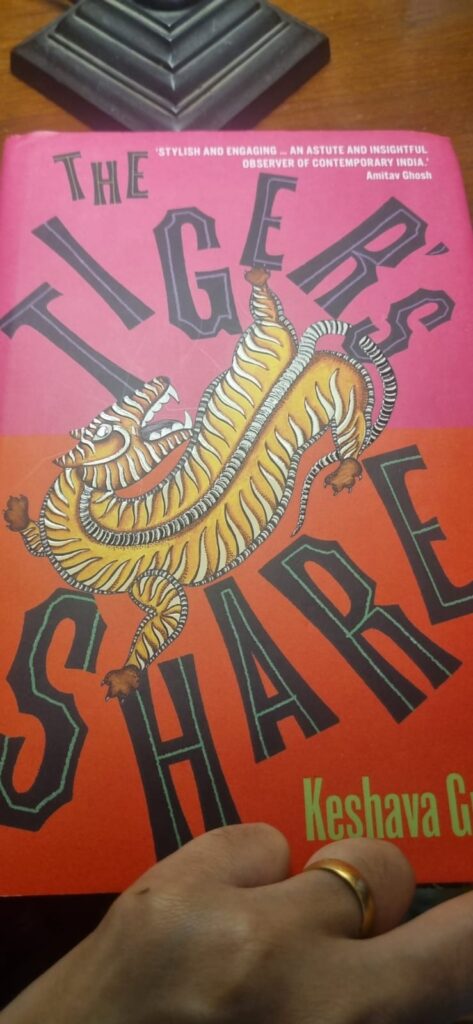
“The Tiger’s Share” by Keshava Guha

A Delhi novel. About two women. About one’s father. Middle class. Typical Delhi crowd. Patriarchal. Different socio-economic stratifications. While providing a commentary on the changing Delhi, particularly after 2014. An ending that is curious.

Tiger’s Share is Keshava Guha’s second novel.

Read it.

Listen to TOI Bookmark episode with Keshava Guha.

Here is a snippet from the conversation:
It is a relatively new term. So, fifty or sixty years ago there was just fiction. And yes at some level I think people understood that there was a difference between Iris Murdoch and Arthur Hailey, even though you would see them both at the British Council Library or whatever. But the idea was that there were novels and you read those that you liked. The problem with this category of literary fiction is that it can give the false impression that these books are not meant to be enjoyable to read. As if eat your vegetables, take your vitamins kind of reading. So, to that extent it is an unhelpful term. But how I would define it is that I think it is fiction that aspires to the status of art …you are trying to create something of enduring aesthetic value whether it has to do with an idea or a sentence, but it does not mean that it should not be enjoyable to read. You still want people to turn the pages.

15 August 2025

Craig Storti’s “The Hunt for Mount Everest”

2021 marks the centenary year of the first Everest expedition. The height of the mountain had been first measured in 1850. It took another seventy-one years for an expedition to be arranged. The members were Bullock, Morshead, Wheeler, Mallory, Heron, Wollaston, Howard-Bury, Raeburn. But in June 1921, the two English men, George Mallory and Guy Bullock, became the first people ever to stand at the foot of Mount Everest.

Craig Storti in The Hunt for Mount Everest ( John Murray, Hachette India), commemorates this remarkable expedition. His book begins with the arrival of George Everest as Surveyor General in the early 1800s and concludes with the 1921 event. To quote Storti:

It is a tale of high drama, of larger-than-life characters — George Everest, Francis Young husband, Lords Curzon and Kitchener, George Mallory — and a few quiet heroes: Radanath Sikdhar, Alexander Kellas, the 13th Dalai Lama, Sir Charles Bell. It is a tale of spies, intrigue and beheadings; of war ( two wars, in fact) and massacre; of breath-taking political, diplomatic and military bungling; of derring-do, hair-raising escapes and genuine bravery. The wind is a powerful presence, as are the rains and mud, along with rhododendrons and orchids, leeches and butterflies, mosquitoes, gnats and sandflies. Hundreds of bullocks, yaks and mules are featured, as are thousands of camels, numerous elephants and at least two zebrules ( they were not a success). And it’s setting is some of the most spectacular geography on earth.

Images from some of the pages from the book attest to the magnificent accounts of rhododendrons, orchids and even butterflies. The descriptions are stunning and are fine examples of nature writing.

The book itself in many instances is an absorbing account of how the mountain was first mapped. There are detailed descriptions of George Everest’s survey tours. Also, an insight into his cantankerous personality which enabled him to overrule any conflict with his authority, including a mutiny of the armed guards. He was a rude man but also very focused on his task. Once the mountain had been identified and named, the goal post shifted to attempting a climb.

Craig Storti first fell in love with this mountain in the late 1970s when he moved to Nepal. It took him nearly four decades to put this book together but he was determined to write an account of the mountain that ended with the 1921 expedition. For a person reading about the survey of India in the nineteenth century, the excitement and thrill of considering mountain climbing as a sport, negotiations with Tibet, the Great Game etc., then from their point of view The Hunt for Mount Everest is a decent book, packed with information.

8 August 2021

“Blood and Oil” by Bradley Hope and Justin Scheck

Blood and Oil: Mohammed Bin Salman’s Ruthless Quest for Global Power by Bradley Hope and Justin Scheck is a rivetting account of the Crown Prince of Saudi Prince. It is published by John Murray, Hachette. Crown Prince Mohammed bin Salman (MBS) of Saudi Arabia, is a prince who has captured the world’s imagination with his suave presence on the global political stage but also with very strong rumours of his unorthodox, at times brutal, methods of ruling. Most notably the allegation of his involvement in the assassination of journalist Jamal Khashoggi and the holding of three hundred members of the Saudi royal family in the Ritz Carlton for month. The authors refer to him on the back cover as “one of the world’s most decisive and dangerous new leaders”.

The two co-authors are experienced journalists and Pulitzer Prize finalists. They seem to know how to strike the balance between getting sufficent evident and putting together a narrative that zips along. It is astonishing to read the facts that they document whether the meteoric rise of the prince or of some of his aides. A case in point being the young Ali Alzabarah, a young Saudi who was educated in the United States on a Saudi scholarship and then had been employed at Twitter. As this extract from the book published in The Wire shows that Ali Azabarah’s rise in Saudi society and definitely within the inner circles of the prince was astonishing. ( “A Saudi Prince’s Attempt to Silence Critics on Twitter: An ongoing investigation reveals how Mohammed bin Salman’s team allegedly infiltrated the platform—and got away with it” The Wired, 1 Sept 2020) It is plain scary.

Other journalists have been equally fascinated by the prince and done their own form of investigative journalism. Take for instance, FRONTLINE PBS correspondent Martin Smith, who has covered the Middle East for FRONTLINE for 20 years, examines MBS’s vision for the future, his handling of dissent, and his relationship with the United States. This documentary was made a year after the murder of columnist Jamal Khashoggi, and FRONTLINE investigated the rise and rule of Crown Prince Mohammed bin Salman (MBS) of Saudi Arabia.

Books like Blood and Oil are fascinating to read but capture only a very brief moment in time. The prince works at a very fast pace and is forever evolving as are the circumstances around him. He is a man in great hurry who has youth on his side. So he will be here for a long time to stay. There are bound to be visible changes in Saudi society. For good or bad, only time will tell. This is an ongoing story.

Perhaps this book will take a life of its own in different media. It needs it.

For now, read Blood and Oil. Well worth the time!

23 Oct 2020

“Sight” by Jessie Greengrass

…the framing of a  radical scientific discovery in ordinary language, the ability to impart understanding without first having to construct a language in which to do so. Rontgen’s description of his work comes like the unravelling of a magician’s illusion which, explained quickens rather than diminishing, the understanding of its working conferring the illusion of complicity …

Jessie Greengrass’s debut novel Sight is about an unnamed narrator pondering whether to have a child or not.

I wanted a child fiercely but couldn’t imagine myself pregnant, or a mother, seeing only how I was now or how I thought I was: singular, centreless, afraid. 

It is a long reflection by the narrator split into three parts like a play with a short interlude.  Every section itself is structured with the long self-reflecting passages about by the narrator interspersed with interludes with factual historical content. The first section involves the Lumière brothers, Auguste and Louis, and Wilhelm Conrad Röntgen’s discovery of X-rays; the second section is about psycho analyst Sigmud Freud and the final section is about Scottish surgeon John Hunter who was exceptionally well known for his knowledge of the anatomy, both human and animal. In fact John Hunter’s fine collection of over 14,000 specimens was acquired by the British government and even today exists at the Hunterian Museum at the Royal College of Surgeons in London. Interestingly every section while the narrator reflects it corresponds with a particular moment in her life. The first section while she tussles whether to get pregnant or not she also contemplates upon Röntgen’s discovery of X-rays whose experiments in the laboratory resulted in a big impact on medical science and society too. It was the intensely subjective moment that led to greater objectivity:

For seven weeks and three days Röntgen existed in a private world transformed for him and him alone, and perhaps this too was a part of his later bitterness: that despite this experience of revelation, the conferral on him of a scientific grace, afterward nothing was different at all, and although he had seen through metal and seen through flesh to what was hidden, and although he had known, or thought that he had known, its nature, what had been left afterwards was only so much quibbling on the bill. 

Similarly mothering her firstborn, remembering the death of her mother due to cancer while the narrator herself was in her early twenties leaving her an orphan,  sharing her fears with her partner Johannes whether to have the second baby or not, while wondering if she is capable of the responsibility — these are intensely personal experiences for any woman more so for the narrator. Pregnancy is a very female experience that is repeated number of times over with every mother-to-be and yet remains an intensely intimate and subjective experience. Towards the end of this section she realises she has “outdistanced her anxiety” and wants the second child.

In the second section the narrator introduces her grandmother, Doctor K, and Sigmund Freud — both psychoanalysts.  Her childhood memories of spending holidays with her grandmother who worked as a professional psychoanalyst while caring for her granddaughter and on those rare occasions for her own daughter. The narrator recalls her mother telling her how when she was a five year old girl her mother, Doctor K, would insist upon analyzing her dreams. Result was the little girl stopped dreaming! It is a jumble of memories shared by the narrator that are at once intimate and intertwined and yet involving distinct individuals and personalities, much as in the way the network of blood vessels connect the unborn baby in the womb to its mother. Similarly Sigmund Freud’s biography and analysis of his patients including daughter Anne are interspersed with that of the personal narrative.

…the past is as prosaic as the future and the facts about it only so much stuff. To pick through dusty boxes, to sift through memories which fray and tear like ageing paper in an effort to find out who we are, is to avoid the responsibility of choice, since when it comes to it we have only ourselves, now, and the ever-narrowing come of what we might enact. Growing up, I said, is a solitary process of disentanglement from those who made us and the reality of it cannot be avoided but only, perhaps, deferred … . 

Plate VI of “The Anatomy of the Human Gravid Uterus” (1774) by William Hunter, engraving by Jan van Rymsdyk.

In the third section the narrator is pregnant and waiting to give birth so a lot of time is spent in hospital waiting rooms awaiting tests. She intersperses her reflections with that of the eighteenth century Scottish surgeon John Hunter who was also known for his phenomenal collection of specimens. He was very keen to know about anatomies and would pay gravediggers to get him bodies from fresh graves so that he could dissect them and study the anatomy.  He worked closely with his brother William Hunter who had in fact introduced him to the medical sciences. The dissections were conducted in the basement of William Hunter’s Convent Garden house where the brothers were inevitably accompanied by the artist Jan van Rymsdyk who rapidly sketched as evident in the illustration on the right.

The Oxford English Dictionary definition of “Sight n. the faculty or power of seeing”. Jessie Greengrass studied philosophy in Cambridge and London. Her novel Sight is a literary example of psycho-geography — a combination of personal reminiscences and factual historical content. It is also an attempt to get at a further truth which is about how we see one another and we see ourselves especially the female experience which is most often taken away from human experience. ( Interview with BBC Radio 4, February 2018) It is a constantly evolving process of the individual’s subjectivity vs objectivity. It was first discussed in a similar meditative fashion by the Romantic poet Samuel Taylor Coleridge in Biographia Literaria. It is unsurprising given that Coleridge  too like Jessie Greengrass was inspired by John Hunter’s work and its focus on the distinctions between life and matter. As Jessie Greengrass remarks in her BBC interview “having a subjective self is something which allows us privacy but also separates us even from the people we are closest to” and this is the angle she explores as a novelist in her powerful debut Sight.

Sight has been shortlisted for the Women’s Prize for Fiction 2018 and the winner will be announced on 6 June 2018. This will be a close finish since the other contenders for the prize are equally strong and experienced women writers.
Jessie Greengrass Sight John Murray ( Publishers), an Hachette UK Company, Edinburgh, 2018. Pb. pp. 
30 April 2018 
* All pictures are off the Internet.
Web Analytics Made Easy -
StatCounter