Hebrew Posts

Interview with historian and editor Chandana Dey
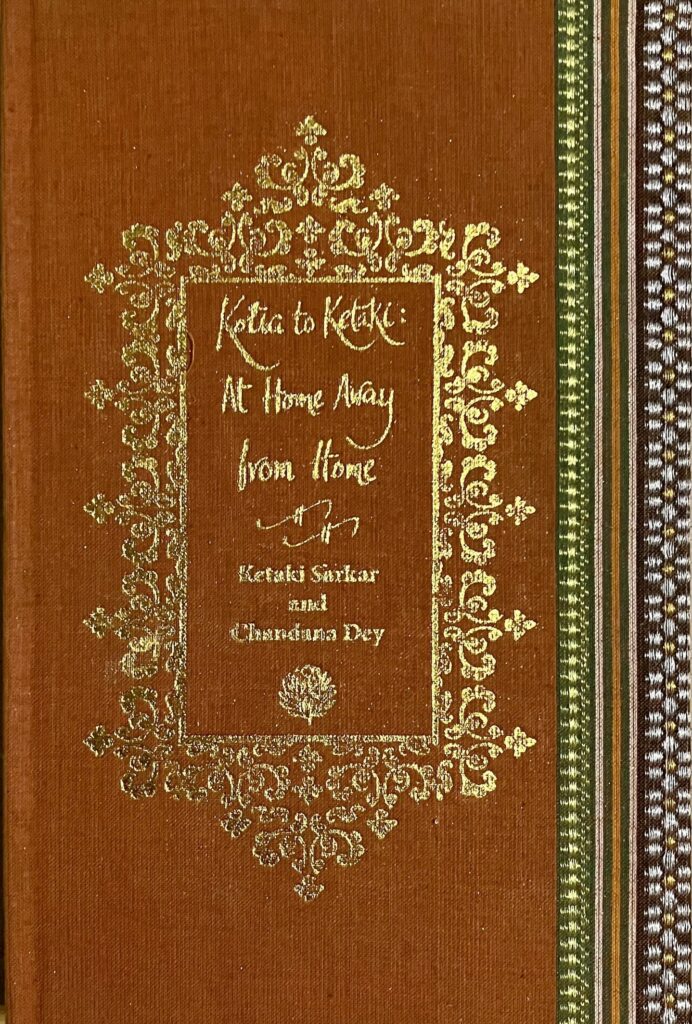
For Moneycontrol, I interviewed Chandana Dey on publishing her Russian/Lithuanian Jewish grandmother’s memoir — Kotia to Ketaki: At Home Away from Home. It is published by Writers Workshop.

Interview with historian and editor Chandana Dey

Chandana Dey studied Modern Indian History at the Jawaharlal Nehru University, Delhi and
International Affairs at the School of International Studies (SAIS), Washington D.C. She has recently published her Russian/Lithuanian Jewish grandmother’s memoir — Kotia to Ketaki: At Home Away from Home. It is published by Writers Workshop India. In fact, Chandana Dey more or less, co-authored the publication by adding a substantial afterword to the original memoir entitled My Life. Ketaki Sarkar was born Kotia Jonas to a middle-class family in Moscow in 1907. She lived through the Russian Revolution, famine and the civil war. The family moved to Switzerland in 1921. Kotya met her husband, Nitai De Sarkar, a medical student. They married in 1930 and came to India in 1934. Kotia learnt Bengali, always wore a sari and made India her home. On one of their visits to Santiniketan, Rabindranath Tagore bestowed the name, Ketaki, on Kotia Jonas. This is the name she retained for the rest of her life. Ketaki made Santiniketan her home and died at the age of ninety-one.  Kotia to Ketaki is a slim book but packed with detail – by both grandmother and granddaughter, stretching across time. Truly worth reading!

Here is the interview conducted with Chandana Dey conducted via email.

  1. When and why did your grandmother, Ketaki Sarkar nee Kotia Jonas write this Memoir? Was it all from memory or did she consult any living relatives at the time?

My grandmother has dated the memoir as 1972. My mother typed the manuscript on her portable typewriter. I would imagine that my Dida got the time for reflection and thought after 1971. She retired from the Alliance Francaise and came to live in Santiniketan, in her home, ‘Akanda’ permanently. Before this, she used to visit Santiniketan only on holidays or occasional weekends. My family members who had heard stories of her childhood in Russia kept urging Dida to write her memoir. I don’t think she consulted any family members, although she was in regular touch with her sister, Tina. When I started the research for the book, no one in the extended family knew that such a document existed. The only people who had read the memoir were people in Santiniketan whom my grandmother was close to — among these were Kshitis Ray, (Teacher of English in Patha Bhavan and Tagore researcher), Rani Chanda (artist and Freedom Fighter) and Uma Das Gupta (foremost scholar of the history of Santiniketan and Sriniketan). Part of the reason for not passing around the Memoir much was partly my grandmother’s own diffidence and the fact that the Jonas family members were not comfortable in English. This discomfort with English also affected many potential readers in Santiniketan in my grandmother’s circle.

  • The memoir reads swimmingly well for a modern reader, even if a little sparse on the historical details. Did you print it in its entirety or is this an abridged version?

It has recently come to my attention that there may have been an original version of the memoir that was written in French. I have never seen such a document. From the 1970s, family members heard of the memoir and each family member was given a typed copy of My Life. This is the entire text that I was given by my mother. I put it and the photographs my mother gave me in a small black suitcase. I think the genesis of Kotia to Ketaki was in my mind for the past 40 years. However, as all precious things are stored away, so was the black bag! When I went to retrieve the contents, I found the black bag empty. My late aunt came to my rescue. As my cousin and I went through her things, we found the copy of My Life. I immediately scanned the single copy and sent a copy to each living family member.

Unfortunately, the memoir ends in 1946. I think we did not pester my grandmother sufficiently to compel her to write about her remaining life history. It was a fascinating one. She was the sole breadwinner of the family. She worked in multiple jobs and made enough money to send my mother to Europe for her higher studies. She also built three houses. I really regret not recording her life and bringing out a companion volume. I also regret not asking her about the memoir in sufficient detail.

  • Your grandmother was a Lithuanian Jew who had been born and brought up in Russia before and after the Russian Revolution and in parts in Switzerland and France. Her memoir observes a smoothish transition for her to living in British India, especially in Shantiniketan; to the extent she learned Bengali so as to speak to family members. How did she assimilate in the Bengali Bhadra society? Did she have to forego her Judaism?

My grandmother spoke Bangla fluently. She did not manage to learn the language to be able to read or write in Bangla. But she used to listen to poetry, would attend all the functions in the Ashrama. Both my uncle and mother studied in Patha Bhavan and Bengali was spoken at home. My grandparents, however, spoke in French with each other. Perhaps it was my grandfather’s support that enabled such a smooth transition into Bengali society. The story goes thus: once they were settled in Calcutta, Dadu said to Dida, ‘Come, let me take you somewhere you will feel at home’- and this was Santiniketan — where there were many Bengalis married to foreigners. Besides, Rabindranth Tagore was almost singlehandedly responsible for trying to turn Santiniketan into a cosmopolitan place, while retaining its fundamentally Bengali ethos. Yet, it continues to be a mystery as to how Dida adjusted so well to Dadu’s family — a joint family that was extremely hierarchical and patriarchal. My grandmother’s mother-in-law was known to be a stern figure and extremely harsh with her daughters in law. My grandmother became her favourite daughter-in-law — and was given privileges, unheard of at that time. This remains a mystery to me and to everyone else.

A word on the Judaism is required here: my grandmother never had any Jewish artefacts in her home. Not even a menorah. The first menorah was one that my mother’s Jewish friend presented to her during their stay in the US. Nor did my grandmother ever step into a synagogue. Yet, the idea of Israel was very important to her since she felt that the Jews deserved a homeland after the Holocaust. This was a reason for perpetual strife in the family since my late brother was a vehement supporter of the Palestinian cause. The ‘Russianness’ revealed itself through a love of literature, music, language. She never taught Russian but never forgot the language. It was a great help to me when I started learning languages. I think I chose French and Russian so as to be able to speak to Dida.

  • Depending on the audience they are addressing, women tend to bifurcate their narratives for private or public consumption. You knew Ketaki Sarkar. Do you think her memoir is true to her personality, the person you knew, or did she skip information in writing that she may have told you verbally.

Interesting question. The memoir was written originally for her children — Maya and Nandan. In fact the memoir is addressed to them. Once written, my uncle and my mother persuaded my grandmother that it should be published. Initially reluctant, my grandmother acceded to their wishes. Dida was always very conscious of the lack of educational foundation in her growing years. She felt that she was self-taught to a large degree. In Santiniketan, she was surrounded by literati. But I think she held her own even in these circles. ‘Kotia Mashi’ was much sought after and she remained close to her friends and their children and grandchildren. Santiniketan is still a very small place where most people know each other. It would be natural therefore for Dida to eschew anything critical about the people she met. When she wrote the memoir, the characters in the narrative were all living. Besides, the memoir is a narrative where she looks back forty years. (She is writing in 1970 about what happened in 1930.). She is taking a look at her previous self.  

  • Why did your grandmother’s family move to Switzerland? Were conditions conducive for a Russian/Lithuanian Jewish family to relocate to the fairly newly established country, Switzerland (established 1874)? Did the internal passport issued by the Lithuanian authorities play a key role or was it linked to the Bolshevik Revolution and the ‘threat of communism’?

My great grandfather, David Jonas, had purchased a piece of land in a place called Richielien, near the Lac Leman. Doctors in Moscow had suggested he go and take rest somewhere and since the family traveled widely, he chose Switzerland. This was around 1912. By 1914, the Swiss doctors gave David a clean bill of health and the family returned to Moscow. After the Russian Revolution, famine and civil war, David was keen to leave Russia. This was only possible because of the internal passport, issued by the Ober-Ost government. A large part of Lithuania was then under German rule.  If David had been born in Moscow, it would have been impossible for the family to leave Russia after the Revolution. David’s sister, Sonya,  lived in Lithuania. Sonya and her husband, Dr Frumkin, helped David get the Lithuanian passports. During my research, a Lithuanian researcher, Elena Borik, found proof of my grandmother’s family’s passports in the Lithuanian archives. My grandmother has written about the large Russian émigré community in Switzerland at the time the Jonas family lived there.

  • What was your Bengali grandfather doing in Geneva when he met Ketaki at a student dance before they moved to Orsieres as a married couple? Or to put it another way, was Geneva a regular landing spot for Indian/Bengali students going overseas to study and work?

My grandfather was studying medicine at the University of Geneva. He had first tried his luck in Paris (where there were more Indian students) and then moved to Geneva. He studied French and even wrote his thesis in French. Some Swiss friends located his thesis in the University of Geneva archives. This Swiss degree was not really recognized as a proper degree when my grandfather returned to India. He struggled to land a proper job and did not manage to have a very successful practice either. My grandfather came from the Amrita Bazar family. The family consisted of staunch nationalists. My grandfather did not want to go and study in a colonial setting. He therefore chose France, then Switzerland. There were many Indian students in Britain. This was the most popular choice and there was no need to learn a foreign language here.

  • Your grandmother and you make references to the Yonas family being related to Eliezer Ben Yehuda (ne Perlman), the founder of the modern Hebrew language. How did you verify your grandmother’s account?

My grandmother spoke often of Eliezer Ben Yehuda. When my parents visited Israel (my father was then in the World Bank, therefore travel was possible), they met Dola BenYehuda, Eliezer’s daughter by his second marriage. (Eliezer Ben Yehuda would marry two of the Jonas sisters, first the eldest Devorah, then the youngest, Pola). Dola presented my mother with a copy of Robert St. John’s book, The Tongue of the Prophets: the Story of Eliezer Ben Yehuda. The Ben Yehuda family considered this the authoritative account of their illustrious forefather. I corroborated the account by delving further into the Ben Yehuda family. The genealogical website revealed a lot of information. I cross-checked this with writing to family members and asking them for more information. I watched films on Eliezer Ben Yehuda and read what he had written. I consulted my friend Dr Brenda McSweeney who taught in Brandeis University and asked her to suggest any colleague who might have worked on the role of women in early nineteenth century Palestine. She suggested the name of Margaret Shilo and I read her work and corresponded with her also. I tried all manner of ways to get information on the Jonas children. The two most interesting remain the most undocumented — Boris and Penina. Of course, the person who wrote the most was Eliezer’s second wife —Pola — who took on the name of Hemda. By all accounts, she had a terrific personality. However, I tried to stay clear of hagiographic accounts as much as possible. It was Hemda who stayed in touch with the entire Jonas clan.  

  • Your afterword is packed with historical context to Ketaki Sarkar’s memoir. Why did you feel the need to write this detailed account? Why did you decide to write a separate section, rather than heavily annotate Ketaki’s text?

My mother tried hard to get the memoir published. Everyone she spoke to said it was too short and could not be a standalone volume. Early on, I thought a short historical background was important to buttress the memoir. While working at the Social Science Press as an editor, I had approached Esha Beteille with the idea of the manuscript. She showed great enthusiasm, as did her daughter, Radha. I wrote a first draft but Radha found that the historical part should be more detailed and Esha di felt that something should be written on my grandmother’s siblings as well. I realized this would mean much more secondary research. Eventually, a chance meeting with Anada and Swati Lal at their iconic home at Lake Gardens allowed me to raise the matter with Ananda. He accepted the manuscript without question. I shortened the text to make it more reader-friendly and budget-friendly. Ananda did meticulous editing and this took time also. I started the research in 2017. My father passed away in 2018. My brother passed away earlier this year. I kept urging my brother to look at the various manuscripts, but he said he would wait to read the final book. This did not happen.

  • What was your research methodology? When did you realise you had sufficient material to put into this book?

I had thought, originally, of writing a very short background to the memoir. I felt that most people knew about Russia’s history, certainly about the Indian National Movement, the Bengal Renaissance and the genesis of Santiniketan. On rereading the memoir after many years, I just had so many questions on the veracity of my grandmother’s story. Surely my great-grandmother could not have ridden on horseback from Siberia to Moscow? I remember seeing her photographs and hearing stories about her. This was just one example. Another question in my mind and one that caused me sleepless nights was —what exactly were my great-grandparents’ political affiliations? Were they card-carrying Bolsheviks? My grandmother did not mention this anywhere. But I know they supported the Revolution. Were they Anarchists? I did not think so. So I went to consult Prof. Hari Vasudevan and he confirmed every single doubt I had. He gave me solid historical evidence to validate my grandmother’s memoir. Prof. Vasudevan passed away from the first round of Covid, leaving me and countless others bereft. I think that the ‘introduction’ developed into a ‘book’ when I found documentary evidence of the burgeoning Jewish ex-mercantilist, educated bourgeoisie and the wealth of secondary material on the Pale of Settlement, the Haskalah (Jewish religious reform movement) and the extent of education for Jewish girls in Russia. When I read about the Haskalah, I thought I was reading about the Brahmo Samaj and the Bengal Renaissance; when I turned to girls’ schools in Palestine or Russia, my thoughts turned to education for girls and women in nineteenth century Bengal. There were so many commonalities that could not be discounted as coincidence. And oh, the wealth of secondary material in English, French and Bengali! A veritable treasure trove. My one regret was that I had completely forgotten my Russian. As I read more and more, sitting in the India International Centre Library, New Delhi, I realized that there was material for a book, and this would be interesting for readers, if I could tie up the history with the narrative covered in the memoir.

  1. What did it mean to you to delve into this history and discover details about your lineage? More importantly, make visible linkages in global movements of the early twentieth century that would have remained hidden from view, but probably continue to have ramifications today.    

Global events such as the terrible treatment of migrants and refugees were the constant backdrop to researching and writing this book. I kept asking myself — were the barriers between countries really insignificant in the early twentieth century? It was indeed possible for my Russian grandmother to meet and marry my Bengali grandfather, live and work in Switzerland, and then come back and live in India. Would this story ever happen today? I have tried meeting and corresponding with Jonas/Frumkin/Ben Yehuda family members. It is astonishing how well we seem to ‘commune’, although I have to say that my fluency in French helps immensely. The global movements you speak of became visible during the research. But I think that more needs to be written on the commonalities of different historical events and movements. We should be linked by our common faith in humanity. I think Rabindranath Tagore thought deeply about so many issues and problems of the twentieth century. His answer was establishing Visva-Bharati — the world in one nest. But we who live and breathe Santiniketan have not been successful in taking his message of peace and brotherhood far enough.  

7 Nov 2025

“Where No Daffodils Grow” by Sandeep Raina

On 24/25 August 2019, Sandeep Raina’s “Where No Daffodils Grow” was published in the Hindu Literary Supplement. Here is the link. Given the space restrictions in print, the article had to be edited. Reproduced below with the kind permission of the author is the unedited version.

Sandeep Raina was born and brought up in Baramulla, Kashmir. He studied engineering in Srinagar, and when in 1990 militancy gripped the Kashmir valley, he finished his education and left for Delhi. He lived in Delhi for 10 years and then in Istanbul for 3 years before moving to Surrey, England where he has been living for the past 15+ years with his wife and 3 children. Sandeep’s wife is a doctor in Surrey, their daughter studies medicine at the University of London, and their twin sons are studying engineering at the Cambridge University.

Sandeep has worked as a senior engineering executive in mobile telecoms for the past 28 years and travels globally for his work. As a mobile telecoms evangelist, he has been invited to speak at many conferences across Europe and the USA, and has published numerous professional articles. Currently, he works for a French-American telecommunications software company in London.

Sandeep has written a novel based on Kashmir, which took him over 11 years to write. The reason to write a novel was that it worked as a slow cathartic process to counter the traumatic and violent experiences of the early-90s Kashmir, and the harsh life of being a migrant/refugee in Delhi. As part of his life and travels outside Kashmir, he has acquired different perspectives of the Kashmir conflict. Through his writing about the Kashmiri people, of all communities, caught in the long-drawn, brutal conflict, he aims to present a better understanding of their predicament.

Sandeep has also published short stories about Kashmir, which reflect the exchanges with people caught in conflicts like Kashmir. They not only highlight the broken relationships, the loss of trust, the rising communal politics of Kashmir and India, but also offer introspection and a hope for the communities that have been disadvantaged because of the strife.

His stories have been published in several magazines and papers, including, The Hindu, The Guardian, The Telegraph, and The Times of India/The Economic Times.

****

Men in tall black hats and flowing black robes strode briskly down an empty street. Some of them had long side burns and some had long beards.  It was a summer afternoon, hot, and they were quite overdressed. I was visiting a friend in Golders Green in London and asked him what was going on, who were those people, why the costumes?

“Nothing, they are our Jewish neighbours back from a synagogue,” said the Kashmiri Pandit friend. “Many Jews live here since the 40s.”

Why were they dressed in such a pronounced manner? I wondered. Here was I, trying my best to assimilate, just landed in London. It didn’t make sense.

We had lunch at our friend’s home, typical Pandit cuisine, mostly lamb dishes: rogan josh, yakhni and matsch. I had met him and his wife after many years. We chatted for long on the table, reminiscing. The flat was sparsely furnished but had a few Kashmiri rugs. I noticed a small ornate candle stand in the window and asked what it was.

“It is a menorah,” said my friend’s wife. “To light candles in the Jewish festival of lights, Hanukkah.”  

Until then I had thought Diwali was the only festival of lights.

 “Everybody in this apartment building is a Jew, most of them old,” said my friend. “And they are very nice people.”

The next day, I told Mike, my colleague in office, about the Jews in costume. Mike was a small young man, who once had said that being Jewish, Catholic and French was the worst one could be in England, and he was all of them. One of his parents was French and Catholic, the other English and Jewish.

“There are other interesting things that we do, such as not doing anything on Sabbath,” he laughed. “Not even switching on a light.”

“Why?” I said.

He didn’t want to explain or didn’t know.

I shouldn’t have been so surprised. In Kashmir, on days of fasts, women in our Kashmiri Pandit family cooked strict vegetarian meals, cleaning and praying, and not doing much else. And the fasts followed the moon’s wax and wane.  Punim, aetham, mavas. On full moon, mid moon, and no moon. There seemed to be much in common with the Jews.

 “We are also really good with money,” laughed Mike.

My grandfather’s father had been a zamindar, a landowner, in Kashmir. My mother said that he was so rich that he didn’t count coins, he weighed them out of hand balances. But, my grandfather was not rich, nor us. My mental comparisons with the Jews ended at this thought.

Years went by. In which my grandfather died. I hadn’t seen him for a long time, but his memories kept on coming back to me in many different ways. By now we had moved into a new house, and I worked for a different company, in a different town in England, where I became friendly with an older Iranian colleague, Paymon.

It was the Persian new year, on spring equinox, when the day equals night, and the opposites balance out, when I told Paymon about Navreh, the Kashmiri Pandit new year. How on the eve, we filled a thaal, a deep plate with rice, milk, yogurt, a pen, a coin, some lentils, a daffodil. Bits that made life.

“We do something similar on Navroz, and we call it haft seen,” he said, surprised.

I felt a sudden connection build. We discussed Navroz and Navreh in snatches between meetings, across our office desks, on the coffee machine. Iran is so far from Kashmir, but it suddenly felt close. I told Paymon about the chinars, the papier-mâché, and the floral woollen carpets that had travelled from Iran, and the origins of rogan josh. Things began to tumble out. I even snatched a paper napkin and wrote my name in Nastaliq, the script that had travelled from Iran to Kashmir.

“I didn’t know this,” he laughed.

I didn’t know either, when growing up in Kashmir. If it’s a part of you, you don’t think much of it. I remembered my grandfather. I remembered his bold loud voice, his very sociable manner, his rambling conversations, his strong physical presence, his eloquent Farsi.

Grandfather used to recite Farsi couplets when he was in a good mood, when he had an audience, which could be my reluctant father or a hapless neighbour who had chanced to step by. Grandfather rolled off the Farsi couplets with the same verve as chanting mantras in Sanskrit, when he did his puja every morning, with lots of flower petals and incense sticks, in front of an array of gods. I was small, the Farsi and the Sanskrit both sounded magical to me, inspiring awe.

I told Paymon all this in the office canteen, and he listened to me with an older man’s patience.

My euphoria was unabated. For a Foodie Friday in the office, I woke up early and cooked rogan josh in the morning over low flame for three hours.  My wife wasn’t happy that I hadn’t let her cook. I packed the rogan josh carefully in a large plastic box, with a sticker on top and wrote- Kashmiri Rogan Josh in my wobbly Nastaliq, and sped to office, just in time for lunch. My colleagues had already begun eating, and there were foods of all kinds on the large canteen table. Italian, Greek, English, Brazilian, Welsh, Indian, Iranian. The rogan josh was late. Then Paymon saw me.

“So, you can read and write Farsi?” said Paymon, looking at the sticker, asking me to put some rogan josh on his plate.

“I can’t,” I said. I couldn’t even read and write Kashmiri.

Rogan josh disappeared fast, everyone ate it. It was declared the best cooked food on that Friday. I brimmed with pride.

When I left that job, on my last day, Paymon wrote four lines in Farsi on my farewell card. Under those he wrote in English: Thank you for enlightening me about Persian Kashmir. It has been great talking with you. It is sad to see you go but I wish you all the best.”

I think Paymon said something about those Farsi words in the card, but in my farewell hurry, I didn’t hear too well.

The card remained unread for years. Later, I wished I had learnt some Farsi, some Nastaliq from my grandfather. I wonder why I didn’t. My question took me back to a faint conversation from my childhood. I was reading out two Kashmiri words written in Nastaliq on a ten rupee note. In those days, currency notes in India had the value written in 15 official languages, each in its own script.

“Dah ropiye,” I read out, trying to decipher the curls, whirls, and dots.

“It’s not dah ropiye, its duh ropiye,” said my mother.

“What’s the difference?”

“Muslims say dah, but Pandits say duh, because dah in Sanskrit means cremation. And Muslims bury their dead.”  

My mother also told me that the ancient script for Kashmiri was Sharada, now dead, and nobody knew what it had looked like.

Pandits and Muslims had other differences too.  I was aware of some. My pheran, the long woollen garment that I wore in winters, had an extra fold, ladh, near its hem, while Bitta, my Muslim friend’s pheran fell straight. My grandfather wore a pajama, not a shalwar. My great grandmother’s pheran was ankle-length, with long sleeves, while old Muslim women wore knee length pherans, and shorter sleeves.

Many differences, all small. Until someone powerful outside Kashmir, heard about the tiny twists of tongue, the lengths and folds of pherans. And questioned if Kashmiri had more Farsi or more Sanskrit? Whether its script was Nastaliq or Sharada? When the powerful became more powerful with this knowledge, a powerless man in a tempo bus, after a squabble over a seat, called my grandfather a kafir, godless. Hurled the word like a weapon. I was with my grandfather in that bus. I had seen him pray to God every morning, in fact, many gods. My proud grandfather’s face was livid, his complaint to the bus driver a mere mumble. I remember my own inertness, the tremble in my fingers.

Not much later, a powerless young boy, just out of teens, gunned down my grandfather’s nephew and niece, my mother’s cousins, with their partners, inside their home. We fled Kashmir.

It’s been 29 springs since that happened. This year, in London, I forgot to fill up the Navreh thaal. Or look up the new panchang, the Hindu calendar book, which my mother posts from India every spring. On Navreh eve, when I was small in Kashmir, I would run out to pluck a handful of nargis, white daffodils, that grew in our garden. They had the sweetest of scents, but I wasn’t allowed to sniff; they were meant for God. And on Navreh morning, when the April air pinched my winter-chapped cheeks, I would wear a new kurta-pajama. Forgetting the thaal has brought sweet nostalgia and tremendous guilt.

Pictures of Navreh thaals flooded Facebook, on cue. Rice, milk, yogurt, coin, pen. No daffodils. Where most Kashmiri Pandits now live, daffodils don’t grow. A panchang said the year is 5094 by the Saptrishi calendar, 2075 by the Vikrami calendar.

“29 by the Pandit exile calendar,” a friend messaged. My heart stopped for a long moment.

On the cover of a panchang, I saw a script that I had never seen before. Sharada. It had fonts like thick brush strokes or like engravings on stone. Blurry, awoken from a deep sleep.

I had read a book long ago about the revival of Hebrew after the Jews had fled from European towns. How Hebrew was invoked to string the scattered Jews. How they would all go home, with a common language and a new script to a land they could call their own. In a desert.

I think of Thar or Kharan, when I think of deserts. One on the India-Pakistan border and the other on the Pakistan-Iran border. I grew up with snow and mountains, I grew up with lush fields, streams and lakes. What would I do in a desert? What if someone powerful traced my roots to the Aryan Iranians? And sent me to Kharan in Balochistan. Would I go? Would my children go? Would my children’s children go?

I am sure the Jews had said this too.

I thought about Iran. I remembered my conversations about Navroz and Navreh with Paymon. I hunted for the farewell card from my last job and found it in a stack of birthday cards that our children had given me over the years. Among dozens of messages written in English was the quatrain written by Paymon in Farsi, in flowing Nastaliq. Asking to be read.

I messaged a photo of the lines to Paymon, asking him if he could translate it for me. Paymon did not reply, I don’t know why. I had thought Paymon would be a friend for life. Friendship’s a promise. I thought of who else could help me: Grandfather. But he was not around anymore to fill me with the awe and magic of his Farsi. Not hearing back from Paymon, not able to read his message brought a deep sense of loss. Like a forgotten Navreh. Like a broken promise.

I asked an English friend to help me. He sent a photo of the Farsi message, all the way to Tehran to his sister-in-law. A week later, I received the transliteration and the translation in my inbox. Grandfather appeared before me. And read out in a bold, loud voice:

Yari keh beh nazd e oo gol o khar yekist

Dar maz hab e oo mos haf o zonnar yekist

Ma ra gham e on yar che bayad khordan

Koo ra khar e lang o asb e rahvar yekist

(Rumi)

“A friend who sees no difference between a flower and a thorn,

In whose religion, the Quran and Zonnar are the same,

Why should we worry about him?

As for him, a lame donkey and a swift horse are the same.”

Zonnar used to be a girdle which Jews wore to distinguish them from Muslims, long back in time.

Paymon had not forgotten, he had kept his promise, he had written me a message to remember for life. Like a true friend, he knew me more than I knew myself.

A few days later, I pulled out a pheran from my clothes cupboard, which my wife had bought from a Kashmiri trader many years ago. It is dull brown and woollen, a bit scratchy at the neck, and it does not have a Pandit fold near the hem. I had never worn it.

That summer day, I wore it. It warmed me up. I looked at myself in the mirror, and the image of the Golders Green Jews walking briskly down a street flashed in front of my eyes. Now I knew why they were dressed like that.

What they were holding on to.

Next spring, I won’t forget Navreh. I will fill up a thaal with rice, pluck a yellow daffodil from our English garden, place a pound coin, a pen and an idol of a god in the thaal. Some milk and yogurt too. And pray. That I’m not sent to a desert.

Note: Names changed to protect identity

17 August 2019

Book Post 42: 21 July – 6 Aug 2019

Book Post 42 includes some of the titles received in the past few weeks. Wherever available Amazon’s Kindle widget has been embedded in the blog post. It will allow you to browse through the book before you decide to buy it.

8 Aug 2019

On translations of the Bible, Diarmaid MacCulloch

[bwwpp_book sku=’97802412540040000000′] Professor of the History of the Church at Oxford University, Diarmaid MacCulloch’s latest book All Things Made New: Writings on the Reformation is a fascinating account of the Reformation, a period that was turbulent and very significant in the political history of England and formation of the Anglican Church. All Things Made New is packed with information. There are many aspects discussed but  a truly fascinating one is that of the translation of the Bible being made available in vernacular languages in Europe — exemplifying the critical importance translations held centuries ago! By dwelling on Tyndale’s translation methodology MacCulloch provides insight in to a specialised skill that is a critical combination of a passion for the languages, writing talent, exceptional scholarship and patient dedication to the craft of making a text available in a different destination language. Reward mostly lies in the reception the newly translated text receives. Making important texts available in other local languages also ensures that the information travels across geo-political boundaries. The cross-pollination of ideas in this manner cements their transference across cultures and regions to disseminate discourses, probably bringing socio-political changes in its wake, in different nation states while giving an identity to the main idea enshrined in the text itself — in this case Christianity.

This is well illustrated in the following extract from the opening lines of the chapter on “The Bible before King James” which also mentions the Tyndale translation of the Bible, considered to be an influential text in the making of King James version (KJV) :

In the fifteenth century the official Church in England scored a notable success in destroying the uniquely English dissenting movement known as Lollardy. One of the results of this was that the Church banished the Bible in English; access to the Lollard Bible translation was in theory confined to those who could be trusted to read it without ill consequence – a handful of approved scholars and gentry. After that, England’s lack of provision for vernacular Bibles stood in stark contrast to their presence in the rest of Western Europe, which was quickly expanding, despite the disapproval of individual prelates, notably Pope Leo X. Between 1466 and 1522 there were twenty-two editions of the Bible in High or Low German; the Bible appeared in Italian in 1471, Dutch in 1492. In England, there simply remained the Vulgate, though thanks to printing that was readily available. One hundred and fifty-six complete Latin editions of the Bible had been published across Europe by 1520, and in a well-regulated part of the Western Church like England, it was likely that every priest with any pretence to education would have possessed one. …

The biblical scholarship of Desiderius Erasmus represented a dramatic break with any previous biblical in England: when he translated the Ne Testament afresh into Latin and published it in 1516, he went back to the original Greek. When he commented on scripture, his emphasis was on the early commentators in the first five Christian centuries ( with pride of place going to that most audacious among them, Origen); his work is notable for the absence of much reference to the great medieval commentators. This attitude was fully shared by William Tyndale, the creator of the first and greatest Tudor translation of the Bible, although Tyndale’s judicial murder at the hands of the Holy Roman Emperor, and indirectly Henry VIII, prevented his work reaching beyond the New Testament and the Pentateuch. Tyndale came from the remote West Country Forest of Dean on the borders of Wales, and it is not fanciful to see his fascination with translation as springing out of the market days of his childhood, listening to the mixed babble of Welsh and English around him. His is the ancestor of all Bibles in the English language, especially the version of 1611; Tyndale’s biographer David Daniell has bluntly pointed out that ‘Nine-tenths of the Authorised Version’s New Testament is Tyndale’s.”

There was no reason why this pioneer should have had the talent of an exceptional writer as well as being an exceptional scholar, but the Forest of Dean man was a gourmet of language; it pleased him to discover as he moved into translating the Old Testament that Hebrew and English were so much more compatible than Hebrew and Greek. He was an admirer of what Luther was achieving in Wittenberg in the 1520s, and visited the town during his years of exile at the end of that decade, but he was also his own man. When creating his New Testament translations, he drew generously on Luther’s own introductions to individual books, but as he came to translate the Pentateuch, the Books of the Law, his own estimate of their spiritual worth began to diverge from Luther’s strong contrast between the roles of law and gospel, and the plagiarism of Luther’s German ceased, to be replaced by his own thoughts.

Surreptitiously read and discussed during the 1520s and 1530s, Tyndale’s still incomplete Bible translation worked on the imagination of those whose so far had virtually no access to public evangelical preaching in England. …By the time of Tyndale’s martyrdom in 1536, perhaps 16,000 copies of his translation had passed into England, a country of no more than two and a half million people with, at that stage, a very poorly developed market for books. And this new presence of the vernacular Bible in Henry VIII’s England entwined itself in a complex fashion around the king’s own eccentric agenda for religious change in his realm, as the monarch, his leading churchmen and secular politicians all puzzled over the meaning of the king’s quarrel and break with the pope in Rome, which had begun in matters remote from the passionate theological claims of religious Reformers.

The popularity of Tyndale’s translation of the Bible at the time of the Tudors proved how important it was to communicate and be accessible in local languages as it was also used for political gains by Henry VIII. This exercise served the dual purpose of introducing the Anglican Church liturgy to the masses but also promoted the political intent of Henry VIII by viewing royal supremacy as the natural condition of the Church. The intimate symbiotic relationship between politics and culture is a universal truth that has not changed in all these centuries. Even now translations and books are viewed as the softest (also cost-effective) way of making inroads into new territories/cultures/regions, making it easier for foreign governments to piggyback upon the cultural impact for strengthening of political and economic bi-lateral ties via diplomatic channels.

Translating important texts is not a new idea. It is now being revived as evident in the translation movement of significant literary texts that is rapidly gaining traction in world literature today. Texts of all genres from different cultures are being rapidly exchanged and published mostly in English to ensure they travel faster worldwide. Increasing presence of world literature in global publishing is disruptive as illustrated by their significance being recognised by international prizes. For instance the merging of the Independent’s translation prize with that of the Man Booker International Fiction Prize to launch the prestigious The Man Booker International Prize which recognises “quality fiction in translation”. ( The longlist for 2018 ) Or for that matter the newly launched JCB Prize for Literature presented to a distinguished work of fiction by an Indian author. “It has a particular focus on translation, and hopes to introduce readers to many works of Indian literature written in languages other than their own.” The presence of a growing body of translations is bringing a change in literary discourses globally by being inclusive of diverse narratives.

Extra: Diarmaid MacCulloch’s 2012 Gifford Lectures on the “Silence in Christian History”. These lectures were later gathered in Silence: A Christian History . [bwwpp_book sku=’97801431258150000000′]

Diarmaid MacCulloch All Things Made New: Writings on the Reformation Allen Lane, an imprint of Penguin Random House UK, London, 2016, rpt 2017. Pb. pp. Rs 699

31 March 2018 


Censorship, state and formation of literature

A Stasi official observing the interrogation of the lover of an East German playwright whose loyalty to the state is questioned, in Florian Henckel von Donnersmarck’s film The Lives of Others, 2006

An extract from the New York Review of Books review by Timothy Garton Ash of Censors at Work: How States Shaped Literature by Robert Darnton” ( 23 October 2014)

I have only once met a censor on active duty. In the spring of 1989, my friends at the newly founded Polish opposition newspaper Gazeta Wyborcza let me take a cartoon up to the in-house censor at the printing house of the main Communist Party daily, on whose weary old presses Solidarity’s organ for the dismantlement of communism was now being produced. I knocked on the door, only to find a bored-looking woman in a floral dress, with a cigarette on her lip and a glass of tea at hand. She slowly scanned the cartoon and the article to which it related, as if to demonstrate that she could read, and then stamped her approval on the back of the cartoon.

My taskmistress showed few obvious signs of being an intellectual, but one of the leitmotifs of Robert Darnton’s new book is how intellectually sophisticated censors have often been. Drawing on original archival research, he offers three fine-grained, ethnographic (his word) studies of censors at work: in Bourbon France, British India, and Communist East Germany. In eighteenth-century France, the censors were not just writers manqués; many were writers themselves. They included men like F.-A. Paradis de Moncrif, a playwright, poet, and member of the Académie française. To be listed as a Censeur du Roi in the Almanach royal was a badge of honor. These royal censors initialed every page of a manuscript as they perused it, making helpful suggestions along the way, like a publisher’s editor. Their reports often read like literary reviews. One of them, M. Secousse, solicitously approved an anthology of legal texts that he himself had edited—thus giving a whole new meaning to the term “self-censorship.”

In British India, the censors—not formally so called—were scholars and gentlemen, either British members of the elite Indian Civil Service (the “heaven born”) or their learned Indian colleagues. Harinath De, a candidate for the post of imperial librarian in Calcutta in 1906,

had mastered Latin, Greek, German, French, Italian, Spanish, Sanskrit, Pali, Arabic, Persian, Urdu, Hindi, Bengali, Oriya, Marathi and Guzerati, along with some Provençal, Portuguese, Romanian, Dutch, Danish, Anglo-Saxon, Old and Middle High German, and a smattering of Hebrew, Turkish and Chinese. He got the job.

Besides being a librarian, that job involved contributing summary reviews to an extraordinary printed catalog of every book published in the Raj from 1868 onward. It included more than 200,000 titles by 1905. Although given to describing anything with erotic content, including the hanky-panky of Hindu gods, as “filthy,” these literary monitors were often highly appreciative of the works under review, especially when the authors showed some virtuosity of style and depth of scholarship.

In the summer of 1990, Darnton, the lifelong historian of books and censorship, had the thrill of finally meeting two real-life censors. In East Berlin, the capital of the soon-to-be-history German Democratic Republic, he found Frau Horn and Herr Wesener, both holders of advanced degrees in German literature, eager to explain how they had struggled to defend their writers against oppressive, narrow-minded higher-ups in the Party, including an apparent dragon woman called Ursula Ragwitz. The censors even justified the already defunct Berlin Wall on the grounds that it had preserved the GDR as a Leseland, a land of readers and reading. Darnton then plunges with gusto into the Communist Party archives, to discover “how literature was managed at the highest levels of the GDR.”

He gives instances of harsh repression from all three places and times. Thus, an eighteenth-century chapter of English PEN could have taken up the case of Marie-Madeleine Bonafon, a princess’s chambermaid, who was walled up, first in the Bastille and then in a convent, for a total of thirteen and a half years. Her crime? To have written Tanastès, a book about the king’s love life, thinly disguised as a fairy tale. In 1759, major works of the Enlightenment, including Voltaire’s poem on natural religion and Diderot’s Pensées philosophiques, were “lacerated and burned by the public hangman at the foot of the great staircase of the Parlement” in Paris.

In British India, civilized tolerance of native literature turned to oppression in the early years of the twentieth century, as Indian nationalist protests grew following the partition of Bengal. A wandering minstrel called Mukanda Lal Das was sentenced to three years’ “rigorous imprisonment” for singing his subversive “White Rat Song,” with lyrics that come out in the official British translation like this:

Do you know, Deputy Babu, now your head is under the boots of the Feringhees, that they have ruined your caste and honor and carried away your riches cleverly?

In East Germany, Walter Janka suffered five years of solitary confinement for being too much involved with György Lukacs in 1956.

Yet such outright persecution is not Darnton’s main theme. As his subtitle suggests, what really interests him is “how states shaped literature.” They have generally done so, he argues, through processes of complex negotiation. In eighteenth-century France, censors made suggestions on grounds of taste and literary form; they also ensured that no well-placed aristocrats received unwelcome attention and that compliments to the king were sufficiently euphuistic. Different levels of authorization were available, from the full royal privilege to a “tacit permission.”

In East Germany, elaborate quadrilles were danced by censors, high-level apparatchiks, editors, and, not least, writers. The celebrated novelist Christa Wolf had sufficient clout to insist that a very exceptional ellipsis in square brackets be printed at seven points in her 1983 novel Kassandra, indicating censored passages. This of course sent readers scurrying to the West German edition, which visitors smuggled into the country. Having found the offending words, they typed them up on paper slips and gave these to friends for insertion at the correct place. Among its scattering of striking illustrations, Censors at Work reproduces one such ellipsis on the East German printed page and corresponding typewritten slip.

Klaus Höpcke, the deputy minister for publishing and the book trade (a state position, and therefore subordinated to higher Party authorities), seems to have spent almost as much time in the 1980s fending off the Party leaders above him as he did curbing the writers below. He received an official Party reprimand for allowing Volker Braun’s Hinze-Kunze-Roman, the scabrous story of an apparatchik and his chauffeur, to be published, albeit in a carefully “negotiated” form. Finally, in a flash of late defiance, Deputy Minister Höpcke even supported an East German PEN resolution protesting against the arrest of one Václav Havel in Czechoslovakia in the spring of 1989.

Some celebrated writers do not emerge trailing clouds of glory from the cold-eyed files of censorship. Voltaire, that legendary champion of free speech, apparently tried to get the royal censors to suppress the works of his enemies. It was the censor-in-chief who, while he might not have agreed with what Voltaire’s enemies said, defended their right to say it.

The office of the East German Politburo member responsible for culture, Kurt Hager, “kept long lists of writers who sent in requests for visas, cars, better living conditions, and intervention to get their children into universities.” A plea by the writer Volker Braun to be allowed a subscription to the leading West German liberal weekly Die Zeit went all the way up to Hager, with a supportive letter from the deputy minister, who argued that this would provide Braun with materials for a novel satirizing capitalism. In the course of tough negotiations with senior cultural apparatchiks in the mid-1970s, Braun is even recorded as saying that Hager was “a kind of idol for him.” Can we credit him with irony? Perhaps. Writers who have never faced such pressures should not be too quick to judge. And yet one feels a distinct spasm of disgust.

17 March 2017 

Web Analytics Made Easy -
StatCounter