Environment Posts

“India’s Forests: Revisiting Nature and History”, An interview with the editors, Arupjyoti Saikia and Mahesh Rangarajan

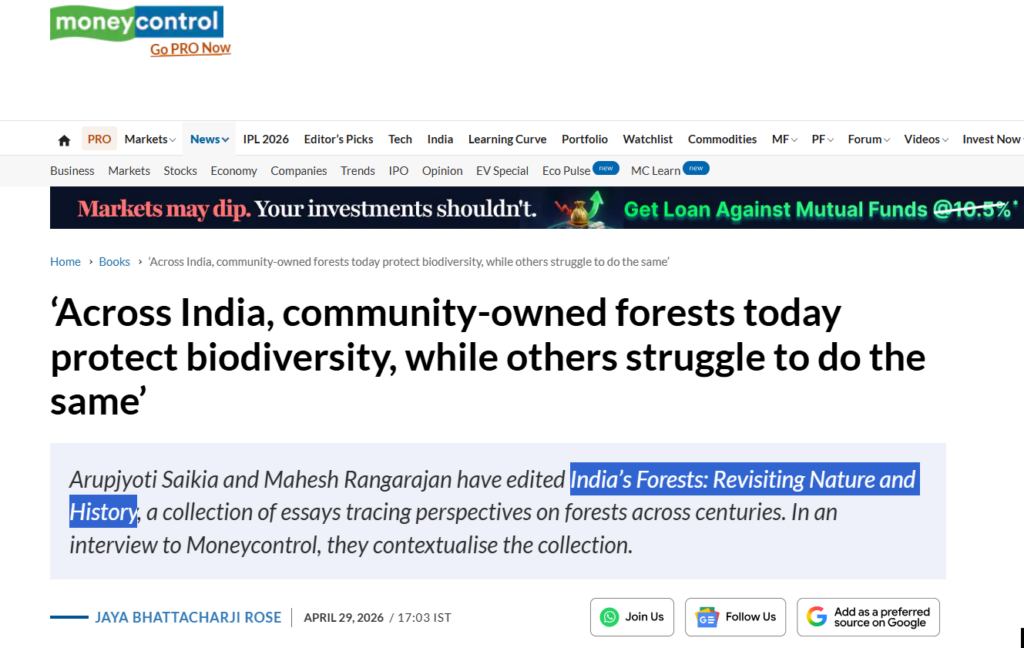
This interview with the editors was published on Moneycontrol on 29 April 2026. Here is the screenshot of the header. Given that many readers outside India are unable to access the interview easily, I am copy-pasting it here.
Arupjyoti Saikia & Mahesh Rangarajan (Eds.) India’s Forests: Revisiting Nature and History Vintage Books, an imprint of Penguin Random House India, 2026. Hb. Pp.360.

India’s Forests brings together essays by some of the country’s leading scholars with a fresh view of nature and history. These reappraisals of Indian forests and their many lives in past and present matter more than ever today. Born of years of sustained reflection, the essays here view forests not as passive unchanging backdrops to the past but as living, contested spaces.
Forests were shaped and in turn deeply influenced by power, culture and society. They could mean very different things to different people who often were in contest over meaning as much as control of the space or the resource. The volume spans from prehistory through ancient and early modern India into the present. It is also alive to the impact of the colonial era while tracing the changing fortunes of tribal and hill peoples. They are ecological lifelines and sites of legend, memory, and scientific knowledge. Material remains and life cycles of animals and plants matter, so too do social and literary imaginations.
Forests have been continually redefined through conflict, negotiation, and care. Attentive to the changing meanings across time and place, the book asks us fundamental and unsettling questions: what are forests for?

Contributors include: Shibani Bose “ ‘Digging’ Tales from Sylvan Trails: Perspectives from Archaeology”; Kumkum Roy, “People, Produce and the Political: Engaging with the Forest through the Arthashastra”; Aloka Parasher Sen “Multiple ‘Forests’ and Changing Borderlands: The Varied Indian Landscapes in Early India”; Meera Anna Oommen & Kathleen D. Morrison “Famines, Flagships and Floods: Historical and Contemporary Identities of Central Travancore’s Eastern Forest Frontier”; Mayank Kumar “Forest and Communities: Negotiations of Early Modern Monsoon Ecologies in India”; Divyabhanusinh “The Lion and the Unicorn: Fighting for Survival”; Sudha Vasan “Shifting Cultivator, Peasant, Forest-Dweller: Legacies and Landscapes of Improvement in the Baigachak”; Mukul Sharma “’God of the First Class’: Politics of Sacred Groves and Sarna in Jharkhand” and Vasudha Pande “Interrogating Ram Guha’s The Unquiet Woods: Thirty Years Later”.

Harini Nagendra, director, School of Climate Change and Sustainability, Azim Premji Universityendorses it saying “India’s Forests is a grand tour of the shifting forms, shapes and meanings taken by the country’s woods and jungles across the great arc of history. This integrative volume synthesizes information from a fascinating array of sources, from Mesolithic cave art and the Arthashastra to field trips and contemporary wildlife surveys; and captures a wide range of geographies from the Himalayas to the forests of Kerala. A must-read for anyone seeking a deeper understanding of the role forests play in our cultures, histories and imaginations.”

Arupjyoti Saikia is a professor of history at the Indian Institute of Technology Guwahati. He held the Agrarian Studies Programme Fellowship at Yale University, and visiting fellow positions a Cambridge University and the School of Oriental and African Studies (SOAS), University of London. His research spans across the economic, political and ecological histories of Assam. His published works include Forests and Ecological History of Assam, 1826 to 2000 AD (2011), The Unquiet River: A Biography of the Brahmaputra (2019) and The Quest for Modern Assam: A History, 1942–2000 (2023).

Mahesh Rangarajan is professor of history and environmental studies and chair of the HDFC Archives of Contemporary India at Ashoka University in Haryana. Previously, he has taught at Cornell University, University of Delhi, Krea University and the National Centre for Biological Sciences, Bengaluru. His notable works include Fencing the Forest (1996) and Nature and Nation (2015). He has edited the Oxford Anthology of Indian Wildlife (1999) and Environmental Issues in India (2007). His co-edited works include Shifting Ground (2014) and At Nature’s Edge (2018).

The following interview with the authors was conducted via email. It was lightly edited before publication.

  1. How do you define a forest? Has the definition changed over the years? Who defines it? What is it today as recognised by the government of India and international authorities? Also, what are the different technical definitions of a forest as determined by these bodies?

MR & AS: The book India’s Forests makes clear that ‘forest’ is, as one of our authors Kathleen Morrison puts it, a “vexed object, poorly defined yet meaningfully rich”. Forest is a space conceived differently across disciplines, eras, and political systems. For instance, in ancient India, forests had many roles. Each shaped by their use and location. The Arthashastra distinguished hasti vana, the area for elephants, from mriga vana, forests for enjoyment, organising woodlands by their strategic and economic value. If Sanskrit texts drew a clear line between grama, the organised village, and aranya, the wild forest, Tamil Sangam poetry described a continuous landscape where hills, bushes, and thick forests blended, reflecting human feelings and mixing wild and farmed land. More changes came in the later centuries.

The colonial period set legal limits on forests. The Indian Forest Act of 1878 turned forests into government-run lands, defined not by their trees but by who owned and controlled them. Forests became a political site instead of living nature. A major change came in more recent time. The Supreme Court of India expanded the definition of forests to include all wooded areas, regardless of ownership or classification in the Godavarman judgment of 1996. This important decision shifted the focus from official documents to the natural environment. This sparked strong debate about the future of communities living in forests without legal ownership. 

India’s Forests takes on the challenge of defining ‘forest’ clearly. Forests in this book cover a wide variety of landscapes, from rich rainforests to dry thorn forests and tall-grass savannahs, excluding only deserts and the tallest mountains. Forests are living nature made not just of trees but also herbs, fungi, orchids, and macro-fauna embedded in socio-cultural matrices. The book does not specify the exact technical definition used by the government though such reports are referred to as an important source of current government data. The idea of forests has made many journeys across time, space, ancient texts or modern legal lenses. This helps to secure the legal and proprietary lens of colonial rule, to the ecologically expansive definitions of recent times. Even now, the meaning of ‘forest’ is still considered by scientists, lawmakers, forest conservators, and activists-conservationists.

2. How did this book come about? How long was it in the making? What was the principle defining the commissioning of the articles? What are the key issues in this narrative that you wished to highlight? 

MR: We chose a range from prehistory to the current era and while all regions and ecotypes could not be covered, we have attempted to get a collection that is original, thoughtful, critical and stimulating. The occasion was the anniversary of the publication of a key work, The Unquiet Woods by Ramachandra Guha in 1989 a foundational work on environmental history, mainly a study of the Chipko movement. The essays engage with themes opened up by the book but in a critical if appreciative light. Much has happened in the study of forest histories in the last 35 years or so and we try in the introduction to look back and in the volume to point possible ways to go forward with fresh lines of enquiry.

AS: As Mahesh mentioned, Ramachandra Guha’s The Unquiet Woods opened up many layers of India’s pasts through the bright lenses of our nature, specially the woodlands. Since then, an enormous corpus of works have critically investigated India’s forested pasts. This trend continues to grow. These works’ geographical range and temporal scale is wide and deep! Equally historians have now explored newer archives and have engaged with newer methods inspired by other scholarly disciplines. All of these have helped us to get a nuanced understanding of India’s complex pasts and their evolving relations with the environment. We also wanted our readers to discover India’s forests as living landscapes shaped by agriculture and the ever-shifting worlds of trade across centuries and regions. We thought of bringing some of these newer works into one single frame which can help us to give a collective view of India’s forested pasts.

3. How will these academic essays on the history of India’s forests and Nature at various points of history help in future environmental action? How do you propose to bridge the communication gaps between this impressive evidence collated and action on the ground? 

MR: Such a work can inform debate, as it is not prescriptive or a call to action directly. But all authors are sensitive to these concerns and some have engaged with the issues for long, years even decades.  There is no short cut method to reaching out and we will try. Initial responses are very positive.

AS: Readers find here not prescriptions, but a firmer and a clearer picture of the variegated life of India’s forests. The essays in this book reveal that India’s forests have always been alive with activity and meaning. Far from being silent backdrops, these woodlands have witnessed centuries of struggle, bargaining, survival, and authority, stretching from the detailed forest classifications of the Arthashastra to the major changes brought by the Forest Rights Act of 2006. They go on to suggest that today’s decisions about conservation, community rights, and the restoration of ecosystems are quietly guided by echoes from centuries past. The creation of colonial forest reserves, the gradual loss of traditional rights, and the privileging of timber over biodiversity did not simply happen; they were crafted by history. The past of India’s forests may not hand us a roadmap, but it does reveal the pitfalls that once tripped up those who came before us.

4. What are the pros and cons of the colonial narrative for ecological histories that we inherited? How did it affect the development of a region, conservation methods, and impacted human behaviour. 

MR: There is no one unified colonial or imperial narrative.  Just as there is no one global or national one today. Certainly not on the forest. The colonial interlude in India was still critical in many ways.

There were indeed Abharanyas (forest reserves) in early India and in early modern India, there were hunting reserves, such as the well-known shikar gahs of the Mughals. Landed groups had pig sticking grounds. But the extent and scale and scope of state forestry was never of the level of imperial China. In this sense the kind of property rights with state forestry in the later years of the East India Company and then under Crown rule post 1858 was far more intrusive.

In order to secure the forest land and its wealth, there was a legal frame and an executive branch for taking land over. This was like enclosure (not literally with fences) but through punitive actions and penalties. There was a major attempt via silviculture to upgrade forest stock to yields more timber and other forests products. This meant many strictures on hunting, fishing, grazing collection and on opening up fresh land for cultivation. This enclosure of commons and open access lands had deep even wrenching effects that are felt to this day. A remarkable administrative accomplishment, the Imperial Forest Service secured the forest and protected it. But it was not conservation for its own sake but in service of empire.

AS: I agree with Mahesh that the colonial era left behind not only vast stretches of forest but also lasting scars on the people who had cared for these lands for generations. But that narrative cannot be so straightforward and each part of India will tell something different. There were undeniable gains: from the 1860s, new laws and policies curbed deforestation and established the framework of forest departments, protected zones, and wildlife safeguards that independent India would later expand. Without this groundwork, the dramatic and yet stable resurgence of the lion in Gir and the greater one-horned rhinoceros in Assam would have been unimaginable.

But these gains came at a steep price. Colonial forestry put profits above conservation [though this was not too simple] or timber above the rich diversity of life, replacing the trees that villages relied on with fast-growing, marketable trees which produced logs. Swidden cultivation simply was branded as a criminal act while pastoralists lost their age-old rights to graze in mountain meadows. Generations of customary rights vanished with a single law. Forests became sites for extraction, stripped of the intricate and emotive bonds that communities had woven over centuries. This imbalance still lingers in many ways but so is the challenging legacies of our environmental past.

5. India’s Forests focuses on the history of an age-old culture of peasant-pastoral wisdom that has been eroded by modernity, consumerism and a variety of vested interests.  Will the preservation and the commendable efforts of keeping this knowledge visible in academic discourses impact key stakeholders, policymakers, perhaps result in afforestation practices? 

MR: Kings, peasants, land owners, merchants and forest peoples looked at forests in different, often contrary ways. There were also times their interests or ideas coincided. It is true industry, commerce and so on have transformed not only forests but the earth system since the late 18th century, the time Britain embarked on the Industrial Revolution and eastern India came under the East India Company. The colonial era had far reached impact on animals, peoples and trees and plants and water as much as on land. What is notable, and this matters, is that the Western Ghats were a source of pepper and ivory makings it way to Rome 2000 years ago so the exchange economy is not new even if modern capitalism is. Oommen and Morrison show pepper collectors in the hills and ivory hunters and the ecosystems very much part of wider networks. In similar ways, the work of Dr Mayank Kumar on the early modern era shows how Rajasthan had records on conflict and control over animals and trees in rural areas by dominant groups and state authorities. There was still room to manoeuvre because peoples beyond or the edge of cultivated arable mattered to rulers. Their knowledge and wealth (animal or other produce) was taken and ties were not equal. But the kind of fixity of property, tenure and settling in the colonial and British imperial era had a ferocity all of its own. It is well illustrated in the novels of Bibhuti Bhushan Bandopadhyay on the clearance of the forest and the later continuities in the works of Mahasweta Devi.

This is of course a short response. For the richness of the stories the book has many voices, explores many forest paths and tracks.

On the last, time will tell. We are delighted at the early reception to the work and hopeful it will help inform if in small way the wider debate. This is not a book about what to set right and how. That calls for a different kind of book and work.

It is meant to be wake up call on ways of thinking most so about what forests mean and why issues of how to relate to nature are as much about the past as the future. How we got here matters no matter where we may want to go. The forests of today are as much as product of human history as of biological processes.

AS: The book does not paint a rosy picture of a missing rural landscape. Instead, India’s Forests reveals how peasant and forest communities were always entangled with power. That they bargained with kings, paid taxes, endured punishments, and constantly adapted. The essays in this book encourage readers to confront the many histories of India’s forests. As Mukul Sharma demonstrates in this volume, India’s sacred groves are also sites of contest, hierarchy, and ecological complexity, as well as a resounding tool for conservation templates. We cannot afford to overlook these tangled pasts, or risk falling into the old colonial trap of imposing one-size-fits-all solutions on richly varied lands and peoples.

As said earlier, one can think of the jhum farmers in the highlands of India’s North East. They observed the land’s slope, soil moisture, rainfall patterns, ecological pasts, and the many worlds of insects before deciding where to burn and where to grow. This complex ecological practice and wisdom had developed over many generations. Anthropological works of the 20th century provided a clearer, more detailed understanding of such ecological practices. The British imperial foresters called it wasteful and tried to stop it. What was challenged there was not just a farming method but a whole way of understanding how to live with forests. 

The essays in this book argue that such intimate encounters with nature were never unchanging or perfect. They changed, adapted, or regularly dealt with power at every step. Along with the measures adopted by the state, the rhinoceroses in Kaziranga also survived because the peasant communities knew about this flooded and forested habitat. For the peasant communities, the wet grasslands of the Brahmaputra floodplain are socio-ecological formations which they understood intimately. India’s Forests thus offers the readers a more critical view about human and nature relations.

6. Where and how did we lose our traditional knowledge bases, especially that exists within our culture? They have a deeper understanding than outsiders who impose their views. What proportion of these information repositories that exist in a micro-culture, stories, cultivation practices etc can we recover?

MR: This is best I defer to Prof Saikia.

AS: The loss happened in layers. Colonial legislation quickly criminalised community forest practices. Postcolonial development deepened the wound. We cannot recover everything. But the epistemological framework survives: the understanding that forests are social-ecological relationships, not timber warehouses.

7. Why are we moving or have we already developed an economy of exclusion and inequality at the cost of depriving traditional knowledge? What are the rights of local communities? Can these be exercised, enforced and implemented?  (As is being done in Brazil, if I am not mistaken.)

A lot of this can be traced to the legal frame, the practice and norms of imperial forestry instituted the 1860s and 1870s on wards. In the early years, while the most senior Inspector General was German for 35 years almost in many provinces, they got former military men to take charge. So, exclusion was built in very early. It was not and cannot be total as labour was required for a variety of reasons, such as cutting fire lines, making roads and felling trees. Until the Forest Rights Act of 2006, the rights of Scheduled Tribes and Other Forest Dwellers had no real legal space. Since then, it has been an uphill struggle between the official mind set and the securing of rights. It is important to acknowledge here that the Act had unanimous support not merely as critics feel to give away land or forest for votes but as a corrective. The land reform process of cultivable land of the 1950s had no counterpart for over 60 years with regard to forests.

Brazil has had a different history and the nature of indigeneity is different. It also has far fewer people in say the Amazon than India’s forests. Closer to home one can look at Nepal that has far more decentralised and participatory approaches via vis parks, forests and water than almost anywhere in India. But there are attempts at change in many cases at the state level so there are grounds for hope yet.

AS: I agree with Mahesh that India’s land reform programme including the abolition of zamindari in the 1950s which were largely done based on the political inspiration of India’s freedom movement had little parallel since then. Mahesh rightly highlighted that the exclusion was not accidental — it was architectured. Colonial forestry-built inequality into its legal foundations, erasing customary rights and replacing multi-layered community relationships with a single extractive logic serving the colonial state. Independent India largely inherited this framework with very limited transformation. The Forest Rights Act of 2006, we do need to note, was a historic corrective. It recognised for the first time both individual and community rights of forest dwellers — but implementation remains bitterly contested. There is little doubt that decentralised forest governance can deliver desirable results.

8. Forest cover has reduced to 21% in India. CSR efforts to plant trees in different parts of the country have been an ongoing practice for a while now. But do these initiatives in any way, take into account the symbiotic relationship between local communities and the forest that are outlined in the book? Will these planting drives help us recover our forests? 

MR: Having not directly worked on this, cannot say much. But replanting is not the same as regeneration. A mixed multi species formation is different from a plantation. A lot of work by ecologists in fact shows this and it might help value protection and prevention over plantation. The latter is needed but as a complement.

AS: The choice of species may of course not at all be in accord with livelihoods. The late Anil Agarwal illustrated how different regions have key trees for livelihood and ecology such as khejri in the Thar desert, banj and moru oak in the western Himalaya, Mahu and tendu in Central India and the peninsular highlands and one might add the Palmyra Palm on the Coromandel coast. These are not planted often but are grown or grow and if fostered with care yield multiple benefits and also play a role ecologically.

9. India’s Forests outlines the significance of forests to communities that has been mentioned in texts like the Arthashastra or preserving the practice of sacred groves in Jharkhand. People had a vested interest in preservation of Nature. We need forests to maintain our climate and weather patterns, most notably, our unique monsoon. This is imperative given the rapid climate change. Yet, large chunks of forests are being cleared for mining, growing cash crops, land banks, and urbanisation. How do we bring back this sense of belonging and enable a collective action to preserve rather than it becoming only the purview of environmental activists/academics? 

MR: Just to be clear, the Arthashastra is about extending and expanding the state role in and over the forest. The aranya or vana is not beyond the ambit of power but extending authority was a challenge. While enumerating multiple productive roles of the forest and kinds of forests, and kinds of peoples, there is a clear sense of power and hierarchy. This is especially clear with the Atavika Rajas or forest chiefs who are to be loyal and guard borders. Ashoka no less in an Edict warns that those who do not behave and obey will be punished.

The collective sense you refer to is strongest perhaps in hill, forest and Adivasi or Scheduled Tribe societies. One of the things we have to be careful about is not to romanticise or generalise. There are many who see this is as either/or choice national park or sacred grove or state versus community.

There is no doubt much to learn from local and communitarian ideas and practices, most so in keeping the systems productive and habitable over long periods. The actions you refer to such as mining and industry are often giving priority to short term extraction without much thought to the biota, top soil or water or to those they displace directly or indirectly. A different way of seeing is the starting point surely. Aside from specific cases or protests, a more holistic appreciation of ecologies and also of producer knowledge. The latter is helpful because if one thinks of mahua or tendu so important in central and main land India, you get a different view of the forest as entity than simply as land for mining.

Scholars and others are learning from real life situations and practices. Yes of course, there should be more informed discussion and the level of awareness all round of the linkages and connections needs to be part of larger discourse.

AS: Think of India’s many highland communities, who named their forest areas not by how much wood they could get but by the spirits living there, or the Van Gujjars of the Shivalik foothills, whose seasonal moves followed not government borders but the memory of grass and pastures. These were not just old traditions; they were exact, proven, living maps for survival. What replaced them when British imperial forestry began was a different kind of exactness the surveyor’s chain, the forest section number, the mining rights planned in colonial offices far from the sound of rain on sal leaves. The hills of Meghalaya lost not just trees and bushes but also a whole way of understanding nature when jhum cycles were restricted by official rules.

Despite those challenges across India, community-owned forests today protect biodiversity, while others struggle to do the same. For many, the Khasi clan’s ancestral forest remains a more effectively conserved landscape than many protected areas. 

The starting point is neither nostalgia nor laws alone; it is listening. When a floodplain dweller describes flood patterns along a river in eastern India, she is sharing climate information that no satellite has yet recorded. 

10. Forest / environment has a specific vocabulary. Why is it not more in vogue? Will it not help preserve and respect trees and forests if people recognise and understand their environment?

MR: In general, yes. But there are different terms in various regions, jangal in Hindustani is common parlance, Kadu in Tamil. Once you get to the local level, there are variety of terms for different kinds of uncultivated land scape: the rakhs for instance in central and western India is a grassland that may be dotted with trees. These were often cleared away and cultivated after independence though vital for diverse fauna and flora and for local livelihoods especially the rural poor. Similarly, despite the Kadu/Nadu dichotomy in Tamil, goat droppings (from their browse off grass, shrubs and herbs) was prized for the nutrient value for the cultivated land.

The problem is in a narrow view if you like a monochromatic view of a multifaceted entity. The forest can be habitat for bats and birds, mammals and insects, and diverse flora. It is not simply waste land to be carved up for cultivation or for industrial projects.

With all their faults, this was realised as early as the 1830s by some East India company surgeons as studied by the late great Dr Richard Grove. The early links of forests and climate were also first drawn in the Indian Ocean by such men and they were men. It is a different matter such ideas were not always acted on and when so only partially.

We still have an immense challenge when forests are viewed only in terms of timer i.e. Net Potential Value or NPV. Useful for forest products it hardly captures or does justice to multiple ecological and social functions or roles or relationships.

AS: Language moulds the way we see, and when words vanish, entire worlds slip away. The people of Arunachal Pradesh hold a treasury of names for forests along the mountain slopes, each term capturing the moisture, soil, seasons and how people relate these to them. Reduce all this to just ‘forest cover, and you erase a living map of relationships between humans and the natural world. When a place loses its name, it is already halfway to being lost.  Despite odds, these forest vocabularies survive in song or in rituals. Their return to the mainstream will be greatly helpful. This is what the earth desperately needs.

11. With the rapid technological growth, especially as the demand for AI grows exponentially, tech companies are being given permission to construct data centres in urban areas as well as agricultural and in some cases, forests. These centres are land, fresh water, and mineral guzzlers. Is there hope for the future of forests in this dismal context?   

MR: Modern industry and this certainly include AI very prominently so did not and does not budget for water. Not only is surface water scarce much of the year in most of India, ground water takes years to accumulate and has to be renewed as it is used. Meeting drinking eater view renewal is possible but more that calls for prudence.

On the other count, if you take a longer view, there has been woodland retreat and resurgence in the past. If we have more productive agriculture and more water prudent forms of use, both urban and rural, given there are less cattle now and pastoralism contrary to popular image can integrate with open land, scrub and open land ecosystems, there is lot of ground for hope.

It is important to note the success of grassroots regeneration of ecologies and also the positive government community partnerships. None are ideal and multiple challenges remain.

But you are correct the resource destructive path way is not prudent or just in such a land mostly of long dry and short wet seasons. Maybe we should look at this from the long-term perspective say a long-lived tree than a human life span. That will give sense of perspective a balance sheet cannot.

AS: I agree with Mahesh.

30 April 2026

Interview with Siddhartha Sarma: “I have found no greater joy in life than in the process of writing a story”

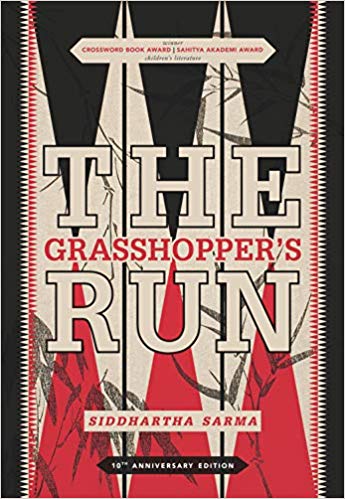
Siddhartha Sarma is a journalist, writer and historian. He has covered insurgency, crime and law in the Northeast and other parts of the country and written for newspapers and magazines as an investigative journalist. His debut novel, The Grasshopper’s Run (Scholastic India, 2009), received the Sahitya Akademi Award for children’s literature in English in 2011 and the Crossword Book Award in 2010. His second novel, Year of the Weeds (Duckbill, 2018) is based on the land rights agitation in the Niyamgiri Hills of Odisha. His latest published work, Carpenters and Kings (Penguin Random House India, 2019) is a history of Western Christianity in India.

  1. Why and how did you get into writing? Where do you find your stories? How long does it take from inception to completion?

A.:  When I was seven, my school was bringing out a commemorative magazine to celebrate an anniversary. I was told anybody could contribute anything they liked for it, so I wrote an approximately 400-word story based on real events. A bit of a tragedy. They printed the story with no edits on the first page, with my name on it. But what I remember now and in the intervening years is not the feeling of seeing my name in print, or of reading my story in printed form, but the joy of writing it, the process of slowly putting things together in my head and of banging it out, over several hours, on my father’s old typewriter, literally sitting on his desk because I was too short to type from the chair. The fear of making a typo (which is such a frustrating experience on a typewriter, unlike on a computer where a typing error is merely an inconvenience). I have found no greater joy in life than in the process of writing a story, of entering or discovering a world, and of narrating it for myself and for any reader I might find. That is how I began writing, and what I still try to do.

I began my career in journalism as a reporter. It is a much-repeated saying in the newsroom that a good reporter never runs out of story ideas. I have never had a problem thinking up story ideas. The problem is deciding which are worth taking up. One does not have this luxury of choice as a reporter, but a writer has to be very selective about which idea she will devote her time and energies to. If my time as a journalist has helped me as a writer in any manner, it is in two: I can be objective in deciding which stories to write and which to shelve, temporarily or permanently. And second: I can be objective in editing my own work. One of the criteria I have for deciding on a story is whether I have the competence to write it. There are many genres that I have a bit of an interest in, but I know I might not be able to execute a story in them very well. Such as fantasy or science fiction.

The complete arc from story idea to research to writing and editing and the final draft depends on the length of the work, its complexity, scope of research and treatment. My first novel, The Grasshopper’s Run, took me a year and half to research and seven months to write. My newest non-fiction book, Carpenters and Kings: Western Christianity and the Idea of India took up nine years of research and eight months of writing. So it varies. But I do seem to spend more time thinking about a story than in actually writing it.

2. Is it only the long form of a novel that appeals to you? Would you ever consider other structures such as short stories or a series arc?

A.: My first work published in a book was a short story, in a humour anthology by Scholastic. Some other commissioned short stories have also been published. But, yes, I find the novel’s longer form more suitable for the kind of stories I have to tell. I have not yet thought of a series of books, although I can’t rule it out in the future. A standalone novel, however, suits the way I want to tell a story for one major reason. While working on a story, I spend a lot of time building the narrative arcs of individual characters. I go back in time, and also forward, into their futures. I create their backgrounds and populate it with other characters and circumstances. Most of these never get written in the final novel, but they do exist. So for me writing a novel is like baking a whole cake and cutting out just a slice of it for publishing. Or creating a tapestry and (again) cutting a slice of it. A short story might give me a much smaller, possibly unsatisfactory slice, while a series might need tough decisions about how many slices to make, or from which part of the cake or tapestry. So far, novels have worked for me.  

3. How much research do you delve into before you begin writing a book? How do you organise your notes? What is your writing routine?

A.: Researching for a book is among the most interesting parts of the writing process for me. Over time, I think I have become a bit more organized in my methodology. The Grasshopper’s Run caused me a lot of anxiety during the research process because I was not accounting for the volume of material I would end up having. For instance, I asked my sources for visual material to base my description of events and topography on, from the China-Burma-India theatre of World War II. I asked for un-curated photographs. I received some 1,800 photos, and most were directly relevant to my research. I had to sift through about 6,000 pages of correspondence and records from that theatre. For Carpenters and Kings, I examined 46 medieval and ancient manuscripts and translated seven of them from Latin because the previous translations were themselves dated. So gathering material is not a problem, particularly in these times. The more difficult part is knowing when to stop researching, or learning to leave out the peripheral or marginally relevant. Otherwise every book becomes a doctoral thesis.

I begin with a basic idea about the plot, in case of non-fiction the general outline of my argument. The notes I take from my research are based on their direct relation to this bare plot or argument. The most directly connected bits of evidence or material gets the highest weightage. Additionally, for fiction, any bit of non-fictional material which can help flesh out a character’s story arc or background (that part of the background which will get written rather than get left on the cutting room floor) also gets priority.

I have no particular routine. My best time is late in the night, but the slow cooking that happens before the physical act of writing can happen at any other time during the day.  

4. How did you decide to write historical fiction set in Nagaland during the Japanese invasion in WWII? And why write it for young adults?

A.: I wanted to base my first novel in the Northeast, as a mark of respect for my homeland. I thought a coming-of-age story during a conflict might work, because I had been asked to write a young adult novel by Sayoni Basu, then editor of Scholastic India. I did not want to base the story during any of the region’s numerous insurgencies, although I have covered them, because the political aspects of those insurgencies were too complex for a novel of the size I had in mind. That left the 1962 war and WWII. The actual fighting in 1962 took place in rather remote places where the human interest aspect did not play out much. WWII was, for my purposes, more suitable.

5. Did winning the 2011 Sahitya Akademi Bal Puraskar and the 2010 Crossword Award for Best Children’s Book for your debut novel The Grasshopper’s Run apart from pleasantly surprising you also put undue pressure on you to excel with your next book?

A.: ‘Pleasant surprise’ is very appropriate. I was surprised and gratified that readers and people who know a lot about children’s and YA literature liked the novel. It was very encouraging, and I met some noted writers afterwards and received valuable advice on writing from them. It was a very pleasant experience.

There has been no pressure. I have always been fortunate in the publishers and editors I have worked with. I just try to work on each story on its own merits, and don’t think much about expectations. The only expectation I have from myself is to write, at each stage, a better story than I have written before. If that happens, I am content. Ultimately, I have to write stories that I would like to read, and re-read.

6. Your second young adult novel, Year of the Weeds, is written nearly a decade later. The plot of the novel is reminiscent of the Niyamgiri movement of the Dongria Kondh Adivasis in Odisha who fought mining company Vedanta’s attempts to exploit their land and emerged victorious. How do you achieve this fine balance between journalistic writing and creating fiction for young adult readers?

A.: Year of the Weeds is indeed based on the Niyamgiri movement and was inspired by it, although the novel ended up containing elements from other similar peoples’ movements, while the workings of the government and companies is based on what I have seen across the country as a reporter. I follow peoples’ movements and Niyamgiri was inspirational and unexpected, so I wanted to commemorate it, even though I suspect it was just a provisional victory. While writing it, I was conscious that my treatment had to be that of a YA novel. However, I have also tried to include in it ideas and insights I have had as a journalist covering different aspects of India, such as how most Indians in the hinterland live, how the government interacts and often exploits or victimizes them, and what the true face of development is in these parts of the country. So, while it remained a YA novel throughout, with the frame of reference being mostly that of the two YA protagonists Korok and Anchita, I also tried to make sure these insights and ideas were properly written into the plot.

Around the time that I began researching for The Grasshopper’s Run, I realised I could not continue as a reporter and simultaneously as a writer of fiction and non-fiction. I was increasingly not content with the limitations (as I saw it) of a reporter, at least in terms of autonomy. I wanted to tell stories which could not be accommodated within my work as a reporter. So I shifted to the desk and have worked as an editor ever since, while writing books. I chose writing at the expense of reporting. I have not regretted it.

7. You have an enthusiastic passion for the Crusades and yet your first narrative nonfiction was Carpenters and Kings: Western Christianity and the Idea of India. Why?

A.: I have studied the Crusades, and my thesis for an M Litt degree was on strategy during the Later Crusades. I find the Crusades very significant in understanding world history in general and European history in particular, because those conflicts sit at the centre of a wide range of connected events, including the Renaissance, the Reformation and the Age of Exploration.

There is a number of good, accessible and recent works on the Crusades by scholars from the West, so I did not intend to write a work of my own, which would not have made any significant contribution to the subject. However, something interesting happened during my research for the thesis, which was a study of three proposals for crusades by scholars in the late thirteenth and early fourteenth centuries. One of these scholars, a Dominican monk, wanted to launch a crusade from India. My supervisor suggested that I could refer to a secondary source on what these Europeans were doing in India in the period before the Age of Exploration. We discovered that there was no work which explained the political history of Western Christianity in India in the pre-colonial period. In December 2017, I realized I had enough material for a book which dealt with this subject, so I wrote Carpenters and Kings. And yes, I did include a brief history of the Crusades in it, and one of the chapters is about the Dominican who wanted a crusade from India, because all these are connected events. What was the Dominican doing in India? Also, much later, what was Vasco da Gama doing here? The answer to both questions is the Crusades.

8. You write young adult literature, travelogues and non-fiction. This is a diverse range of genres. How did this happen?

A.: Each book happened in a specific context and for unique reasons. The Grasshopper’s Run was meant to be a YA novel. While researching it, I travelled in the Northeast and Myanmar, and afterwards wrote a series of emails describing my travels, which I sent to friends. These were read by a publisher, who asked me to expand them into a travelogue, from which East of the Sun (Tranquebar, 2010) happened. Meanwhile, I wrote two books for the popular 103 series by Scholastic, one on great travellers I admire and the other on historical mysteries. And then I wrote Year of the Weeds followed by Carpenters and Kings. I guess one reason why this is an eclectic mix is I follow a story to its natural place and write it accordingly. So we have a situation where, although history is what I am academically suited to writing about, Year of the Weeds is contemporary political fiction. I am comfortable with chasing a story wherever and to whichever genre it leads. I think the only concern for a writer should be whether the story is told well or not. Having said that, I am still learning, so if I discover that I should stick to specific genres, I shall do that.

9. Do the methodologies of research and writing for young adult literature and narrative nonfiction vary?

A.: It is possible that some researchers might have different research methodologies depending on what genre they are planning to write in. I do not have different methodologies. I choose a subject, start reading about it, examine primary and secondary sources, select those sources which are suitable for the story I have in mind, and then sift through the material I obtain.

There are certainly differences in writing YA fiction and narrative nonfiction for general readers, including tone, scope, complexity of ideas, presentation of this complexity. In some ways, like channelling all the research into suitable concepts, narrative nonfiction is more challenging. In several other ways, like writing in a manner which holds the reader’s attention, and creating believable characters and plots, YA literature has its own set of challenges. Both are very rewarding genres to write in.

10. What are the kinds of books you like to read? Any favourites?

A.: I have followed several genres over the years, although now because of demands on my time I have to limit myself to those genres which I have consistently read. Of these, apart from literary fiction, I seem to have read crime and espionage fiction fairly consistently. Fantasy, which I was reading a lot of till some years ago, seems to have dropped off. I do not know if this is a temporary phase.

11. Who are the writers you admire and may have influenced you?

A.: These are among the writers I have liked almost consistently. In literary fiction: Peter Carey, JM Coetzee, Saul Bellow, John Updike, Ernest Hemingway, Graham Greene, Nelson Algren, John Steinbeck. In crime: Dashiell Hammett, Chester Himes, Henning Mankell, Elmore Leonard, PD James, Janwillem van de Wetering. In espionage: John le Carre, John Buchan, Len Deighton.

12. What next? 

A.: Perhaps a dark story. One of the problems with India after 2014 has been we have been affected by the doings of the ideology and the people in power on a daily, personal level. On a daily, personal level, one finds it increasingly difficult to feel joy in most things, or to happily coast along choosing stories to read or tell at a leisurely, whimsical pace. I would have liked to write a story I was working on in 2013, but that will have to wait for some time. At the moment, we need stories that deal with or are related to the situation we have in India, or which go some way towards explaining things. We can’t ignore that. So, perhaps something dark, something angry.

17 August 2019

An interview with Rebecca Servadio, Literary Scout and Managing Partner, London Literary Scouting

Rebecca Servadio, Literary Scout and Managing Partner, London Literary Scouting is an incredible person to meet, crackling with energy, eyes sparkling and speaking rapidly with not an urgency but because there is so much to share about the world of books. No time to waste. She is a powerhouse who is involved with organisations like PEN, World Without Borders, literary festivals, juror for various publishing awards etc. In 2017 she was recognised as one of the Whitefox “Unsung Heroes of Publishing“. Rebecca works for twenty plus publishing houses around the world, for example Riverhead/PRH in the US, Gallimard in France, Einaudi in Italy, Anagrama in Spain, Hanser in Germany, de Bezige  Bij in Holland as well as working in film/tv and stage where she also works for BBC Film and the National Theatre amongst others. Rebecca and I met when we were a part of the Visiting International Publishers Delegation, Sydney (29 April – 5 May 2019). The following interview was conducted via email.


  1. How and why did you get into publishing?

The truth is that I love to read, I love literature, I love the thrill of losing myself within a book, the immediate travel. Immediately I am somewhere else, outside of my experience, inside the human experience whether it be emotional, intellectual or a page turner. I was and am still interested in people and in storytelling and in community and collaboration of all types and publishing is all these things. Creative with words. Local, particular, challenging, ever evolving, transformative, international – publishing is all those things and each interests me. I was a lawyer before starting to work in publishing and although I learnt both rigour and determination and other life skills that serve me well with my scouting agency, I found myself weighed down by the monotony and intense focus. Publishing is as varied as there are stories and people and I relish the challenge of connecting these two things with good books.

2. Why did you choose to be a literary scout and not a literary agent? What are the differences between a literary scout and a literary agent? Does it help to be multi-lingual as you are?

I think the real answer to that question is that I am interested in where the dots connect up and how you build bridges and connect people and books in different countries. I love building bridges and networks that surprise and so help books to travel and help the publishers that I work with discover and publish the best writing and author. I also like to communicate and talk in different languages and across different languages and different domestic, national and international realities. I read in English and Italian and French. I work closely with Spanish and have readers that read in the Scandinavian languages, German, and Portuguese. I think of scouting as curation, as gate opening, as intelligence, as the signal within the noise and the world is very noisy.

There are many differences between scouting and agenting but the primary one is that an agent represents his or her clients – writers generally speaking and is paid through a commission on the sale deal for the book of the author. An agent is always incentivised and interested to recommend an author (and a particular book) because that is the very nature of their job – their bread and butter consists in selling that authors works and so talking about them in a way that strengthen the hand and the value of the book. A scout on the other hand works for a publisher and helps the publisher navigate the publishing world and marketplace. The scout should be opinionated and recommend the best books for a particular publisher and again enable the publisher and their best interests and so advising against a book is as much part of the job as advising to buy a book more economically or again read/buy something different all together. A scout should never have a commercial incentive or interest to recommend a book to their publisher and their loyalty should always lie with the publisher and not the writer or the agent. A scout should not have a client – publisher house – in their home country and again work exclusively in each country unlike agents. Again agents generally work in one territory and not across territories although this is not true of co-agents or foreign rights agents in house or in agencies. 

3. How and when was London Literary Scouting established? What are the genres you specialise in?

As Literary Scouts we are interested in and engaged with storytelling in all its forms. We look for the best fiction and nonfiction to be published, or published in English, as well as in other major languages, on behalf of our international Publishing Clients as well as for Film, TV and Theatre. Rather than thinking in ‘global’ terms, as London-based scouts we can and do individuate those ‘worldwide voices’ which speak across languages. London is the most international of cities and we read widely and omnivorously. Yes, they might be set in other countries, worlds and cultures, but the challenge is to recognise those singular and particular voices that can cross latitudes and longitudes. Without being defined or pre-occupied by ‘the new’ we help find the authors that will build the bridges to readers today, tomorrow and in the future.

London Literary Scouting was born from a partnership between Koukla MacLehose, Rebecca Servadio and Yolanda Pupo Thompson. Koukla MacLehose founded her eponymous scouting agency in 1987, as the agency grew and flourished in 2012 Koukla founded Koukla MacLehose Associates which then became MacLehose, Servadio and Pupo-Thompson in 2014. We are now known as London Literary Scouting and the agency is led by Rebecca Servadio

We read voraciously and widely. We don’t read academic books nor do we read picture books. We read and have readers who read with us in most of the major languages. We try and find readers on a case by case basis in the other languages.

4. What are the notable successes or even failures of your firm? (There is a learning to be gleaned from every experience!)

I think our successes are all in the breadth of our client list – wonderful publishing houses, the BBC, the National Theatre and production companies and well as the calibre and intelligence and hard work of our team. In terms of books there are many by SAPIENS is one of which I am proud.

5. How important are book fairs, rights tables, and international literature festivals to a literary scout?

Essential. Meeting publishers, agents – new friends and old friends, writers and book lovers – new friends and old friends, is right at the heart of the business. Publishing remains a people business so the opportunities to meet and exchange are these ones. Reading, listening to and meeting writers is equally important and interesting. Part of scouting well is understanding what you have in your hand and who needs to know about it when. Part of scouting well is understanding your clients – the publishing houses and their domestic realities and needs and so travelling regularly to their home offices and country and meeting them at fairs is essential.

6. You are an active participant with organisations that believe firmly in the power of literature/words like PEN and Words without Borders. Around the world there is a clamp down on writers. Literary scouts work internationally with their clients. With state censorship and self-censorship by writers/publishers increasing, how does a literary scout navigate these choppy waters?

Carefully. I think network and intelligence and understanding writing and the value of fact and information has never been more important.

7. As a signatory and an advisor to the PEN International Women’s Manifesto you are very aware of the importance of free speech. What are the ways in which you think the vast publishing networks can support women writers to write freely? Do you think the emergence of digital platforms has facilitated the rise of women writers?

This is a hard question to answer properly. I think the primary way that vast networks can support women writers to write freely is to ensure that they are as widely read as possible in as many parts of the world as possible both so that their writing – their freedom of expression is more protected in what is a public and international space and again that it reaches the widest number of people so that change and progress is enacted and again shepherded and enabled forward. Change and collaboration are radical and transformative, community in numbers affords some protection for free speech and again value and visibility. I would agree that the emergence of digital platforms has played an important and facilitatory role.

8. The porousness of geographical boundaries is obvious on the Internet where conversations about translations/ world literature, visibility of international literature across book markets, evidence of voracious appetites of readers, increase in demand for conversion of books to films to be made available on TV & videos streaming services, increase in fan fiction, proliferation of storytelling platforms like Wattpad, growth in audiobooks etc. Since you are also associated with trade book fairs like the Salone Internazionale del Libro, Turin, do you think these shifts in consumption patterns of books have affected what publishers seek while acquiring or commissioning a book?

I think that most publishers acquire and publish the books that they have fallen in love with and are interested by and that to some extent reflect or help us answer or perhaps simply understand questions about how to live and to be that are essential to the human condition and that the changes in the world are necessarily reflected in these choices as the readership too evolves. I think the flip-side of this is true to so for example the fragmentation of society and the proliferation of niche interests and communities on the internet has also translated into a strengthened special interest publishing houses be they neo Nazi publishing houses or Christian evangelical publishing houses.

9. A mantra that is oft quoted is “Content is oil of the 21st Century”. Has the explosion of digital platforms from where “content” can be accessed in multiple ways changed some of the rules of engagement in the world of literary scouts? Is there a shift in queries from publishers for more books that can be adapted to screen rather than straightforward translations into other book markets?

I think that the explosion of digital platforms and perhaps even more importantly the speed and ease with which the digital world is able to share information and again upload/disseminate and/or publish has transformed the mores and publishing reality entirely. Navigating the mass of content, its breadth, depth and scope is very challenging but equally the fact that it is now possible to submit a manuscript quite literally to publishing house around the globe at the same time has transformed the rules of engagement as has the corporatisation of publishing and the establishment of huge global publishing houses such as Penguin Random House or HarperCollins. That said I think the wealth and breadth of content means too that real considered opinion and curation is more important than ever and so intelligent scouting is ever more important and interesting. Of course no one can run faster than email nor should they want too. . . .Re the book to screen market book to screen (and particularly TV) is booming which is surely a good thing for authors who are struggling evermore to make a living from writing and a less good thing for publishing as many interesting and talented writers prefer to write within this more lucrative medium that write simple books. As someone who remains of the opinion that what is sort after is excellence in all ways put particularly storytelling – so in other words the opposite of indistinguishable content – I continue to feel optimistic about wonderful books and writers finding interesting and transformative ways to also tell their stories in other medium and that books will continue to be read and treasured and shared.

10. In your experience what are the “literary trends” that have been consistent and those that have been promising but fizzled out? What do you think are the trends to look out for in the coming years?

I think intelligent narrative nonfiction and popular nonfiction is going and has gone from strength to strength and will continue to do so. People after ever more in need of ways to understand and answer the questions that trouble or times and contemporary societies. A trends that has (fortunately fizzled out) is soft erotica a la 50 Shades of Grey. With regards trends for the future, I look to the environment and the ecological/climate crisis in both fiction – eco thrillers & whistle blowers as well as serious nonfiction.

11. How many hours a day do you devote to reading? And how do the manuscripts/books find their way to you?

How many hours a day…. that is really impossible to answer. I love to read and equally I am interested in people and curious so I meet people which is also how manuscripts make their way to me. How books come to me is that that is the heart of the game. Books can come from anywhere so I work with, talk too and interact with a wide variety of people from agents, foreign rights agents, editors and publishers but also writers and journalists. I read voraciously, online too, longform, short stories, old and new. I love recommendations. Friends. I work closely with both like minded and non like minded people because I don’t see the point of only having a network of people who share your taste. Many agents and foreign rights people send me books because working for a larger family of publishers means it is a way for them to reach a wider audience.

17 June 2019

‘Children are shape shifters who go easily into a story, but adults hesitate’: Writer Cornelia Funke

I interviewed legendary German writer of fantasy fiction for children Cornelia Funke. Scroll published the interview on 2 December 2018. It is c&p below too. 

Award-winning German writer Cornelia Funke, whose books for children have sold millions of copies worldwide in several languages, released The Griffin’s Feather – the sequel to her immensely popular Dragon Rider after a gap of 16 years. The novel, whose animated version is in the works, is about young Ben and his silver dragon Firedrake who go on a magical quest in search of the Rim of Heaven, a quiet and safe haven where dragons may live in peace without being disturbed by human beings.

The Griffin’s Feather marks the return of Firedrake, Ben and his adopted family – the Greenblooms. They all live in MIMAMEIDR, Norway, where accommodation may be found for fabulous guests such as trolls, impets, fossegrims, mermaids, dragons and winged horses, since they would pass unnoticed more easily in the country’s remote forests.

The quest is for a “Griffin’s Feather”, which can be swiped over the three eggs of the winged horses so that their children can either be born or face extinction. Unfortunately, their mother has been killed. So it falls upon Ben and Firedrake to ensure their survival, but not before many incredible adventures along the way. The reading experience is made all the more remarkable with the incredible illustrations accompanying the text.

Funke spoke to Scroll.in over email to talk about her new book and her methods of working, accompanying her answers with this note: “India has a very special place in my heart and I feel so honoured by how passionately my stories are welcomed there. Please give my love to India!” Excerpts from the interview:

How did these magical landscapes of Rim of Heaven, MIMAMEIDR, temple of Garuda and Pulau Bulu come to be?
There is often the misunderstanding that fantasy is about other worlds. I don’t believe that. My stories are always a love song for this world and all the landscapes you travel in them are inspired by places and landscapes of this planet. When I sent the dragons to the Himalayas I did that because I thought it believable that dragons can hide between its mountains.

It’s much harder to find such a refuge in Europe, but the woods of Norway felt like a believable home for MIMAMEIDR and a refuge for fabulous creatures. The temple of Garuda speaks of course of my love of India! And Pulau Bulu…where else would Griffins be able to hide but on one of the countless islands of Indonesia? A boy from Indonesia, Winston Sevala, who visits my website regularly, helped me with research and names so I made him a dragon rider to show my gratitude.

To say one more thing about the Rim of Heaven: I bought 10 acres of land in the Santa Monica Mountains to keep them wild and to one day bring young artists from the countries I am published in to this magical place and see what the wilderness inspires in them. I promise that of course at least one will come from India!

When Anthea Bell (who also translated, among others, the Asterix comics) was translating the books, how involved were you with the process? Did you compare the German and English texts? Are these in any way different?
Of course every language has its very own voice, even with as brilliant a translator as Anthea. At a panel in Jaipur I learned about the impossibility of transferring the lushness of Hindi to an English translation. But Anthea tailored the English clothes for my stories so beautifully that sometimes I liked them even better than the German clothes. We worked very closely together, especially when it came to names and translating them, and Anthea’s research and intricate knowledge of almost everything always fascinated and enchanted me and made the translation process magic in itself.

Why is there a long gap between the two books in the series? Dragon Rider came in 2000 and Griffin’s Feather wasn’t published till 2016.
In Germany it was even longer! I tried several times to write a sequel to Dragon Rider, but each attempt felt repetitive and not as strong as the first adventure. Then I developed the iPad App for Reckless with Mirada and was so happy with the visual interpretation of my world that we began to work on something similar for Dragon Rider. While playing with stories and motives (I just released an audio play based on the work.) I once again fell in love with the characters and suddenly I saw so clearly how the story continues that The Griffin’s Feather almost wrote itself. The digital version had inspired the printed word!

Your stories about “fabulous creatures and other rare things” are imaginatively happy and joyful stories for children. What prompted you to write such stories?
I just write stories I love to read myself. And I am profoundly enchanted by children and young readers, by their openness and curiosity, by their will to still ask the big questions about the world: where do we come from? What is this all about? Why is the world so beautiful and terrible at the same time? Children also still understand that we are just part of a huge web and connected to every plant and creature on this planet. They are still shape shifters and go easily into a story, whereas adults often hesitate to allow their imagination to give them feathers and wings.

Your knowledge about fairies, folklore, myths and legends around the world is encyclopaedic as evident in these novels. How much research was required for writing these books?
Not as much as for the Reckless books. That series actually taught me much about research and how to weave myth and the past into my stories. By now I use my research always on my three worlds: Mirrorworld, Inkworld (which is Mirrorworld 500 years earlier) and the world of Dragon Rider. They all inspire each other, which makes it easy to work on all three at the same time – which I love to do.

Given that you illustrate your own books, do you see the story as a combination of text and illustrations, or is it more of a case of the text being bolstered by the illustrations?
In the past few years illustration have become more and more important for my storytelling. It started when I began to write my stories by hand. I often added sketches, and for The Griffin’s Feather I drew all the characters first before describing them. I love that drawings often reveal aspects of a character that I would have missed by just describing them. For my new Reckless book, The Islands of the Fox, some of my characters even showed up on canvas while I was painting with oil colours, claiming a part in the story or making me realise that a character whom I thought to have human shape does indeed prefer to show himself as a Zentaur.

If you are particular about the layout of the printed text, how do you envision these stories will work in other formats such as digital, interactive apps, films, etc?
I am slightly disenchanted by the movies, as nine adaptations have proved how much is lost from page to screen. I guess my books might do better in a TV format, as they have so many layers and characters. My favourite adaptation by far is the Reckless App for iPad. It made all my dreams about a visual adaptation come true, and instead of shrinking my world, it grew it.

How did you select the opening quotes for each chapter in Griffin’s Feather? Is the lay-out of the page (opening quote, story, illustrations) as important as movement of plot and action in the story?
Choosing quotes is always quite a time-consuming process (and my publishers have a lot of work clearing the copyright), but I love to have other voices in my books. As for the layout – as a visual artist I do love of course to play with initials or chapter headings and this time I did more than 100 ink drawings.

The manner in which you play with figures of speech and minutely describe the magnificent landscapes and its creatures makes me wonder if after writing the manuscript you “test” the stories on younger readers by sending them pages or reading aloud to them.
No, I actually don’t. I only read aloud to myself – and I send the manuscript to my daughter Anna, who is 27 by now and my very best editor (and the strictest one). My son Ben prefers to be a character in my books.

The underlying themes in these books is conservation of the environment and its creatures. In fact you have chosen to immortalise Jacques Cousteau, David Attenborough and Jane Goodall – three of the giants of environmental conservation in the Twentieth Century. Why them?
Not to forget Sylvia Earle! Their passion for the non-human world is exemplary for me, but there are for sure many many more who deserve to be named.

What did you like to read in your childhood? Did you ever desire books like the ones you create?
I always loved fantasy and adventure stories, so yes, I guess I am writing what I looked for in the library as a girl.

3 December 2018 

The Magic School Bus on Netflix

The immensely popular Magic School Bus books have now been released as a new animation series on Netflix. Here is the trailer:


This edutainment series are a marvellous way to introduce children to concepts such as the water cycle, volcanoes, climate change, environment, solar system etc. The reasonably priced and heavily illustrated books published by Scholastic are available on Amazon. Some facts about the series:

More than 90 million books in print, in 9 languages! 
• The book series celebrated its 30th anniversary in 2016
The Magic School Bus is the longest-running children’s television science series, with the classic series on the air for 18 consecutive years
• The series presents scientific facts in the form of stories

• Each book has a page at the end detailing in a humorous manner which parts of the book represented scientific fact and which were fanciful storytelling

The series were released on Netflix on 26 September 2017!

5 Oct 2017 


Arefa Tehsin, “Wild in the Backyard”

Arefa TehsinI have a six-year-old daughter, Sarah, who has taken to borrowing a series of non-fiction picture books from her school library. In the past few weeks we have read books on tarantulas, cockroaches, leeches and dog care. We have watched documentaries on spiders, camels, geckos and fishes. She is reserving the joy of watching a documentary on rattle snakes with her father ( who is not too keen to indulge her this one time!). So you cannot imagine her joy when she discovered Arefa Tehsin’s Wild in the Backyard on my desk. Sarah flipped through it. To her delight she was able to read the simple sentences and descriptions. It is written in a chatty tone. ( I found it to be in a similar vein to Gerald Durrell’s lovely My Family and Other Animals). Here is an example:

If they drink your blood, you won’t become a vampire. But they may leave you, at best, itching, and at worst, drooling and feverish in your beds. Those little Draculas — mosquitoes! They fly straight from drains and sewers to buzz in your ear and feast on your blood. ( p.40)

Arefa Tehsin ( https://arefatehsin.com/)  makes science and nature fascinating whether it is for the child or the adult reader. The illustrations that break up the text are fabulous. Somewhere a cross between authentic line drawings of the creatures being described and an illustration for a children’s book. These enable the young reader to identify the insects and birds described in the environment around them. A very useful and functional aspect. Learning and sensitivity begins at home. So if children can be imparted accurate information about the significance of animals in the eco-system rather than be hostile towards creatures they do not understand, who knows there may be hope in conservation efforts in the future.

Unfortunately the illustrator for the full page drawings tipped in and the tiny drawings scattered over the pages has not been acknowledged on the cover or the title page. Nor is there a blurb describing the illustrator beneath the author blurb. I am assuming it is Sayantan Halder since the copyright page says the illustration copyright rests with him. The back cover only acknowledges him for the book cover illustration. Very confusing and not very correct! Given that this stupendous text has been brought to life by the line drawings that complement it. Surely the illustrator could have been given due credit?

All said and done, Wild in the Backyard, is a must in every school and personal library. It is a brilliant book that shares information about the environment in an accessible manner without preaching to the young readers. It is a book for keeps.

Arefa Tehsin Wild in the Backyard Puffin Books, Penguin Books, India. 2015. Pb. pp. 230. Rs 199.

24 Feb 2016 

Zafar Futehally ” The Song of the Magpie Robin – a memoir”

Zafar FutehallyZafar Futehally was a well-known birder, naturalist and writer. He was one of the pioneers of the conservation movement in India and was instrumental in making it an important middle class concern. For instance getting an advertisement for WWF in a popular magazine of those days.

We had no scruples in ‘using’ any of our friends to advance our work; Khushwant Singh was the editor of The Illustrated Weekly of India in those days, and he promised Shama a full-page advertisement for the WWF in the Weekly if she wrote a completely original article on sparrows. Shama wrote it, and we got our first big advertisement for the Indian appeal. It was designed by Alyque Padamsee, and showed a tiger with the caption ‘Born Free, Sentenced to Death’. ( p.138)

Zafar Futehally’s fascination for bird watching began when accompanied Salim Ali on his expeditions. There are some fabulous memories he recalls of those expeditions. This book was written in collaboration with Shanthi Chandola and Ashish Chandola. They persuaded Zafar Futehally to email them short articles/notes recalling his life, especially related to conservation. All though charmingly written and a little uneven, it is a valuable addition to the history of conservation in India. As George B. Schaller says in his foreword:

Wildlife was little studied or appreciated in India during the 1960s, other than along the sight of a gun. But Zafar already had a vision, as he expressed in 1969 in a keynote speech at the General Assembly of the International Union for Conservation of Nature ( IUCN) held in Delhi, an event I also attended. ‘What I came to do is to reflect the concern of the ordinary citizen about our deteriorating environment.’ And he turned this thought superbly into action. With tenacity and tact, he built bridges between organizations, nurturing their conservation efforts, whether it was promoting green areas in Bangalore ( now Bengaluru), establishing the Karnala Bird Sanctuary or other initiatives that revealed his deep concern and respect for the natural world. He knew that unrestricted development would deprive India of a healthy environment and a secure future, a message he delivered persistently and with the quiet authority of someone who was a high-ranking member of every major conservation organization in the country and a Founder of World Wildlife Fund ( WWF)-India. He,  more than anyone in India, helped forge awareness that the environment, with all its species of animals and plants, must be protected. That is his lasting legacy. ( p.xiii)

Zafar Futehally’s wife, Laeeq Futehally, was a notable writer about nature herself. She wrote many books, including co-authoring some with Salim Ali. But A Sahib’s Manual for the Mali of articles edited by her is an all-time favourite of mine. ( http://permanent-black.blogspot.in/2008/08/cricket-music-gardening-new-paperbacks.html )

Zafar Futehally The Song of the Magpie Robin: A Memoir Rainlight, Rupa, New Delhi, 2014. Hb. p.200 Rs. 500

Some of the other books and essays related to Nature that I came across in 2014 were:

1. George Schaller Deki, the Adventures of  a Dog and a Boy in Tibet A lovely, moving and brilliant story about a boy and his dog also an Dekiintroduction to the environment. It is scrumptiously illustrated by an artist from the Tibetan art collective, Gyurmey Dorjee. According to the publisher, Permanent Black, on their blog,

DEKI is a magical book that will have you instantly under its spell. It is a blend of great story-telling and acute observation of nature and animals. As you read it you travel the stark, barren plateau of Tibet and discover its animals, monasteries, birds, nomads. Thrilling chases and cliff-hanger moments decide the battle between good and evil as the book explores the question: freedom or security, which do you choose? ( http://permanent-black.blogspot.in/2014/05/the-story-of-book.html )

I agree. I read it slowly. Savoured it.

It has been jointly published by Black Kite and Hachette India.

Indian Mammals_bookcover_website2. Vivek Menon Indian Mammals: A Field Guide It is described a reference and exceptionally usable guide to the mammals of India. It is four-colour with more than 400 species of both land and water mammals.

3. George Monbiot’s essay “Back to Nature”. The first article in BBC Earth’s ‘A World of View’ series of essays by leading environmental authors. ( http://www.bbc.com/earth/bespoke/story/20141203-back-to-nature/index.html )wild_wisdom_quiz_book

4. The Wild Wisdom Quiz Book published by Puffin India and WWF India. It consists of questions, trivia and illustrations compiled from India’s only national level quiz on wildlife.

29 Dec 2014 

Web Analytics Made Easy -
StatCounter