Recording every episode of TOI Bookmark is an honour and a privilege. I get to speak with incredible writers and publishing professionals around the world. This interview with Hisham Matar was truly special. I have read every single book that he has written so far. My Friends was exceptionally good and I devoured it in one sitting.
Here is a snippet from the conversation:
Going through… if you have ever lived through a moment of great political upheaval and rupture in your country and therefor you have experienced it beside and alongside people whom you know very well, whom you have grown up with, and known for a very long time. I am sure many of your listeners can find many examples in their mind of this. What’s fascinating is that some of those people will agree with you totally about you know what is a hopeful future and how might it look like but then you notice over the years that each one of you ends up in a different place. I think part of the question isn’t ethics or ideology or political persuasion but it is actually questions of temperament. And within political conversations it is impossible to talk about this because nobody knows what you are talking about, but we all know what is temperament. For example, some of our friends are excited by argument and they get really heated up, and I have other friends who grow poetic saying arguments will convince no one. They think that in order to get to the truth, you have to have a different kind of conversation. And they tend to be quieter perhaps and more reluctant. So those are questions of temperament. And I think, I have always thought of the novel really, the novel really is the place for human temperament. Here, I am focussing more on questions of politics, but of course these questions touch and they do deal with these characters, questions of belonging, what love is, friendship is, intimacy is. They affect all of these.
Listen to it on Spotify:
TOI Bookmark is a weekly podcast on literature and publishing. TOI is an acronym for the Times of India (TOI) which is the world’s largest newspaper and India’s No. 1 digital news platform with over 3 billion page views per month. The TOI website is one of the most visited news sites in the world with 200 million unique monthly visitors and about 1.6 billion monthly page views. TOI is the world’s largest English newspaper with a daily circulation of more than 4 million copies, across many editions, and is read daily by approximately 13.5 million readers. The podcasts are promoted across all TOI platforms. I have recorded more than 130+ sessions with Jnanpith, Padma Bhushan, and Padma Shree awardees, International Booker Prize winners, Booker Prize winners, Women’s Prize for Fiction, Nobel Laureates, Pulitzer Prize, Stella Prize, AutHer Awards, Erasmus Prize, BAFTA etc. Sometimes the podcast interviews are carried across all editions of the print paper with a QR code embedded in it.
Some of the authors who have been interviewed are: Banu Mushtaw, Deepa Bhasthi, Samantha Harvey, Jenny Erpenbeck, Michael Hoffman, Paul Murray, V. V. Ganeshananthan, Hisham Matar, Anita Desai, David Nicholls, Amitava Kumar, Hari Kunzro, Venki Ramakishnan, Siddhartha Deb, Elaine Feeney, Manjula Padmanabhan, NYRB Classics editor and founder Edwin Frank, Jonathan Escoffery, Joya Chatterji, Arati Kumar-Rao, Paul Lynch, Dr Kathryn Mannix, Cat Bohannon, Sebastian Barry, Shabnam Minwalla, Paul Harding, Ayobami Adebayo, Pradeep Sebastian, G N Devy, Angela Saini, Manav Kaul, Amitav Ghosh, Damodar Mauzo, David Walliams, Boria Majumdar, Geetanjali Mishra, William Dalrymple, Abdulrazzak Gurnah, and Annie Ernaux.
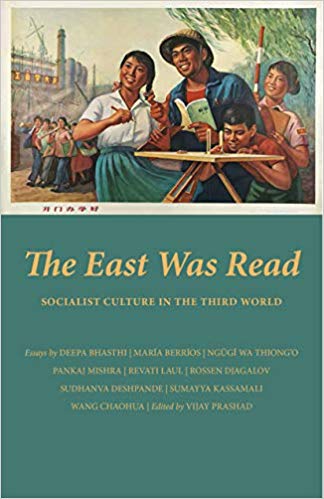
The East Was Readis an anthology of essays on the impacts of socialist culture in various parts of the Third World. Wang Chaohua and Pankaj Mishra recall with fondness the meaning of these books for their very different lives in China and in India respectively. Deepa Bhasthi goes on an emotional journey into the library of her grandfather, a communist intellectual. Rossen Djagalov writes a short history of Progress Publishers. Ngugi Wa Thiong’o talks about how he wrote Petals Of Blood in Yalta on the sidelines of the Afro-Asian Writers’ Association in 1973. Sumayya Kassamali writes about Faiz in Beirut, giving us a sense of the cultural worlds that drew in both the Soviet Union and the Third World Project. Across the Third World, people grew up reading inexpensive beautifully-produced books from the Soviet Union — children’s books, classics of world literature, books on science and mathematics, works of Marxist theory. One such prominent publisher responsible for producing beautiful books, many in translation, was Progress Publishers. The following extracts from the essay have been reproduced with the permission of the publisher.
****
(p. 78)
As an heir to the nineteenth-century Russian intelligentsia’s literature-centrism, the Soviet state, down to its very bureaucracy, believed in literature’s capacity to change society and made an enormous investment in literacy campaigns and the wide accessibility of literature through publishing houses, bookstores, libraries, and public readings. As a testimony to that belief, by the time the USSR ceased to exist, its Writers’ Union had approximately 10,000 members, that is, 10,000 professional writers who could live off their literary work—a number probably never matched in history, before or after. It was not only a matter of financing: through street names and monuments, school curricula and press reports about writers, the state helped to institutionalize the idea of the intelligentsia as the spokesperson of the people. It also helped to cement the idea that literature is an authoritative source of values. And yet from the second half of the 1920s onward, Stalinism also did much to compromise that ideal by increasingly using literature instrumentally, censoring it to better reflect its talking points, and otherwise controlling it.
…
(p. 81 – 83)
Progress’s origins could be found in the utopian visions of the
immediate post-Revolutionary period. In the realm of literature, one of the main
generators of these was Maxim Gorky, who proposed a World Literature publishing
house that would translate all foreign literatures into Russian, Russian literature
into all the major languages of the world, and finally, all of the above in to the
languages of the Soviet Union. An economically devastated and politically isolated
Civil War era Russia, however, was not a place where such visions could be realized.
A World Literature publishing house did appear between 1919 and 1924, focused only
on one part of Gorky’s vision: the translation of world classics into Russian. While
it offered much-needed employment to Petersburg writers as translators and editors,
paper shortages, organizational difficulties, and lack of funding ultimately meant
that most of their translations remained unpublished.[1]
With time, however, the resources at the disposal of the Soviet
state grew and elements of these early visions began to be realized even if compromised
to one degree or another by the growing Stalinist stratification. Founded in 1931,
a Moscow-based literary magazine with issues in several languages, Literature of the World Revolution (renamed
in the beginning of the Popular Front period to International
Literature) may have been the most visible structure
of Soviet literary internationalism. Yet more significant, especially as far as
non-Soviet readers were concerned, was the establishment that same year in Moscow
of the Publishing Cooperative of Foreign Workers (ITIR), Progress’s predecessor,
which translated books into foreign languages.[2]By
that time, there were already several other foreign-language newspapers in the city:
the Polish Tribuna Radzecka, the French Journal de Moscou, the English Moscow News as well as The Communist International, which was publishing issues in German, English, French, Spanish,
and Chinese. Besides, the Executive Committee of the Communist International (ECCE)
was already translating and printing the works of Lenin and other political literature
in different languages.[3]
ITIR drew its translators and editors from both polyglot Soviet citizens with foreign experience and political refugees, often with Comintern connections. Indeed, its staff reflected the composition of Moscow’s foreign community and its shifts: from the influx of Spanish refugees in the late 1930s to their retirement or departures for Mexico, Cuba, or Spain in the 1960s and ’70s, from the return of the Moscow-based East European exiles to their countries in themid-1940s to the increasing numbers of non-Western subjects in post-Stalin-era Moscow such as the main translator of nineteenth-century Russian literature in Hindi—Madan Lal Madhu (1925–2014).
…
(p. 83 – 84)
In the history of publishing, there has probably never been a press so linguistically ambitious. In its first year (1931), it published in 10 West European (English, German, French, Italian, Dutch, Swedish, Norwegian, Danish, Spanish, and Portuguese), seven East European (Serbo-Croatian, Czech, Bulgarian, Romanian, Hungarian, Polish, and Lithuanian), and five Asian languages(Japanese, Chinese, Korean, Persian, and Turkish). And while the first post-Second World War decade saw the emergence of an Afro-Arab (Arabic, Amhara, Yoruba, Hausa, Swahili) and Indian (Hindi, Urdu, Bengali, Tamil, and Telugu) sections, it was in the post-Stalin era that non-Western languages came to dominate the overall publishing plans. Over the course of the1960s alone, the number of ‘Eastern’ languages doubled, from15 to 28. By 1980, the Indian section was producing more titles than the English one, which had led the publishing house since its foundation. (Throughout this period, books in the colonial languages—English, French, Spanish, and Portuguese—were also being sent to Africa, Asia, and Latin America by ITIR’s distributor, Mezhkniga.) By the time it came to an end in 1991, Progress was a behemoth publishing yearly close to 2,000 new titles with a print run approaching 30 million copies.[4]
…
(p. 85-86)
It was publishing in foreign languages, however, that accounted
for the vast majority of Progress’s output. Many around the world fondly remember
Progress’s cheap, high quality editions of otherwise unavailable Marxist literature.
In addition to the classics of Marxism and Leninism, the other three areas Progress
published in were politics, textbooks & illustrated materials, and fiction.
Fiction emerged as a distinct field of the publishing house only gradually, as the
classics of Marxism-Leninism and contemporary political studies had initially been
the main focus of ITIR’s work. Over the course of the 1930s, however, some of the
publishing house’s more distinguished translators such as Alice Oran, George Rui,
Maximilian Schick, Hilda Angarova, Jose Vento, Angel Errais, Margaret Amrome, Ivy
Litvinova (Soviet foreign minister Maxim Litvinov’s wife) began to translate the
classics of Russian and early Soviet literature into foreign languages. Slowly,
over the post-war era, the literature section became the largest of Progress’s four
thematic sections, reaching in 1981 a volume of 404 titles. The following year,
1982, it evolved into an independent publishing house, Raduga (Rainbow). By that
point, the editorial choices for texts to be translated could easily veer away from
the safe classics to include more debatable contemporary Soviet literature such
as Valentin Rasputin and Chinghiz Aitmatov’s novels. There has never been another
publishing house worldwide that could compete with its ability to popularize Russian
and Soviet literature abroad, or more generally, any publishing attempt of such
scale to create a direct translation link between two non-Western literatures, bypassing
the monopolies of London, Paris and New York. And yet, together with all other Soviet
projects for world literature, this one has been largely forgotten, except maybe
for the occasional volume in public libraries and private collections.
[1]Maria Khotimsky, ‘World Literature, Soviet Style: A
Forgotten Episode in the History of the Idea’, Ab Imperio, vol. 2013,
no. 3, 2013, pp. 119–154.
[3]For more on Moscow’s cosmopolitanism
of the 1930s, see Katerina Clark, Moscow,
the Fourth Rome: Stalinism, Cosmopolitanism, and the Evolution of Soviet
Culture, 1931-1941,
Cambridge, MA: Harvard University Press, 2011.