
“Clock Towers of India: Sentinels of Time”, an interview with the author, Debashish Das
This interview was published on Moneycontrol, 21 Oct 2026.
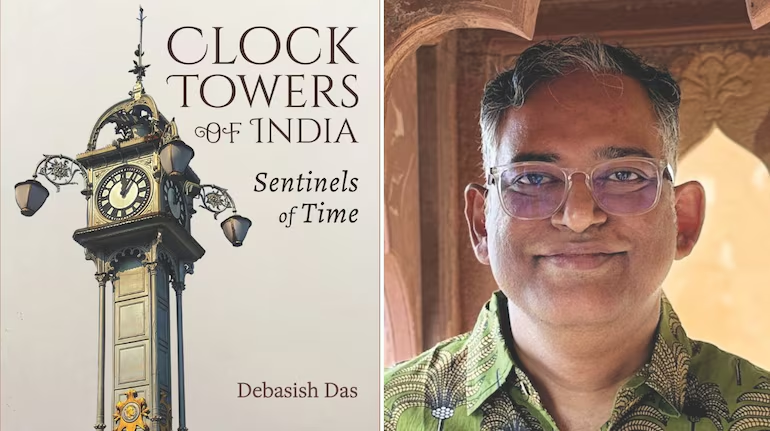
Clock Towers of India is a richly illustrated exploration of India’s clock towers, revealing how public timekeeping has shaped—and been shaped by—the subcontinent’s history. Many clocks were imported from Britain and Europe, yet their continued survival reflects long traditions of local care, repair and adaptation, alongside later Indian manufacture.
Drawing on photographs gathered from across India, Debasish Das surveys more than 150 clock towers from all corners of the country spanning more than three centuries, from early colonial churches, such as the clock tower at the Basilica of Holy Rosary at Bandel in West Bengal (1660) to post-Independence public monuments, such as Mahatma Phule Mandai Clock in Pune (1993).
The book deals with the clock towers chronologically and provides for each clock tower its construction history, full description of the tower and its architectural style, as well as the description of the clock, dials, clockwork and the clockmaker, and finally an account of the subsequent repairs, maintenance and current status.
Bringing together architecture, horology and wider history, this novel volume opens a new visual and documentary record of India’s public clocks and the communities that have sustained them.
Debasish Das is a technology professional with a deep passion for horology and history, particularly the history of the monuments of Delhi. Through his many insightful blogs on Delhi’s heritage, he has contributed to popularizing their history beyond academic circles. His essays on ‘Sundials to Tell the Time of Prayers in the Mosques of India’ and ‘Introduction of the Indian Standard Time: A Historical Survey’ were well received. He made his authorial debut in 2019 with Red Fort: Remembering the Magnificent Mughals, which provides a vivid exploration of its legacy.
0. How and why did you get interested in clock towers?
The following interview was conducted via email. It has been lightly edited.
- Why and how was the clock tower conceived? How did the concept spread in India? When was the first tower clock made and where? Is it still working or there is only archival evidence?
The story of the clock tower is, in many ways, the story of how time moved from being a local, often naturally observed phenomenon to a publicly displayed and increasingly standardised measure.
The word clock is derived from words associated with a bell. In medieval Europe, bells played an essential role in religious and civic life. Church bells summoned people to prayer and announced important moments of the day. Initially, the timing of these signals depended on observation of the sun and other methods of timekeeping. Over time, more elaborate water clocks and mechanical devices helped regulate the sounding of bells, reducing the need for constant manual intervention.
India had its own long tradition of time measurement through water clocks, known as ghati-yantra. One common form used a small perforated bowl that floated in a larger vessel of water and gradually sank as water entered through the aperture. Calibrated to sink at intervals corresponding to one ghati—approximately 24 minutes—such devices were used to measure time. The word ghari, still used in several Indian languages to refer to a clock or time, reflects this older vocabulary of timekeeping.
The Chinese Buddhist traveller Yi Jing, who spent many years studying in India, described monastic practices and methods of measuring time. At institutions such as Nalanda, the passage of time was communicated through sounds, including bells and drums. In medieval Delhi, Firoz Shah Tughluq is also associated with a timekeeping arrangement known as tas-i-ghariyal, reflecting the importance attached to measuring and announcing time.
In Europe, the development of mechanical clocks during the late medieval period marked a major turning point. Henry de Vick’s clock, constructed in Paris in 1360, is an important milestone in this history. Nearly three centuries later, Christiaan Huygens’s invention of the pendulum clock in 1656 dramatically improved accuracy. These advances helped make mechanical clocks increasingly practical for public use.
As European trading powers arrived in India, mechanical clocks entered royal courts and elite households, sometimes as diplomatic gifts. However, the adoption of European timekeeping was gradual, shaped by differences in local time-reckoning traditions and by the needs of administration, commerce and religious institutions. With the expansion of colonial rule, railways and modern urban administration, the demand for a more uniform public time became increasingly important.
The clock tower emerged as a particularly effective way of meeting this need. Rising above the surrounding buildings, it made time visible across a town or neighbourhood. Its bells could also communicate the hour to those who could not see the dial. Clock towers consequently became prominent features of churches, railway stations, markets, educational institutions and civic centres. They were not merely timekeeping devices; they were also symbols of authority, technological progress and civic identity.
Identifying the world’s first tower clock, however, is not straightforward. Several surviving European clocks are regarded as among the earliest examples. These include the Salisbury Cathedral Clock, traditionally dated to around 1386; the astronomical clock at Wells, dating to the late fourteenth century; and the Gros-Horloge of Rouen, installed in 1389. Their histories, restorations and surviving mechanisms differ, so claims about which is the oldest must be treated with care. Some retain historic mechanisms, while others have undergone substantial modification or have been preserved in museums.
In India, the story is equally complex. Portuguese and other European establishments introduced new architectural and horological traditions, particularly through churches and settlements along the coast. Bandel Church in Bengal, whose history dates to the Portuguese period, is an important early site to investigate in tracing the arrival of public clocks. St Francis Church in Kochi, originally established by the Portuguese in the early sixteenth century, is another significant landmark, although the existence of a clock there before the present installation of 1923 requires further evidence.
Ultimately, the spread of clock towers in India was not simply the importation of a European invention. It was part of a larger transformation in public life, as older traditions of observing and announcing time encountered new technologies and new demands for synchronisation. The towers that emerged from this encounter became enduring landmarks—standing at the intersection of technology, colonial history, urban development and the everyday lives of the people they served.
- What is the basic mechanism governing all tower clocks?
Tower clocks have not all operated on the same mechanism. Their designs evolved over centuries, from early water clocks to weight-driven mechanical clocks and, later, clocks regulated by pendulums. Each development reflected the technology available at the time and the growing need for more reliable timekeeping.
The clock built by Henry de Vick in Paris in 1360 is an important milestone in the history of mechanical clocks. The invention of the pendulum clock by Christiaan Huygens in 1656, followed by improvements in escapement mechanisms, greatly enhanced accuracy and helped popularise mechanical timekeeping. Clocks with hour and minute hands subsequently became increasingly common, allowing time to be read directly from a dial.
In a typical mechanical tower clock, four essential systems work together: the driving mechanism, which supplies energy, usually through descending weights; the transmitting mechanism, which carries the motion through gears and wheels; the controlling mechanism, or escapement, which regulates the release of energy and works with the timekeeping element to maintain a steady rate; and the indicating mechanism, which drives the hands across the dial. Many tower clocks have four dials, one on each face of the tower, allowing the time to be seen from different directions. These dials are generally synchronised by the same movement.
India also offers fascinating examples of alternative ways of communicating time. Mumbai’s Time Ball Building, popularly known as Ghadiyal Godi, is a particularly interesting case. Its time ball was designed to drop at a predetermined moment, providing a visual time signal to ships in the harbour. Rather than relying solely on a clock face or the striking of a bell, it communicated a precise moment through a different mechanism.
What fascinates me most is the ingenuity behind these machines and the centuries-long effort to measure, regulate and publicly communicate something as intangible as time. A clock tower is therefore much more than a collection of gears and wheels: it gives time a visible and audible presence in the life of a community.
- Who was first responsible for their construction and why? How has its “patronage” changed over the years? What does the construction of a tower clock signify for the patron?
In India, clock towers were commissioned by a remarkably diverse group of patrons: colonial authorities, princely rulers, wealthy merchants, philanthropists, religious institutions and civic bodies. Their motivations ranged from commemorating royal events and marking important visits to honouring family members, celebrating religious leaders and beautifying towns.
During the colonial period, several towers commemorated the reign of British monarchs. Mumbai’s Victoria Terminus and Gwalior’s Victoria College, for instance, were associated with Queen Victoria’s Golden Jubilee in 1887, while other towers marked royal visits and jubilees. In princely states, progressive rulers commissioned clock towers as part of a broader vision of urban development and modernisation, often alongside schools, colleges, hospitals and public infrastructure.
Personal memorials formed another deeply moving category. Mumbai’s iconic Rajabai Clock Tower was funded by businessman Premchand Roychand in memory of his mother. Baroda’s Maharani Chimnabai Tower commemorated the Maharaja’s wife, while Lucknow’s Irshad Clock Tower was built by Nawab Syed Hamid Hussain Khan in memory of his son. Other towers honoured fathers, forefathers and fallen soldiers, demonstrating how public structures could preserve private grief and family legacy.
Religious institutions also incorporated clock towers into their architecture, while some rulers commissioned them in honour of spiritual leaders. Educational institutions and municipal authorities subsequently became important patrons, reflecting the growing importance of public timekeeping in civic and institutional life.
Over time, therefore, the patronage of clock towers evolved—from royal and colonial commemoration to civic improvement, philanthropy and institutional identity. For a patron, building a clock tower was rarely just about telling time. It was a way of leaving a visible and enduring mark on the landscape: expressing power, demonstrating progress, honouring a loved one or contributing something lasting to the community.
Perhaps that is what makes these structures so fascinating. A clock tower may have been built to commemorate an empire, celebrate a ruler or remember a family member, but it eventually became part of the everyday life and shared memory of entire town.
re town.
- Given the time that these were first created, what was the use of a tower clock in a largely illiterate population? Also, a populace that could read time by watching the movement of the sun?
The interesting thing about clock towers is that their significance went far beyond simply telling the time.
Even in a largely illiterate society, people were not unfamiliar with time. They understood it through the movement of the sun, the changing seasons, the length of shadows, and the rhythms of everyday life. But a sundial required sunshine, and reading it accurately required some understanding of its markings. A clock tower offered something quite different: it made time accessible to everyone, regardless of literacy or the weather. Its dial could be seen from a distance, while the striking of its bell made the passage of time audible across the neighbourhood.
More importantly, clock towers helped bring a degree of uniformity to a society where time was often determined locally. They became particularly significant with the growth of railways, commercial activity, administrative institutions and urban centres, where people increasingly needed to coordinate their activities according to a common time.
There was also a larger symbolic dimension. Erected by kings, princely rulers, municipalities and civic institutions, these towers were often statements of authority, modernity and civic pride. They were not merely instruments for measuring time; they were landmarks around which public life evolved.
So, while the sun had always told people when the day was passing, the clock tower introduced a different idea: that time could be measured mechanically, shared collectively and organised for an entire community. In that sense, these towers were as much about the changing relationship between people and time as they were about the technology of timekeeping itself.
- The variety of clock towers are representative of the age that they were built in. Yet these buildings seem to represent a wide variety of architectural styles. Or did they include certain features that were common to all the clock towers, apart from the clock face? Did the clock towers not follow a single blueprint?
Unlike many public buildings, clock towers in India never followed a single architectural blueprint. Their diversity reflects the periods in which they were built, the patrons who commissioned them, and the architectural traditions and materials available locally.
Colonial-era towers often incorporated Gothic, Victorian, Indo-Saracenic or neoclassical elements, while those commissioned by princely rulers could draw upon Rajput, Mughal or regional architectural traditions. Some were imposing freestanding landmarks; others were integrated into railway stations, markets, educational institutions, palaces or religious buildings. Their designs frequently reflected the aspirations of their patrons—whether to project authority, celebrate modernity, express cultural identity or beautify a town.
Yet, beneath this architectural diversity, certain features recur. Most towers needed a prominent elevated position for the clock dials to be visible from a distance, a supporting structure capable of housing the mechanism and, in many cases, space for bells. Verticality was important: the tower had to rise above its surroundings to serve as a public timekeeper and a recognisable landmark. Many also incorporated decorative crowns, domes, cupolas, pinnacles, balconies or arched openings, although none of these was universal.
The clock tower was therefore less a fixed architectural type than a functional idea that could be adapted to different settings. Its essential purpose remained the same, but its appearance could be Gothic in one city, Indo-Saracenic in another, and distinctly regional elsewhere.
That, to me, is one of the most fascinating aspects of India’s clock towers. They share a common function, but each tells a different story about its time, its place and the people who built it. Together, they form not one architectural style, but a remarkable record of India’s changing architectural, social and cultural landscape.
- How did you select the clock towers featured in the book? How did you gather the information and verify it for every entry? The incident about the Ghanta Ghar in Meerut being restored for a proposed film shoot by Shah Rukh Khan is a lovely story!
The research for Clock Towers of India: Sentinels of Time began in 2019, growing out of my fascination with sundials, the history of timekeeping in India and the evolution of Indian Standard Time. Over five years, I documented around 150 clock towers across the country.
My selection was guided by more than architectural beauty or historical age. I wanted to capture the diversity of India’s clock towers—their architectural styles, patrons, purposes and historical contexts. Some commemorated royal jubilees or important visits; others honoured family members, celebrated religious figures or reflected the vision of progressive rulers. I was equally interested in towers that had been neglected or had unusual stories to tell.
One of the biggest challenges was the absence of any single, comprehensive source of information. The material was scattered across archives, historical publications, newspapers, institutional records and local accounts. Even at the sites themselves, there was often little information available. Online sources could be equally frustrating, with claims repeatedly reproduced without clear evidence of their origins.
The clock mechanisms presented an additional challenge. Records might identify a tower’s date and patron but say little about its manufacturer, mechanism or subsequent restoration. I therefore treated online information as a starting point, not as evidence in itself, cross-checking details against contemporary publications, manufacturers’ catalogues and archival records wherever possible. The Building News, the Antiquarian Horological Society in London and the research of turret-clock specialist Chris Pickford were particularly valuable resources.
Expert guidance was equally important. Clock specialists and restorers, including Vaibhav Maini in Allahabad and Ashwani Kumar in Chandigarh, helped me investigate technical details that conventional historical records often overlooked. The guidance of Professor S. R. Sarma, an eminent authority on ancient Indian scientific instruments, was invaluable in assessing historical sources. Friends and contributors across India also played a vital role in locating local records and connecting me with people familiar with individual clock towers.
Stories such as the restoration of Meerut’s Ghanta Ghar associated with Shah Rukh Khan’s proposed shooting of the film Zero remind us that these structures are not merely relics of the past; they remain part of living communities. Their histories continue to evolve through the people who care for them.
Ultimately, I followed a simple principle: if I could not establish a fact with reasonable confidence, I would rather leave it out than including it.Some towers consequently did not make it into the final selection. I wanted every entry to offer readers not just a description of a building, but a credible account of its history, its mechanism and the people behind it.
- How many of these clock towers are in working condition? Who is responsible for their maintenance? Do skilled clockmakers exist?
It is difficult to give an exact number of India’s clock towers that remain in working condition, because there is no comprehensive national inventory documenting the operational status of their original clock mechanisms. Some continue to keep time, others work intermittently, and many have had their original mechanical movements replaced by modern electric or battery-operated systems.
The responsibility for maintenance varies from tower to tower. Municipal corporations, heritage authorities, religious institutions, educational establishments and other building owners may be responsible, but the availability of funds and technical expertise differs considerably. The greater concern is the dwindling number of skilled clockmakers who understand these historic mechanisms. While clock repairers certainly exist, specialists capable of restoring and maintaining large turret clocks are increasingly rare.
A tower clock is not simply a giant wristwatch. It is a complex machine comprising gear trains, escapements, driving weights, linkages and, often, hammer-and-bell systems. Maintaining it requires mechanical expertise, patience and an understanding of historical technology. Much of this knowledge is acquired through hands-on experience, making the absence of apprenticeships and knowledge transfer particularly worrying.
In many places, replacing the original mechanism with a battery-operated quartz clock appears to be the easier and cheaper option. Yet this can become a false economy. The original mechanical movement, if properly maintained, may continue working for generations, whereas replacement systems can also fail through exposure to weather, inadequate maintenance or unsuitable installation. More importantly, replacing the mechanism can mean losing an irreplaceable piece of horological heritage.
We may well be only one generation away from hearing some of these towers fall silent forever.
Of course, people today have mobile phones and smartwatches; few depend on a clock tower to know the time. But if the original mechanism disappears, something more significant than its practical function is lost. The gears stop turning, the weights become redundant and the bells fall silent. The tower remains, but its mechanical heart is gone.
Countries such as Britain, Germany and the Czech Republic offer examples of how historic clock mechanisms can be treated as heritage in their own right, rather than merely as fittings within historic buildings. India needs a similar commitment through systematic documentation, conservation funding, specialist training, apprenticeships and networks of skilled custodians.
The value of these clocks today lies not simply in their ability to tell time, but in what they represent: the ingenuity of earlier generations and their ability to build machines designed to last. When a clock tower falls silent, we lose more than a way of measuring time. We lose the sound of time passing through history itself.
- Why is the concept of a clock tower being resurrected in some states of India such as Uttar Pradesh? What exactly are these new constructions trying to invoke?
The revival of clock towers in some parts of India, including Uttar Pradesh, reflects a desire to create civic landmarks, beautify public spaces and evoke a sense of heritage and identity. Traditionally, a clock tower was much more than a timekeeping device: it was the focal point of a town, a symbol of civic pride and a place around which public life often revolved. New constructions may seek to recreate some of that symbolism—to give a place a distinctive identity and a sense of permanence.
However, I sometimes wonder whether we are reproducing the appearance of clock towers without fully understanding what made the originals meaningful. A tower placed outside a shopping mall or beside a pavement may be visually attractive, but does it have a genuine relationship with its surroundings, its history or the community it serves? A clock tower cannot acquire significance through architecture alone; that significance develops through its association with people and place.
Strictly speaking, we no longer need clock towers to tell us the time. Our phones and smartwatches have made them largely redundant as timekeeping devices. Yet they remain relevant as landmarks, repositories of collective memory and expressions of a city’s identity.
I would therefore place greater emphasis on restoring and preserving our historic clock towers than on constructing new ones merely for decoration. A historic tower is not simply a building with a clock face. Its architecture, mechanical movement, gears, weights and bells together tell a story about the technology, craftsmanship and society of its time. Replacing its original mechanism with a modern quartz system may keep the hands moving, but it risks reducing a living timepiece to a decorative façade.
New clock towers can certainly have a place in contemporary urban design, provided they serve a meaningful civic or cultural purpose rather than being superficial imitations of the past.
We may no longer need clock towers to tell us the time. But we still need them to remind us where we have come from, to give our cities a sense of place, and to preserve a tangible connection with the generations that came before us.
- An interesting fact that you unearth in your research about clock towers in India is that religions adopt the customs and rituals of another religion as revealed in these clock towers. Please elaborate.
One fascinating aspect of India’s clock towers is how a technology that originated in a particular religious context gradually transcended religious boundaries. In medieval Europe, churches were among the earliest institutions to adopt mechanical clocks, primarily to regulate prayer schedules and announce them through bells. Their prominent towers made time visible and audible to the wider community. In that sense, churches were among the earliest public timekeepers.
When this architectural tradition reached India, clocks were initially associated with churches, but gradually found their way into synagogues, temples, mosques, imambaras and civic buildings.
The central argument is that clock towers illustrate how a technology associated initially with one religious tradition transcended religious boundaries and was adapted by other communities to suit their own cultural and religious contexts.
There are two related but distinct aspects to this:
- The spread of timekeeping: Mechanical clocks were first widely adopted by European churches to regulate prayer times. In India, clock towers subsequently appeared in temples, mosques, synagogues and civic buildings, extending the technology beyond its original religious setting.
- The exchange of religious customs: The interaction was not limited to clocks. Religious communities also adopted and adapted architectural features and ceremonial practices from one another, as illustrated by the examples from Villianur.
The important distinction is that the adoption of a clock tower does not necessarily mean that a religion adopted another religion’s rituals. Rather, clock towers provide a lens through which to examine the wider exchange of technologies, architectural forms and cultural practices.
The takeaway: India’s clock towers tell a story not only of how societies learned to measure and communicate time, but also of how ideas travelled across religious and cultural boundaries, acquiring new meanings along the way.
- How and why did you get interested in clock towers?
The idea emerged naturally from a journey that had begun several years earlier. Under the guidance of Prof. S. R. Sarma, I had first studied sundials in Indian mosques and later the history of Indian Standard Time. Having explored how Indians measured time through shadows, and how the country eventually adopted a common standard time, the next logical step in this historical journey was to study the monuments that made time visible to entire cities—the clock towers.
I finally gathered the courage to begin the project in July 2019. What I had imagined would be a modest undertaking gradually turned into a five-year journey spanning more than three centuries and almost every corner of the country.
What surprised me most was discovering that India’s clock towers were far older, more numerous and more diverse than I had imagined. Like many people, I had assumed that public clocks arrived with the British Raj and were largely confined to a handful of famous monuments. But the evidence revealed a much richer story—of churches, synagogues, temples, markets, railway stations, universities, princely states and even maritime structures.
Each tower opened a door into an unexpected piece of history. A search for a clock tower could lead to the origin of a town’s name, the story of institutions established for the sons of Indian princes, or forgotten episodes preserved only in local memories and old newspapers. Again and again, I found myself verifying dates, consulting archives and cross-checking facts.
By the end, I realised that I had not merely written a book about clock towers. I had stumbled upon a neglected chapter of India’s social and cultural history—and that discovery convinced me that the story deserved to be told.
- Were there any clocktowers that you were aware of, but did not include in the book? Can you list some unique clock towers from the book?
I have included the clock towers that I was able to research sufficiently for the book. However, during the course of the research, I came across many more towers that I could not document adequately or ultimately decided not to include.
There were several reasons for this. In some cases, I could not obtain good photographs or sufficiently reliable information about the tower, its history, clock mechanism or provenance. In other cases, the information available was too limited to develop a meaningful entry. There was also a practical consideration: I wanted to keep the project within a manageable scope rather than turn it into an exhaustive inventory of every clock tower in India.
In the course of my research, I came across clock towers in cities across the country that did not make it into the final selection. These included, among others, Gujarat University in Ahmedabad; the clock towers of Alwar, Amreli, Bikaner, Chandausi, Damoh, Dewas, Faizabad, Hardoi, Haridwar, Himmatnagar, Kasganj, Katni, Khandwa, Nagercoil, Sikar, Udaipur and Ujjain; Egmore Station in Chennai; Annamalai University in Chidambaram; the New Egerton Woollen Mills in Dhariwal; Daly College in Indore; Gun Carriage Factory and other towers in Jabalpur; several structures in Jaipur; St Mary’s Church and Netaji Subhas Dock in Kolkata; several institutional and residential towers in Mumbai; the Mysore Palace clock tower; several towers in Pune; the Golden Rock Railway Workshop and District Court in Tiruchirappalli; and a number of historic towers in Vadodara, including Nyay Mandir, Khanderao Market and Sayaji Tower.
There were also some particularly interesting examples that I would have liked to include but could not document to the standard I wanted. That is one of the realities of researching architectural and mechanical heritage: finding evidence of a clock tower is one thing; finding enough reliable information to tell its story properly is another.
Ultimately, I preferred to include 150 towers for which I could provide a reasonably well-researched and documented story, rather than increase the number simply for the sake of completeness. The towers that did not make the book remain part of my research material and, in some cases, could form the basis for future work.
Regarding some of the unique clock towers, although each one is special and different, few distinctive ones can be as follows.
At the top would be Methan Mani in Thiruvananthapuram—a sacred automaton clock within a temple, unlike anything else in India.
Then the Time Ball Building in Mumbai, which wasn’t built for people at all, but for ships—part of a global maritime time network.
The Paradesi Synagogue in Kochi stands out as a rare example of a Jewish place of worship with a clock tower on the Malabar Coast.
The Hooghly Imambara Clock Tower is remarkable for its massive hand-wound mechanism—one of the largest in the country.
The Charminar in Hyderabad becomes unique because clocks were added to a seventeenth-century monument, blending eras in a single structure.
The Rajabai Clock Tower in Mumbai reflects a beautiful fusion—Victorian design, Indian patronage, and a deeply personal story behind its name.
The Port Blair Clock Tower stands apart for its remote island setting, tied to stories of empire and maritime history.
Kamla Tower in Kanpur represents industrial India—a clock tower built not for religion or governance, but for enterprise.
And the Chinnakada Clock Tower in Kollam shows how a memorial can become the very identity of a city.
And lastly—the Husainabad Clock Tower in Lucknow, India’s tallest, a striking symbol of Nawabi ambition and modernity.
- Can you tell about some clock towers that no longer exist?
I have referred to several such lost towers in the book. These include the 128-foot Northbrook Clock Tower at the centre of Chandni Chowk, which collapsed in the 1950s; the historic Tehri Clock Tower, built in 1897 in honour of Queen Victoria’s Diamond Jubilee and submerged in 2006 following the construction of the Tehri Dam; the Landour Clock Tower in Mussoorie, whose demolition prompted a silent protest led by the late actor Tom Alter in 2010; the Vellore clock erected to commemorate the coronation of King George V and Queen Mary, which was demolished to make way for a new market; and the iconic clock tower of Bengaluru’s Russell Market, which had also disappeared by the time a friend went there to photograph it. These lost towers are not included in the present count of 150.
Regarding the Chandni Chowk Ghantaghar in Delhi. Although the tower itself no longer exists, it is perhaps one of the most evocative examples of what a clock tower can represent in the history of a city.
The 128-foot Northbrook Clock Tower stood at the heart of Chandni Chowk, in Shahjahanabad and close to the Red Fort. It was built by the British in the nineteenth century, alongside the Town Hall, and symbolised a major transformation in the character of Delhi—from the Mughal imperial city to the colonial capital. The site itself had already been at the centre of political power under Mughal emperors such as Shah Jahan, Aurangzeb and Bahadur Shah Zafar.
The tower subsequently witnessed some of the most important political and social changes in modern Indian history. It saw nationalist processions, the Swadeshi movement, political speeches, the celebrations surrounding Independence in 1947 and the upheaval of Partition, including the movement of refugees. The Union Jack was replaced by the Indian Tricolour there on 15 August 1947.
The tower collapsed in the 1950s and was subsequently dismantled, but its memory survives in the name ‘Ghantaghar’, which continues to identify the area. There have also been proposals to recreate a replica of the tower.