
Interview with Likla Lall
The following interview with Likla Lall was conducted for Moneycontrol (15 April 2026).
Likla Lall (Author) & Eva Sánchez Gómez (Illustrator) Ganesh Haloi: Colours of Home ART1ST, Pb. 2025
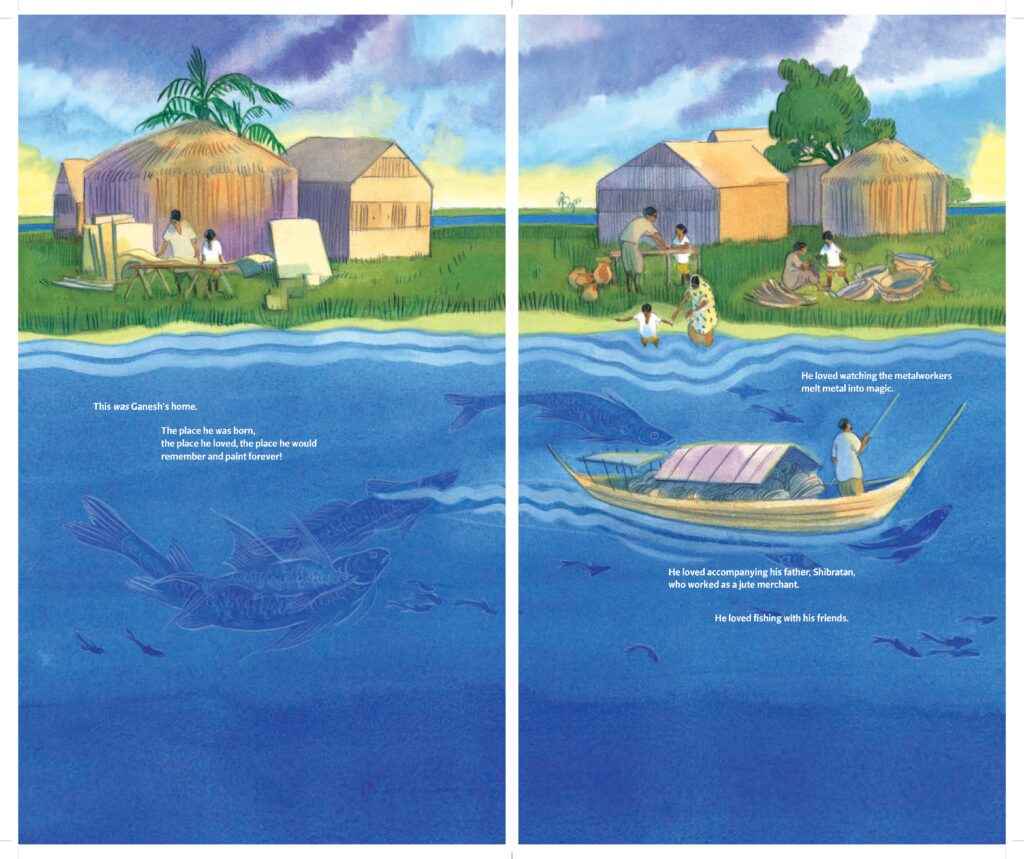
Ganesh Haloi: Colours of Home (2025), is a fascinating picture biography of the artist Ganesh Haloi. It narrates his life history simply and it is multi-layered that readers of all ages can appreciate it. The text is soaked in the art work in a manner that is readable, relevant, and resonates with the art on display. So, the connections offered are once again at multiple levels. Depending on which of the senses of the reader is tickled, it is an introduction to the heart and soul of what defines Ganesh Haloi’s work. Then from there, the reader may move on to different aspects of the story and the beauteous book production supports it impressively. The art work is inspired by Ganesh Haloi’s style including a wonderful three pages that briefly seem to emulate the tunnel books of the nineteenth century. In this book, they replicate the frescoes of the Ajanta Ellora caves that have deeply influenced Haloi. This is a book that weaves within it historical facts, such as that of the Partition of the Indian subcontinent; it is always anchored in time with dates in the artist’s life mentioned and innumerable concepts significantly that of the idea of home — the refugee camp called Cooper Camp, railway platform at Howrah station or Government College of Art and Craft, Calcutta or the caves of Ajanta and Ellora that ultimately shaped Haloi’s art. Ganesh Haloi contains a workbook section wherein the younger readers, can familiarise themselves with the various forms of art, taking inspiration from “ordinary” objects around them and learning to observe before reimagining it with their creative impulse. The end papers of the book provide a mini catalogue of the prominent paintings by Ganesh Haloi, providing thumbnail reproductions and the provenance; thereby gracefully educating readers on how to appreciate and recognise art. It is a legacy worth cherishing.
Published by Art1st and Kiran Nadar Museum of Art, supported by aKaR pRaKaR (Research Partner) and Institut Ramon Llull (with an illustration grant), written by Likla Lall, illustrated by Eva Sánchez Gómez and designed by Rohina Thapar. Art1st Books, reaches beyond art history to the cultural history of India, helping children in various cultural contexts make a personal connection to this heritage. The book is a part Art1sts’t Art Exploration Series. The series delves into the lives, particularly the childhood, of eminent artists. It explores the artists’ work and philosophy, approach and methodology, success and failure, in a story format, to engage and inspire children to in turn create their own art.
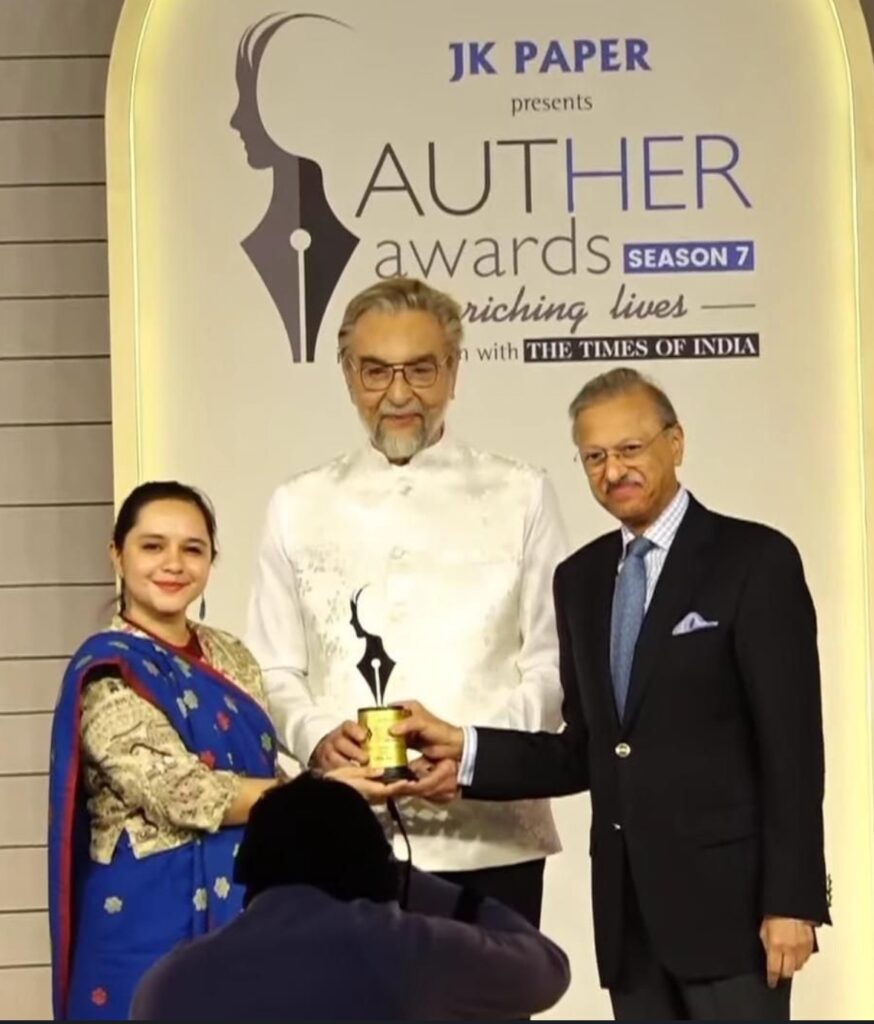
With Art1st, Likla Lall has been writing children’s books about art, including award-winning Art is a Verb and Somnath Hore: Wounds. She writes about the Self (with Little Light), on adventures (with PanicNot!) and comics on nature and mythology (with her sister and illustrator Keya Lall). She won the Best Children’s Literature AutHER Award 2026 for Ganesh Haloi. It was also selected for the BRAW Amazing Bookshelf – part of the Bologna Ragazzi Award 2026.
Eva Sánchez Gómez graduated with her Fine Arts degree from University of Barcelona. Now she lives and draws in La Garriga. She has illustrated more than thirty novels and picture books for publishers from different countries.
Rohina Thapar is a multi-disciplinary designer working at the intersection of communication, product, & brand. Rohina and Likla work together on Khel Theory, a collective that creates interactive educational material.
The following interview with Likla Lall was conducted via email.
- How did this book come about?
Ganesh Haloi: Colours of Home is a part of Art1st’s Artist Exploration series that takes on the format of a picture book biography, along with an exploration of the artist’s work. The series aims to make artists approachable to young readers and inspire them to create their own art. The series began with Raza’s Bindu, but has since covered important Indian artists like Abanindranath Tagore, Somnath Hore, Ganesh Pyne, Jamini Roy, most recently Ganesh Haloi and many others. Our collaboration with the Kiran Nadar Museum Art and Akar Prakar has guided our choice of artists for this series. Reena and Abhijith Lath of Akar Prakar, especially, have a close and long relationship with Ganesh Haloi, and have been instrumental in guiding the research for this book.
- Whose story is this? If it is an amalgamation, then how much research did it involve? What were the primary sources used? Sometimes it almost feels as if you are referring to diaries/letters of the artist. Has Ganesh Haloi seen your book? What has he said about it?
The research for this book began with reading as much as possible about the Ganesh Haloi. We were grateful to access Naishabder Chitrakar, a biography of the artist, edited by Prakash Das. It includes essays on various aspects of his life, from his childhood to his entry into the world of art, his philosophy and pedagogy on art, and some of his poems, which gave me such clear insight into the way his mind works. I was also fortunate to meet and interview him several times, a delightful experience. He was in equal parts cheerful, poetic and kind as he led me through his home and his works. He patiently received various drafts of the story and was always encouraging. The very last page of the story is a direct quote from him. One of the first few copies of the books was received by him and his family in Calcutta. In fact, I called him the day after winning at the AutHer Awards 2026 to share the news, and he was ever-joyful, inviting me once again to visit them in Kolkata.
- Brevity of text is the hallmark of this story. There is so much history to unpack in every sentence. How did you balance the words, facts, concept, and readability for all ages?
It is a task to condense an entire life story into a short story for children. For me, the next step is to arrive at a concept that brings it all together. As I read through the various and distinct parts of Ganesh Haloi’s journey, as well as immersed myself in his vibrant artwork, I began to imagine capturing this in a museum or gallery, much as his art is often displayed. What stuck were these four distinct places that defined him — four places with distinct memories, colours, ecologies and experiences. The illustrations invite the reader to dive into each place and see it through his eyes. The text pulls you through the narrative, guiding you through time and towards the next stop on the journey. And balancing in the space where word and picture meet are the emotions of this journey, of a child turning into a young man. And once you’ve read through the story, you’re invited to see the works for yourself and make your connections to it. These pages are crafted to include history, introspection, curiosity and expression. The instructions are easy to follow, but not dull, leaving room for artistic interpretation; after all, our readers are artists, no matter what age.
- It is more than complemented by the layers of artwork. Was this conceptualised digitally? Please share the ideation process and the various iterations.
The Art1st process of book creation is extremely collaborative. The writer (Likla), illustrator (Eva) and designer (Rohina) have worked together previously on Abanindranath’s House of Stories, and have a beautiful working rhythm between them, executed across geographies. The research isn’t simply for the text and story, but to build visual references for this particular time period in Bengal. ‘What did people wear? Were there photographs and illustrations of Calcutta? Which fish call the Brahmaputra their home?’ Eva is a brilliant illustrator based in Spain, with a keen sense of visual narrative. Her wonderful imagination is perfectly paired with her skills with coloured pencils. She brought each of the four places in the book to life with her vibrant colours. She imagined the fabrication of the book: the many layers of the Ajanta Caves, or the never-ending spreads of the dismal Cooper’s Camp. We’re grateful for the support of Institut Ramon Llull in making this inter-national collaboration possible.
- Did the design evolve to fit the content? How do you ensure that your instructions are followed 100% while it is in production? The pages are shaped differently. There are cutouts arranged in the manner of tunnel books.
The next part of the book-making is the design. Each of us brings a different perspective as we ‘read’ the works of Ganesh Haloi. Bangalore-based Rohina has designed several Art1st books, amongst other creative design projects. Her task was to integrate these various threads (the text, illustration, artworks and activities) and weave them into a coherent and self-encompassing world. She has a fine mastery over the shapes of paper as they fold, open, and even pop right out of the book. There is a long process of testing of pages, redesigning, colour correcting, and sample prints before the book is ready to go. Our print partners are Maharashtra-based Prudent Art & Fab. They painstakingly assemble each complex section of the book to create a piece of magic you can hold in your hands.
- Was the text tested thoroughly before being edited and then discussing design layouts? What did it involve?
The text went through various iterations under the watchful eye of our editor, Ayushi Saxena. The biggest challenge was to wrangle and bring down the word count: there’s always so much more to say! As the illustration and design came together, we could see the shape we were making. It became easier to trust the collaboration of text and picture and kill some of our darlings.
- Art1st specialises in making biographies of prominent Indian artists in a pictorial format with worksheets provided to help learn the basic brushstrokes/ideology of the artist featured. It is the same for Ganesh Haloi too. What were the key details that you wished to incorporate and did and/or were challenged to do so?
This series follows an effective pedagogical design. The first part is the story, where one reads about the life of the artist. In the second part, one is presented with the artist’s works and provocations to look deeper. And finally, one is encouraged to create, through activities inspired by the artist’s process. Ganesh Haloi, as an artist, has a wonderful ability to capture the unseen. His works present abstract-looking landscapes that seem incredibly familiar in their essence. He has developed a language of his own that captures the rhythms of the unseen, the movement of the wind, the whispers of the rivers and the sensation of colour. These are some of the ideas that rest within the pages of this book, through questions and activities.
- Good children’s literature works at multiple levels and is timeless. It cuts across generations and ages. Thankfully, your text does not specify the age group it is meant for. Nevertheless, when working on the draft, how do you determine the target audience? What is it that you seek?
While the series is meant for children aged 8-12, our decade-long experience has repeatedly shown us that art really does transcend age. I have found adults absolutely enchanted by my first book Art is a Verb and its curious paper play. Similarly, adults are quick to admit in a safe space created for children that they haven’t heard of a particular artist or an art form, and the books playfully encourage them to read. Conversely, there is a notion that art belongs to adults, and yet, children of all ages are enchanted by art and quick to share their observations. There is a pedagogical base that guides the creation of the book (the structure, language, font size and so on), but it isn’t prescriptive, rather immersive. There is a freedom to allow the book to turn into the creature it is meant to be.
- How do you incorporate big ideas of free will, independent thinking, being a dreamer while focusing on turning thought into action, being imaginative, freedom of expression, idea of home, etc?
In retrospect, it is possible to decipher themes and learnings in the book, but to me, the process of creation was simpler. I was guided by the life story of an amazing artist. I tried to represent in the truest way possible way the circumstances of Haloi’s life: his birth in Jamalpur, the partition of the Indian subcontinent at the time of Independence in 1947 and the seeking of a new home in Calcutta (as it was known then), his life experience as a teacher and so on, knowing that it will resonate with the reader. Art-making, too, can be contemplated on and understood in so many ways. The absolute imagination of an artist brave enough to confront a blank canvas. The almost-alchemical understanding of materials as they turn pigments and paper into entirely new worlds. Their preoccupations as they consider the same subjects from different angles, repeating symbols, colours and ideas in an attempt to express the world. Once more, as a writer of art, I am guided by the art and by the artist, and I choose to follow and retrace their colourful paths.
- How do you devise the worksheets? What is the intent? Can these be replicated in a classroom or are dependent on the individual text? What results have such experiments shown in the past?
Art1st has a pedagogical division that works with schools and educational organisations. It was from this work that Ritu Khoda (founder of Art1st) saw the gap in and need for books about Indian art for Indian children. We try to create the activity pages in a direct and DIY manner, well aware that not all readers have the same access to art environments or educators. For educators, we often offer a workshop or guide on how to use the books in their classrooms, if required. It is a practice for the book creators to conduct workshops at festivals, schools, libraries and foundations. A huge reason is the advocacy for art education, which is often treated as a secondary subject in STEM-first systems. I am often surprised by the responses. For example, our book Somnath Hore: Wounds came out as the COVID-19 lockdown was lifted. Our engagements around the idea of wounds, catharsis and healing created a safe space for people to share their own wounds and find connection. Colours of Home has been a lovely opportunity to step into ‘abstract’ art, often confusing them, but also giving them the freedom to explore beyond their assumed boundaries of art.
22 April 2026