4th Estate Posts

The Booker Prize 2025 longlist
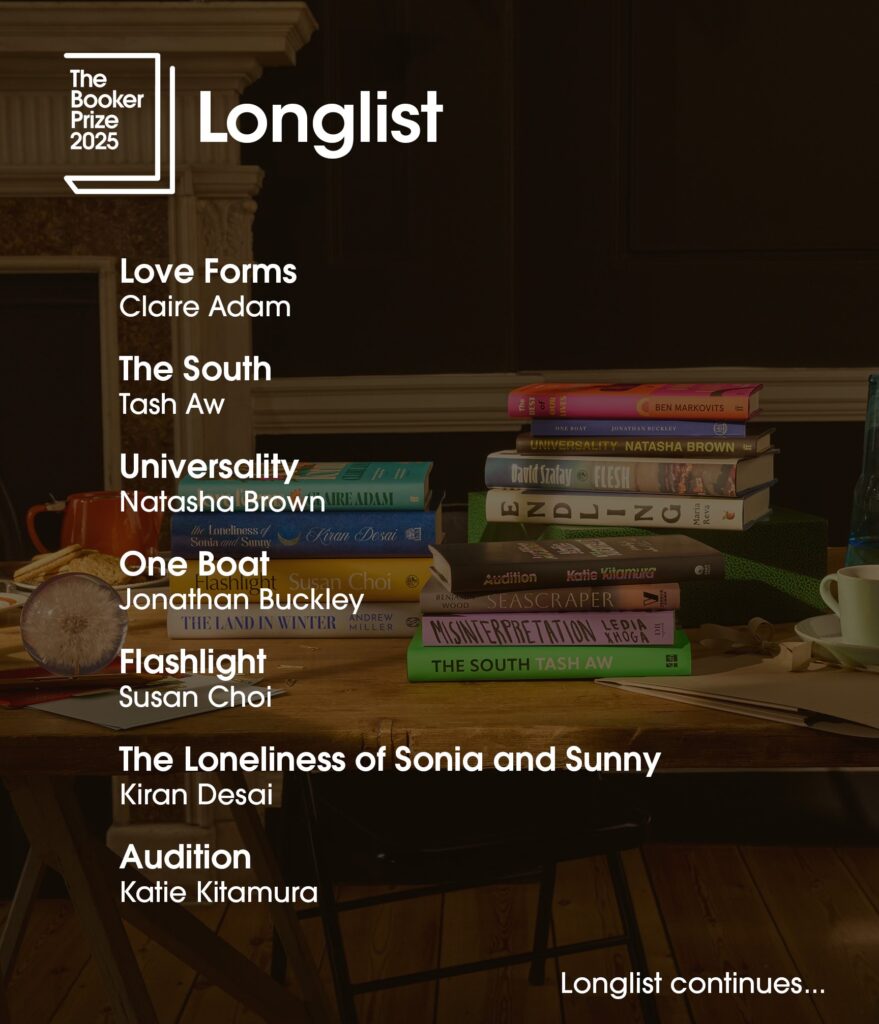
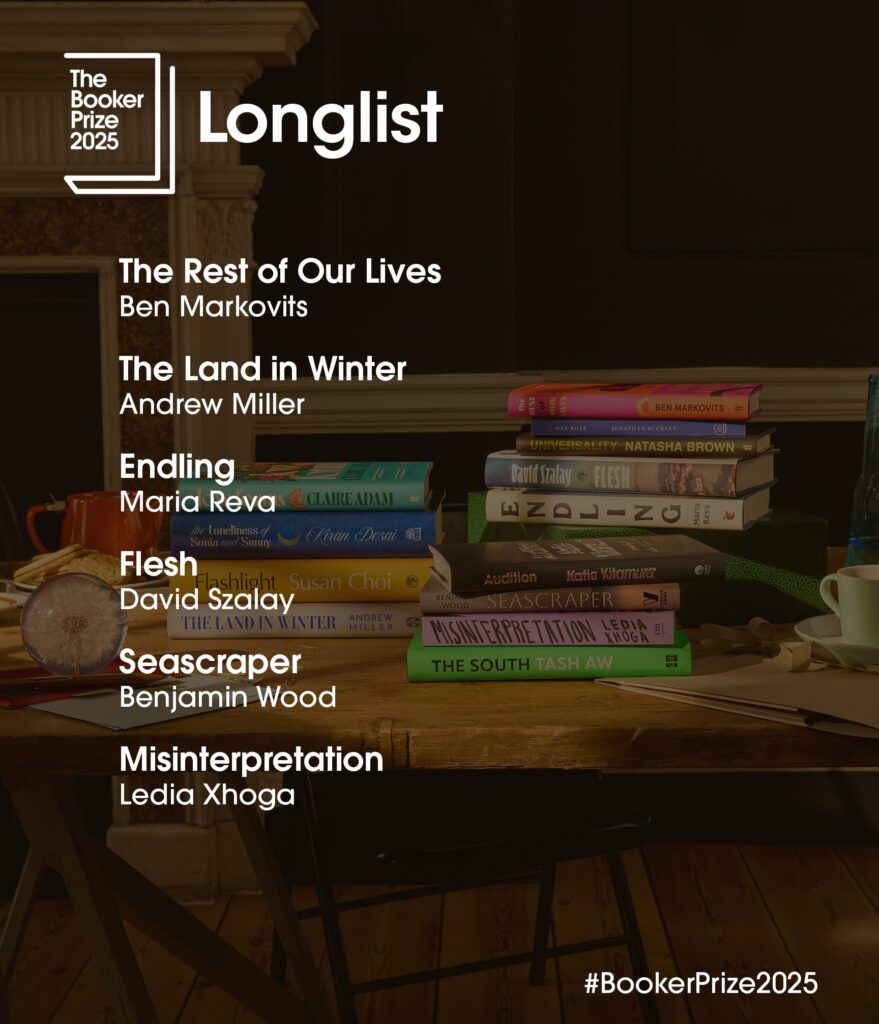
The full Booker Prize 2025 longlist, including author nationality, is:

– Love Forms (Faber) by Claire Adam (Trinidadian)

– The South (4th Estate) by Tash Aw (Malaysian)

– Universality (Faber) by Natasha Brown (British)

– One Boat (Fitzcarraldo Editions) by Jonathan Buckley (British)

– Flashlight (Jonathan Cape) by Susan Choi (American)

– The Loneliness of Sonia and Sunny (Hamish Hamilton) by Kiran Desai (Indian)

– Audition (Fern Press) by Katie Kitamura (American)

– The Rest of Our Lives (Faber) by Ben Markovits (American)

– The Land in Winter (Sceptre) by Andrew Miller (British)

– Endling (Virago) by Maria Reva (Canadian-Ukrainian)

– Flesh (Jonathan Cape) by David Szalay (Hungarian-British)

– Seascraper (Viking) by Benjamin Wood (British)

– Misinterpretation (Daunt Books Originals) by Ledia Xhoga (Albanian-American)

Discover the full list: https://thebookerprizes.com/bp2025
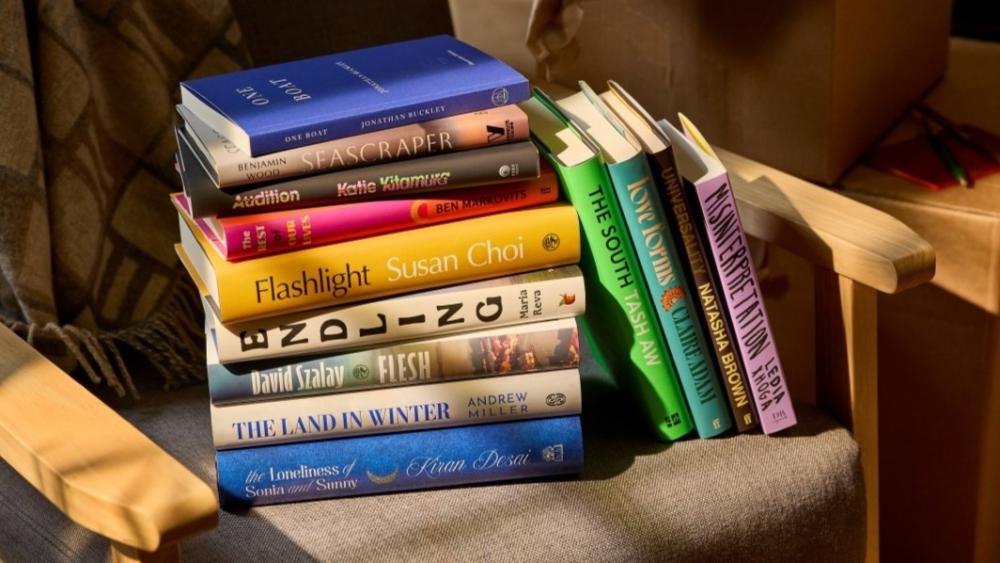
The longlist has been selected by the 2025 judging panel, chaired by critically acclaimed writer and 1993 Booker Prize winner Roddy Doyle

Doyle, who is the first Booker Prize winner to chair the panel, is joined by Booker Prize-longlisted novelist Ayọ̀bámi Adébáyọ̀; award-winning actor, producer and publisher Sarah Jessica Parker; writer, broadcaster and literary critic Chris Power; and New York Times bestselling and Booker Prize-longlisted author Kiley Reid

This year’s selection, which was chosen from 153 submissions, celebrates the best works of long-form fiction by writers of any nationality, written in English and published in the UK and/or Ireland between 1 October 2024 and 30 September 2025.

For the first time, the shortlist of six books will be announced at a public event, to be held at Southbank Centre’s Royal Festival Hall in London on Tuesday, 23 September 2025. The six shortlisted authors will each receive £2,500 and a specially bound edition of their book. The announcement of the winning book  will take place on Monday, 10 November 2025 at a ceremony at Old Billingsgate in London. The announcement will be livestreamed on the Booker Prizes’ channels. The winner receives £50,000.

The ‘Booker Dozen’ features five British authors, while also encapsulating a vast range of global experiences. The 13 novels transport readers to a farm in southern Malaysia, a Hungarian housing estate and a small coastal town in Greece. They shine a light on the lives of Koreans in postcolonial Japan, a homesick Indian in snowy Vermont, a Kosovar torture survivor living in New York, a shrimp fisherman in the north of England, a mother’s search for a child given up for adoption in Venezuela and even endangered snails in contemporary Ukraine. They reimagine the great American road trip as a slow-burning mid-life crisis and take us into the heart of the UK’s coldest winter. 

The judges’ selection features: 

  • Authors representing nine nationalities across four continents, with UK authors securing the highest number of nominations  
  • Kiran Desai, who is nominated 19 years after her previous book won the Booker Prize 
  • Tash Aw, longlisted for a third time, who could become the first Malaysian winner 
  • Past shortlistees Andrew Miller and David Szalay  
  • Two debut novelists among nine authors who appear on the Booker Prize longlist for the first time 
  • The first novel from an opera librettist and the 12th from a former professional basketball player 
  • A book that first garnered acclaim as a short story, and one that is the first in a proposed quartet 
  • Three titles from independent publisher Faber and a first Booker longlisting for Fitzcarraldo Editions, to add to its 16 International Booker Prize nominations  
  • Novels that are ‘alive with great characters and narrative surprises’ which ‘examine the past and poke at our shaky present’, according to Roddy Doyle, Chair of the 2025 judges  

This is a fabulous longlist with so much to discover. I am truly delighted at the coincidence that last week I had interviewed Andrew Miller on his fabulous book The Land in Winter for TOI Bookmark.

29 July 2025

Books on advice for women

Three books of advice for women spread across more than a century is a great way of mapping the enormous strides women have made over the decades. Don’ts for Wives by Blanche Ebbutt ( 1913) is a list of instructions to women advising them on how to survive, particularly on how to manage their husbands. Tucked away in it are some gems like this:

Don’t forget that you have a right to some money to spend as you like; you earn it as wife, and mother, and housekeeper. Very likely you will spend it on the house or the children when you get it; but that doesn’t matter — it is yours to spend as you like. 

Published in 2017 are Little Black Book by Otegha Uwagba ( HarperCollins)  and The Whole Shebang: Sticky Bits of Being a Woman  by Lalita Iyer ( Bloomsbury India) are two handybooks on what it takes to be a professional woman while juggling a million other responsibilities. There is plenty of sound advice offered by Otegha Uwagba whereas Lalita Iyer imparts similar nuggets of information but in a more personal way through anecdotes. There are many, many more books of a similar nature being published and of late there is practically a deluge of these books since the women reader market is burgeoning. Suddenly from a niche area it has become a mainstream market so there is a range of information available. All said and done all the books advise that women need to focus on self-preservation, maintaining their sanity, identity and self-respect and not necessarily capitulating to all that is expected of them. Sharing stories is one way of being able to get through to other women.

16 August 2017 

Chimamanda Ngozi Adichie “Dear Ijeawele”

Dear Ijeawele, or a Feminist Manifesto in Fifteen Suggestions by Chimamanda Ngozi Adichie is a slim little book which developed out of a letter she wrote to her friend. It contains advice to Ijeawele on how to raise her daughter as a feminist. There are some fine pearls of wisdom such as “Teach Chizalum to read.” Or ” Teach her that the idea of ‘gender roles’ is absolute nonsense”. Chimamanda Adichie selects fifteen of the classic arguments associated with feminism that are bandied about which are primarily internalising patriarchal arguments. For instance, mixing up feminism and femininity, choice of dress being confused with morality,  perceiving marriage as an achievement and using the language of ‘allowing’ which encapsulates the power equations, learning about gender-neutral roles instead of capitulating to definitions that are primarily patriarchal constructs, rejecting the idea of gender roles, appreciating to identify yourself as an individual who is composed of many parts to make the whole — motherhood is not the sole definition of a woman’s identity, talking about female sexuality and celebrating it rather than being ashamed of it, and finally not to be caught in biological arguments that ultimately constrict a woman’s movement and ambitions.

But, but, but…Dear Ijeawele  reads too much like a primer for feminism. Agreed it is a good starting point for those who want to understand what feminism is about, the exercising of choice and all genders being equal. Adichie does warn against generalisations from one’s personal experience and does try and encompass various aspects of the feminist spectrum. Yet it is too simple and reductive. For instance it is all very well to stress on the independence of a woman and how to negotiate for her spaces in the world but how can she do it if she does not have financial independence? Adichie touches upon it but specifically within the context of Igbo culture being materialistic so “while money is important — because money means self-reliance — you must not value people based on who has money and who does not”. Whereas this is the crux of feminism and a woman’s identity for economics is the basis of any relationship. Most cultures around the world are deeply embedded in patriarchal structures that essentially clip a woman’s financial means by domesticating her and reminding her of her primary responsibilities being towards the family and children. But if women are taught to be financially sound to earn their independence it will be the first step in “correcting” the social imbalances which exists today in relationships. Otherwise all the good advice which a commercially successful author such as Adichie gives on feminism will sound hollow. ( Brittle Paper, 27 March 2017 “As Sales Approach the Million Mark, Is Americanah Now Adichie’s Signature Novel?” . Also see “New Yorkers just selected a book for the entire city to read in America’s biggest book club“, a “One Book One New York” programme started by NYPL. )

Ultimately feminism like any other ideological language has to be lived daily. The basic tenets can be taught and shared but it varies from individual to individual on how to practise it and thus bring about the social change is aims for. As for bringing up children and introducing them to feminism — the best way is by the parent/s being role models. Children learn best through action and not instructions.

Chimamanda Ngozi Adichie Dear Ijeawele, or a Feminist Manifesto in Fifteen Suggestions 4th Estate, an imprint of HarperCollins Publishers, London, 2017. Pb. pp. 68 Rs 250 


Web Analytics Made Easy -
StatCounter